Introduction
In November 1944, a group of revolutionaries led by Abdukerim Abbasov started an uprising in Ghulja, a city located in northwestern Xinjiang near the China–Soviet border. The East Turkestan Republic (ETR) was established soon afterward. Within a few months, the ETR carved out a huge chunk of territory in northwestern Xinjiang—including Ili, Tarbaghatay, and Altay. The independent state remained in power for six years until the Chinese Communists’ takeover in 1949.
The political turbulence was later known as the “Ili Rebellion.” The ETR officials regarded their effort as a “national revolution” to recover their “East Turkestan motherland” (ZLHB n.d., 5: 1–7). In fact, this was just one of the many ethnopolitical conflicts in the name of the “nation” in the latter half of the twentieth century. The Guomindang (the Nationalist Party; GMD), who was the ETR’s immediate rival during the late 1940s, refused to admit the very existence of the ETR and deemed it a puppet regime of the Soviet Union (Shih Reference Shih2015: 130–36). The Chinese Communists, which eventually came to replace the ETR and the GMD in Xinjiang, viewed it as a part of the “Chinese people’s democratic revolution” against the “GMD reactionaries” (Zhu Reference Zhu2000).
This article concerns not with these ideological contestations, but with the nature of the rebellion. Scholars have offered two major theories to explain the Ili Rebellion, namely, nationalist and geopolitical. The nationalist theory interprets the Ili Rebellion as a movement through which the Turkic-speaking Muslims in Xinjiang sought to establish their own state (Benson 1990). Governor Sheng Shicai’s tyrannical rule and the subsequent GMD regime’s ill-informed ethnic policies were responsible for the Muslims’ antipathy against Chinese rule. The Ili Rebellion and the ETR it established were the culmination of such nationalism. The Soviet Union was not absent, but only provided “tacit support” (Benson 1990: 5). The geopolitical explanation, by contrast, stresses the overwhelming Soviet involvement in the Ili Rebellion (Wang Reference Wang1999a, Reference Wang1999b). David Wang, for example, argues that Sheng Shicai’s shift to the GMD in 1942 provoked the Soviets. The ETR was thus a puppet regime established to recover the Soviet Union’s interests in Xinjiang. In this line of reasoning, the ETR and the Turkic-speaking Muslims it represented was nothing but a “docile pawn” of the Soviet Union (Whiting and Sheng Reference Whiting and Sheng1958). Both theories find resonance in more general explanations of civil war initiation (e.g., Regan Reference Regan2002; van Evera Reference van Evera1994) and in specific cases of ethnic politics (e.g., Brubaker Reference Brubaker1996; Mylonas Reference Mylonas2012).
Despite their merit, however, several facts fit uneasily. First, the Turkic-speaking Muslims in Xinjiang had long suffered from local government oppressions and such unfavorable conditions seldom improved, so why did the guerilla activities break out in mid-1944? Second, given that all minority groups in Xinjiang were discriminated against by Han Chinese—first by Sheng Shicai, and then by the GMD regime—why did the nomadic population (Kazakhs and Mongols)—rather than all Turkic-speaking Muslims—rebel in the first place? Third, the Soviets did suffer a loss of economic interests in northern Xinjiang due to Sheng Shicai’s turn toward the GMD, but how and why did they get support from the guerillas? The nomads were not the Soviets’ natural allies. Not long ago in the 1930s, the Kazakhs suffered miserably when Sheng Shicai repressed Muslims insurgencies all over Xinjiang with the help of the Soviets. Moreover, the nomad guerillas rose up before the Soviets got involved. The time lag suggests that it was the Soviet Union who rode the tide of nomadic unrest.
Against nationalist and geopolitical theories, I suggest that a more accurate explanation of the Ili Rebellion should include both geopolitical and local factors. I seek to sketch and explain the varying rise and fate of guerillas and the varying forms of military confrontation that appeared in different regions in Xinjiang during the rebellion. I argue that such patterns could be accounted for by overlapping and unevenly sketched Soviet and Chinese influence and local ethnic composition and social structure. There was nationalism, but by no means a unifying one widely shared by Turkic-speaking Muslims. Soviet support was the single most important determinant of the fate of guerillas, but the strength of Soviet influence was nevertheless contingent upon local situations. Moving beyond the case of Ili Rebellion, I also discuss broader implications of the role of nationalism and geopolitics in revolutions in small and dependent states.
Sources
I draw on Chinese sources in this article. They include local gazetteers, recollections by eyewitnesses collected in cultural and historical materials (Wenshi ziliao), Compiled Materials of the Three Districts Rebellion in Xinjiang (Sanqu geming ziliao huibian, ZLHB n.d., 1–8), and various monographic memoires by high-ranking officials involved in the rebellion, both on the ETR and on the GMD side (Ai-ze-zi 1987; Bao-er-han 1984; Song 1986; Zhang 1985; Zha-yi-er 1989).
Most of the local gazetteers, cultural and historical materials, and memoires of senior officials were published in the 1980s and 1990s—a time of relative freedom of publishing, especially in minority languages in Xinjiang (Oidtman Reference Oidtmann2014: 59). The bulk of cultural and historical materials that I gathered were originally meant for “internal publication,” which means that they could contain certain sensitive topics that were not allowed to be published for the general public. Indeed, most of these pieces include much detailed descriptions of events while only paying lip service to the official ideology. The memoires written by senior officials, of course, were more problematic in their reliability. Burhan Shehidi’s memoire, for example, was produced by a writing group (Bao-er-han 2013: Appendix, 430–48). Even in this case, there was certain useful information that could be extracted: for example, the distrust of him by the GMD officials. In general, I choose to rely more on the narrative where the author had direct personal experience. Wherever possible, I compare and contrast different accounts on the same topic.
The eight volumes of Compiled Materials of the Three Districts Rebellion in Xinjiang contain much information from ETR-related publishing and classified documents from the military headquarters. Like the cultural and historical materials, these volumes were not formally published. Because some of these materials were explicitly marked as “translations,” they complement my singular reliance on Chinese sources to some extent.
With direct relevance to the Ili Rebellion, I also consult Zhang Dajun’s 12-volume work on Xinjiang history (Zhang Reference Zhang1980, 1–12) and Max Oidtmann’s (Reference Oidtmann2014) detailed study of the Sibes in the Ili Rebellion. Regarding the Tashkurghan guerillas, I also corroborated my sources with Ablet Kamalov’s account, which was based upon sources from the United States’ and British embassy (Kamalov Reference Kamalov2013a, 2013b). Additionally, I consult a group of recently published works that utilized sources in languages that I am not able to read (Brophy Reference Brophy2016; Freeman Reference Freeman2019; Klimeš Reference Klimeš2015; Oidtman Reference Oidtmann2014; Thum Reference Thum2014). They include topics like Uyghur nation and nationalism, Uyghur historiography, and the biography of critical individuals (Meshür Roziev in Freeman [Reference Freeman2019]). Without direct access to sources written other than Chinese and English, my account is at best partial and biased, especially with regard to the non-Han populations involved. In particular, this article falls short in assessing how various non-Han ethnic groups perceived their contemporary situation.
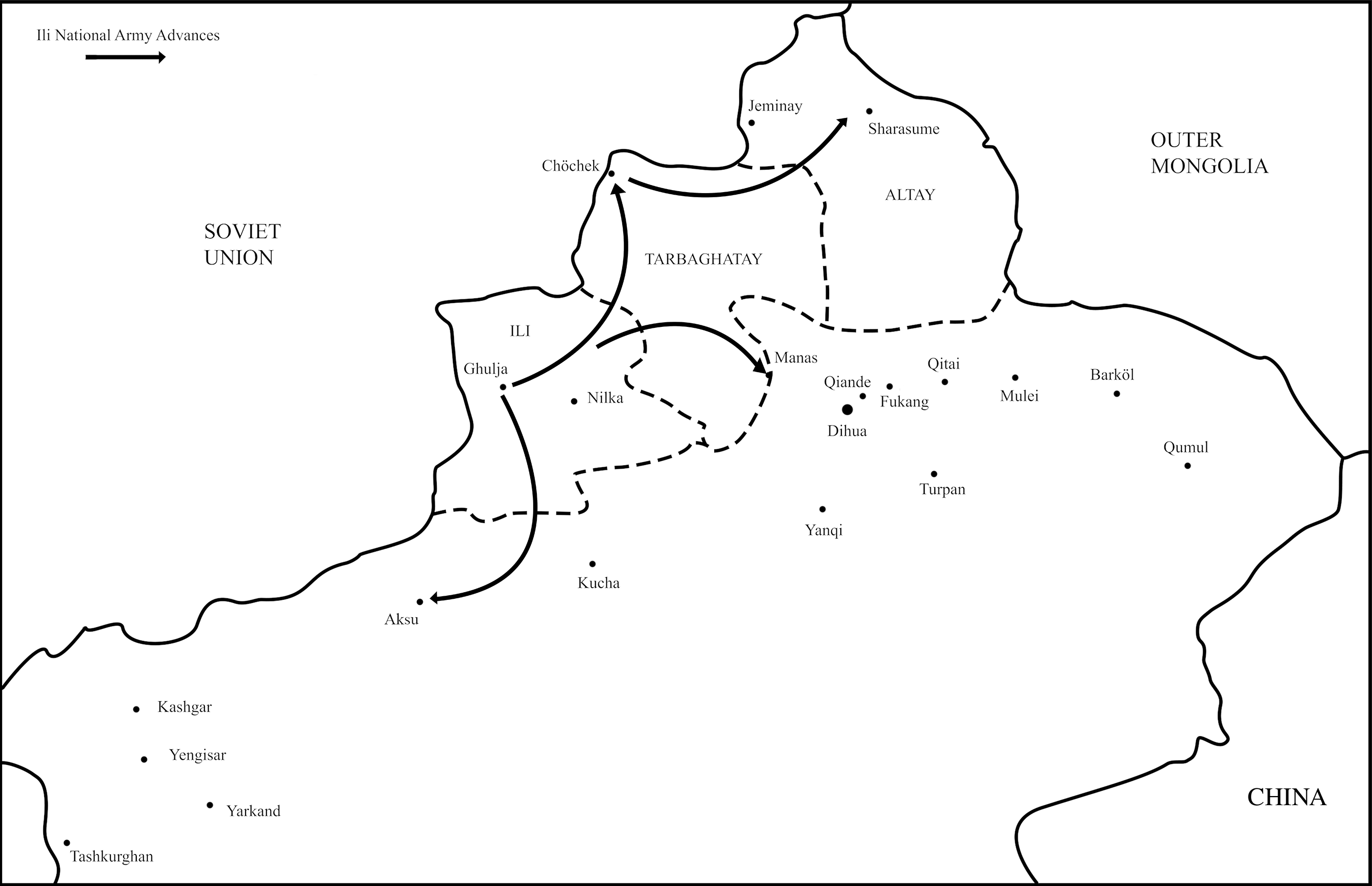
Ili Rebellion map.

Xinjiang Before and During the Ili Rebellion
Xinjiang was incorporated into the Qing empire (1644–1911) in the mid-eighteenth century after the defeat of the Zunghar Khanate (Perdue Reference Perdue2005) and was later established as a province in 1884. During the Republic era (1911–49), Xinjiang was a rather insulated region in Chinese Central Asia under the rule of three successive governors—Yang Zengxin (from 1911 to 1928), Jin Shuren (from 1928 to 1933), and Sheng Shicai (from 1933 to 1944). Political centralization under Jin Shuren triggered unrest in Qumul in the early 1930s that quickly spread to the rest of the province (Jacobs Reference Jacobs2016: 26–34).
Sheng Shicai was a chief-of-staff under Jin Shuren. A coup d’état brought him to power in late 1933. In the early years of his reign, Sheng relied upon Soviet financial and military largesse to repress ethnic unrest, to rebuild the war-torn Xinjiang, and, most important of all, to buttress his personal power (Jacobs Reference Jacobs2011: 294–303). The Soviet support, however, came not without a price. After quelling the insurgencies in the mid-1930s, Soviet troops were stationed in the provincial capital Dihua and Qumul—an oasis located at the gateway between Xinjiang and the China proper (Forbes Reference Forbes1986: 145). Sheng Shicai’s bureaucracy was infiltrated with Soviet staffs (Zhou Reference Zhou1948: 413–414). Xinjiang’s sole trading partner was the Soviet Union. The exploration and exploitation of industrial raw materials in northern Xinjiang was under Soviet monopoly (KinzleyReference Kinzley2018: 109–10). In Ili and Tarbaghatay, Soviet cultural influence held sway (Freeman Reference Freeman2019: 117). In short, Soviet tentacles reached almost every corner in northern and eastern Xinjiang during the 1930s.
Sheng was unsatisfied with the status quo but could do little to change it (Cai Reference Cai1998: 317–22). In the early 1940s, when the Soviet Union was struck by the sudden invasion of Germany from the west, Sheng Shicai seized the opportunity and sought to free himself from the Soviet rein. In September 1942, Sheng urged all Soviet personnel, except for staff at the consulate, to leave Xinjiang in three months (Hasiotis Reference Hasiotis1987: 126). From then on, Sheng Shicai turned to the GMD for support.
Sheng’s breakup with the Soviet Union offered the GMD a chance to extend its influence into Xinjiang. The build-up of GMD party organization in Xinjiang proceeded swiftly (Kao Reference Kao2008: 147–48). This was paralleled by the station of GMD garrisons in Xinjiang (ibid. Reference Kao2008: 149–51). Despite Sheng Shicai’s ostensible allegiance to the GMD, he was an untamable power seeker. He played the Altay Kazakhs off against GMD’s forces and kept GMD armies’ provision under firm control (Cai Reference Cai1998: 388). During early 1944, he even arrested several GMD officials on charge of their collusion with the Chinese Communists (Zhou Reference Zhou1948: 484). It was until August 1944, when the GMD army was rallying in Gansu, that Sheng Shicai was forced to leave Dihua and to assume his sinecure as the head of the Ministry of Forest and Agriculture in the GMD central government.
Amidst the power transition from Sheng Shicai to the GMD, guerilla activities broke out in northern Xinjiang. The Soviet Union, now freed from its western warfront with Germany, was more than willing to recover its economic interests and bring Xinjiang back into its orbit. In November, the Soviet-supported Ili revolutionaries broke into Ghulja and captured the city by a violent uprising. With the help of Soviet armies, the ETR expanded rapidly to capture Ili, Tarbaghatay, and Altay. During the military expansion, the ETR came to incorporate and reorganize much of the guerillas. In April 1945, the Ili National Army (INA) was officially established. Five months later in September, the INA fought its way to the Manas River, only 140 kilometers west of the provincial capital Dihua. The GMD was obviously in a pressing emergency.
Failed on the military front, the GMD tried to resolve it diplomatically. Zhang Zhizhong, then the highest GMD official in charge of Xinjiang reached out to the Soviet consul in Dihua to settle the “Ili Crisis.” From late 1945 to mid 1946, the ETR and the GMD sat down with the coordination of the Soviet Union in rounds of protracted, and often intense, negotiations. Finally, in July 1946, a coalition government was established. Peace was attained, but conflict proceeded as undercurrents. Leaders on the ETR side was infuriated by GMD’s violent suppression of protests in major cities as well as their support for Osman Batur—a force that sought to break Altay out from the ETR (ZLHB n.d., 6: 106–12). The GMD officials, however, suspected that the ETR and the Soviets were clandestinely support these “peaceful” protest to destabilize GMD’s control over these regions (Zhang 1985: 547–48). Finally, when the GMD appointed Mesud Sabiri—denounced by the Ili officials as pan-Turkic and anti-Soviet—as the provincial president, the ETR members in Dihua left for Ghulja. The coalition government bankrupted. Xinjiang remained divided between the ETR and the GMD until the Chinese Communists’ takeover in late 1949.
Breeding Unrest among the Nomads
When Sheng Shicai turned to the GMD for support in 1942, the political landscape in Xinjiang was fast changing. Taking up this opportunity, the GMD urged the Soviet Union to withdraw its troops in Xinjiang. At the same time, however, the GMD also sought to negotiate with the Soviets to purchase the industrial and military facilities that they left behind (Kao Reference Kao2008: 143–47). Sheng Shicai was not totally out of power for he was the key in this delicate Soviet-GMD relation. For both the Soviets and the GMD, he was the ideal person to raise harsh terms without resorting to open conflict.
Although Xinjiang-Soviet trade shrunk almost 95 percent due to Sheng Shicai’s “betrayal” (XJWMZ 2007: 671–73), there were still two large trade deals made between Xinjiang and the Soviet Union—one including war horse, and the other including sheep (Kinzley Reference Kinzley2012: 291; Li Reference Li1993: 512–22). Both of these deals were meant to exchange for the leftover facilities. The horse pact was signed in March 1942. In the pact, the Soviets ordered 50,000 war horses to be delivered within three months (Li Reference Li1993: 512). In late June, 50,200 horses were traded, about 64 percent of which came from Ili and Tarbaghatay, the rest were from Yanqi (ibid.: 513). The sheep pact, signed in mid-1944, included 400,000 heads (ibid.: 517). These sheep were also purchased from Ili, Tarbaghatay, and Yanqi (ibid.: 520).
No exact data are available for us to evaluate how detrimental these two waves of purchases were for the nomadic population. But there were some hints. In 1938, when Xinjiang enjoyed growing exports to the Soviet Union, only 40 horses were traded (XJWMZ 2007: 210). A survey in 1991 suggested that sheep constituted more than 70 percent of the herdsmen’s livestock holdings in Xinjiang (Dao Reference Dao1991: 31–32). These two livestock were the most important properties among nomads. Horses were not as important as sheep economically but was nevertheless significant both as a transportation tool and as a cultural symbol (Wang Reference Wang2018: 37–38).
Why did the local government press on the nomads? The answer seemed obvious. There were only a few profitable local sources to count on in Xinjiang. The most profitable ones were oil and industrial raw materials. However, the equipment and experts were taken away as the Soviets withdrew. What was left for the government was the lucrative local products that required no modern technologies to produce—furs, pelts, wools, and livestock. Fortunately, there were existing institutions to count on for such extraction. Yuxin Local Product Company (tuchan gongsi) had been established in 1934, along with a sprawling purchase network extended over Xinjiang (Kinzley Reference Kinzley2018: 90–95). By November 1942, Sheng Shicai coercively firmed his control over the company and made it the sole channel of trade between Xinjiang and the outside world (Kinzley Reference Kinzley2012: 290). Sheep were the single most profitable products of export during this period, and especially in 1944 when Xinjiang–Soviet trade almost halted. What else would the local government turn to when there were existing channels to rely on and the products were so profitable?
In short, therefore, shifting Soviet–Xinjiang–China relations and the domestic politics of resource extraction combined to fuel unrest among the nomadic population. As the Soviet Union withdrew, the GMD sought to purchase the industrial and military facilities that the Soviets left behind. The most accessible funding sources were horses and sheep. In response to local government’s waves of resource extraction, the nomadic population organized their guerilla forces and rebelled in mid-1944. This time, the Soviets, provoked by Sheng Shicai’s defection and in defense of the GMD’s inroad into Xinjiang, had by now gained an upper hand in their war against Germany on their western front. They were more than willing to use this tide of nomadic unrest to recover their economic benefits in northern Xinjiang.
The Making of the Ili Rebellion
The politics of resource extraction engendered widespread grievances, especially among the nomads. This is why the herdsmen in northern Xinjiang and Yanqi rebelled in the first place. However, the nomads’ resistance would remain sporadic and ultimately unsuccessful without certain top-down organization and external military support. It was the “intermediaries” with Soviet backgrounds that provided the guerillas with crucial organizational and weaponry support. By “intermediaries,” I mean those non-Han ethnic elites in Xinjiang connecting the Soviet Union and the indigenous guerilla forces during the early phases of the Ili Rebellion. Later, as the Ili Rebellion unfolded, the guerillas in eastern Xinjiang and Tashkurghan were also active in fighting against Chinese forces, albeit with different goals, military strengths, and ultimate fates.
Unlike previous accounts that focused almost exclusively on the three districts in northern Xinjiang, I incorporate the guerillas’ activities in eastern Xinjiang, Yanqi, and southern Xinjiang into the story. I highlight the critical role played by the intermediaries in the formation of alliances during the rebellion. However, I pay equal attention to the scope conditions that enabled these intermediaries to perform their tasks as brokers on the ETR and Soviet side.
Guerillas in Northern Xinjiang—Ili, Tarbaghatay, and Altay
The Nilka guerillas were the major guerilla forces in Ili. By the time they occupied Nilka County, east of Ghulja in October 1944, the Nilka guerillas consisted of three divisions with 800 members in total (YLHZZ 2004: 329). Fatih Muslimov, a Tatar with Soviet connection, was a central figure in the organization of Nilka guerillas. Fatih was a manager of the Local Products Company in Nilka County in the 1930s. For fear of Sheng Shicai’s arrest, he escaped to Soviet Union in late 1943 and went back to Xinjiang in August 1944 (Wang, Reference Wang2013: 142; Zhang, Reference Zhang1980, 11: 6258). At the Soviet Union, he met many people who were later to become the central leaders in the ETR and INA (Wang Reference Wang1999a: 97, 140–41).
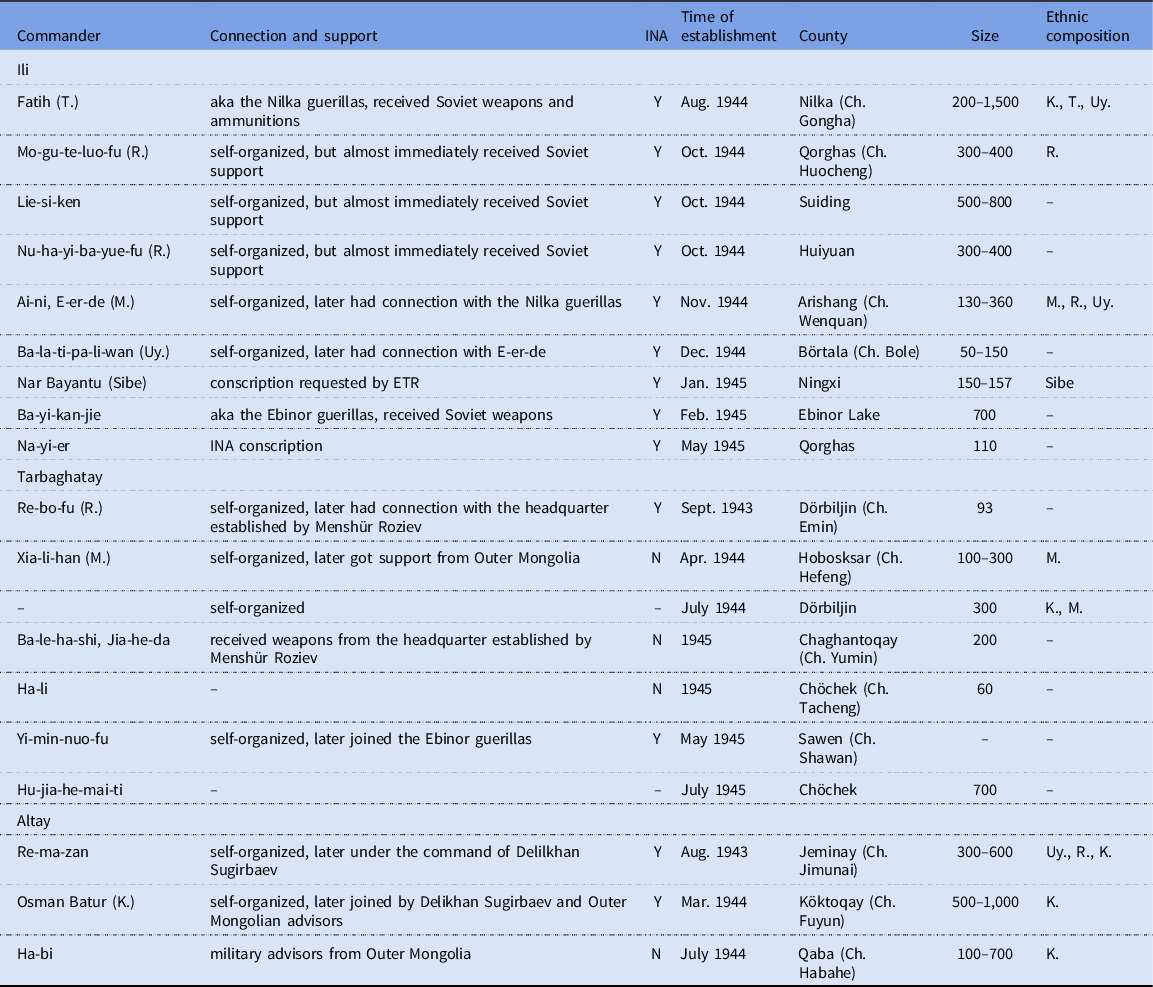
During his stay at Nilka County, he not only incorporated guerillas organized independently by local Kazakhs but he also actively recruited local populations (ZLHB n.d., 3: 30–31). His propagandist activities were welcomed with great popularity; the local people actively joined the guerillas and the herdsmen donated their horses and sheep (YNXZ 2003: 622–23; Zha-yi-er 1989: 3). Soviet weapons brought by Fatih were critical, without which the guerillas would probably be defeated by local police force (NLKXZ 2000: 496). Other guerilla forces followed similar pattern with the Nilka guerillas. They rose independently around mid-1944 and were soon appropriated by the intermediaries who were associated with the Ili regime (table 1).
Guerillas in Ili, Tarbaghatay, and Altay

Sources: YLHZZ (2004: 329–30), YNXZ (2003: 622–23), Song-ha-shi (1995: 87–90), HCXZ (1998: 473), Zha-yi-er (1989: 11–13, 30), Mu-he-mai-ti (1986: 98–99), Yi-bu-la-yin (1984: 98–99), WQXZ (2003: 646), BLSZ (1992: 255), Ya-Sheng (1992: 7), Tu-er-di-you-fu (1993: 121–22, 124), Shu-mu-tong (1990: 46–47), Feng-an-tai (1990: 95–96), ZLHB (n.d. vol. 4: 38–39), TCDQZ (1997: 666, 672), HBKSEMXZ (1999: 418, 422–23), TCSZ (1995: 545), ALTDQZ (2004: 933–34), JMNXZ (2005: 432, 447–48), Mai-he-mu-tuo-fu (1987: 100–9), HBHXZ (2004: 668), Ka-li (1995: 69–70).
Note: The “INA” column documents whether the guerilla was later incorporated into and reorganized under the INA after April 1945. Ethnic categories are abbreviated as follows: T. (Tartar), R. (Russian), K. (Kazakh), Uy. (Uyghur), and M. (Mongol).
Meshür Roziev was Fatih Muslimov’s counterpart in Tarbaghatay (Freeman Reference Freeman2019: 112–13; Wang Reference Wang2013: 101, 209). Menshür Roziev was a Uyghur born in Almaty who was heavily involved in politics in Xinjiang during the 1930s (Freeman Reference Freeman2019: 54–60). He was jailed by Sheng Shicai in 1938 but was soon released and sent back to Soviet Central Aisa under Soviet lobbying (ibid.: 69). In early 1944, Menshür Roziev and another Uyghur exile established “Fight for Liberation Organization” in Chöchek and a military headquarter in Soviet Almaty to coordinate underground guerilla activities in Xinjiang (Wang Reference Wang2013: 210).
The military headquarter played a crucial role in associating local resistances with the ETR’s military initiative; from July to November 1944, “Fight for Liberation Organization” dispatched about 100 liaisons to the headquarters, which contributed to the military takeover of Chöchek (ibid.: 201–11). In existing records, at least Re-bo-fu and Ba-le-ha-shi’s guerillas had connections with the headquarters (table 1).
The self-organized guerillas in Tarbaghatay, however, differed with their Ili counterparts in two major ways (table 1). First, they were smaller in size and weaker in force. They were thus more vulnerable to repressions. Second, fewer of them were later incorporated into the INA. In mid-1944, Sheng Shicai ordered three waves of military crackdowns on the Kazakh-Mongol guerillas in Tarbaghatay, and by early August, almost all such guerrillas were defeated (Zhang Reference Zhang1980, 11: 6329–31). Although timing and geostrategic location were important, the lack of Soviet support was the primary cause of the unsuccessful guerilla activities in Tarbaghatay. Whereas the Soviets supported guerillas in Ili with weapons and military personnel, they seemed only to have involved in actions as distributing leaflets in Tarbaghatay (ibid., 11: 6328). Indeed, the most successful guerilla was the Ebinor guerillas, which was the only guerilla forces in Tarbaghatay to have ammunitions provided by the Soviets (Wang Reference Wang2013: 210).
Further north, the Kazakh guerillas in Altay under the leadership of Osman were the strongest among all nomad guerillas. The local Kazakh forces took over the eastern part of Altay on their own (ALTDQZ 2004: 934; ALTSZ 2001: 371–72). Osman was born into a poor Kazakh family in Altay. He participated in the Altay Kazakhs’ resistance against Sheng Shicai in the 1930s but was not a prominent figure back then. Only in the early 1940s, with the weaponry support he got from Outer Mongolia, Osman was able to successfully attack several Sheng Shicai’s outposts (Benson Reference Benson, Linda and Ingvar1988: 156). Being able to provide his followers with weapons, led them to win battles and accumulate fortune, and thus being able to buy more weapons, win more battles, and attract more followers, Osman rose as a charismatic leader in 1943.
Delilkhan Sugirbaev, a local Kazakh elite, helped to connect Osman with the ETR. Delilkhan was originally a deputy administrator of Sharasume County in the early 1940s (BGWX 1995: 148). In 1941, for fear of Sheng Shicai’s capture, he escaped to Almaty through Jeminay with the help a Soviet consulate (Wang Reference Wang2013: 215, 229). He received political and military training in Almaty and was sent back to Altay in late 1943 and helped Osman to reorganize his Kazakh forces (Sha-wu-lie-xi 1987: 71; Wang Reference Wang1999a: 122). Delilkhan was Osman’s cousin by Kazakh tribal tradition (Jian Reference Jian2015: 39). Kinship ties and the practical needs of military support perhaps explain why Osman accepted Delilkhan—a fellow Kazakh with Soviet background—so easily despite his persistent opposition of Soviet Union.
Aside from Soviet military support through Delilkhan Sugirbaev, the remarkable organizational and military strength of the Kazakh forces in Altay should also be attributed to its effective organization. Compared to the Kazakhs in Ili and Tarbaghatay, who were subjected to heavier Russian agricultural, commercial, and cultural influences throughout the nineteenth century (Moseley 1966: 16–18), Kazakhs in Altay (especially the east part of Altay) largely preserved their traditional patrilineal social structures (Jian Reference Jian2015: 33; Svanberg Reference Svanberg, Linda and Ingvar1988: 122–23). Building on such hereditary and aristocratic social structure, they were able to organize and fight much more effectively than their counterparts in Ili and Tarbaghatay.
After a series of mutually reinforcing dynamics of resistance and repression throughout the early 1940s (A-hei-ti 1987: 80–82, 88–90; Benson Reference Benson, Linda and Ingvar1988: 151–53; La-ti-fu 1979: 92–103), Osman came to the forefront of Kazakh resistance in Altay and became the Kazakh “Batur”—meaning “hero.” In December 1943, Osman established the Altay Kazakh People’s Recovery Committee in north Chinggil County and served as the chairman (ALTDQZ 2004: 933). The rise of Osman as a Kazakh “Batur” was the culmination of the escalating confrontation between Sheng Shicai’s repression and Altay Kazakhs’ resistance.
Guerillas in Eastern Xinjiang and Yanqi
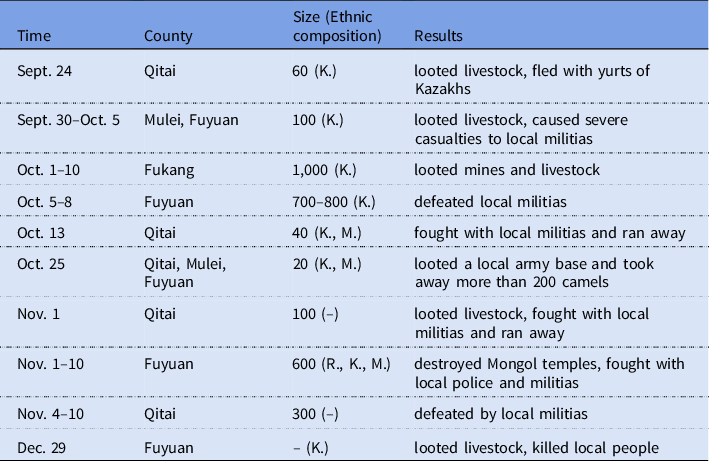
In late 1944, echoing Osman in Altay, Kazakhs in eastern Xinjiang constantly attacked counties east of Dihua—including Mulei, Qitai, Fuyuan, Fukang, and Qiande counties (table 2). These counties lied east of Barköl and north of Tianshan. Note here that guerilla activities in eastern Xinjiang were geographically limited—excluding Barköl, Qumul, and Turpan.
Guerilla attacks in Eastern Xinjiang in late 1944
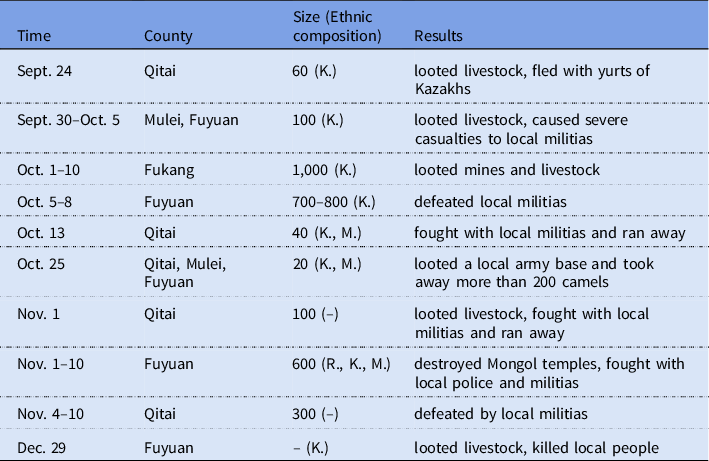
Sources: Zhang (Reference Zhang1980 vol. 11: 6318–26), Lu (1998: 30), Ma (1987: 174–76), Sun M. (1992: 62–63).
Note: Ethnic categories are abbreviated as follows: R. (Russian), K. (Kazakh), and M. (Mongol).
The very first of these guerilla assaults was reported in September 1944 in the north of Qitai County. Zha-la-ban, a Kazakh leader, called upon local Kazakhs to join Osman and move to Altay (Zhang Reference Zhang1980, 11: 6320–21). Osman had started his guerilla career much earlier but the Kazakhs in eastern Xinjiang joined only in September 1944, almost a year later. The striking simultaneity with the emergence of Kazakh and Mongol guerillas in Ili and Tarbaghatay suggests once again that there might be Soviet influence—in this case, however, through Outer Mongolia.
No evidence suggests that the Kazakh guerillas in eastern Xinjiang were under Osman’s command, not to mention Outer Mongolia and the Soviet Union. This explains why these guerillas only looted but never tried to take down any one of the counties, given that they had the force to do so. Suffice it to say that the Kazakh guerillas in eastern Xinjiang were the extension of Altay Kazakh networks under the circumstances of widespread nomadic unrest.
A similar case could also be found in Yanqi. Mongol guerillas there rose almost simultaneously with the Ghulja Uprising. In November 1944, Qiang-zi-de was sent by local elites to Nilka and brought back several rifles (Ba-dai 1989: 2; HJXZ 1995: 518). In December, the Mongol guerillas occupied Bayinbulak grassland, northwest of Yanqi district (BYGLMZZ 1994: 1623). The area thenceforth became the base for guerilla assaults (Qin 1988: 47).
Again, like elsewhere, the Mongol guerillas in Bayinbulak were self-organized—except for scant weaponry support they got from the Nilka guerillas (Ba-dai 1989: 2; HJXZ 1995: 518). The timing of their self-organization suggests that they were influenced by the Ghulja Uprising, but they were certainly not under the Ili regime’s command by this time. Successive guerilla attacks on Yanqi County started in April 1945. After an initial victory, Youludusi County was established along with a Mongol cavalry battalion under the same name. By now, they were clearly under the banner of the Ili regime (Qin 1988: 47–48). Constant military confrontations in Yanqi district continued throughout 1944 and 1945; without much of weaponry support, however, the guerillas failed to take over the county.
Guerillas in Southern Xinjiang—Tashkurghan
Guerilla disturbances broke out in Tashkurghan, southwest of Kashgar, as early as 1943. These guerillas were organized by Ishaq Beg along with local Kirghiz and Uyghur leaders (KZLSKZZ 2004: 1186–87). At the early stage, the guerillas only occasionally clashed with local police forces and the violence remained small in scale (ZLHB n.d., 4: 99–101). It was not until August 1945, when Ishaq Beg sent a group of reinforcement to support guerillas in Tashkurghan, that large-scale military operations started (TSKEGTXZ 2009: 495; ZLHB n.d., 4: 41).
Ishaq Beg, a Kirghiz born in Tashkurghan, was on the Soviet side commanding a Kirghiz cavalry force in southern Xinjiang in the 1930s (BGWX 1995: 92). In 1942, to evade Sheng Shicai’s capture, he fled to the Soviet Union and received training there. He went back to Tashkurghan in 1943 and helped organize local guerillas. Later, he was appointed the commander in chief of the INA in 1945.
Due to the scarcity of sources, we know very little about the members and organizations of the Tashkurghan guerillas. Even though these guerillas were initially organized by Ishaq Beg and was later named “Ishaq Beg Victorious Regiment,” these guerillas were most probably independently operated. Ishaq Beg had left Tashkurghan in mid 1944 and would not be back until early 1946 (Zha-yi-er 1989: 54; ZLHB n.d., 4: 98). Given contemporary logistical conditions, direct coordination between Ghulja and Tashkurghan was next to impossible.
There is still another possibility that the ETR might want to use military pressure in southern Xinjiang as a leverage in their negotiation with the GMD. However, a closer look suggests otherwise. During the first phase of negotiation between the ETR and the GMD, which extended from October to December 1945, the Tashkurghan guerillas were not even mentioned (ZLHB n.d., 6: 1–3). However, it was precisely during this period that military attacks by Tashkurghan guerillas intensified (TSKEGTXZ 2009: 495). This excludes the possibility of the ETR using the guerilla activities as a bargaining chip. Only in the second phase of negotiation in April 1946 was the situation in southern Xinjiang formally addressed (Zhang 1985: 447–48). The result was the dissolution of Tashkurghan guerillas carried out by Ishaq Beg in June and July according to the negotiated truce (AKTXZ 1996: 489; ZPXZ 1992: 372). The fact that Ishaq Beg was sent to dismiss the guerillas indicated their autonomy from the ETR previously.
The Scope Conditions
As we have seen, most of the guerillas rose independently at first. Later, intermediaries were critical in the alliance formation between the ETR and the guerillas. The incorporation of the guerillas took the form of brokerage on an ad hoc basis because Xinjiang in the 1940s lacked institutionalized forms of ethnic mobilization—like those in the Soviet Republics in the 1980s (e.g., Gorenburg Reference Gorenburg2003). However, the GMD also had their potential collaborators (Jian Reference Jian2015: 40–41). Why were the intermediaries on the GMD side less successful than those on the Soviet-ETR side?
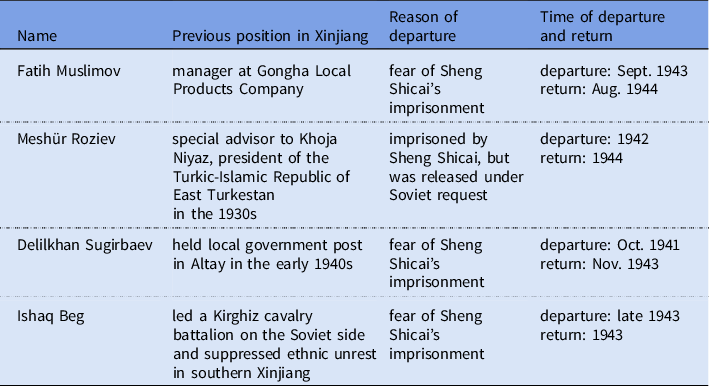
A look at the careers of the central figures just discussed might help (table 3). I should note here that this is not a comprehensive list of intermediaries, but only a very selective one—a selection based upon their ex post political prominence. This selection bias was inevitable given my singular reliance on Chinese sources, though I have incorporated Meshür Roziev, who was almost absent in Chinese sources, into the list. These individuals’ escape to the Soviet Union in the late 1930s and early 1940s were all related to Sheng Shicai’s waves of arrest during this period. Although they left Xinjiang with the help of the Soviets and received military training thereafter, the cause of their departure could only be attributed to Sheng Shicai’s shifting political allegiance and his capture of all individuals whom he deemed unreliable. In other words, the Soviet Union did not coordinate their escape. However, the fact that they received military training in the Soviet Central Asia and were sent back to Xinjiang in 1944 suggests that their return was intentional. Other rank-and-file participants were trained in Tashkent, Uzbekistan, no later than May 1944, months before the Ghulja Uprising (Kamalov Reference Kamalov, Millward, Shinmen and Jun2010: 273–74). This echoes an earlier point that although the Soviets did not initiate the rebellion in the first place, they did prepare for, contribute to, and seek to patronize it.
Intermediaries and their backgrounds

Sources: Wang (Reference Wang2013: 120, 142), Freeman (Reference Freeman2019: 54–69), Sha-wu-lie-xi (1987: 70–71), ZLHB (n.d. vol. 4: 95), BGWX (1995: 92, 148).
The Soviet Union benefited from its decades of cultural influence in northern Xinjiang, but the critical force that drove the non-Han ethnic population—both the elites and the ordinaries—to the Soviet side was Sheng Shicai’s draconian rule. However, when the GMD entered Xinjiang, it had the chance of presenting itself as a benevolent force to the non-Han ethnic population. Indeed, by freeing those minorities kept in prison under Sheng Shicai, the GMD also had their potential collaborators (Zhang 1985: 420). In general, however, the GMD did not trust these potential intermediaries, especially under the ongoing rivalry with the ETR. In late 1945, Burhan Shehidi, who was later to become a central figure in the coalition government, suggested to Wu Zhongxin about establishing a Kazakh militia south of Dihua—with only 100 members—in preemption of Osman’s guerilla attack. Wu Zhongxin rejected his proposal because Wu feared that Burhan might have “other aims” (Bao-er-han 1984: 279). In the end, a Kazakh militia was established, only that it was proposed by a Chinese officer. In his memoire, Burhan Shehidi also mentioned that at one night, when he still held post in the Dihua government, several police intruded his house and took his father-in-law and son away (Bao-er-han 1984: 280–81). Much the same as Sheng Shicai, if not worse, the GMD was no friend of the non-Han ethnic elites.
Only in very rare circumstances—in the case of Osman in Altay, the GMD was able to win over the non-Han ethnic groups in Xinjiang to their side. As I have mentioned, Osman and his Kazakh forces were incorporated into the ETR under the coordination of Delilkhan Sugirbaev. However, when the ETR sought to monopolize control over Kazakh forces in Altay in August 1946, Osman went to the GMD for military support and broke out in open conflict with the ETR in December (Jian Reference Jian2015: 39; Song 1986 241). The “defection” of Osman had popular roots among Altay Kazakhs.
In the 1930s, thousands of Kazakhs moved to Xinjiang because of the collectivization campaign in Soviet Central Asia (Svanberg Reference Svanberg, Linda and Ingvar1988: 115). A large proportion of Kazakh migration flowed to Altay, which was one of the reasons that Kazakhs made up of 85 percent of the population in Altay—compared to 60 percent in Tarbaghatay and 45 percent in Ili (Zhang Reference Zhang1980, 8: 4317–18). Osman claimed that he and his fellow Kazakhs had unhappy memories of the Russian Revolution and the collectivization campaign (Song 1986: 241). In fact, according to a contemporary account, Osman was “a rabid Russophobe” (Barnett 1963: 276).
As we can see from the personal experiences of intermediaries and Osman’s oscillation between the ETR-Soviet and the GMD, the allegiance of guerillas on either side was mostly the result of negative alienation rather than positive affection. The widespread resentment against Sheng Shicai’s rule and the GMD regime’s distrust of the non-Han ethnic population, especially the elites, provided fertile ground for the Soviets to exploit. This made possible the bundles of connections between the intermediaries and local guerillas.
Patterns of Military Conflict
Facing widespread military challenges from non-Han ethnic groups across Xinjiang—some with help of the Soviets—the GMD organized their forces and fought back. Already offering an overview of the emergence and incorporation of guerillas during this period, I now shift to the GMD side of military mobilization. The GMD forces, as will be apparent, were also multifaceted: some were regular armies brought to Xinjiang by the GMD, others were inherited from Sheng Shicai, still others were recently improvised.
Seeing two sides of the military confrontation together, four battle zones could be identified. In the three districts in northern Xinjiang, GMD’s regular army fought against the ETR and the Soviet troops. Facing the military might of the Soviet army and the reorganized INA, the GMD troops were defeated. In eastern Xinjiang, local administrators set up militias to guard against self-organized non-Han guerillas. Although the outcome of such defense varies, local militias were by and large successful in fending off guerilla assaults. Finally, southern Xinjiang was divided into two separated battle zones. Unlike northern Xinjiang, the GMD’s forces in the south were directly inherited from Sheng Shicai. In Aksu district, the GMD’s forces outmaneuvered the INA troops that were of comparable strength. Near Kashgar, the Tashkurghan guerillas were rather inferior vis-à-vis GMD’s local troops. The battles in southern Xinjiang were called to stop after the ETR and the GMD reached an armistice.
Northern Xinjiang: The Major Battlefield
The ETR’s military operation in Ili, Tarbaghatay, and Altay comprised two parts. On the one hand, the intermediaries were sent out to incorporate self-organized guerillas. Later, most of these guerillas were reorganized under the INA. On the other hand, the Soviet troops (along with INA) marched north from Ili, sweeping through and eventually conquering the three districts. Here, I shall not offer a comprehensive overview of military operations in northern Xinjiang but only emphasize the strong Soviet military presence in the ETR’s expansion (see Wang [Reference Wang1999a] for a detailed account).
The Soviet Union was heavily involved in the rebellion from the very start. Several months before the Ghulja Uprising, the Soviet consulate inside the city was made into a fortification—embrasures appeared on the walls (Zhang Reference Zhang1980, 11: 6257), and a machine gun was unveiled on the roof (Jacobs Reference Jacobs2016: 140). Right before the uprising, soldiers with uniforms of the “Kazakhstan Republic” marched from Qorghas to the north of Ghulja with machine guns, grenades, and rifles (Zhang Reference Zhang1980, 11: 6296). Ahead of them, Soviet tanks and air forces were deployed to clear the way (Wang Reference Wang2013: 146, 157–58). Meanwhile, under the coordination of Soviet personnel, the Nilka guerillas attacked Ghulja from the east side (Kamalov Reference Kamalov, Millward, Shinmen and Jun2010: 271).
Being attacked inside and out, Ghulja was eventually controlled by the revolutionaries. Protracted conflicts between the Ili-Soviet forces and the GMD army lasted through the subsequent two months, when Ili was finally occupied by the revolutionaries in late February (BETLMZZ 1999: 784). The protracted military confrontations in Ili almost destroyed GMD’s major forces in Xinjiang. The ETR’s eventual occupation of the three districts was just a matter of time. In the occupation of Tarbaghatay in July 1945, although local guerillas and the military headquarters established by Meshür Roziev played their part, the pivotal force were Ishaq Beg’s cavalry brigade and the Soviet army, with about 5,500 soldiers in total (Sadri Reference Sadri1984: 302; Wang Reference Wang2013: 204). Finally, the ETR claimed suzerainty over Altay after Delilkhan helped to incorporate Osman. Now, the ETR’s military actions on the northern front concluded.
Eastern Xinjiang: Guerillas versus Militias
Guerillas in eastern Xinjiang operated independently and engaged in typical guerilla warfare—raiding and looting. Although the acting governor Zhu Shaoliang was aware of the Kazakh guerillas in eastern Xinjiang, he never considered them to be enemies as important as the ETR and the Soviets on the west side. Thus, these guerilla attacks were left to be coped with by local initiatives.
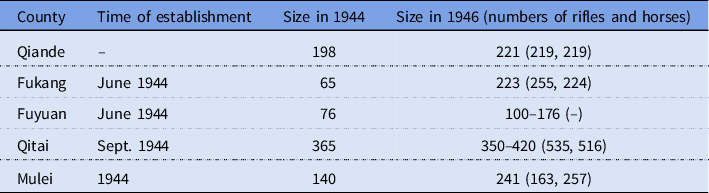
The only effective way to combat these mobile guerillas, as it turned out, was to organize local militias. Starting in mid-1944, local administrators in the counties east of Dihua—including Qiande, Fukang, Fuyuan, Qitai, and Mulei—dispatched military officers to organize local militias, first in Fuyuan and then in other counties (Zhang Reference Zhang1980, 11: 6322). In these counties, villages were combined into stockades for self-defense (Lu 1998: 31–32). At the initial stage, these militias largely operated outside the formal military organ, although local governments did provide them with weapons. Later, they were absorbed into the GMD’s local army; data in 1946 suggest that these militias were well-equipped (table 4).
Local militias in Eastern Xinjiang

Sources: MQXZ (1998: 473), CJHZZ (2002: 1640–41), FKXZ (2002: 534), QTXZ (1994: 477), JMSEXZ (2002: 252), Lu (1998: 30), MLHXZ (2003: 372).
Note: No exact data on weaponry equipment of these militias in 1944 were available, but most sources indicated that local governments provided militias with rifles and horses.
Despite the effectiveness of self-defense by local militias, the establishment of such militias were not always successful, and in some cases, not even desirable for the local Chinese administrators. The local militias were organized by Han Chinese military officers from the top-down, and ethnic category matters in such circumstances. Consider a case in Fuyuan. In 1944, a local Mongol leader in Fuyuan tearfully begged the local administrator, “we do not want to join the bandits, we all know that Osman is a bandit, even the livestock knows … we have no bad people among us, but we do not have weapons. We hope the magistrate can give us some guns to defend ourselves” (quote from Zhang Reference Zhang1980, 11: 6324). The administrator, however, rejected the proposal and suggested that the Mongols escape and migrate elsewhere.
This case indicates that a genuine distrust to non-Han population might prevent militias other than Han and Hui from being organized. The counties mentioned in the preceding text almost all had Han as the majority population, except for Qiande, which had a Hui majority (ibid., 11: 6319). Although there were nomads in these counties, they largely lived in the northern parts. Under such conditions, Chinese military officers could effectively organize local militias, and it would be reasonable to speculate that these militias were made up of Han and Hui members.
Southern Xinjiang: Two Separated Zones of Conflict
The ETR’s military attack on the southern front was carried out by the INA alone—with three cavalry battalions and the Mongol battalion from Bayinbulak (ibid., 11: 6508). On the GMD side, their troops in the south were directly inherited from Sheng Shicai. Unlike that of eastern Xinjiang, the GMD completely failed to establish local militias in Aksu district. To be sure, GMD did make great efforts, but the established “militias” were either only involved in performing public-order-related tasks or simply lacked weapons and military training (AKSSZ 1991: 590; WSXZ 1993: 661).
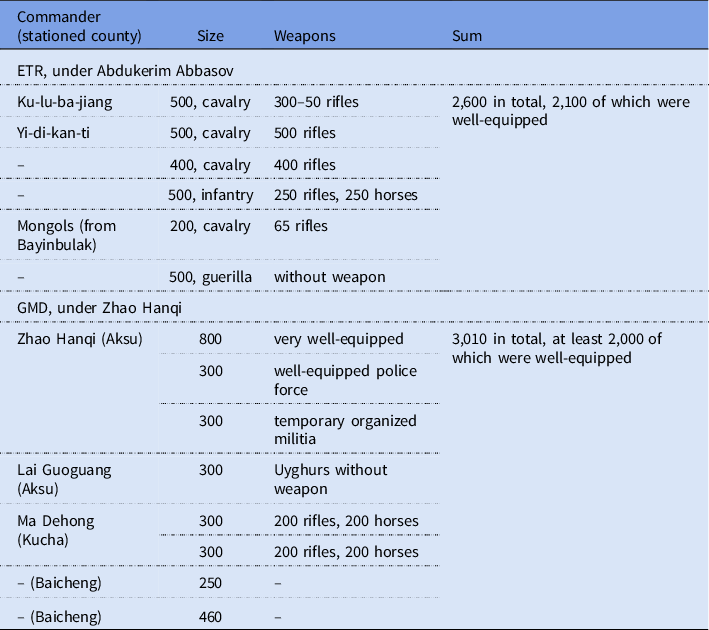
Near Aksu, therefore, the INA and the GMD’s regular army stood at the two sides of military confrontation; INA with Abdukerim Abbasov, and GMD with Zhao Hanqi as their chief commander, respectively. Starting in June 1945, the two sides engaged in a military tug-of-war in Aksu district for four months—both in critical transportation corridors along the Tianshan mountains, and in major counties and cities—forming a largely insulated zone of conflict (Lu 1987: 87–89). At any rate, the conflict near Aksu was a relatively close match. A comparison of forces and their weapons should give us a general outlook on their respective military capacity (table 5).
ETR and GMD forces near Aksu

Sources: Zhang (Reference Zhang1980 vol. 11: 6508), AKSDQZ (2008: 1799), BCHXZ (2004: 188–89), KCXZ (1993: 507–8), Lu (1987: 88).
Sheer size and military equipment alone could not predict the outcome of military conflicts. Tactics, the occupation of strategic locations, timing, and other contingencies may completely alter the scenario. Nevertheless, we can see clearly from the table that the two sides were roughly comparable. Indeed, this was vindicated by the subsequent battles: cities and critical transportation routes shifted hands many times during the latter half of 1945 (Zhang Reference Zhang1980, 11: 6509–15). Only in early October, limited by its military logistics and under severe food shortages, the INA start to show fatigue. In a fight for airdropped supplies outside Aksu city on October 6, the GMD side gained an upper hand under the supreme command and military acumen of Zhao Hanqi (AKSSZ 1991: 603–4; WSXZ 1993: 670). The INA retreated. Battles in Aksu concluded in mid-October when the first phase of peace negotiation was worked out (AKSDQZ 2003: 1800).
Counties near Kashgar formed yet another isolated zone of conflict. As mentioned previously, the Tashkurghan guerillas—comprised primarily of Kirghiz, Tajiks, and Uyghurs—rose in late 1943, but only started large-scale military attacks in late 1945. Unlike the well-matched confrontations in Aksu, however, the Tashkurghan guerillas were in a much more inferior position vis-à-vis GMD’s local forces. Since September 1945, Tashkurghan guerillas started their military attack on Kashgar, Yengisar, Yarkand, and other counties in vicinity. Until December, despite a handful of military successes, Tashkurghan forces failed in their attempt to take over the major counties nearby (KSDQZ 2004: 1432; SCXZ 1996: 628; YJSXZ 2003: 475–76). Finally, after the ETR sent Ishaq Beg to Tashkurghan in June 1946, the guerillas were dismissed.
On the Chinese side, the GMD-commanded local armies were directly inherited from Sheng Shicai (Zhou Reference Zhou1948: 581–82). Although these troops were low in morale and poor in discipline (Kamalov Reference Kamalov2013b: 65), they proved just enough to prevent the Tashkurghan guerillas from taking over major cities. It is worth briefly mentioning that much the same with Aksu district the GMD sought to organize local militias but ended up in failure (AHQXZ 1993: 395; ATSSZ 1996: 599).
Explaining the Patterns of Guerillas and Military Conflicts
How can we account for the rise and fate of guerillas and the varying forms of military conflict in different regions of Xinjiang during the expansion of the Ili Rebellion? More specifically, why did the nomadic population in northern Xinjiang and Yanqi rebel? Why were some guerillas more powerful than others? Why were some guerillas incorporated into the INA while others remained independent? Why was the ETR more successful in the three districts than elsewhere? Why was the GMD able to organize local militias in eastern Xinjiang but failed to do so in the south? Why were the patterns of military conflict different in various regions of Xinjiang? I argue that varying degrees of Soviet and Chinese influences along with local conditions help explain such patterns.
Local government’s extraction of horses and sheep begot widespread unrest among the nomads in northern Xinjiang and Yanqi. Among the nomads, Kazakhs in Altay were the strongest because they were able to organize more effectively based upon their hereditary elite structure. Sheng Shicai’s suppression and the Altay Kazakhs resistances fed upon each other in the early 1940s. The result was the indomitable and ultimately unaligned Osman, the Kazakh “Batur.”
Whereas nomadic social structure and government repression explain the strength of Kazakh guerillas in Altay, Soviet military support—in the form of providing weapons and sending military personnel—was the paramount determinant of the strength of guerillas elsewhere. The unsuccessful guerilla activities in Tarbaghatay, compared to Ili, exemplified the importance of such support. However, military support entails the potential to control. Therefore, we see most of the guerillas eventually incorporated and reorganized under the INA through intermediaries. In its most blunt form, the Soviet Union sent its own troops to help the ETR expand its territory in northern Xinjiang. Even the regular army brought into Xinjiang by the GMD—arguably the most powerful force on the Chinese side during this period—was no match.
In eastern and southern Xinjiang, where GMD faced self-organized guerillas, they responded by organizing local militias. The establishment of militias in eastern Xinjiang by and large succeeded. Two factors help explain such success. First, the counties east of Dihua all had Han or Hui as their majority population. There were nomads, but they lived separately in the north. Second, the GMD troops entered Xinjiang through these counties in late 1943 and had since then established connections with local societies—both by administrative extension and by party-building initiatives (Ma Reference Ma1991: 34–37; Sun Z. 1992: 75). These conditions made the establishment of county militias both desirable and possible for the local Chinese administrators.
In southern Xinjiang, where the GMD had no prior contact with local society and ethnic groups other than Han and Hui, the establishment of local militia completely failed. The GMD’s only presence in southern Xinjiang was the army that it inherited from Sheng Shicai. As it turned out, these forces proved just enough to combat ETR’s army on the southern front, which the Soviet Union showed almost no interests of getting involved. Ultimately, battles in the south halted when ETR-Soviet and GMD signed for peace.
Conclusion and Discussion
Thus far, I have charted the Ili Rebellion as a multifaceted one. In addition to Ili, Tarbaghatay, and Altay, I have incorporated eastern Xinjiang, Yanqi, and southern Xinjiang into the general contours of the rebellion. Minor as they were in military significance, these cases shed important light on the nature of the rebellion. By examining the rise and the fate of non-Han ethnic guerillas and the patterns of military conflict in Xinjiang during this period, I showed that neither a nationalist, nor a geopolitical explanation of the rebellion was satisfactory. Instead, I account such variations with overlapping and intersecting Soviet and Chinese influences and local ethnic composition and social structure.
Unlike previous accounts that followed the Ili Rebellion from its birth to death, I only focused on its expansionist stage. I glossed over later phases because geopolitical influence loomed larger as the rebellion unfolded. However, even after the expansionist stage, the ETR and the various non-Han ethnic populations were not Soviet puppets. By closing, let me briefly touch upon several important issues in the later development of the Ili Rebellion while further clarify my position against nationalist and geopolitical theories of the rebellion.
I have argued that nationalism had played a very limited role, if any, in the actual mobilization of revolutionary forces at the initial stage of the rebellion. Before the Ghulja Uprising, it was the local state’s resource extraction that materialized the long-standing local grievances into resistance among the nomadic population. The Altay Kazakhs, after all, were not fighting for an independent statehood but for the “expulsion of Han Chinese from Altay” (quoted from Wang Reference Wang2013: 214). Resentment and grievance rather than nationalism were the nature of their resistance.
However, I am not denying that there were no nationalisms as such. In any case, nationalism was what the revolutionary leaders were proposing. The first ETR’s president Ali Han Ture’s blueprint was an “East Turkestan” independent from China; Ahmadjan Qasimi, later a prominent leader in the ETR, dubbed the rebellion as a “national revolution.” Among those involved in the establishment and daily workings of the ETR, the Uyghur elites were the most nationally conscious. But a “Uyghur” nation remained ambiguous in the 1920s, only gradually made sense in the 1930s (Brophy 2014; Klimeš Reference Klimeš2015: ch. 3). Neither a “Uyghur,” nor a “Turkic” nationalism served as a powerful mobilization force during the Ili Rebellion.
More importantly, the revolutionary leaders’ “nationalist” façade should not veil the heterogeneity underneath. As much as the leaders of the Ili Rebellion claimed their endeavors to be nationalist, they had to mobilize a variety of groups to fight for their secessionist goal—even those people who did not share the same nationalist aspirations. The on-the-ground mobilization of guerillas was accomplished through intermediaries. These intermediaries made contact with the guerillas on an ad hoc basis because formal institutions were absent in Xinjiang during the 1940s. Sheng Shicai’s autocratic rule and the GMD’s alienation of non-Han ethnic population provided fertile ground for the intermediaries to exploit. However, even under widespread antipathy against Sheng Shicai’s rule, the ETR had to combine persuasion and coercion to recruit its forces. In the case of Sibe, for example, the local elites decided to contribute soldiers because “failure to participate [in the INA] meant the forfeit any right [the Sibes] might have to equal treatment under the new government [of ETR]” (Oidtmann Reference Oidtmann2014: 72).
As the conscription of Sibes indicated, we should perhaps reverse the causation—it was the Ili Rebellion and the ETR state that catalyzed nationalism, rather than the other way around. Through successful battles, the ETR secured the non-Han ethnic groups’ political power in northwestern Xinjiang. Aside from political autonomy, the ETR provided ample career opportunities to the Uyghur intelligentsia (Freeman Reference Freeman2019). In administration and publishing, the ETR became the center of intellectual gravity in Xinjiang. Much of the personal connections among the Uyghur cultural elites were cultivated during the Ili Rebellion and within the ETR. Ultimately secured by battlefield success, the ETR state became the effective and sole provider of public goods within its territory (for a general argument, see Wimmer Reference Wimmer2018: ch. 3). The ETR state was as important as its claim of nationalism.
Moreover, we should not overlook the ideological divisions among the ETR leaders. When the Soviet Union first sought to intervene, it was more interested in approaching local elites and Muslim clergies to win popular support (Ai-ze-zi 1987: 47–50; Sadri Reference Sadri1984: 306–7). This brought Ali Han Ture to the forefront as the first president of the ETR. By contrast, the Soviet-educated elites were not supported and were even considered an annoyance by the Soviet government during this period (Oidtmann Reference Oidtmann2014: 65). Later, when the goal was to negotiate with the GMD, the Soviets favored the Uyghur elites over the religious authorities. Accordingly, Ali Han Ture was considered an obstacle to the negotiation and was kidnapped and sent back to Tashkent, where he would spend the rest of his life studying Islamic history and poetry (Kamalov Reference Kamalov, Millward, Shinmen and Jun2010: 265–67).
The strength of nationalism (and to a lesser extent, Islamic religion) was not in its mobilization potential but in the fact that it was the only ideological banner that could glue so diverse a population of participants together. As John Breuilly (Reference Breuilly1994: 23) aptly puts it, “Nationalist ideology matters, not so much because it directly motivates most supporters of a nationalist movement, but rather because it provides a conceptual map which enables people to relate their particular material and moral interests to a broader terrain of action.” I would further add that the central puzzle here was not the content of nationalisms per se, but when and why people would gather under its banner, and upon whom such nationalisms would came to personify at a specific time. In the case of the Ili Rebellion, an autocratic regime pushed local non-Han ethnic populations to rally under nationalism; Soviet power and interests help establish first the religious authorities and later pro-Soviet elites as the avatars of nationalism.
The Soviet Union’s preponderant influence on the Ili Rebellion could not be understated; the Soviets offered far more than “tacit support.” As I have shown, Soviet–Xinjiang–China relations mattered deeply for the dynamics of the rebellion. The most powerful actor was the Soviet Union; its direct military intervention and weaponry support was critical for guerillas and the ETR.
Geopolitics, however, does not explain everything. The ETR and the various non-Han ethnic groups in Xinjiang were not “docile pawns”; the Soviet Union, in pursuit of its own interests, also had to rely upon these ethnic groups. Previous decades of economic and cultural influences certainly helped, but alienated Sheng Shicai and the GMD regimes provided favorable backdrops. In the case of Osman in Altay, however, we see the very limitation of Soviet influence in Xinjiang. Its collectivization campaign in Central Asia drove the Kazakhs to Xinjiang in the 1930s. A decade later, when the ETR sought to strengthen its control in Altay, Osman was forced to the GMD side. It is worth mentioning that we should not assume that the ETR always had a pleasant relation with the Soviet Union, nor should we assume a monolithic “Soviet” interest in Xinjiang. The ETR-Soviet fissure, the inconsistencies between Soviet central and local states, and the policy particularities of Soviet officials in Central Asia awaits future analyses.
The Soviet Union’s geopolitical influence not only varied across space but it also varied across time. The Soviet Union’s control over the rebellion increased as it unfolded. The Soviets relied upon local notables and religious leaders at the beginning, but they later stuffed the ETR with pro-Soviet personnel (Shen Reference Shen1999: 233). This helps explain the rather indiscriminate and unsanctioned physical violence against non-Muslims, especially Han Chinese, in the initial stage of the rebellion (An 1987: 81; Oidtmann Reference Oidtmann2014: 64, 71; ZLHB n.d., 1: 137–38).
Why did the Soviets increase their presence in the ETR and tried to control it? To this we must consider the broader international and geopolitical climate at the end of World War II. From the perspective of the Soviet Union, its interests in the Far East were much more vested in Manchuria and Outer Mongolia than in Xinjiang (Shen Reference Shen1999: 222). Therefore, to face an ascending Chinese power and to counterbalance the increasing United States’ involvement in Asia (and in Xinjiang [Song 1986: 199–209]) after World War II, the need of a manipulable Xinjiang regime overrided local people’s nationalist agenda (Shen Reference Shen1999: 223). This also explains why the INA stopped at the Manas River in September 1945 when it could easily thrust its force into the provincial capital.
Compared to the ephemeral Turkic-Islamic Republic of East Turkestan (TIRET) centered in southern Xinjiang in the mid-1930s, the ETR had less religious color but more nationalism and organizational strength, all of which are explicable given stronger Soviet involvement. But the ETR nationalism—as represented by the Uyghur elites—was contained within Soviet geopolitical interests. This derived from the fact that the Ili Rebellion unfolded within a confined space between the Soviet Union and China. In this sense, the Ili Rebellion belongs to a family of revolutions in small and dependent states that was sandwiched between geopolitical powers occurring during World War II and the Cold War (Hobsbawm Reference Hobsbawm1992: ch. 6). In such states, the fiercer the geopolitical competition, the more likely that revolution and rebellion in these states would succeed because there would be a higher possibility that geopolitical power would either directly or indirectly intervene. The effectiveness of military intervention of geopolitical power was underpinned by a peculiar condition of such small states—that they are geographically confined made direct military intervention more salient. Therefore, Jeff Goodwin perhaps understated the importance of geopolitics in his comparative work on revolutions in dependent states (Goodwin Reference Goodwin2001: ch. 1; Goodwin and Skocpol Reference Goodwin and Theda1989). In Goodwin’s model, geopolitical influence only channel through local states. However, as the Soviet involvement in the Ili Rebellion demonstrated, the specific forms of intervention were contingent upon historical contexts.
The ETR owed its successful establishment to the Soviet Union, as well as its eventual demise. By 1949, the Soviets had already come to accept the Chinese communists’ sovereignty over Xinjiang. Much against their will, the Ili revolutionaries had no other alternative. For the Ili officials, it was now the People’s Republic of China that they are coming to terms with. But the People’s Republic could not get over with the long shadow of the vanished ETR either. The hunt for the indomitable Osman Batur and other opposing forces continued until the early 1950s. In government administration, the feeble People’s Republic had no choice but to rely exclusively on previous ETR officials and veterans (Freeman Reference Freeman2019: ch. 3). A fierce debate over provincial autonomy brought into life a delicately nested and multilayered system of autonomous blocks that in effect partitioned the power of the Turkic-Muslims (Wu Reference Wu2009: 97–117). Perhaps most consequential of all, the ETR lingers symbolically, becoming the frequent source of inspiration to the resistance to the unjust Chinese rule.
Acknowledgments
I thank Zhao Dingxin, Kenneth Pomeranz, Jiang Lihui, Zhu Yuanhang, Liu Zichuan, and especially the anonymous reviewer for their incisive comments.