Introduction
Haplorchis taichui is a minute intestinal fluke belonging to the Family Heterophyidae (Pearson, Reference Pearson1964). Humans acquire infection with this parasite by eating undercooked fish contaminated with H. taichui metacercariae (Van et al., Reference Van, Ersbøll, Dung and Dalsgaard2011). Haplorchis taichui is recognized as an important pathogen of public-health concern (Dung et al., Reference Dung, De, Waikagul, Dalsgaard, Chai, Sohn and Murrell2007), especially in endemic areas of the Greater Mekong Basin, in Lao PDR, Thailand and Vietnam (Waikagul, Reference Waikagul1991; Chai et al., Reference Chai, Park, Han, Guk, Shin, Lin, Kim, Sohn, Yong, Eom, Min, Hwang, Phommasack, Insisiengmay and Rim2005; Dung et al., Reference Dung, De, Waikagul, Dalsgaard, Chai, Sohn and Murrell2007). It has been reported as a possible aetiologic agent of an irritable bowel-like syndrome (Watthanakulpanich et al., 2010).
In Vietnam, the contamination of aquaculture fish by H. taichui is a serious socio-economic concern (Thien et al., Reference Thien, Dalsgaard, Thanh, Olsen and Murrell2007; Tran, Reference Tran, Dalsgaard, Turnbull, Pham and Murrell2008). Eighteen Vietnamese provinces, especially in northern and central Vietnam, have been identified as endemic areas for H. taichui. These areas include highlands and mountain plateaux, the Red River Delta, the coastal lowlands and the Mekong River Delta (De & Hop, Reference De and Hop2006). The broad distribution of Vietnamese H. taichui raises the question of how its geographic location relates to its genetic diversity.
In this study, using the cytochrome c oxidase subunit 1 (COI) gene as a genetic marker, we examined genetic variation among three populations of H. taichui collected from three localities with different geographical characteristics: Ha Giang (highland area), Thanh Hoa (Red River Delta) and Quang Tri (coastal lowland).
Materials and methods
Collection of stool samples
Adult H. taichui worms were collected from 5, 8 and 4 patients in the Ha Giang, Thanh Hoa and Quang Tri areas, respectively, during the period 2008–2010. After expulsion, the worms were collected into one container per locality, with 0.85% NaCl (Ha Gaing (HG), n= 91; Thanh Hoa (TH), n= 3534; Quang Tri (QT), n= 39,179). Worms from each locality were randomly separated from the sample stock. Each sample was confirmed as H. taichui based on morphological characteristics, i.e. comb-like spines on the ventral sucker (Pearson, Reference Pearson1964). Some worms were fixed with hot formalin for staining and for study of their morphological variation. Twenty worms were preserved in 70% alcohol to study their genetic variation.
DNA analysis
Genomic DNA was extracted individually from adult worms using a Tissue Genomic DNA Mini Kit (Geneaid, Taiwan). The mitochondrial COI gene of the DNA obtained from each sample was amplified by polymerase chain reaction (PCR), with primers COI-Ov-Hap-F (5′ GGG TTY GGT ATR RTK AGW CAC 3′) and COI-Ov-Hap-R (5′ AAA CCA AGT RTC ATG MAA CAA AG 3′) (Thaenkham et al., Reference Thaenkham, Visetsuk, Dung and Waikagul2007). PCR was carried out in a 50 μl solution, consisting of 25 μl of TopTaq™ Master Mix Kit (Qiagen, Germany), 24 μl of genomic DNA and 0.5 μl of each primer (100 pmol/μl). PCR consisted of initial denaturation at 94°C for 3 min, followed by 29 cycles of denaturation at 94°C for 30 s, primer annealing at 56°C for 30 s, and primer extension at 72°C for 45 s. The PCR amplicons were finally extended at 72°C for 10 min. The PCR products were purified and sequenced by BigDyeIM terminator cycling conditions and run with an automatic Sequencer 3730xl (Macrogen, Korea). DNA sequences were checked manually through electropherogram comparison, and aligned using the BioEdit version 7 program (Hall, Reference Hall1999). The BLAST program (McGinnis & Madden, Reference McGinnis and Madden2004) was also used to compare results with the DNA sequence of the H. taichui mitochondrial COI gene in GenBank.
Neighbour-joining and haplotype network analysis
A total of 49 COI gene sequences (accession numbers JN809861–JN809909) from the H. taichui populations of the three different geographical localities in Vietnam generated 1000 pseudosamples using the bootstrap approach. They were then used to construct a phylogenetic tree with p-distances using the neighbour-joining method and the program MEGA 5.05 (Tamura et al., Reference Tamura, Peterson, Peterson, Stecher, Nei and Kumar2011). The relationships between haplotypes from these populations were constructed by using median-joining networks in the Network program (Bandelt et al., Reference Bandelt, Forster and Röhl1999).
Estimates for dates of divergence
The transition/transversion (Ts/Tv) ratio was calculated to estimate a short-term mutation rate that may have caused a new slightly deleterious mutation. The polymorphism present at the time of population divergence overestimated the number of fixations (Peterson & Masel, Reference Peterson and Masel2009). The evolutionary rate difference among nucleotide sites was determined by general time reversible (GTR) model and gamma distribution (four categories) with the maximum likelihood method. The calculated evolutionary rate was used to calibrate divergence dates within and between populations. The relative rate test was also used to determine the molecular clock, to compare evolutionary rates among populations (HG and TH populations, with QT population as the reference taxon). All estimations were performed by MEGA 5.05 program (Tamura et al., Reference Tamura, Peterson, Peterson, Stecher, Nei and Kumar2011).
Analysis of molecular variance (AMOVA)
To investigate the extent of genetic differentiation in H. taichui samples from the three localities in Vietnam, the feasibility of the genetic differentiation of each population was evaluated, using the analysis of molecular variance (AMOVA) in Arlequin version 3.1 (Excoffier et al., Reference Excoffier, Smouse and Quattro1992). Genetic differentiation was tested without grouping by the global AMOVA test for estimating the Fst index.
Results and discussion
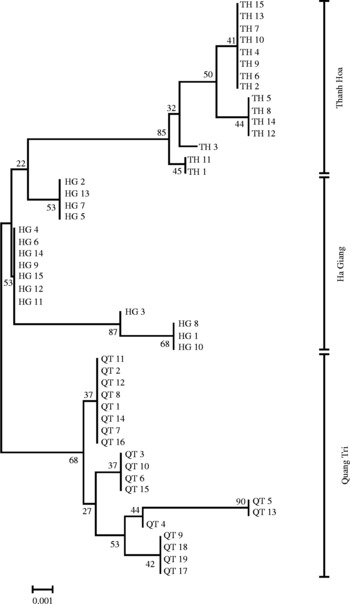
The clustering dendrograms for the three different populations in Vietnam (HG, n= 15; TH, n= 15 and QT, n= 19) showed that these populations were genetically different enough to be three separate groups (fig. 1). The average evolutionary divergence over pairwise sequences within groups was around 0.003 (HG = 0.004, TH = 0.001 and QT = 0.002), while the average over pairwise sequences between populations was around 0.014. These results suggest that evolutionary divergence is not related to geographical distance. Genetically, the TH population (Red River Delta) had diverged further from the QT population (north-central coast lowland) than the HG population (north-east highland). Although the three H. taichui populations were found to be quite different genetically, they did not differ significantly morphologically.
Three clustering groups of three H. taichui populations constructed by the neighbour-joining method. The scale bar represents the genetic divergence based on p-distance.

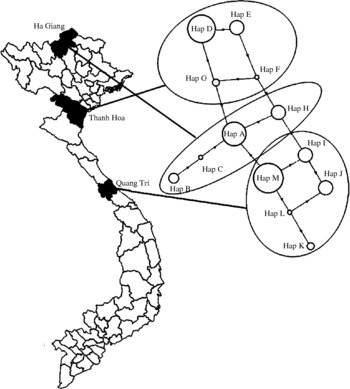
Among the 49 sequences of the 375 bp COI gene studied, there were 13 variation sites (GC content = 0.409) and 13 haplotypes that exhibited high diversity (h= 0.91 ± 0.02). The haplotype network (fig. 2) shows a picture of the haplotype relationship related to the clustering dendrograms (fig. 1). Each population showed specific haplotypes, without overlap. Since the constructed haplotype network did not show a star-like shape, population expansion seems not to have occurred among these three populations. However, each population seemed to have its own most recent common ancestral haplotype (TH = Hap D, HG = Hap A, QT = sHap M) and no singleton. Haplotype relationships did exist between QT and HG populations, and also between HG and TH populations (fig. 2). An F-statistics test confirmed that the three populations exhibited statistically significant genetic differentiation between them (Fst= 0.73; P value < 0.05).
The haplotype network of three H. taichui populations in Vietnam shown in relation to their geographic location of origin.

The COI sequences from the three H. taichui populations indicated that the high mutation rates were intraspecific polymorphisms. The Ts/Tv ratio (Ts/Tv = 1.0) indicated high genetic divergence between populations in a short timescale of population divergence (Peterson & Masel, Reference Peterson and Masel2009). Still, a slightly high transversion may be caused by a short-term mutation rate of a newly arising and slightly deleterious mutation (Simon et al., Reference Simon, Phillips, Cooper and Drummound2005). The mean evolutionary rate was about 1.00 substitutions/site/million years. Estimation of mitochondrial (mt)DNA in human pedigrees (between 0.32–2.5 substitutions/site/million years) (Sigurdardóttir et al., Reference Sigurdardóttir, Helgason, Gulcher, Steffansson and Donnely2000; Howell et al., Reference Howell, Smejkal, Mackey, Chinnery, Turnbull and Hernstadt2003) suggested that the intraspecific evolutionary rate of H. taichui can be accepted. Overestimation due to polymorphisms will only significantly impact the short-term rate of the molecular clock and not long-term total divergence (Peterson & Masel, Reference Peterson and Masel2009). Divergence dates for the three H. taichui populations were estimated. It was revealed that these populations separated from each other around 15,000–20,000 years ago. The molecular clock of the Vietnamese H. taichui populations rejected the null hypothesis, that the rate of substitution was constant.
Differences in geographical areas may possibly drive the genetic differentiation among H. taichui populations once they have separated from a recent common ancestor, which would limit gene flow. With high evolutionary rates, H. taichui could rapidly establish the fittest genotype for each locality's environment. Moreover, evolutionary rate estimations indicate that each H. taichui population separated into at least two groups around 7300 years ago (fig. 1).
According to the history of Vietnam, the ancient kingdom was founded around 2700 years ago (Kenny, Reference Kenny2002). Therefore, the genetic divergence of H. taichui populations may have occurred in the pre-historical period. The populations of this parasite might be separated from each other by different geographical localities. The definitive hosts (reservoir hosts) might not migrate to other areas because of plentiful food. The intermediate host, freshwater fish, could not migrate among these three studied provinces (Ha Giang, Thanh Hoa and Quang Tri) because no river branch from each province connects them together. Therefore, the fish intermediate host in natural rivers could not be the host for parasite transmission.
Paragonimus westermani is a good example of a species having high genetic diversity, resulting from varying ecological factors and geographical isolation. Specimens of P. westermani collected from central and southern parts of Thailand demonstrated high genetic variation in the COI gene. There is no report about the migration of the intermediate host (waterfall crab) between these two localities. This parasite was divided into two groups, due to statistically significant genetic differentiation (Banchai et al., 2007).
Recently, there has been a rapid and widespread development of fish-farming communities throughout Vietnam (Hop et al., Reference Hop, De, Murrell and Dalsgaard2007; Phan et al., Reference Phan, Ersøll, Bui, Nguyen, Murrell and Dalsgaard2009). Fish are raised in enclosed areas and the fish from these small aquaculture sites are usually sold within the rural commune where they are raised or the larger district. They are rarely sold in other provinces. Cultivated fish have reportedly high prevalence rates of H. taichui infection (Tran et al., Reference Tran, Dalsgaard, Turnbull, Pham and Murrell2008). This suggests that they are the major cause of human H. taichui infections in rural communes. Since the fish are raised in separate groups within small enclosed areas, the fish intermediate host is most likely a factor limiting the gene flow of H. taichui.
To develop a deep understanding of the H. taichui population structure, further study of the population diversity in other endemic areas is required to elucidate a picture of this widely distributed species.
Acknowledgements
We thank our colleagues in the Parasitology Department, National Institute of Malariology, Parasitology and Entomology (NIMPE), Hanoi, Vietnam for their technical support. This study was partially supported financially by NIMPE, Thailand Research Fund (TRF) grant no. BRG5180005 and the Faculty of Tropical Medicine, Mahidol University, Thailand. We also thank Mr Paul Adam and Mr Tim Jackson, Office of Research Services, Faculty of Mahidol University, Thailand, for their assistance in editing the English language of our manuscript.