Mutualism is a positive interaction that reduces physical and biotic stresses (e.g. reduced fitness) within ecological communities (Stachowicz, Reference Stachowicz2001). Cleaning symbiosis is a type of mutualism that involves one of the most highly developed interspecific communication systems known and a kind of feeding association only recently recorded between fish and marine turtles (Grutter, Reference Grutter1999; Feitoza et al., Reference Feitoza, Dias, Rocha and Gasparini2002; Sazima et al., Reference Sazima, Grossman, Bellini and Sazima2004a, Reference Sazima, Grossman and Sazima2010; Grossman et al., Reference Grossman, Sazima, Bellini and Sazima2006). In such association cleaners feed on ectoparasites and their eggs, diseased, and necrotic or injured tissues, from the body surface of their ‘clients’, which in turn they get rid of unwanted material (Sazima et al., Reference Sazima, Moura and Sazima1999, Reference Sazima, Grossman, Bellini and Sazima2004a; Arnal et al., Reference Arnal, Côté, Sasal and Morand2000; Feitoza et al., Reference Feitoza, Dias, Rocha and Gasparini2002; Grossman et al., Reference Grossman, Sazima, Bellini and Sazima2006; Francini-Filho & Sazima, Reference Francini-Filho and Sazima2008; Gasparini et al., Reference Gasparini, Luiz and Sazima2008). Several cleaner species hold cleaning station at specific sites on the reef, which are visited by clients seeking cleaning services (Arnal et al., Reference Arnal, Côté, Sasal and Morand2000; Sazima et al., Reference Sazima, Grossman, Bellini and Sazima2004a, Reference Sazima, Grossman and Sazimab).
Marine turtles are frequent clients of cleaner fish. Their carapace and soft body parts are cleaned by a variety of species, such as crustaceans (Sazima et al., Reference Sazima, Grossman and Sazima2004b) and fish (Losey et al., Reference Losey, Balazs and Privitera1994; Smith, Reference Smith1988; Sazima et al., Reference Sazima, Grossman, Bellini and Sazima2004a, Reference Sazima, Grossman and Sazima2010; Grossman et al., Reference Grossman, Sazima, Bellini and Sazima2006).
The green turtle, Chelonia mydas (Linnaeus, 1758) (Cheloniidae), is found worldwide in tropical and subtropical waters (Hirth, Reference Hirth1997). This is a major species feeding along the Brazilian coast (Bellini, Reference Bellini1996; Godley et al., Reference Godley, Lima, Akesson, Broderick, Glen, Godfrey, Luschi and Hays2003). It is primarily herbivorous, with benthic algae and/or seagrasses as the most frequent food items (Ferreira, Reference Ferreira1968; Arthur & Balazs, Reference Arthur and Balazs2008; López-Mendilaharsu et al., Reference López-Mendilaharsu, Gardner, Seminoff and Rodriguez2005).
The banded butterflyfish, Chaetodon striatus (Linnaeus, 1758) (Chaetodontidae), is usually seen in pairs or solitary. It lives associated with the substrate on rocky and coral reefs, and feeds on anthozoans, polychaetes, crustacean, molluscs' eggs, plankton and jellyfish (Randall, Reference Randall1967; Pitts, Reference Pitts1991; Sazima & Sazima, Reference Sazima and Sazima2001; Chaves et al., Reference Chaves, Feitosa and Pereira2010). Occasionally, adults may act as cleaners (Sazima & Sazima, Reference Sazima and Sazima2001).
Cleaning symbiosis between Chelonia mydas and reef fish is recorded for the Indo-Pacific (Booth & Peters, Reference Booth and Peters1972; Losey et al., Reference Losey, Balazs and Privitera1994) and in the Atlantic, where damselfish (Pomacentridae), wrass (Labridae), and surgeonfish (Acanthuridae) were recorded as cleaners (Booth & Peters, Reference Booth and Peters1972; Losey et al., Reference Losey, Balazs and Privitera1994; Gasparini & Floeter, Reference Gasparini and Floeter2001; Sazima et al., Reference Sazima, Grossman, Bellini and Sazima2004a). We report here four adult banded butterfly fish, Chaetodon striatus, cleaning a green turtle, Chelonia mydas, in a rocky shore site located at Baía de Todos os Santos, Bahia State, north-east Brazil.
The cleaning behaviour was recorded opportunistically at Farol da Barra rocky shore (13°00′29.29″S 038°31′59.20″W). This rocky shore is composed of rock covered with algae (mainly Enteromorpha sp.), several colonies of small stony corals (mainly Siderastrea sp. and Favia spp.), hydrozoans (Millepora sp.), Dermospongiae and a large variety of zoanthids. We estimated the size of turtles (curved carapace length; CCL) and fish (total length; TL). Depths at this site ranged from 1.5 to 2 m at high tide.
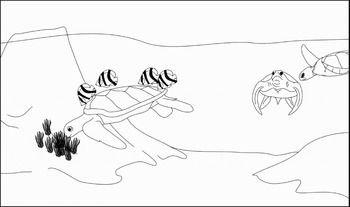
On 24 December 2009, a juvenile green turtle (50–55 cm CCL) was observed feeding on Enteromorpha sp. near the seabed when four adult butterflyfish (10–11 cm TL) cleaned its carapace. A few metres apart two other juvenile green turtles of similar size (50–55 cm CCL) were apparently waiting to be cleaned by the butterfly fish (Figure 1). During the ten minute period of direct observation, four banded butterfly fish were restricted to the region of the carapace, having more interest in the extremities, especially portions near the neck and tail. After being cleaned, the turtle moved away and the fish stayed in the same place, swimming in the water column, signalling the location of a cleaning station. The other two turtles apparently got scared by the presence of divers and swam away.
Four adult butterflyfish cleaning a juvenile green turtle, and two other turtles probably waiting their turn.

Zoobenthivorous reef fish, such as grunts (Haemulidae) (Sazima et al., Reference Sazima, Grossman and Sazima2010) and Chaetodon striatus (present study) probably seek small invertebrates on marine turtle carapace, while wrass (Labridae) tend to seek ectoparasites on skin (Booth & Peters, Reference Booth and Peters1972; Losey et al., Reference Losey, Balazs and Privitera1994; Gasparini & Floeter, Reference Gasparini and Floeter2001). Sazima & Sazima (Reference Sazima and Sazima2001) believe that very occasional cleaning behaviour by C. striatus is mostly induced by conspicuous posing behaviour of the soliciting client rather than due to dietary issues.
The posture and general behaviour displayed by the turtles here are similar to those reported for the same species and the hawksbill turtle, Eretmochelys imbricata (Linnaeus, 1766) (Cheloniidae) (Losey et al., Reference Losey, Balazs and Privitera1994; Sazima et al., Reference Sazima, Grossman, Bellini and Sazima2004a; Grossman et al., Reference Grossman, Sazima, Bellini and Sazima2006; Mendonça, Reference Mendonça2009). This emphasizes that the symbiosis between marine turtles and reef fish follow the pattern described by Grossman et al. (Reference Grossman, Sazima, Bellini and Sazima2006). Apparently, there is no specificity between a turtle species and a particular posture. However, a given posture seems to be related to the cleaner's habits (Sazima et al., Reference Sazima, Grossman and Sazima2010).
Green turtles have the highest number of associated cleaner fish species, probably due to their records being made in marine parks, with clear water, which favours underwater observations (Sazima et al., Reference Sazima, Grossman and Sazima2010). The present new record of a reef fish cleaning marine turtles and the increasing number of fish species known to act as cleaners for marine turtles (Smith, Reference Smith1988; Losey et al., Reference Losey, Balazs and Privitera1994; Sazima et al., Reference Sazima, Grossman, Bellini and Sazima2004a, Reference Sazima, Grossman and Sazimab, Reference Sazima, Grossman and Sazima2010; Grossman et al., Reference Grossman, Sazima, Bellini and Sazima2006) suggests that this behaviour is more common than previously thought and more studies are needed.
ACKNOWLEDGEMENTS
We thank the Centro de Pesquisa e Conservação dos Ecossistemas Aquáticos (Biota Aquática) for logistical support; Milagros López-Mendilaharsu, Gustavo F. Carvalho-Souza, José R. Nogueira Neto, Vívia M. Câncio and Lais C.T. Chaves for the valuable suggestions. Financial support was provided by CNPq to J.A.C.C. Nunes.