

1 Introduction
This study seeks to analyse the role of the payment vehicle when conducting non-market valuations of health care services through the application of stated preference methods. Smith and Sach (Reference Smith and Sach2010) report that in the period from 1985 to 2005, a total of 265 contingent valuation (CV) studies were conducted on health, of which 73% used out-of-pocket payments as payment vehicle, although this was unlikely to be the payment vehicle of choice if the health care services were to be introduced in real life. If health care services are provided via public health insurance programmes, a valuation based on the use of out-of-pocket expenditures as payment vehicle may potentially ignore the value associated with altruism, as well as other utility-generating factors associated with the good.
In a stated preference survey, we analysed the impact of payment vehicle on valuations. It is important to verify whether citizens value goods differently due to, for example, other regarding preferences in order to appropriately guide decision makers on the value of alternative policy options.
There is currently a small empirical literature conducting tests on the relative valuations of goods or services that ideally only differ with respect to them being tax financed and accessible to all citizens, or only accessible to those who pay out-of-pocket. The motivation for these studies has been to measure the value of altruism, assuming that any difference in valuations across publicly and privately financed goods must be generated by concern for equity in access to the risk reductions on offer. In the context of traffic, willingness-to-pay (WTP) is found to be significantly higher when the setting is private rather than public (Johannesson et al., Reference Johannesson, Johansson and O’Conor1996; de Blaeij et al., Reference de Blaeij, Florax, Rietvald and Verhoef2003; Hultkrantz et al., Reference Hultkrantz, Lindberg and Andersson2006; Andersson and Lindberg, Reference Andersson and Lindberg2009; Svensson and Johansson, Reference Svensson and Johansson2010), thus rejecting the impact of altruism generated from equal access to risk reductions on valuations. In contrast, Arana and Leon (Reference Arana and Leon2002), Olsen et al. (Reference Olsen, Kidholm, Donaldson and Shackley2004) and Pedersen et al. (Reference Pedersen, Kjaer and Gyrd-Hansen2011) conducted similar studies in the context of health, and demonstrated that valuations were higher in the public setting. A recent meta-analysis of WTP in the context of conserving biodiversity demonstrated that WTP was significantly higher for coercive payments than for voluntary payments (Martin-Lopez et al., Reference Martin-Lopez, Montes and Benayas2008). The current literature on the subject of the relative valuation of publicly and privately financed goods, thus, emphasises the need to better understand the underlying motivations of these preferences, as they indicate that relative valuations may be highly context-specific.
An explanation for why one may observe that private valuations exceed public valuations is that altruistic preferences can take different forms: altruism may be ‘pure’ or ‘safety focussed’. Jones-Lee (Reference Jones-Lee1991, 1992) distinguishes between pure selfishness, pure altruism – where people in addition to their own well-being are concerned about other people’s utility – and safety-focussed altruism in which altruism relates only to other people’s safety. If an individual is a pure altruist, his/her public valuation (individual preferences inclusive of altruism) could be higher/lower than his/her private valuation depending on his/her predictions of other individual’s WTP, and the net benefit he/she perceives that other citizens incur from the programme. Johannesson et al. (Reference Johannesson, Johansson and O’Conor1996) believe that respondents may include their predictions of the coercive payment (tax) in valuations, and that such behaviour may in some instances generate a negative impact of pure altruism. Messer et al. (Reference Messer, Poe and Schulze2013) found evidence (in an experimental setting involving actual financial losses) that respondents consider the cost of a programme that might be imposed on other voters when they decide to vote for or against a public programme (implying pure altruism). Messer et al. (Reference Messer, Poe and Schulze2013) found that individuals with the most to gain from a risk-reducing policy tend to shade their WTP downward – that is, in a public setting, they express a maximum WTP that is significantly lower than that for an equal reduction in private risk. This expression of pure altruism could drive the preference patterns observed in the traffic-safety literature. Evidence in the context of health suggests, however, that paternalistic altruism is most prevalent (Breman, Reference Breman2006; Jacobsson et al., Reference Jacobsson, Johannesson and Borgquist2007). As paternalistic altruism focusses on the increased safety or health of others (and not on their overall welfare), this type of other-regarding preference would ceteris paribus generate public valuation that are higher than private valuations. A pattern that has been observed by Arana and Leon (Reference Arana and Leon2002) and Pedersen et al. (Reference Pedersen, Kjaer and Gyrd-Hansen2011) and that we expect to observe in the present study focusses on valuation of ambulance helicopter services.
Framing effects may create differences in public and private valuations (Tversky and Kahneman, Reference Tversky and Kahneman1986), possibly because differences in descriptions trigger affective reactions (Heberlein et al., Reference Heberlein, Willson, Bishop and Schaeffer2005). It is a challenge to present a public and a private good holding all other characteristics constant in order to avoid affective reactions, and previous studies that have attempted to hold all things equal in order to isolate the altruistic component may have succeeded to different degrees. For example, in the study by Svensson and Johansson (Reference Svensson and Johansson2010), the private good on offer was a ‘safety device’, whereas the public good was a ‘public road safety investment’. These are essentially very different goods. Public road safety may involve longer travel time, and a safety device may not avoid an accident but merely alleviate the health consequences. In the study by Arana and Leon (Reference Arana and Leon2002), the private intervention consisted of buying an ‘oral vaccine’, whereas the public good was a ‘social policy’, which would reduce the probability of getting flu. In the literature, the public and private interventions are consistently described by way of different intervention labels, thus potentially evoking different affective reactions. In the present study, we seek to exclude the effect of framing by presenting a single intervention (ambulance helicopter service), which can be financed by private subscription or provided to all via income taxes.
There are other potential explanations for the finding that WTP is higher for the privately financed good. We are often not only valuing goods per se, but also attitudes towards payment vehicles as well as attitudes towards providers. We are in fact measuring the welfare implications of policy options – that is, a far more complex package. This issue was raised by Shogren (Reference Shogren1990), who showed that individuals prefer private to public traffic interventions, and argued that the reason behind this finding may be that respondents perceive public provision of traffic safety as inefficient. Svensson and Johansson (Reference Svensson and Johansson2010) confirmed this hypothesis. Their results imply that the value of a private risk reduction is three times higher compared with a public risk reduction, and that a significant part of the difference can be explained by respondents’ attitudes towards private and public provision of goods.
2 The aims of the present study
The present study seeks to test for the existence of altruism and/or other utility-generating factors associated with payment vehicle in a setting where the privately financed good and the publicly financed good on offer are of an identical nature, thus minimising affective reactions. In both settings, the good on offer is the availability of an ambulance helicopter service. In the private setting, the service is only available for those who have signed up and paid for the service. In the public setting, the service is tax financed. In this case, access to the emergency service is ensured for all citizens. The advantage of the present study is that the case presented is highly realistic and relevant to the respondents. The introduction of helicopter services has been debated in Denmark in recent years as a consequence of the closing of local hospitals, and the resulting longer distances to acute care services. Recently, an ambulance helicopter service was introduced in two regions of Denmark on a trial basis for a three-year period. The service was initiated and funded by a private charitable foundation (Trygfonden). Launching a stated preference survey at this point in time was, therefore, opportune, as the question of how to fund the service in the future is highly relevant and there is at present no status quo scenario, which could impact on preferences.
The main aim of this study was to test for the difference between private and public WTP in the context of a health care service, and to seek to explain why respondents may value the private and public intervention differently using potential explanatory variables that reflect attitudes relating to equity in access to health care services and the quality of public health care services.
A further focus, which is highly related to the aforementioned objective, was to analyse and discuss the implications of excluding protest responses. The selective inclusion of responses in valuations may partly drive the difference across private and public valuations, and it may create a bias in the true valuation of the good. Protest response is a relatively under-developed issue in CV research. Protest rates are often not reported, and when they are the criteria for exclusion of such responses differ depending on the subjective assessment of the researcher. The possibility that protest responses and their meaning may vary according to the type of good being valued is seldom acknowledged (Jorgensen et al., Reference Jorgensen, Syme, Bishop and Nancarrow1999). Edwards and Anderson (Reference Edwards and Anderson1987: 168) define protest response as ‘valuations that are intended to express displeasure with some part of the contingent market rather than to reveal true preferences’. However, when seeking to analyse the valuations of services using different payment vehicles distinguishing between ‘true preferences’ and ‘displeasure with some part of the contingent market’ is by no means trivial, as the payment vehicle is at the same time a characteristic of the contingent market, but also an unavoidable characteristic linked to providing the good in real life. Meyerhoff and Liebe (2006) and Fischhoff and Furby (Reference Fischhoff and Furby1988) conclude that protest beliefs (such as trust, confidence and fairness) have a significant effect on the decision to be WTP as well as on the amount of money stated by those who are WTP, and that exclusion of protesters may inconsistently exclude beliefs that are important for the preferences that are elicited.
The standard procedure in CV is to remove protest response from the analysis in order to obtain ‘model coefficients that are unbiased by protesters’ (Dziegielewska and Mendelsohn, Reference Dziegielewska and Mendelsohn2007: 84). Others, however, recommend recoding protest votes as true zero bids (e.g. Halstead et al., Reference Halstead, Luloff and Stevens1992; Meyerhoff and Liebe, Reference Meyerhoff and Liebe2006). In the present study, we explore whether it is possible to establish unbiased valuations of a good per se (in this case helicopter ambulance service) through the exclusion of protest bidders, and discuss whether it is indeed appropriate. Our aim is to contribute to a debate on the appropriate choice of payment vehicle when conducting stated preference experiments in the context of health or other settings.
To summarise, this study seeks to test (1) whether valuations differ across private and public goods, (2) whether differences in valuations are steered by attitudes relating to preferences for equity and/or perceptions of the quality of publically and privately provided goods and (3) whether valuations of goods per se can be isolated from valuations of policy options through the exclusion of protest bids.
3 Methods
3.1. The survey
The web-based survey was conducted in January 2011. Respondents were randomly selected from Gallup’s internet panel (Gallup@Forum.dk), so that they were representative of the general population with respect to gender, age and education level. In the first invitation, around 8841 persons were invited. After two reminders, 4613 individuals responded. In order to obtain the target of 5000 respondents, invitations were subsequently forwarded to a further 715 individuals. Therefore, at the end of the study, a total of 9556 individuals had been invited to participate, and 52.5% had accepted the invitation corresponding to a sample of 5017 respondents. A randomly selected 3808 respondents were presented with the CV tasks that were analysed in this article. We focussed on the 3434 individuals who provided responses to both the CV tasks presented to them. Note that respondents had the option of skipping the question if they found it too difficult to answer. We found no evidence of non-respondent bias with respect to gender, age, education level and county of residence.
Respondents were presented with two CV tasks (CVpublic and CVprivate). They were initially presented with the offer of the publicly financed good and were asked to state their maximum WTP (WTPpublic). Respondents were subsequently asked to imagine a situation where the ambulance helicopter would not be provided through public insurance, but where there was a possibility of obtaining the service through a private insurance scheme. They were then asked to state their maximum WTP for the privately financed good (WTPprivate). The two services were, thus, presented as two mutually exclusive goods. Moreover, the questions were presented just after one another, which allowed the respondents to consider their relative valuations across the two scenarios. The public good was described in terms of access to a national ambulance helicopter service and the payment vehicle was an annual increase in income tax (How much would you maximum be willing to pay more in tax per year for a helicopter service in your region?) The private good was described as access to an ambulance helicopter service through private insurance where the premium was paid once a year (How much would you maximum be willing to pay per year for an insurance policy which ensures helicopter service for you and your family?) Note that the questions were formulated such that any difference in valuations will reflect altruism extending beyond that of the nearest family.
Two valuations were elicited for each individual. This was important for this study as it builds on intra-respondent comparisons of WTP for private and public goods, with focus on dWTP=WTPpublic−WTPprivate. The ordering was fixed such that the public good was valued first and the private good second. This may have induced an anchoring effect, where the absolute valuation of the private good depends on the absolute value of the public good. Svensson and Johansson (Reference Svensson and Johansson2010) found evidence of an order effect such that when the private WTP question was presented first it generated a higher WTP for both the private and public settings, and vice versa when the public WTP question was presented first. The ordering did not, however, have any impact on conclusions regarding the relative valuations of the public and private good, as the WTP for the private good was consistently higher than that for the public good. For the purpose of testing whether this result also holds in the context of the present study, we conducted a supplementary albeit smaller study where respondents were randomly allocated to ordering. The phrasing of the questions was identical to those presented in the main survey.
Before the CV questions, the respondents were presented with a short cheap-talk script. Respondents in the present sample were presented with one of three CV formats (which were identical across CVpublic and CVprivate in the individual questionnaire). One-third of the respondents were asked to indicate their maximum WTP without the assistance of a payment card, one-third of the respondents were asked to indicate their maximum WTP with the use of a payment card where payment bids ranged from 0 to 5000 DKK (with the possibility of expressing other amounts) and one-third of the respondents were initially asked whether they would be willing to pay or not (filter), and only those who indicated a WTP>0 were subsequently presented with a question asking them to move on to indicating maximum WTP (with the aid of the payment card). This study design was applied to test for the impact of applying an initial filter when using payment cards. Our results implied that the introduction of a filter results in preference patterns similar to those elicited when no payment card is provided (Gyrd-Hansen et al., Reference Gyrd-Hansen, Jensen and Kjaer2014). These different formats had no significant effect on dWTP, and the data from the three study arms have, therefore, been collapsed in the analyses presented here.
If respondents indicated zero WTP in CVpublic, they were asked to justify their response by nominating the most important reason from a given set. This follow-up question was presented in a new window, and was not observable before, after the valuation question had been answered. Thus, the pre-defined justifications could not affect valuations. There were four possible reasons that the respondent could provide: (1) the ambulance helicopter service has no value to me, (2) the ambulance helicopter service has no value to anyone, (3) on principle grounds I do not want to pay more in tax and (4) I cannot afford to pay more in tax. If respondents indicated zero WTP in CVprivate, they were likewise asked to justify their response. In this case, possible responses were as follows: (1) the ambulance helicopter service has no value to me, (2) the ambulance helicopter service has no value to anyone, (3) on principle grounds I do not want to buy a private insurance as it is increases inequity in society and (4) I cannot afford to pay.
In addition to the WTP questions, the survey included questions on socio-demography and attitudinal questions relating to the ambulance helicopter service, as well as to public health care services in general. Attitudes were elicited by presenting respondents with statements and asking them to indicate their reactions to these on a scale from ‘strongly disagree’ (=1) to ‘strongly agree’ (=5).
3.2. Analysis
In the present study, we focus mainly on the sign and not the magnitude of (mean) dWTP. We expect to observe a large fraction of individuals exhibiting dWTP=0 as well as respondents who intentionally indicate either dWTP<0 or dWTP>0. We include attitudinal responses as potential explanatory variables in multinomial logistic regression models, where we seek to identify attitudinal features that determine whether dWTP>0 or dWTP<0. We apply the same method to verify whether attitudes differ across protesters and non-protesters.
In our analyses, we define protest responders as those respondents who indicated that the only motivation for expressing zero WTP was “on principle grounds I do not want to pay more in tax” (CVpublic) or “on principle grounds I do not want to buy a private insurance as it increases inequity in society” (CVprivate). In the present study, we are following the common practice, which is to exclude WTP expressions that do not reflect valuations of the good on offer, but is a result of a more general reaction some part of the contingent market such as the payment vehicle applied (Edwards and Anderson, Reference Edwards and Anderson1987). The validity of the practice will, however, be discussed further in light of the empirical evidence presented.
4 Results
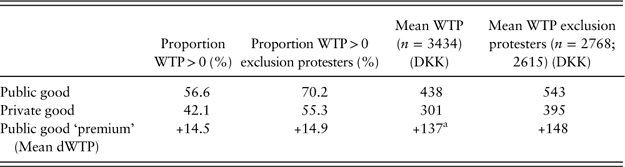
The results of the stated preference task demonstrate that there is a marked difference in the valuation of the acute helicopter service when payment is private and public (Table 1). Results are presented for individuals who provided responses to both CVpublic and CVprivate (n=3434). Individuals are more prone to wanting to pay (WTP>0) when the service is publicly financed (56.6% vs 42.1%), and this is what partly drives the difference in the mean WTP estimates (438 vs 301 DKK), which is highly statistically significant (p<0.0001). When comparing the WTP amongst the subset of respondents who express a positive WTP in both scenarios, the mean WTP amongst those who express a positive WTP is 820 DKK for the public good and 736 DKK for the privately financed good. The difference in WTP was statistically significant (p=0.011). Therefore, not only does public vs private setting affect the rate of zero bidders, but the setting also affects the level of WTP amongst those willing to pay. Overall, these results suggest that valuations are higher when the setting is public. Table 1 also shows the impact of including and excluding protest responses. If some of the zero bids are excluded following the decision rule previously described, the proportion of included respondents who are willing to participate (naturally) increase, as does the mean WTP for the acute helicopter service. The mean WTP estimates increased by 24% (CVpublic) and 31% (CVprivate), and the mean dWTP increased by 8% (from 137 to 148 DKK).
Willingness-to-pay (WTP) for acute helicopter service per annum when the whole population is covered (public good) and when access is a matter of private choice (private good)

a The difference is statistically significantly different according to Wilcoxen matched pairs test (p<0.0001).
A series of bivariate analyses were performed in order to determine which respondent characteristics were associated with the magnitude of WTP. Non-parametric tests (Mann–Whitney) were applied to test for statistical significance. These analyses were mainly carried out in order to verify the validity of the responses. As would be expected, the distance to the nearest hospital had the expected impact on valuations both in the private and public settings: longer distance increased valuations. Including all responses, those with <5 km to the nearest hospital were WTP 399 DKK (CVpublic) and 238 DKK (CVprivate), respectively. These valuations rose to 548 DKK (CVpublic) and 339 DKK (CVprivate) when the distance was >30 km. The same preference patterns were observed if protesters were excluded. WTP was also positively associated with the extent to which the respondent agreed that the introduction of a helicopter service was a good idea (CVpublic: p<0.0001; CVprivate: p<0.0001), the extent to which respondents agreed that the service could improve acute care service (CVpublic: p=0.008; CVprivate: p=0.007) and with the extent to which the respondent worried about quick access to a hospital in case of emergency (CVpublic: p=0.001; CVprivate: p=0.001). Higher income had a positive impact on valuations in both settings (CVpublic: p<0.0001; CVprivate: p<0.0001), whereas lower social class had a negative impact (CVpublic: p=0.002; CVprivate: p=0.070). A higher level of education also lowered the valuations of the helicopter service, irrespective of whether it was offered publicly or privately (CVpublic: p=0.002; CVprivate: p<0.0001). Men tended to value helicopter services lower than women (CVpublic: p<0.0001; CVprivate: p=0.015), whereas there was a markedly different effect of age on valuation across settings. Higher age increased valuations for the private good (CVprivate: p<0.001), whereas this was not the case for the public good (CVpublic: p=0.32). Overall, these results confirm the validity of the WTP responses in both the private and public settings.
4.1. Testing for ordering effect: results of the sub-study
In a sub-study, we tested for impact of ordering. The framing of the questions were identical to the remaining study, but respondents were randomised to either CVpublic followed by CVprivate or CVprivate followed by CVpublic. All respondents were presented with the payment card, which was also presented to the majority of respondents in the main study. In both the scenarios, the privately and publically financed programmes were presented as mutually exclusive. The mean WTP values were as follows: order as in main study (CVpublic−CVprivate; n=487): mean WTPpublic=479 DKK and mean WTPprivate=343 DKK. Reversed order (CVprivate−CVpublic; n=493): mean WTPprivate=311 DKK and mean WTPpublic=403 DKK. Our results are very similar to those of Svensson and Johansson (Reference Svensson and Johansson2010), albeit with a reversed pattern. Svennson and Johansson (Reference Svensson and Johansson2010) found that when the private WTP question was presented first, it generated a higher WTP for both the private and public settings. In our case, the valuations are higher when the public WTP question is presented first. The ordering does not, however, have any impact on the relative valuations, as the WTP for the publically financed good is consistently higher than that for the privately financed good.
4.2. Intra-respondent analyses
As many as 56.7% of the respondents expressed identical valuations across the private and the public goods (dWTP=0), of these 65.0% provided a zero response. A total of 29.1% of the respondents reported dWTP>0, whereas 14.2% of the respondents reported dWTP<0.
A multinomial logistic regression analysis was carried out with the dependent variables dWTP>0 and dWTP<0 (reference: dWTP=0). Explanatory variables included five variables reflecting attitudes relating to the organisation of health care services in general as well as socio-demographic characteristics (income, education, age and gender). Pearson’s correlation coefficients across attitudinal variables were found to be between 0.028 and 0.563, with the highest correlation found between agreement with ‘public health care services is of high quality’ and ‘public health care personnel are respectful’.
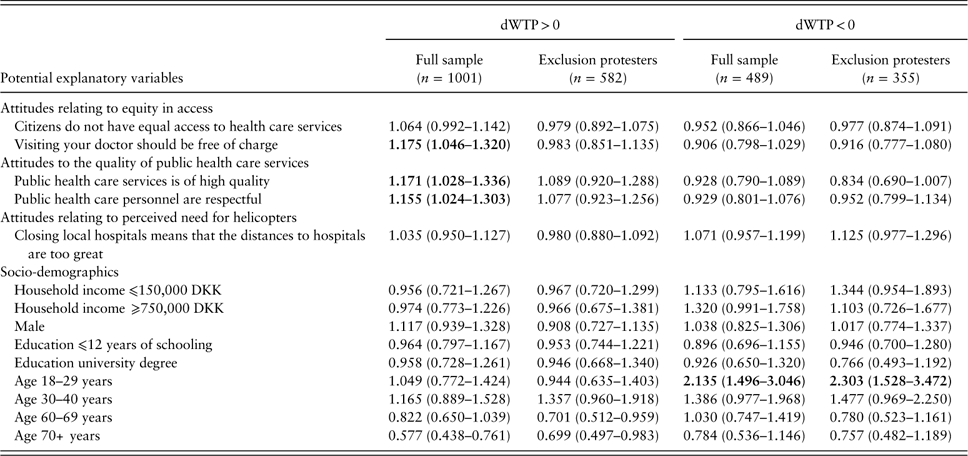
Table 2 reports on results. The odds ratios presented reflect the change in odds associated with one unit increment on the scale of the explanatory variable (with attitudinal variables ranging from 1 to 5). Based on the complete sample, there was a statistically significant association between attitude towards equity in access and WTPpublic>WTPprivate. Respondents were more prone to expressing higher WTPpublic if they strongly agreed with the concept of health care services being free of charge. Further, agreeing that public health care is of high quality and that public health care personnel are respectful also makes it more likely that dWTP>0. Younger individuals (18 to 29-year olds) demonstrated an inclination to express higher WTP for the private service; dWTP<0 could not be explained by attitudinal responses, although the tendency is for odds ratios to be <1. The lack of statistical significance may be explained by the smaller sample size, and the reduced prevalence of protesters (who are likely to have stronger views).
Multinomial logistic regression analysis of the association between the sign of dWTP and attitudes
WTP=willingness-to-pay.
Bold values represents statistically significant coefficients defined by confidence intervals that do not overlap zero.
Reference: dWTP=0. Odds ratios reported (95% confidence interval in parentheses).
Our results suggest that the difference in valuation across the private and public settings is driven to some degree by both equity preferences as well as attitudes towards the quality of services across public and private health care providers. As can also be verified by Table 2, the exclusion of protesters rendered the previously observed associations statistically insignificant. These results suggest that those respondents who are defined as protesters (according to the standard definition) may also be those respondents whose relative WTP values are driven by equity preferences and attitudes towards public and private providers. In the following section, we look closer at the attitudes amongst these so-called protesters.
4.3. Protest bidders
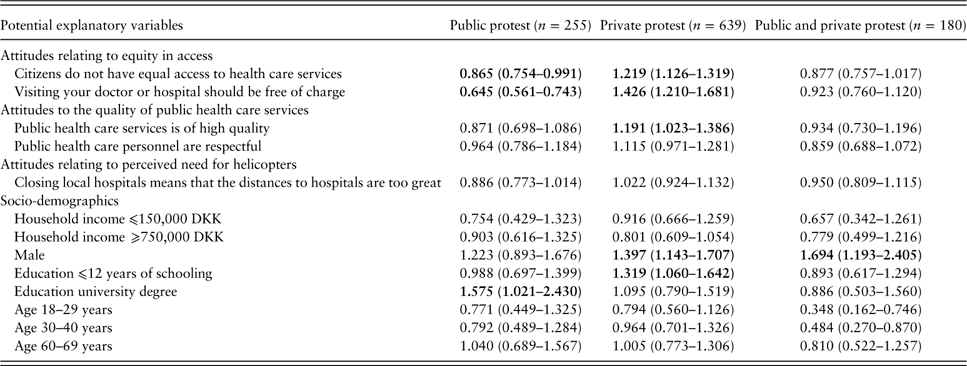
In order to verify the appropriateness of excluding protest bidders, we analysed whether protest bidders differ from other respondents in their attitudes towards privately and publicly financed goods. A multinomial logistic regression analysis was carried out with dependent variables signifying whether the respondent had provided a protest response in relation to CVpublic (public protest) or CVprivate (private protest) or both (public and private protest). The reference is no protest response to either of the CV questions. Attitudinal responses as well as socio-demographic variables were included as potential explanatory variables. Results are shown in Table 3.
Multinomial logistic regression analysis of the association between protesting and attitudes
Bold values represents statistically significant coefficients defined by confidence intervals that do not overlap zero.
Reference: no protest response to either contingent valuation question. Odds ratios reported (95% confidence intervals in parentheses).
Results demonstrate that attitudes towards equity in access to health care services are associated with protesting against one of the two payment vehicles (albeit with reverse impact). Further, if a respondent perceives public health care services as being of high quality, he/she is more likely to protest against paying for services privately. These results imply that protest bidders not only have strong views on access issues but also that they differ with respect to attitudes towards providers.
Further, those who protested against paying privately were more likely to be men and have lower levels of education, whereas those who protested against paying more in tax were over-represented by individuals with university degrees. Interestingly, belonging to a low- or high-income group did not impact on protest patterns. Men were generally more likely to exhibit protest responses.
5 Discussion
A main result of this study is that the public good premium (mean dWTP) was statistically significant and positive. This demonstrates (in line with the findings of Arana and Leon (Reference Arana and Leon2002) Pedersen et al. (Reference Pedersen, Kjaer and Gyrd-Hansen2011) and Olsen et al. (Reference Olsen, Kidholm, Donaldson and Shackley2004)) that the WTP for health care services is higher when services are paid for via increased taxes. It was shown that this result was not an artefact of ordering, as a reversed order of the CV questions provided a similar result.
Our study cannot dismiss that this finding is partly generated by strategic behaviour (free-rider behaviour in the public setting (Carson and Groves, Reference Carson and Groves2007) and/or social desirability bias (moral satisfaction due to the act of paying; Andreoni, Reference Andreoni1989), as suggested by Olsen et al. (Reference Olsen, Kidholm, Donaldson and Shackley2004). However, in contrast with Olsen et al. (Reference Olsen, Kidholm, Donaldson and Shackley2004), we found that not only were respondents potentially more prone to ‘yeah’ saying (expressing positive WTP generated by social desirability bias) in the public setting, but the public setting also generated higher valuations amongst respondents who expressed a WTP irrespective of the setting. The analysis of intra-respondent data (Table 2) suggests that the higher mean valuations expressed in CVpublic are driven by attitudes towards equal access as well as the perception that those services that are provided or authorised by the public health care sector are of a high(er) quality than purely private services. This result confirms that valuations are affected by altruistic preferences as well as perceptions of the quality of services across providers (as recently observed by Svensson and Johannson, Reference Svensson and Johansson2010). The finding suggests that the present use of CV methods in the context of health care services is problematic, so long as the payment vehicle used when eliciting non-market valuations does not appropriately reflect the payment vehicle that will actually be used if the service is delivered. Therefore, the use of out-of-pocket payment as a standard payment vehicle should be critically evaluated by researchers.
As many as 14.2% of the respondents expressed higher WTP for the privately financed service. As suggested by Olsen et al. (Reference Olsen, Kidholm, Donaldson and Shackley2004), a possible reason for this may be that, in a private insurance setting, the receipt of care is to a greater extent secured, whereas when services are financed via tax they are not to the same extent ring-fenced and linked to the payer. Therefore, the delivery of services is not guaranteed, as one is competing with the other for resources. A supplementary reason may be that these respondents exhibit pure altruistic preferences and are lowering their WTP in the public setting in order to not commit others to paying a similar amount.
The results of the analyses of attitude amongst protesters (Table 3) have several implications. First, it is clearly demonstrated that protesters (CVpublic as well as CVprivate protesters) represent individuals who have strong views on access issues. Consequently, exclusion of such individuals is nonsensical if one is seeking to estimate the relative valuations of public and private goods inclusive of other regarding preferences. Second, CVprivate protesters in particular have other distinguishing features. They are over-represented by men and individuals with low levels of education. As argued by Halsted et al. (Reference Halstead, Luloff and Stevens1992), the removal of protest bids can only be sustained if the characteristics of protest bidders do not differ from those of respondents whose bids are accepted as legitimate. In the present case, the exclusion of protest bids may lead to biased estimates, as this would entail under-representation of a group of the population (men and those with low level of education). Our results suggest that analysts should be very careful in omitting protest responses in valuation studies, and if it cannot be rejected that these so-called protests are generated by legitimate reactions to a feature of the policy on offer.
This study’s results further imply that valuations should not be transferred across settings that involve different payment vehicles. Nor is it appropriate to transfer benefits across settings with different providers. The optimal strategy must, therefore, be to use the most relevant payment vehicle to be applied in real-life scenario and rely on valuations of policy options rather than valuations of goods.
6 Conclusion
This study sought to test (1) whether valuations differ across private and public goods, (2) whether differences in valuations are steered by attitudes relating to preferences for equity and/or perceptions of the quality of publically and privately provided goods and (3) whether valuations of goods per se can be isolated from valuations of policy options through the exclusion of protest bids. We found that mean WTP for a public good was higher than that for the corresponding private good in the context of a health care service, suggesting that valuations are not independent of payment vehicle, and that researchers should take due care in choosing an appropriate and realistic payment vehicle for the good they are valuing. Individuals’ relative WTP for the public good vs the private good was a function of attitudes relating to altruism as well as perceptions of the quality of public health care services. As these are valid sources of value, it is important that researchers seek to elicit the total value of goods inclusive of these factors when appropriate. Finally, it was shown that excluding protest bidders is problematic and may bias true welfare estimates. Thus, the standard approach of handling protest bidders should be re-evaluated, and more attention must be given to understanding the underlying reasons for protesting.
Acknowledgements
Financial support for data collection was received from the Danish foundation Trygfonden. The opinions and conclusions expressed are solely those of the author. Trygfonden played no role in the study design, data analysis and interpretation or dissemination of results.