I. INTRODUCTION
Titanium dioxide can be considered a key technological material as it is used in a large panel of applications; also, titanium is a plentiful element, being the 10th most abundant element on the earth. Titanium dioxide is widely used as a white pigment (i.e., in paints and cosmetic products)Reference Gussman1 and plays a role in the biocompatibility of bone implants.Reference Rasmusson, Roos and Bystedt2 Other prospective applications include photocatalysis,Reference Fujishima and Zhang3, Reference Henderson4 fuel cells,Reference Qiao, Bao, Li, Cui, Lu and Guo5 solar cells,Reference Peter6 sensors,Reference Yuan, Mao, Li, Zhang and Wang7 corrosion-protective coatings,Reference Hu, Guan, Zhang, Ren, Wen, Zeng and Peng8, Reference Lei, Zhou, Feng, Zhu and Du9 capacitors and thin films transistors.Reference Chao and Dogan10, Reference Majewski, Schroeder and Grell11
Energy storage is another most promising application for TiO2. Anatase was tested long ago in lithium secondary cells with nonaqueous electrolytesReference Ohzuku, Takehara and Yoshizawa12 showing a flat discharge curve (∼1.8 V) and quite a good cyclability but moderate reversible capacity. The feasibility of a rocking chair lithium ion battery using nanosized anatase as negative electrode was provedReference Huang, Kavan, Exnar and Gratzel13 and the electrochemical testing of other TiO2 polymorphs in the form of nanoparticles further investigated.Reference Su, Wu, Zhan, Wu, Wei and Guo14, Reference Yang, Choi, Kerisit, Rosso, Wang, Zhang, Graff and Liu15 TiO2 has a theoretical specific capacity of 335 mAh/g [assuming full reduction to Ti(III) to yield lithium titanate (III) (LiTiO2)] and a higher operation voltage when compared with graphite, most commonly used in batteries. This entails a severe penalty in terms of energy, which is not acceptable for portable applications. However, as the safety of lithium-ion batteries depends on the thermodynamic stability of electrode materials with respect to the electrolyte, materials operating at moderate potentials are intrinsically safer and hence most suitable for use in large-scale applications, especially for those where energy density is not the key parameter (e.g., grid). In such cases, the use of low-cost materials based on abundant and nontoxic elements is an added value, especially if suitable sustainable synthesis routes can be developed.
Microwave synthesis is becoming an increasingly attractive alternative to produce inorganic nanoparticles.Reference Chen, Wang, Zhang and Jin16–Reference Pascu, Carenza, Gich, Estradé, Peiré, Herranz and Roig22 The specific microwave dielectric heating provides several advantages over other processing approaches. It is easy to operate, efficient in terms of energy and therefore is considered more environment-friendly.Reference Mingos and Baghurst23–Reference Stuerga, Gonon and Lallemant25 In the case of TiO2 the most clear advantage brought out by this route is the reduction of processing time,Reference Addamo, Bellardita, Carriazo, Di Paola, Milioto, Palmisano and Rives26–Reference Gressel-Michel, Chaumont and Stuerga30 other reported advantages are the production of smaller particles and differences in the polymorphs when compared with those obtained from conventional heating.Reference Dufour, Cassaignon, Durupthy, Colbeau-Justin and Chanéac29 The microwave (MW) time reduction effect is a consequence of the enhancement in the reaction rate, due to improvements in the nucleation step.Reference Jhung, Jin, Hwang and Chang31 Activation of adsorbed species in the growing particles may also play a significant role, as interfacial reactions are particularly susceptible to microwave irradiation.Reference Conner and Tompsett32 Interestingly, microwave-assisted synthesis can be carried out in domestic microwave ovens,Reference Estruga, Domingo and Ayllon33–Reference Pol, Langzam and Zaban35 reproducible results being achieved as long as the amount of reagents, the irradiation time and the resting periods between irradiation intervals are adequately controlled.Reference Ding, Miao, Liu, Zhang, Han, An, Miao and Xie36–Reference Yacou, Fontaine, Ayral, Lacroix-Desmazes, Albouy and Julbe40 The use of domestic apparatus has the advantage of lower cost whereas ovens specifically designed for laboratory operation allow temperature and pressure control.Reference Kappe41 In some MW laboratory ovens the irradiation of the sample can be much more homogeneous than in domestic MW ovens. For the latter, the cavity exhibits regions of high energy and regions of low energy (nodes), but these inhomogeneities can be alleviated using the turning plate. Another important difference is that in domestic MW ovens the irradiation power is constant and “power control” can be achieved by switching the magnetron on and off following a duty cycle.
To the best of our knowledge no previous reports on the electrochemical testing of TiO2 prepared using MW-based routes were available at the beginning of the present study. Two recent studies have appeared dealing with electrochemical performance of anatase prepared from titanium tetrachloride (TiCl4) using a laboratory microwave-assisted solvothermalReference Yoon, Lee and Manthiram42, Reference Zhang, Wen, Zhang, Zhu, Li and Li43 route, but no such reports using domestic microwave ovens have yet been published.
II. EXPERIMENTAL
A. Materials
All chemicals, including tetrabutyl orthotitanate (TBOT) (Aldrich, St. Louis, MO), benzyl alcohol (Aldrich), hexafluorotitanic acid (H2TiF6, HFTA, 60 wt% in H2O, Aldrich), boric acid (H3BO3, BA, 99%, Aldrich), triethyl ammonium chloride (TEACl, Fluka, Buchs, Switzerland), and benzyl trimethyl ammonium chloride (BTMACl, Fluka) were, at least, of reagent grade and used as received without further purification.
B. Synthetic procedure
1. TiO2 nanoparticles synthesized using a laboratory MW oven
A 0.1 M (342 μL)TBOT solution was prepared in 10 mL of benzyl alcohol. The solution was stirred for 5 min and then placed in the microwave oven (Discover Explorer Hybrid, CEM) at 200–300 W and heated up to a selected maximum temperature (between 160 and 200 °C) for 30 min (25 min of ramping time and 5 min of heating time at the chosen temperature). The sample thus obtained was washed with ethanol and centrifuged for 20 min to remove as much benzyl alcohol as possible. The obtained powder was dried overnight at 70 °C. We have determined a minimum temperature of 185 °C to have full reaction of the precursor species. Samples were labeled as microwave anatase (MWAT) the subindex indicating the temperature of the reaction.
2. TiO2 nanoparticles synthesized using a domestic MW oven
Materials were prepared as previously reported.Reference Estruga, Domingo and Ayllon33 Briefly, ionic liquid-like precursors were obtained by adding two equivalents of the desired organic derivative (TEACl or BTMACl) to 10 g (36.6 mmol) of HFTA solution. Precautionary steps are necessary and were taken due to the exothermic nature of the reaction and the corrosive character of the mixtures. The mixture was allowed to remain undisturbed until most of the by-product, i.e., hydrochloric acid (HCl) was lost as a vapor. Once the precursor cooled to room temperature, 1.5 equivalents of BA were added. Boric acid acted as fluoride scavenger allowing a controlled hydrolysis of the titania fluorocomplexes, leading to tetrafluoroborate (BF4−) anion formation and TiO2 precipitation.Reference Deki, Aoi, Hiroi and Kajinami44 After BA addition, the mixture was irradiated in an open 100 mL PTFE beaker during intervals of 15 s at 800 W, using a LG Intellowave 2.45 GHz microwave oven. Two-minute resting periods were established between irradiation intervals for limiting the temperature increase. Total irradiating time was 1 min for precursor containing BTMA cation and 3 min for TEA precursor.
After the heat treatment, the crude product of the reaction was thoroughly dispersed in water by means of sonication during 5 min. Ultrapure double distilled and deionized water (Milli-Q system, Billerica, MA, conductivity lower than 0.05 μS/cm) was used in the dispersion. Then, the mixture was centrifuged at 4000 rpm to separate the solid phase. This protocol was repeated five times. Finally, the solid was dried at 85 °C overnight, producing a white compact solid that was gently milled in an agate mortar to get a white powder. Materials were labeled as domestic microwave anatase (DMWTEA and DMWBTMA), the subindex indicating the precursor.
3. Characterization
X-ray diffraction patterns were obtained with Siemens D-5000 (Munich, Germany) and Rigaku RU-200B diffractometers (Tokyo, Japan) using Cu λKα = 1.5418 Å radiation. The diameter of the nanoparticles, was calculated by using the MAUD softwareReference Rodriguez-Carvajal45 – the acronym MAUD standing for ‘Materials Analysis Using Diffraction – with the Scherrer equation.Reference Schreiner and Jenkins46 Thermogravimetric analysis (TGA) was performed on a TGA/SDRA 851E (Mettler Toledo, Columbus, OH) under synthetic air (mixture of 79% N2 and 21% O2, purity 99.996% Carburos Metálicos) in the temperature range 25–500 °C with a heating rate of 10°/min. Transmission electron micrographs (TEM) were obtained using a JEM-1210 electron microscope (JEOL Ltd., Tokyo, Japan) with an accelerating voltage of 120 kV. The sample was prepared by depositing a droplet of a dispersion of the sample in ethanol onto a holey carbon-coated copper grid.
Electrochemical tests were performed in two-electrode Swagelok cellsReference Guyomard and Tarascon47 using lithium metal foil (Aldrich, 99.9%) as counter electrode. Two sheets of GF/D borosilicate glass fiber (Whatman, Kent, UK) were used as separator, soaked with 1 M hexafluoorphosphate (LiPF6) in ethylene carbonate/dimethyl carbonate (1:1) electrolyte. The cells were tested using both an Arbin BT 2040 and a MacPile potentiostat (Bio-Logic, Claix, France) through galvanostatic cycling with potential limitation (GCPL) experiments. The voltage window was 1–3 V. The rate was set at C/15 for powdered electrodes whereas different rates from C/15 to 2C were used for film electrodes (where C/n is equivalent to 1 mol of lithium atoms per formula unit within n hours). The working electrode consisted either of a powdered mixture containing 80% of TiO2 with 20% of carbon black (Super P, Timcal, Bodio, Switzerland) or a 0.8 cm2 disk composite tape electrode. The later were prepared from slurries [65 wt% TiO2, 8 wt% of polyvinylidene fluoride binder (PVDF; Arkema, Colombes, France) and 27 wt% of Super P carbon in N-methylpyrrolidone (NMP; Aldrich)] mixed for 15 h by magnetic stirring with three intermediate 10-min sonication steps.Reference Ponrouch and Palacin48 These were tape-cast on a 20-μm thick copper foil (Goodfellow, Huntingdon, UK) with a 250-μm Doctor-Blade and further dried at 120 °C under vacuum prior to pressing at 8 tons.
III. RESULTS AND DISCUSSION
A. Materials synthesis and characterization
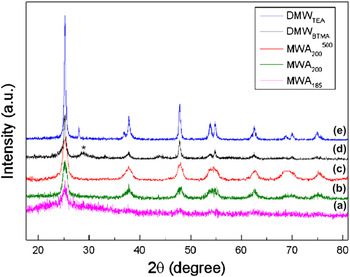
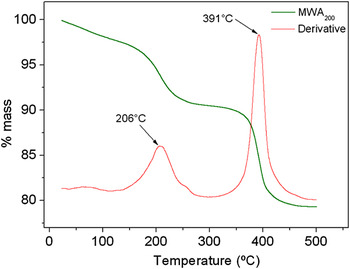
In the case of the laboratory microwave synthesis, benzyl alcohol was chosen as a solvent as it is environmentally friendly and has proved to be very useful for the synthesis of different transition metal oxide nanoparticles.Reference Niederberger, Bard and Stucky49, Reference Niederberger, Bartl and Stucky50 Patterns (a) and (b), in Fig. 1, correspond to MWA185 and MWA200 as-prepared samples. The former is poorly crystallized and exhibits very broad peaks, which are much better defined for the latter. All observed reflections correspond to anatase and the calculated crystallite sizes are in nanometric range, around 8 nm. The as-obtained MWA powders were orange in color, indicating the presence of adsorbed organics. TGA curve coupled with its derivative (Fig. 2) exhibits a first 10% mass loss centered around 206 °C ascribed to organic volatile compounds and a second 10% weight loss around 391 °C presumably probably due to benzyl alcohol degradation products strongly adsorbed on TiO2 surface. The sample turned white after heat treatment at 500 °C in agreement with the remaining organics being responsible for the orange color. Sample MWA200 was thus further annealed at 500 °C (MWA200500) to eliminate remaining organics. XRD pattern [Fig. 1(c)] confirms that the anatase polymorph was preserved after annealing.
XRD pattern of MWA185 (a), MWA200 (b), MWA200500 (c), DMWBTMA (d), DMWTEA (e) with peaks ascribed to TiO2-B(*).

TGA curve for MWA200and its derivative.

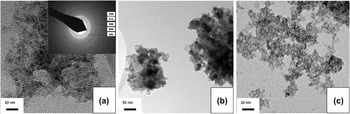
Transmission electron micrographs show that the as-made MWA200 sample [Fig. 3(a)] consists of particles with a size ranging between 4 and 15 nm consistent with the values derived from x-ray diffraction data, wrapped in a sort of gel that we ascribe to the organic matter, which prevented them from aggregating. After heat treatment, in MWA200500 the particle size is roughly preserved, but the elimination of the organic matter has led to the formation of aggregates [Fig. 3(b)].
TEM micrographs of anatase synthesized using a laboratory MW oven: MWA200 (a), MWA200500 (b), and a domestic microwave DMWBTMA(c).

In the case of the domestic oven, we have attempted to use precursors that would yield pure TiO2 free of organics and to choose salts consisting of an organic cation and the hexafluorotitanate anion. The conversion of these precursors to TiO2 has been previously found to progress effectively using MW radiation and boric acid as fluoride scavenger. Nanocrystalline anatase was obtained after 3 min of MW treatment for both precursors [see Figs. 1(d) and 1(e)], the estimated crystallite sizes being 28 and 20 nm for DMWTEA and DMWBTMA respectively. Samples were not subjected to any further thermal treatment. A closer look at the XRD pattern allowed identifying a certain amount of TiO2-B in these samples, higher for DMWBTMA prepared from BTMA (see Fig. 1). Transmission electron micrographs for DMWBTMA [Fig. 3(c)] consist of disperse particles with a size ranging between 4 and 10 nm, similar to MWA200.
B. Electrochemical characterization
The redox reaction mechanism reported for anataseReference Huang, Kavan, Exnar and Gratzel13, Reference Jiang, Wei, Qi, Kudo, Honma and Zhou51–Reference Wagemaker, Borghols and Mulder54 is found to consist of three distinct steps. First, an initial monotonous potential decrease is observed corresponding to lithium insertion into the empty octahedral sites within the anatase structure through a single-phase process forming LiεTiO2. Second, a plateau is observed at ∼1.8 V corresponding to a two-phase process involving the formation of Li0.5TiO2whereas a sloppy region is observed after the plateau, which has been found to increase with increasing surface area of the samples and to have a significant capacitive-like contribution.
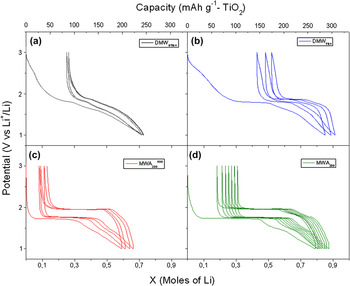
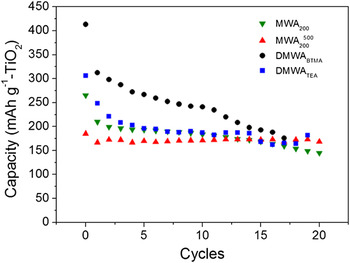
Figures 4 and 5 exhibit the voltage versus composition profile and capacity versus cycle number for all the studied samples when tested using powder electrode technology, which is consistent with what would be expected for anatase. Still, some differences are observed between the samples. The three regions are clearly distinct for MWA200 with the initial solid solution range extending to ε = 0.087, the plateau ending at Li0.45TiO2and overall Δx value close to 0.8 (268 mAh/g).
Potential versus composition and capacity profile for DMWBTMA (a), DMWTEA (b) MWA200500 (c), MWA200(d), cycled at C/15-rate.

Capacity versus cycle number for MWA200 (green inverted triangles), MWA200500 (red triangles), DMWBTMA (black circles), DMWTEA(blue squares) cycled at C/15-rate.

There is a significant irreversible capacity on the first cycle (Δx irr = 0.18) but capacities are maintained afterward (∼200 mAh/g) with some slow fading. The sample annealed at 500 °C (MWA200500) exhibits a similar profile but with a much smaller solid solution degree (ε = 0.056) and smaller overall capacity on the first cycle (Δx value close to 0.59, 170 mAh/g) but also smaller irreversible capacity (Δx irr = 0.08) and much lower capacity fading (45% after 20 cycles for MWA200 compared with 8% for MWA200500). This would be in agreement with some irreversible capacity for MWA200being due to reduction of the remaining organics. The outcome of such organics upon cycling is difficult to ascertain, as in addition to being reduced/decomposed they may even be dissolved in the electrolyte, yet, it seems clear that their presence is detrimental for capacity retention.
Samples prepared using the domestic microwave (DMWTEA and DMWBTMA) exhibit much less defined plateaux, especially for the latter, prepared from DMWBTMA. These profiles are much closer to those reported for TiO2-BReference Bruce55, Reference Ren, Liu, Pourpoint, Armstrong, Grey and Bruce56 than to the typical behavior of anatase. This similarity was further confirmed by preparing nanometric TiO2-B according to Estruga et al.Reference Estruga, Domingo and Ayllon57 and testing them electrochemically under the same conditions used for DMWTEA and DMWBTMA. The reason behind this behavior is unclear at this stage, as such a profile would not be expected if the sample were a biphasic mixture of anatase and TiO2-B particles. The most plausible hypothesis at this time is that the sample is constituted of biphasic particles and that the small fraction of TiO2-B constitutes the particles’ outer surface layer and hence dominates the electrochemical response. Still, further investigations are being undertaken to ascertain this point. Correlation of microstructure/phase composition with electrochemical performance for such samples would help in ascertaining the reasons behind the good performance achieved for DMWBTMA.
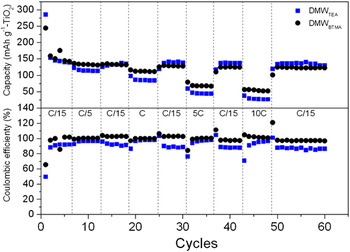
With the aim of determining both performance at high rates and capacity fading, tests on the samples exhibiting higher capacities (DMWTEA and DMWBTMA) were also made using a tape electrode technology very similar to industrial electrode fabrication processes. Electrodes were overall tested at C/15 for ∼60 cycles with intercalated cycling steps at higher rates ranging from C/5 to 10C. Figure 6 exhibits the capacity versus cycle number for such tests.
Capacity versus cycle number of DMWBTMA (black circles) and DMWTEA(blue squares).

DMWBTMA and DMWTEA exhibit initial capacities of 285 and 243 mAh/g at C/15 but undergo significant losses upon the first set of cycles. Overall, capacities tend to stabilize to values close to 140 mAh/g, which are similar, though slightly lower, than those recently reported for nanosized anatase made through a microwave-assisted solvothermal route.Reference Yoon, Lee and Manthiram42, Reference Zhang, Wen, Zhang, Zhu, Li and Li43 Still, the coulombic efficiencies upon cycling are close to 100% (being higher for DMWBTMA containing TiO2-B). The rate capability for both samples is found to be rather good and again, higher for DMWBTMA. Indeed, capacity values of ∼70 and 45 mAh/g were recorded at 5C for DMWBTMA and DMWTEA, respectively (i.e., 50% and 32% of the full capacity recorded at C/15). While it is known that electrochemical performance at such high rates will certainly be dependent on electrode processing,Reference Ligneel, Lestriez, Richard and Guyomard58 no specific optimization study for electrode formulation was carried out; these capacity values are somewhat lower than those reported for mesoporous anatase TiO2 nano networksReference Jung, Oh, Ce, Jayaprakash and Sun59, Reference Kubiak, Fröschl, Hüsing, Hörmann, Kaiser, Schiller, Weiss, Landfester and Wohlfahrt-Mehrens60 but within the same order of magnitude of those reported for nanosized anatase prepared using alternative methods and tested under similar conditions.Reference Wang, Cheng, Liu, Chen, Jiang, Lu, Li, Chung, Zhang, Zapien, Martinu and Bello61
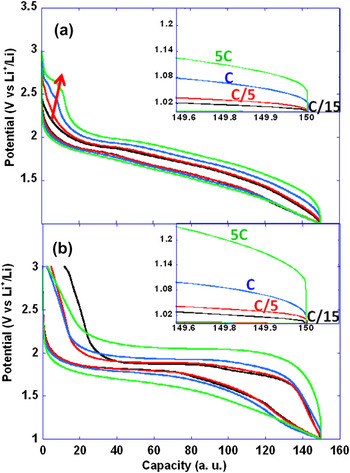
For a better understanding of the good performances in terms of capacity retention at high C rates observed in the case of DMWBTMA, potential versus capacity profiles at C rates ranging from C/15 to 5C were plotted for both DMWTEA and DMWBTMA. The results are shown in Fig. 7 and capacity values were normalized for sake of clarity. A much higher voltage hysteresis between charge and discharge is observed for DMWTEA tape-cast electrodes cycled at high C rates as compared with DMWBTMA based electrodes. This can also be seen by comparison of the overpotential values at the end of discharge [see inset in Figs. 7(a) and 7(b)], being as high as 100 mV at 5C for DMWTEA. By contrast, only ∼46 mV overpotential is recorded at the same C rate for DMWBTMA, indicating a better electronic and/or ionic conductivity when BTMA is used as a precursor. It is hypothesized that the presence of TiO2-B in BTMA favored the ionic conductivity of Li+ inside the particles, due to its structure being more open than other polymorphs, with a density of 3.73 g/cm3 compared with 3.89 g/cm3 for anatase and hence allowing easier Li+ transportReference Yang, Choi, Kerisit, Rosso, Wang, Zhang, Graff and Liu15 but further studies are needed to ascertain this point. Overpotential contributions have dramatic consequences on the capacity retention for systems with a redox mechanism entailing an almost linear potential decay at low potential values and should thus be avoided by manipulation of (i) the electrode formulation for reducing the ohmic drop contribution as much as possible and (ii) the phase composition so as to improve Li+ diffusion. The appearance of an additional oxidation feature visible for DMWBTMA when the C rate is increased [see Fig. 7(a), red arrow] is also worth mentioning. It is found that such feature shifts to higher potential values when the C rate is increased and disappears when the C rate is decreased down to C/15. This observation is consistent with the presence of two distinct electrochemical processes with different kinetics, the one occurring at higher potential being slower. Research is currently underway for optimizing the synthesis parameters allowing tuning the proportion of the different TiO2polymorphs in the samples and hence a more fundamental study on the electrochemical response.
Normalized voltage versus capacity profiles for (a) DMWTEA and (b) DMWBTMA, cycled at C rates of C/15, C/5, C, and 5C. Insets display zoomed plot of the overpotential visible between charge and discharge.

IV. CONCLUSIONS
The use of microwave radiation was demonstrated as a successful synthetic technique to yield nanocrystalline TiO2 with laboratory and domestic dedicated microwave ovens. The short exposition times (only ∼1–3 min) provided small particle size (5–15 nm) interesting for electrochemistry. Good electrochemical performances were recorded for such nanoparticles with stable specific capacity values of more than approximately 140 mAh/g at C/15 and good capacity retention at high C rates (70 mAh/g at 5C). The fact that samples are not pure anatase but do also contain some TiO2-B may indicate that diverse polymorphs can also be obtained using domestic ovens, as reported for laboratory ovens, through control of precursors and synthesis conditions. These results clearly prove that microwave synthesis is an appealing route to obtain nanometric TiO2with good electrochemical performance.
ACKNOWLEDGMENTS
We acknowledge Patrik Johansson for valuable discussions and are grateful to Ministerio de Ciencia e Innovación (Spain) for Grant Nos. MAT2011-24757, MAT2009-08024 and Nanoselect-CSD2007-00041 and the Generalitat de Catalunya for Grant No. 2009SGR-203.