Introduction
The Rubiaceae – Psychotrieae are a very diverse group in tropical rainforests, especially in Central Africa, where they are mostly represented by the genera Psychotria L. (> 150 species), Chassalia Comm. ex Poir. (c.15 species) and Chazaliella E.M.A.Petit & Verdc. (c.15 species). The first two genera in particular are still very poorly known. The only revision available for the African species of Psychotria is that of Petit (Reference Petit1964, Reference Petit1966), dating back to a time when large areas of Central Africa were not or scarcely prospected, while no revision at all is available for the Central African Chassalia (although one is currently in preparation by the first author).
Among the plants collected by the second author in the Dzanga-Sangha Reserve, Central African Republic, several unidentified Rubiaceae – Psychotrieae were recorded (Harris, Reference Harris2002). Three of them, one Chassalia and two Psychotria species, have since been confirmed as new, and more material has been found from other Central African countries, allowing for their description. In addition, some of the other unidentified species listed in the same work have been identified as follows:
Chazaliella sp. A sensu Harris Reference Harris2002: = Chazaliella oddonii (De Wild.) E.M.A.Petit & Verdc. var. cameroonensis Verdc. New record for Central African Republic.
Psychotria sp. B sensu Harris Reference Harris2002: = Polysphaeria subnudifaux Verdc.
Psychotria sp. E sensu Harris Reference Harris2002: = Psychotria auxopoda E.M.A.Petit. Another collection from the country has been found: Boukoko, Tisserant 2571 (P). Together these are the first records from Central African Republic.
Species Descriptions
Chassalia lutescens O.Lachenaud & D.J.Harris, sp. nov.Figs 1,2.
Chassalia sp. A sensu Harris, Vasc. Pl. Dzanga-Sangha Reserve 163 (2002).
Ab omnibus Africanibus congeneribus endospermio in sectione transversali fissura mediana T-formi munito differt. Habitu erecto corollaque tubo brevi et recto C. coralliferae et C. kolly affinis, sed differt a primo lamina papyracea (nec coriacea) et a secundo corolla majora, fructibusque bilobatis (nec globosis vel ellipsoideis); ab ambabus etiam differt pyrenis facie adaxiali plana et sine apertura, inflorescentiis corollaeque in sicco saepe aurantiaco-luteis. – Type: Cameroon, Zingui hill, 20 km WSW of Ebolowa, fl. & fr. 5 iv 1970, Letouzey 10268 (holo BR; iso K, P, YA).
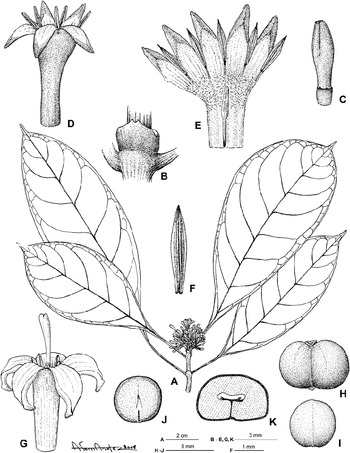
Chassalia lutescens O.Lachenaud & D.J.Harris. A, flowering twig; B, stipules; C, flower bud; D, short-styled flower; E, same, interior of corolla; F, anther; G, long-styled flower; H, fruit; I, pyrene, dorsal view; J, same, ventral view; K, same, cross-section. From Breteler 12876 (A, C–F), De Wilde & Jongkind 9457 (B, H–K) and Lachenaud et al. 625 (G).

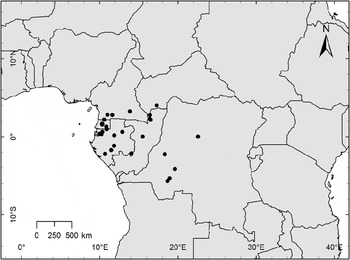
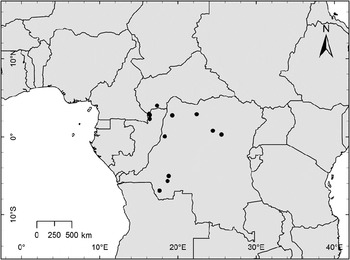
Distribution of Chassalia lutescens.

Erect shrub, 0.4–1.6 m high, little-branched or occasionally single-stemmed, with dark brown bark; wood whitish in life, becoming orange-yellow when dry. Twigs glabrous, smooth or very faintly bicostate, slender (1–1.5 mm thick). Stipules 2–4 mm, triangular, acute, entire to very shortly notched, connate at base for 1/3 to 1/2 of their length, glabrous, persistent and becoming corky. Petiole 0.9–2.3(–3.5) cm long, glabrous. Lamina elliptic to slightly obovate, attenuate at base and acuminate at apex, 8.5–16 × 3–6 cm, papyraceous, glabrous on both surfaces, in life shiny dark green above and pale silvery green below, in herbarium olive green to olive brown with underside of nerves often tinged yellow; midrib prominent above; lateral nerves 5–9(–11) pairs, slightly impressed above, arching 1.5–3 mm from margin; tertiary nerves apparent but very lax. Inflorescences shortly paniculate, hemispherical, trichotomously branched, glabrous, whitish-green at anthesis, becoming fleshy, white to pale blue (rarely pale pink) in fruit, in both stages drying orange or yellowish-brown; peduncle 0.2–1(–1.5) cm; flowering part 0.8–2 × 1.5–2 cm at anthesis, up to 3.5 cm broad in fruit; pedicels indistinct; bracts minute. Flowers 5-(rarely 4- or 6-)merous, very fragrant, smelling of grilled coconut, heterostylous. Calyx very shortly cupuliform, c.0.25 mm, with minute teeth. Corolla pure white on both sides (drying orange to brownish), with straight funnel-shaped tube ± broadened towards throat, c.5–6 × 1.5 mm, and patent lobes 2 mm long, thickened at apex (but lacking any appendages); outer surface glabrous; inside of tube pubescent in upper half below throat; flower buds cylindrical, rounded. Anthers yellow, linear, c.2 × 0.5 mm, included except for the tip (long-styled flowers) or exserted for most of their length (short-styled flowers). Ovary c.0.75 mm high, glabrous; disk hemispherical, c.0.5 mm, glabrous. Style shortly bifid, glabrous, exserted by c.2 mm (long-styled flowers) or included (short-styled flowers). Fruits green turning to dark blue and then shiny black when fully mature, bilobed (mature fruits nearly globose in the fresh state), 7–10 mm diameter in life, c.5 × 7 mm when dry. Pyrenes hemispherical, 5 × 5 mm, planoconvex, dorsally smooth and ventrally closed (without any opening but sometimes with a very faint depression in the middle), opening with one dorsal slit. Seeds with deep ventral T-shaped furrow, otherwise entire.
Distribution. Widespread from southern Cameroon to western Democratic Republic of Congo (Fig. 2). Locally common, at least in Gabon (apparently not so in Democratic Republic of Congo given the small number of collections).
Ecology. Undergrowth of evergreen and mixed evergreen/semideciduous forests; usually on dry land (although Tailfer records it growing in marshy areas). Recorded from c.100 to 1100 m, but most commonly between 400 and 800 m.
Local names. Fang dialect: mvunga (van Reeth).
IUCN conservation assessment. Least Concern (LC). This species has a large range and is locally common.
Additional specimens examined. Cameroon. Efoulan, S of Akom II, fl. & fr. imm. 8 v 2009, Lachenaud et al. 625 (BR, YA); Engon, S of Efoulan, fr. 7 iii 2004, Sonké & Beina 3337 (BRLU, K); Nkamouna, fr. imm. 14–15 vi 2004, Sonké & Nguembou 3503 & 3532 (both BR); Efoulan, fl. 24 iv 2000, Tchouto et al. 2821 (WAG); Efoulan, hills around Akom II, fl. buds 27 iv 2000, Tchouto et al. EFOUX 319 (WAG); Nsengou, fr. imm. 8 ii 2001, Tchouto et al. NSEX 42 (WAG).
EquatorialGuinea. Monte Alen National Park, fr. 21 x 1993, Lejoly 93/389 & 93/413 (both BRLU); Kukumangkok, 13 km W of Aconibe, fr. 29 vii 1998, Lejoly & Esono 58 (BRLU); Monte Alen, fr. 12 iii 1997, Ngomo 17 (BRLU); Monte Alen National Park, fr. 11 iii 2002, Senterre et al. 2778 (BR, BRLU); Monte Alen National Park, fr. 12 xii 1997, van Reeth 27 (BRLU); ibid., fr. 23 xii 1997, van Reeth 92 (BRLU); ibid., fr. 3 i 1998, van Reeth 124 (BRLU).
Gabon. Tchimbélé, fl. 15 ix 1994, Breteler et al. 12876 (WAG); Agonenzorck, upper Komo river, fl. buds 7 x 1912, Chevalier 26950 (P); 2 km N of Tchimbélé, fr. 6 ii 2008, Dessein et al. 1727 (LBV); km 23 Tchimbélé–Kinguélé, fr. (fallen) 7 ii 2008, Dessein et al. 1775 (BR, LBV); Mount Iboundji, fr. 3 iii 2008, Dessein et al. 2319 (BR, LBV); Ivindo National Park, Ivindo River downstream from Ipassa, fr. 9 iii 2008, Dessein et al. 2487 (LBV); 15 km N of Doussala, fr. 19 iii 1988, De Wilde & Jongkind 9457 (WAG); Région de l’Estuaire près Adza ‘montagne de sable’, fl. (fallen) 22 ix 1983, Floret & A.M. Louis 1380 (P, WAG); 7 km NE of Makokou, fr. 11 iii 1961, N. Hallé 1456 (P); border of Komo river near Mbel, fr. 11 i 1968, N. Hallé & Villiers 4310 (P); Andem, 70 km on road Libreville–Kango, 2 km NE, fl. buds 26 ix 1985, A.M. Louis & Wilks 1810 (WAG); Koumameyong, fl. buds & fr. imm. xi 1987, A.M. Louis et al. 2559 (WAG); Mont Koum, fl. buds 14 iv 2002, Mboma 44 (BRLU); ibid., fl. & fr. 18 iv 2002, Mboma 139 (BRLU); c.9 km ESE of Medouneu, Efot, inselberg Simanguen, fl. (fallen) 21 xii 2002, Ngok Banak et al. 1059 (BR, LBV, WAG); Haut-Ogooué, 1 km from camp PPG, 2°07′S, 14°04′E, fr. 24 i 2004, Niangadouma & Stone 362 (LBV, MO, WAG); Mt Fene, inselberg at foot of Efot village, 15 km from Médouneu to Sam, 15 i 2000, Parmentier & Nguema 635 (BRLU); 4 km N of Yeno, fr. 19 iv 1986, Wilks 1267 (LBV, WAG).
Congo (Brazzaville). Road from Makoua to Etoumbi, 18 km from Makoua, fr. 20 vii 1985, Cusset 1487 (P); Nouabalé-Ndoki National Park, Goualango study site, 38 km E Bomassa, fr. imm. 13 vi 2002, Harris 8016 (E); Sangha Region, 4 km E of Ndoki river on Mbeli watershed, Nouabalé-Ndoki National Park, fr. imm. 9 v 2007, Harris & Ndolo Ebika 9158 (E, IEC); ibid., fl. 9 v 2007, Harris & Ndolo Ebika 9161 (E, IEC).
CentralAfricanRepublic. Kongana Research Camp, 25 km SE of Bayanga, fr. imm. 6 vii 1993, Harris 3402 (E); ibid., fl. 20 v 1994, Harris 4905 (E); ibid., fl. 23 v 1994, Harris 4932 (E); ibid., fl. 31 v 1994, Harris 4994 (E); ibid., fr. 3 xi 2000, Harris 6992 (BR, E); ibid., fr. 7 xi 2000, Harris 7099 (E); ibid., fr. imm. 23 v 2001, Harris 7814 (E); ibid., fr. imm. 25 v 2001, Harris 7866 (E); 5 km W of Ngotto, fr. imm. 14 vi 2003, Sonké & Beina 3018 (BRLU, K); Ngotto Forest, fl. buds 27 iii 2000, Yongo 167 (BRLU).
DemocraticRepublicofCongo. Kasai: Kiyaka-Kwango, ster. 7 ix 1955, Devred 2597 (BR); towards Makamba, terr. Bulungu, fr. 21 iv 1976, Pauwels 5567 (BR); Ipamu, ster. viii 1921, Vanderyst 10440 (BR); Ipamu, ster. no date, Vanderyst 11778 (BR). Central Forest: Wamba, zone de Djolu, fr. (fallen) 6 xii 1988, Nsola 1235 (BR); Patambalu, fl. buds 3 iv 1958, Tailfer 56 (BR, K).
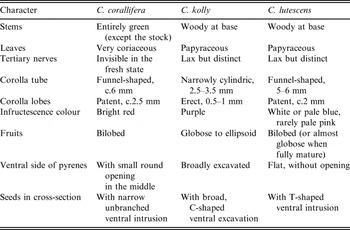
This species can be placed in Chassalia by its pyrenes which open with one dorsal slit, persistent stipules, and blue to black fruits. Chassalia lutescens resembles C. corallifera (A.Chev. ex De Wild.) Hepper and C. kolly (Schumach.) Hepper in having an erect habit, hemispherical inflorescences and a short, straight corolla tube. However, it differs from both in the characters listed in Table 1. Particularly noteworthy are the seeds with a T-shaped ventral furrow in transverse section (unique among African Chassalia: other species have either an unbranched I-shaped groove or a broad C-shaped excavation). The lack of a ventral opening to the pyrenes is also unusual in the genus, but occurs, for example, in Chassalia subherbacea (Hiern) Hepper and C. ischnophylla (K.Schum.) Hepper.
Distinguishing characters between Chassalia corallifera, C. kolly and C. lutescens

In addition, the inflorescences and corollas of Chassalia lutescens (and often also the nerves on the underside of the lamina) usually turn bright orange-yellow on drying. This is an immediate way of recognising most herbarium collections, although the discoloration is not apparent on overdried specimens. Chassalia subspicata K.Schum. often shows a similar discoloration but is readily separated by its spiciform inflorescences and long, curved corolla tube.
Psychotria nodiflora O.Lachenaud & D.J.Harris, sp. nov.Figs 3,4.
Uragoga mortehanii De Wild., Mém. Inst. Roy. Colon. Belge, Sect. Sci. Nat. 4: 163 (1936), nom. inval.
Psychotria sp. C sensu Harris, Vasc. Pl. Dzanga-Sangha Reserve 178 (2002).
Psychotria sp. D sensu Harris, Vasc. Pl. Dzanga-Sangha Reserve 178 (2002).
Inflorescentiis capitatis et involucratis, fructibus caeruleis et pyrenis dorso costatis sect. Involucratae pertinens. Habitu humili et reptante P. schnellii et P. mwinilungae valde affinis, sed inflorescentiis axillaribus et geminatis (raro solitaribus), alabastris corniculatis et pubescentibus (nec rotundatis et glabris), bracteisque angustioribus differt. – Type: Central African Republic, Madibwé, close to St François road, c.12 km NE Bayanga, fl. 8 v 2001, Harris 7609A (holo BR; iso E).
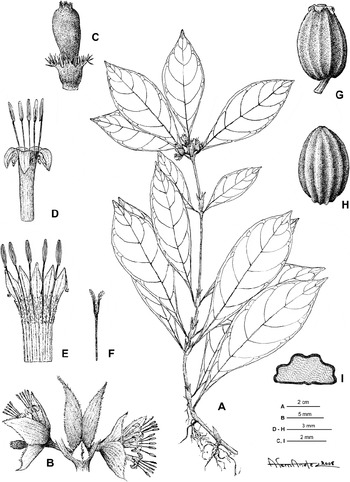
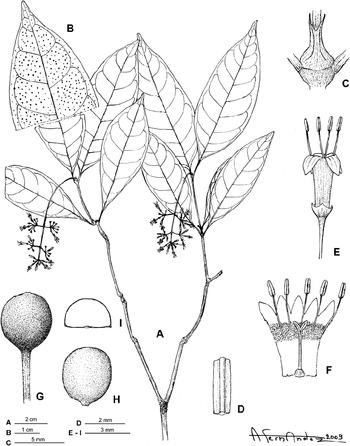
Psychotria nodiflora O.Lachenaud & D.J.Harris. A, flowering twig; B, node with stipule and paired inflorescences; C, flower bud; D, short-styled flower; E, same, interior of corolla; F, style; G, dried fruit; H, pyrene, dorsal view; I, same, cross-section. From Robyns 718 bis (A–B), De Giorgi 1248 (C), Louis 7391 (D–F) and Louis 6463 (G–I).

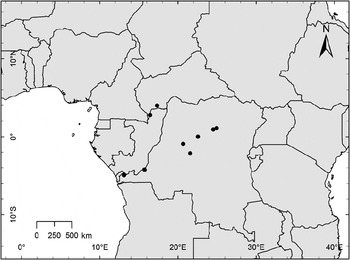
Distribution of Psychotria nodiflora.

Undershrub, creeping at base, with ascending stems 20–50 cm high. Stems either pubescent all around, or glabrous except for two opposite longitudinal lines of hairs below the nodes. Stipules 9–20 × 5–10 mm, rather narrowly obovate and deeply bifid with acuminate triangular lobes, with slightly prominent basal keel, pubescent on margins or all over, tardily caducous to persistent. Petiole 0.3–1.5 cm long, channelled above, pubescent on channel margins or all over. Lamina elliptic to usually slightly obovate, attenuate at base, acuminate (usually shortly) at apex, 5.5–12(–17.5) × 2.2–5.5(–7) cm, papyraceous, upper surface glabrous and drying ashy green to olive brown, lower surface glabrous to densely pubescent and drying pale olive to pale greyish-brown; lateral nerves 9–16 pairs, arched c.2 mm from the margin; tertiary nerves rather dense but inconspicuous below. Domatia and bacterial leaf nodules absent. Inflorescences axillary and paired, or sometimes only one developing per node, capitate and involucrate; peduncle 0.2–0.6 cm (rarely up to 2 cm in fruit), shortly pubescent; flowering part 0.5–0.7 × 0.9–1.5 cm; pedicels very short. Involucre consisting of two pairs of free, entire bracts (sometimes with additional smaller bracts inside); bracts elliptic to slightly obovate, acute at top, 3–8 × 3–5 mm, pubescent on the margin. Flowers 5-merous, heterostylous. Calyx cupuliform, with 0.5–1 mm long tube and 1–1.5 mm long, somewhat patent, lobes, ciliate on the margin. Corolla white, drying dark brown, with tube slender, c.4 × 1.25 mm and lobes c.2 mm, with an apical horn outside; outer surface pubescent on summit of lobes, otherwise glabrous; inside of tube pubescent in upper half below throat; flower buds cylindrical, horned. Anthers linear, c.1.5 mm long, included (long-styled flowers) or with filaments long and exceeding throat (short-styled flowers). Ovary c.0.5 mm high, glabrous; disk hemispherical, c.0.5 mm high, glabrous. Style bifid with shortly pubescent stigmas, exceeding throat by c.2 mm (long-styled flowers) or included (short-styled flowers). Fruits blue, ellipsoid, c.10 × 8 mm in life, very fleshy when mature. Pyrenes ellipsoid, c.5 × 4 mm, planoconvex, dorsally ribbed, indehiscent. Seeds subentire, with two very faint ventral furrows.
Distribution. Widespread in the middle part of the Congo Basin (northern and southwestern Democratic Republic of Congo, southern Central African Republic and northern Congo-Brazzaville) (Fig. 4). The species might also occur in extreme southeastern Cameroon.
Ecology. Rainforest on dry land, especially Gilbertiodendron dewevrei (De Wild.) J.Léonard formations; altitude c.400–500 m.
Local names. Turumbu dialect: likawfi (J. Louis 7391, 14846, 14898, 16315); likawfi li fufow (J. Louis 6463). ‘Likawfi’ is a collective name used for many Psychotria species (see P. pteropus below).
IUCN conservation assessment. Least Concern (LC). The species is not rare and has a large range.
Additional specimens examined. Congo (Brazzaville). Sangha Region, 4 km E of Ndoki river on Mbeli watershed, Nouabalé-Ndoki National Park, fr. imm. 9 v 2007, Harris & Ndolo Ebika 9163 (E, IEC).
CentralAfricanRepublic. Kongana camp, 8 vii 1993, Harris 3439 (E); ibid., fr. 29 i 1994, Harris 4340 (E); ibid., fr. 31 v 1994, Harris 5015 (E); ibid., fl. 1 ii 1996, Harris 5420 (E); ibid., fl. 7 iii 1996, Harris 5490 (E); ibid., fr. 5 xi 2000, Harris 7050 (E); Ngotto Forest, fr. imm. 21 xii 1999, Zawa 535 (BRLU).
DemocraticRepublicofCongo. Kasai: Kidima, fr. ii 1952, Callens 3503 (BM, BR); towards Makamba, terr. Bulungu, fr. 21 iv 1976, Pauwels 5544 (BR); Kikwit, fl. x 1920, Vanderyst 8132 (BR); Malamfu, fr. v 1932, Vanderyst 31155 (BR). Central Forest: Dundusana, fl. buds vi 1913, De Giorgi 1032 (BR); Musa, fl. ix 1913, De Giorgi 1248 (BR); 15 km N of Wanié-Rukula, Amunyalu falls, fl. buds 13 v 1979, Lejoly 5159 (BR); Yangambi, Itasukulu plateau, fr. 30 x 1937, J. Louis 6463 (BR); Yangambi, along Lilanda river, fr. 5 i 1938, J. Louis 7391 (BR); Yangambi, Réserve flore Isalowe, fl. buds 16 v 1939, J. Louis 14846 (BR); ibid., fr. 18 v 1939, J. Louis 14898 (BR); ibid., fl. buds 22 v 1939, J. Louis 14918 (BR); km 51 route Bengamisa, fr. 11 xi 1939, J. Louis 16315 (BR); Dundusana, fl. buds x 1913, Mortehan 563 (BR); route Lubutu km 44, fr. imm. 15 vi 1981, Ndjele 287 & 289 (both BR); Mongo, surroundings of Eala, fl. 24 ix 1925, Robyns 718 bis (BR, K).
De Wildeman’s (Reference De Wildeman1936) description is not valid, being published in French shortly after Latin was made obligatory; indeed, De Wildeman makes it clear that the species described in French are only provisional names (some species described in the same work have a Latin diagnosis). Furthermore, his epithet cannot be taken up since there is already a Psychotria mortehanii De Wild.
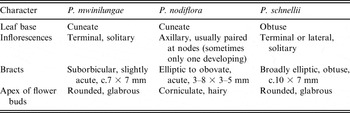
The involucrate heads, blue fruits and ridged indehiscent pyrenes of this species readily place it in Psychotria subgen. Psychotria sect. Involucratae E.M.A.Petit & Verdc., a difficult group which is not treated in Petit’s (Reference Petit1964, Reference Petit1966) revision of African Psychotria. With its low creeping habit, Psychotria nodiflora resembles P. schnellii (Aké Assi) Verdc. of Ivory Coast and Guinea, and P. mwinilungae Verdc. of Zambia, both of which are very poorly collected. The differences between the three species are summarised in Table 2.
Distinguishing characters between Psychotria mwinilungae, P. nodiflora and P. schnellii

The inflorescences of Psychotria nodiflora are truly axillary, which is unique among African species of the genus. In all other species the inflorescences are solitary and terminal, though often appearing lateral due to sympodial growth of the stem. Species with paired axillary inflorescences are also known in the related genera Hymenocoleus Robbr. (H. axillaris Robbr.: Robbrecht, Reference Robbrecht1977) and Chazaliella (C. letouzeyi Robbr.: Robbrecht, Reference Robbrecht1989), both of which usually have terminal inflorescences. It is, therefore, not too surprising to find axillary inflorescences in a species of Psychotria as well.
Psychotria nodiflora is a somewhat variable species. The collections from Kasai have densely pubescent stems and undersides of the leaves, while in those from, for example, the Yangambi area these parts are almost glabrous. However, both hairy and glabrescent forms occur at the same locality in Central African Republic. They were initially listed as two different species (respectively Psychotria sp. C and sp. D of Harris, Reference Harris2002) but are now regarded as conspecific, there being no differences other than pubescence. Specimens from Kasai also tend to be more robust, with more strongly acuminate leaves, and as a consequence can have a quite different facies, but these characters are not constant.
Psychotria pteropus O.Lachenaud & D.J.Harris, sp. nov.Figs 5,6.
Psychotria sp. A sensu Harris, Vasc. Pl. Dzanga-Sangha Reserve 177 (2002).
Nodulis in lamina dispersis subgen. Tetramerae pertinens; foliis glabris et sicco viridibus, pedunculisque conspicue alatis P. leptophyllae valde affinis, sed differt nodulis densioribus (20–50/cm2, nec 3–12), corollae tubo angusto, 2–3 × 0.6–1 mm (nec lato et 1.25–2 × 1–2 mm), filamentis in floribus brevistylis longiore exsertis, fructibus globosis vel ellipsoideis, lamina tenuiter coriacea et opaca (nec membranacea et ± nitidula), inflorescentiis ad anthesim reflexis statu fructifero solum erectis (nec semper erectis). – Type: Democratic Republic of Congo, Mofinu, terr. Maluku, fl. 10 xi 1970, Breyne 964 (holo BR).
Psychotria pteropus O.Lachenaud & D.J.Harris. A, flowering twig; B, detail of lower leaf surface, showing bacterial nodules; C, stipules; D, winged peduncle; E, short-styled flower; F, same, interior of corolla; G, fruit; H, pyrene, dorsal view; I, seed, cross-section. From Breyne 964 (A–B, E–F), Breyne 2946 (D, G–I) and J. Louis 15485 (C).

Distribution of Psychotria pteropus.

Erect shrub 0.4–1.25 m high, not or little branched. Twigs glabrous to minutely and sparsely puberulous, green, slender (1–2 mm thick). Stipules 3–7 × 1.5–4 mm, bifid with linear lobes, glabrous, very caducous. Petiole 0.7–2 cm long, glabrous to minutely puberulous. Lamina elliptic, attenuate at base and acuminate at top, 5.5–17 × 2.5–6(–7) cm, slightly coriaceous, glabrous, drying matt olive green above and pale green below; lateral nerves 6–9(–11) pairs, somewhat ascending, inconspicuously arching 1–3(–5) mm from the margin; tertiary veins not or hardly visible on both sides. Domatia absent. Bacterial leaf nodules regularly dispersed in lamina, very conspicuous, dense (20–50 per cm2), dot-like and small (c.0.2–0.5 mm in diameter), or some of them occasionally larger and linear. Inflorescences laxly paniculate, 4–11.5 cm long, glabrous, reflexed at anthesis, erect or half-erect in fruit; peduncle 2–9.5 cm long, with two broad (0.5–1.5 mm wide) longitudinal wings; flowering part pyramidal to hemispherical, 1.5–3.5 × 1.6–2.5(–4) cm, with secondary branches opposite or rarely verticillate; pedicels 1–3 mm long; bracts minute. Flowers 4- to 5-merous, probably heterostylous but only short-styled form collected. Calyx shortly cupuliform, c.0.5 mm long, truncate to minutely denticulate, glabrous. Corolla white, drying yellowish brown, with slender tube 2–3 × 0.6–1 mm, about three times as long as broad, and lobes 1–1.5 mm long, lacking appendages; outer surface glabrous, inside of tube with a ring of dense hairs in upper half below throat; flower buds cylindrical, rounded. Anthers narrowly elliptic, c.1 × 0.3 mm, on long exserted filaments (exceeding throat by c.1.5 mm). Ovary c.0.5 mm high, glabrous; disk shortly conical, c.0.5 mm, glabrous. Style bifid, with shortly papillose stigmas, included (almost reaching throat). Fruits green turning red at maturity, globose to slightly ellipsoid, 4–5 mm in diameter when dry, on pedicels 4–8 mm long. Pyrenes slightly ellipsoid, c.4 × 3.5 mm, planoconvex, dorsally smooth, indehiscent. Seeds entire.
Distribution. Western Democratic Republic of Congo and extreme southwestern Central African Republic (Fig. 6); possibly also in Congo-Brazzaville (see note below) and to be expected in southeastern Cameroon as well. Despite a fairly extensive range, the species appears to be rare.
Ecology. Undergrowth of rainforest, often riverine; recorded from Gilbertiodendron dewevrei forest (Harris, Evrard, Louis), Julbernardia forest (Breyne) and Cleistanthus riparian forest (Evrard). Recorded altitudes are 470–700 m, but some collections probably come from lower areas.
Local names. Mongo dialect: loka (Evrard 2835). Turumbu dialect: itoko (J. Louis 10032); inaolo a likawfi (J. Louis 14485). The names ‘itoko’ and ‘likawfi’ are used collectively for many Psychotria species, and the first one as well for other herbaceous Rubiaceae and Acanthaceae; ‘inaolo’ means ‘related to’.
IUCN conservation assessment. Least Concern (LC). Although uncommon, the species has a rather broad range, including some very remote areas, and is, therefore, not currently threatened.
Additional specimens examined. Central African Republic. Kongana camp, 22 km SE Bayanga, fl. 1 ii 1996, Harris 5422 (E); ibid., fr. 29 x 2000, Harris 6938 (E); ibid., fr. 7 xi 2000, Harris 7103 (E); Ngotto Forest, fr. 30 vii 1985, Zawa 95/146 (BRLU); Ngotto Forest, fl. 25 v 1997, Zawa 97/224 (BRLU).
DemocraticRepublicofCongo. Mayumbe: Maduda, northern Mayumbe, fr. 15 iv 1976, van Hove 109 (BR). Lower Congo: Mofinu, fr. 1 iv 1976, Breyne 2946 (BR); ibid., terr. Maluku, fl. 10 xi 1970, van Hove 25 (BR). Central Forest: Iwama, terr. Monkoto, fr. 13 x 1957, Evrard 2835 (BR); Salonga river, left bank, 3 km upstream from Yenge, fr. imm. 5 viii 1958, Evrard 4492 (BR); Yalibwa, 25 km NW of Yangambi, fr. 16 vi 1938, J. Louis 10032 (BR); cirque sources de la Ngula, km 62 Weko–Bengamisa, fr. imm. 6 vii 1939, J. Louis 14485 (BR); Wamba, zone de Djolu, fr. 7 xii 1988, Nsola 1251 (BR).
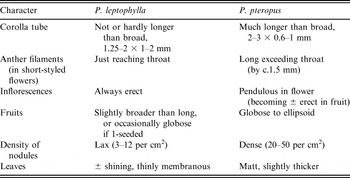
The red fruits, indehiscent pyrenes, and bacterial nodules in the leaves of Psychotria pteropus allow it to be recognised as a member of Psychotria subgen. Tetramerae (Hiern) E.M.A.Petit. The earliest, and very poor, collections of the species (Evrard 2835, J. Louis 10032 & 14485) were identified as ‘cf. Psychotria leptophylla Hiern’ by Petit, but not cited in his revision of the group (Petit, Reference Petit1966), presumably due to some doubt (expressed by the ‘cf.’) over their identity. Psychotria leptophylla and P. pteropus are indeed very closely related, sharing glabrous leaves, a typical green colour when dry, winged peduncles, entire seeds, and dot-like nodules (not star-like as in P. gossweileri E.M.A.Petit, another related species). However, they can be separated by the characters in Table 3. The separation is rather easy in flower but much more difficult in fruit. Psychotria leptophylla occurs from eastern Nigeria to northern Gabon, and (apparently disjunctly) in northern and southwestern Democratic Republic of Congo, where its area overlaps that of P. pteropus.
Distinguishing characters between Psychotria leptophylla and P. pteropus

The fact that all flowering specimens of Psychotria pteropus have strongly reflexed inflorescences, while all fruiting specimens (some of them from the same locality as flowering ones) have erect or half-erect peduncles, strongly suggests that the peduncles turn upwards after flowering. Field observations are needed to confirm this phenomenon, which would be very exceptional (the opposite case, of erect inflorescences turning downwards in fruits, is much more usual).
A collection from Congo-Brazzaville: Mt Lebayi (Moutienne), 2°40′43″S, 13°35′54″E, fl. 29 iii 2009, Cheek et al. 14465 (BR, E, IEC n.v., K) is very close to Psychotria pteropus but the inflorescences are larger, and still pendulous in fruit. Flowering material from the same area would be needed to assess whether it is a variant of Psychotria pteropus, or a new related taxon.
Acknowledgements
The first author is a research fellow of the FRS-FNRS (Belgian national fund for scientific research). His visits to the herbaria of Brussels (2005), Wageningen (2006) and Edinburgh (2007) were funded by the SYNTHESYS program of the European Community (www.synthesys.info), and a second visit to Wageningen (2008) by the Alberta Mennega Stichting. The herbarium curators of Paris (P) and Wageningen (WAG) are thanked for sending specimens on loan. Fieldwork in Gabon and Cameroon was supported respectively by the National Geographic Society, and by the FRS-FNRS and the FFRSA (Fondation pour Favoriser les Recherches Scientifiques en Afrique). The illustrations were done by Antonio Fernandez, to whom we are most grateful. Martin Cheek and an anonymous reviewer made helpful suggestions on the manuscript. Mark Hughes helped to prepare the maps.