





Impact statement
Pollination is a fundamental ecological process that sustains plant reproduction, biodiversity, and the many ecosystem services on which people depend. However, habitat loss, changes in land use, and other human disturbances are increasingly disrupting plant–pollinator interactions worldwide, particularly in drylands where environmental conditions are already challenging. This study provides new evidence that native shrub species in arid northeastern Patagonian ecosystems rely on different reproductive strategies to ensure seed production. While some species depend heavily on pollinators and benefit from pollen exchange among multiple individuals, others combine insect- and wind-mediated pollination. This increases their chances of producing seeds when pollinator activity is limited. Understanding how native plants reproduce is essential for predicting their responses to environmental change, as well as for designing effective conservation and restoration strategies. These results add information to the management of natural and semi-natural landscapes by emphasizing the importance of preserving pollinator communities, maintaining habitat connectivity, and safeguarding remaining native vegetation. As the species in question are a defining feature of the Monte ecosystem and offer ecological, cultural, and economic benefits, this research helps to ensure the long-term resilience of Patagonian drylands. More broadly, it advances our understanding of how plant reproductive systems influence the stability of semiarid ecosystems that are facing increasing human pressures.
Introduction
In the current global scenario, where complex native ecosystems are being replaced by homogeneous agricultural landscapes, plant species with high pollinator dependency often fail to receive the pollination rates required to achieve a sturdy fruit set (Garibaldi et al., Reference Garibaldi, Ingolf, Kremen, Morales, Bommarco, Cunningham, Carvalheiro, Chacoff, Dudenhöffer, Greenleaf, Holzschuh, Isaacs, Krewenka, Mandelik, Mayfield, Morandin, Potts, Ricketts, Szentgyörgyi, Viana, Westphal, Winfree and Klein2011, Reference Garibaldi, Carvalheiro, Leonhardt, Aizen, Blaauw, Isaacs, Kuhlmann, Kleijn, Klein, Kremen, Morandin, Scheper and Winfree2014). Land-use change reduces biodiversity and affects ecosystem services because many pollinators essential for seed production face increasing challenges in meeting their basic needs for food and shelter in simplified landscapes (Garibaldi et al., Reference Garibaldi, Carvalheiro, Leonhardt, Aizen, Blaauw, Isaacs, Kuhlmann, Kleijn, Klein, Kremen, Morandin, Scheper and Winfree2014), and are further impacted by agrochemicals use (Kennedy et al., Reference Kennedy, Lonsdorf, Neel, Williams, Ricketts, Winfree, Bommarco, Brittain, Burley, Cariveau, Carvalheiro, Chacoff, Cunningham, Danforth, Dudenhöffer, Elle, Gaines, Garibaldi, Gratton, Holzschuh, Isaacs, Javorek, Jha, Klein, Krewenka, Mandelik, Mayfield, Morandin, Neame, Otieno, Park, Potts, Rundlöf, Saez, Steffan-Dewenter, Taki, Viana, Westphal, Wilson, Greenleaf and Kremen2013). As a result, insect diversity declines (Kennedy et al., Reference Kennedy, Lonsdorf, Neel, Williams, Ricketts, Winfree, Bommarco, Brittain, Burley, Cariveau, Carvalheiro, Chacoff, Cunningham, Danforth, Dudenhöffer, Elle, Gaines, Garibaldi, Gratton, Holzschuh, Isaacs, Javorek, Jha, Klein, Krewenka, Mandelik, Mayfield, Morandin, Neame, Otieno, Park, Potts, Rundlöf, Saez, Steffan-Dewenter, Taki, Viana, Westphal, Wilson, Greenleaf and Kremen2013), which in turn diminishes pollination success in both crops and remnant native vegetation, ultimately affecting the provision of this vital ecosystem service (Garibaldi et al., Reference Garibaldi, Carvalheiro, Leonhardt, Aizen, Blaauw, Isaacs, Kuhlmann, Kleijn, Klein, Kremen, Morandin, Scheper and Winfree2014).
Plant–pollinator interactions are central to understanding the quality and resilience of pollination services. Flowers of semiarid shrubland plants, typically associated with insect pollination syndromes (small, yellow, or whitish flowers), display a wide range of floral traits that suggest diverse pollination strategies (Petanidou, Reference Petanidou2005; Tadey et al., Reference Tadey, Tadey and Tadey2009). Yet, reproductive biology in some plants, like Argentinian Monte species, remains poorly documented (Rossi et al., Reference Rossi, Debandi, Peralta and Martinez Palle1999; Tadey et al., Reference Tadey, Tadey and Tadey2009; Chacoff and Aschero, Reference Chacoff and Aschero2014), limiting our ability to predict their responses to environmental change.
Animal-mediated pollination is vital for both human food production and the reproduction of wild plants. The latter of which underpins broader ecosystem services. Around one-third of global crop production relies on animal pollinators, and between 60% and 90% of plant species depend on them (Kremen et al., Reference Kremen, Williams, Aizen, Gemmill-Herren, LeBuhn, Minckley, Packer, Potts, Roulston, Steffan-Dewenter, Vázquez, Winfree, Adams, Crone, Greenleaf, Keitt, Klein, Regetz and Ricketts2007). However, human disturbance is increasingly disrupting these interactions, including cross-pollination (Eckert et al., Reference Eckert, Kalisz, Geber, Sargent, Elle, Cheptou, Goodwillie, Johnston, Kelly, Moeller, Porcher, Ree, Vallejo-Marín and Winn2010). Therefore, understanding mating systems is critical for dryland conservation and agricultural management. Furthermore, examining interspecific pollination among native species may provide valuable insights into the mechanisms by which alien plants disrupt native reproductive success, particularly through the usurpation of pollinator interactions (Morales and Traveset, Reference Morales and Traveset2009). As reproductive systems have a strong influence on evolutionary responses to environmental change (Barrett, Reference Barrett and Richardson2010), studying them is essential. Reproductive failure is commonly driven by pollen limitation in disturbed landscapes (Aguilar et al., Reference Aguilar, Ashworth, Galetto and Aizen2006) and by limitations in the pollination of plants that rely on animals (Larson and Barrett, Reference Larson and Barrett2000; Wilcock and Neiland, Reference Wilcock and Neiland2002). These effects can be so profound that even restoration sites can face barriers to re-establishing pollination services. Such barriers are associated with habitat fragmentation and isolation from undisturbed populations, as well as with unsuitable conditions for pollinators and landscape heterogeneity (Menz et al., Reference Menz, Phillips, Winfree, Kremen, Aizen, Johnson and Dixon2011; Devoto et al., Reference Devoto, Bailey, Craze and Memmott2012). All of these factors affect pollination success, as well as seed quantity and quality (Aguilar et al., Reference Aguilar, Ashworth, Galetto and Aizen2006), which are often assessed through mating system parameters, such as the outcrossing rate (Krauss et al., Reference Krauss, Anthony, Lapenzee, Ritchie, Elliott, Dobrowolski and Standish2024). Thus, changes in mating systems serve as indicators of population processes and inform conservation strategies (Coates et al., Reference Coates, Sampson and Yates2007).
In this context, livestock grazing introduces an additional significant level of disturbance. Domestic animals degrade vegetation attributes (Peter et al., Reference Peter, Funk and Torres Robles2013), alter pollinator assemblages by modifying vegetation cover (Tadey, Reference Tadey2023), and consume reproductive structures (Vázquez and Simberloff, Reference Vázquez and Simberloff2004). These disturbances also reduce seed production services (Leder et al., Reference Leder, Peter and Funk2015) and may be particularly severe for heterogamous species reliant on specialized interactions. Therefore, research into the reproductive biology of native species is crucial in order to assess the impact of grazing and habitat fragmentation on pollination and seed production in northeastern Patagonia and to evaluate the role of remnant native vegetation patches in sustaining reproductive success within these mixed crop-livestock systems.
Because pollinator-dependent species are particularly vulnerable to disturbances that disrupt plant–pollinator interactions, and because cross-pollination is often more sensitive to reductions in pollinator availability and habitat connectivity than self-fertilization, understanding the reproductive biology and mating systems of native plants is essential. This information is critical for predicting how species will respond to ongoing habitat loss and land-use change in northeastern Patagonia. The aim of this study was to characterize the mating systems of three widespread shrub species of northeastern Patagonia and to assess their dependence on cross-pollination for successful reproduction. We hypothesized that these particular shrub species rely strongly on cross-pollination.
In order to achieve the objective, we selected three dominant and distinctive shrubs of the study area (Torres Robles and Rodríguez, Reference Torres Robles and Rodríguez2023). Neltuma flexuosa (DC.) C.E. Hughes & G.P. Lewis var. depressa (F.A. Roig) C.E. Hughes & G.P. Lewis (Fabaceae) possess a robust subterranean trunk and a hemispheric and lax canopy with stems bearing large axillary thorns (3–4 cm) that reach a height of ~3 m. Their small and hermaphrodite yellowish flowers are grouped in pendulous dense 4–14 cm long racemes with ~200 flowers each, which later produce sweet and edible legumes (Anton and Zuloaga, Reference Anton and Zuloaga2025). Due to these characteristics and its abundance throughout the region, this species has a considerable potential use for apiculture, livestock grazing, and restoration strategies in semiarid ecosystems of Argentina (Renzi et al., Reference Renzi, Reinoso, Quintana and Cantamutto2023).
Schinus johnstonii F.A. Barkley is a shrub that can reach a maximum height of 2 m tall (Steibel and Troiani, Reference Steibel and Troiani2008). It possesses gray and thorny stems gathered in a dense hemispheric canopy. It produces whitish to pale yellow flowers, with an approximate diameter of 1.5–2 mm, arranged in dense pseudoracemes (Anton and Zuloaga, Reference Anton and Zuloaga2025). This species is polygamous-dioecious; the female flowers are characterized by the presence of rudimentary stamens and a spherical ovary. In contrast, the male flowers are distinguished by linear stamen filaments and the absence or rudimentary state of a gynoecium (Steibel and Troiani, Reference Steibel and Troiani2008). Currently, there is no published evidence of the functionality of staminoids in S. johnstonii . Female individuals produce small purple drupes (Anton and Zuloaga, Reference Anton and Zuloaga2025), which are greatly consumed by the native fauna (Martín et al., Reference Martín, Nicosia, Colombo and Lucas2001). In addition, this is an endemic species highly characteristic of the Monte shrubland, listed as vulnerable in Buenos Aires Province, and highly regarded for its medicinal properties and its significance in apiculture (Deluchhi, Reference Deluchhi2006; Doria, Reference Doria2010; Torres et al., Reference Torres, Escobar and Cenzano2020).
Larrea divaricata Cav. is a shrub characterized by an open and conic-shaped canopy. It has solitary and yellow flowers, each measuring approximately 2 cm in diameter. Its fruit is a schizocarp that splits into five indehiscent mericarps (Anton and Zuloaga, Reference Anton and Zuloaga2025). This species also has great cultural value for its numerous medicinal uses, which are related to its antifungal (Quiroga et al., Reference Quiroga, Sampietro and Vattuone2004), anti-inflammatory (Pedernera et al., Reference Pedernera, Guardia, Guardia Calderón, Rotelli, de la Rocha, Di Genaro and Pelzer2006), and antimicrobial properties (Stege et al., Reference Stege, Davicino, Vega, Casali, Correa and Micalizzi2006).
We expect these species to exhibit reduced seed set and lower seed germination when self-pollinated (particularly in S. johnstonii), highlighting the importance of cross-pollination for their reproductive success.
Materials and methods
This experiment was conducted in Patagones District, northeastern Patagonia, Argentina, where the vegetation is characteristic of the Monte-Espinal transition. Patagones is the largest district in Buenos Aires Province (1,356,971 ha), and contains the most extensive native shrubland in the region (Torres Robles and Rodríguez, Reference Torres Robles and Rodríguez2023). Historical policies focused on the Humid Pampas encouraged deforestation to make way for pastures and cereal crops, particularly wheat and oats. Further clearing is currently being carried out to reduce shrub cover and give livestock access to the grasslands beneath it. Between 2010 and 2020, the area of native shrubland decreased to a mere 29% of the total district area (Torres Robles and Rodríguez, Reference Torres Robles and Rodríguez2023). This ongoing habitat loss poses a significant threat to the pollination and sexual reproduction of numerous plant species. The climate of the region is subtemperate dry, with warm summers (averaging 24°C), mild winters (averaging 7°C), and an annual precipitation of 300–350 mm, characterized by significant variability (Godagnone and Bran, Reference Godagnone and Bran2009). Phytogeographic analyses classify the region as an ecotone between the Espinal and Monte provinces (Torres Robles and Rodríguez, Reference Torres Robles and Rodríguez2023). This is characterized as a shrubland steppe dominated by L. divaricata , Chuquiraga erinacea D. Don, N. flexuosa var. depressa , Lycium chilensis Miers ex Bertero, and Condalia microphylla Cav., with an herbaceous layer of winter-growing grasses (Cabrera, Reference Cabrera1971; Oyarzabal et al., Reference Oyarzabal, Clavijo, Oakley, Biganzoli, Tognetti, Barberis, Oesterheld and León2018; Torres Robles and Rodríguez, Reference Torres Robles and Rodríguez2023).
Fieldwork was carried out in areas with natural vegetation fenced off from livestock at the Patagones Experimental Ranch (40°39′S, 62°54′W). The vegetation, topography, climate, and soil conditions of this site are representative of the region. The Experimental Ranch covers 1210 ha and that is under the jurisdiction of the government of Buenos Aires Province. It is located in the Patagones District, 23 km from the city of Carmen de Patagones.
In addition to the cultural and economic relevance of the aforementioned shrub species, previous research in the region have indicated that S. johnstonii and L. divaricata are the most abundant shrub species in the seed rain (Leder et al., Reference Leder, Peter and Funk2015). These species represent a selected group of shrub species that contribute to the soil seed bank (Leder et al., Reference Leder, Torres Robles and Peter2021). Additionally, there is evidence of low germination of both species in the study area (Peter et al., Reference Peter, Leder and Funk2016; Zeberio and Pérez, Reference Zeberio and Pérez2020), raising questions about potential issues with the capacity of seeds to germinate that could be linked to deficiencies in pollination. We added N. flexuosa var. depressa to our study to explore three important shrub species with significantly different flowering traits: small hermaphrodite flowers in dense racemes in this case, small unisex flowers in dense pseudoracemes for S. johnstonii and medium-sized hermaphrodite solitary flowers for L. divaricata.
Individuals of N. flexuosa var. depressa (15 individuals), S. johnstonii (7 individuals), and L. divaricata (10 individuals) were randomly selected based on their abundance at the study site, with a distance of at least 5 m between the same species. From each individual, two shoot/branch tips with 10 to 30 buds were randomly selected to establish “floral units” (except for S. johnstonii for which four shoots/branches were selected from each individual). This method is commonly preferred over selecting individual flowers whenever species produce small flowers (maximum 2 cm in diameter) arranged in clusters with weak peduncles (FAO, 2011).
To avoid an overestimation of cross-pollination, all pre-opened flowers were manually removed using scissors, and the buds were covered with tulle bags. In summary, each individual had six bagged branches and two marked branches without bags (to allow open pollination). Periodic visits were conducted to monitor bud opening within the bags. Once the buds had opened, one of the following treatments was applied to two branches:
-
- Cross-pollination: Each floral unit was enclosed in a tulle bag and, once the flowers had opened, manual pollination was performed using pollen from other plants of the same species. To achieve this objective, open flowers from different individuals within the same population were placed in a sterilized flask. Pollen was then collected with a brush directly from the flask and carefully applied to the stigma of the bagged flowers, with the transfer of pollen being confirmed visually.
-
- Self-pollination: Each floral unit was enclosed in a tulle bag, and upon flower opening, manual pollination was performed using pollen from the same plant. A brush was used to collect pollen from open flowers of the same individual, which was then meticulously applied to the stigma of the bagged flowers, ensuring visual confirmation of pollen transfer.
-
- Spontaneous pollination: Each floral unit was enclosed in a tulle bag and not manually pollinated. These flowers were neither artificially pollinated nor visited by pollinators.
-
- Open-pollination: Marked floral units were left without tulle bags, to allow for natural pollination.
The selected flowers were monitored weekly until fruit production. Subsequently, the fruits were collected and the seeds were manually extracted from them in order to assess seed set and seed germination capacity. Seed set was calculated by dividing the number of seeds obtained by the number of ovules per flower in the floral unit. Each L. divaricata flower contains five ovules, whereas S. johnstonii flowers are uniovulate. Due to the variable number of ovules, and therefore seeds, in the legumes of N. flexuosa var. depressa (10–30), seed set was calculated as the ratio of the number of seeds per legume harvested from branches with open pollination to the number of seeds per legume harvested from bagged branches.
To estimate germination capacity, the recommended pre-germination treatment for each species was applied. The seeds were then placed in Petri dishes with moistened cotton and filter paper and transferred to a germination chamber under controlled conditions of constant light and temperature (24-hour continuous light at 25°C). The number of replicates and seeds per replicate varied depending on the number of seeds obtained from the treatments for each species. L. divaricata seeds were gently scarified with sandpaper (Hernandez et al., Reference Hernandez, Pérez and Busso2020) and then placed in groups of 30 in five Petri dishes per pollination treatment (30 seeds × 5 Petri dishes × 4 treatments = 600 seeds). S. johnstonii seeds did not undergo a pre-germination treatment (Zeberio and Pérez, Reference Zeberio and Pérez2020) but were immersed in warm water for 24 hours to accelerate imbibition. Ten seeds per replicate were then placed in five Petri dishes per treatment (10 seeds × 5 Petri dishes × 4 treatments = 200 seeds). No fruits were obtained from N. flexuosa var. depressa in any treatment; therefore, germination capacity tests were not conducted for this species.
The capacity of each species to produce seeds from its own pollen was evaluated using the indices proposed by Zapata and Arroyo (Reference Zapata and Arroyo1978), where appropriate. The self-incompatibility index was calculated as the ratio of the number of seeds obtained from manually self-pollinated flowers to the number of seeds obtained from flowers manually pollinated with pollen from other individuals. Additionally, the spontaneous self-pollination index was calculated by comparing the number of seeds obtained through spontaneous pollination with the number of seeds obtained through manual self-pollination.
The effects of pollination treatments on reproduction and seed germination capacity were analyzed using RStudio (R Core Team, 2026). Reproductive success was defined as the proportion of developed seeds relative to the total number of treated ovules and was evaluated using generalized linear mixed models (GLMM) with a binomial distribution and a logit link function. The pollination treatment was included as a fixed effect and the individual as a random effect to account for the dependence among observations obtained from the same plant. The presence of overdispersion was assessed using Pearson’s residuals; when detected, beta-binomial models were fitted and used for statistical inference. The overall significance of the treatments was assessed using likelihood ratio tests.
Germination capacity was analyzed using generalized linear models (GLMs) with a binomial distribution and logit link function, using the number of germinated seeds relative to the total number of seeds per replicate as the response variable. The significance of the treatment effect was assessed using deviance analysis based on likelihood ratio tests. In all cases, multiple comparisons between treatments were performed using estimated marginal means (EMMs) with Tukey’s adjustment. Model fit was verified by inspecting simulated residuals using the DHARMa package.
Results and discussion
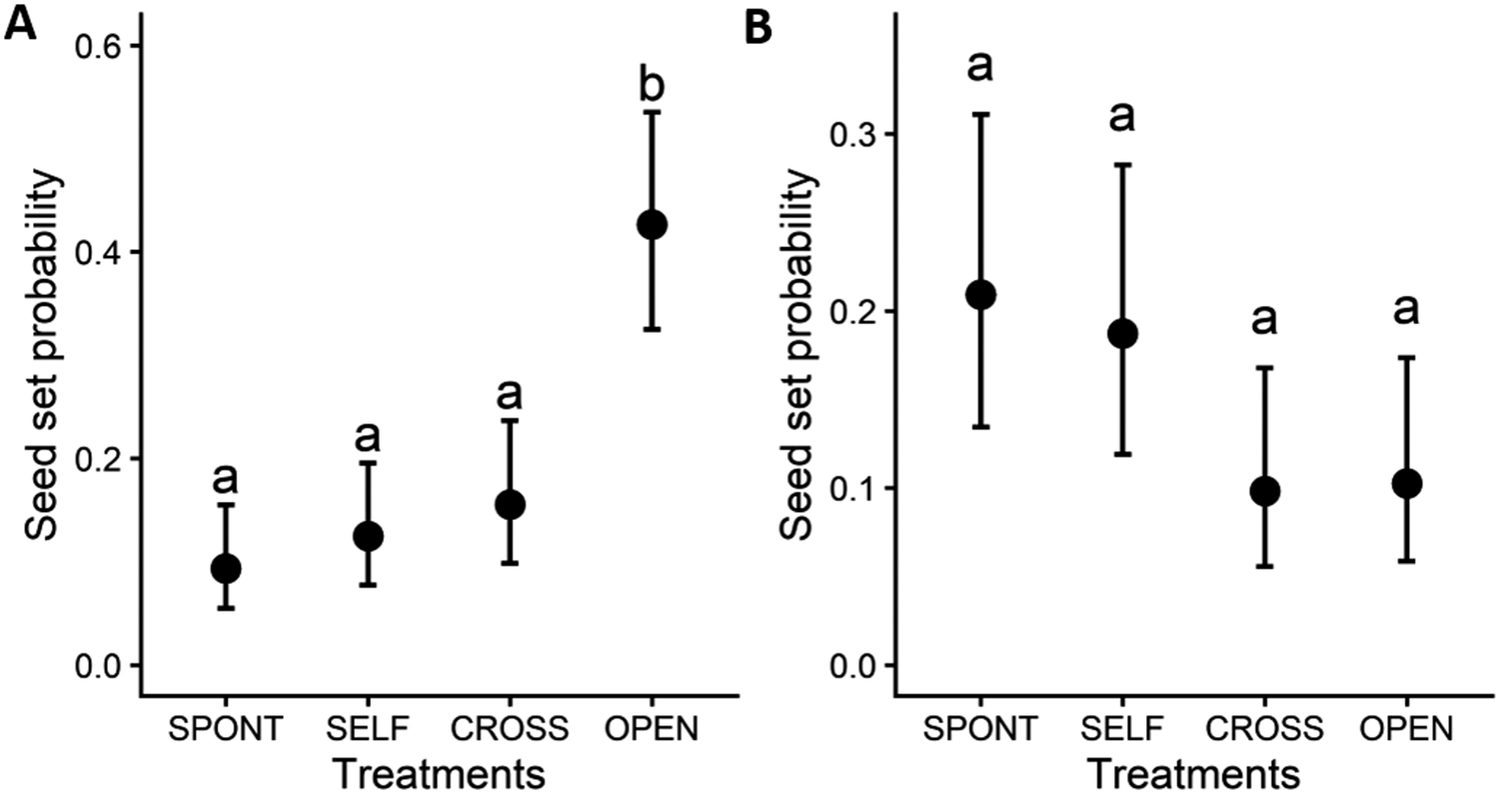
The findings for L. divaricata indicated that there was a significant effect of the treatments applied (LRT = 37.31, p < 0.0001). Seed set was higher under open pollination than under the three manual pollination treatments (Figure 1A), suggesting that natural pollinator activity significantly enhances reproductive success. This pattern may be related to the generalist pollination strategy of the species, which was identified as the most generalist plant species within the Monte pollination network studied by Tadey et al. (Reference Tadey, Tadey and Tadey2009), interacting with a broad diversity of floral visitors. In addition, Vázquez et al. (Reference Vázquez, Lomáscolo, Maldonado, Chacoff, Dorado, Stevani and Vitale2012) demonstrated that pollinator species differ markedly in their contribution to plant reproductive success, highlighting the importance of interaction quality in addition to visitation frequency. Thus, flowers exposed to natural pollination may receive larger amounts of compatible pollen, pollen from multiple donors, or repeated visits by highly effective pollinators, resulting in greater seed production than that achieved through manual pollination. Furthermore, Rossi et al. (Reference Rossi, Debandi, Peralta and Martinez Palle1999) reported incomplete protogyny and early stigma receptivity in Larrea flowers, traits that favor the receipt of outcross pollen before self-pollen becomes available.
Predicted mean seed set probability (± 95% confidence intervals) estimated from the generalized linear mixed model for L. divaricata (A) and Schinus johnstonii (B) under different pollination treatments, as estimated from the generalized linear mixed model. Different letters indicate significant differences among treatments based on Tukey post hoc tests (p < 0.05). References: CROSS, cross-pollination; OPEN, open pollination; SELF, self-pollination; SPONT, spontaneous pollination.

Figure 1. Long description
The figure consists of two panels, A and B, each with a Y-axis labeled Seed set probability and an X-axis labeled Treatments.
Panel A (Larrea divaricata):
* The Y-axis ranges from 0.0 to 0.6.
* S P O N T: Mean probability is approximately 0.1 with a small error bar, labeled with letter a.
* S E L F: Mean probability is slightly above 0.1, labeled with letter a.
* C R O S S: Mean probability is approximately 0.15, labeled with letter a.
* O P E N: Mean probability is significantly higher at approximately 0.42, labeled with letter b, indicating a significant difference from the other three treatments.
Panel B (Schinus johnstonii):
* The Y-axis ranges from 0.0 to 0.3.
* S P O N T: Mean probability is approximately 0.21 with a large error bar, labeled with letter a.
* S E L F: Mean probability is approximately 0.19, labeled with letter a.
* C R O S S: Mean probability is approximately 0.1, labeled with letter a.
* O P E N: Mean probability is approximately 0.1, labeled with letter a.
* All treatments in Panel B share the letter a, indicating no significant differences among them.
Although autonomous selfing can provide reproductive assurance in L. divaricata when pollinators are scarce, our results support the hypothesis proposed by Rossi et al. (Reference Rossi, Debandi, Peralta and Martinez Palle1999) that floral traits favor the receipt of outcross pollen. In this context, the greater seed set observed in open-pollinated flowers suggests not only a preference for outcross pollen, but also that reproductive success is strongly dependent on pollinator activity.
The self-incompatibility index for L. divaricata was 0.55, indicating a moderate degree of self-compatibility in the species. In addition, the spontaneous self-pollination index was 0.90, suggesting a notable capacity for self-pollination. These findings are consistent with Tadey et al. (Reference Tadey, Tadey and Tadey2009), who classified the species as facultatively self-compatible. Together, these indices suggest that while the species is capable of autonomous reproduction, cross-pollination mediated by floral visitors plays a major role in maximizing reproductive success under natural conditions.
The significant effect of pollination treatment, as indicated by the beta-binomial GLMM, denotes that reproductive success in S. johnstonii is influenced by pollen availability and/or pollen source (LRT = 9.89, p < 0.05). However, the comparatively weak pairwise differences observed among the treatments suggest that fruit production may not be entirely dependent on insect-mediated pollination (Figure 1B). The production of seeds in bagged flowers, including those that did not receive manual pollination, suggests the existence of alternative mechanisms contributing to reproductive success. One plausible explanation is wind-mediated pollen transfer, as the bags used in this study effectively excluded floral visitors but did not prevent the arrival of airborne pollen. This interpretation is consistent with findings reported for Schinus pilifera, a closely related species, in which seed set was recorded in bagged inflorescences and an ambophilous pollination system was proposed (Benci Arqued et al., Reference Benci Arqued, Fabbroni, Fuentes, Gil, Villada, Araya, Aquino, Alemán, Lozano and Zapater2019). In that species, both experimental evidence and floral traits commonly associated with anemophily, including unisexual flowers, exposed reproductive organs, and a low ovule number per flower (also present in S. johnstonii ), support the contribution of wind pollination to reproductive success.
The potential significance of wind pollination in S. johnstonii may be further enhanced by its reproductive phenology. The species flowers early in the season, exhibiting a restricted flowering period, with flowering beginning in September and concluding in early October (Steibel and Troiani, Reference Steibel and Troiani2008). The flowering period of other dominant entomophilous shrubs and herb species begins in mid-October and can extend until February (Naab and Tamame, Reference Naab and Tamame2007; Tamame, Reference Tamame2011), which is consistent with the peak pollinator activity (Michelette and Camargo, Reference Michelette and Camargo2000; Peralta et al., Reference Peralta, Stevani, Chacoff, Dorado and Vázquez2017). Consequently, early flowering (in periods of relatively low pollinator activity) increases the importance of alternative pollen-transfer mechanisms that provide reproductive assurance when insect visitation is limited. Furthermore, studies conducted on other species of Schinus have reported the presence of a thick stigmatic membrane (Zapater et al., Reference Zapater, Aleman, Lozano, Aquino, Flores, Gil, Villada and Araya2018; Benci Arqued et al., Reference Benci Arqued, Fabbroni, Fuentes, Gil, Villada, Araya, Aquino, Alemán, Lozano and Zapater2019). In the event of S. johnstonii presenting similar structures, variation in fruit set may be influenced not solely by the quantity of pollen deposited but also by the effectiveness of pollinators in disrupting it (Zapater et al., Reference Zapater, Aleman, Lozano, Aquino, Flores, Gil, Villada and Araya2018).
An additional explanation for fruit production in flowers that were not manually pollinated is the occurrence of facultative apomixis. While the present results are unable to demonstrate apomictic reproduction, the formation of fruits under pollinator-exclusion treatments raises this possibility and warrants further investigation. However, given that the exclusion bags did not entirely prevent the arrival of wind-borne pollen, the current experimental design is unable to distinguish between apomixis and wind-mediated pollination. Research conducted on other species of Schinus has indicated the presence of apomixis in some cases, while in others, it has been ruled out (Lenzi and Orth, Reference Lenzi and Orth2004; Iponga, Reference Iponga2010). Consequently, it can be concluded that any inferences regarding apomixis in S. johnstonii should be considered preliminary until experiments specifically designed to exclude all external pollen sources can be conducted. The results of this study indicate that S. johnstonii may possess a reproductive strategy that is more flexible than expected for a functionally dioecious shrub. Wind pollination is potentially playing an important role in reproductive assurance under the environmental conditions of the Monte ecosystem. This strategy, which combines insect- and wind-mediated pollination, may be particularly advantageous in arid environments, where pollinator availability is often unpredictable (Hall et al., Reference Hall, de Manincor, Fisogni, Hoey-Chamberlain, Yanega and Rafferty2026; Pereira-Guaqueta et al., Reference Pereira-Guaqueta, Sosa, Búrquez and Mandujano2026).
No fruits were obtained from N. flexuosa var. depressa; therefore, statistical analyses could not be performed in its case. Despite the fact that this species produces numerous inflorescences, each comprising a considerable number of flowers, there are precedents for significant losses between this stage and fruit formation in related species (Agüero, Reference Agüero2009). In N. flexuosa var. flexuosa , the proportion of inflorescences that successfully initiate fruit development is less than 3%, and of those, only half or a third complete the process (Solbrig and Cantino, Reference Solbrig and Cantino1975). This could explain why, by chance, the inflorescences selected for our treatments did not produce legumes.
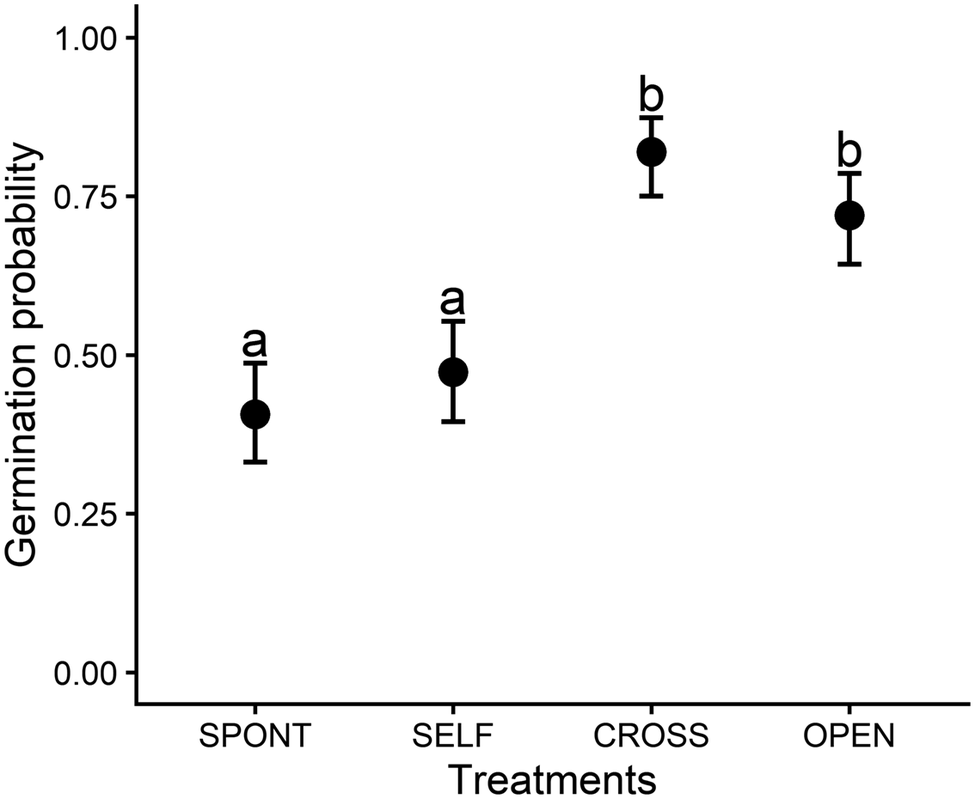
To establish whether different pollination types also affect seed functionality, we evaluated the germination capacity of seeds obtained from each pollination treatment. In L. divaricata , seeds obtained from cross-pollination and open-pollination treatments showed higher germination rates than those obtained from the other treatments (Figure 2), which reinforces the importance of pollen exchange for the functionality of seeds in this species. On the other hand, the pre-germination treatment applied in this study resulted in a higher germination capacity than that reported by Hernandez et al. (Reference Hernandez, Pérez and Busso2020) for the same species. This difference could be attributed to the seed scarification in the mentioned study, which employed a mechanical tool, while in this experiment, scarification was done manually, seed by seed, allowing for greater precision and uniformity in the treatment of the seed coat.
Predicted germination capacity (± 95% confidence intervals) for L. divaricata seeds from different pollination treatments, as estimated from the generalized linear mixed model. Different letters indicate significant differences between treatments based on Tukey post hoc tests (p < 0.05). References: CROSS, cross-pollination; OPEN, open pollination; SELF, self-pollination; SPONT, spontaneous pollination.

None of the S. johnstonii seeds germinated under the conditions of this study, so germination capacity analyses were not conducted for this species. Zeberio and Pérez (Reference Zeberio and Pérez2020) and Diaz Arias et al. (Reference Diaz Arias, Torres, Ithurrart and Cardillo2020) reported a germination rate of close to 10% in S. johnstonii in experiments with twice as many seeds as those used in this study. Therefore, this, combined with the low number of seeds obtained from our treatments, could explain the inability to obtain analyzable data to assess differences in germination capacity for this species.
Our hypothesis that these species rely strongly on cross-pollination was only partially supported. In the case of L. divaricata, the highest seed set was obtained under open-pollination treatment. Furthermore, seeds produced through open- and cross-pollination showed superior germination capacity to those obtained from self-pollination treatments. These findings suggest that pollen exchange substantially enhances reproductive success. These results are consistent with our prediction that self-pollination would reduce both seed production and seed performance. In contrast, S. johnstonii produced seeds even under pollinator-exclusion treatments, suggesting the possible contribution of wind pollination or other reproductive assurance mechanisms. This finding partially contradicts our prediction that self-pollination would result in markedly lower reproductive success. Finally, due to the absence of fruits obtained from N. flexuosa var. depressa, the dependence of this species on cross-pollination could not be evaluated. The findings indicate that the importance of cross-pollination varies among Monte shrub species. This variation is attributed to the activity of pollinators in certain species and the presence of different pollen-dispersal mechanisms in others.
Conclusions
Our results demonstrate that reproductive success in the studied shrub species depends on both the quantity and source of pollen, although the relative importance of different pollination mechanisms varies among species. In L. divaricata, open-pollinated flowers produced more seeds, and these exhibited higher germination capacity than those produced by self-pollinated flowers. This finding indicates that although the species is capable of autonomous selfing, pollinator-mediated cross-pollination maximizes reproductive success and seed quality. These findings support previous evidence that the floral traits of this species favor outcrossing while retaining self-compatibility as a mechanism of reproductive assurance.
In S. johnstonii, the study of seed production under pollinator-exclusion treatments suggests that reproductive success may not depend exclusively on insect visitation. The results obtained are consistent with a potential contribution of wind pollination and/or alternative reproductive mechanisms that provide reproductive assurance in response to the challenges associated with early flowering. However, further studies specifically designed to exclude airborne pollen are required to evaluate these hypotheses.
Conclusions could not be drawn for N. flexuosa var. depressa as no fruits were produced in the selected experimental units. Nevertheless, the absence of fruit set is consistent with the high levels of flower abortion and fruit loss reported for related taxa, thus emphasizing the necessity for further research involving a greater number of reproductive structures.
The study under review here demonstrates that the species of shrubs in question at the Monte-Espinal transition possess a wide variety of reproductive strategies, and underscores the ecological importance of maintaining pollination and pollen transfer processes. It is imperative to conserve pollinator communities and the environmental conditions that facilitate pollen movement in order to sustain seed production, restoration processes, and the long-term resilience of these ecosystems.
Open peer review
For open peer review materials, please visit https://doi.org/10.1017/dry.2026.10045.
Data availability statement
The data that support the findings of this study are available from the corresponding author, Guadalupe Peter, upon reasonable request.
Acknowledgements
We thank the Ministerio de Desarrollo Agrario of Buenos Aires Province for granting us access to the ranch.
Author contribution
Acquired the funding: C.V.L., G.P.; Conceived and designed the study: C.V.L., G.P., L.A.G.; Carried out the fieldwork: C.V.L., J.M.S.L., G.P.; Carried out the sample processing: C.V.L.; Drafted the manuscript: C.V.L.; Statistical analyses: J.M.S.L. All authors provided editorial comments on a draft manuscript and approved the final manuscript.
Funding statement
This work was supported by grants from CONICET (PIP-402, GP) and UNRN (PI-JI VP 40-C-1169, CVL).
Declaration of interests
The authors declare none.

 Open access


Comments
Viedma, January 14th, 2025
Dear Editor in Chief
Cambridge Prisms: Drylands
I hope this message finds you well. My name is Guadalupe Peter; I am affiliated with CEANPa (Universidad Nacional de Río Negro) and CONICET in Viedma, Argentina. I wish to submit an article to the forthcoming Themed Collection entitled “Drylands of South America: Ecology without borders that integrates environment and society”. This manuscript addressed an analysis of the effects of different pollination treatments on fruit set production and seed germination in Monte species. The manuscript is titled “Reproductive biology of three species of northeastern Patagonia” and the authors are Cintia V. Leder, Juan M. Seco López, Guadalupe Peter and Lucas A. Garibaldi.
This study aligns closely with the aims of your journal, as it contributes to a better understanding of the reproductive dynamics of semi-arid plants. Through the study of a functionality aspect (pollination and germination), the manuscript explores the reproductive biology of three shrubby species from northeastern Patagonia, focusing in the effects of different pollination treatments on fruit production and seed germination capacities. Our aim is to understand how plants interact with their pollinators because this could provide information about the characteristics of the pollination service that these plant communities provide.
Thank you very much. With my best wishes,
Guadalupe PETER
CEANPa, Universidad Nacional de Río Negro
CONICET, Viedma, Argentina