Adolescent pregnancy and childbirth are developmental challenges, increasing the health risks of mothers and their infants,Reference Menacker, Martin and MacDorman 1 depriving girls of opportunities for education and better employment,Reference Wellings, Wadsworth and Johnson 2 and eventually hindering social development and economic growth throughout society. 3 The impact is more serious on younger mothers, because they tend to be immature and less educated and they lack the life skills to keep themselves and their children healthy. Often, if unmarried women become pregnant, they have 2 basic options: they can drop out of school, marry, and begin raising children, or they can seek an abortion that often is life-threatening and illegal.
The risk of early pregnancy often increases in humanitarian emergencies, such as armed conflicts and large-scale natural disasters. Social views on compensating for the loss of livesReference McGinn 4 are driving forces in post-emergency fertility increases. Young girls are encouraged to marry early to reduce household economic burden or to protect themselves against sexual abuse. The incidence of sexual violence due to the lack of security and involvement in the sex trade due to economic difficulties increases the risk of extramarital pregnancy. Adolescents separated from their families and communities tend to become victims of sexual exploitation and are prone to engage in risky sexual behavior. 5 , 6 For example, in Colombia, the pregnancy rate among displaced women under 15 years of age was reported to be higher than that of other girls in the same age group.Reference Rehn and Sirleaf 7 Similarly, 58% of Palestinian refugee women in Lebanon started childbearing before the age of 20 years.Reference McGinn 4
Worryingly, little attention has been paid to adolescents’ reproductive health after humanitarian emergencies,Reference Chynoweth 8 because adolescents usually are not considered a “vulnerable population.” Instead, adolescents face the huge responsibility of caring for their families, earning income, and reconstructing their communities. Few adolescent reproductive health programs exist, compared with the number of programs for other age groups, partly because few reports have been made to raise awareness of adolescent reproductive health in post-emergency situations.Reference Hynes, Sheik and Wilson 9 We aimed to estimate adolescents’ pre- and post-disaster fertility rates by creating a hypothetical age cohort to develop and validate the design of a health-impact assessment in post-emergency areas when reliable statistics are not available.
Methods
A cross-sectional study was conducted 2 years after the Indian Ocean tsunami in Aceh Province, Indonesia, where people were affected by both a long-lasting armed conflict and a large-scale natural disaster. In Aceh province, in the northwest part of Sumatra Island, nearly 30% of the population lives under the poverty line. 10 Most of the people in Aceh do not have access to the economic benefits of the land’s abundant natural resources.Reference Shie 11 Aceh had been in a conflict with the central government for almost 30 years.Reference Cohen, Nababan and Widjaya 12 On December 26, 2004, the Indian Ocean tsunami destroyed many of Aceh’s coastal villages. Hundreds of thousands of people lost their families, houses, and jobs. Many of the estimated 900,000 adolescent tsunami survivors 13 were then at increased risk of reproductive problems.
Although the prevalence of early marriage varies among areas according to the geographic distributions of ethnic groups, 3 in Indonesia, 24.2% of women aged 20 to 24 years were married by the age of 18 in 2002, 14 and 13.7% of women aged 15 to 19 years in rural areas had begun childrearing. 15 This high prevalence of early marriage and fertility in part is because unmarried girls in Indonesia and Aceh have limited access to reproductive health information and contraception,Reference Utomo 16 , 17 accompanied by negative social attitudes towards premarital sex.Reference Simon and Paxton 18
The present study was conducted for 8 weeks between September and December 2006. Adolescent fertility data were retrospectively collected for 2004 through 2006. A total of 252 Acehnese women born between 1985 and 1991 were selected with stratified adaptive cluster sampling. We studied 5 areas in Aceh province, where over 10% of the population had been displaced for 8 months or more following the tsunami (Figure 1): the districts of Aceh Besar, Aceh Jaya, Aceh Barat, Simeulue Island, and Banda Aceh (the provincial capital city). All study areas, except Simeulue Island, shared similar characteristics, including engagement in a long-lasting armed conflict and being located on the west coast of Sumatra. Simeulue Island, located about 200 km west of Sumatra, was not within the conflict zone and had few casualties during the tsunami. Twelve clusters (villages) were allocated to the study areas according to population size. Clusters were selected by using simple random sampling from a list of villages obtained from local government offices. Within each cluster, we selected 21 eligible women on the basis of information provided by the villagers.
Map of Nanggroe Aceh Darussalam (Aceh Province, Indonesia).

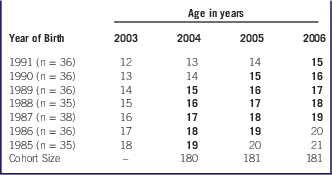
Age-specific fertility rates (ASFRs) for women aged 15 to 19 years and other relevant statistics from 2004 to 2006 were estimated by creating a hypothetical age cohort from the sample participants born between 1985 and 1991 (Table 1). Equal numbers of participants were selected from each birth cohort during 1985 to 1991 to create age cohorts with a size of 180 or 181. This sample size would enable us to detect a threefold or greater change in fertility, with 60 per 1000 women as a reference rate, with a 95% confidence interval (CI; α<0.05) and over 80% power (β<0.25). This degree of fertility change was reported in previous post-conflict fertility studies. 5 The fertility rate referred to the Indonesian rural average ASFR in the 2002–2003 Indonesian Demographic Health Survey (IDHS): 63 births per 1000 women aged 15–19 years. 15 We chose the rural average ASFR because Aceh is among the most rural areas, although it is located in the North Sumatera Region, where the lowest proportion of childbearing is reported in the same edition of IDHS (4%). The social context for marriage and reproduction is also considered similar in many post-emergency situations, though few post-disaster fertility studies are available. The estimated fertility data were later compared with 2002–2003 and 2007 data to evaluate validity and accuracy. Because the tsunami occurred at the end of 2004, data in or before 2004 represent the pre-tsunami population, whereas those of 2005 and 2006 represent the post-tsunami population.
Age Cohort ModelFootnote a

a Values in the table in bold indicate the 15–19-year-old cohort.
We used a self-administered questionnaire in Indonesian, which required approximately 15 to 30 minutes to complete. Trained data collectors—locally recruited young Acehnese females—guided respondents in answering the questionnaire. One hundred twenty-seven respondents (50.4%) completed the questionnaire, and the remaining (49.6%, n=125) answered the structured interview questions. The data collected provided information about the socioeconomic changes after the tsunami: housing type and condition, household size, past and current pregnancies, and experience with crime (victim of or witness to a crime).
A Poisson regression model was used to estimate and compare the fertility data. The statistical software package STATA/IC, version 10 (STATA Corporation, College Station, TX, 2007), and Microsoft Excel 2003 were used for the analyses.
The study was approved by the Ethics Review Committee of Nagoya University School of Medicine (no. 342; January 6, 2006). We also consulted the local office of the Department of Islamic Law of the Indonesian Government for religious and ethical advice. Every interview was conducted after obtaining written informed consent.
Results
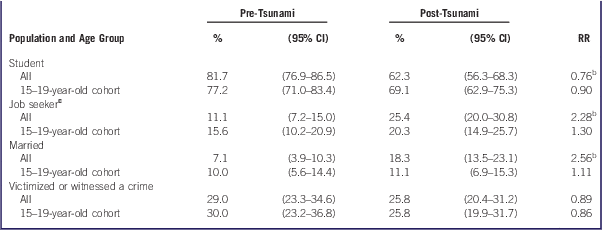
The socioeconomic changes among the study population before and after the disaster are shown in Table 2. Some of the socioeconomic changes lost significance when controlled for age. Among the 252 respondents, 40.9% (95% CI: 34.7%, 47.2%) lost family members, and 18.7% (95% CI: 14.0%, 24.0%) lost income earners in the tsunami. Seventeen respondents (7.8%; 95% CI: 4.2%, 11%) married under the age of 20 after the tsunami, 4 of them to widowers. Four respondents lost spouses and 2 of them remarried later in their teens, one of them to a widower.
Pre-Post Tsunami Socioeconomic Changes in the Study PopulationFootnote a

a Abbreviations: CI, confidence interval; RR: rate ratio.
b P≤0.01.
c Those who were seeking regular employment regardless of social status.
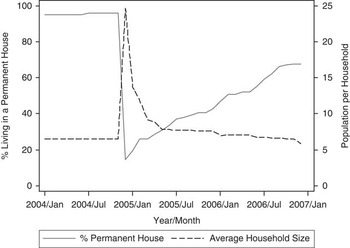
Changes in housing condition are shown in Figure 2. The percentage of respondents living in a permanent house significantly decreased immediately after the tsunami (P<0.01). Many evacuated to shelters (tents or public buildings) and sometimes were forced to stay with many strangers, with 39% (95% CI: 33%, 45%) having to sleep with one or more adult males in the same room besides their husbands or partners. The median length of displacement was 13 months.
Type of Housing and Household Size in Aceh Province, Indonesia.

Since 2001, 36 of 252 women in our sample (14.3%; 95% CI: 9.9%, 18.6%) reported 43 pregnancies, and 23 respondents (9.1%; 95% CI: 5.9%, 13.4%) reported 27 live births and 1 miscarriage. The age at pregnancy ranged from 15 to 21 years, and age at delivery from 16 to 21 years. None of the respondents reported nonmarital, extramarital, or unintended pregnancy or births. No pregnancies were reported from June 2004 (6 months before the disaster) to March 2005 (3 months after the disaster), whereas few births were reported from November 2004 to November 2005, for 1 year.
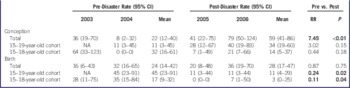
The estimates of fertility rates among the hypothetical cohorts by age are shown in Table 3. The post-tsunami age-specific fertility rate among the women aged 15–19 years significantly decreased, whereas the post-tsunami pregnancy rate appeared to increase. The pre-tsunami fertility rate among the study population (4.4% of women aged 15–19 years in 2004; 95% CI: 2.3%, 9.1%) was not significantly different from the provincial average in the 2002–2003 IDHS 15 (“percentage who are mothers”: 3.5% of the women aged 15–19 years in North Sumatera, P=0.49). On the other hand, the post-tsunami fertility rate (1.1% of the women aged 15–19 years; 95% CI: 0.4%, 2.9%) was significantly lower than the provincial average in the 2007 IDHS 19 (“percentage who have had a live birth”: 4.1% of the women aged 15–19 years in Nanggroe Aceh Darussalam, P=0.0041).
Estimates of Fertility Rates Per 1000 Women by Year and Age GroupFootnote a

a Abbreviations: CI, confidence interval; NA, not available; RR, rate ratio. Notes: Data from 2003 and 2004 represent the data from 2 years before disaster and 1 year before the disaster, respectively. Data from 2005 and 2006 represent the data 1 year after disaster and 2 years after the disaster, respectively.
The tsunami’s impact on adolescent marriages, pregnancies, and births is shown in Table 4. Household size was the only apparent social impact that influenced the adolescent fertility rate.
Adolescent Marriage, Pregnancy, and Fertility After the TsunamiFootnote a

a Among women aged 15 to 19 years born between 1986 and 1991 (217 person-years).
b Men aged 14 years or older and not a husband or partner.
c Those living in individual housing were considered to have better privacy than those living in tents or shelters.
In association with the Aceh conflict, the pre-tsunami fertility rate among women aged 15–19 years in the conflict zones was significantly lower than in the non-conflict zones (85% lower; rate ratio: 0.15, P=0.01). However, no births were reported in the non-conflict zones after the tsunami for the study period.
Discussion
The pre-tsunami adolescent fertility rate was not significantly different from the official statistics, which suggests that the study population adequately represented the tsunami-affected adolescents as far as pre-disaster fertility is concerned. However, when we examined the pregnancy rates among the women aged 15 to 18 years, which were available in 2003, the rate plunged to null in 2004, immediately before the tsunami (Table 3). Because there was no significant event other than the tsunami that would have affected pre-tsunami fertility rates, 20 it is likely that the study naturally excluded women who perished during the tsunami and that many pregnancies and births were omitted from the pre-tsunami fertility estimation. This finding suggests that the pregnancy rate among women aged 15 to 19 years in 2003 would have been much higher than the rate in 2004 if those data were available. Given the underestimation of the pre-tsunami fertility rates, the true difference between the pre- and post-tsunami fertility rates was likely larger than estimated. In fact, a greater decrease in fertility was detected among women aged 15 to 18 years by comparing the rate in 2003 with the post-tsunami average (relative rate: 0.22, P=0.01).
Post-disaster adolescent fertility, on the other hand, which was significantly lower than the official statistics, appeared to reflect the actual situation in the high mortality area. Several studies suggested that tsunami-related mortality was significantly high among the women between 10 and 69 years of age,Reference Doocy, Rofi and Moodie 21 , Reference Nobuyuki, Tomoko and Dehiwala 22 overlapping with the reproductive period. Assuming that the tsunami mortality among the fertile women in Aceh was significant, survival may have been less likely among women who were pregnant or breast-feeding newborns during the tsunami. Therefore, it is likely that the post-tsunami fertility rate decreased by roughly the number of births that pregnant women who died in the tsunami would have given, although it may have been temporary.
Underreporting of births also had additional effects on the statistics. The tsunami may have increased the risk of neonatal death due to physical and psychological trauma to the mothers and fetuses or due to damage to the health infrastructure, including health services. Furthermore, cultural values may have prevented mothers from reporting pregnancies that resulted in fetal or neonatal deaths. Some pregnant women might have evacuated to other areas and given birth.
Our initial assumption was that the change in post-tsunami socioeconomic conditions, such as the loss of income earners or family and the security deterioration would promote teenage marriage. However, after controlling for age, few socioeconomic changes were observed among teenage women except for household size. The post-disaster housing conditions appeared to be directly associated with fertility. The post-tsunami household size increased significantly due to the shortage of housing. Assuming a constant relative hazard over time, the relative rate of post-tsunami pregnancies among women aged 15–19 years was estimated to be 0.71 (P=0.04). In other words, the pregnancy rate decreased by 29% per one-person increase in households, suggesting a decrease in pregnancies in large households. The required number of new houses was 82,000 to 110,000, although only 16,000 new houses had been completed as of November 2005. 23 In December 2006, 12,000 households were still in need of relocation.Reference Fitzpatrick 24 Even if shelter had been provided, the standard rooms were only 9 m2, with one household per room, which restrained married couples from having sex, consequently keeping married couples from having children.
Despite the considerable damage, the proportion of students among the 15–19-year-old women remained high and stable. Some families who lost income earners may have had to give up their education and start working. However, owing to the expanded post-tsunami opportunities for education and employment, which was a result of the reconstruction and influx of foreign aid, 25 decreases in school enrollment or employment may have been offset. However, women’s access to health services did not increase, which was most likely because post-emergency adolescent health was not a priority for most of the relief organizations.
There is not enough evidence to suggest the presence of post-emergency security deterioration, which could have increased the risk of extramarital pregnancies. Even if some women became pregnant outside of marriage, they might not have increased the prevalence of extramarital pregnancies if they moved to other areas to give birth in secret or managed to get married and report the birth as a marital one. In Indonesia, cultural values prevent teenagers from bearing children outside of marriage.Reference Utomo 16
The armed conflict with the central government appeared to have little association with post-tsunami fertility rates, mainly because of the cease-fire agreement soon after the tsunami. 26 Although a few studies have suggested decreases in post-emergency fertility, only some of those studies were relevant to Aceh’s situation. In Angola, the pregnancy rates in war-affected areas, which declined during wartime, were related to constraints in childbearing before the rates increased again after the war.Reference Agadjanian and Prata 27 In Eritrea, after the border conflict in 1998 to 2000, couples married much older, causing a steep decrease in fertility.Reference Blanc 28 This study also found a decrease in fertility among married women aged 15–19. Another study in Ethiopia reported declines in fertility after war associated with the physical separation of women from their husbands during their husbands’ military service or migration.Reference Lindstrom and Berhanu 29 In the case of Aceh, however, not many husbands had left their wives for military duties. 30
In addition to the small sample size, the magnitude of the disaster reduced the accuracy of the fertility estimates in this study. Although we took into consideration the nature of fertility as an annual cumulative rate, we relied heavily on the data in 2004, the very year of the disaster, to estimate the pre-disaster rate, because the disaster occurred at the end of the year. We paid more attention to recall bias instead, although it turned out not to be measurable, because childbirth is a major event in a lifetime. However, the estimated ASFR 2004, the very year of the disaster, appeared to be biased, because, theoretically, the data from the 40-week period preceding the disaster, the average gestation period, may have been affected by the excess mortality of childbearing mothers and the underreporting of neonatal deaths. Therefore, when the mortality of childbearing mothers or newborn babies is expected to be high, pre-disaster estimation should exclude the data from the year of the disaster. In this study’s design, for example, data from the hypothetical pre-disaster cohort (15–19 years old) should have been analyzed with the samples selected from the birth cohort between 1984 and 1988. The estimates of fertility from 2003 should have been used as the pre-tsunami cohort, because that year apparently was less affected by the tsunami and recall bias. The sample size, therefore, should have been adjusted accordingly.
Conclusion
This study found a reasonable and valid way of creating a hypothetical age cohort to estimate age-specific fertility rates in disaster-affected areas where reliable vital statistics are not available. The design enabled the control of factors associated with disaster-affected adolescents.
One of the noteworthy insights of this study was, however, that estimates of fertility in the immediate year of the emergency may yield a pseudo outcome, because the data from the 40-week period preceding the disaster may be biased by excess mortality in childbearing mothers and newborn babies. Therefore, if the scale of a disaster is huge and fatal, pre-disaster fertility is better estimated by using data that are at least/at most 2 years retrospective to minimize both selection bias and recall bias.
Acknowledgments
We are grateful to the Provincial and District Government Offices in Aceh for kindly allowing us to conduct this study. We wish to thank Prof. Gilbert Burnham and Dr. Courtland Robinson, of the Centre for Refugee and Disaster Response, Johns Hopkins Bloomberg School of Public Health, for technical advice, and Peace Winds Japan for logistic support.
Funding
This study was supported by a Grant for International Health Cooperation Research (17A-3) from the Ministry of Health, Labour and Welfare of Japan, which was awarded to AA, and a Gushinkai Research Grant (2005–06) and Fulbright Foreign Student Program with the Japan-U.S. Educational Commission (JUSEC, 2007–08 Fulbright Doctoral Dissertation Research Program), which were awarded to MK.