Introduction
The two-spotted spider mite, Tetranychus urticae Koch (Trombidiformes: Tetranychidae), has a worldwide distribution and damages more than 900 species of plants, including annual and perennial crops (Pakyari and Enkegaard, Reference Pakyari and Enkegaard2012). Control of two-spotted spider mite with synthetic pesticides is challenging because of its short development time, high fecundity, a habit of feeding on the lower leaf surface making the efficacy of acaricide applications problematic and rapid development of acaricide resistance (Pakyari and Enkegaard, Reference Pakyari and Enkegaard2015a). Biocontrol programs play a significant role in the population management of spider mite. Entomophagous control agents include a wide range of taxa such as acarophagous ladybird beetles (Coccinellidae), predatory anthocorids (Anthocoridae), predatory mites (Phytoseiidae) and predatory thrips (Thripidae) (Sabelis, Reference Sabelis, Helle and Sabelis1985; Gotoh et al., Reference Gotoh, Yamaguchi, Fukazawa and Mori2004; Trdan et al., Reference Trdan, Andjus, Raspudic and Kac2005; Kreiter et al., Reference Kreiter, Amiri, Douin, Bohinc, Trdan and Tixier2020). The majority of the above-mentioned predators, feed on the most soft-bodied insects across several acarophagous but all species of the genera Scolothrips appear to be specialized spider mite predators (Pakyari and Enkegaard, Reference Pakyari and Enkegaard2015b).
Scolothrips longicornis Priesner (Thysanoptera: Thripidae) is widely distributed across the Middle East, North America, India and several European countries (Pakyari and McNeill, Reference Pakyari and McNeill2020). This species appears to be a specialized predator of T. urticae (Gilstrap and Oatman, Reference Gilstrap and Oatman1976). Scolothrips longicornis is generally found in greenhouse and farm crops like cucumber, tomato, soybean and bean where two-spotted spider mite are present (Pakyari et al., Reference Pakyari, Fathipour and Enkegaard2011a, Reference Pakyari, Fathipour and Enkegaard2011b).
Detailed studies of S. longicornis demographic parameters at different temperatures, functional response, prey stage preference and prey consumption have been measured (Pakyari et al., Reference Pakyari, Fathipour, Rezapanah and Kamali2009, Reference Pakyari, Fathipour and Enkegaard2011a, Reference Pakyari, Fathipour and Enkegaard2011b; Pakyari and McNeill, Reference Pakyari and McNeill2020), but no previous research has examined the effect of cold storage on species development duration and demographic parameters.
Cold storage of predatory insects for periods of 14 days and over can be an important tool for successful mass rearing and augmentative release. Storage at low temperatures also allows for the synchronized release of control agents into a crop when pest monitoring indicates potential economic loss to the crop, or in response to an undetected outbreak, where insecticide applications do not allow for the use of pesticides (e.g. in organic systems). In addition, the optimization and development of effective storage procedures at low-temperature for natural enemies can decrease the cost of biological control programs cost by extending the rearing period to synchronize with the biology of the target pest (Rezaei et al., Reference Rezaei, Talebi, Fathipour, Karimzadeh, Mehrabadi and Reddy2020).
Tolerance to cold storage and consequent effects on longevity and efficacy when released into the target environment varies amongst natural enemies (Rathee and Ram, Reference Rathee and Ram2018). Storage at low temperatures can have a negative effect on insect biology, reducing survival of both immatures and adults, sex ratio and fecundity (e.g. Rathee and Ram, Reference Rathee and Ram2018). When mass rearing natural enemies for inundative releases, it is also essential to choose the life stage that can tolerate low-temperature storage (Benelli et al., Reference Benelli, Toth and Dindo2018). In this respect, the pupal and adult stages of predatory insects are considered to be the most appropriate stage for low-temperature storage (Abdel-Salam and Abdel-Baky, Reference Abdel-Salam and Abdel-Baky2000; Zhang et al., Reference Zhang, Zhang, Zhang, Chen, Wang, Liu and Mao2019).
For evaluating the quality of natural enemies, life table analysis provides a suitable measure of their efficiency and potential biological impacts on target hosts (Pakyari et al., Reference Pakyari, Pilefroshha, Arbab and Enkegaard2018; Rezaei et al., Reference Rezaei, Talebi, Fathipour, Karimzadeh, Mehrabadi and Reddy2020). The most critical parameters that have been utilized for the evaluation are the net reproductive rate (R 0), intrinsic rate of increase (r), finite rate of increase (λ), and mean generation time (T) (Carey, Reference Carey2001). Furthermore, for the estimation of low-temperature storage of predators in biocontrol programs, the use of the cumulative fecundity curves of first-generation predators, net reproduction and emergence rate, has also been recommended (Rezaei et al., Reference Rezaei, Talebi, Fathipour, Karimzadeh, Mehrabadi and Reddy2020).
Nevertheless, previous research has not evaluated the influence of cold storage on the life table parameters of S. longicornis. To optimize mass rearing of S. longicornis, we determined the influence of low temperature storage at constant 5 °C for four time periods (5, 10, 20 and 30-days) on life tables of S. longicornis. We selected 5 °C since this temperature is above the low-temperature threshold of 3.96 °C estimated by Pakyari et al. (Reference Pakyari, Fathipour and Enkegaard2011a). Another reason for selecting 5 °C was that several research studies have demonstrated that the appropriate temperature for storage of insect predators ranges from 1 to 10 °C (Abdel-Salam and Abdel-Baky, Reference Abdel-Salam and Abdel-Baky2000; Sakaki et al., Reference Sakaki, Jalali, Kamali and Nedvěd2019; Zhang et al., Reference Zhang, Zhang, Zhang, Chen, Wang, Liu and Mao2019), and this provides a mid-point with which to assess effects on S. longicornis biological parameters This contribution describes research to establish the optimal temperature for storage of S. longicornis, with a view of developing recommendations for commercial rearing operations in biocontrol programs targeting T. urticae.
Material and methods
Mite and thrips colony rearing
Two-spotted spider mite and S. longicornis were initially collected from a cucumber field in the Varamin Tehran province (35.3252° N, 51.6472° E and 920 m above sea level) in July 2016. These were maintained on excised leaves of cucumber which were put upside down on a piece of moist tissue paper in a plastic petri dish (15 cm diameter × 1 cm deep). Ventilation was provided by a 3 cm diameter hole drilled into the lid and covered by a thin nylon mesh secured with a water proof glue. Each petri dish was maintained in a controlled grow chamber at 25 ± 0.5 °C, 16L: 8D and 60 ± 10% r.h. To keep the S. longicornis culture, a single cucumber leaves infested with two-spotted spider mites was placed in a petri dish (18 cm diameter × 1 cm deep) as mentioned above. Every three days, adult predatory thrips are transferred to a new arena. The laboratory culture of S. longicornis was held for three months on two-spotted spider mite before been used for the experiments.
Host plant
Bean plants (Phaseolus volgaris L. cv. Akhtar) were grown in a mixture of soil 65% and peat moss 35% in a glasshouse. Bean leaf disks (c. 3 cm in diameter) with minor veins were selected to provide the host plant for the mites. Each bean leaf was placed upside down on a piece of moist cotton inside a petri dish (6 cm in diameter × 1 cm deep). Ventilation was provided by a 1 cm diameter hole, drilled into the lid and covered by a thin nylon mesh secured at the margins with glue.
Cold storage bioassay
To estimate the influence of low-temperature storage on predatory thrips, twenty newly emerged predatory adults (1 day old) were maintained at a constant 5 °C for 5, 10, 20 and 30 days, at 16L: 8D, and 60 ± 10% r.h. As the control, one day old S. longicornis adults were maintained at 25 ± 0.5 °C, 16L: 8D and 60 ± 10% r.h. At the end of the cold storage treatment intervals thrips were transferred into an environment chamber set at 25 ± 0.5 °C, 16L: 8D and 60 ± 10% r.h. The subsequent assessment of biological performance was conducted under these conditions, with 20 mated adult females from each cold storage treatment transferred to Petri dishes. Females were placed with adult males in bean leaf disk for 48 h, to obtain mated females.
Females lay eggs singly in an incision made in the leaf disk with their ovipositor that distinguished as white elliptic floats on a leaf tissue that visualized under binocular (×20). For each treatment, 30 (24 h old) S. longicornis eggs were held in an environmental chamber. Newly hatched larvae were provided daily with sufficient eggs of T. urticae (about 100 spider mite eggs); the number of offered preys was greater than the utilization capacity (Pakyari and Enkegaard, Reference Pakyari and Enkegaard2012). The bean leaf disks were replaced every three days until death. One male and female (1 day old) were placed onto the leaf disks to allow for mating. Thereafter, they were checked daily to determine the initiation of egg production.
Life table analysis
Longevity, survival rate, development rate and daily fecundity of S. longicornis females were calculated utilizing the age-stage, two-sex life table method and theory (Chi and Liu, Reference Chi and Liu1985; Chi, Reference Chi1988) and analyzed using the TWOSEX-MSChart software (Chi, Reference Chi2020). The age-specific oviposition rate (mx), the age-specific survival rate (lx), the age-stage-specific survival rate (sxj) (x = age, j = stage) and the age-stage-specific fecundity (fxj) along with the population parameters including the net reproductive rate (R 0), intrinsic rate of increase (r), finite rate of increase (λ), and mean generation time (T), were analyzed according to Chi and Su (Reference Chi and Su2006). The adult preoviposition period (APOP) and total preoviposition period (TPOP) were also calculated. The mean and standard error of life table parameters were estimated with the bootstrap method with 10,000 resampling to get a reliable estimation (Efron and Tibshirani, Reference Efron and Tibshirani1994). To establish differences between cold storage treatments, the paired bootstrap test was then performed.
Result
Development, longevity, and reproduction by S. longicornis
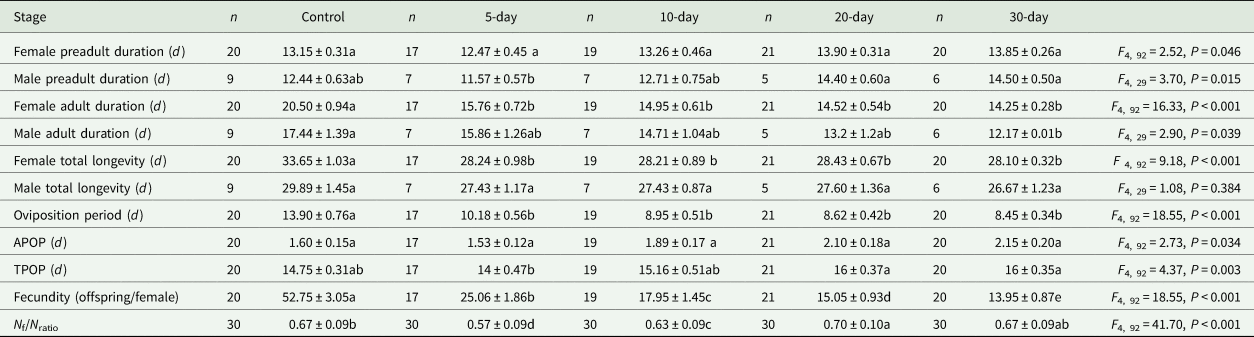
Cold storage did not significantly influence the female preadult duration but significantly affected the male preadult duration (table 1). Female adult duration and female total longevity were not influenced by the cold storage treatment durations but all were significantly different from the control. The mean minimum and maximum female total longevity were recorded in the 30-day low-temperature storage (28.1 ± 0.32 d), and the control (33.7 ± 1.03 d) treatments, respectively. The oviposition period decreased with increasing duration of cold storage with all these treatments significantly different from the control (table 1). The sex ratio of offspring was affected by the period of cold storage with the maximum was monitored in the 20-day cold storage and minimum was observed in the 5-day cold storage.
Mean (±SE) development time (days) of immature stages, mean longevity, fecundity, total preoviposition period (TPOP), adult preoviposition period (APOP), and oviposition periods of Scolothrips longicornis reared on eggs of Tetranychus urticae at 5 °C for different cold storage intervals

N, Number of individuals survived to the adult stage.
Values followed by small different letters within the same row are significantly different (paired bootstrap test, P < 0.05).
Age-stage, two-sex life table
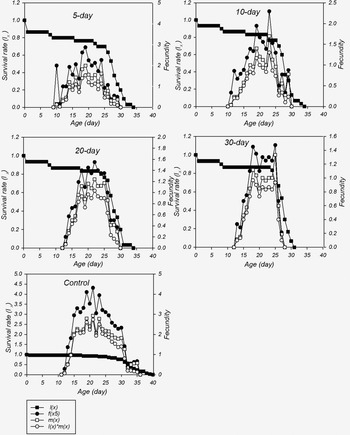
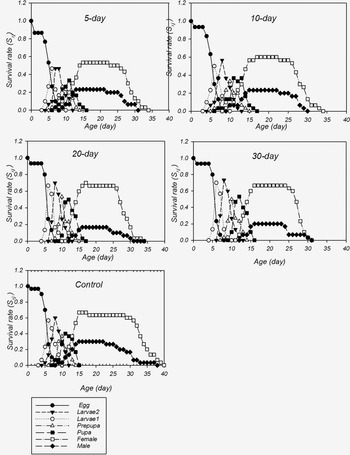
The age-stage specific survival curves indicate the likelihood that a newly laid egg surviving to stage j and age x. The sxj curves for S. longicornis at each duration of cold storage overlapped, indicating a difference in development rates among individuals. The age-specific survival rate (lx), of S. longicornis adults were 0.97 for the control, 0.87 for 5-day cold storage duration and 0.93 for the 10, 20 and 30-day cold storage durations (fig. 1). The age-specific survival rate (lx), age-stage-specific fecundity (fx5, adult is the five-life stage), age-specific oviposition rate (mx), and age-specific maternity (lx mx) for each treatment are presented in fig. 2. The oviposition period decreased with increasing duration of cold storage. S. longicornis took more time to achieve their peak mx at the 5-day cold storage treatment (fig. 2).
Scolothrips longicornis survival rate (sxj) for eggs, larvae, prepupa, pupae and adults (both female and male) reared on Tetranychus urticae eggs following storage at 5 °C for 5, 10, 20 and 30 days compared to the control treatment (25 ± 0.5 °C). The sxj depicts the probability that an individual can survive to age x and stage j. The variable developmental rates among individuals are depicted as the overlaps between different stages during developmental periods.

Age-specific survival rate (lx), oviposition rate (mx), maternity (lxmx), and age-stage-specific fecundity (fx5) of Scolothrips longicornis adults reared on Tetranychus urticae eggs following storage at 5 °C for 5, 10, 20 and 30 days, compared to the control treatment (25 ± 0.5 °C). Note different Y-scale for the control treatment.

Life table parameters for S. longicornis
The life table parameters for the four cold storage and control treatments are shown in table 2. For all life table parameters, there were significant differences across treatments. The intrinsic rate of increase (rm, d−1) was lowest for the 30-day cold storage treatment (0.106 ± 0.007) and the highest for the control (0.169 ± 0.008). Mean generation time (T) was the shortest for the 5-day cold storage treatment (19.36 ± 0.58) and the longest for the 20-day cold storage treatment (21.25 ± 0.39).
Mean (±SE) intrinsic rate of natural increase (rm), finite rate of increase (λ), net reproductive rate (R 0), and mean generation time (T) of Scolothrips longicornis reared on eggs of Tetranychus urticae following storage at 5 °C for different intervals compared to the control (25 ± 0.5 °C)

Values followed by small different letters within the same column are significantly different (paired bootstrap test, P < 0).
Discussion
Commercial production of beneficial insects requires periodic rearing followed by the ability to maintain the predators produced in a healthy state, especially when used in augmentative biocontrol release programs (Rathee and Ram, Reference Rathee and Ram2018). Storage of natural enemies at cold storage is a simple method for maintaining a large number of the natural enemies dormant for short- and long-term and talking them to appropriate conditions for reproduction and to control pests when needed (Hodek et al., Reference Hodek, Ruzicka and Sehnal1973). Age-stage two-sex life tables were utilized to determine the reproductive and developmental biology of S. longicornis following low-temperature storage of the adult at a different duration. Our study demonstrated that overall, maintaining S. longicornis adults at 5 °C was detrimental to the longevity, fecundity, oviposition period, and life table parameters compared to the control treatment. Decreasing temperature from the optimum will commonly decrease the rate of metabolic, oxygen consumption, developmental rates and activity of beneficial insects to stretch their lives, which is the foundation for utilizing cold storage (Liu and Ridsdill-Smith, Reference Liu and Ridsdill-Smith2000). The effect of cold storage on biological parameters of predatory insects has been examined in several studies including, Coccinella septempunctata and Adalia bipunctata (Col.: Coccinellidae) (Hamulainen and Markkula, Reference Hamalainen and Markkula1977), Conccinella undecimpunctata (Col.: Coccinellidae) (Abdel-Salam and Abdel-Baky, Reference Abdel-Salam and Abdel-Baky2000), Cryptolaemus montrouzieri (Col.: Coccinellidae) (Ozgokce et al., Reference Ozgokce, Atlihan and Karaca2006), Orius insidiosus (Hem.: Anthocoridae) (Bueno et al., Reference Bueno, Carvalho and van Lenteren2014), Rodolia cardinalis (Col.: Coccinellidae) (Abdel-Baky et al., Reference Abdel-Baky, Ragab, Gahanim, El-Nagar and El-Mtewally2015), Podisus nigrispinus (Hem.: Pentatomidae) (Costa et al., Reference Costa, Soares, Junior, Silveira, Reis and Pires2016) and Rhyzobius lophantae (Col.: Coccinellidae) (Senal et al., Reference Senal, Demirozer and Karaca2017). But this study is the first experiment about the influence of cold storage for various storage durations on S. longicornis.
Our results demonstrate that the development time of S. longicornis females not significantly different with extending the storage period at 5 °C. But in males, development time increases with increasing the storage period from 10 to 30-day. It also suggests that a greater female storage tolerance might be relevant to their greater body size (e.g. Queiroz et al., Reference Queiroz, Bueno, Pomari-Fernandes, Grande, Bortolotto and Silva2016). Female and male adult duration decreased with increasing the cold storage period.
The female proportion in the cohort is also investigated as an important factor in the augmentative release of biological control programs (Rezaie et al., Reference Rezaei, Talebi, Fathipour, Karimzadeh, Mehrabadi and Reddy2020). In this research, the sex ratio of S. longicornis was significantly influenced by different duration of low-temperature storage. The proportion of females became more female-biased with extending storage duration and included more females when stored longer. In 5-day cold storage, the least effect on the proportion of females and this storage duration better tolerance to low temperatures compared to other treatments.
Oviposition period was also found to decrease with an increase in storage duration, and agrees with other research on parasitoid and predatory insects (e.g. Rundle et al., Reference Rundle, Thomson and Hoffmann2004; Silva et al., Reference Silva, Cividanes, Pedroso, Barbosa, Matta, Correia and Otuka2013; Rathee and Ram, Reference Rathee and Ram2014). One reason for this effect can be the storage relation between the adult longevity and fat reserves rate (Rathee and Ram, Reference Rathee and Ram2014; Kidane et al., Reference Kidane, Yang and Wan2015). Additionally, there was no significant difference in the preoviposition period of adults (APOP) after a different cold storage period.
Mean total fecundity of S. longicornis ranged from 52.8 eggs per female (control treatment) to 13.9 (30-day treatment). Total fecundity decreased with increasing duration of cold storage. Low-temperature storage can either cause reproductive organ deformity or egg maturation delay (Colinet and Boivin, Reference Colinet and Boivin2011). The present result agrees with other studies conducted on parasitoid and predatory insects (Rathee and Ram, Reference Rathee and Ram2014).
An insect's demographic parameters can depend on different factors, involving conditions of rearing (Pakyari et al., Reference Pakyari, Fathipour and Enkegaard2011a). Few research studies have determined the demographic parameters of beneficial insect's subject to cold storage prior to use in biocontrol programs (Ismail et al., Reference Ismail, van Baaren, Briand, Pierre, Vernon and Hance2014; Rezaei et al., Reference Rezaei, Talebi, Fathipour, Karimzadeh, Mehrabadi and Reddy2020). In this research, all population parameters varied the four cold storage intervals. The calculated value of life table parameters of the intrinsic rate of increase (r), net reproductive rate (R 0) and finite rate of increase (λ), were decreased by increasing cold storage duration. It is well known that even a little decrease in the intrinsic rate of increase can cause big changes in the size of the population (Ozgokce et al., Reference Ozgokce, Atlihan and Karaca2006). After 5 days of storage, the intrinsic rate of increase (0.169 at 25 °C) was lower than those demonstrated by Pakyari et al. (Reference Pakyari, Fathipour and Enkegaard2011b) (0.201 at 26 °C). The differences between their results with the results presented here may be related to utilizing the traditional female-centric life table analysis. In traditional life table analysis, the male population component is ignored and based on female age-specific parameters (Pakyari and McNeill, Reference Pakyari and McNeill2020). Since the sex ratio plays an essential role in population growth and life table rate is usually concentrated on parameters of female, we recommend that the age-stage, two-sex life table could be utilized in future research.
In conclusion, achieving an optimal cold storage temperature and duration depends on the field implementation of the low temperature stored parasitoid and predator insects. But, there are very little researches that have determined post-storage efficiency by open crop system and greenhouse experiments. Creation in low-temperature storage in near future can reduce the cost of mass rearing of beneficial insects, therefore making biocontrol more economical, ready to implement and easier. These results indicate that S. longicornis adults may be stored at 5 °C for five days without producing significant effects on the population parameters, especially fecundity that effect their efficacy as a biocontrol agent targeting T. urticae.
Acknowledgements
The authors are very acknowledged for the help provided by the Islamic Azad University, Takestan Branch, Iran in administering of this study.