INTRODUCTION
The relationship between Confucianism and democracy has received scholarly attention for long, because this theme involves the “cultural prerequisite” for democracy and relates to the prospect of Asian democratization. Confucianism emphasizes conformity, hierarchical relationships, maintenance of harmony, and group primacy (Chiao Reference Chiao and Bolton1989; Bond and King Reference Bond and King1985; Bond and Wang Reference Bond, Wang, Goldstein and Segall1983; Fairbank Reference Fairbank1966). The attributes of Confucianism are considered as an obstacle to Chinese people embracing democracy (Huntington Reference Huntington1996; Nathan Reference Nathan1986). Moody (Reference Moody1996) correctly suggests that Confucianism has not been a unique tradition in China. Besides Confucianism, Legalism, Taoism, and Zen Buddhism were influential in particular periods in Chinese history. However, Confucianism is the core of Chinese culture. It penetrates all levels of social life and provides a model of civic behavior (Fetzer and Soper Reference Fetzer and Soper2010; Yao Reference Yao2001). It has continuously shaped the Chinese people's political and social attitudes.
In China's long history, Confucian masters have performed priestly roles and justified the state; the state, in turn, exalted Confucianism as an official ideology — this relationship fell well into the religion's “priestly” relationship to the state (Fetzer and Soper Reference Fetzer and Soper2010; Jelen and Wilcox Reference Jelen, Wilcox, Jelen and Wilcox2002). However, Confucianism is not a religion with an organized and exclusive membership, and there is no Confucian “church” that ordinary people can join (Koh Reference Koh and Tu1996; Yao Reference Yao2001). It functions as a de facto religion in East Asia, where “to study religion and politics is to study the relationship between Confucianism and political practice” (Fetzer and Soper Reference Fetzer and Soper2010, 499). Even though few people identify themselves as followers of Confucianism, Confucian ethics and behavioral norms infiltrate ordinary Chinese people's minds. Deviating from other religions’ rituals, such as formal sacrifices and ceremonies, Chinese people have integrated Confucianism into their everyday lives (Yao Reference Yao2000).Footnote 1
Do Confucian values deter Chinese citizens’ support for democracy? Confucianism has been seen as threatening individual liberties and rights and weakening the public's support for democracy. In contrast to Western civilization, Confucian values are regarded as a notable contrast to liberal democratic ideas (Linz and Stepan Reference Linz and Stepan1996, 74–76). Further, Confucianism was blamed for its association with authoritarianism. Confucianism not only indoctrinates people with a blind trust in rulers, but also shapes a false self-consciousness of the incapability of the people themselves. This reflects two sides of one coin. Deferential people tend to accept all unfair treatment voluntarily and view themselves as politically incompetent and ignorant. When Chu surveys the concept of loyalty in Chinese political culture, he finds that the Chinese are easily ruled — “Chinese people made few demands on the government. Easily satisfied and possessed of a strong fatalistic sense coupled with an unusual capacity for endurance, they readily accepted the unresponsive political system and meekly submitted to the authority” (Chu Reference Chu and Hua2001, 45). As one of the core components of Chinese political culture, Confucian values have been utilized to shape ordinary Chinese people's orientation toward conformity in order to serve dictatorships. In addition, previous studies indicate that a future political transition in China relies on eliminating Confucian values, because as an influential political culture in China, Confucian values are incompatible with democracy (Huntington Reference Huntington1991; Reference Huntington1996; Weatherly Reference Weatherly1999; Moody Reference Mishler and Roes1996). A decline in Confucian values is regarded as implying the increased probability of a democratic transition in China (Dalton and Shin Reference Dalton and Chull Shin2006).
However, some researchers argue that Confucianism is sufficiently compatible with democracy: “Long association with autocratic practice does not imply that Confucianism is inherently anti-democratic” (Tan Reference Tan2012, 294). Fukuyama (Reference Fukuyama1995) argues that “Confucianism by no means mandates an authoritarian political system.” Points of incompatibility between Confucianism and democracy are fewer than what many people in Asia and the West believe. Fukuyama (Reference Fukuyama1998) states that Asian political leaders’ appealing to Confucianism traditions is simply a strategy to justify their authoritarian regimes. Japan and Korea considerably value political participation and individual liberties without compromising their own Confucian beliefs. Sen (Reference Sen1997) also states that Confucianism does not endorse a blind allegiance to the ruler. Some East Asian governments have distorted Confucian principles for ideological gains (O'Dwyer Reference O'Dwyer2003). Confucianism is sufficiently compatible with democratic ideas and institutions, and accommodating both Confucian values and democratic principles is possible (Chen Reference Chen2007; Tamney and Chiang Reference Tamney and Hsueh-Ling Chiang2002). An empirical study found that the ideological orientation stemming from Eastern religions, including Confucianism, played an important role in enhancing the democratic development in Taiwan (Chang Reference Chang2012).
Existing literature on the relationship between Confucianism and democracy has deepened our understanding about how this Eastern religion affects ordinary people's support for democracy. However, these studies have not addressed some important issues. Spina, Shin, and Cha (Reference Spina, Shin and Cha2011) reveal many facets of Confucianism and support for democracy. He (Reference He2010) suggests that the relationship between democracy and Confucianism is multifaceted and complex. “Much of the controversy stems from the fact that scholars use different conceptions of democracy and give different interpretations of Confucianism to support their positions” (He Reference He2010, 18). This relationship must be investigated according to the specific aspects of Confucianism and support for democracy.
This study contributes to this line of research by examining the multiple dimensions of Confucian values and classifying the two types of democratic commitment: attachment to democracy and adherence to liberal democratic values. First, Confucian values are a multi-dimensional system of value orientations. Flanagan (Reference Flanagan1982) correctly emphasizes the importance of distinguishing the properties of private and political values. Confucian family and social ethics are not equivalent to Confucian political values. Their respective effects on attitudes toward democracy should be examined separately. This article divides Confucian values into two broad patterns — Confucian values in the non-political sphere (Confucian family and social values) and Confucian values in the political sphere (Confucian political values). Second, I investigated two dimensions of support for democracy — attachment to democracy and adherence to liberal democratic values. Attachment to democracy indicates explicit support for democracy, while adherence to liberal democratic values reflects implicit support for democracy. Both attachment to democracy and adherence to liberal democratic values are crucial to democratization. But adherence to liberal democratic values is more critical to the consolidation of new democracies (Shin Reference Shin2012).
SUPPORT FOR DEMOCRACY
As stated above, this study divides support for democracy into attachment to democracy and adherence to liberal democratic values. An attachment to democracy reflects the public's overt support for democracy, whereas liberal democratic values are value orientations internalized by individuals and they are measured without usage of “D-word” in surveys (Chu and Huang Reference Chu and Huang2010). They represent ordinary people's explicit and implicit support for democracy. These two indicators have been widely used in the empirical research (Chu et al. Reference Chu, Bratton, Lagos, Shastri and Tessler2008; Chu and Huang Reference Chu and Huang2010; Shin and Wells Reference Shin and Wells2005).
The first of these, attachment to democracy, depicts the positive attitudes of the masses toward democracy, such as the desirability and suitability of democracy. Previous studies have identified four important aspects of attachment to democracy: the desire for democracy, the suitability of democracy, the efficacy of democracy, and the priority of democracy (Mishler and Rose Reference Mishler and Roes2001; Shin and Wells Reference Shin and Wells2005). Chu et al. (Reference Chu, Bratton, Lagos, Shastri and Tessler2008) construct an index to measure the degree of attachment to democracy. They utilize five factors in the estimation of the level of support for democracy: desirability, suitability, efficacy, preferability, and priority of democracy. Considering differences between intrinsic support for democracy and instrumental support for democracy (Bratton and Mattes Reference Bratton and Mattes2001; Welzel and Inglehart Reference Welzel and Inglehart2006), the conceptualization and measurement of attachment to democracy in this study excludes “efficacy of democracy” and “priority of democracy.”Footnote 2 It only incorporates three intrinsic elements of democratic support: desirability, suitability, and preferability of democracy.
Besides attachment to democracy, support for democracy in this study incorporates a normative indicator of liberal democratic values.Footnote 3 Liberal democratic values incorporate several fundamental principles, such as rule of law, political pluralism, civil liberties, separation of powers, political equality, and so on (Bollen Reference Bollen1980; Reference Bollen1986; Reference Bollen1990; Dahl Reference Dahl1971; Diamond and Plattner Reference Diamond and Plattner2006; Huntington Reference Huntington1984, 195; Lipset Reference Lipset1981, 27; Schumpeter Reference Schumpeter1976, 269; Vanhanen Reference Vanhanen1990, 11). (a) Rule of law and separation of powers aim to establish a controllable and law-abiding government. Liberal democrats put much emphasis on the liberties of individuals and are cautious about government intervention with citizens’ freedom and privacy. They support control of the government's power — legislative checks and judicial independence are frequently used to avoid the abuse of government power. (b) Political pluralism is another indispensable element of a liberal democracy. By means of pluralism, liberal democrats strive to prevent “the dominance or the submission of any one to the others” (Shils Reference Shils1956, 154). Domination in ideology or politics is dangerous and unacceptable. A tolerance of differences and coexistence of diverse interests and opinions are preferable in a liberal democracy. (c) Without civil liberties, freedom is threatened. Protecting freedom of speech and freedom of association is relevant to preventing a tyranny of the majority and to protecting the rights of minorities. (d) In a liberal democracy, political groups are encouraged to compete for and share political power (Gilman Reference Gilman2003, 49). Fair competitive elections constrain office-holders through pressure from the people. Incumbent officials would be removed from power if their performance was not satisfactory, which is a salient contrast with dictatorships. (e) Without political equality, democracy has a fatal defect. Dahl (Reference Dahl1971, 2) particularly emphasizes the importance of political equals, which matters with citizens’ preferences weighed equally in the conduct of the government. In a liberal democracy, all citizens, regardless of their age, gender, ethnicity, or wealth can equally participate in politics. According to liberal democrats, a well-functioning democracy has its roots in the aforementioned liberal democratic values.
Theorists in the field of democratization implicitly hypothesize that when a person is a supporter of democracy, he or she holds some sort of liberal democratic values, such as belief in competitive elections, a multi-party system, and other extensive liberties and rights. As a result, these “pro-democratic citizens” will fight for democratic transitions in their societies. This study will investigate whether attachment to democracy is consistent with adherence to liberal democratic values in China. In other words, I test whether pro-democratic Chinese citizens have motivations to promote democratization, linked to a liberal democracy. This question has important implications that matter for China's future political development.
Hypothesis 1:
Attachment to democracy is positively associated with adherence to liberal democratic values.
MULTIPLE DIMENSIONS OF CONFUCIANISM
Confucianism has multiple dimensions. “The history of Confucianism is a tale of powerful central states repeatedly appropriating key Confucian tenets for state ends” (Hahm Reference Hahm2004, 105). It is necessary to separate authentic Confucianism and politically manipulated Confucianism. “Philosophical Confucianism must be kept distinct from the politicized Confucianism which has existed since the Han dynasty” (Liu Reference Liu and Tu1996, 92). Tu (Reference Tu1984, 90) distinguishes between what he calls “political Confucianism,” which legitimizes a hierarchical imperial system, and “Confucian personal ethics,” which regulates the day-to-day life of its followers. An important legacy of traditional Confucianism is not its political teachings, but rather, its ethics that regulate attitudes toward family, work, education, and other aspects of daily life that are valued in Chinese society (Tu Reference Tu1984). Given that Confucian values are complex and multi-dimensional, it is ineffective to deal with it by a single index. Based on the methods of conceptualizing Confucian values in previous literature, this study categorizes Confucianism into Confucian values in the non-political sphere (Confucian family and social values) and those in the political sphere (Confucian political values), and then examines their respective effects on Chinese people's support for democracy.
Confucian Values in the Non-Political Sphere
Ordinary Chinese people have been indoctrinated by Confucian family and social values in the socialization process. According to Pye (Reference Pye1968; Reference Pye1988), socialization has two stages. One is the earlier socialization, such as children and adolescents forming an orientation to authority in the family, school, and community. The second stage is political socialization, in which the masses acquire political experience and form their political orientations. This section discusses socialization in the family and in the social sectors where the Chinese internalize conformity and harmony-pursuing orientations in an ordered and hierarchical social system when they are young.
The family is a basic unit in Chinese society and a primary socializing agent in one's childhood. Civic culture theory treats family authority relations as the important agency in shaping political culture (Almond and Verba Reference Almond and Verba1963). In the family, parents establish a system of rules and enforce them in education, by which children acquire their value orientations. A typical characteristic of Chinese family morality is the authority of and respect for the senior adult, and the priority of family interests over individual interests. Chan (Reference Chan1997) states that respect for the elderly and filial piety may serve authoritarian purposes. There is a link between familial ethics and political orientation (Hahm Reference Hahm2004). Nathan and Chen (Reference Nathan and Tse-hsin2004) find that family loyalty reduces sympathy for freedom of speech and people with Confucian family values are highly unlikely to hold democratic values.
The same mechanism of socialization works in the school, community, and the workplace. The Chinese tend to define themselves as belonging to some larger group or community. Self-sacrifice and collective identity are given glorious connotations in China (Pye Reference Pye1988, 60). Obedience to parents transforms into conformity to social authority, and the desire for family harmony evolves into avoidance of conflicts with colleagues and friends. An orientation toward the priority of family interests may shift to the priority of collective interests. Confucian social values comprise conformity to social authority, pursuit of social harmony, and the priority of collective interests over individual's interests. An empirical study finds that Confucian social values negatively affect support for democracy and human rights (Chang, Chu, and Tsai Reference Chang, Chu and Tsai2005). Confucian social values may conflict with support for democracy.
This study hypothesizes that Confucian values in the non-political sphere impede Chinese citizens’ support for democracy. As discussed previously, this study categorizes support for democracy into attachment to democracy and adherence to liberal democratic values. Two hypotheses were proposed to test the effects of Confucian values in the non-political sphere on attachment to democracy and the holding of liberal democratic values.
Hypothesis 2.1:
Confucian family and social values inhibit Chinese public's adherence to liberal democratic values.
Hypothesis 2.2:
Confucian family and social values inhibit Chinese public's attachment to democracy.
Confucian Values in the Political Sphere
Conformity and deference maintain a pervasive influence in Chinese political culture. Political Confucianism seems undeniably to lead to autocracy. Political Confucianism promotes deference to authority and supports an autocratic government (Ackerly Reference Ackerly2005; Xu Reference Xu2006). Confucian political values incorporate paternalism, blind support for authority, political harmony, and priority of national interests. Paternalism is the highest ideal of government in China. “Citizens never demanded their rights; they sought instead the sympathy, and indeed the pity, of those more powerful than themselves” (Pye Reference Pye1968, 19). This psychological dependency facilitates the Chinese's desires for a strong external authority that assures provision of protection and comforting reassurance. Moreover, the Chinese have always sought avoidance of conflicts and disorder in politics in preference to harmony (Pye Reference Pye1968, 31). Confucian political values help maintain social order and political stability, build trust in political leaders, and shape public attitudes toward democracy (an instrument for social good). Confucianism provides an ideological justification for authoritarian political practices (Fetzer and Soper Reference Fetzer and Soper2010).
In contrast, autonomy, freedom, and political competition are the basic elements of a liberal democracy, which is apparently contradictory to above authoritarian political values. Empirically, Park and Shin (Reference Park and Chull Shin2006) find that Confucian political values deter people from supporting a liberal democracy. Confucian political values educate people to obey the government unconditionally, to avoid quarrels and conflicts in politics, and to view the government as their parents. Confucian political values are regarded as a stubborn resistance against democracy (Robison Reference Robison1996; Rodan Reference Rodan1996). Confucian values in the political sphere are incompatible with democracy, and they serve to reduce people's support for democracy (Hahm Reference Hahm2004; Huntington Reference Huntington1991; Reference Huntington1996; Moody Reference Moody1996; Weatherly Reference Weatherly1999). This study hypothesizes a negative relationship between Confucian political values and support for democracy.
Hypothesis 3.1:
Confucian political values inhibit Chinese public's adherence to liberal democratic values.
Hypothesis 3.2:
Confucian political values inhibit Chinese public's attachment to democracy.
DATA AND METHODS
Data
The Chinese data in the Asian Barometer SurveyFootnote 4 project were collected using a probability proportional to size design. The standard questionnaire was carried out using face-to-face interviews. Before the start of the survey, all supervisors, fieldwork managers, and interviewers had undergone intensive training. The second wave survey was finished in December 2008, and 5075 valid cases were obtained. The age of the respondents ranged from 18 to 95. There were 2598 male respondents (51.19%) with 2477 females (48.81%).
Dependent Variables
Attachment to Democracy
Based on previous studies (Bratton and Mattes Reference Bratton and Mattes2001; Mishler and Rose Reference Mishler and Roes2001; Shin and Wells Reference Shin and Wells2005), attachment to democracy was measured by (1) Desirability of democracy. Do you want our country to be democratic (q97)? (2) Suitability of democracy. Do you think democracy is suitable for our country (q98)? (3) Preferability of democracy. Do you agree democracy is preferable to any other kind of government in any circumstances (q121)? A PCA was performed, and the first component score was extracted as the indicator of attachment to democracy.Footnote 5
Adherence to Liberal Democratic Values
Liberal democratic values were measured by a battery of items incorporating nine fundamental principles of liberal democracy (Dahl Reference Dahl1971; Diamond and Plattner Reference Diamond and Plattner2006; Huntington Reference Huntington1984; Schumpeter Reference Schumpeter1976): the rule of law (q141), respect for diversity (q140), elections (q139), legislative checks (q138), judicial independence (q137), political pluralism (q136), freedom of speech (q135), self-determination (q134), and political equality (q133). A PCA was performed, and the first component score was extracted as the indicator of liberal democratic values.Footnote 6
Independent Variables
Confucian Family Values
Confucian family values incorporate two aspects of Confucian values in the family — conformity in family and priority of family interests. “Conformity in family” was measured by the statement that even if parents’ demands are unreasonable, children should still do what they ask (q56). “Priority of family interests” was measured by the statement that one should put personal interests after the interests of the family (q60). A PCA was performed, and the first component score was extracted as the indicator of Confucian family values.Footnote 7
Confucian Social Values
Confucian social values incorporate four aspects of Confucian values in the social sector — conformity in school, harmony in community, harmony in the workplace, and priority of collective interests. “Conformity in school” was measured by the statement that being a student, one should not question the authority of one's teachers (q57). “Harmony in community” was measured by the statement that when one has a conflict with a neighbor, the best way to deal with it is to accommodate the other person (q58). “Harmony in the workplace” was measured by the statement that a person should not insist on his own opinion if his co-workers disagree with him (q59). “Priority of collective interests” was measured by agreement with the statement that if the majority of people can benefit from a policy, the respondent should support it even if it jeopardizes his/her private interests (q72). A PCA was performed, and the first component score was extracted as the indicator of Confucian social values.Footnote 8
Confucian Political Values
Confucian political values incorporate four aspects of Confucian values in the political field — unconditional support for the government, paternalism, political harmony, and priority of national interests. “Unconditional support for the government” was measured by the question of whether people should always support the decisions of their government even if they disagree with them (q65). “Paternalism” was measured by how far the relationship between the government and the people mirrors that between parents and children (q64). “Political harmony” was measured by two items. One item is that conflict among political groups is a bad thing for our country (q71); the other is that open quarrels among politicians are harmful to society (q63). “Priority of national interests” was measured by the statement that for the sake of the national community, the individual should be prepared to sacrifice his/her personal interests (q76). A PCA was performed, and the first component score was extracted as the indicator of Confucian political values.Footnote 9
Control Variables
The family economic situation, political efficacy,Footnote 10 and evaluation of the political situation may influence the masses’ support for democracy. In theory, people who do not suffer from economic insecurity, who have a higher level of efficacious feelings, or who are less satisfied with the current political situation are more inclined to be committed to democratization. Therefore, this study incorporated these three variables in the regression model. Moreover, the influence of demographic variables (age, gender, and educational level) was controlled as well.
RESULTS
Descriptive Statistics of Confucian Values and Support for Democracy in China
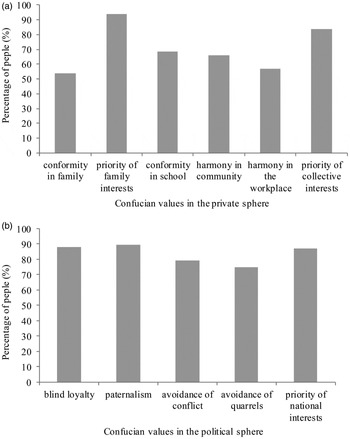
The Asian Barometer Survey asks the respondents about their religious affiliations. In mainland China, the percentage share of religions among the population is as follows: Buddhism (11.08%), Taoism (0.98%), Catholicism (0.33%), Protestantism (2.71%), others (0.37%), and non-affiliated (82.15%).Footnote 11 In communist China, it is not surprising that most people do not formally affiliate to any religious organization. However, this does not mean that they do not hold religious beliefs. Some folk religions mix Confucian ethics and Daoist rituals. As stated previously, Confucianism is a de facto religion whose rituals are beyond formal sacrifice and religious ceremonies (Chang Reference Chang2012; Yao Reference Yao2000). Even though Chinese people may not explicitly identify Confucianism as their religion, Confucian values permeate belief systems and guide people's behavior. Figure 1 shows the distribution of Confucian values in China. Over half of the Chinese people surveyed adhere to Confucian family and social values (see Figure 1a). There are variations in these Confucian values in the non-political sphere. Family and collective interests are prioritized over conformity to family and school as well as communal and workplace harmony.
Confucian values in mainland China.

This may be because the establishment of communist ideology in the past decades has undermined Confucian respect for authority and pursuit of harmony. In the Cultural Revolution (1966–1976), the Chinese were mobilized to challenge authority and disregard harmony under a Maoist revolutionary doctrine. Rebellion and aggression replaced conformity and harmony in mainland China. However, in recent years, the Chinese government has proposed to build a harmonious society. Harmony and social authority have gradually revived and it has never been challenged that personal interests are secondary to the collective interest.
More than 70% of Chinese people surveyed adhere to Confucian values in the political sphere (see Figure 1b). Three indicators of Confucian political values — blind loyalty, paternalism, and prioritization of national interests — obtained over 85% of the respondents’ support. These political values were also upheld in the Cultural Revolution. Red Guards in Mao's era, who were regarded as the most radically revolutionary and the least traditional activists, “displayed a loyalty towards Mao very similar to that which loyal subjects displayed towards the Emperor in imperial times” (Hua Reference Hua2001, 11). The strong adherence to Confucian political values demonstrates a persistent influence of the Confucian legacy in China. Clearly, Confucian political values differ from Confucian family and social values, and will influence Chinese people's support for democracy.
Chinese citizens’ support for democracy is examined through attachment to democracy and adherence to liberal democratic values (see Appendix). The survey reveals a strong attachment to democracy on all three indicators — the evaluations of desirability (M = 8.58 on a 10-point scale), suitability (M = 8.31 on a 10-point scale), and preferability of democracy (M = 2.72 on a 3-point scale). In contrast, there is a remarkable variation in the Chinese public's adherence to liberal democratic values. Democratic values of political equality and rule of law earn more endorsement, while the Chinese people show less support for self-determination and political pluralism.
Attachment to Democracy and Adherence to Liberal Democratic Values
As stated previously, support for democracy was divided into attachment to democracy and adherence to liberal democratic values in this study. Model 1 tested whether the Chinese public's overt attachment to democracy is consistent with their adherence to liberal democratic values (see Table 1). Hypothesis 1assumed that the Chinese who were attached to democracy would desire democratization heading to a liberal democracy. Competitive elections, freedom of speech, and separation of powers are all characteristics of a liberal democracy. However, attachment to democracy had no significant relationship with adherence to liberal democratic values (β = 0.01, p > 0.1, model 1). The regression analysis did not confirm Hypothesis 1. The results indicate that Chinese citizens who claim to be attached to democracy (in oral interviews) do not hold liberal democratic values.
The impacts of attachment to democracy on adherence to liberal democratic values

Note: Standard errors in parentheses. *p < 0.05, **p < 0.001, two-tailed test. Dependent variable = liberal democratic values.
The Impacts of Confucian Values on Adherence to Liberal Democratic Values
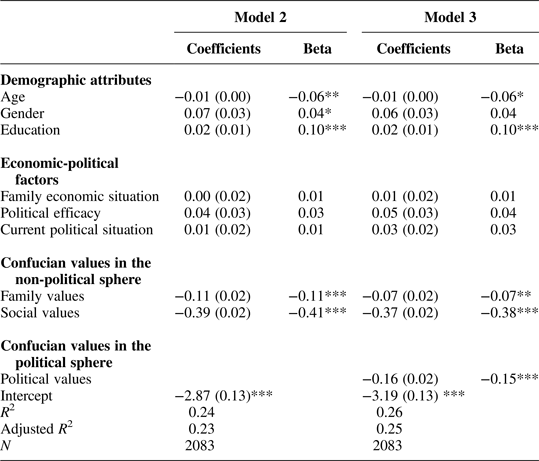
Table 2 shows the effect of multifaceted Confucianism on Chinese public's liberal democratic values. Model 2 examines the effect of Confucian family and social values on liberal democratic values. Model 3 introduces Confucian political values into the analysis and investigates their impact on liberal democratic values. Hypothesis 2.1 assumed that Confucian values in the non-political sphere suppressed adherence to liberal democratic values, and hypothesis 3.1 assumed that Confucian values in the political sphere restrained adherence to liberal democratic values. The results show that Confucian values in both the non-political and the political spheres are negatively correlated with adherence to liberal democratic values. Therefore, hypotheses 2.1 and 3.1 were confirmed.
The impacts of Confucian values on adherence to liberal democratic values

Note: Standard errors in parentheses. *p < 0.05, **p < 0.01, ***p < 0.001, two-tailed test. Dependent variable = liberal democratic values.
However, the younger generations and the better-educated tended to hold more liberal democratic values (β = −0.01, p < 0.05; β = 0.02, p < 0.001). Nathan and Shi (Reference Nathan and Shi1993, 116) argue that modernization will promote China's culture to resemble “the patterns characteristic of democratic countries.” Chinese democracy may embody Confucian elements, but it may not abandon liberal democratic values. In the future, generational replacement and continuous socioeconomic modernization may promote liberal democratic values, which may compete with Confucian political values.
The Impacts of Confucian Values on Attachment to Democracy
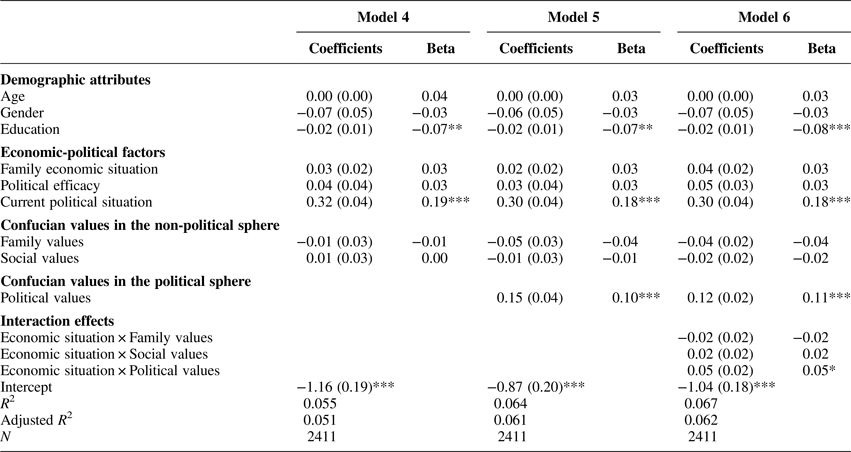
After discussing the relationship between Confucian values and adherence to liberal democratic values, Table 3 displays how Confucian values affect the Chinese public's attachment to democracy. The results show that the Chinese with lower education tended to claim an attachment to democracy. Evaluation of the current political situation was positively connected to attachment to democracy. This indicates that it is not those who are disappointed with the current political situation who aspire for democracy, but rather the people who favorably evaluate the current Chinese political situation. Model 4 examines the relationship between Confucian family and social values and attachment to democracy. Model 5 combines Confucian political values with Confucian family and social values to test the effect of Confucian values on Chinese people's attachment to democracy. The results show that Confucian values did not significantly restrain Chinese citizens’ attachment to democracy (desirability, suitability, and preferability of democracy). Hypotheses 2.2 and 3.2 were not supported. In summary, Confucian family and social values did not have significant negative effects on attachment to democracy. Surprisingly, Chinese people who embraced Confucian political values showed a higher level of attachment to democracy (β = 0.15, p < 0.001, model 5). In short, Confucian values are compatible with attachment to democracy.
The impacts of Confucian values on attachment to democracy

Note: Standard errors in parentheses. *p < 0.05, **p < 0.01, ***p < 0.001, two-tailed test. Dependent variable = attachment to democracy.
Given that economic security may influence Chinese's support for democracy, Model 6 tests an interaction between family economic situation and attachment to democracy. The result show that after adding the interaction items, the effects of Asian values remained consistent with the results reported in Model 5. The interaction item of the family economic situation and Confucian political values was significant (β = 0.05, p < 0.05, model 6). In addition, the results show that Confucian family and social values had no significant effects on attachment to democracy but Confucian political values had a positive effect on such attachment (β = 0.12, p < 0.001, model 6).
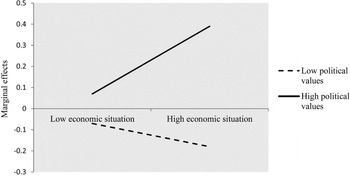
Figure 2 depicts how the family economic situation interacted with Confucian political values. Improvement of the family economic situation increased attachment to democracy among those with higher Confucian political values. However, an improvement in the family economic situation caused attachment to democracy to decline in the people with less Confucian political values. Among the people who adhered less to Confucian political values, an improvement in the family economic situation may result in increased indifference to politics rather than anti-democratic orientations. Ultimately, their attachment to democracy appeared to be in a lower level.
Interaction effects of family economic situation and Confucian political values

Due to different levels of Confucian political values, a big gap in attachment to democracy is evident among people from high-income families. People who have a higher level of Confucian political values tend to express a greater preference for democracy. Nevertheless, despite being economically well-off, people who have lower levels of Confucian political values do not argue strongly that they are attracted to democracy. What is the difference in socio-demographic characteristics between these two groups of people? I make a further comparison in terms of age, education, and residential area (rural areas versus urban areas). The results show that people who have a lower level of Confucian political values and are in high-income family situations (M = 41.79, SD = 15.05) are significantly younger than people who have a higher level of Confucian political values and are in high-income family situations ((M = 46.70, SD = 15.04), t (1567) = −6.37, p < 0.000). However, the two groups do not exhibit a significant disparity in their educational levels (t (1476) = 1.37, p = 0.17) and residential areas (t (1565) = 0.30, p = 0.77). The results indicate that age is an important factor that explains the salient gap in attachment to democracy among people from high-income families. The older generations with improved economic situations have higher levels of Confucian political values and tend to express their attachment to democracy more overtly. Nevertheless, the more prosperous youth are less committed to Confucian political values, but they also do not like to voice their support for democracy. As Figure 2 clearly shows, the youth and the elderly do not show a significant difference in attachment to democracy, when they are from low-income families.
DISCUSSION AND CONCLUSION
There is a great controversy as to whether or not Confucian values are compatible with support for democracy. Dalton and Ong (Reference Dalton and Ong2005) examine the link between social authority orientations and support for democracy. Their research indicates that parental and social authority relations do not have a negative spill-over effect on attachment to democracy; “Those who support a democratic regime do not have to defy traditional authority relations within the family or in the workplace” (Dalton and Ong Reference Dalton and Ong2005, 20). Support for democracy does not have to generate tension and dissonance with Confucian values in the non-political sphere. Dalton and Ong's study suggests traditional parental and hierarchic authority relations are not impediments to democratic development in East Asia.
The findings of this study clarified the relationship between Confucian values and support for democracy. The results reveal that Confucian values in the non-political sphere do not significantly undermine attachment to democracy. This indicates that attachment to democracy is compatible with Confucian family and social values in China. Fetzer and Soper (Reference Fetzer and Soper2007) also show that Confucianism remains strong in Taiwan, but Taiwanese people do not undermine support for democracy. Studies on Japan, South Korea, and other East Asian countries also demonstrate that the Confucian values of family loyalty, social hierarchy, and social harmony are not applicable to politics, and that Confucianism can be congruent with democracy (Ikeda and Richey Reference Ikeda and Richey2012; Shin Reference Shin2012). “The publics of Confucian societies are more supportive of democracy than is generally believed” (Inglehart and Welzel Reference Inglehart and Welzel2005, 156). Confucian values of filial piety, social harmony, and a communal ethos can be promoted because of their intrinsic value, without the baggage of association with authoritarianism (Fetzer and Soper Reference Fetzer and Soper2010). The results show that Confucian values are compatible with attachment to democracy in China.
However, the negative effects of Confucian values on support for democracy were confirmed in terms of adherence to liberal democratic values. Previous studies have not examined adherence to liberal democratic values (a form of implicit support for democracy) when examining the relationship between Confucianism and support for democracy. Unsurprisingly, these studies found that Confucianism is compatible with commitment to democracy. The present study confirms this result by conceptualizing support for democracy as attachment to democracy. However, the conflict between Confucian values and democracy manifests when we conceptualize support for democracy as adherence to liberal democratic values. Confucian family values, social values, and political values are all constrain the acquisition of liberal democratic values in China. The results indicate some potential challenges in China's political development. Confucian values in the non-political and the political spheres internalized by the Chinese are incompatible with the liberal democratic values. It indicates not only that Confucian political values undermine adherence to liberal democratic values, but also that Confucian values in the non-political sphere have negative effects on the liberal democratic values. Bell (Reference Bell2006) proposes a modern Confucian democracy. The shadow of the Confucian legacy may create a mass base for an illiberal democracy.
The findings highlight the complex relationship between Confucianism and democracy. This relationship has been under debate for decades. This study shows that the dimensions of Confucianism have a distinct effect on the attitudes toward democracy, and illustrates variations in the support for democracy. By classifying support for democracy into overtly expressed attachment to democracy and adherence to liberal democratic values, this study identifies the specific conditions in which Confucianism is compatible, or incompatible, with democracy. This new analytical framework reconciles the conflicting arguments and empirical evidence on the relationship between Confucianism and democracy in the existing literature.
Lastly, this study has relevant implications for the theoretical and practical understanding of the “cultural prerequisites” for democracy — whether Confucianism facilitates or hinders public support for democracy. The findings indicate that Confucianism will not inhibit the Chinese public's support for democracy in a prospective democratic transition, but it may considerably influence the consolidation of democracy in China. On the one hand, there are highly favorable evaluations of desirability, suitability, and preferability of democracy in authoritarian China. Confucian values in both the non-political and political spheres are sufficiently compatible with the public's attachment to democracy. On the other hand, attachment to democracy does not show any positive correlation with adherence to liberal democratic values, which are vital for the consolidation of democracy in this country.
Previous research views popular support for democracy as an indicator of democratic rootedness (Bratton and Mattes Reference Bratton and Mattes2001; Diamond Reference Diamond1999; Schedler Reference Schedler2001). However, overt support for democracy fails to predict the establishment of effective democracy, because the masses also show a high level of democratic support even in non-democracies where overt support for democracy is no more than lip service (Chu and Huang Reference Chu and Huang2010; Hadenius and Teorell Reference Hadenius and Teorell2005; Inglehart and Welzel Reference Inglehart and Welzel2003; Zhai Reference Zhai2016). The findings suggest that Chinese democratization faces potential challenges, as those who overtly express attachment to democracy do not possess liberal democratic values. One possible explanation is that the democracy that Chinese people adhere to is not in line with a liberal conception of democracy. Lu and Shi (Reference Lu and Shi2015) characterize alternative Chinese conceptions of democracy as a guardianship discourse on democracy (a mix of deep-rooted Confucian traditions and more recent Leninist legacies). The current study reflects the complex nature of Chinese pro-democratic attitudes. Even though Confucianism persistently influences the Chinese public's political attitudes, the young and the educated strongly support liberal democratic value; it is therefore reasonable to expect that a generational change will replace Confucian political values with liberal democratic values.
APPENDIX
Descriptive statistics of the Chinese public's explicit and implicit support for democracy