Introduction
The past three decades have witnessed remarkable economic growth and dramatic socio-demographic and epidemiological transition in China (Yang et al., Reference Yang, Wang, Zeng, Gao, Liang and Zhou2013). The huge economic success has, to a great extent, been fuelled by the unprecedented large-scale rural-to-urban migration (Liang & Ma, Reference Liang and Ma2004). Due to the household registration (hukou) system, which institutionalized a rigid rural–urban division in China for more than half a century operating as a major means of controlling population mobility and determining eligibility for state-provided social benefits (e.g. housing, public schooling and health care coverage) (Chan, Reference Chan2010), permanent urban settlement for most rural migrants is extremely difficult if not impossible. Coupled with rural migrants' overall poor living conditions (Zhou & Cai, Reference Zhou, Cai and Logan2008), these structural barriers often make it economically and logistically prohibitive for migrant workers to take their family with them when they move to the cities to work for better earnings. As a result, a large paediatric population in China has emerged and rapidly grown, labelled as ‘left-behind children’ (LBC), referring to youths with one or both parents away from home working in the cities as temporary labour migrants. The size of this youth population is enormous: approximately 60 million according to recent estimates, accounting for over 28% of the entire rural Chinese population younger than 18 years (Shang et al., Reference Shang, Wang, Gao, Xu, Cao and Zhu2011). How this special group fares in terms of health and well-being bears considerable public health and social significance as this issue has far-reaching implications for city planning, rural development, social stability and society's overall human development (Qin & Albin, Reference Qin and Albin2010).
Much research has been done on the psychology of LBC (Qin & Albin, Reference Qin and Albin2010) but fewer quantitative studies have been conducted to explore the role of parental migration on LBC's physical health, with evidence on non-communicable diseases and their risk factors being particularly lacking. The issue of non-communicable diseases is not constrained to richer, urban sectors but is also relevant to poorer, rural areas in China. For example, from 1991 to 2004, Chinese children and adolescents became increasingly overweight and obese and the prevalence of pre-hypertension and hypertension also increased dramatically in both rural and urban areas (Zhang et al., Reference Zhang, Seo, Kolbe, Middlestadt and Zhao2010; Liang et al., Reference Liang, Xi, Hu, Wang, Liu and Yan2011).
High blood pressure (HBP) is a major non-communicable disease of high adulthood prevalence throughout the world and a leading cause of disability and mortality in developing countries, accounting for 7 million deaths each year (Dong et al., Reference Dong, Wang, Wang, Liu and Ma2013). Ample evidence has shown that HBP in adults can be traced back to childhood (Feber & Ahmed, Reference Feber and Ahmed2010). Little evidence is available as to how parental migration is associated with LBC's HBP in the Chinese setting (Liu et al., Reference Liu, Yin and Mao2014).
There are a number of reasons why parental migration may affect LBC's blood pressure (BP) levels. Rural-to-urban migrant workers typically send a large share of their income back to their rural stay-behind households (Du et al., Reference Du, Park and Wang2006). Migrant remittances serve as a key mechanism underlying the impacts of migration in sending areas as they increase income in the original community (Beine et al., Reference Beine, Docquier and Rapoport2008), buffer mental health costs of family out-migration (Lu et al., Reference Lu, Hu and Treiman2012), and improve LBC's nutritional status (de Brauw & Mu, Reference De Brauw and Mu2011) by making available a healthier diet such as dairy products, which have been found to be antihypertensive in children (Yuan et al., Reference Yuan, Kakinami, Gray-Donald, Czernichow, Lambert and Paradis2013). Given the general negative link between socioeconomic status and HBP (Grotto et al., Reference Grotto, Huerta and Sharabi2008), parental migration should be a protective factor against HBP for left-behind children. On the other hand, increased income may also lead to a transition from traditional rural diets high in fibre and low in fat to modern convenient diets high in sodium and saturated fats and low in vegetables (Mittal & Singh, Reference Mittal and Singh2010), which can lead to an elevated BP. Therefore, income effects of parental migration are theoretically ambivalent.
Besides its effect on income, parental migration is inevitably concomitant with parental absence, often incurring social deficits in terms of less parental control, supervision and support available to LBC. These deficiencies may partly explain why LBC tend to have a higher prevalence of cigarette smoking and alcohol consumption compared with children in non-migrant households (Gao et al., Reference Gao, Li, Kim, Congdon, Lau and Griffiths2010, Reference Gao, Li, Chan, Lau and Griffiths2013). Unhealthy diets, cigarette smoking and heavy alcohol drinking have all been found to be risk factors of HBP (Lazarou et al., Reference Lazarou, Panagiotakos and Matalas2009; Kerr & Ye, Reference Kerr and Ye2010; Virdis et al., Reference Virdis, Giannarelli, Neves, Taddei and Ghiadoni2010). Meanwhile, physical activity is another behavioural factor associated with both parental migration and LBC's blood pressure. Research has found that older LBC were more likely to take on more household chores and field work due to the reduced human endowments at home caused by parental migration and had similar or lower risk of overweight compared with non-left-behind children (non-LBC), namely rural Chinese youth living in non-migrant households (De Brauw & Mu, Reference De Brauw and Mu2011; Ye & Lu, Reference Ye and Lu2011). Thus, there seem to be paradoxical forces of parental migration shaping changes in LBC's lifestyle factors in complex ways. Depending on the relative strengths of these forces, holding other things constant, parental migration may contribute to a higher or lower BP for LBC.
In addition to behavioural mechanisms, parental migration may be linked to HBP via psychosocial mechanisms. Despite mixed results on a whole spectrum of mental outcomes (Qin & Albin, Reference Qin and Albin2010; Gao et al., Reference Gao, Li, Chan, Lau and Griffiths2013), LBC are generally found to have lower levels of self-efficacy (Liu et al., Reference Liu, Sun, Zhang, Wang and Guo2010) and social support (Gao et al., Reference Gao, Wang, Wang and Liu2007; Wen & Lin, Reference Wen and Lin2012) and higher levels of anxiety, depression, loneliness and hostility (Luo et al., Reference Luo, Wang and Gao2007; Liu et al., Reference Liu, Li and Ge2009; Su et al., Reference Su, Li, Lin, Xu and Zhu2013). Net of other influences, these negative psychosocial processes may be associated with heightened stress level and HBP (Din-Dzietham et al., Reference Din-Dzietham, Nembhard, Collins and Davis2004; Zhang et al., Reference Zhang, Niaura, Todaro, Mccaffery, Shen, Spiro and Ward2005; Ginty et al., Reference Ginty, Carroll, Roseboom, Phillips and De Rooij2013).
Taken together, as money and time are two pivotal resources parents can provide for their children, and because the effects of parental migration on the two factors are theoretically conflicting, how parental migration and LBC's HBP are linked is an empirical question. The present study sought to examine this question by analysing data from a recent longitudinal survey comparing LBC with non-LBC. In addition to parental migration, the role of sibling migration when both parents stayed at home was also examined. A recent study reported that LBC's education benefited from the migration of siblings, whereas parental migration was not a significant factor (Lu, Reference Lu2012). Yet we know little about the role of sibling migration on LBC's health, although in theory LBC may benefit from sibling migration via their remittances while avoiding developmental deficits possibly incurred by parental absence. To the best of the authors' knowledge, the present study is the first to report longitudinal evidence on the associations between parental and sibling migration and HBP among LBC in rural China.
Methods
Data
This study draws on four waves of longitudinal data from the China Health and Nutrition Survey (CHNS) in the years 2000, 2004, 2006 and 2009. The CHNS is an ongoing prospective multi-cohort survey that applies a multistage, random clustering sampling design to obtain information from about 4400 households with a total of 26,000 individuals in nine Chinese provinces. The average response rate was 88% at the individual level and 90% at the household level in the four survey waves (Popkin et al. Reference Popkin, Du, Zhai and Zhang2010). Although the CHNS is not designed to be nationally representative, it covers areas that account for approximately 45% of China's total population varying substantially in geography, economic development, public resources and health indicators. Thus it can provide a comprehensive picture of how social and economic transformation is affecting the health and nutrition status of the Chinese population as a whole. This study's analyses were limited to children aged 7–17 years who lived in rural areas and excluded respondents who had missing values on any variables. The final analytical sample included 2170 rural children and 3045 person-year observations, where a unique respondent could contribute to one to four observations across the four survey waves.
Measures
Several blood pressure outcomes were examined. Blood pressure levels were measured by trained examiners at three different consecutive times on the same visit. After a subject had rested at least 5 minutes in the sitting position, BP was measured on the right arm with the arm-cuff maintained at heart level. Korotkoff phase 1 and Korotkoff phase 5 were used to define systolic BP and diastolic BP, respectively, and the means of the three BP measures were used as the final BP values. A categorical BP measure was then created using a recently validated age–sex-specified distribution for Chinese youth (Mi et al., Reference Mi, Wang and Meng2010). This distribution considers normal BP as <90th percentile in the reference sex and age groups, pre-hypertension as the ≥90th percentile but <95th percentile, and hypertension as ≥95 percentile. Thus, the first BP measure used in the analysis was a dichotomous variable indicating whether a child had normal BP (coded as 0) or HBP, which can be categorized into either pre-hypertension or hypertension ranges (coded as 1). The second BP measure was a three-level ordinal variable distinguishing normal BP (coded as 0), pre-hypertension (coded as 1) and hypertension (coded as 2). The last two BP measures were continuous systolic and diastolic BP levels.
The key independent variable of interest was family migration status. Despite its rich data, the CHNS was not originally conceived to study internal migration. Subjects' migration status needs to be built up from the household roster. Following previous work (de Brauw & Mu, Reference De Brauw and Mu2011; Lu, Reference Lu2012), a variable of migration status was created by combining information on family members' migration status in a household and their relationship to the focal child. The CHNS household questionnaire had a question asking whether a family member lived in the home; if not, a follow-up question asked why this family member was absent, with one response option indicating he/she had emigrated for work. This information was then linked to CHNS's relationship file to identify whether the person who had emigrated for work was the focal child's mother, father or sibling. Therefore, the measure used in the analysis contained five mutually exclusive categories: non-migrant family versus mother-only, father-only, both-parent, and sibling-only migration family.
Demographic controls included children's age (dichotomized into age 7–12 versus age 13–17 groups) and sex (male versus female). Family socioeconomic status was captured by parental educational attainment and annual household per capita income. Each parent's educational attainment was categorized into no education (reference group), primary school, middle school and high school or above categories. Annual household per capital income was standardized in regression models to accommodate its skewed distribution.
Statistical analyses
Age-standardized rates of HBP (including both pre-hypertension and hypertension) and hypertension alone were calculated. A series of logistic random effects models were constructed for the dichotomous HBP measure (i.e. normal BP versus pre-hypertension or hypertension) and ordinal logit random effects analyses were performed for the three-level ordinal BP measure (i.e. normal, pre-hypertension and hypertension). For the continuous measures of systolic and diastolic BP levels, linear random effects regression analysis was conducted. Model 1 examined children living in migrant households as a general category as compared with those living in non-migrant households. Model 2 examined the four specific migration types (i.e. mother-only, father-only, both-parent and sibling-only migration family) against the reference group: non-migrant family. These two models were repeated for the four BP outcomes: 1) binary outcome of normal BP versus pre-hypertension or hypertension; 2) three-level ordinal outcome of normal BP, pre-hypertension and hypertension; 3) continuous systolic BP levels; and 4) continuous diastolic BP levels. The interaction effects of age and sex with parental migration were also examined but the results were not presented given the null findings.
All the models controlled for age, sex, mother's education, father's education and annual per capita household income (standardized). Overall, random effects models can aid in exploring heterogeneity across individuals and permit inference about the effects of the explanatory variables on an individual respondent while taking into account repeated observations of each respondent. Although fixed effects models have the advantage of purging out unobserved differences to achieve better causal inference in longitudinal data, they considerably reduce the power of the analysis and the Hausman test (Greene, Reference Greene2008) suggested that random effects models should be more appropriate for the present study.
Results
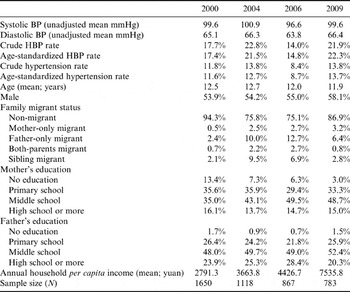
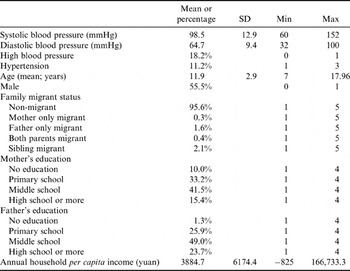
Table 1 presents descriptive statistics by survey year. The age-standardized HBP rate and hypertension rate showed that from year 2000 to year 2009 rural Chinese children's risk for high blood pressure had considerably increased. As to family socioeconomic characteristics, compared with mothers, fathers were less likely to have received no formal education and more likely to have finished high school or received higher education. Increase in the mean annual per capita household income was remarkable, from 2791 yuan in 2000 to 7536 yuan in 2009, parallel to China's overall rapid economic development in the 2000s. To provide more detailed information of the analytical sample, Table 2 presented descriptive statistics of the 2170 individuals at their initial wave. The CHNS noted that it was possible for some households to report negative income as a result of the cyclic nature of raising livestock, natural disasters or varying market prices of livestock and agricultural products (China Health and Nutrition Survey, 2011).
Descriptive statistics of sample by survey year, rural children aged 7–17, China

Note: unweighted sample. Sampling weights are not available in the CHNS. Sample size may vary due to different missing values across variables.
Descriptive statistics of respondents at their initial wave (N=2170), rural children aged 7–17, China

Note: unweighted sample. Sampling weights are not available in CHNS.
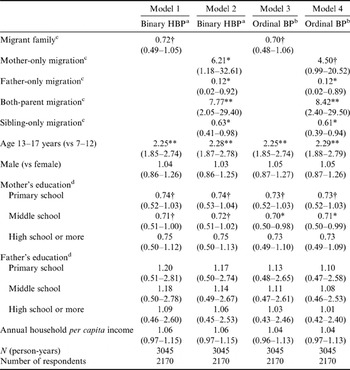
Table 3 presents results on the odds of pre-hypertension or hypertension. Models 1 and 2 show results of logistic random effects models (on the binary outcome of hypertension or not) and Models 3 and 4 present results of the ordinal logit random effects models (on the three-level ordinal outcome), predicting the odds of rural Chinese children's pre-hypertension or hypertension as a function of parental migration status and a range of demographic and socioeconomic factors. The results were fairly consistent across these two modelling strategies. There were marginal differences in the odds of HBP or higher BP between children from non-migrant families and those from migrant families (Models 1 and 3). However, when parental migration was further specified into four subcategories, including mother-only, father-only, both-parent and sibling migration types, significant associations emerged. Being a child in mother-only (Model 2: OR=6.21, p<0.05; Model 4: OR=4.50, p=0.52) or both-parent (Model 2: OR=7.77, p<0.01; Model 4: OR=8.42, p<0.01) migrant families was strongly and positively associated with the odds of the child having pre-hypertension or hypertension, whereas father-only (Model 2: OR=0.12, p<0.05; Model 4: OR=0.12, p<0.05) and sibling-only migration (Model 2: OR=0.63, p<0.05; Model 4: OR=0.61, p<0.05) were negative covariates compared with mother-only and both-parent migration families.
Odds ratio estimates from logit or ordinal logit random effects models of high blood pressure, rural children aged 7–17, China

a Binary HBP distinguishes normal BP versus pre-hypertension or hypertension.
b Ordinal BP has three levels: normal BP, pre-hypertension and hypertension.
c Reference category is ‘non-migrant family’.
d Reference category is ‘no education’.
95% confidence intervals are in parentheses.
**p<0.01; *p<0.05; †p<0.10.
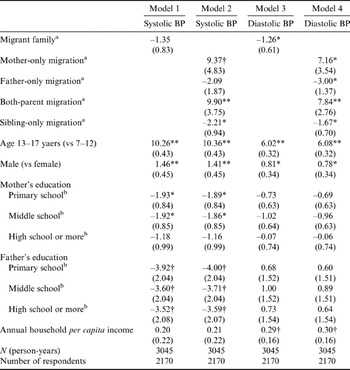
Table 4 presents results on the levels of systolic and diastolic blood pressure. The results do not differ much from those presented in Table 2. Model 1 and Model 3 show that parental migration status, when measured crudely with a dichotomous indicator, had a significant and negative effect on diastolic BP but no significant effect on systolic BP. Model 2 shows positive associations of systolic BP with mother-only migration (coefficient=9.37, p=0.52) and both-parent migration (coefficient=9.90, p<0.01) but no effect of father-only migration. Sibling-only migration had a significant and negative association with systolic BP (coefficient=−2.21, p<0.05). Model 4 shows positive associations of diastolic BP with mother-only (coefficient=7.16, p<0.05) and both-parent migration (coefficient=7.84, p<0.01) and negative associations with father-only (coefficient=−3.00, p<0.05) and sibling-only (coefficient=−1.67, p<0.05) migration.
Coefficient estimates from OLS random effects models of systolic and diastolic blood pressure levels, rural children aged 7–17, China

a Reference category is ‘non-migrant family’.
b Reference category is ‘no education’.
Standard errors are in parentheses.
**p<0.01; *p<0.05; †p<0.10.
The results on age and annual household per capita income were consistent across models. Adolescents, on average, had higher BP levels and greater odds of HBP than children. Few significant associations were found for income, except for its marginally negative association with diastolic BP (Table 4, Models 3 and 4). Sex differences were not found in the odds of HBP (Table 3) but were found for mean BP levels (Table 4). Boys had higher mean levels of systolic BP but lower mean levels of diastolic BP than girls. Some significant effects were found on parental education, with mother's education being more associated with decreasing children's odds of HBP or systolic BP levels than father's education (Tables 3 and 4).
Discussion
Using data from a longitudinal survey collected from nine provinces of China, this study investigated the associations between family member migration and the odds of high BP and mean systolic and diastolic BP levels of left-behind children in rural China. The key finding is that different migration circumstances play different roles in LBC's blood pressure, with mother-only and both-parent migration being detrimental and father-only and sibling-only migration either having no association or negative associations with LBC's HBP. This pattern remains consistent across age and sex subgroups and across the four different BP outcomes. While systolic BP was previously viewed as a stronger predictor of cardiovascular disease, recent evidence shows an independent significance of diastolic BP with specific health risks identified according to which number is elevated (Rapsomaniki et al., Reference Rapsomaniki, Timmis, George, Pujades-Rodriguez, Shah and Denaxas2014). It is thus necessary to examine a range of BP outcomes to achieve a comprehensive understanding of HBP aetiology.
Despite a burgeoning literature on LBC's health and well-being in rural China (Qin & Albin, Reference Qin and Albin2010; Lu, Reference Lu2012; Wen & Lin, Reference Wen and Lin2012), little work has been done on the effect of parental migration on LBC's physical health. This study focused on the effect of family migration on childhood and adolescence hypertension, a serious public health problem given its rapidly rising trend in China. As far as the authors are aware, only one prior study (Liu et al., Reference Liu, Yin and Mao2014) has hitherto examined this issue, and this showed positive associations between parental migration and LBC's BP levels. The study was limited by its cross-sectional design, relying on one-time BP measurements, and not specifying different parental migration circumstances. The present study offers a valuable extension by performing longitudinal analysis, measuring BP levels from three consecutive BP readings on a single visit (thereby reducing ‘white coat’ bias), and delving into detailed parental migration categories including both parental and sibling migration. The findings suggest separation from the mother to be particularly detrimental, whereas father or sibling migration per se seems protective against LBC's HBP.
If an association between family migration and LBC's HBP is routinely established, the next step would be to understand why. In theory, as discussed above, family migration may matter for LBC's HBP via complex socioeconomic, behavioural, and psychosocial pathways. Examining these mediators is beyond the scope of the present study. However, speculations can be made based on findings from this study and other studies as to the varying strength of the different hypothesized mechanisms. One hypothesized pathway linking family migration and LBC's HBP is via increased BMI owing to dietary changes following increased income. Yet a recent study (de Brauw & Mu, Reference De Brauw and Mu2011) found LBC aged 7–12 were more likely to be underweight rather than overweight, possibly due to increased housework, thereby indirectly disputing the BMI hypothesis. Meanwhile, increased income may also lead to greater amounts of dairy intake, which has been found to be antihypertensive and may be a source of benefit from father-only and sibling-only migration. Although mother-only and both-parent migration also contribute to staying-behind household's income, these two types of migration may exert more detrimental effects on other aspects of LBC's life to ultimately exert a net detrimental effect. Therefore, the paradoxical findings on different effects on childhood hypertension of the mother versus father and sibling migration seem to lend more support to the behavioural and psychosocial explanations given previous findings that LBC of mother-only or both-parent families were more likely to suffer from risky behaviours such as smoking, binge drinking and illicit drug use and psychosocial issues such as low self-efficacy, anxiety and depression compared with non-LBC and other migrant families (Liu et al., Reference Liu, Li and Ge2009; Wen & Lin, Reference Wen and Lin2012; Gao, Reference Gao, Li, Chan, Lau and Griffiths2013). Previous work has presented suggestive evidence that LBC's greater susceptibility to cardiovascular disease is probably mediated via mental conditions such as depression, anxiety and loneliness (Liu et al., Reference Liu, Yin and Mao2014). These different hypotheses on mechanisms underlying the migration–HBP link among rural Chinese children need to be empirically tested in future work.
To design effective interventions and curb the rising tide of childhood hypertension in China, better understanding of the risk factors needs to be achieved. The aetiology of childhood hypertension is generally less studied than adulthood hypertension and prevention recommendations are often based on extrapolated findings from adult samples (Lazarou et al., Reference Lazarou, Panagiotakos and Matalas2009). It has been reported that elevated BP levels in childhood are associated with the same lifestyle factors as in adults such as fat and salt dietary intake, physical (in)activity and body mass, socio-demographic factors such as socioeconomic status and ethnicity, and psychosocial processes (Lazarou et al., Reference Lazarou, Panagiotakos and Matalas2009; Ginty et al., Reference Ginty, Carroll, Roseboom, Phillips and De Rooij2013). More research is needed to assess demographic and modifiable environmental factors on childhood hypertension in China. Of the socio-demographic factors examined in this study, annual household per capita income was the only one that was insignificant, possibly due to the above-mentioned ambivalent impact remittance-based income increase may have on LBC's nutritional status, BMI and psychosocial processes such as lessened stress from lower poverty. The other socio-demographic factors, namely parental migration, age, sex and parental education, were all significant. A clear-cut pattern was observed in this sample regarding age difference, with adolescents having higher mean BP levels and greater odds of HBC than children aged 7–12, a finding consistent with those of other studies (e.g. Liang et al., Reference Liang, Xi, Hu, Wang, Liu and Yan2011). Sex difference only exists for BP levels, with boys having higher systolic BP levels but lower diastolic BP levels. Educational effects also differed by BP outcomes, with the mother receiving some education (vs no education) being linked to children's lower hypertension risks and lower systolic BP levels. These discrepancies may be due to statistic artifacts or could reflect true differences in sex and education impacts on children's BP levels resulting from complex and sometimes even conflicting mechanisms.
The current study has three major strengths. The first is its longitudinal design with a reasonably broad geographic and population coverage. The second is the use of average values of three repeated BP measurements on a single visit to confirm diagnosis of pre-hypertension and hypertension; this measurement approach affords less bias (Meng et al., Reference Meng, Liang, Liu, Hu, Yan and Mi2013). The third is the analysis of more-detailed family migration categories including multiple parental migration types and sibling migration. To the best of the authors' knowledge, this level of nuanced analysis has not been done in studies of LBC's health and well-being in China. The findings are consistent with a previous study reporting beneficial effects of sibling migration and insignificant effects of parental migration on LBC's educational outcome (Lu, Reference Lu2012).
Two limitations are particularly noteworthy. First, despite the data's longitudinal design, no causal conclusions can be made considering the study's observational nature. Selection bias cannot be ruled out. Second, due to sample size and survey limitation, it was not possible to take migration characteristics such as length of separation and distance of migration into account. Presumably there should be many interaction effects of family migration associated with these factors. An ad hoc analysis was performed to explore interaction effects of family migration with age and sex and none was found to be significant (data not reported but available upon request).
In summary, the key conclusion from the current study is that there can be both benefits and costs of family migration on LBC's blood pressure outcomes depending on who is the one that has migrated. The picture is more complex than suggested by the general developmental literature on LBC in China; that is, with a few exceptions (e.g. Wen et al., Reference Wen, Su, Li and Lin2014), the literature generally expects and reports negative effects of family migration on LBC's development and is typically silent on positive sides of the story. More research is clearly needed to examine family migration effects on LBC's physical health. Although youth are generally healthy, many latent health conditions developed prior to adulthood can have lingering effects on health later in life. Hypertension is one of such conditions, which is often labelled a ‘silent killer’ because it can damage the heart, kidney and brain, yet have no symptoms, and can track from childhood into adulthood. Hypertension is both preventable and treatable thanks to epidemiological and medical advancement but its asymptotic nature often makes the condition undiagnosed due to the lack of public awareness of the existence and harmfulness of this condition, particularly among children. Serious attention should be paid to HBP issues among Chinese children in general and rural LBC in particular. To alleviate the potential detrimental effects of family migration, particularly mother-only and both-parent migration, on LBC's health and well-being, the central or local government might consider implementing policies such as providing nutritious meals at school and strengthening community support and informal social control for LBC in high migration areas.