INTRODUCTION
Batoid fish (order Rajiformes) are the most speciose order of extant cartilaginous fish, comprising 56% of elasmobranch species (Fowler et al., Reference Fowler, Cavanagh, Camhi, Burgess, Cailliet, Fordham, Simpfendorfer and Musick2005; Ruocco et al., Reference Ruocco, Lucifora, Díaz de Astarloa and Wöhler2006). The skates (family Rajidae) are the most diverse family of batoids with 283 species described (Fowler et al., 2005; Ruocco et al., Reference Ruocco, Lucifora, Díaz de Astarloa and Wöhler2006). They are found worldwide from equatorial to polar latitudes, ranging in depth from along the shoreline to 3000 m (McEachran & Miyake, Reference McEachran, Miyake, Pratt, Gruber and Taniuchi1990). They are important benthic predators, feeding on invertebrates in soft sediment sea-floor communities. Many larger skates also feed on large pelagic or demersal fish. Despite their ecological importance, there is relatively little information known about the reproductive behaviour and population dynamics of skates.
Like most chondrichthyans, skates have life histories that include low fecundity, slow growth, late maturity, and depend on high survivorship at all ages (Holden, Reference Holden1973, Reference Holden and Hardin-Jones1974, Reference Holden and Gulland1977; Walker & Heessen, Reference Walker and Heessen1996; Camhi et al., Reference Camhi, Fowler, Musick, Bräutigam and Fordham1998; Ebert et al., Reference Ebert, Compagno and Cowley2007). These characteristics have made chondrichthyans increasingly susceptible to fishing pressures as either targeted or by-catch species (Bonfil, Reference Bonfil1994; Musick et al., Reference Musick, Burgess, Caillet, Camhi and Fordham2000), and vulnerable to overexploitation (Stevens et al., Reference Stevens, Bonfil, Dulvy and Walker2000; Dulvy & Reynolds, Reference Dulvy and Reynolds2002; Ebert et al., Reference Ebert, Compagno and Cowley2007). Species with such K-selected population structures rely on high survival and recruitment of young. Understanding habitat requirements may be critical for successfully evaluating population dynamics in skate species.
Bathyraja is the most diverse genus of skates in the North Pacific (Ishihahra & Ishiyama, Reference Ishihara, Ishiyama, Uyeno, Arai, Taniuchi and Matsuura1986), with new species being identified relatively recently (Díaz de Astarloa & Mabragaña, Reference Díaz de Astarloa and Mabragaña2004; Stevenson et al., Reference Stevenson, Orr, Hoff and McEachran2004). Bathyraja species are increasingly targeted by commercial fishing (Díaz de Astarloa & Mabragaña, 2004) and are common as by-catch (Cedrola et al., Reference Cedrola, González and Pettovello2005). The golden skate (Bathyraja smirnovi, Soldatov & Pavlenko, 1915) commonly occurs in the western Bering Sea, Sea of Okhotsk, and is the dominant skate in the Sea of Japan (Ishihara, Reference Ishihara1990). There is no other published information on the population structure of this species (Ishihahra & Orlov, 2007). It occurs from 100 to 1125 m depth, is born around 22 cm total length (TL), and reaches maturity at about 100 cm TL in males and 92 cm TL in females (Ishihara & Orlov, Reference Ishihara and Orlov2007), unlike most skates in which females reach maturity at a larger size than males (Ebert et al. Reference Ebert, Compagno and Cowley2007; Hoff, Reference Hoff2008). In Japanese waters, the species is reported to feed on crustaceans, octopus, Japanese sardine, Pacific saury, Japanese horse mackerel, and rockfish (Ishihara, Reference Ishihara1990). Although there is no current conservation concern for the species, it is a common by-catch species in Japan for bottom trawl and long-line fisheries targeting cod, spiny dogfish, and anglerfish (Ishihara & Orlov, Reference Ishihara and Orlov2007).
Recently, identification of skate nurseries and initial characterization of habitat have received more attention (Hoff, Reference Hoff2007, Reference Hoff2008, Reference Hoff2010; Love et al., Reference Love, Schroeder, Snook, York and Cochrane2008). To this effort, we add our observations here of a nursery site for Bathyraja smirnovi along the eastern edge of the Shiribeshi Seamount in the Sea of Japan. Observations and analyses of five submersible dives establish that this site has been used repeatedly to lay eggs. Given the lack of information on habitat use and reproductive habits of skates in general, coupled with the increasing concern for chondrichthyan populations, these observations should prove valuable in future efforts to understand skate population dynamics and establish conservation guidelines.
MATERIALS AND METHODS
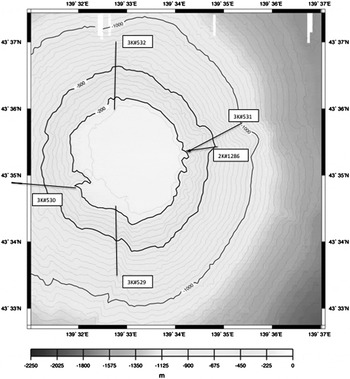
Benthic surveys around the Shiribeshi Seamount, Sea of Japan, were conducted by the Japan Marine Science and Technology Centre (JAMSTEC) during July 2001. The seamount is approximately 45 nautical miles off the west coast of Hokkaido, Japan (Figure 1). Bottom transects were performed from the bottom to the top of the seamount. Four transects were conducted during the ROV ‘Dolphin 3K’ dives 529–532 and one during the crewed submersible (HOV) ‘Shinkai 2000’ dive 1286 (Table 1). The four ROV transects were conducted along the four cardinal directions around the seamount, and the ‘Shinkai’ dive was conducted along the east side (Figure 2). The ROV ‘Dolphin 3K’ was equipped with a three-chip CCD camera, light sensitive Super Harp camera, three 400-W SeaArc HMI/MSR metal halide lights, one 250-W SeaLine SL-120/250 halogen light, specimen collection gear, and a SeaBird SBE19 CTD to measure water parameters (for details on instrumentation see Hunt & Lindsay, Reference Hunt and Lindsay1999). The HOV ‘Shinkai 2000’ was equipped with a Victor GF-S1000 HU three chip CCD camera, light sensitive Super Harp camera, three 400-W SeaArc HMI/MSR metal halide lights, and five 250-W SeaLine SL-120/250 halogen lights, a collection canister, a SeaBird SBE19 CTD and SBE oxygen sensor (for details on instrumentation see Lindsay, Reference Lindsay2003). Video data were recorded in NTSC format on BCT-D124L Digital BetaCam tapes, and then dubbed Digital BetaCam videotapes were reviewed using a Sony HR Trinitron PVM-2054Q monitor.
Map of the Sea of Japan, showing the location of the Shiribeshi Seamount 45 nautical miles off the coast of Hokkaido Island.

Bathymetric map of Shiribeshi Seamount showing the transect locations for the five submersible dives analysed.

Transect starting and ending locations with depth for the five submersible dives analysed.

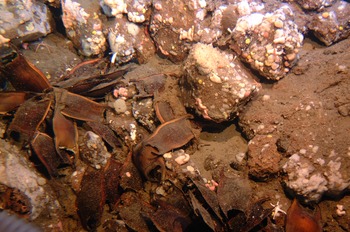
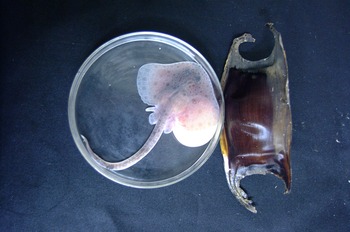
Skate eggs were observed at 43°35′21.90″N latitude by 139°34′15.48″E longitude during the ‘Dolphin 3K’ dive 531 along a benthic transect on the east side of the seamount. Two egg cases were sampled by the ROV. Skate eggs were also observed at 43°35′23.16″N latitude by 139°34′16.2″E on the ‘Shinkai 2000’ dive 1286 (Figure 3). The exact location of the nursery in Figure 2 can be observed where the two transect lines intersect. Samples were collected and one male embryo (186 mm TL) was also confirmed to be Bathyraja smirnovi based on morphological characters including a break in the distribution of spines and tubercles between the head and the tail (Figure 4). Estimates of egg abundances were carefully made from the video by directly counting individual eggs and small egg clusters where possible, and estimating abundances for larger clusters of eggs by using the area of smaller proximate clusters that could be counted and extrapolating to larger areas. Care was taken not to recount eggs by using landmarks in the video and repeatedly jogging a section of footage forward and backward to ensure each patch was counted only once. This effort was aided by using the compass heading, time, and depth data recorded on the video. The data from the video were recorded into an Excel spreadsheet for analysis.
Egg cases of Bathyraja smirnovi as photographed in situ by the ROV ‘Dolphin 3K’.

Embryo of Bathyraja smirnovi collected on the ROV ‘Dolphin 3K’ dive 531. The Petri dish is 15 cm in diameter.

RESULTS
During the ‘Dolphin 3K’ dive 531, 1670 egg cases were observed over a period of 9 1/2 minutes, the vast majority being observed in a relatively small rocky area near a ledge dominated by primnoid gorgonians (Matsumoto, Reference Matsumoto, Freiwald and Roberts2005). Eggs were deposited in spaces and hollows between exposed rocks. The abrupt appearance and disappearance of eggs on the video suggests that the eggs were confined to this limited area.
During the ‘Shinkai 2000’ dive 1286, a total of 1760 eggs were observed on top of a rocky ledge. Seven scattered egg cases were observed on a mudflat adjacent to the ledge as the submersible moved from 406 m depth to 347 m depth. One skate with adult coloration was observed in proximity to these seven egg cases (344 m). Within the same mudflat area, young skates (age based on size and coloration) were observed from 313 m to 306 m. A total of 15 skates was observed on the video, with sizes ranging from slightly larger than an average egg case to three times as long as an egg case including the tail (estimates were aided by video sequences where individuals were near an egg case).
As the submersible ascended over the edge of the rocky outcrop to continue the transect at 293 m, egg cases were observed in abundance. As in the ROV observations, eggs were piled in spaces among the rocks. During one 6-minute period, 1530 egg cases (87% of the dive total) were observed in a relatively small area (approximately 2000 m2) from depths of 271 m to 245 m. Over the next several minutes, 30 more egg cases were observed in lower densities, and then abruptly there were no more eggs. By fixing landmarks in the distance and estimating how far the submersible travelled, the distance along the sea-floor between where the eggs were still abundant (depth 245 m) and completely gone (depth 233 m) was approximately 30 m. Using data available from other dives in the nursery area, we estimate the annual ranges for temperature to be from 0.8°C to 2.0°C, with salinity between 33.97 and 34.08 psu, and dissolved oxygen between 5.2 and 5.3 ml/l.
DISCUSSION
There has been very little published on Bathyraja smirnovi since its description (Ishihara, Reference Ishihara1990). Phylogenetic analyses on morphological characters confirmed it as a distinct species (McEachran & Dunn, Reference McEachran and Dunn1998). Recent work by Kanokubo (Reference Kanokubo2004) reports the smallest free-living individuals (200–400 mm TL) eat mostly shrimp (60%) with some fish and squid. Shrimp declines to 30% of the diet in larger animals (400–600 mm TL) as more squid are eaten. Shrimp eaten included Argis lar, Spirontocaris spinus, and Pandalus borealis. At least one of these species (P. borealis) is known to be common on soft-bottom mudflats and many shrimp were also observed attached to the primnoid gorgonians in the video record.
Recent work by Hoff (Reference Hoff2007, Reference Hoff2008, Reference Hoff2010) characterized the nursery habitats for Bathyraja parmifera, B. aleutica, and B. interrupta. These studies used trawling data over much larger areas of soft-bottomed sea-floor than can be observed with ROVs, but excluded rocky ledges where trawling equipment would be damaged. Love et al. (Reference Love, Schroeder, Snook, York and Cochrane2008) reported on a nursery for the long-nose skate Raja rhina. They used a manned submersible over a smaller targeted rocky reef area yielding high egg densities. Our study complements the above work, being the first report for a Bathyraja species also restricted to a rocky area where trawling would be difficult.
Hoff (Reference Hoff2008) reported on an egg nursery for the Alaska skate (Bathyraja parmifera) sampled using trawls. He defined an index site of approximately 1 km2 based on egg densities that reached over 50,000 eggs/km2. Eggs were found (in lower densities) several km in each cardinal direction from the index site in depths ranging from approximately 125 m to 155 m (see Hoff (Reference Hoff2008) figure 1B). The nursery described in the present study is much more restricted in extent. Based on landmarks observed in the video and known dimensions of the submersible equipment, we estimate the site to be restricted to approximately 2000 m2 or 0.2% of 1 km2. If we extrapolate the eggs observed in this study, the density would exceed 750,000 eggs/km2. This value is similar to abundances reported for some nursery grounds (Hoff, Reference Hoff2008, Reference Hoff2010).
Hoff (Reference Hoff2007) hypothesized and Love et al. (Reference Love, Schroeder, Snook, York and Cochrane2008) supported the idea that young skates may leave nursery grounds quickly. Our observations also support this idea as no young skates were observed on top of the rocky ledge with the eggs, though they were observed in the nearby mudflats. Hoff (Reference Hoff2010) and Love et al. (Reference Love, Schroeder, Snook, York and Cochrane2008) reported that skate nurseries are found near the mouths of submarine canyons. The nursery site described here was located near the top of Shiribeshi Seamount, on a rocky ledge near a mudflat valley, though on a smaller scale it appears there may be similarities in selecting habitats based on topographic features.
There were notable differences in our direct observations of the nursery area than that reported by Love et al. (Reference Love, Schroeder, Snook, York and Cochrane2008). On both dives in the present study where eggs were observed, clusters occurred in the gaps between rocks along a rocky ledge. Very few eggs (7) were observed on the mudflats near the rocky ledge, though young skates were observed exclusively there. The highest density of eggs occurred at depths where the density of both primnoid gorgonians and rossellid sponges was low, though those organisms occurred in abundance in areas surrounding the nursery. Primnoids were dominant at depths below the nursery and rossellids were prevalent at shallower depths. This is in contrast to the observation by Love et al. (Reference Love, Schroeder, Snook, York and Cochrane2008) that Raja rhina eggs were attached more often to sponges than rocks, and that the eggs occurred in areas dominated by sponges and gorgonians. We did not observe any eggs attached at all, but rather heaped together in clumps between the rocks. These observations may or may not be directly related to the deposition of eggs in the nursery, but we believe they may be useful to future investigations of skate nursery areas. It is possible that steeper ledges with presumably higher water flow in deeper waters were preferred by the primnoids (see photographs in Matsumoto, Reference Matsumoto, Freiwald and Roberts2005). The depths where rossellids were more common were approaching the summit of the seamount. The eggs were found in between these areas. Whether or not adults use these organisms as cues for where to lay eggs is speculative.
Regardless, the eggs observed in this study were clustered in one relatively small area. Three hypotheses were considered to explain this observation. First, skates may be choosing this location due to some environmental cue such as salinity or temperature. Second, skates may be choosing this location based on local topographic features such as a rocky outcrop near a mudflat. Third, skate eggs were laid in a broader area (including at shallower depths) and drifted to their present location.
We dismiss the third possibility on the basis of two observations. First, transect data from shallower depths revealed no eggs. If eggs were drifting to their current position, one would expect at least a few eggs to be stuck in crevasses or sea-floor depressions at shallower depths. Second, if currents were strong enough to push eggs onto the rocky ledge where they were observed (often higher off the sea-floor than surrounding mudflats), the same currents should have been strong enough to push eggs out onto the surrounding mudflats again. Since a small number of egg cases (7) were observed on the mudflats, we cannot completely dismiss the possibility that they drifted there from the rocky ledge, though this seems unlikely given how few were observed on the mudflat and that they were observed in the same area of the mudflat where young skates were observed. Perhaps some egg cases were transported to the mudflat by hatching skates.
It appears then that the skates are actively choosing this small area repeatedly as a site to lay eggs. This may be based on some combination of local topography and environmental conditions. Bathyraja smirnovi is a cold-water species. The CTD data indicate that the depth where eggs were found was approaching the depth where the water began to warm near the surface (Figure 5). Hoff (Reference Hoff2008) analysed the published literature on embryo development versus rearing temperature in oviparous chondrichthyans and estimated the developmental period for B. parmifera to be 1290 days using 4.4°C as the mean developmental temperature. Since all of our dives were conducted in July, we cannot be sure of the average year-long temperature at the nursery site, though the temperature at the nursery during these dives was 1.2°C. Using data from other dives, we estimate the yearly range of temperatures at the site to be between 0.8°C and 2.0°C. It is possible that B. smirnovi then has a developmental period of several years, similar to other cold water skate species.
CTD data for temperature and salinity of the two dives where Bathyraja smirnovi eggs were observed (ROV ‘Dolphin 3K’ dive 531 and HOV ‘Shinkai 2000’ dive 1286).

The location of the rocky ledge where the eggs were discovered was located at the shallow end of a small valley (see Figure 2). We suggest that the skates swim up the seamount, along the muddy bottom of the valley until they reach the rocky ledge. This is nearing the top of the seamount and the limit for their preferred temperature range. Once hatched, young skates swim the short distance down off the ledge onto the mudflat to feed on the invertebrates buried there. This is not unlike the ontogenetic shift suggested for other skates by Hoff (Reference Hoff2010). The topographic map (Figure 2) shows two more small valleys on the eastern side of Shiribeshi Seamount, just south of where the transects were conducted in this survey. Future transects in those valleys would be useful in determining how unique this particular location is.
Although little is known about the breeding and egg-laying habits of deep-sea skates and rays, we can infer some useful information from the video data. It appears that the skates are using this location for egg-laying iteratively. This is based on several observations. First, the young skates observed on the mudflat were of varying sizes, with some individuals twice the length of others. Second, collected egg specimens were in varying condition from containing well-developed embryos to having holes where embryos hatched and were partially decomposed. Furthermore, some of the hatched eggs were dark and clean of debris, while others were degraded, pale in colour, with sessile organisms (e.g. bryozoans) attached to them. Video observations confirm that darker eggs, clear of debris were usually observed on top of paler coloured egg cases covered with debris.
It remains unclear if the skates are using this site repeatedly throughout a single extended breeding season, or if the older eggs represent the remains of eggs laid over a series of years. We note, however, that only one large skate was observed in this study, suggesting that the adults were not in the immediate area or were unusually good at avoiding the submersible (though our observations suggest skates tend to remain still and allow submersibles to pass over them rather than swim away). A number of deeper-water skate species are reported to have year-round egg deposition (Templeman, Reference Templeman1982; Ruocco et al., Reference Ruocco, Lucifora, Díaz de Astarloa and Wöhler2006) and the same could be true of B. smirnovi. There was very little evidence that the egg cases were being fed upon, though several urchins were observed to be feeding on either the cases or the epibiota living on the cases (D.J. Lindsay, personal observation). Asteroids, ophiuroids, and gastropods were frequently observed in and around the eggs, though none were observed directly feeding on the eggs. We did not observe any large predatory fish during these dives. Given these observations, we believe that the older eggs represent eggs laid in previous years, making this site an important nursery for the species and a possible site for future conservation efforts such as the designation of a marine protected area (MPA). It is unclear if the few available reports on skate nurseries reflect real differences in habitat selection between species (rocky versus muddy bottom) or an artefact of sampling gear (trawling versus submersibles). It is also unclear if there is a range of habitat preferences from muddy to rocky within a given species. If this were true, commercial trawling over soft-bottomed areas may be acting as a selective pressure to change the population dynamics of skates in ways we do not understand. Gathering more information on nursery habitats is crucial to assessing and implementing appropriate conservation measures.
The results of this study indicate that Bathyraja smirnovi have used a specific area along the Shiribeshi Seamount in the Sea of Japan as a nursery. They have laid eggs in this location repeatedly over a season or more likely several years. Given the number of eggs counted in a single transect, the species is laying hundreds, or possibly thousands, per breeding season at this one site. Since most skates have low fecundity, it is likely that hundreds of females make their way to this nursery site each year. It remains unclear why this particular area has been chosen, or if the females arrive together or independently over the course of a breeding season. Future dives in and around this site on the Shiribeshi Seamount may provide a better understanding of the reproductive habits of this poorly known skate species.
ACKNOWLEDGEMENTS
We thank the captain and crew of the RV ‘Natushima’ and the operations team for the ROV ‘Dolphin 3K’ and the HOV ‘Shinkai 2000’ for their assistance in collecting the data. We are indebted to Dr Hajime Ishihara and Dr Toru Taniuchi for their assistance in identifying the skate embryos. Jun Tanada and Takashi Itoh provided support for the video analysis and Hirotaka Nakamura captured frames from the HDCAM video for publication. The present study contributes to the Census of Marine Life through the Japan National Regional Implementation Committee (Japan NRIC). This manuscript was supported, in part, by a grant from the Pennsylvania State System of Higher Education (FPDC no. 3032600108.1).