Introduction
The endoscopic modified Lothrop procedure is a modification of a technique that was first described by Lothrop over a hundred years ago. In more recent years, advances in computed tomography, endoscopy and drilling equipment have allowed the re-invention of the procedure. In 1991, Draf classified frontal sinus surgery into a series of three operations for widening the frontal sinus ostium using both an operative microscope and an endoscope.Reference Draf 1 The equivalent to the original Lothrop procedure was termed a Draf type III procedure. Gross et al. were the first to perform the procedure solely using the endoscope and coined the term ‘endoscopic modified Lothrop procedure’.Reference Gross, Gross, Becker, Moore and Phillips 2
This procedure was originally used as an endoscopic alternative to open approach osteoplastic frontal sinus obliteration for the treatment of chronic, refractory frontal sinusitis. The osteoplastic flap is historically the mainstay of surgical access to the frontal sinus.Reference Middleton, Briant and Fenton 3 It is now rarely used for chronic frontal sinusitis; the advent of functional endoscopic sinus surgery (FESS) has revolutionised the surgical treatment of sinus disease. Messerklinger developed the endoscopic technique with the aim of relieving diseased sinuses while preserving mucosa and at the same time being minimally invasive.Reference Stammberger and Posawetz 4 However, accessing the frontal sinus endoscopically can be challenging because of anatomical constraints in this area. Furthermore, the frontal sinus is susceptible to scarring and re-stenosis, which can result in recurrent frontal sinusitis. In such resistant cases, the endoscopic modified Lothrop procedure is a suitable option, and indeed the main indication for the procedure is persistent frontal sinusitis in cases in which multiple FESS procedures have failed.Reference Rajapaksa, Ananda, Cain, Oates and Wormald 5 , Reference Wormald, Ananda and Nair 6 In the largest reported world series, the average number of standard FESS procedures prior to an endoscopic modified Lothrop procedure was 3.8.Reference Naidoo, Bassiouni, Keen and Wormald 7
The Draf type III procedure or endoscopic modified Lothrop procedure, commonly known as a ‘frontal sinus drill out’, is in fact an advancement of the standard endoscopic approach to the frontal sinus. The endoscopic modified Lothrop procedure involves removing the inter-frontal sinus septum and the frontal sinus floor medial to the frontoethmoidal recesses, along with the cephalic portion of the nasal septum. This creates a common drainage pathway for both frontal sinuses, and avoids the need for external incisions and their associated morbidity.
Although the main indication for endoscopic modified Lothrop procedure has been difficult-to-treat frontal sinusitis, it is also used to provide surgical access to the frontal sinus in patients affected by other pathologies. We have previously shown that the endoscopic modified Lothrop procedure affords excellent access to the lateral walls of the frontal sinuses.Reference Anvarali, Hassaan and Saleh 8 This has also been shown in a cadaveric study, which demonstrated that the endoscopic modified Lothrop procedure permitted direct contact with the bone of the lateral wall under direct vision with the head of a 70-degree diamond burr.Reference Timperley, Banks, Robinson, Roth, Sacks and Harvey 9 Such lateral access would be impossible with standard endoscopic techniques, and this region could only previously be accessed via an open approach. The endoscopic modified Lothrop procedure has therefore widened the potential of endoscopic surgery for the frontal sinus, although the technique is of limited use in patients with frontal sinuses that have a narrow anteroposterior depth, narrow frontal sinus floor or hard bone in the nasal beak.Reference Sonnenburg and Senior 10
Thus, we have used the endoscopic modified Lothrop procedure for a variety of other disease processes affecting the frontal sinus, in addition to refractory frontal sinusitis. We describe our experience of the extended applications of the endoscopic modified Lothrop procedure, and review the relevant current published literature.
Materials and methods
We conducted a retrospective study of all patients who underwent an endoscopic modified Lothrop procedure, performed by the senior author (HS), during a seven-year study period, from 2005 to 2012. We evaluated the patients who underwent the endoscopic modified Lothrop procedure for any indication other than chronic frontal sinusitis. Hence, patients with idiopathic frontal sinusitis were excluded. Demographic and clinical data for all patients were retrieved from a case note review.
All patients underwent definitive surgical treatment with an endoscopic modified Lothrop procedure. Surgical outcomes assessed included symptom resolution, disease recurrence and the need for revision surgery.
Results
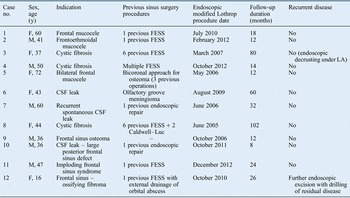
A total of 12 consecutive patients, who underwent the endoscopic modified Lothrop procedure for ‘alternative’ frontal sinus pathology, performed by the senior author (HS), were identified during the study period. These included 6 males and 6 females, with a mean age of 45.2 years (range, 16–78 years). The indications for surgery were diverse, and included: frontoethmoidal mucoceles (n = 3), cerebrospinal fluid (CSF) leaks within the frontal sinus (n = 3), cystic fibrosis (n = 3), osteoma (n = 1), ossifying fibroma (n = 1) and frontal silent sinus syndrome (n = 1). All patients were tertiary referrals to our centre. All patients, except for one patient with frontal sinus osteoma, had undergone multiple previous sinus operations prior to the endoscopic modified Lothrop procedure (Table I).
Summary of patient data*

* These were patients who underwent an endoscopic modified Lothrop procedure for alternative sinus pathology (not refractory chronic frontal sinusitis) over a seven-year study period. No. = number; y = years; F = female; FESS = functional endoscopic sinus surgery; M = male; LA = local anaesthesia; CSF = cerebrospinal fluid
All patients underwent an endoscopic modified Lothrop procedure performed by the senior author, using navigation scanning (Brainlab® protocol). All patients had successful treatment of their frontal sinus pathology, with none requiring conversion to an external approach. No peri-operative complications were encountered.
The mean follow-up period was 33.3 months (range, 8–102 months). One patient had a follow-up duration of less than 12 months, as this patient attended for their surgery from overseas.
To our knowledge, none of the patients in this series have required any further formal revision surgery following their endoscopic modified Lothrop procedure, aside from one cystic fibrosis patient who underwent endoscopic decrusting under local anaesthetic some five years after her surgery and one ossifying fibroma patient who required a separate further endoscopic procedure through the widely patent frontal sinostomy created from the initial endoscopic modified Lothrop procedure, for residual disease (Table I).
Discussion
The frontal sinus has been recognised as being a problematic region to access and treat for over 400 years.Reference Anderson 11 Since the original description of frontal sinus trephination in 1704, there have been a myriad of frontal sinus procedures developed to deal with chronic frontal sinusitis.
Traditional FESS procedures are now frequently performed to access and control disease within the sinus cells. The aim is to create a patent space, thus enhancing the impaired natural mucociliary clearance mechanism, drainage and aeration of the sinus. Nevertheless, the management of frontal sinus disease represents a challenge for many surgeons. The array of operations available varies from the minimally invasive to the extensive open surgery procedures.
The Lothrop procedure has evolved to allow better access for complete eradication of the frontal sinus complex and recurrent diseases, with adequate drainage.Reference Kuhn 12 The endoscopic modified Lothrop procedure performed via an endonasal approach is now widely accepted to be a safe and low morbidity procedure for patients with recurrent frontal sinusitis, who have not improved following multiple minimally invasive procedures such as traditional FESS.
In addition to this main indication, there are a limited number of other disease pathologies or specific lesions affecting the frontal sinus that can be addressed with the endoscopic modified Lothrop procedure. We have reported a spectrum of disease processes affecting the frontal sinus for which we have used the endoscopic modified Lothrop procedure to provide adequate access to the frontal sinus.Reference Virk, Elmiyeh and Saleh 13 One of the most frequent indications in our current series was frontal sinus CSF leaks.
The endoscopic approach has generally now become the preferred technique for the surgical management of patients with CSF leaks, particularly leaks of the anterior, sellar and parasellar skull base which are easily accessible. However, CSF leaks occurring in the frontal sinus can still be challenging given the limited access and difficulty in instrument use, particularly for defects that extend superiorly or laterally within the sinus and those arising from the posterior table of the frontal sinus. These have traditionally necessitated an external approach with an extracranial osteoplastic flap, with or without obliteration.
We have previously reported the use of standard nasal endoscopic instrumentation for the repair of frontal sinus CSF leaks, through the wider access afforded by the endoscopic modified Lothrop procedure.Reference Anvarali, Hassaan and Saleh 8 This approach widens access to the frontal sinus, thus reducing the need for extracranial and intracranial approaches with their associated morbidities. During the period of this study, we had three cases of frontal sinus CSF leaks that were repaired endoscopically using the endoscopic modified Lothrop procedure approach, including two patients who had undergone previous attempts at endoscopic surgical repair elsewhere. There have been no CSF leak recurrences since the endoscopic modified Lothrop procedures were undertaken.
A less common indication is polypoid sinusitis in cystic fibrosis patients, complicated by super-infection of virulent bacteria such as the pseudomonas species. Although radiological studies of cystic fibrosis patients report agenesis of the frontal sinuses in up to 40 per cent of patients,Reference Mackay and Djazaeri 14 those small number of cystic fibrosis patients who do have a well-developed frontal sinus can suffer from debilitating frontal sinusitis.Reference Jaberoo, Pulido and Saleh 15 Control of upper respiratory tract infections is an important factor in preventing relapse of lower respiratory tract infections, and this is of particular significance in cystic fibrosis patients undergoing heart or lung transplantation. Thus, the indications for paranasal sinus surgery are now changing from symptomatic nasal obstruction to pre-lung transplantation care.
Standard FESS procedures are often of limited benefit in cystic fibrosis patients, as these patients frequently develop rapid recurrences of sinus symptoms and infections. Indeed, the results of primary surgery are discouraging. Rowe-Jones and Mackay reported symptom recurrence and the need for a second procedure in up to 50 per cent of cystic fibrosis patients within two years;Reference Rowe-Jones and Mackay 16 this can result in more damage to the remaining functional mucosa, low ciliary activity and bone thickening from osteitis.
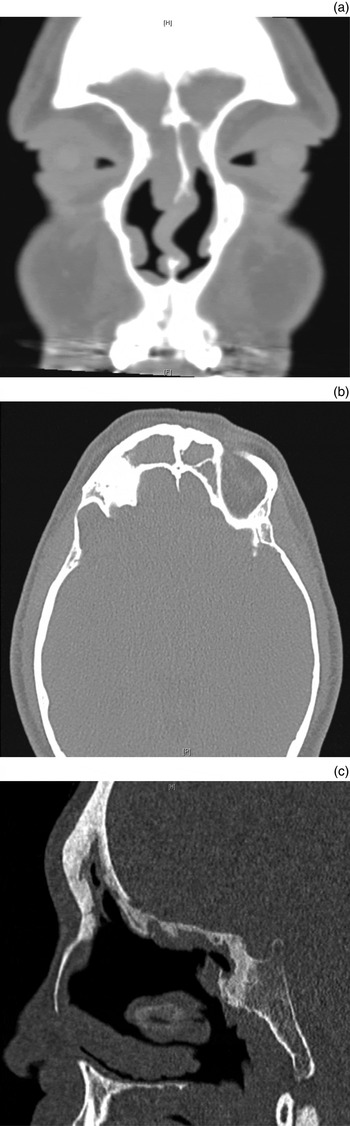
We have previously described the endoscopic modified Lothrop procedure via an endonasal approach as a safe, low morbidity procedure in cystic fibrosis patients with a history of multiple minimally invasive procedures, for management of recurrent frontal sinus disease.Reference Jaberoo, Pulido and Saleh 15 During this study period, we used this approach in three cystic fibrosis patients and successfully achieved long-term frontal sinus patency, resulting in improvement in overall quality of life and excellent functional results over a prolonged follow-up period, in excess of five years in some cases. Successful sinus management reduced the incidence of tracheobronchitis and pneumonia necessitating antibiotic treatment, and all of our patients claimed that their endoscopic modified Lothrop procedure surgery gave them immense improvement in quality of life. Our findings therefore support the fact that this more extensive surgical approach can be safely performed in cystic fibrosis patients to achieve endurable sinus clearance (Figure 1) and contribute to lower respiratory tract infection clearance, which is of most relevance in such patients undergoing heart or lung transplantation.
(a) Coronal and (b) axial computed tomography (CT) scans of a patient with cystic fibrosis. (c) Sagittal CT scan following an endoscopic modified Lothrop procedure performed to clear frontal sinus disease and carry out wide, patent sinusotomy.

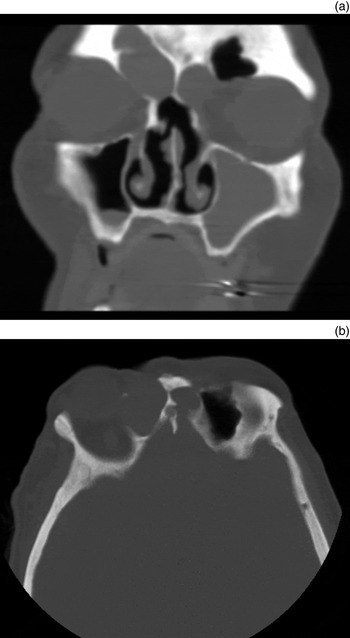
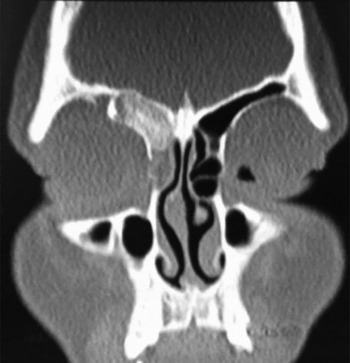
Other previously reported frontal sinus pathologies for which the endoscopic modified Lothrop procedure has been used include frontoethmoidal mucocelesReference Khong, Malhotra, Selva and Wormald 17 – Reference Georgalas, Hansen, Videler and Fokkens 19 and frontal sinus osteomas.Reference Chen, Selva and Wormald 20 , Reference Seiberling, Floreani, Robinson and Wormald 21 In our present series, we utilised the endoscopic modified Lothrop procedure in three cases of frontoethmoidal mucoceles (Figure 2) and one case of frontal sinus osteoma; all of these cases were successfully managed with no recurrences, with up to 18 months’ follow up. We also encountered rarer frontal sinus pathology, including one case of ossifying fibroma (Figure 3) in which some residual disease required a further drilling procedure, as well as the first ever reported case of frontal silent sinus syndrome to be managed using the endoscopic modified Lothrop procedure.Reference Naik, Khemani and Saleh 22 The endoscopic modified Lothrop procedure was used in both cases to provide adequate access for surgical clearance and wide, long-term sinus patency.
(a) Coronal and (b) axial computed tomography scans showing bilateral frontal sinus mucoceles, completely drained via an endoscopic modified Lothrop procedure.

Coronal computed tomography scan of a patient with a right frontal sinus ossifying fibroma, which required the endoscopic modified Lothrop procedure to provide adequate access for disease clearance.

In summary, a wide variety of surgical approaches have evolved to manage frontal sinus disease, including frontal sinus trephination, an osteoplastic flap, endoscopic frontal sinusotomy and the endoscopic modified Lothrop procedure. The endoscopic modified Lothrop procedure permits a common medial drainage pathway of both frontal sinuses, and is now widely accepted as a suitable option for patients with refractory chronic frontal sinusitis. Anderson and Sindwani conducted a systematic review and meta-analysis of the endoscopic modified Lothrop procedure.Reference Anderson and Sindwani 23 They concluded that it is a safe and efficacious procedure that is well tolerated by patients, and which permits adequate and permanent aeration to the frontal sinus despite the anatomical constraints.
-
• The endoscopic modified Lothrop procedure is a modification of a technique first described by Lothrop over a hundred years ago
-
• The endoscopic modified Lothrop procedure performed via an endonasal approach is accepted as a safe, low morbidity procedure
-
• The main indication for the procedure is persistent frontal sinusitis in cases of multiple endoscopic sinus surgery failure
-
• We have used the endoscopic modified Lothrop procedure for access, to facilitate treatment for an extended range of frontal sinus pathologies
-
• These pathologies include frontoethmoidal mucoceles, frontal sinus cerebrospinal fluid leaks, cystic fibrosis, frontal sinus osteoma, frontal sinus ossifying fibroma and frontal silent sinus syndrome
In addition, we have identified a variety of other frontal sinus pathologies for which we have used the endoscopic modified Lothrop procedure to provide wide surgical access to all parts of the frontal sinus. Thus, a wide range of pathologies can be approached via this technique, which obviates the need for open, external surgical approaches. This paper describes such extended applications of the endoscopic modified Lothrop procedure and indicates that these pathologies can be treated safely via this minimally invasive, endonasal approach.