I. INTRODUCTION
Ni-based transition weldments between tempered martensitic and austenitic creep-resistant steels are frequently used in power engineering for construction of terminal parts of superheaters in supercritical steam boilers. The use of Ni-based weld metal (Ni WM) for fabrication of dissimilar welds is related to its medium coefficient of thermal expansion and thus the ability to moderate residual welding stresses. In addition, it prevents diffusional migration of carbon between the dissimilar base materials.Reference Anand, Sudha, Karthikeyan, Terrance, Saroja and Vijayalakshmi1 However, it has been generally accepted that fusion weldments of tempered martensitic power-plant steels require the application of postweld heat treatment (PWHT). Conventional “single-step” PWHT of such welds is commonly carried out by their subcritical tempering with regard to the corresponding steel Ac1 temperature. Besides its stress-relieving effect, it also contributes to thermal stabilization of initial microstructures with a positive effect on the weldments toughness.Reference Silwal, Li, Deceuster and Griffiths2 However, a persisting problem of tempered martensitic steels weldments during operation in creep conditions is related to the occurrence of premature “type IV failure” within their heat-affected zone (HAZ).Reference Zhao, Jing, Xu, An, Xiao, Xu, Chen and Han3,Reference Abson and Rothwell4 Recently, Abe et al.Reference Abe, Tabuchi, Tsukamoto and Shirane5 revealed that the welded joints of newly developed 9Cr–3W–3Co–0.2V–0.05Nb steel with 160 ppm boron and 85 ppm nitrogen exhibited no “type IV failure” during creep exposure as a result of specific HAZ microstructure modification. Nevertheless, literature information about the effects of such increased boron contents in advanced tempered martensitic steels welds on their toughness is rather scarce.Reference Dudova and Kaibyshev6,Reference Baumgartner, Posch and Mayr7 Another approach assuring “type IV failure” suppression and thus creep strength enhancement of tempered martensitic steels weldments is the application of “two-step” PWHT consisting of their complete renormalization and subsequent subcritical tempering.Reference Widak, Dafferner, Heger and Rieth8–Reference Falat, Čiripová, Kepič, Buršík and Podstranská11 Widak et al.Reference Widak, Dafferner, Heger and Rieth8 investigated the effects of “two-step” PWHT on microstructure and creep properties of electron beam (EB) dissimilar welds between P91 and PM2000 base materials. They reported that the “two-step” PWHT homogenized the grain structure but it created a new weld interface prone to cracking due to the occurrence of unfavorable precipitates and soft dendritic microstructure.Reference Widak, Dafferner, Heger and Rieth8 Rieth and ReyReference Rieth and Rey9 investigated the effects of both “single-step” and “two-step” PWHT procedures on the resulting mechanical properties of specific EUROFER97 low activation steel welds for test blanket modules produced by several different fusion welding technologies. They found out that the “two-step” PWHT removed the coarse-grained weld microstructure and led to the hardness levels similar to those of the base material. In contrast, all “single-step” treatments did not change the microstructure but they preserved higher weld hardness than after the application of “two-step” PWHT. The obtained Charpy impact properties indicated that thin EUROFER97 steel plates might be welded by EB or laser techniques without the necessity of “two-step” PWHT. However, the creep strength was reduced in all welds after “single-step” PWHT and it could be restored using “two-step” PWHT only.Reference Rieth and Rey9
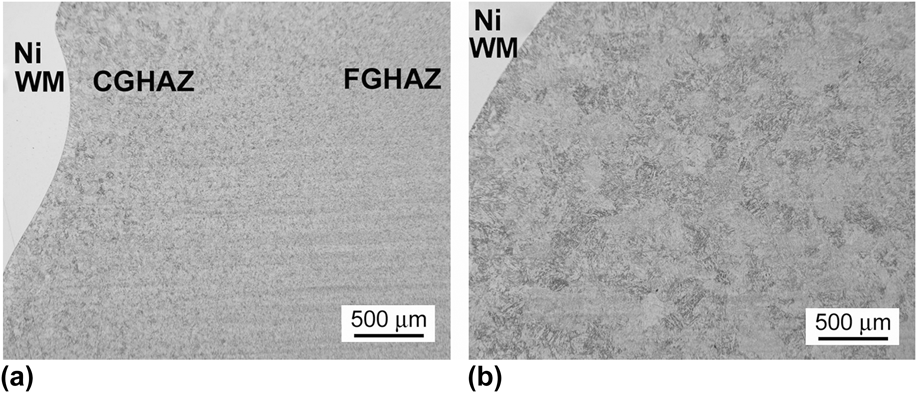
Our former worksReference Falat, Výrostková, Svoboda and Milkovič10,Reference Falat, Čiripová, Kepič, Buršík and Podstranská11 were dealing with the effects of both “single-step” and “two-step” PWHT procedures of T92/TP316H martensitic-austenitic weldments on several aspects of their creep behavior in relation with microstructure. It was revealed that after the “two-step” PWHT, the microstructures of all materials regions within the whole weldment became coarser and homogenized in comparison to those of the weldment after the “single-step” PWHT [see Fig. 1 (Ref. Reference Falat, Výrostková, Svoboda and Milkovič10)]. Thus the original heterogeneity of T92 HAZ microstructural gradient was considerably suppressed after the “two-step” PWHT as a result of performed reaustenitization. In addition, the creep life of the weldments after the “two-step” PWHT increased significantly due to the “type IV failure” elimination.Reference Falat, Výrostková, Svoboda and Milkovič10,Reference Falat, Čiripová, Kepič, Buršík and Podstranská11 Unfortunately, these weldments exhibited at the same time extremely brittle fracture behavior, manifested by the occurrence of decohesion failure at their T92/Ni WM interface with no reduction of area at fracture location. This behavior has been ascribed to the presence of unfavorable arrangements and high density of interfacial precipitates, mainly of M23C6 type occurring almost continuously along the whole WM interface.Reference Falat, Čiripová, Kepič, Buršík and Podstranská11
Overall view on the initial microstructures of martensitic (T92) regions of T92/TP316H weldments after: (a) “single-step” PWHT and (b) “two-step” PWHT.Reference Falat, Výrostková, Svoboda and Milkovič10

The present study represents a continuation of our research work focused on T92/TP316H weldments performance. It investigates the effects of both “single-step” and “two-step” PWHT procedures and subsequent long-term isothermal expositions of the studied martensitic-austenitic weldments on their T92 HAZ mechanical properties at room temperature.
II. EXPERIMENTAL PROCEDURE
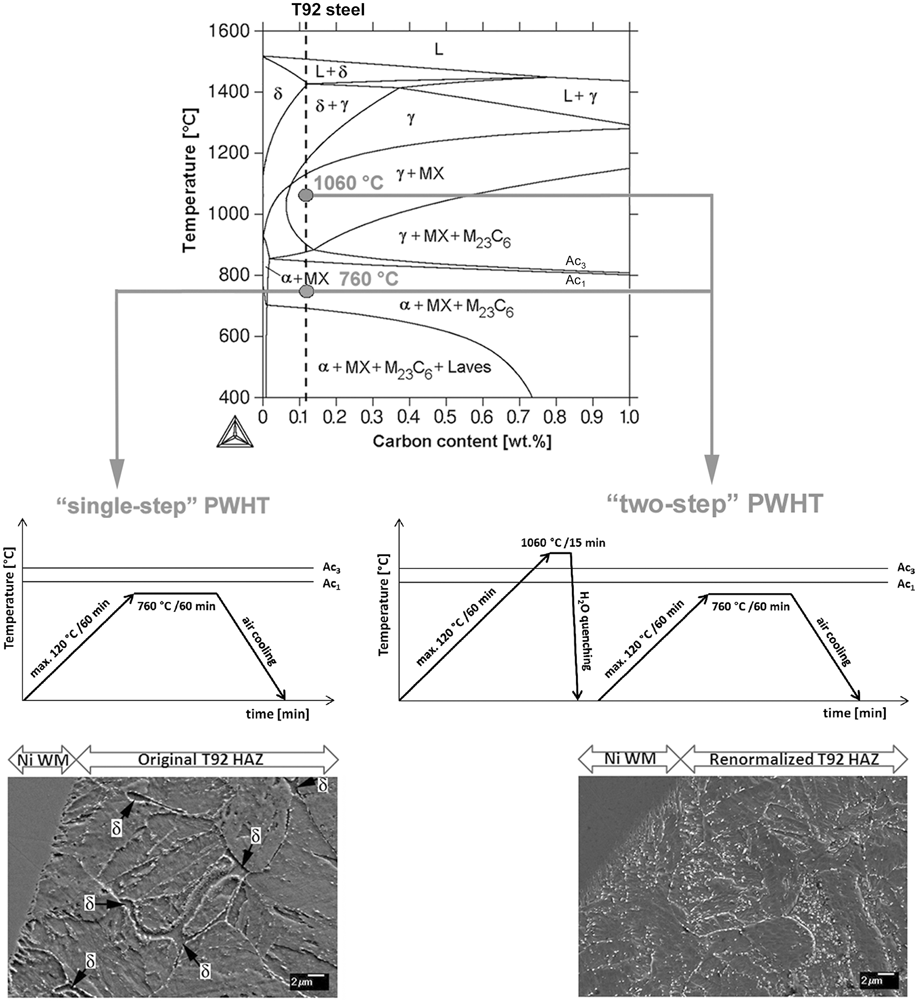
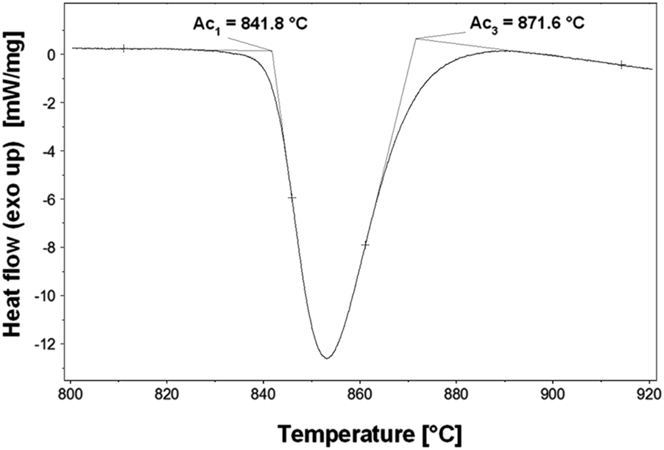
Dissimilar weldments between T92 martensitic and TP316H austenitic steels tubes (D38/5.6 mm) were produced by gas tungsten arc welding using Ni-based alloy Nirod 600 as filler metal. Chemical compositions of the individual input materials for fabrication of studied weldments are shown in Table I. All details regarding the welding procedure can be found in Ref. Reference Falat, Výrostková, Svoboda and Milkovič10. After the welding, two separate series of produced weldments were subjected to two different PWHT procedures, respectively. The conventional “single-step” PWHT of the first series of T92/TP316H weldments comprised of subcritical tempering at 760 °C (i.e., below Ac1 temperature of T92 steel) and subsequent air-cooling. The second series of the weldments was processed by a modified “two-step” PWHT consisting of their full reaustenitization at 1060 °C (i.e., above Ac3 temperature of T92 steel) with water-quenching and final subcritical tempering. The used PWHT procedures have been proposed with respect to thermodynamic calculation predicting the occurrence of stable phases for T92 steel depending on temperature (see Fig. 2). The calculated values of Ac1 and Ac3 equilibrium transformation temperatures of T92 base material were 847.7 and 903.1 °C, respectively. Moreover, it has been demonstrated that the renormalizing “two-step” PWHT represents a suitable way to remove non-equilibrium δ-ferrite from T92 steel HAZ microstructure (Fig. 2). The equilibrium phase diagram was calculated using software Thermo-Calc12 and modified thermodynamic database via Calphad method using optimized parameters for Fe–B–V system.Reference Homolová, Kroupa and Výrostková13 The T92 steel composition is indicated in the diagram by corresponding isopleth at 0.11 wt% C. Additional experimental determination of critical transformation temperatures was performed using differential scanning calorimetry (DSC), see Fig. 3. By comparison of theoretically calculated and experimentally determined values of Ac1 and Ac3 it can be concluded that relatively good agreement between the measurement and calculation has been obtained.
Chemical compositions in wt% of input materials for fabrication of investigated martensitic-austenitic weldments.
Thermodynamically based computational design for T92 steel weldments PWHT procedures showing the potential of renormalizing “two-step” PWHT for suppression of non-equilibrium δ-ferrite in T92 HAZ microstructure.
DSC plot indicating experimentally determined Ac1 and Ac3 critical transformation temperatures corresponding to α/γ phase transformation in T92 steel during its heating at 10 K/min.
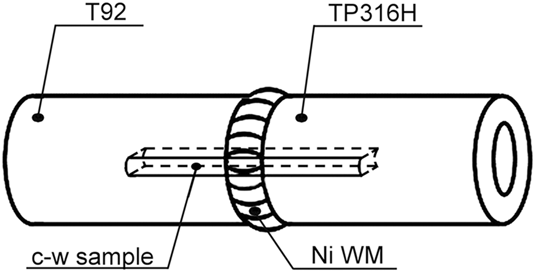
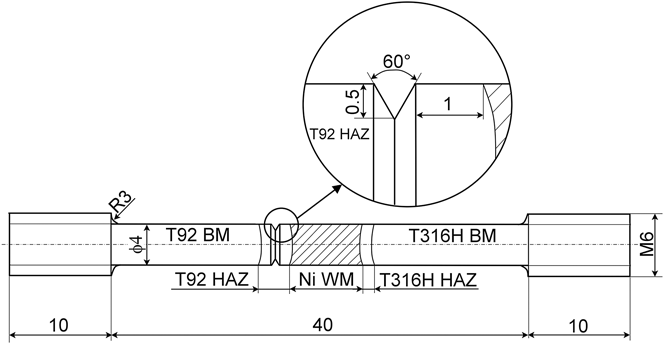
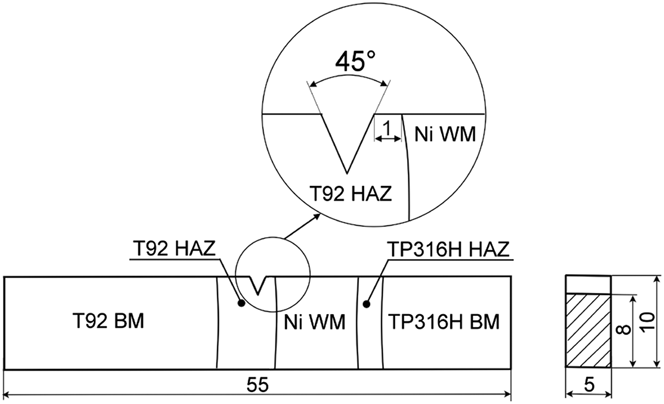
Subsequent experimental investigations were performed using cross-weld specimens cut out from prepared tubular welds including both base materials and Ni WM in their central part (see Fig. 4). The measurements of the weldments local mechanical properties were focused in the T92 HAZ regions which were considered the most critical regions with respect to their microstructural degradation and the occurrence of service failures. Vickers hardness profile measurements at a load of 98 N were performed linearly, covering microstructural regions from the Ni WM center-line up to the T92 base material (T92 BM). Room-temperature notch-tensile tests were performed at a loading rate of 1 mm/min using M6 cylindrical tensile test specimens having circumferential V-notch (see Fig. 5). The samples geometry included 40 mm gauge length and 0.5 mm deep circumferential V-notch located in T92 coarse-grained HAZ at a distance of 1 mm from T92/Ni WM interface. Diameter in notch root cross-section was 3 mm. The T92 HAZ notch-tensile strength was determined from the maximum load and notch root cross-sectional area. Due to the welded tubes dimensional limitations, room-temperature impact toughness was determined from Charpy impact tests using subsized “half-thickness” samples i.e., the samples with dimensions of 10 × 5 × 55 mm and 2 mm deep V-notch located in the T92 HAZ at a distance of 1 mm from T92/Ni WM interface (see Fig. 6). The impact toughness was determined as absorbed energy divided by area below the notch root. Note that the use of subsized notch bend specimens for microstructural changes evaluation has been verified e.g., in work of Stratil.Reference Stratil, Hadraba, Buršík and Dlouhý14 The mechanical properties from tensile and impact tests were evaluated as average values from three individual measurements performed for each material state. Microstructures and fracture surfaces of broken specimens after the mechanical tests were analyzed by scanning electron microscopy (SEM) at an acceleration voltage of 15 kV.
Schematic cross-weld (c-w) sampling from tubular T92/TP316H weldment.
Notch-tensile test specimen geometry used for measurement of T92 HAZ tensile properties.
“Half-thickness” Charpy test specimen geometry for measurement of T92 HAZ impact toughness.
III. RESULTS AND DISCUSSION
A. The effects of PWHT and thermal exposure on microstructure
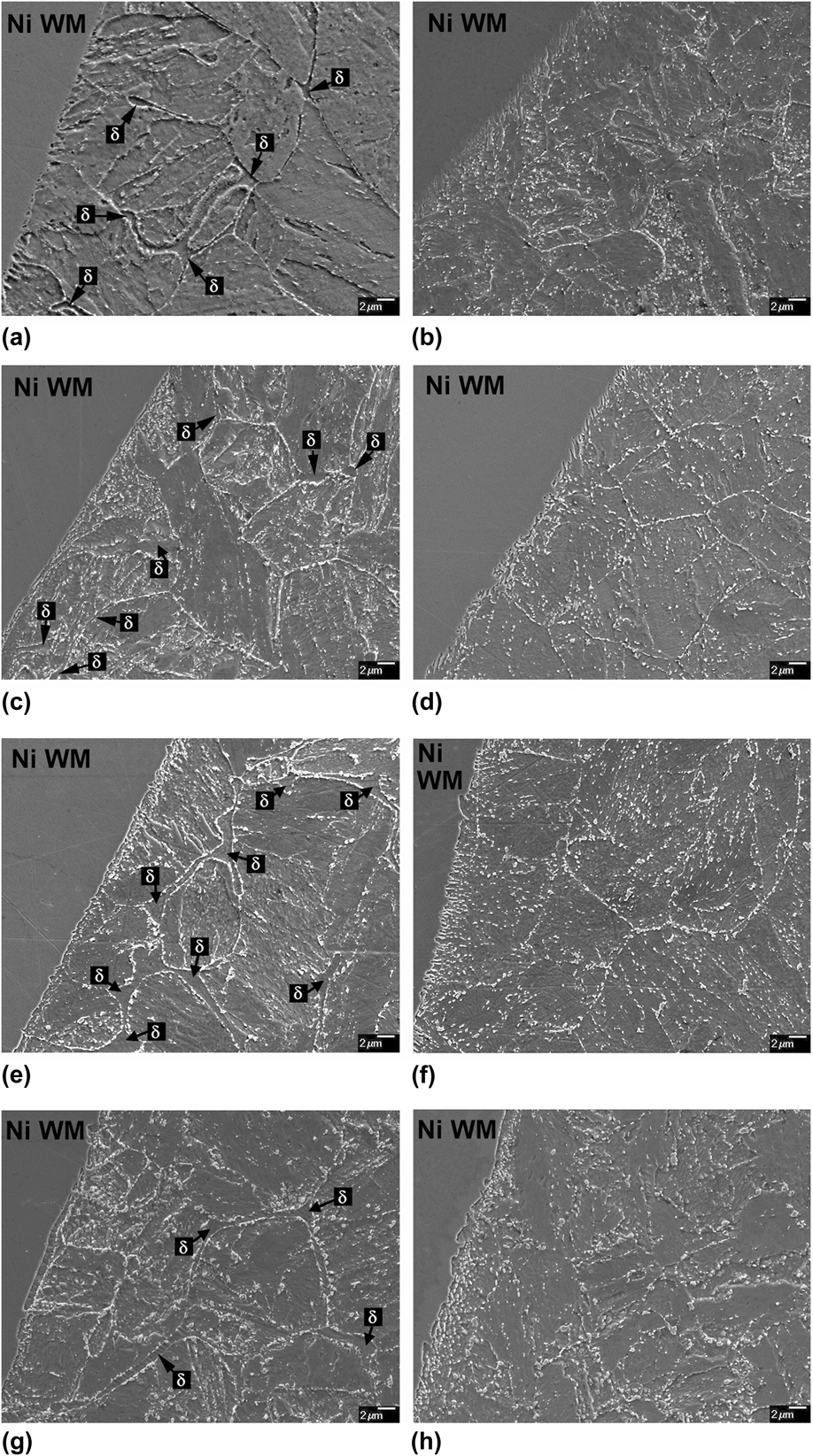
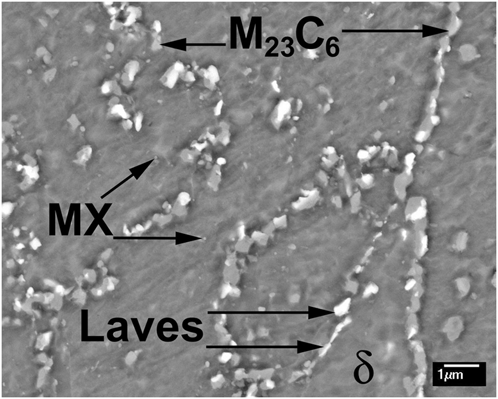
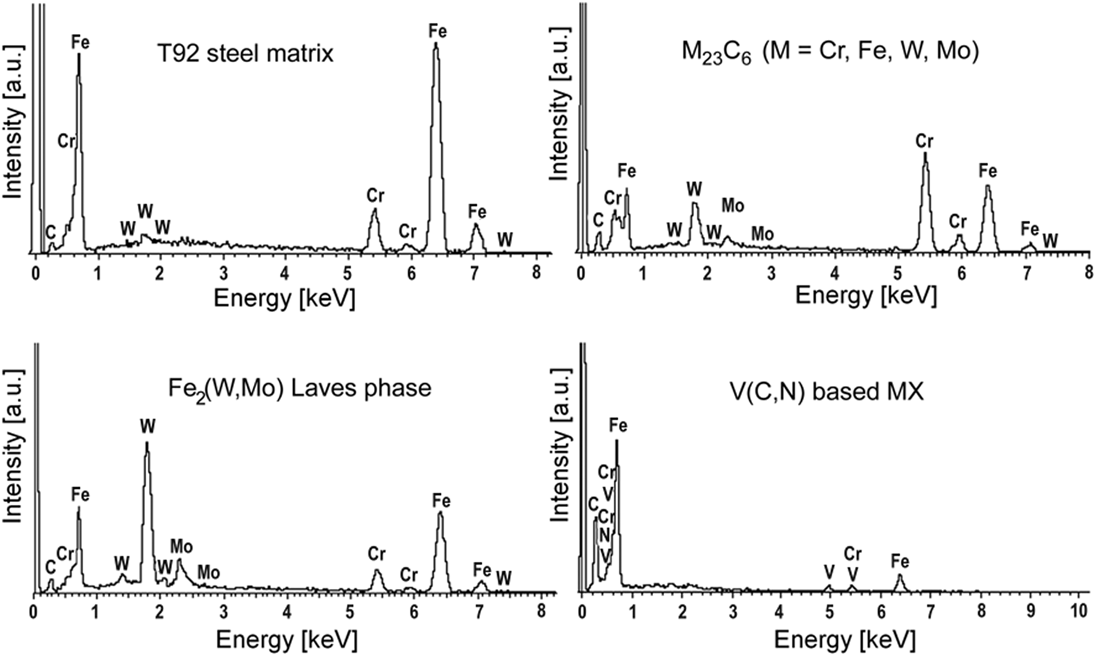
Figure 7 shows microstructural evolution of T92 HAZ regions of investigated T92/TP316H weldments depending on their initial PWHT procedure and subsequent thermal exposure at 625 °C for several time durations. The T92 HAZ microstructures in both initial PWHT states [Figs. 7(a) and 7(b)] contain tempered martensite with intragranular MX (M = V, Nb; X = C, N) carbonitrides and intergranular M23C6 (M = Cr, Fe) carbides which represent typical secondary phase precipitates in 9Cr tempered martensitic creep-resistant steels.Reference Hald15 However, the T92 HAZ microstructure processed by “single-step” PWHT [Fig. 7(a)] exhibits additionally the occurrence of non-equilibrium δ-ferrite decorating prior austenitic grain boundaries. Moreover, it is obvious from all subsequently aged T92 HAZ microstructures [Figs. 7(c), 7(e), and 7(g)] that even long-term aging for up to 11,000 h of the weldments initially processed by “single-step” PWHT did not result in δ-ferrite decomposition. On the contrary, the used renormalizing “two-step” PWHT has been identified as a suitable procedure for δ-ferrite suppression in T92 HAZ microstructure [see Figs. 7(b), 7(d), 7(f), and 7(h)]. Regardless the used initial PWHT procedure of studied weldments, the effects of long-term aging on T92 HAZ regions were generally manifested by additional precipitation of carbidic precipitates and newly formed intermetallic Laves phase already after 500 h of thermal exposure [Figs. 7(c), 7(d) and 8], followed by their gradual coarsening [Figs. 7(e)–7(h)]. Qualitative differentiation of individual phases on metallographic cross-section was performed by their local energy dispersive X-ray (EDX) analyses (Fig. 9). It can reasonably be deduced that the kinetics of microstructure evolution was affected by the initial state of T92 HAZ microstructures depending on the initial PWHT procedure used. According to the findings, e.g.,Reference Cui, Kim, Kang and Miyahara16 the presence of δ-ferrite grains enriched by strong ferrite-stabilizing elements such as W and Mo in microstructure may promote nucleation of Fe2(W,Mo)-based Laves phase. Indeed, the local EDX analysis performed in present study confirmed more than twice increased amount of W in δ-ferrite in T92 HAZ, compared to that declared in Table I for the T92 steel overall chemical composition. The amount of Mo in δ-ferrite and matrix was not detected by means of performed EDX analyses. Further details on microstructural features are discussed in correlation with investigated mechanical properties in the following sections.
Microstructural evolution of T92 HAZ regions of T92/TP316H weldments depending on initial PWHT procedure and subsequent aging time at 625 °C: (a) “single-step” PWHT + 0 h, (b) “two-step” PWHT + 0 h, (c) “single-step” PWHT + 500 h, (d) “two-step” PWHT + 500 h, (e) “single-step” PWHT + 2500 h, (f) “two-step” PWHT + 2500 h, (g) “single-step” PWHT + 11,000 h, and (h) “two-step” PWHT + 11,000 h.
Detailed SEM visualization in back-scattered electrons contrast of T92 HAZ microstructure after aging at 625 °C for 500 h of T92/TP316H weldment initially processed by “single-step” PWHT.
Typical EDX spectra corresponding to local EDX analyses focused on individual phases in T92 HAZ microstructure enabling qualitative phase discrimination on metallographic cross-section.
B. The effects of PWHT and thermal exposure on hardness
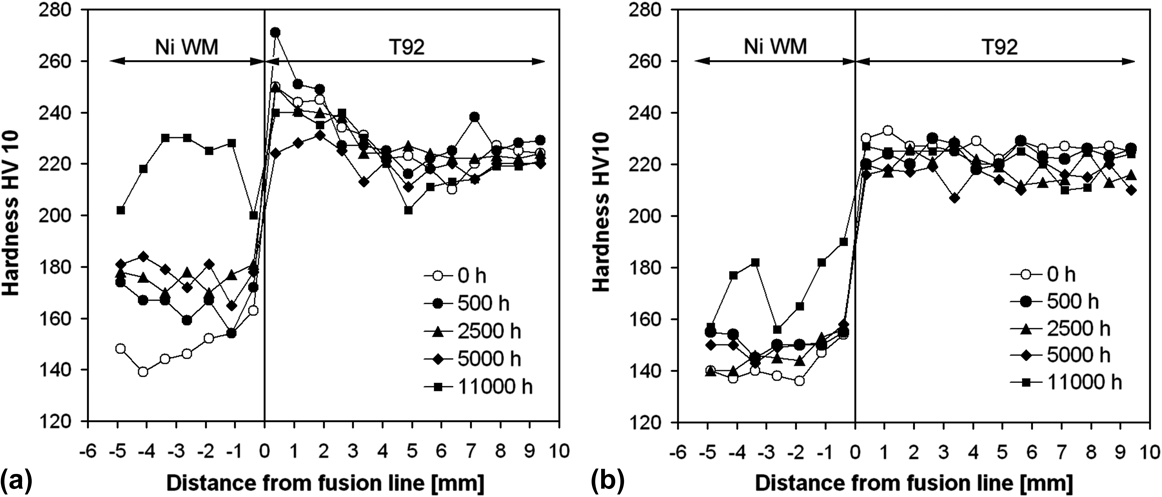
Figure 10 shows hardness profiles measured along the Ni WM/T92 HAZ interface of the studied weldments after two different initial PWHT procedures and subsequent long-term thermal expositions. After the “single-step” PWHT, all hardness profiles show a steep hardness gradient within the region of T92 HAZ [see Fig. 10(a)]. Their general course reflects typical microstructural heterogeneity of HAZ regions of tempered martensitic steels and agrees well with observations performed by other authorsReference Zhao, Jing, Xu, Han and Xiu17,Reference Zhu, Wang and Xuan18 on similar type of dissimilar weld joints. During the first periods (500–2500 h) of thermal expositions at 625 °C, notable strengthening effects were observed within the T92 HAZ close to the fusion zone with Ni WM. This secondary hardening behavior can be related to the additional precipitation of secondary phases, in particular MX (M = V, Nb; X = C, N) carbonitrides within the grain interiors and M23C6 (M = Cr, Fe) carbides at the grain boundaries (Fig. 7). Fine MX carbonitrides are known to be the major type of intragranular precipitates in 9Cr creep-resistant steels with dispersion strengthening effect due to their negligible tendency to coarsening.Reference Hald15 On the other hand, the effect of intergranular M23C6 carbides is based rather on the stabilization of grain and subgrain structure.Reference Abe, Horiuchi, Taneike and Sawada19,Reference Hu, Huang, Yan, Wang, Sha, Shan and Yang20 According to our observation (Fig. 8) supported also by findings of other studies,Reference Kipelova, Belyakov and Kaibyshev21,Reference Abe22 the initial precipitation of intermetallic Laves phase may also play a role in hardening of Grade 92 steels during the first periods of their thermal and/or creep exposure besides the strengthening by MX and M23C6 precipitates. Kipelova et al.Reference Kipelova, Belyakov and Kaibyshev21 observed in a modified P911 tempered martensitic steel that the volume fraction of Fe2(W,Mo) Laves phase increased to its saturation after about 3000 h of creep test at 650 °C. AbeReference Abe22 and Dudova et al.Reference Dudova, Plotnikova, Molodov, Belyakov and Kaibyshev23 reported that the fine Laves phase particles have a significant effect on the stabilization of tempered martensitic lath structure during the initial stage of creep due to their additional pinning force for migrating boundaries. In present study, the Laves phase precipitates have been observed in T92 regions of the weldments already after 500 h of thermal exposure at 625 °C (Fig. 8). The detailed quantification of the Laves phase precipitates in advanced 9–12Cr steels was performed by Dimmler et al.Reference Dimmler, Weinert, Kozeschnik and Cerjak24 The increase of aging time above 2500 h led to gradual decrease in hardness values of T92 HAZ [Fig. 10(a)] due to the effect of precipitate coarsening besides thermally activated static recovery processesReference Ghassemi-Armaki, Chen, Maruyama, Yoshizawa and Igarashi25 of highly tempered martensitic microstructure [Fig. 7]. Many other authors e.g., Ref. Reference Yan, Liu, Bao, Weng and Liu26–Reference Jiang, Zhu and Wang28 reported the effect of Laves phase and M23C6 carbide coarsening to be one of major factors causing strength drop in creep-resistant steels during their long-term thermal or creep exposure. In contrast, gradual hardness increase of Ni WM with increasing aging time [Fig. 10(a)] can be attributed to the fine precipitation of thermally stable NbC carbides which were particularly characterized in Ref. Reference Falat, Výrostková, Svoboda and Milkovič10. The “two-step” PWHT caused the hardness values “equalization” within the whole T92 region of the studied weldment [see Fig. 10(b)] as a result of suppression of T92 HAZ microstructural heterogeneity during the reaustenitization. The influence of additional thermal expositions on the general course of hardness profiles within the T92 regions was rather small. This finding corresponds well with the hardness profile measurements performed on the same type of creep-exposed weldments in our previous study.Reference Falat, Čiripová, Kepič, Buršík and Podstranská11 It can be additionally supported by the fact of T92 microstructure homogenization after the “two-step” PWHT, resulting in suppression of both microstructural and chemical gradients.Reference Falat, Výrostková, Svoboda and Milkovič10 Thus, the hardness profiles in the T92 regions of the samples after the “two-step” PWHT and subsequent thermal expositions exhibited always stable behavior without any remarkable variations. The hardness behavior of Ni WM after the “two-step” PWHT [Fig. 10(b)] was similar like in the case of “single-step” PWHT [see Fig. 10(a)].
Isothermal aging effects on hardness profiles along Ni WM/T92 HAZ interface of T92/TP316H weldments initially processed by: (a) “single-step” PWHT and (b) “two-step” PWHT.
C. The effects of PWHT and thermal exposure on tensile strength
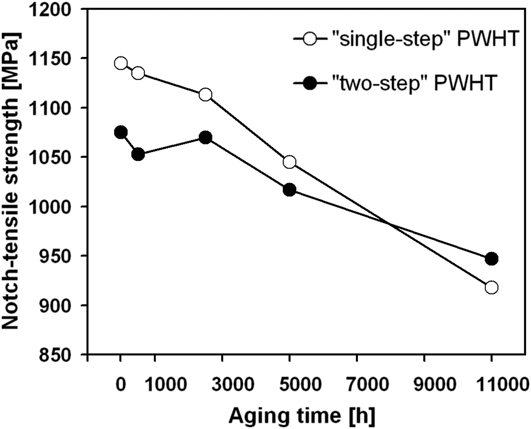
Figure 11 shows the values of notch-tensile strength (RmV) of T92 HAZ of studied T92/TP316H weldment in dependence of its initial PWHT procedure and subsequent thermal expositions. After the initial “single-step” PWHT, the T92 HAZ region exhibits clearly higher tensile strength in comparison to the state after the “two-step” PWHT. The higher T92 HAZ strength (Fig. 11) and hardness (Fig. 10) after the “single-step” PWHT can be explained in terms of higher level of transformation hardening i.e., lower tempering grade of fresh martensitic microstructure, enhanced by localized solid solution hardening in the fusion zone resulting from mixing of partially melted T92 HAZ substrate with Ni WM. After subsequent thermal expositions, the tensile strength of T92 HAZ initially processed by the “single-step” PWHT gradually decreases down to its minimum value corresponding to the longest duration of thermal exposure (Fig. 11). However, some slight secondary hardening effects could still be indicated for T92 HAZ material aged for 2500 h (Fig. 11). In general, the observed nearly monotonous decrease of tensile strength can be related to successive microstructural degradation related mainly to precipitate coarsening and microstructural recovery processes with increasing aging time (Fig. 7). Similar softening effects have been observed by Yan et al.Reference Yan, Liu, Bao, Weng and Liu26 after the tensile testing of thermally exposed 9Cr–3W–3Co martensitic steel at 650 and 700 °C. In contrast, the tensile strength of T92 region of thermally exposed weldments initially processed by the “two-step” PWHT exhibits more complex behavior. After the first 500 h of aging it shows a slight decrease followed by its notable increase reaching the maximum after 2500 h of aging (Fig. 11). This result is likely related to homogenization effects of the “two-step” PWHT followed by additional fine precipitation during the first periods of thermal expositions (Fig. 7). Chen et al.Reference Chen, Zhang, Liu, Wang, Yu, Hua, Bai, Zhang, Zhang and Tang29 investigated the microstructures and mechanical properties of T92/Super304H dissimilar welds after their high-temperature aging at 650 °C for time up to 3000 h. They also observed secondary hardening behavior during tensile tests of the weldments after their short-term heat treatments followed by gradual softening effects with further increase of aging time. The observed behavior was explained by dispersion strengthening effects at the early stage of aging followed by the softening effects due to the precipitate coarsening and simultaneous loss of solid solution hardening from carbide-forming alloying elements. The aging temperature of 650 °C was too high to consider the strengthening effect of Laves phase due to its small volume fraction and fast coarsening kinetics in T92 steel at this temperature.Reference Chen, Zhang, Liu, Wang, Yu, Hua, Bai, Zhang, Zhang and Tang29 Jang et al.Reference Jang, Shim, Komazaki and Honda30 performed nanoindentation experiments and microstructural analysis on high Cr ferritic steel in as-tempered and thermally aged conditions. It has been indicated that thermal softening of tempered martensitic steels is primarily related to matrix softening rather than reduction in grain-boundary strengthening effect. In present study, gradual decreasing of tensile strength of T92 region of the weldment processed by the “single-step” PWHT can also be attributed to its initially lower thermal stability in comparison to the homogenized T92 microstructure immediately after the “two-step” PWHT (Fig. 7). However, it can be clearly seen (Fig. 11) that with increasing duration of thermal expositions, the differences in T92 HAZ tensile strength between the weldments initially processed by different PWHT procedures are getting smaller. This result can be attributed to the similar level of microstructure degradation of the weldments after long-term aging, regardless of their initial PWHT procedure (Fig. 7). It can also be supported by findings of Zhu et al.Reference Zhu, Wang and Xuan18 who observed notable homogenization effects of long-term aging on HAZ microstructure of their Ni–Cr–Mo–V steel weldment.
Isothermal aging effects on notch-tensile strength of T92 HAZ of the T92/TP316H welds initially processed by different PWHT procedures.
D. The effects of PWHT and thermal exposure on impact toughness
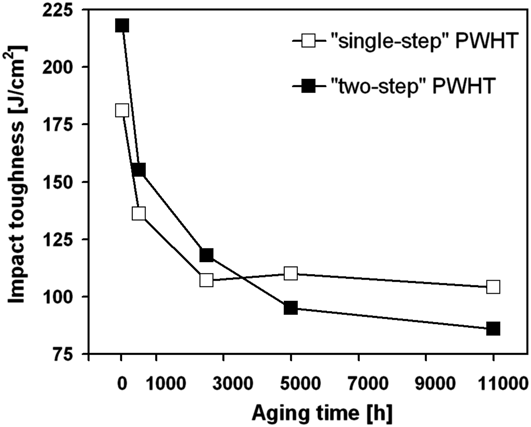
Figure 12 shows the values of Charpy V-notch impact toughness (CVN) of T92 HAZ of T92/TP316H weldment in dependence of its initial PWHT procedure and subsequent thermal exposure. With respect to the effects of initial PWHT procedures on resulting T92 HAZ mechanical properties of studied weldments, it can be stated that the CVN dependencies (Fig. 12) show in principle complementary behavior to the RmV dependencies (Fig. 11). Specifically, after the initial “single-step” PWHT, the T92 HAZ exhibits lower impact toughness (Fig. 12) and higher tensile strength (Fig. 11) in comparison to the T92 region after the “two-step” PWHT. However, after long-term thermal expositions above 5000 h, clear reversions of mechanical properties dependencies were observed in favor of the “single-step” PWHT (see Figs. 11 and 12). The higher impact toughness after the initial “two-step” PWHT can be attributed to the microstructure homogenization in terms of more uniform prior austenite grain size and alloying elements redistribution leading to considerable suppression of both structural and chemical gradients.Reference Falat, Výrostková, Svoboda and Milkovič10 Gao et al.Reference Gao, Liu, Di, Yu and Yan31 studied martensite transformation in the modified high Cr heat-resistant steel during continuous cooling and indicated that with increasing cooling rate the aspect ratio of martensite laths decreases and their density increases. This finding can also support our observation of increased impact toughness of re-austenitized, water quenched, and tempered T92 HAZ corresponding to the performed “two-step” PWHT. On the other hand, Moitra et al.Reference Moitra, Parameswaran, Sreenivasan and Mannan32 investigated the HAZ toughness of 9Cr–1Mo steel weldments after conventional “single-step” PWHT and observed its minimum within coarse-grained region adjacent to the weld fusion zone which also qualitatively agrees with findings of present study. Chen et al.Reference Chen, Zhang, Liu, Wang, Yu, Hua, Bai, Zhang, Zhang and Tang29 reported the local occurrence of non-equilibrium δ-ferrite in T92 HAZ of their T92/Super304H weldments to be one of significant factors influencing the resulting mechanical properties. As already discussed in Sec. III. A of our present investigation, the occurrence of δ-ferrite was really observed along prior austenite grain boundaries within the T92 HAZ of the weldments initially processed by the “single-step” PWHT [Figs. 7(a), 7(c), 7(e), and 7(g)], whereas the weldments after the “two-step” PWHT were found to be free of this phase [Figs. 7(b), 7(d), 7(f), and 7(h)]. Detrimental effects of δ-ferrite on toughness and creep strength of high Cr tempered martensitic steels have been widely reported in the literature, e.g., Ref. Reference Lomozik, Zeman and Jachym33 and Reference Meng, Lu, Cui, Ding, Tang and Huo34. The results of present study show that the CVN values of the samples initially processed by the “two-step” PWHT decrease gradually with increasing thermal exposure duration, whereas the CVN dependency of the samples initially processed by the “single-step” PWHT does not show simple monotonous decreasing (Fig. 12). The observed differences in mechanical behavior can likely be associated with the differences in kinetics of microstructure degradation due to the different initial microstructures after the individual PWHT procedures. In contrast to the RmV dependencies (Fig. 11), it is obvious that with increasing duration of thermal expositions the differences in CVN values between the weldments initially processed by different PWHT procedures are increasing (Fig. 12). Consequently, after the longest thermal exposure at 625 °C for 11,000 h, the T92 HAZ region of the weldment initially processed by the “two-step” PWHT exhibits the lowest impact toughness of all tested specimens which indicates its most severe thermal embrittlement. Thus the obtained results indicate that after long-term thermal expositions, a more suitable combination of T92 HAZ mechanical properties (i.e., the higher impact toughness and acceptable tensile strength) is achieved for the weldments initially processed by the “single-step” PWHT (Figs. 11 and 12).
Isothermal aging effects on impact toughness of T92 HAZ of the T92/TP316H weldments initially processed by different PWHT procedures.
E. The effects of PWHT and thermal exposure on fracture characteristics
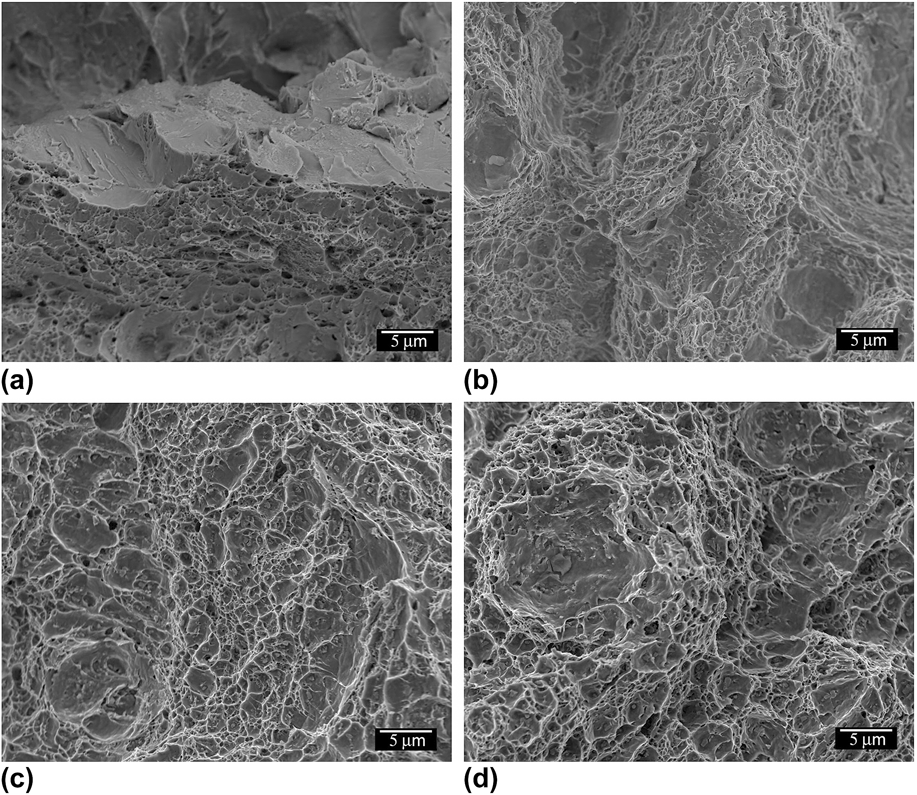
Figure 13 shows some typical SEM fractographs of the T92 HAZ notch-tensile samples of studied T92/TP316H weldments in dependence of their initial PWHT procedure and subsequent thermal exposure. The sample initially processed by the “single-step” PWHT and subsequently thermally exposed at 625 °C for 500 h (i.e., the sample with higher tensile strength, see Fig. 11) shows a mixed fracture consisting of coarse transgranular cleavage facets and relatively fine ductile dimples [Fig. 13(a)]. On the other hand, the sample initially processed by the “two-step” PWHT and the same thermal exposition (i.e., the sample with lower tensile strength, see Fig. 11) shows mostly ductile dimples with different sizes and morphologies and occasionally some signs of quasi-cleavage fracture [Fig. 13(b)]. However, after the longest thermal exposure for 11,000 hours, the samples initially processed by different PWHT procedures show very similar fracture behavior characterized by typical ductile dimple tearing [Figs. 13(c) and 13(d)]. This behavior correlates well with decreasing differences in tensile properties with increasing aging time of the samples initially processed by different PWHT procedures. At the bottom of larger dimples, brittle cracking of coarsened secondary phase precipitates is clearly visible on both fracture surfaces [Figs. 13(c) and 13(d)].
SEM fractographs of T92 HAZ regions after notch-tensile tests of T92/TP316H weldments initially processed by different PWHT procedures and subsequently aged at 625 °C for several durations: (a) “single-step” PWHT + 500 h, (b) “two-step” PWHT + 500 h, (c) “single-step” PWHT + 11,000 h, and (d) “two-step” PWHT + 11,000 h.
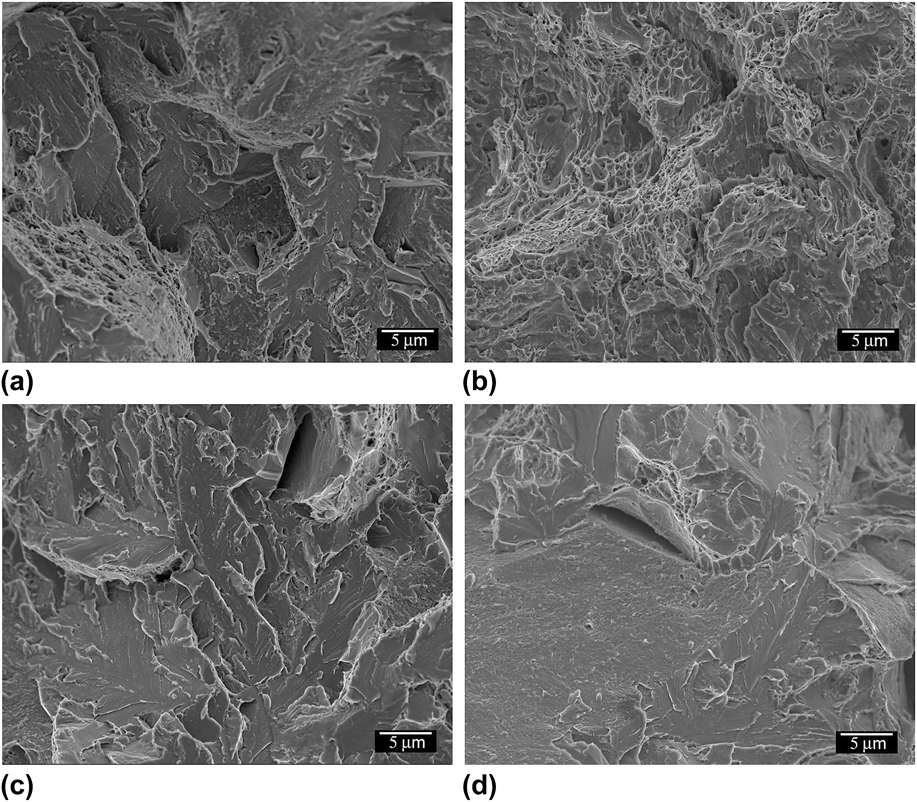
Figure 14 shows some typical SEM fractographs of the T92 HAZ impact toughness samples of studied T92/TP316H weldments in dependence of their initial PWHT procedure and subsequent thermal exposure. The fracture surface of T92 HAZ of the weldment after “single-step” PWHT (i.e., the sample with lower impact toughness) exhibits majority of transgranular cleavage fracture besides some small portion of ductile dimple fracture [Fig. 14(a)]. On the contrary, the fracture surface of T92 region of the weldment after “two-step” PWHT (i.e., the sample with higher impact toughness) shows by rule ductile dimple fracture with small portion of fine transgranular cleavage facets [Fig. 14(b)]. After long-term thermal exposure for 5000 h, the T92 HAZ fracture surface of CVN sample of the weldment initially processed by “single-step” PWHT is completely formed of transgranular cleavage [Fig. 14(c)]. On the other hand, the long-term isothermally aged T92 region of the weldment initially processed by the “two-step” PWHT shows even more pronounced thermal embrittlement after the impact test. It shows a mixture of both transgranular cleavage and intergranular decohesion [Fig. 14(d)]. This observation fairly correlates with intensive embrittlement of the identically processed weldments exhibiting decohesion creep failures in long-term creep conditions.Reference Falat, Výrostková, Svoboda and Milkovič10,Reference Falat, Čiripová, Kepič, Buršík and Podstranská11 The observed fracture behavior corresponds well with the course of impact toughness values depending on the initial PWHT processing and duration of subsequent thermal exposure (Fig. 12). During long-term thermal exposition the initial cleavage fracture mechanism is usually changed from dislocation triggered to carbide triggered cleavage nucleation.Reference Pluvinage, Azari, Kadi, Dlouhý and Kozak35 The occurrence of intergranular decohesion is usually taken as the evidence of impurity effect.Reference Hadraba, Nemec and Dlouhý36 In the case of present investigation the impurity segregation effect might be enhanced by synergic effects of increased grain size after the “two-step” PWHT and subsequent coarsening of intergranular precipitates during long-term aging.Reference Janovec37 From that point of view, although ductile and cleavage fracture micromechanism was more beneficial in initial microstructures, it changed to more detrimental for “two-step” PWHT comparing to “single-step” PWHT due to cumulative effects of embrittling factors.
SEM fractographs of T92 HAZ regions after impact toughness tests of T92/TP316H weldments initially processed by different PWHT procedures and subsequently aged at 625 °C for several durations: (a) “single-step” PWHT + 0 h, (b) “two-step” PWHT + 0 h, (c) “single-step” PWHT + 5000 h, and (d) “two-step” PWHT + 5000 h.
IV. SUMMARY AND CONCLUSIONS
Mechanical properties of T92 HAZ of T92/TP316H martensitic-austenitic weldments were investigated in dependence of their initial PWHT processing and subsequent long-term isothermal expositions. Following main conclusions can be drawn:
(1) Regardless the duration of isothermal expositions, the use of initial PWHT conditions showed a crucial affect on the general course of individual cross-weld hardness profiles. All hardness profiles of the weldments initially processed by the “single-step” PWHT exhibited a steep hardness gradient in T92 HAZ. In contrast, the “two-step” PWHT caused the hardness values “equalization” within the whole T92 regions.
(2) After the initial “single-step” PWHT, the T92 HAZ exhibits significantly higher notch-tensile strength in comparison to the T92 region after the “two-step” PWHT. With increasing duration of isothermal expositions, the notch-tensile strength of T92 HAZ of the weldments processed by “single-step” PWHT monotonously decreases. On the contrary, the notch-tensile strength of T92 region of the weldments processed by “two-step” PWHT shows slight hardening during the first periods of thermal expositions followed by gradual softening with increasing aging time.
(3) After the initial “two-step” PWHT, the T92 region exhibits higher impact toughness in comparison to the T92 HAZ after the “single-step” PWHT. However, with increasing duration of aging, the T92 regions of the weldments processed by the “two-step” PWHT exhibited more pronounced decrease of impact toughness than in the case of the weldments processed by the “single-step” PWHT.
(4) With increasing duration of thermal expositions, the differences in T92 HAZ notch-tensile strength between the weldments initially processed by different PWHT procedures were getting smaller. In contrast, the differences in T92 HAZ impact toughness between the weldments initially processed by different PWHT procedures were increasing with aging duration in favor of the weldments processed by “single-step” PWHT. Thus the obtained results indicated that after the long-term aging, a more suitable combination of T92 HAZ mechanical properties i.e., the higher impact toughness and acceptable tensile strength exhibited the weldments initially processed by the “single-step” PWHT.
ACKNOWLEDGMENTS
This work has been financially supported by “Vedecká Grantová Agentúra MŠVVaŠ SR a SAV (VEGA)” under the grants numbers 2/0116/13 and 2/0151/16. The experimental welded joints were produced by the company SES, a.s., Tlmače, Slovakia. The authors are grateful to Dr. Martin Sopko (IMR SAS, Košice, Slovakia) for performed DSC measurement.