International institutions are politically savvy. Nowhere is this more evident than in reading the legal decisions that they hand down. Students of the European Court of Justice (ECJ), for example, insist that some of the court's verdicts are tailored to appease member states. Along these lines, some argue that the ECJ restrains its jurisprudence when a ruling might otherwise run contrary to its members' sensibilities.Footnote 1 Smith reasons similarly about the World Trade Organization (WTO), insisting that the Appellate Body (AB) balances the need to render legally consistent rulings, on the one hand, with the objective of gaining compliance, on the other.Footnote 2 Yet, WTO panels engage in politics long before the AB hears a case. Indeed, in 41 percent of all cases, panels exercise judicial economy,Footnote 3 a practice by which they rule not to rule on certain of the litigants' legal arguments, deeming these unnecessary to solving the dispute at hand. This practice is important not only for the litigants, who frequently appeal its use, but for the membership as a whole, since judicial economy limits the scope of the case law that results. We argue in this article that panels invoke judicial economy to narrow the precedentFootnote 4 they create, and do so largely at the insistence of the wider membership.
At first glance, the concept of judicial economy seems straightforward. As the AB established its decision in US—Wool Shirts and Blouses, “[a] panel need only address those claims which must be addressed in order to resolve the matter in issue in the dispute.”Footnote 5 This is not a requirement, however; in US—Lead and Bismuth II, the AB went on to clarify that, while panels have discretion to use judicial economy, they need not do so, rejecting the idea that “panels may not address any issues that need not be addressed in order to resolve the dispute between the parties.”Footnote 6 On the other hand, the AB has been just as concerned that panels will be overly zealous in avoiding issues that are crucial to resolving the dispute, falling victim to what, in Australia—Salmon, it called “false judicial economy.”Footnote 7 In short, far from predetermining the decision to invoke judicial economy, WTO rules—and the AB's verdicts—give panels considerable latitude in this regard. Not surprisingly, some observers suggest that panels could use judicial economy more than they do,Footnote 8 while others are struck by how often they use it.Footnote 9 This begs the question: why do panels exercise judicial economy in some cases, but not in others?
The literature on this issue speculates that politics probably plays a role. Davey, for example, explains that judicial economy is an appropriate means of avoiding “controversial issues” in rendering a decision.Footnote 10 Likewise, Quick and Blüthner argue that the use of judicial economy was “legally shocking” in EC—Hormones, chalking it up to the controversy surrounding the health and safety standards at issue.Footnote 11 In this sense, judicial economy is typically seen as a means of securing the litigants' compliance in the case at hand, the logic being that not ruling on arguments the defendant finds most objectionable may lead to compliance with a narrower verdict. There is certainly something to this; defendants often ask panels to exercise judicial economy, and their demands are occasionally acted upon. We argue, however, that judicial economy is mainly used in response to the concerns of the wider membership, as proxied by the input of third parties.
Third parties are member governments,Footnote 12 other than the litigants, who reserve rights in a dispute, looking to influence the outcome by offering written and oral submissions before panels (and later the AB). While most third parties side with the complainant, others vouch for the defendant, and still others deliver mixed submissions, meaning they endorse the views of both litigants on the same or different legal claims, or comment on the proper interpretation of WTO law more generally. We argue that these mixed third-party submissions are the key to understanding judicial economy.
Purely partisan submissions better the odds that the complainant or defendant wins a favorable ruling, as recent research has shown.Footnote 13 Mixed submissions, by way of contrast, bear on the scope of the verdict. This is because panels interpret mixed submissions as an informative signal that the wider membership is ambivalent about the potential fallout of a ruling, and are thus more likely to exercise judicial economy to limit the case law that results. Controlling for a variety of case-specific factors, as well as variables that tap the conventional wisdom, we find that an increase in the number of third parties offering mixed submissions increases the odds that the panel invokes judicial economy by as much as 67 percent, in contrast to partisan submissions, which have no effect.
Two implications follow. First, the literature on institutional design suggests the need to strike a balance between greater legalism (that is, “rigidity”), which aims at furthering compliance, and more flexibility (that is, “stability”), which helps attract and retain members.Footnote 14 Measures such as escape clauses get a lot of attention in this regard, the idea being that, in tough political times, governments need a safety valve to release the pressure on their commitment to free trade. The exercise of judicial economy, however, is one of the ways the institution, as opposed to its members, can seek to balance rigidity and stability, and not just at the WTO. Indeed, similar efforts are observed at institutions ranging from the ECJ to the International Court of Justice.Footnote 15 By showing that this use of judicial economy is more likely where panels are concerned about establishing a precedent that the wider membership is doubtful of, our study sheds new light on the mechanism by which the multilateral trade regime, on a case-by-case basis, balances rigidity and stability.
Second, while most studies of international courts focus on the direction of a ruling—that is, whether the complainant or defendant wins—our research indicates that the content of a ruling can be just as politically charged. Indeed, since panel reports contribute to the institution's body of case law, the exercise of judicial economy can be controversial, potentially influencing whether governments file subsequent cases at the multilateral institution, or instead file their disputes before preferential trade agreements, or opt not to file at all.Footnote 16 In fact, some suggest that judicial economy is, in this sense, an expression of the WTO's jurisdictional reach in relation to other institutions.Footnote 17 The reasons behind its use thus merit careful consideration. This article offers the first empirical look at the exercise of judicial economy.
The Literature
The idea that international institutions sometimes adjust their rulings to the views of their memberships is by no means novel. Scholars have hypothesized on the ways in which states can actively “signal their displeasure” with legal rulings, either by threatening to renegotiate the agreement, or by restricting the authority of the legal body.Footnote 18 Others explain that international institutions take it upon themselves to limit their rulings to pre-empt members from constraining their behavior. Indeed, arguments of this sort are commonplace in studies of the ECJ,Footnote 19 the United Nations Human Rights Committee (UNHRC),Footnote 20 and the WTO's AB, among others.Footnote 21 With respect to the WTO, Steinberg refers to the concept of “strategic space” to denote the legal and political constraints within which panels and the AB function.Footnote 22 Steinberg goes so far as to suggest that the AB has an interest in learning about, and abiding by, these constraints, and that to do so, it needs to “obtain information on the preferences of members,” although he does not pin down the means by which the AB accomplishes this.Footnote 23 What is lacking, then, is a better sense of how panels assimilate members' preferences, on the one hand, and an explanation of how WTO panels respond to this information, on the other. We argue that the answer to the first question can be found in the input of third parties, specifically those that offer mixed submissions; the answer to the second question rests on panels' use of judicial economy.
Students of the WTO put judicial economy alongside other “issue avoidance” techniques like non-liquet (asserting that the law is unclear) and in dubio mitius (deferring to the member where the law is ambiguous), yet together these measures have been employed exactly once across all WTO disputes.Footnote 24 By comparison, panels exercise judicial economy 41 percent of the time. Put simply, if issue-avoidance happens at the WTO, it happens through the use of judicial economy.
The literature on judicial economy focuses mostly on its consequences for the case at hand. Observers voice concern, for example, about the combination of judicial economy and the AB's lack of ability to remand—to send back to the panel for further consideration—a given decision. To be sure, in overturning a panel's finding, the AB may, in the process, nullify a panel's reason for invoking judicial economy. When this happens, the AB is not always able to go back and “complete the analysis” on an issue that the panel chose not to rule on, since the AB has no fact-finding ability of its own.Footnote 25 Because the AB cannot remand matters back to the panel, this means that, on appeal, judicial economy sometimes leaves potentially valid claims unexamined, in all likelihood making the dispute more difficult to resolve, as occurred in EC—Sugar.Footnote 26 Neither a charge of false judicial economy, nor the possibility of a skipped claim left unexamined for lack of the AB's fact-finding abilities, are likely to suit the panel.Footnote 27 This is further confirmed by the way in which some panels have explicitly stated that they could exercise judicial economy over a given claim, but have ended up finishing the analysis so as “to provide sufficient factual basis to allow the AB to complete the analysis, if necessary.”Footnote 28 This practice, which remains relatively infrequent, has come to be called “judicial cooperation.” The point is that panels have successfully internalized the broad constraints imposed by the AB on the exercise of judicial economy, and have little interest in contravening them. Other issues arise when panels choose the order in which they examine claims, as this can determine which claims are liable to be left unexamined in the event that judicial economy is employed.Footnote 29 The point to these observations is that judicial economy comes at a price; rather than serving as a means of economizing legal resources, as the term is typically taken to mean in the context of domestic courts,Footnote 30 judicial economy at the WTO is a means by which panels practice self-restraint in cases where a broader ruling may be politically untenable.
The Puzzle
In rendering a verdict, the Dispute Settlement Understanding (DSU) requires that a panel rule on those arguments that are necessary to the satisfactory resolution of a dispute. The logic of judicial economy is that if a panel has found the defendant in violation of Article X of an agreement, it can choose not to rule on the complainant's arguments about Articles Y and Z if these would add little to the substance of the ruling. Yet there is considerable variation in the way panels follow through on this opportunity.
In EC—Bed Linen, an antidumping case brought by India, the panel reasoned that, “in light of considerations of judicial economy, it is neither necessary nor appropriate to make findings” on three of the complainant's claims,Footnote 31 a decision that was recorded without any comment by the AB.Footnote 32 This is what the AB had in mind in US—Wool Shirts and Blouses: since, in the opinion of the panel, a review of further claims would not contribute much to the substance of the verdict, it was entirely reasonable for it to invoke judicial economy.
In Argentina—Footwear (EC), by way of contrast, the panel did not invoke judicial economy. Here, Europe challenged an Argentine safeguard, and the panel completed an analysis of other issues it thought important. The AB strongly disagreed, perplexed by the panel's decision to examine claims of causation after having already found that there was no increase in imports, and no serious injury. In fact, the “surprised” AB observed that it “would be difficult, indeed, to demonstrate a ‘causal link’ between ‘increased imports’ that did not occur and ‘serious injury’ that did not exist.”Footnote 33 Yet the AB added that it had found no error in the panel's views on causation, or on the Safeguard Agreement more generally. In other words, the AB not only tolerates but also promotes the use of judicial economy when it is appropriate.
Moreover, these decisions on whether to use judicial economy carry considerable weight in WTO law. Since earlier verdicts are commonly used to justify current ones, a panel's decision not to rule on specific legal claims can have a substantial influence on subsequent cases. Bhala, for example, goes so far as to argue that the widespread use of judicial economy is evidence that there is de facto stare decisis—or quasi-binding precedent—at the WTO.Footnote 34 This is because, absent quasi-binding precedent, judicial economy would lose much of its meaning, and would neither be the subject of such contention, nor resorted to nearly as often. He concludes that judicial economy is a “principle of self-restraint” by panels that has been sanctioned by the AB “in a way strongly reminiscent of a common law court.”Footnote 35
The significance of judicial economy can further be gleaned from the institution's case law itself. In Canada—Dairy, for example, the question of whether to resort to judicial economy arose in the context of Articles 9.1 and 10.1 of the Agreement on Agriculture. Since Articles 9.1 and 10.1 “complement each other by focusing on different subsidy elements” and the borderline between them is “not always clear-cut,”Footnote 36 judicial economy could have been invoked to rule on one article and omit the other. The panel in this case repeatedly mentioned this possibility, but chose to complete its investigation and make rulings on both articles—despite the fact that no complainant had requested it to do so—in anticipation that this would help the AB if appealed.Footnote 37 In the process of ruling on Article 9.1 (c), the panel found that both payments in kind and payments through reduced input prices were “payments” under Article 9.1. Later, this interpretation was cited by the complainants and third parties (including Canada, against whom the original ruling was made) in EC—Sugar and became the basis for the ruling against the EC on Article 9.1(c) in that case. Had judicial economy been exercised by the panel in Canada—Dairy, that precedent would not have been available.
These two disputes are also compelling in light of our argument: in Canada—Dairy, where the panel did not exercise judicial economy, all third parties sided with the complainant, whereas in EC—Sugar, where the panel faced exactly the same choice but decided not to rule on Article 10.1, three third parties offered mixed submissions.Footnote 38
Argument
Panels exercise judicial economy to limit the precedent set by a ruling where the wider membership is ambivalent about its scope. By precedent, we simply mean that rulings influence subsequent disputes by contributing to the body of WTO jurisprudence. This definition is not controversial; as Palmeter and Mavroidis explain it, “parties will continue to cite prior reports to panels, and panels will continue to take them into account by adopting their reasoning—in effect, following precedent…”Footnote 39 Echoing this sentiment, Steinberg adds that the importance of a ruling “lies not only in its implications for the national measures that are the subject of the decision, but also in its precedential value.”Footnote 40 Bhala, as noted above, calls this de facto stare decisis, which, in contrast to de jure stare decisis, is followed for extra- and quasi-legal factors, including custom and habit, rather than as a matter of legal requirement.Footnote 41 That said, he insists that both are “binding” sources of law, in that they establish a presumption that precedents will be followed in the future.Footnote 42 The AB could not agree more, explaining in a highly important ruling that “[t]he reasoning in our Report in United States—Shrimp on which the Panel relied was not dicta; it was essential to our ruling. The Panel was right to use it, and right to rely on it. Nor are we surprised that the Panel made frequent references to our Report in United States—Shrimp. Indeed, we would have expected the Panel to do so.”Footnote 43 More generally, the institution's case law is clearly catalogued in the WTO Analytical Index, which sets out precedents by article and agreement. In sum, the practice of WTO law is such that, as Bhala quips, it is only “[o]ur intellectual rigidity [that] precludes us from admitting openly that the holdings of the Appellate Body—and, for that matter, panel—reports actually are a source of international law.”Footnote 44
Taking that precedent matters, our argument is in two steps. First, panels hold preferences over the results of their rulings. In the dispute at hand, they would prefer to gain the litigants' compliance, avoid appeal, or, in the alternative, have their findings upheld by the AB. Much of this depends on how the ruling is likely to impact the body of WTO case law. Since verdicts become part of the jurisprudence that governs dispute settlement, panels have to consider the broader ramifications of ruling on all of the litigants' arguments in establishing a broader or narrower precedent, not least because the AB has incentive to be politically savvy as well. If the panel addresses all the legal issues raised, there is potentially more for the litigants to appeal, whereas if it addresses fewer, the risk is that the litigants will make—and the AB may uphold—charges of “false judicial economy.”
To assess these prospects, panels look for input from third parties. As Smith has observed, the AB encourages third-party participation precisely “to gain access to valuable information regarding the views of the broader WTO membership.”Footnote 45 At the panel stage, where a complainant requests that a three person ad hoc tribunalFootnote 46 hear its case, third parties with a “substantial interest”Footnote 47 in the dispute are permitted, under Article 10 of the DSU, to deliver both written and oral testimony during the first of (what is typically) two rounds of litigation, and thus access to the first of the two submissions of the litigants.Footnote 48 The views expressed by third parties, which are recounted in both the interimFootnote 49 and final report, are to be taken into account by the panel in rendering a verdict. If the ruling is, in turn, appealed, DSU Article 17 gives those third parties that reserved rights at the panel stage the same access to proceedings before the AB. Members typically reserve third-party rights when they have a commercial stake in a dispute, but not one that is sufficient to commit the resources necessary to join as a co-complainant. All told, they participate in 65 percent of WTO disputes. Looking back just over the last twenty disputes in our dataset (which roughly coincides with China's entry into the WTO in 2001), the members who most frequently reserve third-party rights include the United States and the European Communities (EC) (100 percent), China (95 percent), Japan (66.7 percent), Chinese Taipei (62 percent), Mexico (47.4 percent), and Canada (36.8 percent), although Australia, Brazil, Chile, Costa Rica, Colombia, Ecuador, Guatemala, Honduras, India, Korea, Norway, and Switzerland, among others, also make the list. Indeed, it is no exaggeration to say that if developing countries, in particular, have experience with WTO dispute settlement, it is as a third party.
Second, the most influential third-party input in this regard are mixed, rather than partisan, submissions. Third parties are typically partisan, siding with the complainant 56 percent of the time, versus 32 percent with the defendant. They can influence the direction of a ruling by endorsing either litigants' arguments. In Dominican Republic—Cigarettes, for example, the defendant decried the fact that “[i]t was not until the first meeting of the Panel that Honduras suddenly included all of the products in the complaint, taking the idea from the written submissions of certain third parties.”Footnote 50 Conversely, in EC—Sugar, the panel listened to African, Caribbean, and Pacific (ACP) countries who, as third parties, argued for a protectionist regime that discriminated in their favor. Looking at all WTO disputes through 2002, one study finds that in cases that attract partisan third parties, the likelihood of a pro-complainant or pro-defendant ruling rises by half and a third, respectively.Footnote 51
But another 12 percent of third parties are not partisan. Rather, they deliver mixed submissions, meaning that they support and critique both sides in the dispute, often on the exact same legal claim, or comment on how the panel should balance the competing arguments before it. These mixed submissions, which are offered in 20 percent of all disputes, are strikingly different from partisan submissions. This is not to say that these third parties are “honest brokers,” since they, like their partisan counterparts, tend to have a commercial interest at stake. Third parties giving mixed submissions are influential inasmuch as their ambivalence is a credible signal of the wider membership's sensibilities. Whereas partisan arguments reflect coalitional politics in the case at hand, and thus have an impact on who wins, mixed submissions indicate deeper questions about how a ruling would bear on future disputes.
Moreover, this input is informative precisely because it is not offered by honest brokers. The fact that third parties have a commercial interest at stake means that mixed submissions are costly for them to make, since they risk a more encompassing legal victory in the case at hand—that is, one in which all of the legal arguments are ruled upon—which would otherwise be of benefit to them. The trade-off for these third parties, in other words, is between being partisan to raise the odds of gaining more trade liberalization or, for pro-defendant third parties, continued protection, and pushing for a narrower precedent, given concerns for its future implications, both as a complainant and defendant. In short, mixed third-party submissions, given the underlying commercial interests, credibly signal the wider membership's ambiguity about points in law.
To illustrate what mixed third-party submissions look like, and flesh out the intuition of our argument, consider the following. In Mexico—Telecoms, for example, a case brought by the United States that called into question Mexico's regime for basic and value-added telecommunications services, ten third parties reserved rights, four of which made submissions in time to be included in the panel's report. Of the four, three delivered decidedly mixed arguments: Brazil both challenged and gave weight to Mexico's positions, while the EC wavered between criticizing and embracing U.S. arguments. With twenty-two pages of its report dedicated to these third-party submissions, the panel reflected on how it had approached its “daunting task with the utmost prudence” and had “decided to exercise ‘judicial economy’.” In elaborating its decision, the panel likened judicial economy to the “constructive ambiguity” that “WTO negotiators sometimes praise … as a diplomatic means of enabling consensus on WTO rules.” The point was that judicial economy had worked as intended: “[o]ur legal findings are thus limited to … the very particular context of this bilateral dispute, and do not go beyond what we consider indispensable for deciding on the legal claims submitted to this Panel.”Footnote 52
In EC—Biotech, the United States and Canada, later joined by Argentina, brought suit against Europe's de facto moratorium on approving applications to sell genetically modified foods. The case attracted seventeen third parties, many of whom offered both written and oral submissions. EC—Biotech was said to raise an “extraordinarily wide range of factual, scientific and legal issues,”Footnote 53 many of which had little existing case law to draw on for a ruling. Moreover, health and safety cases are thought to be especially prone to controversy, since these measures are, by definition, contingent on constantly changing scientific findings and evolving risk assessment. Yet, what makes EC—Biotech so striking is that Australia, as a third party, was unusually candid about the goals of its written statement. In a perfect example of a mixed submission, Australia raised no specific legal issues, nor did it take any stance for or against either the complainant or the defendant, but instead only registered its strong interest in the panel's assessment and called for the panel to adopt “a measured approach” and to “limit its ruling and recommendations accordingly.”Footnote 54 More telling still, Australia explicitly reminded the panel of its “considerable discretion to exercise ‘judicial economy’ in making an objective assessment of the matter before it,”Footnote 55 thus directly linking the novel and uncharted nature of the arguments at issue with the panel's option to exercise judicial economy. Finally, Australia ended its submission by calling for maximum participation by third parties in the dispute. In response, the panel did, in fact, expand third-party rights, giving all of them the opportunity to respond to the questions posed to the litigants. Importantly, the panel went on to exercise judicial economy with regard to a large number of claims by Canada and Argentina,Footnote 56 thus considerably limiting the reach of its ruling. Much like in Mexico—Telecoms, third parties were worried about what a broad ruling would mean for their exposure to litigation in the future, and wanted to ensure that the law would not fill in where the politics of genetically modified foods had fallen short.
One possible objection might be that mixed submissions would not be costly if partisanship, rather than ambiguity, led third parties to prefer that the complainant win some arguments and the defendant win others. Put another way, it might be argued that mixed submissions are self-serving, rather than a signal of ambivalence, and as such are not costly for lack of a vested interest in a more encompassing legal victory. This concern is misleading for two related reasons. First, whereas we argue that judicial economy serves the purpose of third parties who are uncertain about how a ruling will impact their commercial interests, the same would not be true of third parties favoring the defendant on some arguments, and the complainant on others. In recognizing that their allegiances are split, these third parties stand to benefit only if the panel renders a mixed ruling: that is, one that partly favors the complainant and partly favors the defendant. This, rather than a decision not to rule on points of law over which they have clear preferences, is in their best interest.
Second, and following from this, mixed submissions, even if they could be traced to partisan preferences, do not improve the odds of securing a mixed ruling (or any type of ruling, for that matter). Previous research indicates that only pro-complainant or pro-defendant submissions help boost these odds; mixed submissions have no bearing on the direction of a ruling.Footnote 57 Mixed rulings are likely facilitated by coalitional politics among partisan third parties lining up on both sides of the dispute. In our analysis, we include a variable, partisan split, to account for this. But the point to make clear is that members with divided commercial interests benefit from mixed rulings, not judicial economy, and mixed third-party submissions (partisan or otherwise) do not help them in this regard. In this sense, we can clearly distinguish between what ought to happen if mixed third-party submissions reflect ambiguity as opposed to split partisanship—that is, the exercise of judicial economy versus an increase in the odds of a mixed ruling—and will return to this in our empirical results.
To sum up, our argument is that panels are likely to exercise judicial economy where third parties offer mixed submissions, reflecting the wider membership's ambivalence about the precedential value of a ruling. By providing mixed submissions, these third parties, unlike their partisan counterparts, seek to define the contours of what they see as an acceptable ruling. We hypothesize that the more third parties offering mixed submissions, the more likely the panel is to exercise judicial economy.
Before moving on to the empirical tests, it is important to relate our argument to the conventional wisdom, which is that panels use judicial economy to sidestep certain arguments for the sake of securing the litigants' compliance in the case at hand. We are not arguing that this is wrong, but rather that it does not go far enough. As we observe above, panels have incentive to gain the litigants' compliance, and thus we include several variables that tap this logic. Our point is that, while gaining the litigants' compliance is likely to weigh on the panel's deliberations, the wider membership's ambivalence about the resulting case law should be expected to have an independent effect on the prospects for judicial economy.
Research Design
We compiled data on the use of judicial economy in all WTO panel reports from 1995 to 2005, for a total of 105 disputes. This task was made easier by the fact that the exercise of judicial economy must be explained and identified as such by the panel in every case. As the AB clarified in Canada—Autos, a panel must always “address expressly those claims which it declines to examine and rule upon for reasons of judicial economy,” and went on to state that “[s]ilence does not suffice for these purposes.”Footnote 58 For this reason, the coding of judicial economy is unambiguous. Of the 105 panel reports we examine, judicial economy is exercised in forty-two reports. Our dependent variable, judicial economy, is thus coded 1 if the panel rules “not to rule” on certain of the litigants' legal arguments, and 0 otherwise.Footnote 59
Our main explanatory variables concern third parties and their submissions. We code for the number of third parties reserving rights in a dispute, and how many of those make submissions that are pro-complainant, pro-respondent, or mixed. Our coding is based on a careful read of third-party arguments, building on an existing datasetFootnote 60 that we updated to include more recent disputes. We code third-party submissions as mixed when they support or critique both sides in the dispute, or comment on how the panel should balance the competing claims before it. All the variables pertaining to third parties are count variables. While the number of pro-complainant and pro-defendant third parties is sometimes as large as eighteen, the number of mixed third-party submissions in our data never exceeds three per case.
We also control for a number of case-specific attributes which might otherwise predispose the panel to exercise judicial economy. First, we include the variable new panelists, which is a count of the number of members who have never previously served on a panel. The (untested) conjecture in the literature is that, on the one hand, new panelists may be more desirous of completing their analysis, so as to afford the AB more to work with in the event of an appeal. In this case, they may be less likely to invoke judicial economy than their more experienced colleagues. On the other hand, new panelists might also be more inclined to shy away from setting important precedents, in which case they may be more likely to invoke judicial economy.
We also include articles cited, a count variable of the complainant's legal claims. Existing research, grounded in the literature on American courts, suggests that a high number of articles cited could be a proxy for the weakness of a case, reflecting a “kitchen sink” approach to piling on claims against the defendant.Footnote 61 Under these circumstances, it may be easier for the panel to sidestep certain of the complainant's legal arguments. Indeed, panels would be hard pressed to exercise judicial economy where a complainant presented but a single claim.
Other controls include nonviolation, sps (that is, sanitary and phytosanitary standards, or health and safety standards), and agriculture cases, all dummy variables. The suspicion in the literature is that these more politically sensitive disputes lend themselves more readily to the practice of judicial economy. For example, nonviolation complaints, because they are about nullification or impairment resulting from measures that are not themselves in violation of WTO law, might be more likely to trigger the use of judicial economy.Footnote 62 Likewise, disputes over health and safety standards and agricultural issues are also viewed as being especially sensitive for political reasons, and thus panels might be more inclined to avoid ruling on arguments levied by a complainant in these disputes.Footnote 63 These variables are among the foremost barometers of political discord in the empirical literature on WTO dispute settlement.Footnote 64
Given that some scholars have suggested that more powerful countries may be better able to make their preferences known to the panel, suggesting some distributional effects in panels' issue avoidance,Footnote 65 we add a dummy variable to indicate whether the United States or EC is a defendant, us/ec defendant. Defendants often support the use of judicial economy, as might be expected, and sometimes expend considerable effort trying to convince the panel to invoke it. Proceedings routinely feature defendants assuring the panel that a finding on a single claim is enough to “secure a positive solution” to the dispute. For instance, in Mexico—Soft Drinks, the defendant tried to convince the panel that it could invoke judicial economy to decline jurisdiction, an argument that the panel dismissed.Footnote 66 For this reason, we control for whether the United States or EC is the defendant, given the expectation that the two largest traders are likely to be particularly vocal in demanding judicial economy, and potentially more successful in this regard.
Another suspicion might be that whether the United States or EC, as the complainant, asks for judicial economy is a key influence. Indeed, in some cases, the United States and EC, as complainants, have vehemently argued for the panel to finish the analysis, sometimes even pre-empting a panel's mention of judicial economy. These arguments are typically unsuccessful. In US—Zeroing (EC), for example, the complainant strongly protested the panel's use of judicial economy, yet the panel exercised it all the same.Footnote 67 The EC then made three claims on appeal requesting that the AB overturn the panel's use of judicial economy, but to no avail.Footnote 68 Nonetheless, we control for the presence of either of these powerful countries as complainants.
To get at the conventional wisdom even more directly, we include a dummy variable for whether the United States or the EC, as the defendant, lost the case at hand. This variable, us/ec loss, is coded 1 for all cases where these defendants found themselves on the losing side of a ruling, and 0 otherwise.Footnote 69 The logic is that if panels are especially motivated to secure compliance in disputes involving the two largest members of the multilateral trade regime, they may be more likely to exercise judicial economy to ease the burden of compliance for these defendants. As such, we would expect to see this variable positively signed.Footnote 70
Likewise, to get at the concern discussed above about partisan mixed submissions, we include a control for the level of divisiveness among third parties. Here, the logic might be that some disputes are more likely to attract third parties with split commercial interests because of the number of unrelated issues being addressed by the dispute, for example. This might lead to greater divisiveness and bear on the prospects of judicial economy for reasons other than the wider membership's ambiguity about the resulting case law. To ensure that this is not driving our findings, we thus include partisan split, a continuous bound variable that ranges from 0 to 1 as the distribution among partisan third parties goes from all pro-complainant (defendant) to fully balanced, meaning that submissions split half-and-half.Footnote 71
We also include the number of co-complainants, as some disputes have as many as eleven, and greater numbers could be revealing of the political nature of the case. For example, the argument might be that, even if a complainant's demands for judicial economy do not sway a panel, there might be strength in numbers, and thus more co-complainants could have some effect on the panel's likelihood of exercising judicial economy.
Finally, we check for the impact of cases where third parties join a dispute by claiming a systemic interest, rather than or in addition to a claim of a substantial interest, which any would-be third party must establish. Systemic interests are formally notified as such, making our coding straightforward; they are often registered along with claims of a substantial interest (as opposed to substituting for them) and, as previous research has shown, signal that third parties intend to raise broader—and potentially more axiomatic—concerns.Footnote 72 This, in turn, may tip off the panel that there is likely discord over the proper interpretation of a legal text, leading it to exercise judicial economy. Summary statistics on all of these variables are reported in Table 1.
Descriptive statistics

Notes: SPS = health and safety standards.
To avoid the risk of finite sample bias, as described by King and Zeng, we estimate a rare-events logit model. This technique is the appropriate method to employ where the sample is small (less than 200) or unbalanced (fewer 1s or 0s), or, as in our case, both. We have 105 observations and fewer instances of judicial economy than naught.Footnote 73 Under these conditions, a rare events model prevents against bias in the coefficients and predicted probabilities.Footnote 74 As we explain below, we also ran a Heckman probit model to test for selection bias, but having found no evidence of this, we report the (more efficient) results of the rare-events logit estimates.
Results
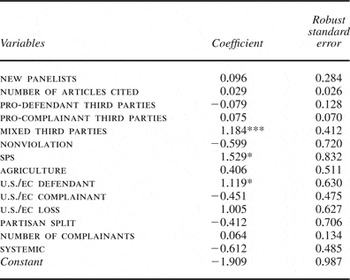
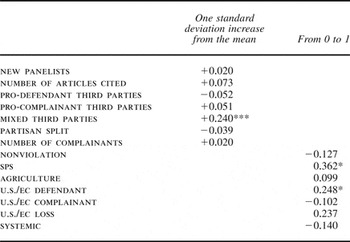
Our model fits the data well, correctly predicting 78 percent of the cases. As per our hypothesis, the effect of mixed submissions on the panel's exercise of judicial economy is strongly positive, and both statistically and substantively significant, controlling for the case-specific attributes described above, including those pertaining to the conventional wisdom, that is, that panels practice judicial economy to ease the burden of compliance on the system's most frequent users. The results are reported in Table 2. Because we employ a nonlinear logistic regression, the size of the coefficients in Table 2 tells us little about predicted effects of the variables. To gauge this, we focus on the substantive effects of our variables of interest, as seen in Table 3.Footnote 75 Keeping all other variables at their sample mean, we find that, by varying the number of third parties offering mixed submissions from 0 to 3, the odds of observing judicial economy increase by 67 percent. More conservatively, if we move from zero to just one third-party offering mixed arguments, the odds that the panel exercises judicial economy still increase by an impressive 27 percent.
Rare-events logit model of judicial economy

Notes: n = 105. SPS = health and safety standards. In two-tailed tests: * p < .10; ** p < .5; *** p <.01.
Substantive effects: change in odds of observing judicial economy

Notes: Figures correspond to the average effect on the likelihood of seeing judicial economy of a one standard deviation increase from the mean of the variable of interest (or a passage from 0 to 1, in the case of dummy variables); all other variables held at their mean, where the baseline likelihood with all variables at their mean is 0.388. SPS = health and safety standards. In two-tailed tests: * p < .10; ** p < .5; *** p < .01.
What about strictly partisan third-party submissions? Strikingly, neither pro-complainant nor pro-defendant third parties exert a statistically significant effect on the panel's use of judicial economy. These results are consistent with the view that while partisan third parties are influential in determining who wins, they are not with respect to the scope of the legal victory handed down. This is where mixed third-party submissions come in. As our findings make clear, mixed third-party submissions exert a sizable influence on the prospects of judicial economy. The point merits repeating: our result is not about who wins the case, but about the contours of the ruling, as limited (or not) by the panel's exercise of judicial economy.
In testing for the effects of dispute-specific attributes, our results also tell an interesting story. While agriculture is insignificant, sps is positively signed and statistically significant at 7 percent, indicating that health and safety disputes are more likely to lead the panel to invoke judicial economy. In substantive terms, keeping all other variables at their sample means, SPS cases are, on average, 36 percent more likely to result in judicial economy. This dramatic difference between the effect of agricultural and SPS cases fits nicely with our argument. Again, we do not make the claim that all politically sensitive issues—for which agriculture often serves as the quintessential exampleFootnote 76—increase the likelihood of judicial economy. Rather, panels use judicial economy in reaction to the broader ambivalence of the membership concerning the precedent at stake. In SPS cases, which rely in great measure on changing scientific findings and evolving risk assessment, this is more likely to be the case. A panel may thus wish to limit its ruling to the findings that are minimally necessary for resolution of the dispute, leaving any unresolved issues for later panels facing different political circumstances.
The coefficient on partisan split, which measures the distribution of pro-complainant and pro-defendant submissions, is insignificant. This suggests that while panels look to mixed submissions for an indication of the wider membership's concerns about the implications of a verdict, the distribution of partisan submissions does not convey the same information. This finding is consistent with our argument that mixed submissions are informative because they are costly. Had it been significant, partisan split would have revealed competing interests at play, rather than a signal of wider attitudes about the case's precedential value. Controlling for this likelihood, the effect of mixed third-party submissions remains powerful and significant. Thus, our confidence that judicial economy reflects third parties' ambiguity over a ruling's impact on case law, rather than mixed commercial interests, should be greater still.
Finally, we have included two variables testing the implication of the conventional wisdom. First, we find that cases in which the United States or EC is the defendant are also more likely to see judicial economy used by the panel. Indeed, when either of these countries is the defendant, the odds that the panel exercises judicial economy surges from 26 percent to 51 percent.Footnote 77 This strong effect, taken together with the widespread view that judicial economy advantages the defendant, suggests the presence of distributional effects in panels' use of judicial economy. When either of the two main users of dispute settlement, and the system's main economic powers, are defendants in a dispute, the panel is significantly more likely to show restraint in the scope of its rulings. This result is sure to strike a cord with those who consider disputes brought against the United States and Europe as being of intrinsically more value to the membership as a whole. Indeed, if one of the purported goals of the DSU is to “redress asymmetries of power,”Footnote 78 then this is disconcerting, since it suggests that panels are more prone to exercise judicial economy precisely in those cases where the membership, as a whole, has the greatest interest in a fuller vetting of the issues at hand.
Second, we included a variable to test whether judicial economy is more likely to be exercised when the United States or EC is losing a case, so as to lessen the costs of compliance for these economic powers. Importantly, we find no evidence that this is happening: the coefficient is positive but not significant.Footnote 79 Even if we recode this variable to take into account cases that are going against any defendant, not just the United States or EC, it is not significant and does not change any of our results, most notably mixed submissions. Our findings thus offer qualified support for the conventional wisdom. While the presence of powerful defendants (us/ec defendant) does raise the odds of judicial economy, panels do not seem to use judicial economy to lessen the burden of compliance on losing defendants, regardless of their economic power.
Robustness
While we have sought to articulate a parsimonious model in light of the small number of observations at hand, we also performed a number of important robustness checks. First, does the identity of the third parties matter? Given that we find some effect for the presence of powerful defendants, it is worth asking whether panel proceedings that attract powerful third parties might be more likely to result in judicial economy. While certainly a valid concern, it should be noted that some members are disproportionately represented as third parties. For example, the EC reserves third-party rights in 90.8 percent of those disputes in our sample that attract at least one third party, and where the EC is not, itself, one of the litigants. The equivalent number for the United States is higher still at 94.9 percent. Needless to say, a great majority of disputes thus attract both the United States and the EC as third parties, and as a result, almost all disputes feature powerful members among the countries reserving rights.
What is likely to matter beyond political clout, then, is the sheer number of third parties, and whether they offer partisan or mixed submissions. To ensure the robustness of our results to variation in the makeup of third parties, we thus control for both the economic clout and the stake of third parties in the dispute at hand (these results are not reported in the tables, but are available from the authors). The first of these variables, third party exports, corresponds to the summed exports by third parties of the specific product(s) affected by the disputed measure(s). The second variable, third party stake, represents the exports from third parties to the defendant of the specific product(s) affected by the disputed measure(s).Footnote 80 One could plausibly argue that, as the vested interest held by third parties increases, these members will attempt to argue for judicial economy more forcefully. Our findings, however, do not bear this out: neither of these variables turns out to be significant, and their inclusion in our models has no bearing on our main results.
Another obvious concern might be that our results may suffer from selection bias. In other words, there could be something about the type of cases that result in a panel ruling that makes judicial economy more likely. To check this, we ran a Heckman selection model, the first stage of which estimates the likelihood of a verdict (as opposed to no verdict) in the 234 disputes in our data set, the second stage being our original specification. To properly identify the first stage, we follow the lead of Busch and Reinhardt who estimate the likelihood of a ruling using: a dummy for third parties; a dummy for whether third parties invoke a systemic interest in joining a dispute; a count of the number of co-complainants; logs of the gross domestic product (GDP) of both the complainant and the defendant; a dummy for the request of consultations under Article XXII (as opposed to Article XXIII)Footnote 81; the number of articles cited; a dummy for nonviolation cases; whether the case concerns particularly politically sensitive areas, such as national security or SPS; whether the case is over agriculture; and a log of the defendant's imports from the complainant of the products of concern in the dispute.Footnote 82
Our original results are in no way affected by the selection model. The effect of mixed third-party submissions, SPS cases, as well as the defendant being either the United States or EC remain the same, and are more significant than in our original specification. But because the estimation errors of the first stage and the estimation errors of the second stage are not correlated, we can conclude that our original model does not suffer from selection bias. In other words, factors that affect the likelihood of a dispute leading to a panel report are not related to the subsequent likelihood of observing judicial economy in those reports. For this reason, the Heckman model is not warranted in this case, and our substantive effects are rightly derived from the rare-events logit estimates.
Conclusion
The use of judicial economy is the means by which WTO panels reveal themselves to be politically savvy. No other technique—not non-liquet or in dubio mitius—comes close in this respect. Yet the exercise of judicial economy is not simply correlated with controversial cases. Far from it. While there are many potential cues concerning the sensitivities surrounding a dispute, panels engage in issue-avoidance under much more limited circumstances. In particular, third parties offering mixed, as opposed to partisan, submissions can more than double the odds of judicial economy. Rather than being about securing the litigants' compliance in the case at hand, judicial economy is about the membership shaping how the institution handles disputes in the future by limiting the scope of the case law that results. In that similar practices are evident on the part of institutions ranging from the ECJ to the ICJ, our results reach much further than the WTO.
Two implications follow. First, this article speaks to the literature that contrasts the benefits of having an institutional design that is more flexible than rigid. The tendency has been to focus on provisions such as escape clauses that permit members to lessen the political costs of compliance—and thus membership—by seeking temporary relief. These provisions are clearly set out in the institution's makeup, with precise rules concerning their use. Judicial economy is slightly different in two respects: there are few hard-and-fast rules governing its exercise, and, unlike a safeguard, it is the institution, as opposed to the member, that ultimately decides if it is employed. While students of the ECJ and other institutions have long argued that courts can render politically informed rulings, the precise mechanism by which they do this, and under what conditions, is often unclear. At the WTO, it is only a slight exaggeration to say that all of the action is in judicial economy. Ours is the first study to elaborate and test an argument about the circumstances under which an institution takes it upon itself to practice issue-avoidance. The finding is clear: judicial economy is not simply about gaining compliance in the case at hand, as per the conventional wisdom, but rather is an investment in the future by third parties offering mixed testimony, which we contend sends an informative signal as to the full membership's ambivalence about the case law that might otherwise result.
Second, and related, this article shows that it is not just the direction of a ruling that matters, but its scope. This, after all, is what judicial economy is all about. The panel's choice to use judicial economy, or not, inspires such passion from members precisely because a ruling's reach bears directly on the institution's acquis of case law, and thus its efficacy. Third parties offering mixed submissions grapple with how the case might impact their prospects not only as a complainant in the future, but as a defendant.Footnote 83 If the content of a ruling was not “sticky,” third parties would care little about precedent and might instead be expected to be more partisan, worried only about shaping their side's prospects in the case at hand. In this sense, the exercise of judicial economy is, itself, evidence that international courts matter, since members invest in shaping the content of the rulings rendered, and not just who wins.