INTRODUCTION
The hill and upland areas of the UK are characterized by a harsh environment, often featuring thin, acid soils with low organic matter turnover together with high rainfall and low temperatures. In the decades following the Second World War, great efforts were made to improve agricultural productivity in the uplands (Cunningham & Groves Reference Cunningham, Groves, Maxwell and Gunn1985). Large areas were ploughed and drained, and swards of cultivated grasses established (Newbould Reference Newbould1974, Reference Newbould1975). Improved permanent pasture and temporary grass leys today account for around one-third of the grazed areas of the hills and uplands. Crucially, herbage production from such sown swards can be over five times higher than from indigenous grasslands (Davies et al. Reference Davies, Munro and Morgan1984) and, consequently, such pastures are vital to livestock farming in the hills. However, despite the inclusion of improved swards in most upland production systems, average incomes on hill farms have remained low and heavily reliant on support payments for many decades (Cunningham & Groves Reference Cunningham, Groves, Maxwell and Gunn1985; Waterhouse et al. Reference Waterhouse, Gardner, Pearce-Higgins and Grant2006). As a result, many farmers now see their future in non-farming activities, and many farming families are already supported heavily by off-farm employment. At the same time, however, farming is a vital part of the fabric of rural communities in the hills and uplands and, consequently, any improvement in the production efficiency and associated economic viability of upland livestock farming has the potential to be linked to wider socio-economic benefits.
Grassland accounts for 0·90 of the total energy requirements of sheep, a much higher proportion of the total energy needs than with other livestock enterprises of the UK (Davies et al. Reference Davies, Fothergill and Jones1989). As a result, an improvement in the efficiency of production or utilization of grass has the potential to enhance the profitability of upland sheep units significantly. Perennial ryegrass (Lolium perenne) is the most appropriate grass species for establishing in the majority of upland situations (Newbould Reference Newbould1974, Reference Newbould1975), and has been shown to persist for 30 years or more in some upland pastures in England and Wales (Hopkins et al. Reference Hopkins, Wainwright, Murray, Bowling and Webb1988; Wilman et al. Reference Wilman, Byrne and Owen2001). Among the most recent advances in ryegrass breeding has been the development of cultivars with high water-soluble carbohydrate (WSC) concentrations (Humphreys Reference Humphreys1989, Reference Humphreys2005; Wilkins Reference Wilkins1991; Wilkins & Humphreys Reference Wilkins and Humphreys2003). Such cultivars have been bred in response to the comparatively low efficiency of conversion of plant to animal protein, which can lead to up to 0·40 of the associated nitrogen (N) being lost as rumen ammonia (Lee et al. Reference Lee, Harris, Moorby, Humphreys, Theodorou, Macrae and Scollan2002b). Increasing the supply of carbohydrate should theoretically increase the N utilization efficiency in the rumen, and results from proof-of-principle experiments have been encouraging. Animals offered cultivars with elevated concentrations of WSC have been found to lose less N in urine than those offered conventional cultivars (Miller et al. Reference Miller, Moorby, Davies, Humphreys, Scollan, Macrae and Theodorou2001) and this improvement in efficiency has been linked to increases in milk production (Miller et al. Reference Miller, Moorby, Davies, Humphreys, Scollan, Macrae and Theodorou2001) and live-weight gain (Lee et al. Reference Lee, Jones, Moorby, Humphreys, Theodorou, Macrae and Scollan2001b).
While it is possible that upland producers could benefit from such advances in ryegrass breeding, experimental work to date has focused on sward and animal performance under lowland conditions. The dairy experiments conducted by Miller et al. (Reference Miller, Moorby, Davies, Humphreys, Scollan, Macrae and Theodorou2001) and Moorby et al. (Reference Moorby, Miller, Evans, Scollan, Theodorou and Macrae2001) were based on zero-grazed swards managed in such a way as to enhance differences in WSC concentration, while the sheep study undertaken by Lee et al. (Reference Lee, Jones, Moorby, Humphreys, Theodorou, Macrae and Scollan2001b) was conducted on rotationally grazed swards established on fertile soils. As such, the results obtained are unlikely to be representative of what might be achieved under continuous grazing and exposure to the climatic conditions found in marginal areas. Furthermore, the study of Lee et al. (Reference Lee, Jones, Moorby, Humphreys, Theodorou, Macrae and Scollan2001b) concentrated on the performance of suckling lambs, yet for the commercial producer successfully rearing lambs to weaning represents only one component of the production cycle. Producing finished lambs ready for slaughter is often the main route by which producers earn their revenue.
A major production constraint for the upland sheep producer is the shorter grass growing season at altitude compared to the lowlands. On enclosed pasture at elevations of over 200 m, the period of herbage growth is short, commencing in mid April and ceasing by the beginning of October (HFRO 1979). Boosting animal performance from pasture during this period would have clear economic benefits in terms of reduced reliance on supplementary feeds and winter forage to finish lambs for slaughter. However, one of the major challenges associated with managing swards for high WSC is the degree to which environmental and management factors such as temperature (Salisbury & Ross Reference Salisbury and Ross1992; Wulfes et al. Reference Wulfes, Nyman and Kornher1999) and fertilizer application (McGrath Reference Mcgrath1992; Peyraud & Astigarraga Reference Peyraud and Astigarraga1998; Valk et al. Reference Valk, Leusink-Kappers and Van Vuuren2000; Binnie et al. Reference Binnie, Mayne and Laidlaw2001; Lee et al. Reference Lee, Jones and Scollan2003) can affect the levels achieved. As altitude increases, the climate becomes more severe and soil nutrient availability decreases, and such constraints could potentially have a negative impact upon the concentrations of WSC which can be achieved in upland conditions.
In order to investigate whether the latest developments in ryegrass breeding can improve productivity in the uplands, an experiment was conducted to evaluate the effect on sheep performance of grazing two perennial ryegrasses cultivars nominally differing in WSC content. Plots of a cultivar bred for higher concentrations of WSC and a standard cultivar were continuously grazed to recommended sward heights to test (a) whether elevated concentrations of WSC are manifest when a ‘high-sugar’ cultivar is grown under marginal upland conditions and (b) whether sheep grazing such a cultivar exhibit improved performance relative to those grazing a control cultivar when swards are managed under commercial conditions.
MATERIALS AND METHODS
Site and management
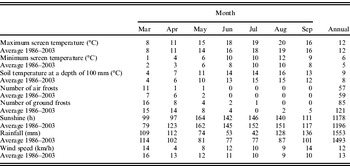
The experiment was conducted at the IBERS Bronydd Mawr Upland Research Centre (51°37′N, 03°38′W), and was sited at 310–363 m asl on Devonian sandstone of the Milford series (Rudeforth et al. Reference Rudeforth, Hartnup, Lea, Thompson and Wright1984). Meteorological data for the site are summarized in Table 1. The experimental treatments consisted of two perennial ryegrasses: a cultivar bred for elevated concentrations of WSC (cvar AberDart) and a control cultivar (cvar Fennema) with similar agronomic traits (heading date, yield and persistency) (NIAB 2002). Four replicate plots of each treatment had been established in 2001 by ploughing and reseeding 8 ha of permanent pasture. During 2002 and 2003, the plots had been grazed by growing cattle to a target sward height of 60–80 mm during May and June and then 80–100 mm from July until the sward heights fell below 60 mm in late August and mid-October, respectively (Marley et al. Reference Marley, Davies, Vale, Evans, Scollan, Moorby, Macrae and Theodorou2005a). During the autumn periods the swards were grazed off by weaned lambs until sward heights fell below 30 mm. The current experiment began at turnout in March 2004.
Meteorological data for the upland site used during the experiment, together with corresponding means across the years from the time the weather station was installed

For the current study, grazing was split into two experimental periods of approximately 90 days; pre-weaning and post-weaning. The pre-weaning period ran from 31 March until 29 June. Throughout this time the swards were maintained at a target sward surface height of 40 mm (±5 mm) using a ‘put and take’ system, i.e. when sward heights were greater than the upper limit of the defined range, additional non-experimental animals were allocated to the plot. Similarly, when sward heights were lower than the defined range, non-experimental animals were removed. The post-weaning period began on 29 June and ended on 30 September. Following weaning the sward surface height was maintained at 60–70 mm, again using a ‘put and take’ system. The sward heights implemented during the experiment were based on the guidelines of Maxwell & Treacher (Reference Maxwell, Treacher and Pollott1986) for upland sheep systems. All stock movements were recorded. The experiment ended on 30 September.
An initial application of compound fertilizer was made to all plots when a soil temperature of 5·5°C at a depth of 100 mm was maintained for a period of 5 consecutive days. This was applied at a rate of 50 kg N/ha and 20 kg P/ha on 30 April. A second application of fertilizer was made at a rate of 50 kg N/ha, 20 kg P/ha and 30 kg K/ha on 1 June. A final application of fertilizer was made on 4 August, at a rate of 50 kg /ha, 20 kg P/ha and 30 kg K/ha, giving a total annual application of 150 kg N/ha, 60 kg P/ha and 60 kg K/ha.
Animals
Each of the eight 1 ha plots were stocked with a core group of 12 Beulah Speckled Face ewes and their Suffolk-cross lambs for the pre-weaning period. The animals were selected from a commercial 600-ewe flock that had lambed in early March. Ewes of a similar age group (2–3 years), live weight and body condition score were selected. The lamb to ewe ratio was 1·5:1, with equal numbers of singles and twins allocated to give a total of 18 lambs per plot. Lambs were also balanced for live weight and sex, with male lambs castrated shortly after birth. During the post-weaning period, each core group of 18 Suffolk cross lambs were returned to the same plot they had grazed during the pre-weaning period. Non-experimental animals were of the same breed and age. When non-experimental animals were not grazing the study plots they were pastured together on ryegrass-dominant permanent pasture adjacent to the study site.
Routine veterinary care was carried out during the experiment, including periodic dosing with an anthelmintic. Prior to the start of the experiment, all ewes were dosed with an ivermectin anthelmintic (Oramec (0·8 g/l ivermectin); Merial Animal Health Ltd, Harlow, Essex, UK) according to the manufacturer's instructions, with faecal egg counts taken to confirm the efficacy of the treatment. During the pre-weaning period lambs were dosed at regular intervals of 21 d with an ivermectin anthelmintic (Oramec). From 24 June all lambs were treated with a combined benzimidozole anthelmintic and mineral drench (Allverm (40 g/l ricobendazle, 28·8 g/l Cobalt and 3 g/l Selenium); Novartis Animal Health, Roston, UK). All non-experimental animals were dosed with an anthelmintic prior to plot allocation.
Sward measurements
Sward surface height was recorded twice weekly using an HFRO sward stick (Barthram Reference Barthram and Alcock1986) by taking 40 measurements in a ‘W’ transect across each plot. Sward composition and biomass within each plot was monitored at 21 d intervals by cutting the herbage within four separate areas of 0·71×1·77 m to the ground level using a reciprocating-blade autoscythe (Shanks GC135, Italy). The fresh weight of each sample was recorded and a sub-sample taken to determine dry matter (DM) content by oven drying for 48 h at 80°C to constant weight. The remaining material was then bulked on a plot basis, and from this a further two samples were taken. The first of these, a sub-sample of c. 200 g, was stored at −20°C prior to subsequent analysis for chemical composition. A second, larger, sub-sample of c. 400 g was separated into ryegrass, unsown grass species, dicotyledonous species and dead material. Following oven drying, the dry weight of all components was measured and botanical composition expressed on a proportional DM basis.
Separate herbage samples for WSC analysis were harvested at the same time of day (1000 h) each week. On each occasion, herbage was cut to the ground level with electrical shears (Heiniger Ltd, Herzogenbuchsee, Switzerland) at 20 random locations across each plot. A minimum of 250 g of herbage per plot was collected, with the harvested material placed in an ice box immediately after sampling and subsequently stored at −20°C prior to analysis.
Chemical analyses
The DM content of the samples submitted for chemical analysis was determined by weighing before and after freeze drying. Ash, total nitrogen (TN), WSC, acid detergent fibre (ADF), neutral detergent fibre (NDF) and digestibility of organic matter in the DM (DOMD) analyses were carried out on material that had been freeze dried and milled through a 1 mm sieve. Ash was measured by igniting samples in a muffle furnace at 550°C for 16 h. Total N concentrations were determined using a Leco FP-428 nitrogen analyser (Leco Corporation, St. Joseph, MI, USA), and expressed as crude protein (CP) (TN×6·25), WSC concentrations were measured by an automated anthrone technique (Thomas Reference Thomas1977) and NDF was determined with the Gerhardt Fibrecap detergent system (FOSS UK Ltd, Warrington, UK). Reagents were as described by Van Soest et al. (Reference Van Soest, Robertson and Lewis1991), with the following exceptions; sodium sulphite was omitted and Termamyl (NCBE Enzymes, Reading, UK) replaced α-amylase. ADF concentration was determined according to the method of Van Soest & Wine (Reference Van Soest and Wine1967) using the Fibretec System equipment (Tecator Ltd, Thornbury, Bristol, UK). In vitro DOMD was determined according to the two-stage method of Tilley & Terry (Reference Tilley and Terry1963), adapted for the ANKOM DAISYII 220 incubator system (ANKOM Technology Corporation, Fairport, NY, USA).
Live-weight gain and lamb finishing
Throughout the pre-weaning grazing period live weight and body condition score of the core groups of ewes and lambs were recorded at 21 d intervals. Body condition was assessed by handling the loin, using a scale of 1 (poor) to 5 (fat) (Anderson Reference Anderson2000), with quarter scores as intermediate points along the scale. During the post-weaning period, the lambs were weighed at 14 d intervals and handled on a weekly basis to assess fatness. Lambs were selected for slaughter when they had attained a live weight of 34 kg or greater and an anticipated slaughter target fat class of 2–3L (a slight to average covering of fat as defined by the EUROP classification scheme) (Anderson Reference Anderson2000).
Core group lambs removed from the plots for slaughter were replaced with non-experimental animals of the same breed and sex in order to maintain grazing pressure. Prior to allocation, these were managed together on a ryegrass-dominated sward of similar quality. Animals selected for slaughter were weighed at pasture (full weight), housed and re-weighed (empty weight) after a 12 h fasting period. The lambs were slaughtered at a commercial abattoir (Hamer International Ltd, Llanidloes, UK), where the carcasses were weighed hot and cold, graded for conformation and assessed for external fat (Anderson Reference Anderson2000).
The daily records of numbers of core and non-experimental animals grazing each plot were used to calculate the average stocking density for each plot at the target sward height across the pre- and post-weaning periods. These values were then combined with the corresponding live-weight gains of the core animals to estimate lamb output on an area basis.
Statistical analyses
Data were analysed using the GenStat 11 statistical software package (Lawes Agricultural Trust 2005). Following plotting of the data to check distribution, live-weight gain of the lambs was calculated by linear regression using individual data from the start of the experiment to a point at which lambs were removed from the plots prior to weaning, and from re-allocation to the plots until removal when they had reached the target body condition score. The effects of grazing treatment (Treatment), litter size (single or twin) and sex (male or female) on live-weight change were analysed using residual maximum likelihood (REML). The fixed models were Treatment×Litter size for ewes and Treatment×Litter size×Sex for lambs, with Replicate/Treatment as a random model. Stocking density (in terms of animal number per unit area) was analysed by one-way analysis of variance (ANOVA) with replicate as a blocking structure. Slaughter data (full weight, empty weight, carcass weight and killing out percentage) were analysed using REML with Treatment×Litter size×Sex as the fixed models and Replicate/Treatment as the random model. Herbage data were analysed using repeated measures ANOVA.
RESULTS
Sward height and biomass
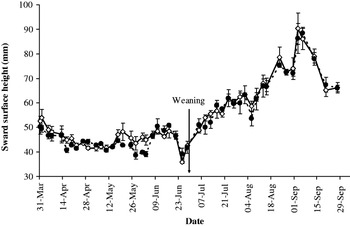
The sward surface height drifted slightly above the target of 40 mm during the pre-weaning period (Fig. 1). Maintaining the sward within the 60–70 mm range during the post-weaning period was also a challenge, particularly towards the end of the grazing period. However, despite this variation over time, the sward height on the two treatments was consistently similar, with the average heights across the pre-weaning period of 45 and 42 mm for the AberDart and Fennema plots respectively (s.e.d.=1·1 mm; not significant (ns)). Across the post-weaning period the average heights were 66 and 65 mm, respectively (s.e.d.=3·3 mm; ns).
Mean surface height of swards of AberDart (—◊—) and Fennema (---●---) cultivars of perennial ryegrass across the experiment. The plots were grazed by ewes and lambs from 31 March to 29 June (pre-weaning) and by lambs only from 29 June to 30 September (post-weaning).

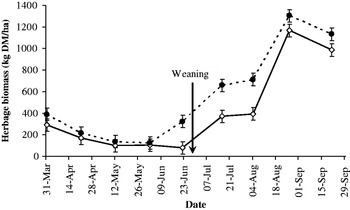
The higher sward surface heights post-weaning were reflected in greater herbage biomass for both cultivars (Fig. 2). For most of the pre-weaning period, the biomass of the Fennema and AberDart swards was similar, but towards the end of this period the biomass of the Fennema plots became greater than that of the AberDart (P<0·05). This pattern was sustained for the first part of the post-weaning period, but by the latter two sampling dates the difference in biomass was not statistically significant.
Mean herbage biomass of swards of AberDart (—◊—) and Fennema (---●---) cultivars of perennial ryegrass across the experiment. The plots were grazed by ewes and lambs from 31 March to 29 June (pre-weaning) and by lambs only from 29 June to 30 September (post-weaning).

Botanical composition
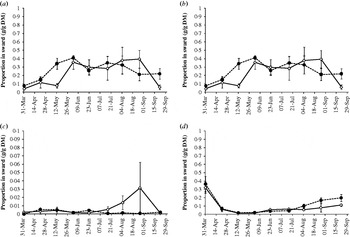
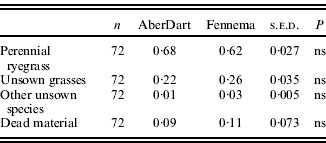
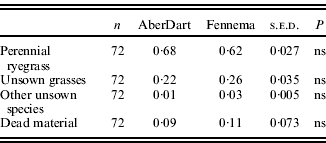
The overall botanical composition of the treatments was similar (Table 2), and relatively consistent across the growing season (Fig. 3). Live material accounted for c. 0·85 of both swards, with around two-thirds of this being the sown species. Unsown grass species encountered were largely Poa spp. Non-grass species made only minor contributions to both swards, and white clover was found in only a single sub-sample. Dead material accounted for over one-third of the sward at the start of the experiment, but this dropped to less than 0·1 during the periods of peak herbage growth.
Change in proportional contribution of (a) perennial ryegrass, (b) unsown grasses, (c) other species and (d) dead material to experimental swards of cultivars AberDart (—◊—) and Fennema (---●---) across the growing season.

Mean botanical composition of experimental swards of AberDart and Fennema cultivars of perennial ryegrass across the grazing season (all values g/g DM)
ns: not significant.
Chemical composition
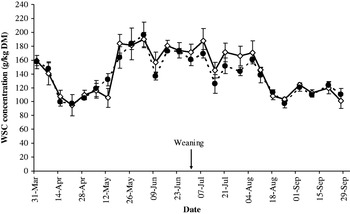
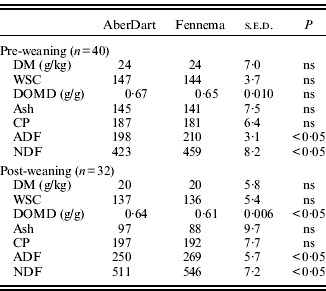
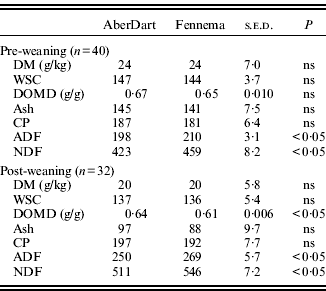
There was little difference in the WSC concentration of the two ryegrass cultivars across the growing season (Fig. 4), and the mean WSC concentration of the AberDart and Fennema swards were similar during both the pre- and post-weaning periods (Table 3). The DOMD of the two swards was also similar during the pre-weaning period, but was significantly higher for the AberDart swards post-weaning. In addition, the ADF and NDF concentrations of the AberDart swards were significantly lower than those of the Fennema swards during both periods. The DM and ash contents of the two swards were found to be similar throughout the experiment, as were the CP concentrations.
Mean WSC concentrations of AberDart (—◊—) and Fennema (---●---) cultivars of perennial ryegrass (g/kg DM) across the experiment. The plots were grazed by ewes and lambs from 31 March to 29 June (pre-weaning) and by lambs only from 29 June to 30 September (post-weaning).

Mean chemical composition of experimental swards of AberDart and Fennema cultivars of perennial ryegrass from 31 March to 29 June (pre-weaning) and 29 June to 30 September (post-weaning) (all values g/kg DM unless otherwise stated)
ns: not significant.
Lamb performance
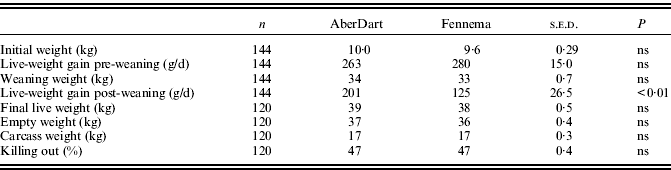
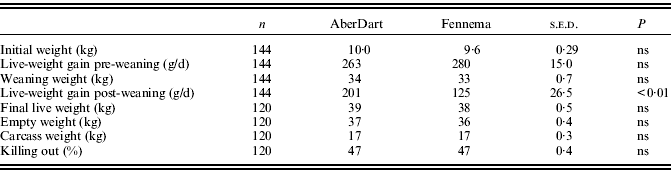
During the pre-weaning period the growth rate of single lambs was significantly higher than that of twin lambs (293 v. 251 g/d; s.e.d.=7·0 g/d; P<0·001), and the live-weight gain of male lambs was significantly higher than that of female lambs (278 v. 266 g/d; s.e.d.=66·3 g/d; P<0·01). There was no effect of grazing treatment on lamb growth at this time (Table 4). During the post-weaning period lamb live-weight gain was significantly higher for those grazing AberDart in comparison with those on the control, with no significant effects of either litter size or sex.
Lamb growth rates and finishing performance when grazing swards of AberDart and Fennema cultivars of perennial ryegrass continuously stocked at target sward heights of 40 mm (pre-weaning) and 60–70 mm (post-weaning)
ns: not significant.
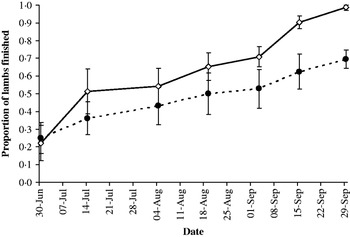
At weaning, the proportion of lambs which were deemed finished and ready for slaughter was similar on both treatments (0·22 v. 0·25 for AberDart and Fennema respectively; s.e.d. 0·083; ns). However, by the end of the post-weaning period a significantly higher proportion of lambs had finished from the AberDart swards (0·99 v. 0·70 respectively; s.e.d.=0·062; P<0·05; Fig. 5).
Proportion of lambs finished from plots of AberDart (—◊—) and Fennema (---●---) cultivars of perennial ryegrass over the course of the post-weaning period.

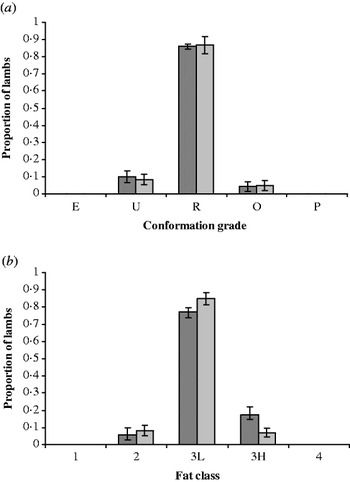
Slaughter data were collected for those lambs which had finished. The majority of the lambs achieved a carcass conformation grade of R and a fat class of 3L (Fig. 6), and there were no statistically significant treatment effects on carcass classification. The grass cultivar grazed during the post-weaning period also had no effect on carcass weight or killing out percentage (Table 4), but both sex and litter size significantly affected the results obtained. The final live weight of male lambs was significantly higher than those of female lambs (39·5 v. 37·8 kg; s.e.d.=0·52 kg; P<0·001), and this led to the male lambs having significantly higher empty weights (36·7 v. 35·6 kg; s.e.d.=0·40 kg; P<0·001), and carcass weights (17·1 v. 16·2 kg; s.e.d.=0·25 kg; P<0·01). Single lambs were also found to have significantly higher carcass weights than twin lambs (17·5 v. 16·3 kg; s.e.d.=0·25 kg; P<0·001), and the killing out proportion of single lambs was significantly higher than twins lambs (0·48 v. 0·46; s.e.d.=0·004; P<0·001).
Distribution of carcass classification results of slaughtered lambs previously grazed on swards of cultivars AberDart (dark grey) and Fennema (light grey), in terms of (a) conformation grade and (b) fat class (mean plus s.e.m.).

Ewe performance
At the start of the experiment the ewes on each treatment had similar live weights (49 v. 48 kg on AberDart and Fennema respectively; s.e.d.=1·1 kg; ns) and BCS (2·6 v. 2·5; 0·06; ns). Both live weight (55 v. 56 kg; s.e.d.=1·4 kg; ns) and BCS (2·6 v. 2·6; 0·07; ns) of the ewes on the two treatments remained similar at removal from the plots at weaning.
Stocking density
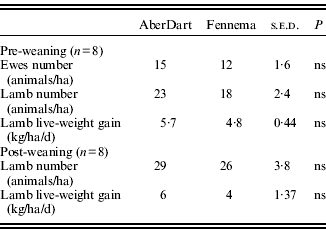
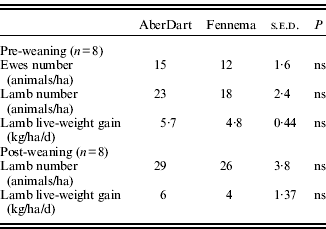
Although the AberDart swards carried more stock both pre- and post-weaning, the differences were not statistically significant (Table 5). The recorded differences in total lamb live-weight gain per unit area were also not statistically significant.
Stocking density and total lamb output when grazing experimental swards of AberDart and Fennema cultivars of perennial ryegrass from 31 March to 29 June (pre-weaning) and 29 June to 30 September (post-weaning)
ns: not significant.
DISCUSSION
A close relationship exists between sward height and the performance of grazing sheep, and it is recognized that by managing pastures at specific sward heights, improved levels of utilization with optimum herbage growth and intake can be achieved (Maxwell & Treacher Reference Maxwell, Treacher and Pollott1986). The swards of the present study were managed in a manner that reflects recommended agricultural practice for upland areas (Davies Reference Davies1998), and thus the results obtained reflect what may be achieved under commercial conditions. Although the average sward heights of the plots of AberDart and Fennema were similar during both the pre-weaning and post-weaning periods, the Fennema sward had a higher herbage biomass by the end of the pre-weaning period. This difference is in keeping with results from studies in Ireland, which reported significantly higher yields for Fennema at first harvest (Conaghan et al. Reference Conaghan, O'Kiely, O'Mara and Caffrey2002; Howard et al. Reference Howard, O'Kiely, Conaghan and O'Mara2003). The higher biomass of the Fennema swards during the post-weaning period of the current study is consistent with observations in the field that these plots headed earlier and to a greater degree than the AberDart swards (J. G. Evans, personal communication), and echoes previous experience with the Fennema plots at this site (D. A. Davies, personal communication). While the associated inflorescences will have contributed to the biomass estimates they are ignored during sward surface height determinations. The higher ADF concentrations in the Fennema also suggest more heading in this cultivar in early season. Fennema had been specifically selected for use as the control cultivar in a number of experiments incorporating AberDart, because of reported similarities in their general agronomic parameters (NIAB 2002). The observations made during this and the earlier beef studies regarding early heading by Fennema indicate that this cultivar had responded differently when grown under marginal upland conditions, highlighting the value of additional varietal testing in such environments.
During the current experiment the WSC concentration of the AberDart and Fennema swards were similar. These results contrast with those of Davies et al. (Reference Davies, Fothergill and Jones1991), Radojevic et al. (Reference Radojevic, Simpson, St John and Humphreys1994), Smith et al. (Reference Smith, Simpson, Oram, Lowe, Kelly, Evans and Humphreys1998), Miller et al. (Reference Miller, Moorby, Davies, Humphreys, Scollan, Macrae and Theodorou2001) and Moorby et al. (Reference Moorby, Miller, Evans, Scollan, Theodorou and Macrae2001), in which a number of different cultivars bred for elevated WSC were reported as having higher concentrations than control cultivars. The results also differ to those obtained by Marley et al. (Reference Marley, Fisher, Davies, Moorby, Macrae and Theodorou2005b) for AberDart when grazed by sheep at a lowland site. More recent studies by Halling et al. (Reference Halling, Longland, Martens, Nesheim, O'Kiely, O'Mara, Wilkins, 't Mannetje, Lovett, Rogers and Boland2005) recorded no significant differences between the AberDart and Fennema cultivars at either Welsh or Norwegian sites during a 3-year period, while experimental work in Ireland found only modest increases in the WSC concentration of AberDart compared to Fennema (O'Kiely et al. Reference O'Kiely, Conaghan, Howard, Moloney and Black2005). Other authors, such as Lee et al. (Reference Lee, Jones, Moorby, Humphreys, Theodorou, Macrae and Scollan2001b), have found that differences in WSC concentration between a high WSC cultivar (AberDove) and a control cultivar (AberElan) recorded at the beginning of a study were not sustained throughout the experiment. Similarly, an earlier beef study conducted by Marley et al. (Reference Marley, Davies, Vale, Evans, Scollan, Moorby, Macrae and Theodorou2005a) on the same areas used for the present study recorded significantly higher WSC concentrations for AberDart than Fennema during the first grazing year, but found this difference was no longer detectable by the second grazing year. The present trial began in spring 2004, following the end of the Marley et al. (Reference Marley, Davies, Vale, Evans, Scollan, Moorby, Macrae and Theodorou2005a) study in the previous autumn, and the WSC concentrations of the AberDart and Fennema recorded during the current experiment were similar to those reported for the second year of the Marley et al. (Reference Marley, Davies, Vale, Evans, Scollan, Moorby, Macrae and Theodorou2005a) study.
A number of climatic and managerial factors might have contributed to the results from the present trial failing to fulfil expectations in terms of WSC concentrations. Wulfes et al. (Reference Wulfes, Nyman and Kornher1999) noted that WSC concentrations varied with changes in the season and weather, and solar radiation and temperature in particular are known to have a strong influence (Salisbury & Ross Reference Salisbury and Ross1992; Fulkerson & Trevaskis Reference Fulkerson, Trevaskis, Corbett, Choct, Nolan and Rowe1997). An assessment of the meteorological data for the experimental site in 2004 revealed the upland site had lower mean annual sunshine hours than the lowland site at IBERS Trawscoed (5·0 v. 3·2 h/d), where the studies of Miller et al. (Reference Miller, Moorby, Davies, Humphreys, Scollan, Macrae and Theodorou2001), Moorby et al. (Reference Moorby, Miller, Evans, Scollan, Theodorou and Macrae2001) and Marley et al. (Reference Marley, Fisher, Davies, Moorby, Macrae and Theodorou2005b) had taken place. These figures demonstrate the less favourable growing conditions found in the uplands, and more specifically the potential impact of factors such as increased cloud cover, which is known to influence WSC concentrations within the plant (Fulkerson & Trevaskis Reference Fulkerson, Trevaskis, Corbett, Choct, Nolan and Rowe1997; Ciavarella et al. Reference Ciavarella, Simpson, Dove, Leury and Sims2000).
It is also known that defoliation affects WSC levels within the plant, because the WSC reserves will fall in order to fuel the re-growth of new shoots, and it is not until 3–4 new leaves per tiller are formed that the plant will replenish these reserves (Fulkerson & Donaghy Reference Fulkerson and Donaghy2001). The largest differences in concentration found between the high WSC (cvar AberDove) and control (cvar AberElan) cultivars used in much of the earlier work were recorded after 5–6 weeks re-growth (Miller et al. Reference Miller, Moorby, Davies, Humphreys, Scollan, Macrae and Theodorou2001). This need for a substantial re-growth period before WSC concentrations increased was recognized as limiting the practicality of using such cultivars within grazing systems, and subsequent breeding work focused on different genetic lines. While there is some evidence to suggest that AberDart has an inherently lower WSC concentration than AberDove, the period of growth required before elevated WSC concentrations are present is shorter in AberDart, and more of these WSC are located within foliar tissue (P.W. Wilkins, personal communication). Consequently, AberDart was believed to have improved on-farm applicability. However, during the current study when sward heights were comparatively low and there was constant grazing pressure from sheep, there did not appear to have been sufficient time for AberDart to replenish its WSC reserves. In studies where differences in WSC concentrations have been observed, such as those reported by Lee et al. (Reference Lee, Jones, Moorby, Humphreys, Theodorou, Macrae and Scollan2001b) (for AberDove) and Marley et al. (Reference Marley, Davies, Vale, Evans, Scollan, Moorby, Macrae and Theodorou2005a, Reference Marley, Fisher, Davies, Moorby, Macrae and Theodoroub) (for AberDart), the target sward heights have been generally higher than those of the present study. The high WSC ryegrass in these studies appears to have had sufficient time to replenish the WSC reserves, while during the zero grazing studies reported by Miller et al. (Reference Miller, Theodorou, Macrae, Evans, Adesogan, Humphreys, Scollan and Moorby1999, Reference Miller, Moorby, Davies, Humphreys, Scollan, Macrae and Theodorou2001), and Moorby et al. (Reference Moorby, Miller, Evans, Scollan, Theodorou and Macrae2001) the harvesting of swards was deliberately managed to enhance the WSC differential. Further research is required to explore further the degree to which interactions between sward height, method of defoliation (cutting/grazing), pattern of grazing (continuous/rotational and the type of stock) and time since sward establishment influence WSC concentrations in different cultivars of ryegrass, in order to be able to provide management guidelines tailored to different production systems.
The findings of the present study suggest that the AberDart sward was of a higher digestibility and less lignified than the control. These findings are in keeping with the observations of other authors (Davies et al. Reference Davies, Fothergill and Jones1991; Radojevic et al. Reference Radojevic, Simpson, St John and Humphreys1994; Smith et al. Reference Smith, Simpson, Oram, Lowe, Kelly, Evans and Humphreys1998; Miller et al. Reference Miller, Moorby, Davies, Humphreys, Scollan, Macrae and Theodorou2001; Moorby et al. Reference Moorby, Miller, Evans, Scollan, Theodorou and Macrae2001; Lee et al. Reference Lee, Jones, Moorby, Humphreys, Theodorou, Macrae and Scollan2001b, Reference Lee, Brooks, Moorby, Humphreys, Theodorou, Macrae and Scollan2002a, Reference Lee, Harris, Moorby, Humphreys, Theodorou, Macrae and Scollanb). It has been suggested that the herbage intake of ruminants is related to the concentration of NDF (Waldo Reference Waldo1986), with the slow digestion of the NDF fraction in the herbage reducing the rate of passage through the digestive tract and therefore having a direct effect on rumen fill (Allen Reference Allen1996). Thus it is possible the lambs grazing the AberDart swards may have had higher intakes. However, evidence from previous studies with similar types of grasses has been variable, and while some indicated high WSC ryegrasses have increased intake potential (Miller et al. Reference Miller, Theodorou, Macrae, Evans, Adesogan, Humphreys, Scollan and Moorby1999; Mayland et al. Reference Mayland, Shewmaker, Harrison and Chatterton2000; Lee et al. Reference Lee, Evans, Moorby, Humphreys, Theodorou, Macrae and Scollan2001a), others found no difference (Valk et al. Reference Valk, Leusink-Kappers and Van Vuuren2000; Miller et al. Reference Miller, Moorby, Davies, Humphreys, Scollan, Macrae and Theodorou2001). Grazing behaviour can also influence intake and, as indicated previously, visual appraisals had revealed differences in the heading pattern of the grasses, with reproductive flowering heads present on all Fennema swards by mid June. In comparison, the AberDart swards experienced only modest development of reproductive material in the latter period of study. These differences may have influenced foraging behaviour, as sheep are known to consume leaf in preference to stem, and thus the time taken to select preferred material could have reduced the intake rate of those grazing Fennema, although unfortunately it was not possible to measure intake as part of the current project.
In the present study, the CP concentrations of the AberDart and Fennema were similar during both experimental periods, in line with the findings of earlier studies (Lee et al. Reference Lee, Jones, Moorby, Humphreys, Theodorou, Macrae and Scollan2001b; Conaghan et al. Reference Conaghan, O'Kiely, O'Mara and Caffrey2002; Howard et al. Reference Howard, O'Kiely, Conaghan and O'Mara2003). In contrast, Smith et al. (Reference Smith, Simpson, Oram, Lowe, Kelly, Evans and Humphreys1998) reported that high WSC ryegrasses were associated with higher CP concentrations than the control ryegrass, while a further study by Miller et al. (Reference Miller, Moorby, Davies, Humphreys, Scollan, Macrae and Theodorou2001) found the CP content to be lower for a high WSC ryegrass. Such results again highlight the variability in the response of such grass cultivars under different management conditions.
Similar lamb live-weight gains were recorded for lambs grazing the AberDart and Fennema swards during the pre-weaning period. These results are consistent with those of Evans & Scurlock (Reference Evans, Scurlock and Pollott1987), Davies et al. (Reference Davies, Fothergill and Jones1989) and Munro et al. (Reference Munro, Davies, Evans and Scurlock1992), who found that there were no significant performance differences for lambs grazing early heading high WSC ryegrasses during the pre-weaning period. In contrast, Lee et al. (Reference Lee, Jones, Moorby, Humphreys, Theodorou, Macrae and Scollan2001b) found that, during periods when there were significant differences in WSC concentrations between the two cultivars, lambs grazing swards of AberDove grew significantly faster than those grazing swards of AberElan. However, the live-weight gains recorded for the singleton Welsh Mule lambs (247 and 213 g/d, respectively) were somewhat lower than those recorded during the present study for lambs on either AberDart or Fennema. During the post-weaning period, lambs grazing AberDart had significantly higher live-weight gain than those on Fennema. For the commercial sheep producer, the additional 0·5 kg live-weight gain per lamb per week would be viewed as a significant improvement in production. The post-weaning growth rate for lambs grazing both cultivars were substantially higher than those previously recorded for lambs of a similar breed type grazing permanent pasture improved 15 years previously, and thus typical of long-term upland leys (Fraser et al. Reference Fraser, Davies, Vale, Hirst and Wright2007). In terms of stocking density, the AberDart swards also carried more lambs than Fennema, and these findings are in keeping with those of Lee et al. (Reference Lee, Jones, Moorby, Humphreys, Theodorou, Macrae and Scollan2001b). Grazing AberDart also resulted in a substantially greater proportion of finished lambs at the end of the study. Generally, finished lambs realize a higher sale value than those sold as stores (unfinished) and, as a result, may increase sales output and potential income for upland producers. Finishing more lambs without additional inputs in terms of concentrate feed would also be of economic benefit. Given that comparatively small profit margin per animal of most upland producers such improvements could have a substantial impact on overall economic viability. Maximizing lamb growth and achieving earlier finishing should also require less farm resources and reduce maintenance costs (Mayne et al. Reference Mayne, Steen, Vipond, Rook and Penning2000), offering further benefits to the producer.
During the present study, similar values for carcass conformation, weight and external fat cover were recorded on the two treatments, confirming that the lamb selection process employed during the study had been consistent and relevant to commercial lamb production. Consequently, the higher growth rate and greater proportion of lambs finished by the end of September on the AberDart treatment indicate that there is potential for sheep production in the uplands to be significantly improved by grazing sheep on AberDart rather than Fennema, even in situations where the swards are similar in terms of WSC concentration. Further research is required to pinpoint the characteristics exhibited by cultivars such as AberDart that can lead to improved animal performance even in situations where higher WSC concentrations are not achieved. The extent to which these are influenced by time since sward establishment and management decisions must also be explored in order to generate guidelines which maximize the productive potential of such cultivars in the uplands. There is also a need to explore potential dynamics within mixed swards. During the current study, the cultivars were sown as a pure stands in order to directly compare the performance of sheep grazing a perennial ryegrass cultivar bred for elevated WSC concentrations relative to a control when grown in upland conditions. As such, the swards were atypical of the majority of commercial swards sown in the uplands, which would generally consist of several ryegrass cultivars, of varying heading dates, sown in combination with a forage legume. Further research is also required to evaluate the performance and longevity of contrasting cultivars of ryegrass when grown as part of more typical seed mixtures, especially when sown in combination with white clover.
CONCLUSIONS
The cultivar bred for elevated concentrations of WSC used during the current experiment was unable to express the high WSC trait when continuously grazed by sheep in an upland environment at sward heights recommended for commercial systems. While the digestibility of the AberDart sward was higher than that of the control, the values for both cultivars were comparatively low. Higher live-weight gains post weaning and an associated reduction in time to finish for lambs grazing AberDart relative to those grazing Fennema indicate that advances in plant breeding have the potential to reduce dependence on bought-in feedstuffs, and hence improve the efficiency and profitability of lamb production in the uplands. However, additional research is required to explore the extent to which growing conditions in marginal environments influence the expression of traits.
The authors would like to thank J. E. Vale, K. Davies and the Bronydd Mawr farm staff for help with sample and data collection. Thanks also to the Analytical Chemistry Group of IBERS for carrying out the chemical composition analyses. This work was funded by a LINK Sustainable Livestock Production programme involving the UK Department for the Environment, Food and Rural Affairs, the Milk Development Council, the Meat and Livestock Commission and Germinal Holdings Ltd.