INTRODUCTION
There are few hard structures with taxonomic relevance in cephalopods, but it has not been an obstacle to develop a specific method of classification of this group of species (Clarke, Reference Clarke1962, Reference Clarke1986). In particular, the cuttlefish is characterized by an internal shell (the cuttlebone), as skeleton, constituted by a porous matrix of calcium carbonate that plays an important role in the control of flotation (Richard, Reference Richard1972). Boletzky (Reference Boletzky1974, Reference Boletzky and Boyle1983) suggested that the cuttlebone of Sepia officinalis, in natural conditions, presents a sexual differentiation being wider in females than in males and this difference is accentuated in starved animals.
In fishery studies, the cuttlebone may be a common component in the catches and it is discarded. For instance, in the small-scale trap fishery off Gran Canaria Island (Spain), the cuttlebone may represent approximately 50% of total Sepia caught (Almonacid-Rioseco, Reference Almonacid-Rioseco2006), which is unrecorded in the landings. In this sense, the biomass and several biometric characteristics can be estimated according to the relationships between the measurements of some parts of the cuttlebone and the mantle length of the animal. In this way, it is possible to obtain specific equations for a certain area, which is of importance in species with high geographical variability such as Sepia officinalis.
The results obtained in this work could be of practical application and are of interest in order to implement both the assessment and management of the fishery.
The aim of this study was to determine the morphometric relationships between the cuttlebone and the dorsal mantle length (DML) and wet weight of the cuttlefish in relation to both of the sexes as we have observed a high proportion of this hard structure in the catches, particularly when the deployment of the traps surpass four days of fishing.
MATERIALS AND METHODS
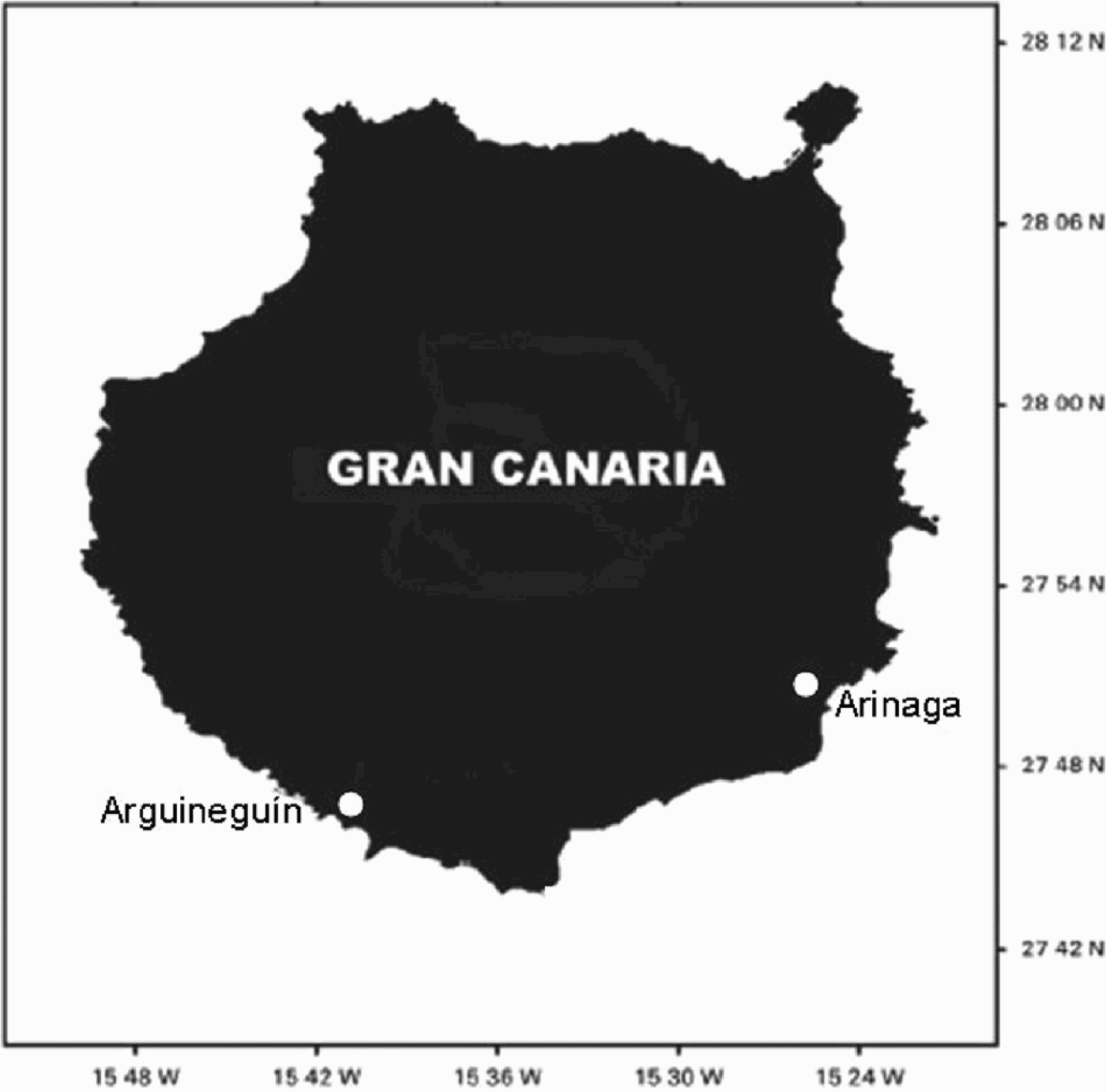
We analysed 426 cuttlefish (320 males and 106 females) obtained from commercial catches landed at the Arguineguín and Arinaga ports (south-west and south-east of the island of Gran Canaria, respectively; Figure 1) by the small-scale trap fishery between November 2002 and November 2004.
Geographical situation of the sampling ports at the Gran Canaria Island (Canary Islands, Spain, central-east Atlantic).

The morphometric features recorded, according to Roper & Voss (Reference Roper and Voss1983) were: (a) the dorsal mantle length (DML), wet weight (W) and sex of each individual; (b) once eviscerated, the length (CL), height (CH) and width (CW) of the cuttlebone; and (c) the length and width of the fragmocone (FL and FW respectively), and the width of the internal (ICW) and external (ECW) cones, with an accuracy of 0.05 mm (Figure 2). The cuttlebone was also weighed (CTW) with an accuracy of 0.01 grams.
Morphometric measures taken on the cuttlebone of Sepia officinalis: length (FL) and widths of the fragmocone (FW), cuttlebone (CW), external cone (ECW) and internal cone (ICW) (ventral view). Length (CL) and high (CH) of the cuttlebone (lateral view).

With the aim to determine the sex from the measurements of the cuttlebone, we used discriminating analysis with the inclusion method by steps (Pérez-López, Reference Pérez-López2001). This procedure generated a function based on the linear combinations of the prediction variables that gave better discrimination between males and females. The function was estimated by using 426 individuals in which sex was previously known. Also, the relationships between DML, weight and the measurements of the cuttlebone of both sexes were determined through linear regression. Furthermore, we used multiple regressions taking into account the sexes and their contribution to each sample according to the corresponding independent variable. From this method, it was possible to estimate an equation for the complete sample (without sex distinction), and for each sex. Calculations were carried out using the SPSS software (v. 11.0.1), and with an α lower than 0.05.
RESULTS
Sex identification
Using the aforementioned variables, it was possible to differentiate the cuttlebones of males from those of females, with an accuracy of 91.8%, following equation 1:

The mean distance between centroids (C) was 0.66. Cuttlebones belonged to males and females as f(x) were lower and higher than C, respectively.
Morphometric relationships
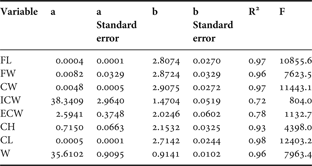
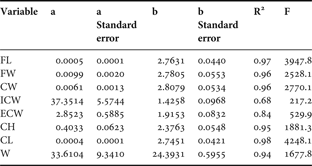
The parameters of the estimated relationships between the different measures of the cuttlebone and the body wet weight for both sexes are shown in Tables 1 and 2.
Parameters of the potential fitting equations between morphometric variables of the cuttlebone and the dorsal mantle length (DML) of males Sepia officinalis.

Parameters of the potential fitting equations between morphometric variables of the cuttlebone and the dorsal mantle length (DML) of females Sepia officinalis.

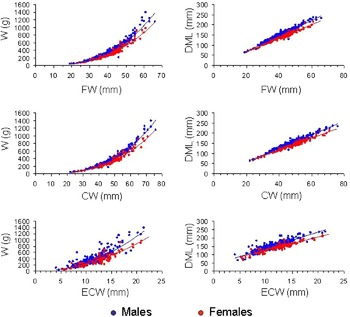
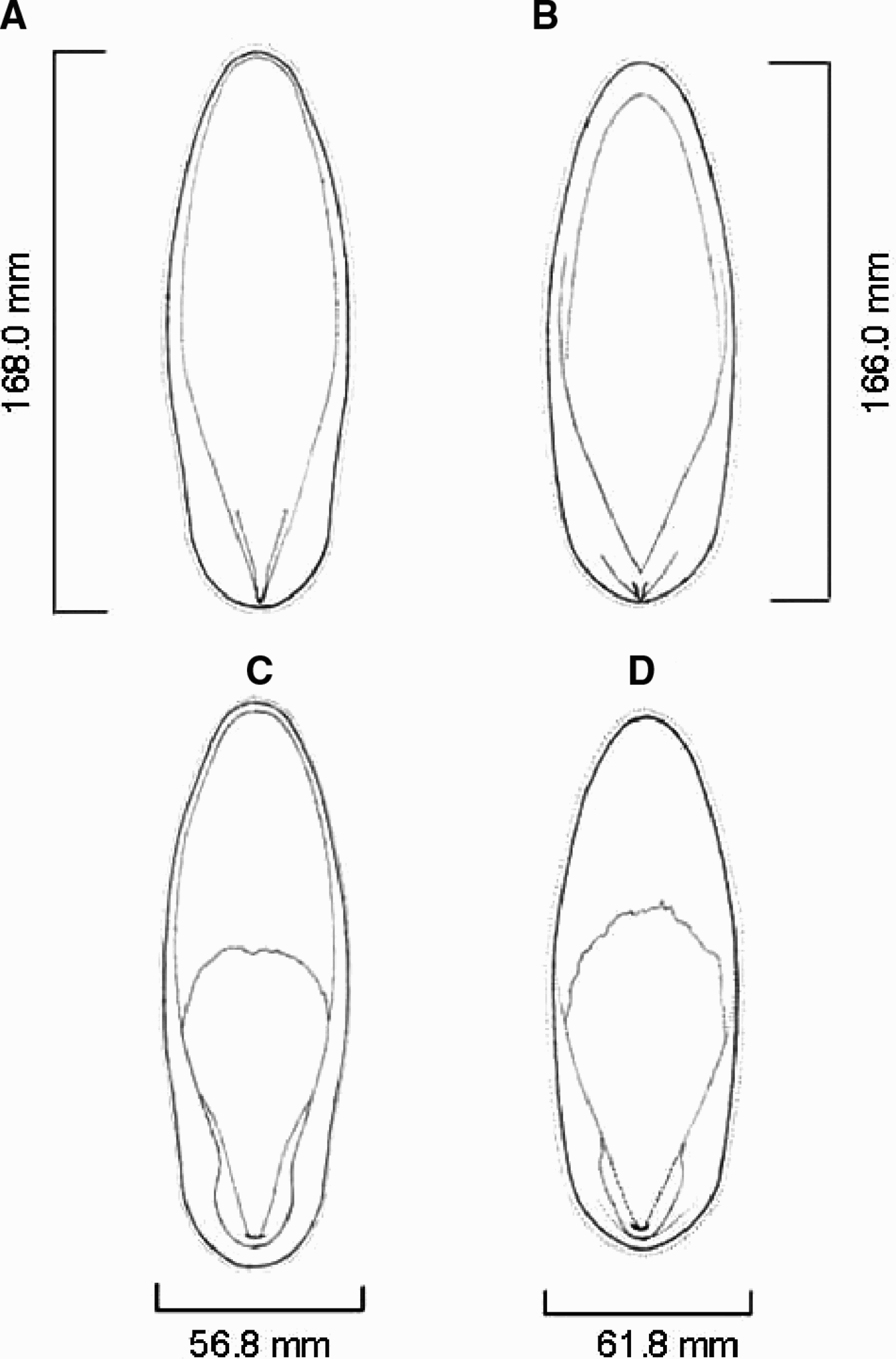
Using the analysis of variance (ANOVA), it was determined that the CW (F = 5.219; P < 0.05), FW (F = 5.946; P < 0.05) and ECW (F = 10.123; P < 0.05) were variables that may reflect some of the morphometric differences between the sexes. The results obtained indicated that these measures are proportionally larger in females than in males, being more accentuated in the bigger specimens (Figures 3 & 4).
Relationships of wet weight (W) and length (DML) with the widths of the fragmocone (FW), cuttlebone (CW) and the external cone (ECW) for male and female cuttlefish caught off Gran Canaria.

Dorsal and ventral views of the cuttlebones of the adult male (A,C) and female (B,D).

DISCUSSION
In the fishing grounds used by the artisanal fleet that operate with fish traps off the Canary Islands (Hernández-García et al., Reference Hernández-García, Hernández-López and Castro1998), we have observed that a major proportion (>50%) of the Sepia officinalis caught is in the form of cuttlebones. This may be due to mortality in the fishing trap caused by predation by other cephalopods (Sepia and Octopus) and/or sparids and monacanthids fish. Due to this, it may be of great relevance to take the cuttlebones into account and convert their numbers to biomass and fishing mortality estimations.
The morphometric measures of the cuttlebone were analysed having taken into account the possible differences due to sex, and considering the depth range where the cuttlefish were caught. In this way, Bandel & Boletzky (Reference Bandel and Boletzky1979) and Gower & Vincent (Reference Gouver and Vincent1996) suggested that the form and level of compactness of the cuttlebone depend on the depth where the animals live as pressure directly affects the form and the interlamellar space in the fragmocone. Also, the differences found between males and females in FW, CW and ECW, are explained from the phylogenetic point of view (Hewitt & Stait, Reference Hewitt and Stait1988; Sainz, Reference Sainz1990) as females have developed adaptations that permit them to obtain a major surface to lodge the eggs. This adaptation of the female anatomy may be described by a relationship of a wider cuttlebone (relative to males) in relation to the body length.
The cuttlebone growth pattern strongly depends on the temperature oscillations, availability of nutrients, and depths where the animals live (Choe, Reference Choe1963; Richard, Reference Richard1969, Reference Richard1972; Boletzky, Reference Boletzky1974; Natsukari et al., Reference Natsukari, Hirata, Washizaki and Boucaud-Camou1991; Ré & Narciso, Reference Ré and Narciso1994; Le Goff et al., Reference Le Goff, Gauvrit, Pinzon du Sel and Daguzan1998; Bettencourt & Guerra, Reference Bettencourt and Guerra2001). However, there is no evidence that shows that these factors may alter the morphometric features of the cuttlebone in a different way depending on the sex. This structure has traditionally been used in taxonomic studies to identify species according to the morphological variations and their sexual dimorphism (Lu, Reference Lu and Voss1998; Neige, Reference Neige2006).
The results obtained in the present study may allow developing a useful tool for both: (a) the estimation of the total biomass caught of Sepia officinalis; and (b) determination of the fishing mortality generated by the small-scale trap fishery. This may be possible due to the direct biometric relationships between the cuttlebone and the length and weight in Sepia. Also, the presence of cuttlebone parts (from which the length, weight and sex of the eaten cuttlefish may be determined) in the stomach contents of predators such as marine turtles, may further allow to determine the impact of these species on the cuttlefish population.
ACKNOWLEDGEMENTS
We would like to thank Alejandro y Ulises Medina (fishermen in Arguineguín, Gran Canaria) for their collaboration in the sample collection, and Ms Angela Caballero for her assistance in the laboratory. Dr Ángel Guerra (CSIC, Vigo, Spain) is acknowledged for his helpful suggestions and comments on this work.