I. INTRODUCTION
Pb(Zr0.52Ti0.48)O3 (PZT) films, with their perovskite structure,Reference Noheda, Gonzalo, Cross, Guo, Park, Cox and Shirane1 have been extensively investigated because of their wide range of applications including microwave devices,Reference Wang, Cao, Otsuka, Yoshikawa, Kokawa and Taniguchi2 microcantilever sensors,Reference Kang, Bae, Park and Kim3 and medical imaging instruments.Reference Foster, Pavlin, Lockwood, Ryan, Harasiewicz, Berube and Rauth4 The fact that PZT films have higher piezoelectric activity than other piezoelectric materials such as ZnO, GaN, and AlN,Reference Polla and Francis5, Reference Bernardini, Fiorentini and Vanderbilt6 makes them potential candidates for high frequency transducers. The desire to use high frequency transducers that operate in the frequency range of 30–150 MHz originates from the high demand in medical ultrasonic imaging to examine the eye, the skin, and the vascular structures.Reference Foster, Pavlin, Lockwood, Ryan, Harasiewicz, Berube and Rauth4
One of the keys to fabricate high frequency transducers is to process crystalline piezoelectric PZT films with a thickness of a few micrometers.Reference Abrar, Zhang, Su, Button, Kirk and Cochran7 Compared to other growth techniques such as the sol–gel process,Reference Ishikawa, Kurosawa, Endoh and Takeuchi8, Reference Zhou, Shung and Huang9 RF-magnetron sputtering,Reference Kanno, Fujii, Kamada and Takayama10 and pulsed laser deposition,Reference Horwitz, Grabowski, Chrisey and Leuchtner11 the hydrothermal method allows the fabrication of thick crystalline PZT films at a lower temperature (<200 °C) in a much more cost-effective way. The lower processing temperature also effectively alleviates problems such as Pb volatilization, film-substrate inter-diffusion, and stress formation because of thermal expansion mismatch. However, hydrothermal-processed PZT thick films are composed of randomly oriented grains that result in grain discontinuity and large film porosity, leading to lower electromechanical and ferroelectric properties.Reference Ishikawa, Kurosawa, Endoh and Takeuchi8 The sol–gel filling process has been demonstrated to be an effective way to reduce film porosity and enhance the overall film density for a better ferroelectric property.Reference Zhu, Zhou, Shi, Shung, Irisawa and Takeuchi12
Another key issue in fabricating high frequency transducers is to prepare freestanding PZT films that have less residual stress.Reference Cho, Anderson, Richards, Bahr and Richards13, Reference Cho, Anderson, Richards, Bahr and Richards14 In our previous study, self-separated hydrothermal PZT thick films were processed by liftoff via rapid thermal treatment. The quality of resulting films satisfies the requirements for high frequency transducer applications.Reference Zhu, Zhou, Shi, Shung, Irisawa and Takeuchi12 For example, a high frequency single element ultrasound transducer fabricated using these films at a center frequency of 67 MHz yielded an impressive bandwidth at −6 dB of 73%.
In this work, a record high electromechanical coupling factor (k t) comparable to the value of bulk PZT 5H ceramics with one of the highest electromechanical coupling factors (k t = 0.53) among the different kinds of bulk PZT ceramics has been demonstrated for self-separated hydrothermal PZT thick films followed by a sol–gel filling and sintering process. The enhanced piezoelectric and electromechanical properties were achieved by processing PZT thick films with a very high film density and unique microstructure. A detailed microstructural analysis was conducted to correlate the structures to the enhanced electromechanical properties.
II. EXPERIMENTAL
The PZT thick films were first deposited on Ti substrates by the hydrothermal method at 180 °C under hydrostatic pressure with an approximate thickness of 30 μm. Details for the hydrothermal process can be found elsewhere.Reference Ishikawa, Kurosawa, Endoh and Takeuchi8 An optimized temperature of 650 °C was used to anneal the hydrothermal PZT thick films with a fast heating rate in air under atmosphere pressure for 1 min. Then the PZT thick films self-separated from the Ti substrates without any cracking.
The sol–gel PZT solutions were prepared using 2-methoxyethanol (2-MOE) as the solvent. First, Pb acetate trihydrate was initially dissolved in 2-MOE at 80 °C, then refluxed at 115 °C for 1 h under Ar. The water of hydration was distilled at 115 °C under vacuum about 130 mbar. Appropriate quantities of zirconium n-propoxide and titanium iso-propoxide were mixed and stirred in 2-MOE at 25 °C. Upon completion of the dehydration step, the rotary flask containing the Pb acetate complex was cooled well below 100 °C and the zirconium and titanium precursors were added. This mixture was refluxed for 2 h at 120 °C. To compensate for Pb volatilization during sol–gel heat treatments, 20 mol% excess Pb was added to the solutions. Following the reflux step, the solution was distilled at 115 °C again with the aid of vacuum. The mixture was allowed to cool to near room temperature and 22.5 vol% acetylacetonate (2,4 pentanedione) was introduced while stirring, which acted as a chelating agent to prevent solution hydrolysis in the presence of atmospheric moisture. 2-MOE was added to achieve a final solution concentration of 0.35 M.
The sol–gel filling process was conducted by immersing the self-separated films in a PZT sol–gel solution for 30 min followed by 2 min heat treatment on hot plate at 200 and 400 °C, and then 1 min rapid thermal annealing at 650 °C. Last, these films were annealed at 950 °C for 1h in oxygen.
The characterization of the microstructure of these films was performed using a high resolution field emission scanning electron microscope (JEM-7500F Cold Emission Scanning Electron Microscope, JEOL Ltd., Tokyo, Japan)and a transmission electron microscope (TEM, JEOL 2010 analytical electron microscope with a point-to-point resolution of 0.23 nm, JEOL Ltd., Tokyo, Japan). Both plan-view and cross-section TEM samples were prepared on the freestanding PZT films using the standard gluing, grinding, polishing, and ion milling steps. The high field hysteresis properties were characterized using a TR6000 (Radiant Technology, Albuquerque, NM) ferroelectric test system. Samples were poled at room temperature for 5 min with 150 V. The magnitude and phase of the electrical impedance of a PZT hydrothermal thick film for high frequency transducer were measured using an HP4291B impedance analyzer (Hewlett-Packard Company, Palo Alto, CA).
III. RESULTS AND DISCUSSION
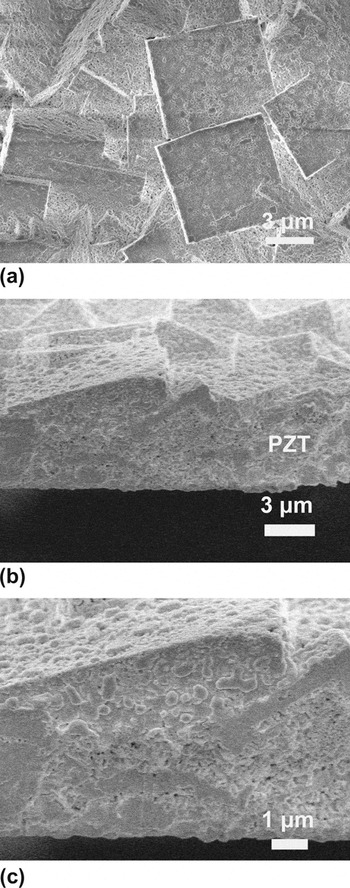
The x-ray diffraction analysis (XRD) of the hydrothermal PZT thick films (not shown here) suggests a pure perovskite phase that is consistent with that of the PZT film in our previous study.Reference Zhu, Zhou, Shi, Shung, Irisawa and Takeuchi12 The surface morphology and cross-sectional view of the thick PZT films were studied by scanning electron microscope (SEM) in both plan-view and cross-section view, as shown in Figs. 1(a)–1(c). The surface of the films shows many large randomly oriented square-shaped grains with an average size of around 10 μm. No microcracking was observed in these freestanding PZT thick films. As shown in the cross-sectional images [Figs. 1(b) and 1(c)], the grains are well-connected without any obvious gaps. On the top surface of the grains these are nanoparticles with an average size of ∼200 nm which grew during the sol–gel filling process and filled the gaps between the grains, resulting in enhanced grain connectivity. Both the plan-view and cross-sectional SEM images indicate the high density of hydrothermal PZT films achieved after the sol–gel filling.
SEM (a) plan-view, and (b) and (c) cross-sectional images of hydrothermal Pb(Zr0.52Ti0.48)O3 (PZT) thick film sintered at 950 °C after sol–gel filling.

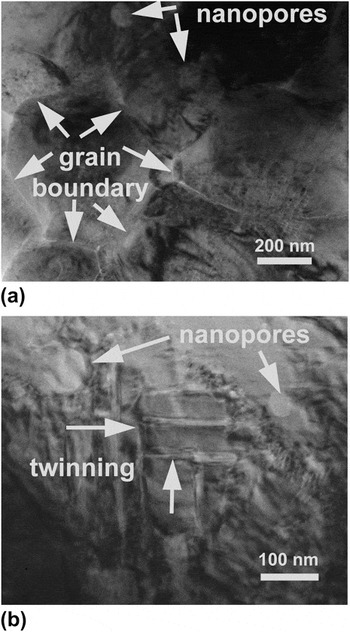
To further study the microstructure and grain connectivity, TEM was conducted on both plan-view and cross-sectional samples. The plan-view and cross-sectional TEM images are shown in Figs. 2(a) and 2(b), respectively. In the plan-view image [Fig. 2(a)], the hydrothermal PZT thick film exhibits dense columnar subgrains ∼400 nm in size. Those columnar subgrains constitute randomly oriented large grains seen in the previous SEM images indicating a columnar structure in the hydrothermal PZT film. The columnar structure could help in relieving the lateral stress in the films because the columnar grain boundaries are more disordered than the bulk lattice within the grains. It is clearly seen that the subgrains are well-connected without any obvious pores at the boundaries. One particular subgrain with neighboring boundaries is marked for illustration. The cross-sectional TEM image [Fig. 2(b)] also confirms the dense film with few twin boundaries observed in the middle of the image, which suggests a high crystallinity and relaxed strain in the film. It is noted that a few nanopores (∼50 nm) were observed in both the plan-view and the cross-sectional images, which may help to relieve the film stress. The estimated porosity based on the nanopore density and size is 1.3%. The columnar microstructures and nanopores might help to relieve the residual stress, resulting in crack-free thick films during self-separation process.
(a) Plan-view and (b) cross-sectional TEM microscopy images of hydrothermal PZT thick film sintered at 950 °C after sol–gel filling show well-connected grains and small nanopores within grains.

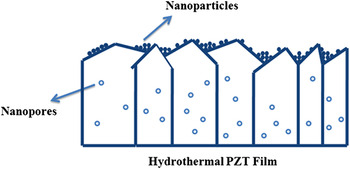
A schematic cross-section view of the PZT hydrothermal films after the sol–gel filling and the sintering process is given in Fig. 3 to summarize the main observations in SEM. The self-separated freestanding crack-free PZT thick films consist of randomly oriented columnar structures with PZT nanoparticles on the surface of columns and in the gaps between those columns achieved by the sol–gel filling process.
A schematic of the cross-sectional view of PZT hydrothermal film after sol–gel filling and sintering process.

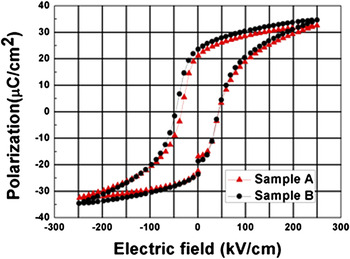
The ferroelectric hysteresis loops (polarization versus electric field) of the hydrothermal PZT thick films without filling (sample A) and after filling (sample B) are shown in Fig. 4. Both sample A and B have symmetric loops, indicating there are very few oxygen vacancies.Reference Granzow, Dorfler, Woike, Wohlecke, Pankrath, Imlau and Kleemann15 It can be seen that the remnant polarization (P r) and the saturation polarization of sample A are 21.0 μC/cm2 and 33.0 μC/cm2 at an applied electric field of 250 kV/cm, respectively. For sample B the values are 24.5 μC/cm2 and 35.0 μC/cm2. It should be pointed out that PZT films without filling break down at a field slightly higher than 250 kV/cm. On the other hand, the breakdown field of PZT films with filling can be >300 kV/cm. The results suggest that the sol–gel filling could have slightly enhanced the ferroelectric property and effectively enhanced the voltage sustainability of the self-separated hydrothermal PZT thick films.
Polarization–electric field hysteresis loops of the PZT thick films (sample A: sintered at 950 °C without sol–gel filling and sample B: after sol–gel filling).

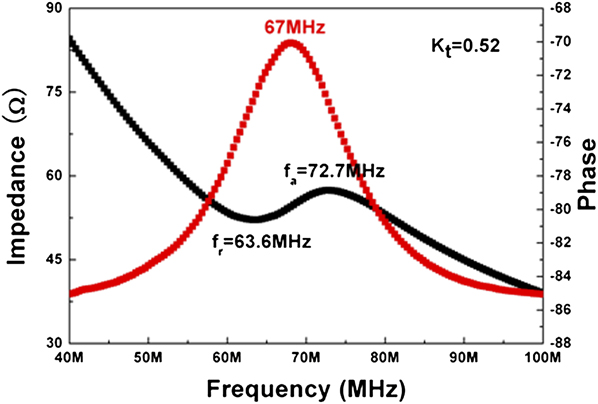
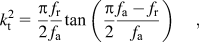
Figure 5 shows an experimentally measured magnitude and phase of the electrical impedance of a PZT hydrothermal thick film as a function of frequency in air. The resonant and antiresonant peaks were observed around 63.6 MHz and 72.7 MHz, respectively. The electromechanical coupling coefficient (k t) of materials can be determined by Eq. (1),16
Spectrum of the magnitude and phase of the electrical impedance of a PZT hydrothermal thick film after sol–gel filling and sintering.
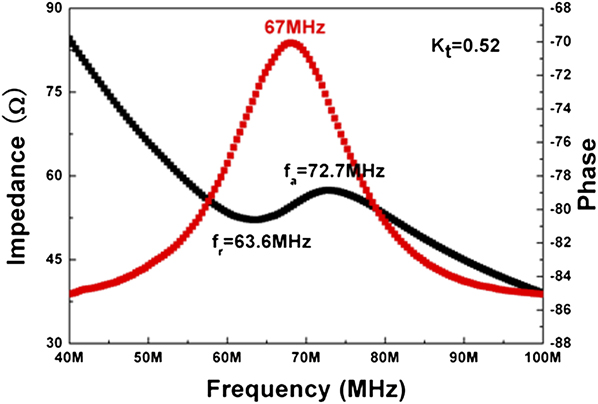
where f r is the resonant frequency with minimum impedance and f a is the antiresonant frequency with maximum impedance. According to Eq. (1), kt is about 0.52, which is very close to the value of PZT 5H ceramics. These results show that hydrothermal PZT thick films have excellent piezoelectric properties that approach the optimal bulk values.
The main reasons for achieving bulk-like piezoelectric and electromechanical properties in hydrothermal thick PZT films are the following. First, the well-crystallized PZT thick films fabricated by the hydrothermal method resulted in a pure perovskite phase without any obvious secondary phases evidenced in our XRD and TEM study. Second, the unique columnar microstructure and nanopores within the columns effectively relieve the residual stress and result in crack-free films during the liftoff process and the annealing step after sol–gel filling process. Third, sol–gel filling and high temperature sintering following the liftoff process yielded a high density film. These processes allowed the PZT to fill the gaps between the large PZT columns and enhanced the overall film density and grain connectivity, resulting in high density, well-crystallized, stress-relieved PZT thick films with bulk-like properties.
IV. CONCLUSIONS
In summary, the self-separated hydrothermal PZT films after sol–gel filling and high temperature sintering (950 °C) exhibit bulk-like ferroelectric and piezoelectric properties. The remnant polarization (Pr) is 30.5 μC/cm2, close to that of PZT bulk materials sintered at a high temperature, whereas the electromechanical coupling factor (k t) reaches as high as 0.52, which is very close to the value of PZT 5H ceramics. The SEM and TEM images show that the self-separated hydrothermal PZT films possess a large columnar grain structure with good connectivity. The columnar grain structure and nanopores could help relieve the residual stress in the films and result in crack-free films during all the processes. The excellent grain connectivity was achieved by PZT filling and high temperature sintering. All of these factors contribute to the overall bulk-like ferroelectric and piezoelectric properties.
ACKNOWLEDGMENTS
The research effort at Texas A&M University was supported by National Science Foundation (NSF-1007969 and NSF-0846504). The effort at Los Alamos National Laboratory was performed, in part, at the Center for Integrated Nanotechnologies, a U.S. Department of Energy, Office of Basic Energy Sciences user facility. The effort at University of Southern California was partially supported by National Institutes of Health P41-EB2182. BHP was partially supported by the World Class University program through the National Research Foundation funded by Ministry Of Education, Science and Technology (Grant No. R31-2008-000-10057-0).