Introduction
Minerals with varying chemical compositions exist commonly in the form of a type of isomorphism, where cations substitute in the crystal structure and form so-called ‘solid solutions’. The magnitude of isomorphism essentially depends on the difference in the radii of the substituting cations (Reeder, Reference Reeder and Reeder1983; Putnis, Reference Putnis1992; Böttcher and Dietzel, Reference Böttcher and Dietzel2010). Effective cationic radii of Ba2+, Mg2+, Fe2+ and Mn2+ in six-fold coordination are 1.35 Å, 0.72 Å, 0.77 Å and 0.82 Å, respectively (Shannon and Prewitt, Reference Shannon and Prewitt1969). Therefore, cations with similar radii (∆r < 0.11 Å) may principally replace each other at the same lattice position (e.g. Mg2+, Fe2+ and Mn2+); alternatively, they could form a layer-structure (e.g. Mg2+ and Ba2+) (Reeder, Reference Reeder and Reeder1983).
The formation of norsethite BaMg(CO3)2 and PbMg(CO3)2 has been suggested as a geochemical and crystal chemical analogue for dolomite (CaMg(CO3)2) (Lippmann, Reference Lippmann1967, Reference Lippmann, Müller and Friedman1968, Reference Lippmann1973; Böttcher, Reference M.E2000; Lindner et al., Reference Lindner, Saldi, Carrocci, Benezeth, Schott and Jordan2018). The formation conditions of the rock-forming dolomite and the less-abundant kutnohorite (CaMn(CO3)2) are still far from being completely understood (Peacor et al., Reference Peacor, Essene and Gaines1987; Reeder and Dollase, Reference Reeder and Dollase1989; Böttcher and Dietzel, Reference Böttcher and Dietzel2010). The natural occurrence of norsethite-type carbonates, BaMg(CO3)2, has been described from very different geological environments. The first report from the sedimentary Green River formation (Mrose et al., Reference Mrose, Chao, Fahey and Milton1961) was later complemented by findings in hydrothermal, metamorphic and even carbonatite settings (Sundius and Blix, Reference Sundius and Blix1965; Kapustin, Reference Kapustin1965; Steyn and Watson, Reference Steyn and Watson1967; Platt and Woolley, Reference Platt and Woolley1990; Damyanov et al., Reference Damyanov, Bakardjiev and Popov1996; Secco and Lavina, Reference Secco and Lavina1999; Onac, Reference Onac2002; Zidarov et al., Reference Zidarov, Petrov, Tarassov, Damyanov, Tarassova, Petkova, Kalvachev and Zlatev2009). From natural mineral compositions, Glynn (Reference Glynn2000) estimated substantial solid-solution formation in the rhombohedral system magnesite–rhodochrosite (MgCO3–MnCO3) including at ambient temperatures. Similarly, the chemical compositions of natural norsethite carbonates show that Mg2+ cations may be substituted by small amounts of Mn2+ to form Ba(Mg1–xMnx)(CO3)2 solid solutions (x ≤ 0.2), with a substantial Mn replacement reported from both sediments and hydrothermal settings (Zidarov et al., Reference Zidarov, Petrov, Tarassov, Damyanov, Tarassova, Petkova, Kalvachev and Zlatev2009; Böttcher et al., Reference Böttcher, Gehlken, Skogby and Reutel1997, Reference Böttcher, Effenberger, Gehlken, Grathoff, Schmidt, Geprägs, Bahlo, Dellwig, Leipe, Winde, Deutschmann, Stark, Gallego-Torres and Martinez-Ruiz2012). Although natural BaMn(CO3)2 has been found in the sediments of the Baltic Sea (Böttcher et al., Reference Böttcher, Effenberger, Gehlken, Grathoff, Schmidt, Geprägs, Bahlo, Dellwig, Leipe, Winde, Deutschmann, Stark, Gallego-Torres and Martinez-Ruiz2012) and its crystal structure has been characterised using synthetic single crystals (Liang et al., Reference Liang, Li, Yin, Li, Li, Liu, Zhao, Yang, Meng, Li, He and Li2019), it is still missing its recognition as an official mineral (Pasero, Reference Pasero2025). It is still unclear whether there are any gaps in the potential range of Mn content in norsethite carbonates and whether BaMg(CO3)2–BaMn(CO3)2 can form a continuous solid-solution series. More importantly, the crystal chemical characterisation and consequence of isomorphism in the BaMg(CO3)2–BaMn(CO3)2 solid-solution series is essential to link the geochemical composition of natural norsethite to the formation environment (e.g. Zheng and Böttcher, Reference Zheng and M.E2016) and to the potential source of incorporated elements. The relationship between the compositions, the crystal structures and vibrational spectra are deemed as the core factors of quantitative research for understating isomorphic element substitution in these carbonate minerals.
In this paper, single crystals from the continuous solid-solution series Ba(Mg1–xMnx)(CO3)2 (x = 0, 0.25, 0.50 and 0.75) were grown under the same high PT conditions. The crystal structures of the synthesis products were determined by single-crystal X-ray diffraction (XRD), Raman and infrared spectroscopy and then quantitative relations to the composition established. The results presented here provide a starting point to discover Mn-rich members of this solid-solutions series in Nature.→
Experimental methods
A precursor-based method was adopted for the synthesis of the norsethite-type solid solutions and the high PT reactions were performed in a DS 6×600t cubic-anvil-type apparatus by using a h-BN pressure medium and graphite heater. BaCO3 (99.99%, Alfa Aesar), synthetic MgCO3 and MnCO3 (99.99%, Alfa Aesar) were used as starting materials to prepare the precursors of BaMg(CO3)2, BaMn(CO3)2 and (Mg1–xMnx)CO3, in which the synthetic MgCO3 was prepared by the high PT decomposition reaction of the oxalate (Liang et al., Reference Liang, Li, Wang, Chen and Li2017). Sample assembly and reaction conditions were followed the information of BaMn(CO3)2 (Liang et al., Reference Liang, Li, Yin, Li, Li, Liu, Zhao, Yang, Meng, Li, He and Li2019), and the relevant solid reactions were described as:
Precursor method 1
BaCO3 + MgCO3 → BaMg(CO3)2
BaCO3 + MnCO3 → BaMn(CO3)2
(1-x)BaMg(CO3)2 + xBaMn(CO3)2 → Ba(Mg1-xMnx)(CO3)2
(1)
Precursor method 2
(1-x)MgCO3 + xMnCO3 → (Mg1-xMnx)CO3
BaCO3 + (Mg1-xMnx)CO3 → Ba(Mg1-xMnx)(CO3)2(2)
The as-synthesised powder samples were labelled BM000, BM025, BM050 and BM075, relating to the Mn/(Mn + Mg) mole fractions XMn of 0, 0.25, 0.50 and 0.75, respectively. Using the powder samples as starting materials, Ba(Mg1–xMnx)(CO3)2 single crystals were grown in an aquatic medium under 3 GPa and 700°C for 48 h. The results for BaMn(CO3)2 are cited from Liang et al. (Reference Liang, Li, Yin, Li, Li, Liu, Zhao, Yang, Meng, Li, He and Li2019) and labelled as the end-member BM100.
The crystals were examined optically under a plane polarised microscope (model: 59XC, Shangguang, China; magnification conditions: 200×). Several crystals were selected and prepared for the thin sections, and the chemical compositions were quantified by electron probe microanalysis. Major elements (wt.%) in minerals were measured in WDS mode with a JEOL JXA-8230 electron microprobe at Shandong Institute of Geological Sciences, China. To reduce the beam damage, a small current and large beam spot were used, and the operating conditions were 15 kV accelerating voltage, 1×10⁻⁸ A beam current and 5 μm beam spot. The standard samples used were baryte (Ba), dolomite (Mg), and rhodonite (Mn). Matrix effects were corrected using the ZAF software provided by JEOL.
The powder XRD data were collected on a Panalytical multifunction X-ray diffractometer (model: Empyrean) with CuKɑ radiation at Guizhou Minzu University, China, and the phase identification was carried out by Jade 6 XRD analysis software. Single crystals of sample BM000 were selected for the single-crystal XRD measurements, which were performed at ambient conditions with a Rigaku Xtalab PRO diffractometer system and HyPix-6000HE detector at the China University of Geosciences, Beijing. The intensity data were collected using a 1.2 Kw water cooled microfocus source with a Mo rotor target and multilayer mirrors. Data processing was performed with the CrysAlisPro processing program. Crystallographic data for BM025, BM050 and BM075 were collected on a Bruker APEX 2 CCD diffractometer with graphite monochromated MoKα radiation on a Bruker D8 Venture diffractometer at Guangdong University of Technology. The structures were determined using direct methods with the SHELXS package and refined in the anisotropic approach for non-hydrogen atoms using the SHELXL program (Sheldrick, Reference Sheldrick2008).
Raman spectra were obtained on a Renishaw 2000 micro-confocal laser Raman spectrometer equipped with a charge-coupled device detector, a 2400 lines mm−1 diffraction grating and a holographic notch filter. The spectrum physics model of the 2017 argon ion laser operating at 514.5 nm was used as the excitation source. The laser power was fixed at 30 mW to avoid overheating of the carbonates and the zero-offset was calibrated by silicon crystal at 520.0 cm−1. Fourier-transform infrared (FTIR) spectroscopy in transmission mode was carried out at room temperature and ambient pressure as described previously (Böttcher et al., Reference Böttcher, Gehlken and Liang2021). Ground samples were analysed with a FTIR spectrometer (Nexus 470, Thermo Nicolet), using specimen grain sizes of <2 µm. The spectra were recorded in transmission mode in the mid-infrared (MIR) region in the wavenumber range 4000 to 400 cm–1. Aliquots of 1.25, 2.5, 5 and 10 mg samples were mixed in an agate mortar with 1 g KBr each, dried at 20°C and 110°C, and pressed to transparent KBr pellets at room temperature and a pressure of ∼7.5 tons/cm2 (≡ 0.74 GPa) under vacuum conditions. 64 scans were acquired at a resolution of 0.5 cm–1 by means of a DTGS (deuterated triglycine sulfate) detector. The precision of the measured wavenumbers is ±0.5 cm–1 for υ1, υ2, and υ4 and ∼ ±3 cm–1 for υ3 and the υ1 + υ3 and υ1 + υ4 combination modes (Böttcher et al., Reference Böttcher, Gehlken and Liang2021).
Results and discussion
Crystal structure of norsethite BaMg(CO3)2
Despite considering norsethite BaMg(CO3)2 as the structural analogue of dolomite, its layer-structure has been controversial until now. According to the analyses of single-crystal XRD of BaMg(CO3)2 synthesised at ambient pressure, Effenberger et al. (Reference Effenberger, Pippinger, Libowitzky, Lengauer and Miletich2014) observed a superlattice associated with oxygen ordering and determined the structure had R  $\bar 3$c symmetry corresponding to a doubling of the c-axis. Conversely, the structure of BaMn(CO3)2 (synthesised at high PT) was confirmed to be in the R
 $\bar 3$m space group, as no superlattice was found in the X-ray images (Liang et al., Reference Liang, Li, Yin, Li, Li, Liu, Zhao, Yang, Meng, Li, He and Li2019). Therefore, there may be potentially limited solid solubility in the BaMg(CO3)2–BaMn(CO3)2 series caused by the incomplete isomorphism of the end-member phases, or at least the jump in crystal chemical and physicochemical properties. Notwithstanding, recent research on the norsethite analogue BaFe(CO3)2 indicates that the crystal structure and the two space group symmetries depends strongly on the formation conditions (Liang et al., Reference Liang, Peters, Li, Leupold, Li and M.E2021). If the crystal structure of BaMg(CO3)2 is synthesised at high PT it could be isomorphic with BaMn(CO3)2, and thus in our investigation it is anticipated that the two end-member phases are capable of continuous solid-solution formation on the premise of the complete isomorphism. Proving this series will contribute to species of carbonates that are potentially part of the missing minerals of carbon (Hazen et al., Reference Hazen and Ausubel2016).
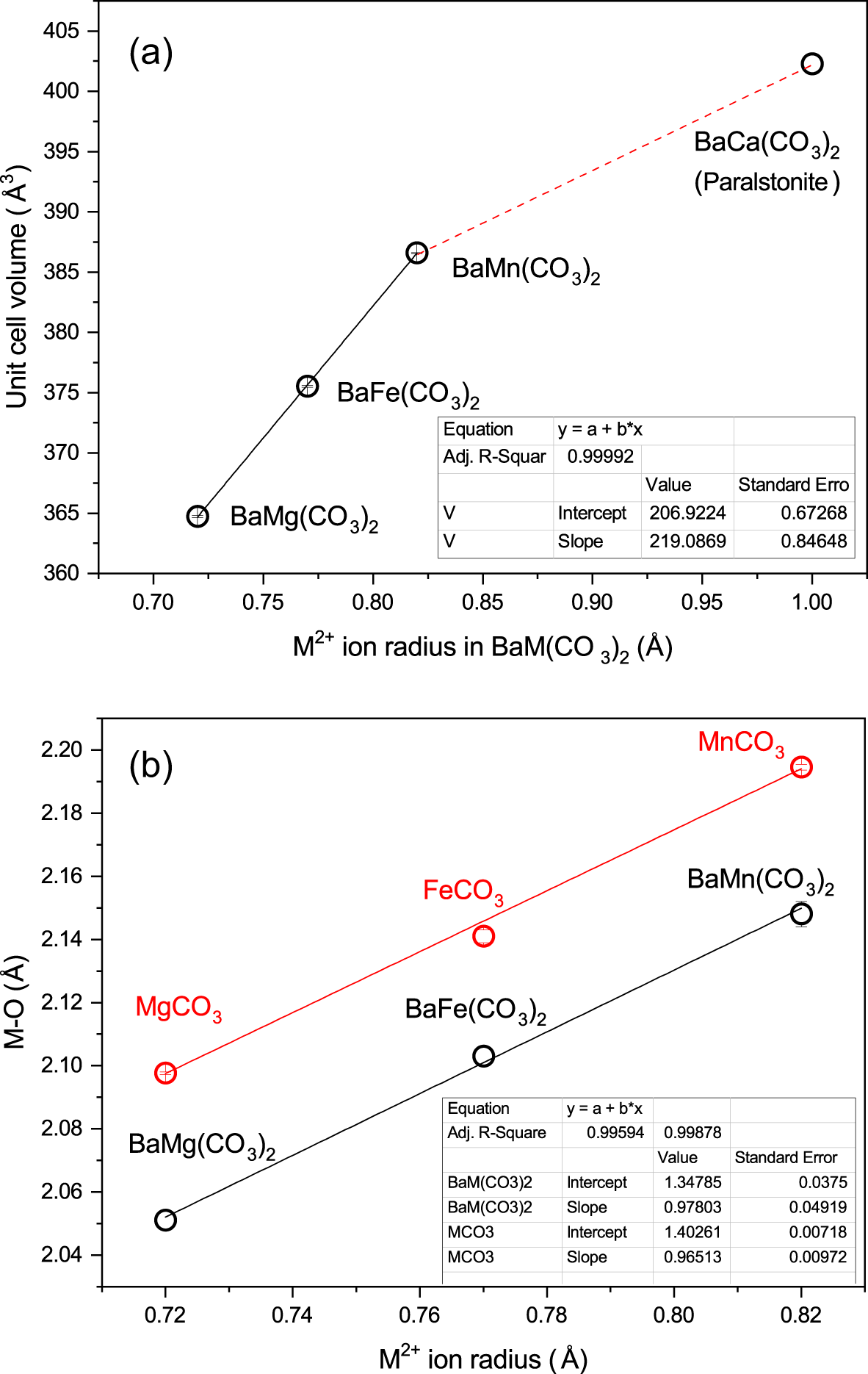
Noting that no superstructure reflections were detected along a*, b*, and c* in the X-ray images of BaMg(CO3)2 synthesised under high PT (Supplementary Fig. S1), the space-group symmetry was identified as R  $\bar 3$m in agreement with results for BaFe(CO3)2 and BaMn(CO3)2 (Liang et al., Reference Liang, Li, Yin, Li, Li, Liu, Zhao, Yang, Meng, Li, He and Li2019, Reference Liang, Peters, Li, Leupold, Li and M.E2021). The lattice parameters of BaMg(CO3)2, BaFe(CO3)2 and BaMn(CO3)2 are plotted in Fig. 1a using the effective cationic radii to weigh the M-sites (Mg2+, Fe2+ and Mn2+) substitution (Shannon and Prewitt, Reference Shannon and Prewitt1969). The behaviour of unit cell volume (V unit_cell) and M–O bond length (M–O) obeys a statistically significant linear relationship, according to:
 \begin{equation}V_{\text{unit\_cell}} = 206.92 + 219.09 \times {r} (R^2 = 0.999)\end{equation}
 \begin{equation}M-{O_{(\text{norsethite-type})}} = {\text{ }}1.4026{\text{ }} + {\text{ }}0.9651{\text{ }} \times r\left( {{R^2} = {\text{ }}0.999} \right)\end{equation}
(a) The rigid body model of BaMg(CO3)2, BaFe(CO3)2 and BaMn(CO3)2, in which the results of BaCa(CO3)2 were reported by Effenberger Reference Effenberger1980, BaMn(CO3)2 by Liang et al. (Reference Liang, Li, Yin, Li, Li, Liu, Zhao, Yang, Meng, Li, He and Li2019), BaFe(CO3)2 by Liang et al. (Reference Liang, Peters, Li, Leupold, Li and M.E2021). (b) The Mg2+–Mn2+ substitution depending on (MO6) octahedral units.

The linear behaviour for equations 3 and 4 provides convincing evidence that the divalent ion substitution in (MO6) octahedra follow a regular rigid body mechanism, as shown in Fig. 1b. To better understand, the M–O bond length in the calcite-type structure is added for comparison (Liang et al., Reference Liang, Li, Li, Yin, Li, Liu, Shan, He, Meng, Li and Li2020):
 \begin{equation}M-{O_{\left( {\text{calcite-type}} \right)}} = {\text{ }}1.3479{\text{ }} + {\text{ }}0.9780{\text{ }} \times r\left( {{R^2} = {\text{ }}0.999} \right)\end{equation}
Obviously, the two straight lines from equations 4 and 5 are almost parallel (the slope: 0.9651 and 0.9780), revealing that the (MO6) octahedra expand in an equal amplitude due to the same softening of (BaO12) polyhedrons in the norsethite-type structure. Compared with the packing of (MO6) octahedra in a calcite-type rhombohedral structure, the expansion of M–O as the M2+ radius increases is a constant, quantified to 0.055 Å. The unit cell volume of paralstonite [trigonal BaCa(CO3)2], as a comparison, is also plotted into Fig. 1a and there is an obvious deviation from the norsethite-type rigid body model, which could be caused by the symmetry difference between R  $\bar 3$m and P321 (Effenberger, Reference Effenberger1980). According to the existing solid solubility between MnCO3 and CaCO3 (Peacor et al., Reference Peacor, Essene and Gaines1987; Böttcher, Reference M.E1998), a ternary new solid-solution phase with the rhombohedral system may appear in the mixing region between the double carbonates BaMn(CO3)2 and BaCa(CO3)2, which is worthy of future investigations on the family of Ba-bearing double and rhombohedral carbonates.
Formation of Ba(Mg1–xMnx)(CO3)2 solid solutions at high PT
As the crystal structures of the as-synthesised end-member phases in this work are isomorphic, the binary solid-solutions should realise the expectation for a continuous end-member mixing. As noted earlier, the choice of precursors has a great influence on the progress and kinetics of the reaction. There are two possible mechanisms for the formation of the norsethite-type BaM(CO3)2 solid solution. (a) The layering of Ba-sites and M-sites is first completed and then miscibility occurs at the M-sites, which could be attained by the binary solid-solutions formation from the two end-member phases, BaMg(CO3)2 and BaMn(CO3)2. (b) After the miscible process at the M-sites is established, the ordering of Ba-sites and M-sites occurs; that is, BaCO3 and (Mg1–xMnx)CO3 solid-solutions combine to form Ba(Mg1–xMnx)(CO3)2.We fixed XMn as 0.5 to clarify the mechanism (a) and (b) using the equations 1 and 2, and the results showed that the two mechanisms have almost no difference on the results (see Supplementary Fig. S2). This is because there could be no other potential side reactions except the solid-solution formation of 1:1 for the binary system BaCO3 and MgCO3/MnCO3 owing to the rather large difference between the radii of the Ba2+ and Mg2+/Mn2+, which proves that the Mg2+–Mn2+ substitution only depends on (MO6) octahedral units.
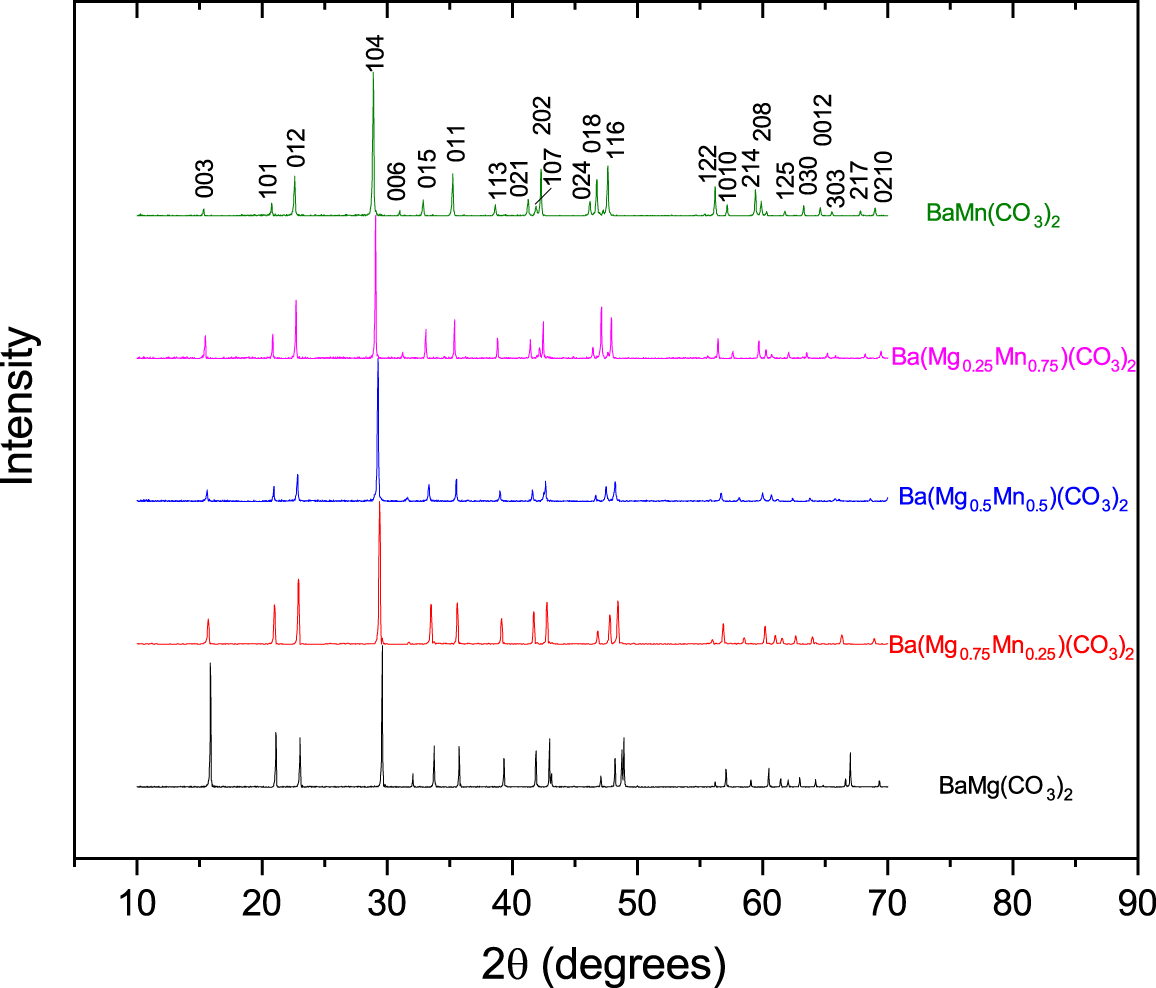
Using the precursor method (1), the Ba(Mg1–xMnx)(CO3)2 solid-solutions samples BM025, BM050 and BM075 were achieved at high PT. The powder XRD pattern in Fig. 2 indicates that all diffraction peaks can be indexed as the R  $\bar 3$m norsethite-type structure and no impurities was observed (see Supplementary Table S1). The positions of the diffraction peaks shift to a low angle with the increase of XMn, indicating that the lattice is gradually increasing. The intensities of some diffraction peaks undergo obvious evolution and no peak disappears. Here, the powder XRD data were used primarily in phase identification and the accurate structural parameters are presented using single-crystal XRD data in the text below.
The powder XRD of Ba(Mg1–xMnx)(CO3)2 solid-solutions.

Morphology and composition of Ba(Mg1–xMnx)(CO3)2 crystals
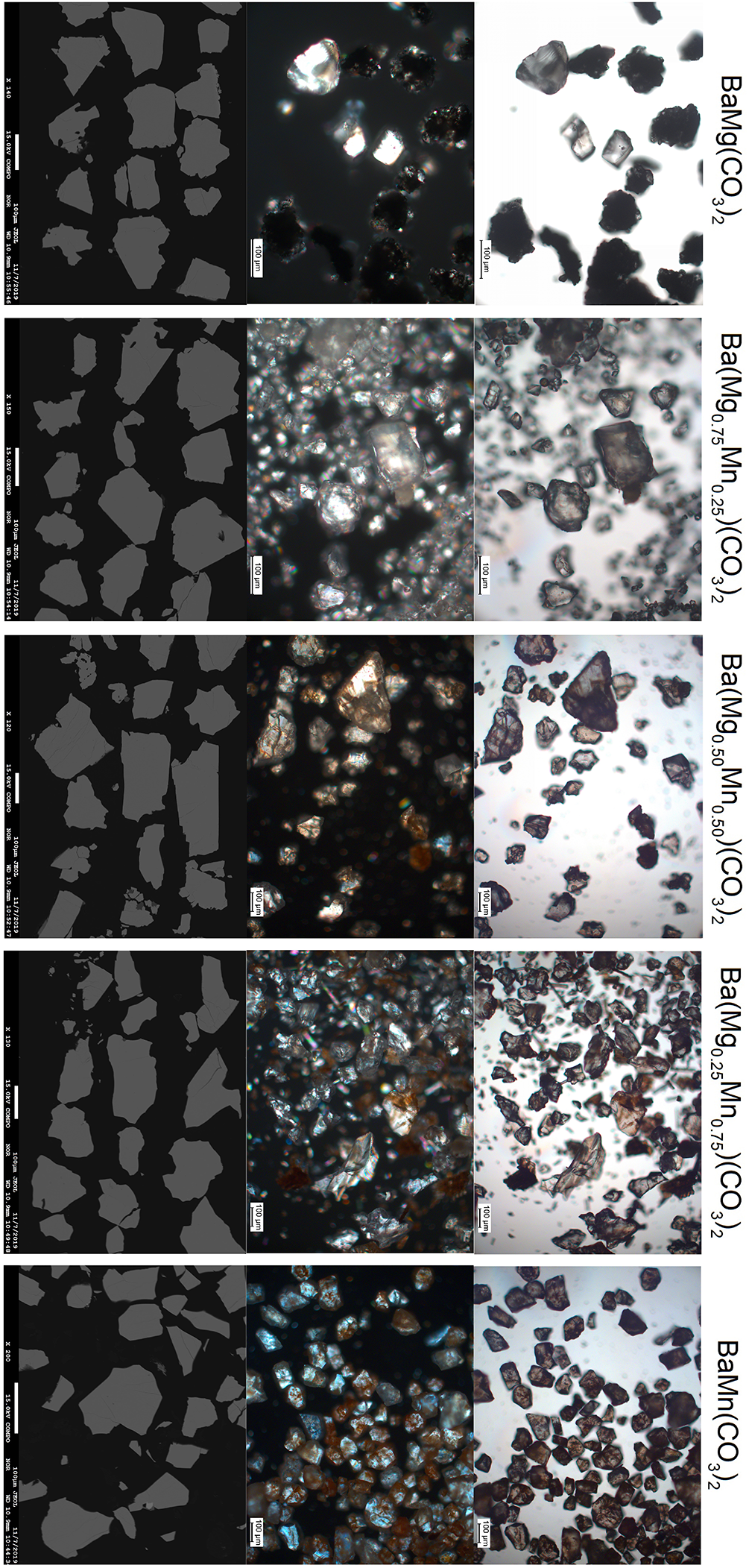
In Fig. 3, the Ba(Mg1–xMnx)(CO3)2 crystals exhibit a plate shape with irregular dissociation overall and inclusions on the surface of fine powder coming from the solution precipitation. The crystals of BaMg(CO3)2 were colourless and transparent with black inclusions but their size varied greatly. However, the BaMn(CO3)2 crystals were relatively uniform in size and were transparent with a light blue lustre and the inclusions appeared yellowish-brown. The morphology of BaMg(CO3)2 and BaMn(CO3)2 could be distinguished distinctly despite the same growing conditions. Likewise, the morphology of Ba(Mg1–xMnx)(CO3)2 crystals with the increase of XMn appeared to gradually transform from BaMg(CO3)2 to BaMn(CO3)2. The solid-solution crystals were prone to fracture into thin flakes during the cutting process, whereas the crystals of BaMg(CO3)2 and BaMn(CO3)2 remained blocky. Perhaps the degree of crystallinity of the solid solutions decreased.
The morphology of Ba(Mg1–xMnx)(CO3)2 crystals at various compositions in the solid solution.

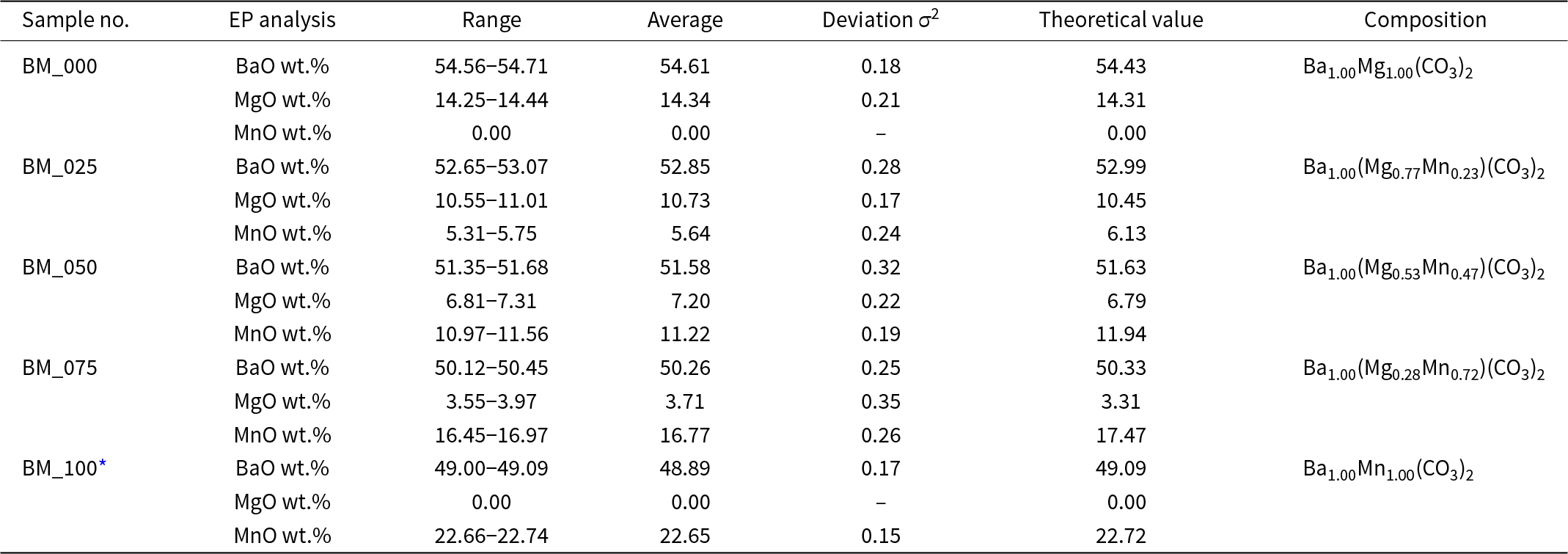
The chemical compositions are the precondition for the quantitative analysis of crystal structure. Figure 3 and Table 1 show the back-scattered electron (BSE) images and the element contents quantified by electron probe. The relative change in greyscale and the brightness of BSE were almost identical with changes in XMn, which mainly depends on BaO wt.% ranging slightly from 48.9–54.6%. According to the measurement value of BaO wt.%, MgO wt.% and MnO wt.% (Table 1), it was demonstrated that the composition of the crystals was homogeneous. The formulas of BM000, BM025, BM050 and BM075 were calculated as Ba1.00Mg1.00(CO3)2, Ba1.00(Mg0.77Mn0.23)(CO3)2, Ba1.00(Mg0.53Mn0.47)(CO3)2 and Ba1.00(Mg0.28Mn0.72)(CO3)2.
The composition data for Ba(Mg1–xMnx)(CO3)2 solid-solution samples

* Notes: data from Liang et al. (Reference Liang, Li, Yin, Li, Li, Liu, Zhao, Yang, Meng, Li, He and Li2019)
Crystal structure of Ba(Mg1–xMnx)(CO3)2 solid-solutions
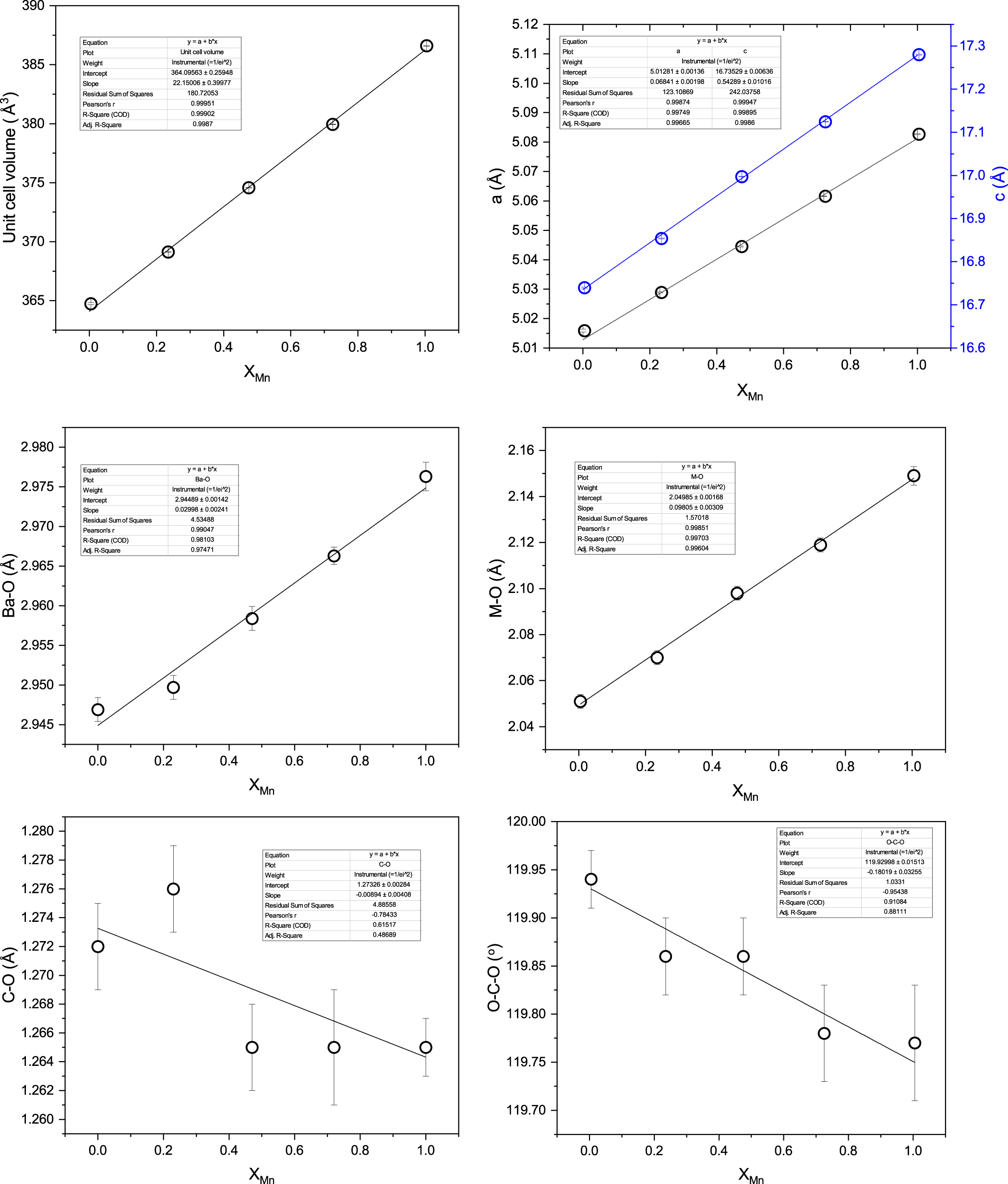
The identification of the crystal structure for the BM000–BM075 samples was performed by single-crystal XRD, as summarised in Table 2, together with BM100 from the previous results of BaMn(CO3)2 (Liang et al., Reference Liang, Li, Yin, Li, Li, Liu, Zhao, Yang, Meng, Li, He and Li2019). The high-angle region exhibited significant noise and some grains have mild undulatory extinction; therefore, the low-angle region was applied. The results were formatted into crystallographic information files (CIFs), which are available as Supplementary material (see below). Figure 4 presents the variations in the lattice parameters (a and c), unit cell volume (V unit_cell), bond length (M–O, Ba–O and C–O), and bond angle (O–C–O) as the functions of XMn, which can be fitted as:
 \begin{align}
& {V_{\text{unit\_cell}}}\left( x \right){\text{ }} = {\text{ }}364.096{\text{ }} + {\text{ }}21.150 \,x\,( {{{\unicode{x00C5}}^3}} ){\text{ }}\left[ {{R^2} = {\text{ }}0.999} \right] \nonumber \\
& a\left( x \right){\text{ }} = {\text{ }}5.013{\text{ }} + {\text{ }}0.068x \left( {\unicode{x00C5}} \right){\text{ }}\left[ {{R^2} = {\text{ }}0.997} \right] \nonumber \\
& c\left( x \right){\text{ }} = {\text{ }}16.735{\text{ }} + {\text{ }}0.543x\left( {\unicode{x00C5}} \right){\text{ }}\left[ {{R^2} = {\text{ }}0.999} \right] \nonumber \\
& Ba-O\left( x \right){\text{ }} = {\text{ }}2.945{\text{ }} + {\text{ }}0.030x\left( {\unicode{x00C5}} \right){\text{ }}\left[ {{R^2} = {\text{ }}0.975} \right] \nonumber \\
& M-O\left( x \right){\text{ }} = {\text{ }}2.050{\text{ }} + {\text{ }}0.098x\left( {\unicode{x00C5}} \right){\text{ }}\left[ {{R^2} = {\text{ }}0.996} \right] \nonumber \\
& C-O\left( x \right){\text{ }} = {\text{ }}1.273-0.009x\left( {\unicode{x00C5}} \right){\text{ }}\left[ {{R^2} = {\text{ }}0.487} \right] \nonumber\\
& O-C-O\left( x \right){\text{ }} = {\text{ }}119.93-0.18x\left( ^\circ \right){\text{ }}\left[ {{R^2} = {\text{ }}0.881} \right]
\end{align}
The lattice parameters of Ba(Mg1–xMnx)(CO3)2 solid solutions

Lattice and crystal structure parameters, for space group R  $\bar 3$m

* Notes: data from Liang et al. (Reference Liang, Li, Yin, Li, Li, Liu, Zhao, Yang, Meng, Li, He and Li2019)
The fitting lattice parameters (equation 6) of the V unit_cell, a and c display a good linear increase with the increasing x, which is consistent with Vegard’s law. Specifically, the linear correlation of M–O (x) as well as Ba–O (x) conforms to the characteristics of an ideal solid solution; that is, Mg/Mn cations are completely miscible at the B sites. Likewise, the C–O and O–C–O decreases and the change is roughly linear with the increase of XMn, which means that the CO32– ions develop slight compression and even more aplanarity when the (Mg/Mn)O6 octahedra expand.
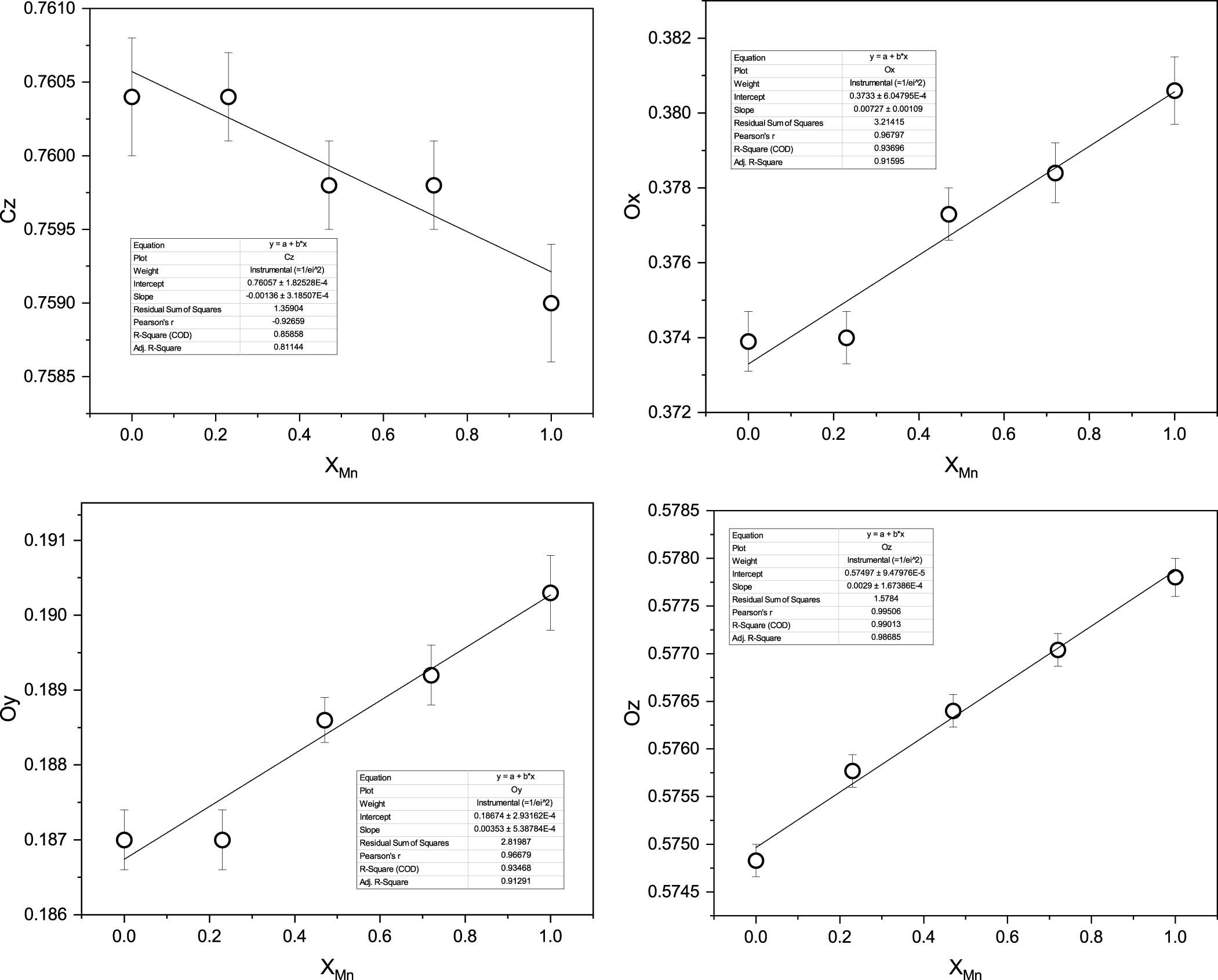
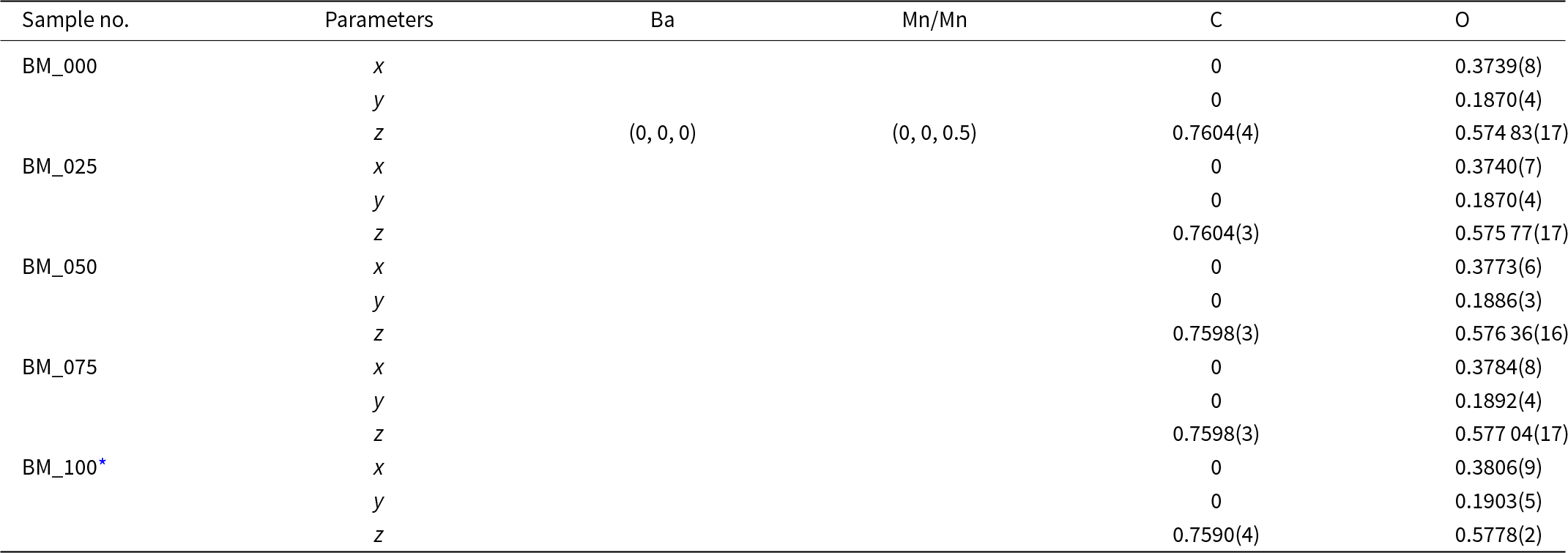
The Ba atom is located at position 3(a) (0, 0, 0) and the Ba atom is located at position 3(b) (0, 0, ½); C atom at position 6(c) (0, 0, Cz); O atom at position 18(h) (Ox, Oy, Oz), which is consistent with the R  $\bar 3$m structure given by Effenberger and Zemann (Reference Effenberger and Zemann1985). In Fig. 5, the C 6(c) and the O 18(h) atomic positions move slightly with the increase of x and the correspondence can be fitted as:
 \begin{equation}\begin{gathered}
\text{C}_\text{z}(x){\text{ }} = {\text{ }}0.7606{\text{ }} - {\text{ }}0.0014x\left[ {{R^2} = {\text{ }}0.811} \right] \hfill \\
\text{O}_\text{x}(x){\text{ }} = {\text{ }}0.3733{\text{ }} + {\text{ }}0.0073x\left[ {{R^2} = {\text{ }}0.916} \right] \hfill \\
\text{O}_\text{y}(x){\text{ }} = {\text{ }}0.1867{\text{ }} + {\text{ }}0.0035x\left[ {{R^2} = {\text{ }}0.913} \right] \hfill \\
\text{O}_\text{z}(x){\text{ }} = {\text{ }}0.5750{\text{ }} + {\text{ }}0.0029x\left[ {{R^2} = {\text{ }}0.987} \right] \hfill \\
\end{gathered} \end{equation}
The positional parameters (Cz, Ox, Oy, Oz) of the carbonate group in the Ba(Mg1–xMnx)(CO3)2 solid-solution series.

These constraint relations (7) could be applied to calibrate the lattice parameters and the positional parameters (Table 3) of the Ba(Mg1–xMnx)(CO3)2 solid-solutions for all XMn.
The positional parameters of Ba(Mg1–xMnx)(CO3)2 solid solutions

* Notes: data from Liang et al. (Reference Liang, Li, Yin, Li, Li, Liu, Zhao, Yang, Meng, Li, He and Li2019)
Vibrational spectra of Ba(Mg1–xMnx)(CO3)2 solid-solutions
Raman and infrared spectroscopy allow for an additional characterisation of the crystal structure (White, Reference White and Farmer1974; Schmidt et al., Reference Schmidt, Gehlken and M.E2013; Böttcher et al., Reference Böttcher, Effenberger, Gehlken, Grathoff, Schmidt, Geprägs, Bahlo, Dellwig, Leipe, Winde, Deutschmann, Stark, Gallego-Torres and Martinez-Ruiz2012, Reference Böttcher, Gehlken and Liang2021). Carbonate solid-solution series have been shown to yield continuous shifts in the position of Raman- and infrared-active modes as the composition changes (Böttcher et al., Reference Böttcher, Gehlken, Usdowski and Reppke1993, Reference Böttcher, Gehlken and Reutel1996, Reference Böttcher, Gehlken, Skogby and Reutel1997; Sánchez Pastor et al., Reference Sánchez-Pastor, Gigler, Jordan, Schmahl and Fernández-Díaz2011). Therefore, Raman and infrared spectroscopy for a certain binary or even ternary isomorphic series can be correlated with chemical composition (Böttcher et al., Reference Böttcher, Gehlken and Reutel1996, Reference Böttcher, Gehlken, Skogby and Reutel1997, Reference Böttcher, Gehlken and Liang2021; Urashima et al., Reference Urashima, Tomoya and Hiroharu2022); this approach is also used here to investigate the new members of the norsethite-type family.
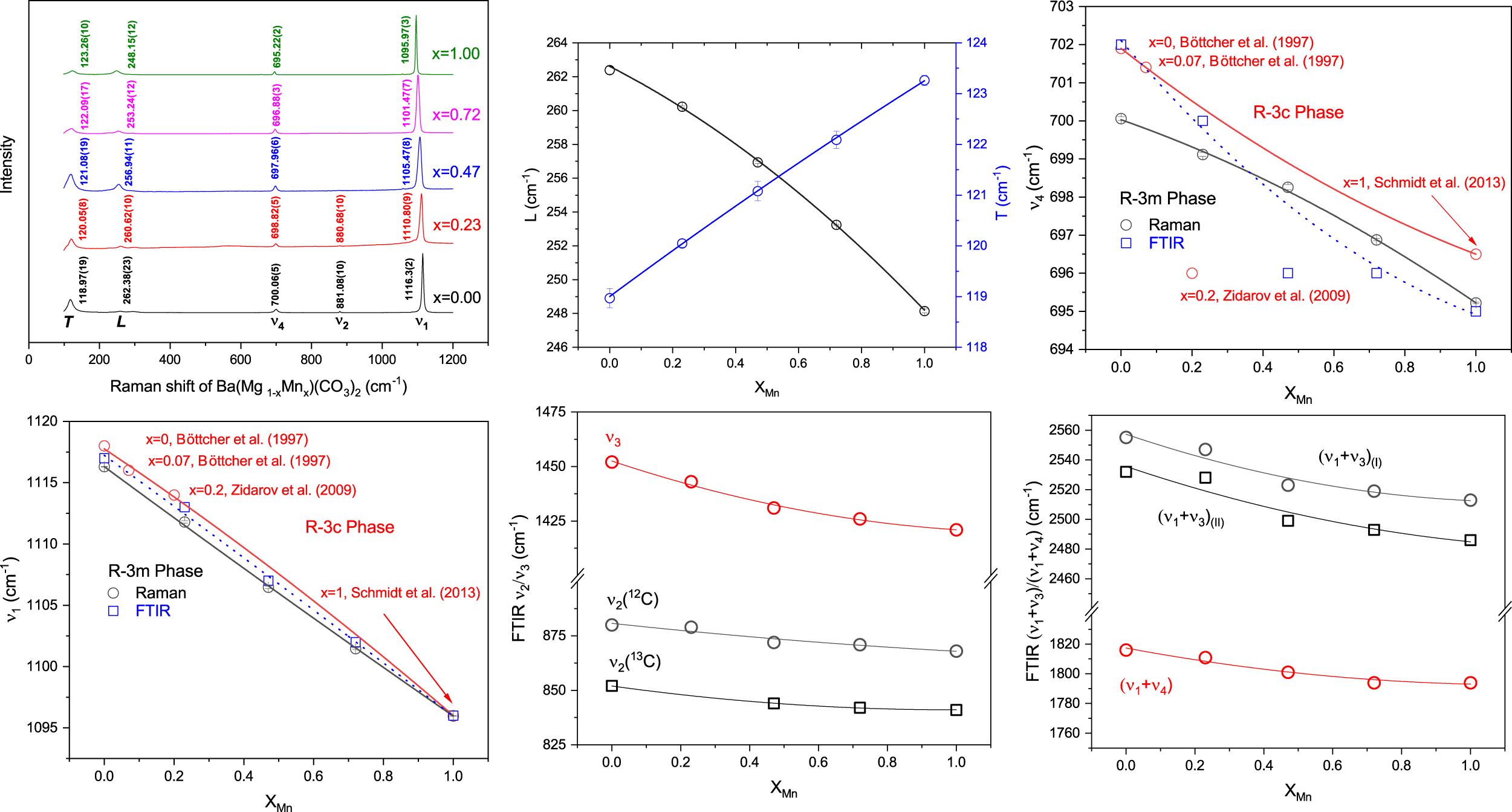
We present here the compositional calibrations for a new pseudo-binary set of solid-solution series between norsethite-type carbonates. In Fig. 6, five Raman active vibrations within a wavelength of 100–1200 cm−1 were easily distinguished and identified in order as the translational lattice mode T, the librational lattice mode L, the in-plane bending internal mode υ4, the out-of-plane bending internal mode υ2, and the symmetric stretching internal mode υ1. The υ2 vibration disappeared when the x > 0.25, and the remaining four vibrations were used to derive the fit. In the FTIR spectra, four fundamental modes were found (υ1, υ3, υ4,υ2(12C) and υ2(13C)) and two combination modes ((υ1 + υ3) and (υ1 + υ4)), one of them (υ1 + υ3) was split. The peak fitting results from Raman and FTIR spectroscopy are shown in Table 4 and Table 5.
Raman and FTIR spectra of Ba(Mg1–xMnx)(CO3)2 solid solutions

Raman vibrations of Ba(Mg1–xMnx)(CO3)2 solid solutions

* Notes: data from Liang et al. (Reference Liang, Li, Yin, Li, Li, Liu, Zhao, Yang, Meng, Li, He and Li2019); n.d.: not detected.
FTIR spectroscopic fundamental and combination modes for Ba(Mg1–xMnx)(CO3)2 solid solutions (frequencies in cm–1)

Notes: n.d.: not detected.
Raman active (υ in cm–1):
T(x) = 119.07 + 4.60x – 0.42x 2 [R 2=0.998]
L(x) = 262.30 – 8.81x – 5.28x 2 [R 2=0.999]
υ4(x) = 700.01 – 2.73x – 2.05x 2 [R 2=0.997]
υ1(x) = 1116.28 – 20.30x [R 2=0.999]
Infrared active (υ in cm – 1):
 \begin{equation}\begin{gathered}
\upsilon 1 + \upsilon 3{\text{ }}{\left( x \right)_{\left( I \right):\,\,\,}}2557.26{\text{ }}-{\text{ }}78.49x + {\text{ }}33.85{x^2}\left[ {{R^2} = {\text{ }}0.952} \right] \hfill \\
\upsilon {1_ + }\upsilon 3{\text{ }}{\left( x \right)_{\left( {II} \right):\,\,\,\,}}2535.59{\text{ }}-{\text{ }}78.20x + {\text{ }}27.49{x^2}\left[ {{R^2} = {\text{ }}0.927} \right] \hfill \\
\upsilon 1 + \upsilon 4{\text{ }}\left( x \right){\text{ }}{ = _{\,\,\,\,\,}}1817.33{\text{ }}-{\text{ }}43.17x + {\text{ }}18.89{x^2}\left[ {{R^2} = {\text{ }}0.966} \right] \hfill \\
\upsilon 1{\text{ }}\left( x \right){\text{ }} = {\text{ }}1117.22{\text{ }}-{\text{ }}20.65x-{\text{ }}0.64{x^2}\left[ {{R^2} = {\text{ }}0.985} \right] \hfill \\
\upsilon {2(^{12}C)}\left( x \right) = {\text{ }}880.72{\text{ }}-{\text{ }}16.95x + {\text{ }}4.15{x^2}\left[ {{R^2} = {\text{ }}0.934} \right] \hfill \\
\upsilon {2(^{13}C)}\left( x \right){\text{ }} = {\text{ }}851.98{\text{ }}-{\text{ }}21.96x + {\text{ }}11.02{x^2}\left[ {{R^2} = {\text{ }}1.000} \right] \hfill \\
\upsilon 3{\text{ }}\left( x \right){\text{ }} = {\text{ }}1452.52{\text{ }}-{\text{ }}52.72x + {\text{ }}21.20{x^2}\left[ {{R^2} = {\text{ }}0.993} \right] \hfill \\
\upsilon 4{\text{ }}\left( x \right){\text{ }} = {\text{ }}702.24{\text{ }}-{\text{ }}14.905x + {\text{ }}7.75{x^2}\left[ {{R^2} = {\text{ }}0.951} \right] \hfill \\
\end{gathered} \end{equation}
Using the results of the crystal structure, the variation of C–O bond length is very slight for the different compositions so that the vibration frequencies involving mostly CO32– ions should not be strongly correlated with XMn. However, significant variations of those vibrational modes are present because Raman shifts and the infrared active modes of the CO32– ion group are not only related to C–O bond lengths but also are affected by the surrounding bonding environment (White, Reference White and Farmer1974). In this present case, vibrational spectra have enough sensitivity to establish the calibrations interrelated to the compositions and structures, although these fitting relationships are not always linear. The T, υ4, and υ1 vibrations and all infrared-active fundamental and combination modes (equation 8) show an upwards trend with the increase XMn, whereas L changes in the opposite direction. The results for υ4 and υ1 are slightly lower when compared to previous literature reports (Fig. 6), although similar overall. To date, two type of structures with R  $\bar 3$m and R
 $\bar 3$c symmetry, originate from the vacancies in Ba sites and have already been proposed for the norsethite-type carbonate BaFe(CO3)2 (Liang et al., Reference Liang, Peters, Li, Leupold, Li and M.E2021; Böttcher et al., Reference Böttcher, Gehlken and Liang2021). The Raman spectra indicate that the R
 $\bar 3$m phase corresponds to the lower Raman frequency shift and the R
 $\bar 3$c phase to the higher. Therefore, it is expected that the Mn-bearing norsethite with superlattice will belong to the R
 $\bar 3$c group. In addition the potential impact of vacancies at the Ba sites and superlattice will need to be further investigated in detail.
Conclusions
The relationships between the compositions, the crystal structures and spectra properties are evident in the system of Ba(Mg1–xMnx)(CO3)2. This important information will aid the discovery of natural norsethite-type carbonates, especially for amorphous forms in sediments. On this basis, further investigation, focusing on Ca or Fe-bearing solid-solutions, the vacancies at Ba sites as well as the superlattice, are planned. In addition, the solubility product of these synthetic phases may be determined to derive the physicochemical stability, reactivity and fundamental thermodynamic properties (Glynn and Reardon, Reference Glynn and Reardon1990; Bertram et al., Reference Bertram, Mackenzie, Bishop and Bischoff1991; Liang et al., Reference Liang, Peters, Li, Leupold, Li and M.E2021; Böttcher and Dietzel, Reference Böttcher and Dietzel2010). These investigations will provide a better foundation and understanding for investigating the occurrence and reactions of Ba-bearing carbonates in Nature, both under natural conditions or those relevant for underground carbon storage (e.g. Oelkers and Gislason, Reference Oelkers and Gislason2023). Our results expand the existing knowledge and offer new perspectives for carbonate mineral synthesis, crystal chemistry and spectral investigation in the family of norsethite-type carbonates, as a model for dolomite–ankerites.
Acknowledgements
This study was supported financially by the National Science Foundation for Young Scientists of China (41802044). Work on carbonate solid solutions is supported to MEB by Leibniz IOW. The authors wish to thank the editor Stuart Mills for handling, and Peter Leverett and an anonymous reviewer for their detailed suggestions that helped to improve the final manuscript.
Supplementary material
The supplementary material for this article can be found at https://doi.org/10.1180/mgm.2024.94
Competing interests
The authors declare that they have no known competing financial interests or personal relationships that could have appeared to influence the work reported in this paper.