

Introduction
Islands represent only 6.67% of global landmass (Sayre et al. Reference Sayre, Noble, Hamann, Smith, Wright and Breyer2018), but they are home to about 20% of the world’s biota (Tershy et al. Reference Tershy, Shen, Newton, Holmes and Croll2015). Indeed, about 50% of global threatened species are insular and around 75% of documented extinctions have occurred on islands (Fernández-Palacios et al. Reference Fernández-Palacios, Kreft, Irl, Norder, Ah-Peng and Borges2021). This is mainly due to anthropogenic factors such as habitat loss, overexploitation, invasive species, and climate change, and to genetic and demographic factors typical of the small population sizes of many island species (Fernández-Palacios et al. Reference Fernández-Palacios, Kreft, Irl, Norder, Ah-Peng and Borges2021).
The Seychelles archipelago is one of these biodiversity hotspots, with about 7,200 species of animals, plants, and fungi recorded on the islands, and a high level of endemism, which ranges from 50% to 88% for animals and is about 45% for plants (Gerlach Reference Gerlach2008). Such an extraordinary level of biodiversity, however, is in jeopardy, with 34% of the assessed species categorised as threatened according to IUCN Red List criteria (Gerlach Reference Gerlach2012).
The Seychelles Kestrel Falco araeus (Oberholser, 1917), Katiti in Creole, is one of the most charismatic endemic species of the Seychelles archipelago, and is currently classified as “Vulnerable” because it has a very small population and range and there have been declines in the subpopulation of Praslin (BirdLife International 2016). The first data on the presence of the Seychelles Kestrel date back to the end of the nineteenth century; we have no data prior to that. At the end of the nineteenth century, the Seychelles Kestrel was present on Mahé and its satellite islands, Praslin, Thérèse, Silhouette, Curieuse, Fèlicite, and Marianne (Hartlaub Reference Hartlaub1877; Newton Reference Newton1867; Oustalet Reference Oustalet1878; Vesey-Fitzgerald Reference Vesey-Fitzgerald1936; Fisher Reference Fisher1981), and it was probably also present on La Digue, North, Petit, and Grand Souer (Watson Reference Watson, B-U and Chancellor1989). In the 1970s, the distribution of Seychelles Kestrel on the archipelago was significantly reduced. Breeding pairs were sighted only on Mahé and satellite islands, such as Silhouette, North, and Therese, whereas it was declared extinct on two of the largest islands of the granite group: La Digue and Praslin (Penny Reference Penny1968; Watson Reference Watson1981). This is corroborated also by genetic analysis that revealed a recent and severe population crash between the 1940s and 1970s with an estimated effective population size during this decline that was approximately eight individuals (3.5–22). This supports previous claims made in the 1960s that the Seychelles Kestrel was “Critically Endangered”, with the population on Mahé island dropping to fewer than 30 birds at one point (Groombridge et al. Reference Groombridge, Dawson, Burke, Prys-Jones, Brooke and Shah2009). Finally, from the 1980s, the population recovered to at least 800 individuals, corresponding to about 530 mature individuals (BirdLife International 2016).
The Seychelles Kestrel inhabits native, evergreen, and upland forests, but is now also found in secondary rainforests and coconut plantations, as well as in residential areas on Mahé (BirdLife International 2016). The diet is principally composed of indigenous lizards (mainly geckos Phelsuma spp.), insects, small birds, mice, and occasionally frogs and chameleons (Watson Reference Watson1981, Reference Watson1992; Barilari Reference Barilari2010). Breeding season for the Seychelles Kestrel is between August and November, and nesting is predominantly on cliffs above 200 m, and less successfully at lower elevations, mainly on buildings (in roof cavities) and in tree holes (Watson Reference Watson1992; Barilari Reference Barilari2010).
At the present, the species is protected by law and the conservation goal is to secure a stable breeding population of at least 500 pairs distributed among the larger granitic islands to reduce the threat of extinction (https://natureseychelles.org/knowledge-centre/seychelles-wildlife-2/endemic-bird-species/56-seychelles-kestrel). Since the Seychelles Kestrel population on Mahé is stable (Millet et al. Reference Millett, Norris, Holloway, Digney, Schultz and Wagner2003), and probably still around its maximum carrying capacity, as detected through breeding pair removal experiments (Watson Reference Watson1981; Kay et al. Reference Kay, Millett, Watson and Shah2002), the establishment of a stable population on Praslin and its satellite islands is essential to achieve this goal. However, it remains unclear why the Seychelles Kestrel has been unable to establish a large and stable population on Praslin or what were the causes of the limited success of the 1977 reintroduction project (Watson Reference Watson, B-U and Chancellor1989). Watson thought that the reintroduction had been a success when 10 years later, 10 breeding pairs were recorded on Praslin, but several subsequent studies confirmed that the Praslin subpopulation is very small (four pairs) and the pairs have a level of productivity and reproductive success which is only a third of their counterparts on Mahé (Watson Reference Watson1981; Kay et al. Reference Kay, Millett, Watson and Shah2002; Barilari Reference Barilari2010). We can conclude that the Praslin population is probably in decline and may become extinct in a few years.
This study therefore aimed to analyse the ecology of the species to determine the causes of the apparent decline of the Praslin population in order to plan an intervention and conservation project. In particular, we analysed four recognised limiting factors for raptors, namely nest-site availability, trophic availability, predatory pressure, and interspecific competition (Newton Reference Newton1998) on the islands of Mahé and Praslin. We then drew a comparison between the islands as regards these limiting factors to determine if there are differences that can account for the inability of the species to colonise Praslin.
Material and methods
Study area
The Seychelles archipelago comprises 115 islands of coral and granite origin (Gerlach Reference Gerlach2008). The geology of granitic islands is very similar to that of East Africa, and their dominant rock is granite of about 600 mya (Baker and Miller Reference Baker and Miller1963). The landmass formed by Madagascar–India–Seychelles separated from Africa about 165–121 mya, while India and the Seychelles drifted northwards 88–63 mya, and, finally, India and the Seychelles separated about 65 mya (Vences Reference Vences2004).
The climate of the granitic islands is very humid (≥80%) all year round, and on Mahé average temperatures vary little throughout the year, ranging from 24°C to 30°C at sea-level, and average annual rainfall is about 2,500 mm (Robert et al. Reference Robert, Rocamora, Julienne and Goodman2011).
The present study was carried out on the two principal granitic islands: Mahé and Praslin. Mahé (55°30’E, 4°40’S), with an area of 144.8 km2 and a maximum elevation of 905 m a.s.l., is the largest island in the Seychelles. Four types of habitat are present on the island, two in areas with an elevation greater than 200 m a.s.l. (forest and open areas), and two in areas with an elevation of less than 200 m a.s.l. (coastal forest and open areas) (Watson Reference Watson1981). Praslin is the second largest granite island of the archipelago with an area of 37 km2. Unlike Mahé, most of the land on Praslin lies at relatively low elevations (80% of the territory is below 200 m a.s.l.) and reaches its maximum elevation at Fond Azore (367 m a.s.l.). The island has been affected by numerous fires, especially in the northern areas where there are still large areas of red earth derived from granite, pioneer vegetation, and sporadic tree regeneration (Senterre Reference Senterre2009). The inhabited areas mainly lie along the coastal strip and include open areas used for agriculture, whereas in the higher elevations there are still small areas of secondary forest composed of native and exotic plant species (Barilari, personal observation).
Limiting factors
We compared Mahé and Praslin as regards the following ecological parameters, considered limiting factors, in order to evaluate possible differences between the islands, i.e. nest-site availability, trophic availability, predatory pressure, and interspecific competition. These parameters were analysed during the 2009/2010 reproductive season on Mahé and during the 2008/2009 reproductive season on Praslin. Nest-site availability was assessed in seven forest areas on Mahé and seven forest areas on Praslin for a total of 14 areas. Trophic availability, predatory pressure, and interspecific competition were assessed in nine areas on each island in three different habitats (three urban areas, three suburban areas, and three forest areas) for a total of 18 areas.
To assess nest-site availability we used 1,000 × 10 m transects placed within each sampling site, where we recorded each cavity found at a minimum height of 4 m from the ground and with a minimum diameter at the entrance of 15 cm (the minimum diameter and height recorded at the occupied nests; Barilari 2008, personal observation). The number of cavities was finally standardised as the number of cavities per hectare, so that we could compare nest-site availability between the islands.
To determine if trophic availability could be a limiting factor for the Seychelles Kestrel, we assessed the abundance of Green Day Geckos (Phelsuma spp.) and Seychelles Skink (Trachylepis seychellensis), which are the main food sources for the Seychelles Kestrel (Feare et al. Reference Feare, Temple and Procter1974; Watson Reference Watson1981; Barilari Reference Barilari2010). Trophic availability was assessed in nine areas on each island in three different habitats (three urban areas, three suburban areas, and three forest areas) for a total of 18 areas. Green Day Geckos are mainly present on tree fronds (Gardner Reference Gardner1984), while skinks are found on the ground, and only in very rare cases on tree trunks at heights that are always lower than 2 m (Bowler Reference Bowler2006). We therefore used two different methods to detect the presence and abundance of the two species in the various habitats of both islands. In particular, to evaluate the density of skinks we used 500 × 4 m transects within each of the 18 territories. No transects were performed when it was rainy as skinks tend to hide in cavities or ravines when it rains (Barilari, personal observation). Observations were made at a minimum distance of 20 m from each tree, using 10 × 50 binoculars, to avoid disturbing and scaring away the Phelsuma. To determine the density of the various species and subspecies of Phelsuma present on the two islands we calculated the abundance of Phelsuma on 100 randomly selected trees in order to compare the two islands with their different vegetation characteristics: Phelsuma index = Phelsuma number per 100 trees (Watson Reference Watson1981). For Mahé we included in the index Phelsuma sundbergi longinsulae and Phelsuma astriata, while for Praslin we counted Phelsuma astriata and Phelsuma sundbergi sundbergi. The surveys were conducted twice a week in urban, suburban, and forest habitats in a total of 18 sample territories. For each transect, the data collected during each repetition were pooled and averaged.
In order to assess the predatory pressure on both islands we used artificial nests (false nests) containing eggs modelled with plasticine. False nests are a useful tool for testing the ecological mechanisms that influence predation (Paton Reference Paton1994; Jokimaki and Huta Reference Jokimaki and Huta2000; Carignan and Villard Reference Carignan and Villard2002; Purger et al. Reference Purger, Meszaros and Purger2004). They are widely used because of the flexibility in experimental design that they afford and because they ensure a superior sample compared with investigations relying only on natural nests (Leimbruger and McShea Reference Leimbruger and McShea1994). The nests were built of cubic size with a side of 25 cm and secured to the trunk of different types of trees. A plasticine egg was placed in the false nests and fixed to the nest with a metal wire (invisible from the front) to prevent it from being removed by predators, as has occurred in studies using a similar method (e.g. Bayne et al. Reference Bayne, Keith, Fargey and Fargey1997; Bayne and Hobson Reference Bayne and Hobson1999; Pierre et al. Reference Pierre, Bears and Pazkovsky2001). Any incisor or beak marks on the plasticine eggs were used to determine the species of the predator. Five false nests were placed in each of the 18 sample territories (nine on Mahé and nine on Praslin). Each time an egg was found with signs of predation, the nest was registered as predated, its position was changed, and it was considered a new nest. A total of 194 nests were considered. The false nest position was changed after a predation because rats returned more frequently once they found the nest with plasticine (Barilari, personal observation). False nests were monitored weekly during the breeding season (August–March) to calculate the predation index as: Predation index = number of predations/days of exposure × 1,000.
To determine the presence of interspecific competitors we evaluated the abundance of the Common Myna (Acridotheres tristis) on both islands. The Common Myna (introduced to the Seychelles) is a species that mainly inhabits urban or suburban areas living in a commensal relationship with humans (Counsilman Reference Counsilman1974), and nesting in natural cavities or in buildings. The Common Myna is a very aggressive species, with the male actively defending the areas surrounding the nest, roosts, and territory, competing vigorously with native species for nesting sites (Pell and Tidemann Reference Pell and Tidemann1997). The abundance of mynas was assessed in the 18 sample areas on the two islands (nine on Mahé and nine on Praslin) in urban, suburban, and forest habitats as described above, through observation points. The observations were carried out twice a week in points with good visibility of the surrounding area for a total duration of 10 minutes. During each observation period we recorded the number of mynas sighted. For each transect, the data recorded during each observation were pooled and averaged.
Statistical analysis
All the dependent variables were Log or Log(x + 1) transformed before the analysis to approximate the normal distribution. For parameters that presented homogeneous variances (Levene’s test: P >0.05), one-way analyses of variance (ANOVA), with a Tukey post hoc test for multiple pairwise comparisons, were employed to test if limiting factor means differed between the islands, habitats, and islands*habitat. For parameters that presented heterogeneous variances (Levene’s test: P <0.05), a Welch’s ANOVA was employed to test if limiting factor means differed between the islands, habitats, and islands*habitat. When the Welch’s ANOVA tests indicated significant differences between parameter means, Games–Howell post hoc tests were applied in order to establish pairwise comparisons between factors. Statistical analyses were performed with SPSS version 25 (IBM Corp., Armonk, NY, USA).
Results
Nest-site availability
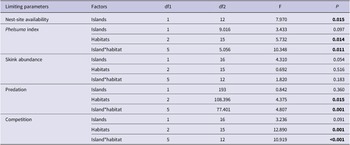
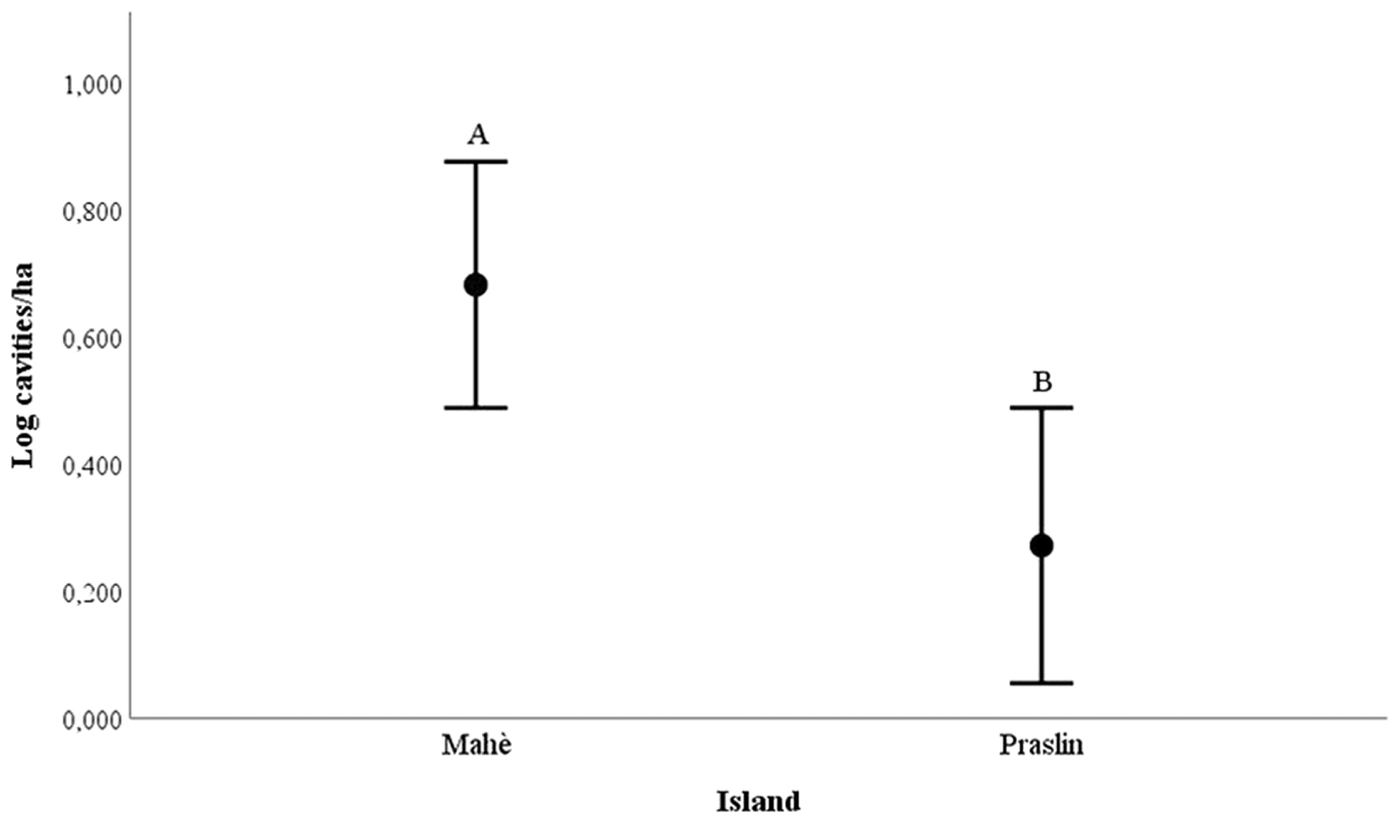
There were significantly more cavities per hectare on Mahé than on Praslin (P = 0.015) (Table 1 and Figure 1).
Results from ANOVA and Welch’s ANOVA analyses estimating the effects of three factors (island, habitat, and island*habitat) on the limiting parameters evaluated (i.e. nest-site availability, trophic availability, predation, and competition). ANOVA = one-way analyses of variance.

Number of available cavities per hectare (cavities/ha) on Mahé and Praslin. Dots represent means and bars represent ± 2 SE. Different letters indicate a significant difference (P <0.05).

Trophic availability
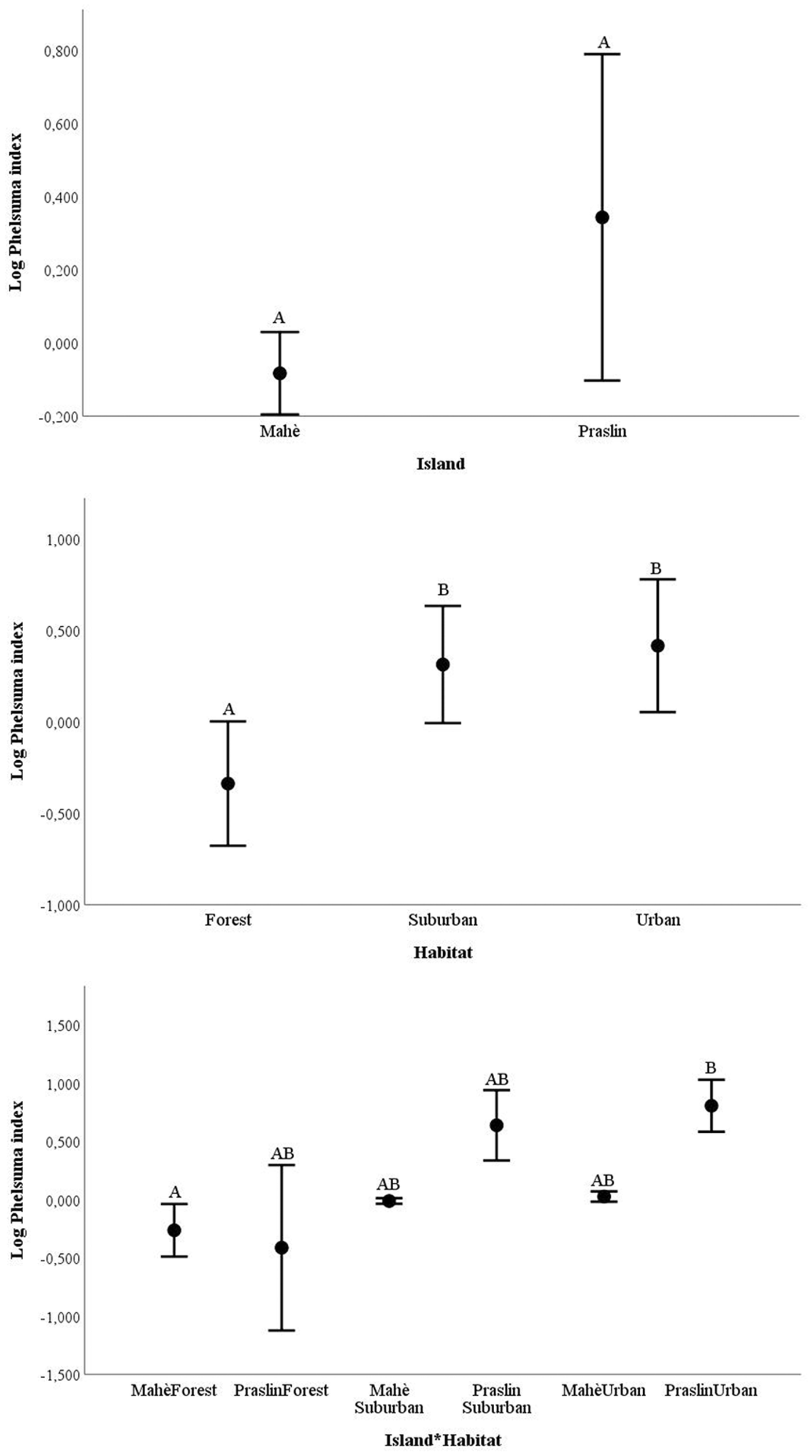
The Phelsuma index did not show a significant difference between Mahé and Praslin (P = 0.097); however, significant differences were found between habitats with forests which showed a lower Phelsuma index compared to suburban (P = 0.041) and urban (P = 0.018) areas which, on the contrary, did not differ from one another (P = 0.906). The comparison of different habitats on the two islands showed that urban areas on Praslin have a higher Phelsuma index than forest areas on Mahé (P = 0.015), whereas other comparisons did not show significant differences (P >0.05) (Table 1 and Figure 2).
Phelsuma index for different islands, habitats, and habitat*island. Dots represent means and bars represent ± 2 SE. Different letters indicate a significant difference (P <0.05). Tukey and Games–Howell post hoc tests.

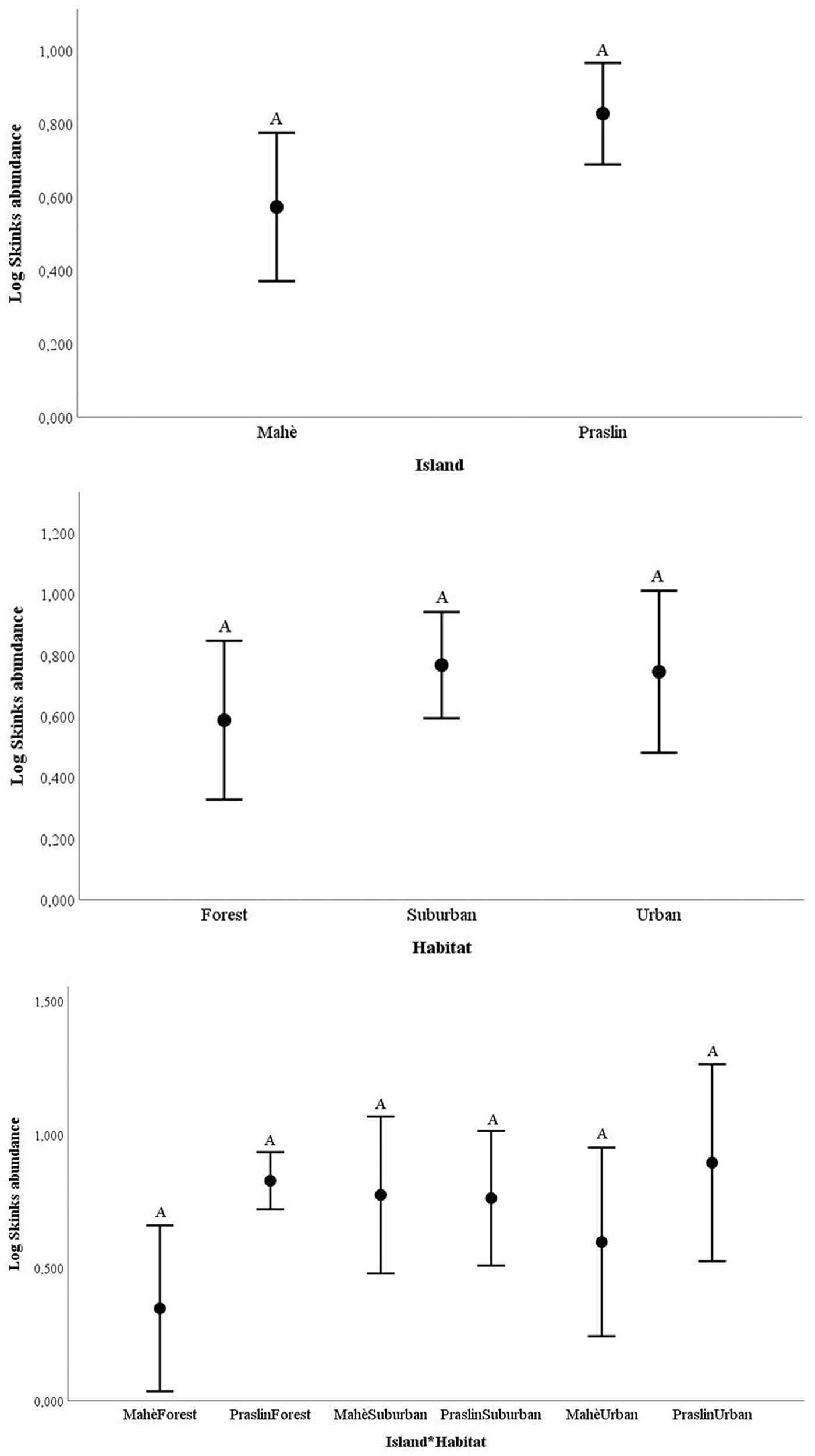
Mahé and Praslin did not differ significantly as regards skink abundance (P = 0.054). Moreover, skink abundance did not differ between habitats either, with no significant differences found between Forest vs. Suburban (P = 0.542), Forest vs. Urban (P = 0.620), and Suburban vs. Urban (P = 0.991). Hence, the comparison of different habitats on the respective islands showed no significant differences in skink abundance (P >0.05) (Table 1 and Figure 3).
Skink abundance for different islands, habitats, and habitat*island. Dots represent means and bars represent ± 2 SE. Different letters indicate a significant difference (P <0.05). Tukey and Games–Howell post hoc tests.

Predatory pressure
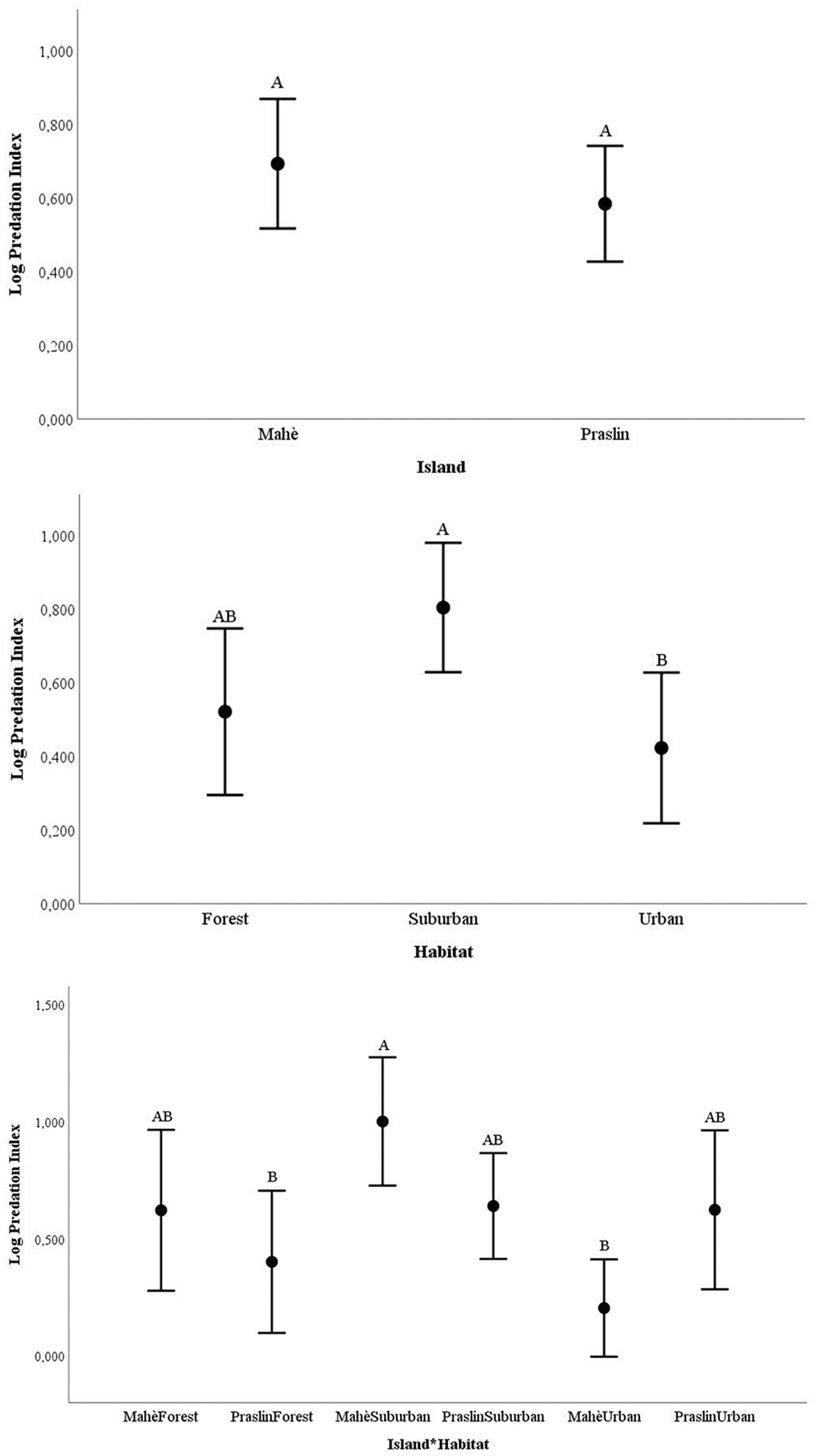
The predatory index did not show significant differences between Mahé and Praslin (P = 0.360), but it did reveal significant differences between the habitats, with suburban areas showing higher levels of predation than urban areas (P = 0.015). Drawing comparisons between different habitats on the two islands, we found that suburban areas on Mahé had a significantly higher predatory index than urban areas on Mahé (P <0.001) and forest areas on Praslin (P = 0.044) (Table 1 and Figure 4).
Predation index for different islands, habitats, and habitat*island. Dots represent means and bars represent ± 2 SE. Different letters indicate a significant difference (P <0.05). Tukey and Games–Howell post hoc tests.

Interspecific competition
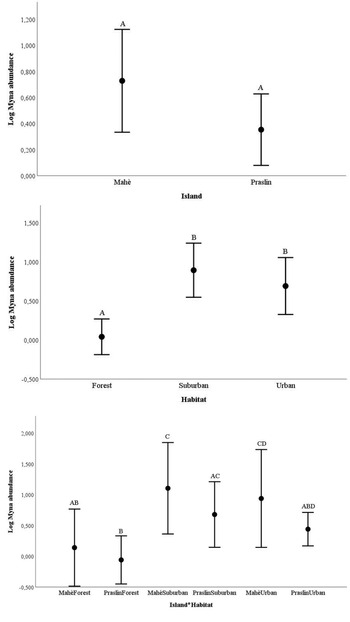
The abundance of mynas did not differ significantly between Mahé and Praslin (P = 0.091); however, it differed significantly between habitats, with forest areas showing lower abundance than suburban (P = 0.001) and urban (P = 0.006) areas, which, however, did not differ from one another (P = 0.498). The comparison of different habitats between islands highlighted several significant differences. Specifically, Mahé Forest showed a lower myna abundance than Mahé Suburban (P = 0.003) and Mahé Urban (P = 0.014); Mahé Suburban showed a higher abundance than Praslin Forest (P = 0.001) and Praslin Urban (P = 0.045); Mahé Urban showed a higher abundance than Praslin Forest (P = 0.003), and Praslin Forest was found to have a lower abundance than Praslin Suburban (P = 0.024). However, it should be noted that no significant differences were found when comparisons were drawn between the same habitats found on the two different islands (Table 1 and Figure 5).
Common Myna abundance for different islands, habitats and habitat*island. Dots represent means and bars represent ± 2 SE. Different letters indicate a significant difference (P <0.05). Tukey and Games–Howell post hoc tests.

Discussion
Little is known about the Seychelles Kestrel. Indeed, there are no recent studies on the species, and the only study on the biology of the bird dates back to 1980. Furthermore, the Seychelles Kestrel is a “Vulnerable” species with a very small population and range (BirdLife International 2016). The conservation goal is to increase the population of the species to reduce the threat of extinction (Groombridge et al. Reference Groombridge, Dawson, Burke, Prys-Jones, Brooke and Shah2009), but the island of Mahé, the largest of the Seychelles, has probably already reached its carrying capacity. Praslin is another large island in the Seychelles that could host a population of Seychelles Kestrel, but it has a limited number of pairs (four pairs) with a very low breeding success (57%) (Barilari Reference Barilari2010).
Of the four limiting factors studied, it was found that only the density of available nesting sites was lower on Praslin than on Mahé. Thus, it is likely that the small number of pairs on Praslin and the limited success of the 1977 reintroduction stem from an inadequate number of nesting sites and/or low quality nesting sites on the island. The low availability of nesting sites was found to be a limiting factor for the genus Falco across different habitats (Cavè Reference Cavè1968; Village Reference Village1983; Hamerstrom et al. Reference Hamerstrom, Hamerstrom and Hart1973; Kostrzewa and Kostrzewa Reference Kostrzewa and Kostrzewa1994). According to the observations of Kay et al. (Reference Kay, Millet, Watson and Shah2004), Praslin has significantly fewer cavities available than Mahé. Over the past 30 years, Praslin has had numerous fires that have destroyed large areas of forest on the island. Today only a small percentage (10–15%) of the island of Praslin is covered by forest, whereas 50% of Mahé is forested (Kay et al. Reference Kay, Millett, Watson and Shah2002, Reference Kay, Millet, Watson and Shah2004). Furthermore, on Mahé, we did not include rock walls in the census due to their inaccessibility, therefore, the availability of cavities on Mahé is probably underestimated.
The island of Praslin, with the exception of the limited area of the Valleè de Mai, has relatively young forests and most of the tree vegetation is not of sufficient size for the formation of cavities. The use of coastal areas for Praslin pairs is not attributable to trophic availability, which is not significantly different between the forest areas of the two islands, but is probably due to the low availability of nesting sites in the young Praslin forests. Moreover, Praslin, unlike Mahé, has very few rock walls, which offer the highest quality type of cavity with the highest rate of reproductive success (Watson Reference Watson1981). Given the low availability of nesting sites on the island, Praslin pairs are probably forced to select non-optimal nesting sites. This is corroborated by the nesting failure rate of Praslin, which is approximately triple that of Mahé (Barilari Reference Barilari2010). As reported by Watson (Reference Watson1981), the same phenomenon occurred in the coastal area of Mahé where the low availability of optimal nesting sites, due to the presence of coconut plantations, limited the pairs to nesting in coconut palms, which have suboptimal characteristics.
The situation of the Seychelles Kestrel on Praslin is critical, and with a population of only four breeding pairs, it will be probably become extinct in a few years. Indeed, the Seychelles Kestrel population on Praslin cannot be sustained without human intervention. None of the 25 nest boxes placed on Praslin in 2002–2003 have been occupied by the Seychelles Kestrel (Barilari Reference Barilari2010). This confirms our findings that there is a very small number of unmated kestrels on the island (Barilari Reference Barilari2010). We think that the main cause of the limited number of Seychelles Kestrel currently found on Praslin is the low number of individuals reintroduced in 1977, which was insufficient to re-establish a stable population, and the lack of nest cavities on the island. Hence, in order to reintroduce a Seychelles Kestrel population on Praslin, with the aim of boosting the number of individuals in the species, it would be necessary to implement a restocking of the population. Moreover, artificial nest boxes would have to be installed to increase the availability of nesting sites, and kestrel chicks reintroduced to Praslin Island would have to be of the same species and from a healthy and well-monitored population. The kestrel population on Mahé meets these requirements because it appears stable, with a minimum of 350 breeding pairs (Rocamora and Skerrett Reference Rocamora, Skerrett, Fishpool and Evans2001) and adequate productivity (Barilari Reference Barilari2010).
The installation of nest boxes must take into consideration some parameters that have been found to be important to the species (Barilari Reference Barilari2010). Shade and height from the ground are two factors that influence the Seychelles Kestrel nest site selection. Indeed, 88% of the occupied nests are in the shade for most of the day (from 75% to 100% of daytime hours), and the kestrel never nests below 4 m from the ground with a significant correlation between height from the ground and the percentage of occupied nests (Barilari Reference Barilari2010). Shade could be an important factor because excessive sun exposure could cause overheating of eggs and chicks (Schaffner Reference Schaffner1991; Burger and Gochfeld Reference Burger and Gochfeld1991), whereas higher nests are likely more difficult for predators to locate and reach (Bakaloudis et al. Reference Bakaloudis, Vlachos, Papageorgiou and Holloway2001). In addition, altitude and distance from the coast also have an important effect on the breeding success of the Seychelles Kestrel (Barilari Reference Barilari2010). The success rate of pairs breeding above 100 m a.s.l. was between 65% and 100% higher than that of pairs breeding below 100 m a.s.l. (Barilari Reference Barilari2010), probably reflecting habitat quality and the anthropisation gradient. Moreover, there is a significant positive correlation between breeding success and distance from the coast, with the pairs breeding more than 2,250 m from the coast showing a success rate that was double that of pairs breeding within 750 m of the coast (Barilari Reference Barilari2010).
Acknowledgements
The first author wishes to thank the following individuals for the logistical, technical, and field support that they provided: Massimo Pandolfi, Nirmal Jivan Shah, Gabriele Cavallini, Sara Nicolai, Tony Jupiter, Massimiliano Foresta, Emili Pasquini, Carlotta De Biagi, Victorine Laboudallon, Verlaque Richelieu, Miguel Ferrer, Gerard Rocamora, Susanna Lucchi, Giusy Badulato, Luca Boscain, Sergio Muratore, Francesca Bianchi, Rachel Bristol, and Gribui Gloud. Author contributions: conceptualisation and methodology: M.B.; validation: M.B. and M.T.; formal analysis: M.T.; investigation: M.B.; writing original draft: M.T.; writing – review and editing and visualisation: M.B. and M.T.