Introduction
A large body of research has documented the correlates of risky sexual behaviour among youths in sub-Saharan Africa. However, two drawbacks remain in these studies that need to be addressed to improve the efficiency of reproductive health interventions targeted at adolescent and young adults. First, most studies are atheoretical and have focused on individual risk factors. In contrast, they have paid little attention to individual, family and community factors that may decrease the rates of risky sexual behaviour, referred to as protective factors. Yet, research conducted in Western contexts has showed that families, especially parents, remain a powerful influence in fostering healthy teenage development and preventing negative outcomes such as early sexual debut, multiple sexual partners and unwanted pregnancies (Davis & Friel, Reference Davis and Friel2001; Miller et al., Reference Miller, Benson and Galbraith2001). Second, researchers have often adopted a risk-oriented approach by contrasting two-parent families with other types of families, assuming that the former are protective while the latter are risky (see, for a discussion, Odimegwu et al., Reference Odimegwu, Solanke and Adedokum2002; Wu et al., Reference Wu, Chong, Cheng and Chen2007; Benzies & Mychasiuk, Reference Curran, Hussong, Cai, Huang, Chassin, Sher and Zucker2009). In this approach, two-parent families are considered homogeneous in strengths: cohesion, connectedness, communication, supervision/monitoring. Yet empirical evidence shows that adolescents and young adults from two-parent families also engage in risky sexual behaviour, especially in the context of severe poverty (Meekers & Calvès, Reference Curran, Hussong, Cai, Huang, Chassin, Sher and Zucker1997; Kuate Defo, Reference Curran, Hussong, Cai, Huang, Chassin, Sher and Zucker2004).
Drawing on a positive-oriented approach (Mullin & Arce, Reference Curran, Hussong, Cai, Huang, Chassin, Sher and Zucker2008), this paper argues that within each family type are factors that decrease risky sexual behaviour among youths. Understanding these strengths within a given type of family provides a positive view about ‘at-risk’ families that may encourage social workers and policymakers to develop more appropriate reproductive health programmes. These strengths, referred to as family factors, are associated with lower rates of risky sexual behaviour. Specifically, this paper investigates the following question: what are the family factors associated with lower rates of risky sexual behaviour? Risky sexual behaviour is defined as the co-occurrence of multiple sexual partners and non-use of condoms during the last 12 months among unmarried and sexually experienced youths. This question poses both conceptual and methodological challenges. Conceptually, each type of family is analysed separately to shed light on the strengths needed to protect youths, particularly those from ‘at-risk’ families. Methodologically, models including family structure as the key independent variable are risk-oriented and less appropriate to answer this question because they compare two-parent families with others. Thus models investigating each specific family type are needed to address the research question.
Theoretical framework and literature review
Previous research indicates that a myriad of individual, family and community factors influence risky sexual behaviour among adolescents and young adults. Bronfenbrenner's ecological theory (Bronfenbrenner, Reference Adu-Mireku1979) and resiliency perspective (Rutter, Reference Rutter1987, Reference Rutter1993; Walsh, Reference Walsh2002) were used as frameworks to examine the effects of risk and protective factors associated with risky sexual behaviour.
Individual risk factors
Risk factors are defined as those conditions that increase the likelihood of negative or undesirable outcomes in a variety of life domains from health and well-being to social role performance (Deković, Reference Deković1999; Lohman & Billings, Reference Lohman and Billings2008). Individual risk factors examined include age at first sex (Cleland et al., Reference Cleland, Boerma, Carael and Weir2004; Pettifor et al., Reference Pettifor, van der Straten, Dumbar, Shiboski and Padian2004; Harrison et al., Reference Harrison, Cleland, Gouws and Frohlich2005; Hallett et al., Reference Hallett, Lewis, Lopman, Nyamukapa, Mushati and Wambe2007), gender (Türmen, Reference Türmen2003; Institut National de la Statistique (INS) & ORC Macro, Reference Madise, Zulu and Ciera2004; Fergus & Zimmerman, Reference Fergus and Zimmerman2005) and motivation for first sex (Ott et al., Reference Ott, Millstein, Ofner and Halpern-Felsher2006). Previous research has identified four dimensions of motivation for sex associated with sexual risk-taking. Motivation for sex can be physically oriented (desire for feelings of excitement or pleasure) (Parsons et al., Reference Parsons, Halkitis, Bimbi and Borkowski2000), relationship oriented (desire for intimacy) (Sanderson & Cantor, Reference Sanderson and Cantor1995; Tschann et al., Reference Tschann, Adler, Millstein, Gurvey and Ellen2002; Gebhardt et al., Reference Gebhardt, Kuyper and Greunsven2003), socially oriented (desire for approval or respect) (Kinsman et al., Reference Kinsman, Romer, Furstenberg and Schwarz1998) or individually oriented (desire to gain a sense of competence and learn more about oneself) (Stanton et al., Reference Stanton, Li, Black, Ricardo, Galbraith, Kaljee and Feigelman1994). Each dimension may impinge on youths' decisions to protect themselves against HIV/AIDS. However, existing studies show that sexual sensation-seekers for pleasure are at higher risk of HIV/AIDS because they are more reluctant to use condoms (Mashegoane et al., Reference Mashegoane, Moalusi, Ngoepe and Peltzer2002).
Individual protective factors
Protective factors are those that buffer the effects of stressful events and promote coping skills and good adjustment; they modify an individual's response to a risk situation (Rutter, Reference Rutter1987). These factors are associated with positive outcomes in the presence of risk. Of interest are respondent's age as a proxy for psychological development, education (Snelling et al., Reference Snelling, Rasugu Omariba, Hong, Georgiades, Racine and Boyle2007), contraceptive use at first sex, and church attendance as a measure of religiosity (Rostosky et al., Reference Rostosky, Wilcox, Comer Wright and Randall2004; Fergus & Zimmerman, Reference Adu-Mireku2005; Agha et al., Reference Agha, Hutchinson and Kusanthan2006). Religion is often considered a source of social control. As such, it provides positive and normative behaviours among youths. However, religious affiliation is only a precondition; religiosity appears as the powerful indicator of the effect of religion on sexual behaviour (Rostosky et al., Reference Rostosky, Wilcox, Comer Wright and Randall2004). Snelling et al. (Reference Snelling, Rasugu Omariba, Hong, Georgiades, Racine and Boyle2007) describe the pathways leading to the protective effect of education. Better-educated youths are more likely to be knowledgeable about HIV/AIDS transmission routes, which in turn heightens their perception of risk and strengthens their motivation to practise safe sex.
Family structure and family processes associated with resilience
A vast literature has documented the relationship between families and sexual risk-taking among youths in developed countries (for a review, see Miller et al., Reference Miller, Benson and Galbraith2001) and sub-Saharan Africa (Meekers & Ahmed, Reference Meekers and Ahmed2000; Ngom et al., Reference Ngom, Magadi and Owuor2003; Rwenge, Reference Rwenge2003; Karim et al., Reference Karim, Magnani, Morgan and Bond2003; Babalola, Reference Curran, Hussong, Cai, Huang, Chassin, Sher and Zucker2004; Kabiru & Orpinas, Reference Curran, Hussong, Cai, Huang, Chassin, Sher and Zucker2008). These studies have focused on two main dimensions: family structure and family processes. Most of the studies about the effect of family structure on negative outcomes have uncovered similar results: living in two-parent families, compared with neither- or one-parent families, is associated with lower rates of negative outcomes, such as risky sexual behaviour. This risk approach has been criticized because each family encompasses different dynamics and processes. Indeed, several studies have supported this claim with regard to youth's sexual behaviour, noting that it is not single-parent families per se that are the risk factor, but rather it is family transitions or disruptions commonly associated with single-parenthood that increase the likelihood of risky sexual behaviour (Wu & Thomson, Reference Wu and Thomson2001). For some researchers, economic deprivation observed in one-parent families partly explains the higher rates of risky sexual behaviours among youths living in these homes (Frauenglass et al., Reference Frauenglass, Routh, Pantin and Mason1997; Madise et al., Reference Madise, Zulu and Ciera2007).
Researchers are almost unanimous about the protective effect of two-parent families. However, it is worthy to note that the family environment in African settings differs in some ways when compared with developed countries. In the latter, biological parents are the main caregivers of their children. The absence of at least one parent in the home is often detrimental due to a lack of parental resources, for example parents' warmth and affection, low levels of supervision or few economic resources. Thus, parental absence leads to a series of consequences associated with risky sexual behaviour. In contrast, children in African societies are socialized collectively although parents continue to play the most important role (Nsamenang, Reference Nsamenang2000; Verhoef, Reference Verhoef2005). Each adult in the community is respected and considered a father or mother, and he/she can rebuke youths' social misbehaviours. This should, in turn, minimize the higher rates of risky sexual behaviour observed among youths from single- or neither-parent families in developed countries.
Past research has also shown that, rather than family structure per se, family processes – referred to as parent–child interactions within the family – have the highest explanatory power (Wu & Thomson, Reference Wu and Thomson2001; Lenciauskiene & Zaborskis, Reference Curran, Hussong, Cai, Huang, Chassin, Sher and Zucker2008). Besides assessing the aforementioned individual risk and protective factors, this study documents the protective family effects of the quality of parent–youth relationships (Slap et al., Reference Slap, Lot, Huang, Daniyam, Zink and Succop2003; McBride et al., Reference McBride, Freier, Hopkins, Babikian, Richardson and Helm2005; Regnerus & Luchies, Reference Adu-Mireku2006), parent–youth communication about sexuality (Newcomer & Udry, Reference Curran, Hussong, Cai, Huang, Chassin, Sher and Zucker1987; Patterson, Reference Patterson2002; Adu-Mireku, Reference Curran, Hussong, Cai, Huang, Chassin, Sher and Zucker2003) and parental control/supervision (DiClemente et al., Reference DiClemente, Wingood, Crosby, Sionean, Cobb and Harrington2003). Studies have reported that higher levels of parent–child interactions are associated with lower rates of risky sexual behaviour. To summarize, a protective family environment needs the presence of warm and supportive parents/guardians (Rew & Horner, Reference Rew and Horner2003) in which parent–child interactions play an important role. The protective effect of family structure on risky sexual behaviour cannot be fully understood without an integration of family processes.
At the community level, previous research reported urban–rural differences regarding risky sexual behaviour (Akwara et al., Reference Akwara, Madise and Hinde2003). To explain higher rates of risky sexual behaviour in urban areas, some researchers (Meekers, Reference Meekers1994; Meekers & Calvès, Reference Curran, Hussong, Cai, Huang, Chassin, Sher and Zucker1997) have speculated that increasing urbanization has broken traditional values and reduced the levels of social control over youths. However, urban residence is expected to be associated with lower rates of risky sexual behaviour. In fact, reproductive health services are more accessible in urban areas. For instance, condoms are more available in urban areas (Mashamba & Robson, Reference Mashamba and Robson2002). In addition, urban residence may operate through education; urban youths are better educated and more knowledgeable about HIV/AIDS. Thus, they are more likely to report condom use to protect against HIV/AIDS.
The present study
This study is based on the premise that all families experience stressful events (e.g. poverty or economic hardship) that may lead to risky sexual behaviour. It is widely recognized that the presence of two parents can help youths in reducing risky sexual behaviour through better parent–youth interactions. However, assuming that family processes are barely protective in two-parent families is unmerited. Protective family factors may also operate in one- or neither-parent homes. Specifically, this paper investigates the protective effects of parent–child interactions on risky sexual behaviour regardless of family structure. In order to achieve this goal, family structure is not used as the key independent variable in the estimation models, except for comparison with the common approach. Instead, adolescent and young adults are stratified by family structure and analyses are performed for each type of family.
Methods
Study area and population
The study was carried out in the prefecture of Bandjoun, in the western part of Cameroon (Kuate Defo, Reference Curran, Hussong, Cai, Huang, Chassin, Sher and Zucker2006). This area is 274 km2 and is representative of the belief system, customs and social structure of the population of west Cameroon. It combines the features of a highly modernized environment with a typical traditional Cameroonian society. The urban and semi-urban localities have one of the country's universities, three public hospitals, two private hospitals in operation since the early 1950s, about a dozen public health centres, several traditional healers attracting people from various social strata, several high schools and infrastructures for communication and transport. The large number of schools in this setting is partly a result of the secular importance the local population attaches on their children's education. Compared with the rest of the country, the western part of Cameroon, including Bandjoun, is more educated. In the rural areas of Bandjoun, there are over 70 chiefdoms with traditional authorities and practices, an extensive practice of polygamy, agricultural production and extensive farming. The geographical distribution of the population reflects one of the highest population densities, with a population of 51,624 inhabitants and a density of 188 inhabitants per km2 (BUCREP, Reference Curran, Hussong, Cai, Huang, Chassin, Sher and Zucker2010).
Data
This research used data from two independent population-based surveys: the Cameroon Family and Health Survey (CFHS), carried out under the auspices of the Population Observatory in Socio-clinical Epidemiology (POSE) in western Cameroon in 1996–1997 and 2002. These surveys covered all 75 localities and towns of the Bandjoun administrative division. To ensure the representativeness, an updated version of the population distribution of the 1987 Cameroonian census was used to build representative samples. Participants were males and females in age groups 10–19 years, 20–49 years and 50 years and above. Overall, 2377 households were randomly selected in 1996–1997, whereas 1765 households were randomly selected in 2002. In 1996–1997, the CFHS employed a self-weighted proportional sampling design, with the proportions of randomly sampled households in all 75 localities forming Bandjoun equal to the same proportions in the general population. Only one person of 10 years and above was selected per household in the CFHS-1996. In 2002, all people aged 10 years and above in a selected household (4950 women and men) were interviewed. Questions about reproductive health topics were restricted to people aged 10–49 years in the two surveys. Hence, observations in 2002 were correlated, but limiting analyses to sexually experienced youths solved this issue because there were on average 1.1 sexually experienced youths per household. A final pooled sample of 1025 sexually experienced youths of both sexes aged 12–24 years was utilized.
Pooling data increases the probability of Type I error, especially if each subject has multiple observations. However, this probability was minimized because the two samples were independent. Moreover, pooled data are not used here in an inferential manner. Pooling data is beneficial for many reasons, including the increased statistical power it provides, greater sample heterogeneity in important demographics and the ability to estimate a variety of models that would not be possible within any single data set (Curran et al., Reference Curran, Hussong, Cai, Huang, Chassin, Sher and Zucker2008). Data were pooled to obtain sufficient cases in each type of family structure in the stratification strategy. To account for the pooling nature of the data, a dummy variable for the survey date was included in the estimation equations.
In this paper, analyses were limited to unmarried individuals who had ever had sexual intercourse for two practical reasons. First, abstinent youths were excluded because the adoption of safe sexual behaviours requires more abilities than in the case of abstinence although the latter has been promoted as an important tool for preventing the spread of HIV/AIDS. For example, the decision to use a condom to protect oneself against HIV/AIDS is more difficult for females under male pressure (Gage, Reference Gage1998) or males' sexual sensation-seeking during intercourse (Mashegoane et al., Reference Mashegoane, Moalusi, Ngoepe and Peltzer2002; Randolph et al., Reference Randolph, Pinkerton, Bogart, Cecil and Abramson2007). Second, marriage is not fully protective against AIDS. Indeed, extramarital sex and condom non-use are not uncommon among married couples (Clark, Reference Clark2004; De Walque, Reference Cleland, Boerma, Carael and Weir2007). However, married youths were excluded because family structure was no longer meaningful as they reached social autonomy or independence, and were living with spouses.
Measures
Dependent variable: risky sexual behaviour
Risky sexual behaviour is a subject of debate in HIV-related studies, and various conceptualizations have been used (Hubbs-Tait, Reference Hubbs-Tait1995; Sussman, Reference Sussman2005). According to Hubbs-Trait (1995): ‘Risky sexual behaviours in the era of AIDS can be grouped into three categories: (i) participation in any one of the sexual activities that involve passage of bodily fluids, (ii) lack of condom use during such activities, and (iii) inadequate discrimination rules for choosing sexual partners (i.e. having sexual encounters with multiple partners, or with partners who have had multiple partners)’. The occurrence of any one of these activities is risky. More than one of these behaviours, in any combination, further increases an individual's overall total risk. In this paper, risky sexual behaviour is defined as the co-occurrence of multiple sexual partners and the non-use of condoms. Two questions were used to capture risky sexual behaviour. The first was, ‘How many sexual partners did you have in the last 12 months?’ Reporting lifetime sexual partners may be subject to recall bias. To overcome this shortcoming, the time interval was limited to the last 12 months. Responses varied in the two samples. In 1996, the reported number of sexual partners ranged from 0 to 18 (mean 1.43; SD 1.66). In 2002, young people reported between 0 and 28 sexual partners (mean 1.82; SD 3.29). Second, respondents were asked: ‘What contraceptive method are you currently using?’ Condom use is of great importance in the monitoring of the spread of HIV in major international initiatives and the Millennium Development Goals (Cleland et al., Reference Cleland, Boerma, Carael and Weir2004). To capture the real motivation for condom use, an additional question was asked. Responses included: to avoid (i) pregnancy, (ii) HIV/AIDS or (iii) both. In reproductive health interventions, the condom is a dual protection against unwanted pregnancies and sexually transmitted diseases, including AIDS. Youths who reported condom use were considered to be protecting themselves against HIV/AIDS.
Independent variables
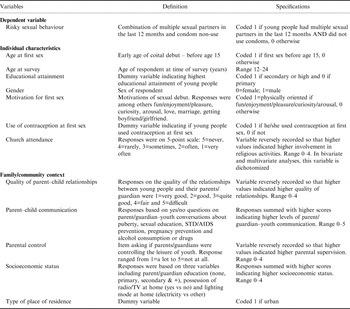
The postulated risk and protective factors at the individual, family and community levels are presented in Table 1. Individual risk factors include age at sexual debut, gender and motivation for first sex. Individual protective factors are respondent's age, educational attainment, contraceptive use at first sex and church attendance. Family characteristics include family structure, quality of parent–child relationships, parent–child communication about sexuality, parental control and an index of the household socioeconomic status. Youths from neither-parent families reported family factors related to their guardians. These terms (quality of relationships, communication, and control) are referred to throughout the paper as ‘parent/guardian–child’ factors. The type of residence was included as a community characteristic.
Definitions and specification of selected variables

Analytic strategy
The methods of data analysis include an examination of the association between risk/protective factors and risky sexual behaviour (bivariate analyses) for the selected independent variables, using unadjusted odd ratios (OR) derived from logistic regression. For multivariate logistic regression, six models were estimated for each type of family structure and the pooled sample. Models 1–3 assess the effects of (a) risk factors, (b) protective factors and (c) family variables associated with resilience. Models 4 and 5 estimate the effects of risk factors in the presence of individual protective factors and family variables, respectively. Model 6 includes risk/protective factors, family factors associated with resilience and the place of residence.
Two-way interactions were performed in additional analyses to determine whether the effects of risk or protective factors varied by gender and age. For instance, motivations for first sex may differ for males and females. Likewise, parental control and church attendance may vary by age and gender. As young people are growing up, their degree of autonomy is increasing and they will be less likely to attend church. If females are more religious, then the effect of church attendance is expected to be stronger for females than males. Finally, gender and age-specific differences in socioeconomic influences on risky sexual behaviour were also investigated. Statistical analyses were performed using STATA version 9 (StataCorp, Reference Parsons, Halkitis, Bimbi and Borkowski2005).
Preliminary analyses
Before fitting multivariable models, assumptions about logistic regression were checked carefully. In particular, multicollinearity tests and statistical significance of the associations between dependent and independent variables were examined. These methodological issues are discussed in previous research (Sun & Kay, Reference Sun and Kay1996; Bagley et al., Reference Bagley, White and Golomb2001). Using variance tolerance, known as Variance Inflation Factor (VIF), the tests revealed no problem of multicollinearity.
Goodness-of-fit of the models and the influence of the outliers
Another issue discussed in multivariable logistic regression is the extent to which estimated models significantly fit the data. The set of tests used here include log-likelihood, test of Hosmer-Lemeshow, Pearson's Chi-squared of the model and the Receiver Operating Characteristic (ROC) curve for each type of family structure. The influence of outliers on the estimates was examined using a plot of the residuals and predicted probabilities of the outcome to check for covariate patterns and overdispersion. Residuals with absolute values more than 1 indicate a problematic covariate pattern that can undermine the goodness-of-fit of the models. However, the plots depicted no residual values above 1 or overdispersion issues.
Results
Descriptive results
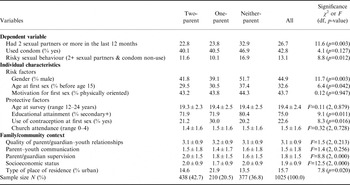
Table 2 presents the percentage distribution of respondents by family structure. In the pooled sample, 42.7% of the youths resided with two biological parents, 20.5% lived with one parent, while 36.8% lived in neither-parent families. The top panel of Table 2 displays the dependent variable. Overall, 26.7% of adolescents and young adults reported two or more sexual partners in the last 12 months. Those who resided in neither-parent families were more likely to report a higher number of sexual partners. Research in sub-Saharan countries indicates that youths report low levels of contraceptive use. In this sample, a noticeable proportion of respondents (42.8%) had used condoms in the last 12 months. This proportion was higher among youths from neither-parent families (46.9%) compared with one- (40.5%) and two-parent families (40.1%). Taken together the findings indicate that overall 13.1% of young people had engaged in risky sexual behaviour. Young people in neither-parent families were significantly more likely to engage in risky sexual behaviour. The middle panel of Table 2 outlines individual risk and protective factors.
Distribution of respondents by family structure (percentage or mean±SD)

Source: CFHS (1996/97 and 2002).
Risk factors
Almost 45% of young people in the sample are male. Between-family differences are observed in gender composition, and a greater proportion of males is found in neither-parent families. Likewise, 32.6% of respondents have experienced sexual debut before age 15. Those currently living in neither-parent families are more likely to engage in sexual intercourse for the first time at an early age, compared with those in one- or two-parent families. Forty-four per cent of youths report physically oriented motivations for first sex, but differences between families are not statistically significant.
Protective factors
On average, respondents are 19.4 years old. Most of the youths (75%) have reached at least high school. This percentage is higher than the general pattern observed in sub-Saharan Africa, supporting the aforementioned importance people in this area attach on their children's education. In addition, the proportion of youths who reached high school or more is significantly higher in neither-parent families (80.4%) compared with two-parent (71.9%) and one-parent families (71.9%). The prevalence of contraceptive use at first sex shows significant differences between families, with a greater proportion of youths living in one-parent families (30%) having had a contracepted first sex. Finally, church attendance shows no significant differences across family structures.
Family factors associated with resilience
Examining the family factors (lower panel of Table 2) indicates similarities for the quality of parent/guardian–youth relationships and communication about sexual topics, while significant differences in parental control and socioeconomic status are observed between families. On average, the quality of parent/guardian relationships was high (mean 3.1; SD 0.9). Consistent with previous research, youths reported low levels of parent–youth communication about sexuality (mean 1.5; SD 1.8). Compared with neither-parent families, the levels of parent/guardian control were significantly higher in one- and two-parent families. One-parent families showed lower socioeconomic status (mean 1.7; SD 0.8) compared with neither- (mean 2.0; SD 0.9) and two-parent families (mean 2.0; SD 0.9).
Community context
The variable examined at the community level is the place of residence (rural vs urban). Most respondents live in rural areas (84.3%), reflecting the semi-urban character of Bandjoun.
Bivariate associations of individual, family and community factors with risky sexual behaviour
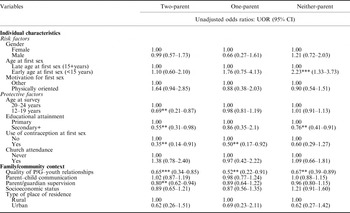
The first step of the analysis was to assess the gross effects of individual risk and protective factors and family characteristics on risky sexual behaviour. Table 3 displays unadjusted odds ratios (OR) and confidence intervals (CI) for each independent variable. Analysis of risk and protective factors reveals that relationships differ for each family type. In one- and two-parent families, the risk factors do not reach statistical significance although findings went in the expected direction. In contrast, early age at first sex is significantly associated with risky sexual behaviour in neither-parent families (OR=2.23; 95% CI=1.33–3.73).
Bivariate associations between risky sexual behaviour and selected variables by family structure

*** p<0.01,
** p<0.05,
* p<0.10.
Source: CFHS (1996/97 and 2002).
Likewise, the effects of protective factors vary across family structures. In two-parent families, respondent's age significantly decreases the odds of risky sexual behaviour (OR=0.69; 95% CI=0.21–0.87). Education shows a significant protective effect in neither- (OR=0.76; 95% CI=0.41–0.91) and two-parent families (OR=0.55; 95% CI=0.31–0.98). Contraceptive use at first sex shows negative and significant effects in one- and two-parent families (OR=0.50; 95% CI=0.17–0.92; OR=0.35; 95% CI=0.14–0.91, respectively). Examining the effects of family and community factors, the findings show that quality of parent/guardian–youth relationships decrease significantly the odds of risky sexual behaviour in each family type. As the quality of parent/guardian–youth relationships increases, the odds of risky sexual behaviour among adolescents and young adults decreases by 33%, 48% and 35% in neither-, one- and two-parent families, respectively. Parental control was negatively associated with risky sexual behaviour, but the effect is significant only in two-parent families. Associations between parent/guardian–youth communication, household socioeconomic status and risky sexual behaviour are not statistically significant. Finally, urban residence shows a weak and non-significant association with risky sexual behaviour. These results show at least one family factor that decreased the rates of risky sexual behaviour in each family type. The next step examines the robustness of the effects of family factors when individual risk and protective factors are included.
Multivariate results
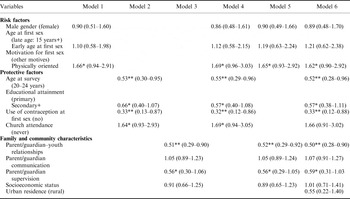
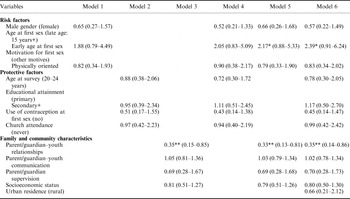
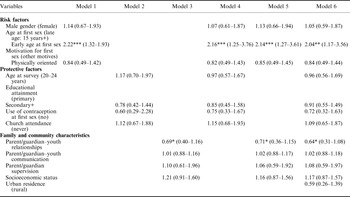
Tables 4–6 present the effects of risk, protective factors and family characteristics on risky sexual behaviour. Models 1–3 display the effects of individual risk and protective factors, and family context. Models 4–5 control the effects of risk factors in the presence of protective factors and family characteristics. Finally, Model 6 presents the additive effects of three sets of factors.
Estimated odds ratios of risky sexual behaviour among young people living in two-parent families in Bandjoun, Cameroon

Sample size: N=438.
** p<0.05,
* p<0.10.
Source: CFHS (1996/97 and 2002).
Reference categories are in parentheses.
Two-parent families
Table 4 shows the net effects of risk and protective factors and how family dynamics are associated with risky sexual behaviour. When all risk factors are included in the regression equation (Model 1), motivation for first sex becomes marginally significant (OR=1.66; 95% CI=0.94–2.91). Model 2 indicates that three individual factors operate as protective: age (OR=0.53; 95% CI=0.30–0.95), education (OR=0.66; 95% CI=0.40–1.07) and contraceptive use at first sex (OR=0.33; 95% CI=0.13–0.87). Contrary to expectations, church attendance marginally increases the odds of risky sexual behaviour. There are two possible explanations. First, in a context of a narrow socialization like that in Bandjoun (Cameroon), where adolescents and young adults are often supervised, church attendance constitutes a good opportunity for females and males to meet, talk and plan their sexual pledges. In this case, church attendance may be a risk factor because it allows youths to escape from parental control. Second, compared with Western contexts, the higher proportion of church attendees in the sample (52%) may explain the unexpected effect of religiosity. Indeed, most youths attending church in developed countries belong to conservative religions that restrict sexual activity to within marriage. That may explain the protective effect of church attendance observed in the Western context but not in the area under study.
With regard to family factors associated with resilience, the findings demonstrate that the quality of parent/guardian–youth relationships and parental control significantly decrease the odds of risky sexual behaviour (OR=0.51; 95% CI=0.29–0.90; and OR=056; 95% CI=0.30–1.06, respectively). These effects persisted in subsequent models (Models 4–5). Model 6 reveals that risk factors are not significantly associated with risky sexual behaviour. Two individual factors (respondents' age and contraceptive use at first sex) and two family factors (quality of parent/guardian–youth relationships and parental control) show significant protective effects.
One-parent families
Analysis shows that neither risk nor protective factors reach statistical significance (Models 1 and 2 in Table 5). Interestingly, the quality of parent/guardian–youth relationships significantly reduces (by 65%) the odds of risky sexual behaviour (Model 3 of Table 5). When the effects of individual risk factors are controlled for family variables (Models 5 and 6), age at first sex becomes marginally significant at 10%.
Estimated odds ratios of risky sexual behaviour among young people living in one-parent families in Bandjoun, Cameroon

Sample size: N=210.
** p<0.05,
* p<0.10.
Source: CFHS (1996/97 and 2002).
Reference categories are in parentheses.
Neither-parent families
Among young people who resided with other relatives, the findings reveal two significant variables at the individual and family levels (Models 1 and 3 of Table 6). Early age at first sex significantly increases the odds of risky sexual behaviour (OR=2.22; 95% CI=1.32–1.93). In contrast, the quality of parent/guardian–youth relationships emerges as a protective factor in Model 3 (OR=0.69; 95% CI=0.40–1.16). This finding remains robust when all factors are included in the estimation equation (Model 6).
Estimated odds ratios of risky sexual behaviour among young people living in neither-parent families in Bandjoun, Cameroon

Sample size: N=377.
*** p<0.01,
** p<0.05,
* p<0.10.
Source: CFHS (1996/97 and 2002).
Reference categories are in parentheses.
Interaction effects
Previous findings were extended to test the interactions. The full model (Model 6) is used as the baseline for each family type. Two-way interactions were entered once in the full model for each hypothesized interaction. Motivations for first sex, church attendance and parental control were expected to be gendered and age-dependent. However, no significant interaction term was detected. Thus, results are limited to additive models.
Discussion and conclusion
Researchers and social workers often contend that two-parent families are protective while other types of families are risky. Yet, within each type of family are factors that may decrease or increase sexual risk-taking among youths. This paper examined family factors associated with lower rates of risky sexual behaviour in the context of HIV/AIDS prevention. To achieve this goal, each family type was considered ‘pure’ in the sense that youths were stratified into family structure and models were performed separately to determine what family factors decrease significantly risky sexual behaviour. For comparison with the risk approach, models using family structure as the key independent variable were fitted (results not shown). Controlling for all other factors, the findings show that youths from two-parent families were less likely to engage in risky sexual behaviour, net of control of all other factors. This finding provides support for the widely documented hypothesis about the protective effect of two-parent families, and does not bring new insights in this field. The focus here is on the positive-oriented approach emphasizing strengths within each type of family. Thus, the effects of these factors are discussed for each family type at the individual, family and community levels.
What are the risk and protective factors at the individual level?
The results indicated that neither risk factors nor protective factors consistently reached statistical significance. In contrast, findings showed variations of the effects of these factors between families.
Two-parent families
First, motivation for first sex emerged as a marginal significant risk factor for youths living with two biological parents (p<0.10). This finding corroborates the assumption that sexual sensation-seekers are more likely to engage in risky sexual behaviour. This is in line with previous research in Cameroon. A study among senior students at the University of Douala (Cameroon) found that students engaged in unprotected sexual intercourse for sexual pleasure (Njikam Savage, Reference Njikam Savage2005). Second, the odds of risky sexual behaviour significantly decreased with age and contraceptive use at first sex. Older youths are more likely to protect themselves against HIV/AIDS. Previous research showed that condom use at first sex is associated with a higher likelihood of subsequent condom use (Shafii et al., Reference Shafii, Stovel, Davis and Holmes2004). The results showed that having a contracepted first sex significantly increased the probability of protecting oneself against HIV/AIDS. Together, these findings provide new insights for HIV interventions in sub-Saharan Africa. Reproductive health programmes must encourage youths to delay first sex. Delayers are maturing and gaining more knowledge of how to protect themselves against HIV/AIDS, and how to negotiate a protected first sexual intercourse. In this long process, parents and guardians play an important role in providing youths with a supportive family environment. However, further research is needed to enhance our understanding of parent–youth interactions that reinforce youths' abilities to negotiate protected sexual onset. This is particularly important in the context of an increasing gap between age at first sex and marriage currently observed in sub-Saharan Africa (Mensch et al., Reference Mensch, Grant and Blanc2006) and Cameroon (Adair, Reference Adair2008).
One-parent families
Most of the risk and protective factors operated in the expected direction, but only age at first sex reached statistical significance. Respondents who reported early sexual debut were two times more likely to report risky sexual behaviour compared with those who reported later age at sexual onset.
Neither-parent families
Among young people from neither-parent families, age at sexual debut increased significantly the odds of risky sexual behaviour. Whether age at sexual debut is a significant risk factor in neither- and one-parent families deserves particular attention. A plausible explanation is that higher proportions of youths who report early sexual debut are often observed in neither- and one-parent families during childhood and adolescence (Ngom et al., Reference Ngom, Magadi and Owuor2003; Babalola, Reference Babalola2004).
Are there family traits that reinforce protection among adolescents and young adults?
The quality of parent/guardian–youth relationships appeared as a protective factor irrespective of family type. This finding is robust, net of controls for individual risk and protective factors, and family processes as well. Studies in Western countries have shown that children were more likely to report positive outcomes such as delaying sexual debut and contraceptive use in a supportive and warm family environment (Regnerus & Luchies, Reference Curran, Hussong, Cai, Huang, Chassin, Sher and Zucker2006). The quality of parent/guardian–youth relationships may impact the quality and frequency of communication about sex and the youths' reactions about parental control. Young people who perceive higher levels of closeness with parents or other adults within the home are more likely to internalize family values and attitudes about sexuality, and will be subsequently more likely to report lower rates of risky sexual behaviour (Slap et al., Reference Slap, Lot, Huang, Daniyam, Zink and Succop2003; McBride et al., Reference McBride, Freier, Hopkins, Babikian, Richardson and Helm2005).
Findings from this research provide limited support for the effect of parent–child communication and parental control in Bandjoun, particularly in neither- and one-parent families. Like other African settings, parent/guardian–child communication about sexuality in Bandjoun is limited to sexual rites led by grandmothers and other adults towards a marriage perspective and daily-life duties for boys and girls (Kouinche & Tagne, Reference Curran, Hussong, Cai, Huang, Chassin, Sher and Zucker1998). Furthermore, previous studies in sub-Saharan Africa on the association between parent/guardian–child communication and youth sexual behaviour have shown mixed results. They reported a significant negative effect (Ngom et al., Reference Ngom, Magadi and Owuor2003) or a weak relationship (Adu-Mireku, Reference Adu-Mireku2003). Measurement issues such as scale construction may explain these discrepancies.
As regards parental control, studies in the Western context have shown that youths from two-parent families are less likely to engage in risky sexual behaviour because they are well supervised (Wu & Thomson, Reference Tschann, Adler, Millstein, Gurvey and Ellen2001; DiClemente et al., Reference DiClemente, Wingood, Crosby, Sionean, Cobb and Harrington2003). However, the involvement of other adults within the community in youth supervision may explain the expected protective effects of parental supervision in neither- or one-parent families in sub-Saharan Africa. Findings were in the expected direction in one-parent families. In contrast, parental control increased marginally the likelihood of risky sexual behaviour in neither-parent families. It is possible that youths living without biological parents are less likely to follow the discipline within the home.
The cultural homogeneity of Bandjoun partly explains the unexpected powerless of parental control on risky sexual behaviour because parenting practices are almost identical. Bandjoun is inhabited by local people with the same ethnic roots (98% of inhabitants). Other studies drawn from the Western context reported that children in one- or neither-parent families are likely to report feelings of loneliness, withdrawal, fear and anger as a result of divorce and violence (Gill et al., Reference Gill, Sharma and Verma2003). They are also likely to face both social and emotional problems, distress and anxiety, show high levels of family conflicts and less cohesion. These factors are also relevant in African settings. However, there is a dearth of research in sub-Saharan Africa about these mechanisms, which are not considered in this paper. Yet, they may impinge on the protective effect of parental control. Finally, a hidden bias of the expected protective effect of parental control in this area may exist but is not explored here: how do youths react to parental control? Future research needs to address this question by examining the agreement about the levels of parental control reported by parents and youths to understand how it can boost positive outcomes.
To the best of the authors' knowledge, no prior study in sub-Saharan Africa has documented risky sexual behaviour using a salutogenic approach. Policymakers and practitioners may realistically shift from the traditional views to a more positive approach regarding the relationships between family structure, family processes and risky sexual behaviour. While risky sexual behaviour cannot be completely eliminated, a way to protect young people is to reinforce factors that reduce the risk at the individual, family and community levels. Practitioners must seek within each type of family which factors youths need to overcome risky sexual behaviour. Each type of family structure encompasses strengths (and weaknesses). The quality of parent/guardian–youth relationships emerged as a strong protective family factor. Improving these strengths is a proactive avenue for HIV/AIDS prevention. Importantly, positive connections between youths and their daily environments, including families, schools, churches and communities, could be a promising way for a healthy future (WHO, 2007). When youths are positively connected with families (parents/guardians), they are more likely to internalize family values, parental control and socially acceptable behaviours. Thus, intervention programmes that aim at strengthening connectedness with daily life environments through prosocial activities (physical activity, organized sports and other activities, volunteer or religious activities) and managing HIV/AIDS prevention by forming a nexus between youths, families, practitioners and community, are recommended.
Acknowledgments
This study is part of the research programme of the PRONUSTIC Research Laboratory at the University of Montreal, which was supported by grants from the Rockefeller Foundation (grants RF94054-24 and RF97045-90 to Professor Barthélemy Kuate Defo, Principal Investigator). Additional financial support was provided to Zacharie Tsala Dimbuene by the Programme de bourses AFSSA funded by the Mellon Foundation (to Professor Barthélemy Kuate Defo, Principal Investigator) and the Graduate School of the University of Montreal, Canada. The authors thank Justine Gibbings, Aldo Bongiorno, Ann E. Biddlecom, Keith Owre, Jessie Sagawa and an anonymous referee for their comments on previous versions of this paper.