Community violence plagues American youths living in urban communities. Prevalence estimates consistently show that 50% to 96% of children and adolescents who reside in urban areas are exposed to some form of violence in their neighborhoods (Stein, Jaycox, Kataoka, Rhodes, & Vestal, Reference Stein, Jaycox, Kataoka, Rhodes and Vestal2003). The majority of youths are confronted with less severe but pervasive forms of violence on their streets, such as drug deals or robberies, whereas a substantial portion of children and adolescents are exposed to the most extreme forms of neighborhood violence, including witnessing stabbings and shootings or being the victim of such acts (Gorman-Smith, Henry, & Tolan, Reference Gorman-Smith, Henry and Tolan2004). Furthermore, youths seem unable to escape from this violence; longitudinal studies indicate that the rates of exposure to violence remain constant across years (Gorman-Smith et al., Reference Gorman-Smith, Henry and Tolan2004; Lambert, Ialongo, Boyd, & Cooley, Reference Lambert, Ialongo, Boyd and Cooley2005; Lynch & Cicchetti, Reference Lynch and Cicchetti1998).
Researchers have recognized the potential harmful effects of such pervasive exposure to violence and since the late 1980s have produced a vast body of work exploring the potential consequences of community violence on mental health. Reviews of this literature show a significant positive correlation between exposure and psychological symptoms, including externalizing symptoms, posttraumatic stress disorder (PTSD), and other internalizing behaviors (Buka, Stichick, Birdthistle, & Earls, 2001; Gorman-Smith & Tolan, Reference Gorman-Smith, Tolan and Luthar2003; Lynch, Reference Lynch2003). However, the strength of this relationship varies between outcomes as well as individual studies, confusing the pattern of findings. Cohesive models of the effects of exposure to community violence have yet to emerge; rather, theories specific to certain outcomes or subtypes of violence have been posited to explain empirical findings. Differences in methodologies, as well as the presence of moderating factors, such as subtypes of community violence or different age groups, may account for a portion of this variation. The goal of this meta-analysis is to summarize the growing body of literature on the impact of community violence on the psychological well-being of children and adolescents, as well as identify moderating variables that amplify or ameliorate these effects.
Effects of Community Violence
The most consistent findings in community violence research are those related to externalizing problems and to PTSD symptoms. Externalizing problems, such as deviant and aggressive behavior, have been consistently shown to result from exposure to community violence among children, adolescents, and young adults in cross-sectional and longitudinal studies (Gorman-Smith et al., Reference Gorman-Smith, Henry and Tolan2004; Gorman-Smith & Tolan, Reference Gorman-Smith and Tolan1998; Lynch & Cicchetti, Reference Lynch and Cicchetti1998; Miller, Wasserman, Neugebauer, Gorman-Smith, & Kamboukos, Reference Miller, Wasserman, Neugebauer, Gorman-Smith and Kamboukos1999; Schwab-Stone et al., Reference Schwab-Stone, Chen, Greenberger, Silver, Lichtman and Voyce1999). Social cognition theories suggest that exposure to community violence models violence as an appropriate behavior. Physiologically based theories indicate that children exposed to community violence are less likely to experience arousal during violent acts, which can facilitate their own aggressive behavior. At the same time, youths exposed to community violence are more likely to experience hyperarousal in benign situations that may increase their hostile attribution bias (Dodge & Somberg, Reference Dodge and Somberg1987). Finally, it is likely that among older children and adolescents a transactional relationship exists by which children with externalizing behaviors place themselves in situations that increase their exposure to community violence (Lynch & Cicchetti, Reference Lynch and Cicchetti1998).
Similarly, published research consistently finds a moderate relationship between exposure to community violence and PTSD symptoms (Fitzpatrick & Boldizar, Reference Fitzpatrick and Boldizar1993; Horowitz, Weine, & Jekel, Reference Horowitz, Weine and Jekel1995; Lynch & Cicchetti, Reference Lynch and Cicchetti1998). Children and adolescents exposed to elevated rates of witnessing and victimization by community violence are at much greater risk for developing PTSD symptoms, as well as clinical diagnosis of the disorder. As noted above, exposure to community violence leads to chronic hyperarousal, and the pervasiveness of violence in some communities is likely to lead to a communal sense of insecurity. Parents who have been traumatized are also more likely to have children who feel unsafe or develop PTSD symptoms (Linares & Cloitre, Reference Linares, Cloitre and Silva2004; Yehoda, Halligan, & Grossan, 2001).
The effect of exposure to community violence on other internalizing problems, however, is less clear. Many published studies have found a significant main effect of exposure to community violence on internalizing problems (Cooley-Quille, Boyd, Frantz, & Walsh, Reference Cooley-Quille, Boyd, Frantz and Walsh2001; Kliewer, Lepore, Oskin, & Johnson, Reference Kliewer, Lepore, Oskin and Johnson1998; Lynch & Cicchetti, Reference Lynch and Cicchetti1998), yet other studies have failed to find such a relationship (Cooley-Quille, Turner, & Beidel, Reference Cooley-Quille, Turner and Beidel1995; Fitzpatrick, Reference Fitzpatrick1993; Singer, Anglin, Song, & Lunghofer, Reference Singer, Anglin, Song and Lunghofer1995). Although it appears counterintuitive to suggest that community violence might not lead to internalizing outcomes, some researchers suggest that youths who are chronically exposed to community violence may become desensitized and suppress feelings of sadness or anxiety (Farrell & Bruce, Reference Farrell and Bruce1997; Fitzpatrick, Reference Fitzpatrick1993; Terr, Reference Terr1991). Within this model, youths may develop initial internalizing symptoms in reaction to new or unusual exposure to violence, but over time their symptoms might be expected to abate. Although one meta-analysis established a moderate association between community violence and internalizing symptoms across 37 studies (Wilson & Rosenthal, Reference Wilson and Rosenthal2003), by restricting their sample to published studies of internalizing outcomes among adolescents, the analysis only began to organize the available literature.
Moderators of Community Violence
A number of moderating factors further complicate understanding of the effects of community violence. Exposure to different forms of community violence may impact youths differently. However, researchers do not uniformly measure community violence, and rarely do they compare the effects of different types of exposure on outcomes. In general, exposure to community violence commonly refers to parent or child reports of violent events personally experienced by youths outside of their homes (Lynch, Reference Lynch2003; Richters & Martinez, Reference Richters and Martinez1993). This definition excludes domestic violence and media violence (e.g., as seen on television or in movies). Although differences exist in categorization, three subtypes of community violence have been identified: victimization, witnessing, and hearing about/vicarious exposure (Buka et al., Reference Buka, Stichick, Birdthisle and Earls2001). Victimization by community violence refers to having been the object of intentional acts initiated by another person to cause harm. Such events include being chased, threatened, robbed, beaten up, shot, stabbed, or otherwise assaulted. Witnessing community violence refers to eye-witnessing an event that involves loss of property, threat of physical injury, actual injury, or death. Hearing about community violence is learning of another person's victimization by neighborhood violence. One example of vicarious exposure would be hearing about a friend who was chased through the neighborhood.
Research contrasting the three types of exposure to community violence suggests that the effect of exposure to violence on negative outcomes may increase with the physical proximity of children to the violent event (Nader, Pynoos, Fairbanks, & Frederick, Reference Nader, Pynoos, Fairbanks and Frederick1990; Pynoos et al., Reference Pynoos, Frederick, Nader, Arroyo, Steinberg and Eth1987; Richters & Martinez, Reference Richters and Martinez1993). That is, the closer children are to the violent event, the more symptoms they exhibit, suggesting that studies using victimization measures of community violence will find stronger effects than studies using measures of witnessing community violence, which in turn should show greater effects than studies using measures of vicarious exposure. Nader et al. (Reference Nader, Pynoos, Fairbanks and Frederick1990) examined PTSD symptoms at a school 14 months after several children were shot and killed by a sniper on a playground. Students who were on the playground at the time of the shooting reported more severe symptoms than children in the school building. In addition, both of these groups showed more symptoms than children who did not attend school on the day of the shooting, but presumably were vicariously exposed by hearing about the shooting later (Nader et al., Reference Nader, Pynoos, Fairbanks and Frederick1990). In another study investigating varying levels of exposure to violence, Fitzpatrick (Reference Fitzpatrick1993) found that victimization, but not witnessing community violence, predicted elevated depressive symptoms among children. With the exception of these two studies, few researchers have explicitly compared the effects of different forms of community violence on various outcomes.
The effects of community violence may also vary by developmental period. Although not a consistent finding, age, a proxy for developmental stage, has been found to moderate the relationship between exposure to community violence and internalizing problems. Younger children report more depressive symptoms when exposed to greater levels of community violence (Buckner, Beardslee, & Bassuk, 2004; Fitzpatrick, Reference Fitzpatrick1993; Weist, Acosta, & Youngstrom, Reference Weist, Acosta and Youngstrom2001). Social cognitive theories suggest that younger children may not yet have developed the cognitive coping skills necessary to mitigate the effects of community violence (Farver, Xu, Eppe, Fernandz, & Schartz, 2005); alternatively, they may not yet have become desensitized to chronic community violence (Fitzpatrick, Reference Fitzpatrick1993). Other studies, however, have shown no moderating effects of age on the relationship between community violence and negative outcomes (Schwab-Stone et al., Reference Schwab-Stone, Ayers, Kasprow, Voyce, Barone and Shriver1995). A lack of longitudinal studies that track the effects of exposure to community violence from early childhood to late adolescence makes it difficult to determine if exposure affects children in varied ways at different developmental states. A meta-analysis allows systematic comparison of exposure effects among samples of different ages. Although this method falls short of quality longitudinal research, it provides a better understanding of the issue than is currently available.
A meta-analysis on this body of literature will summarize this work and elucidate our understanding of the impact of exposure to community violence on mental health outcomes among children and adolescents. Currently, different measurements of community violence, different outcomes, and different samples have resulted in a vast range of effect sizes. Aggregating across studies, as done in a meta-analysis, provides a more robust effect size, and facilitates the disentangling of the influences of various moderators. It must be noted that exploration of possible moderating as well as mediating processes is limited to variables that are consistently measured across studies. At the time of this analysis, too few studies exist that consistently examine the role of other important influences on development, such as personality characteristics, parental and peer support, and contextual factors. More research is needed to better understand how and when exposure to community violence disrupts psychological well-being.
In addition, a meta-analysis permits systematic comparison of the influences of multiple factors on effect size of various outcomes, as well as allowing comparisons between the targeted outcomes. By including unpublished dissertations and manuscripts, this meta-analysis also corrects for the “file-drawer” problem commonly found in the literature, where the importance of a variable becomes inflated because of the lack of publications reporting null findings (Bradley & Gupta, Reference Bradley and Gupta1997).
Hypotheses
Correlations between exposure to community violence and mental health outcomes have ranged from nonsignificant to large effect sizes, with most falling between .20 and .60, representing low to moderate effects (Cohen, Cohen, West, & Aiken, Reference Cohen, Cohen, West and Aiken2003). We predicted that our meta-analysis would find a moderate association between exposure to community violence and PTSD symptoms, other internalizing problems, as well as externalizing problems. In general, we expected that total exposure to community violence would correlate more highly with externalizing problems and PTSD symptoms than with other internalizing problems. Prior studies have consistently found that exposure to community violence increases hyperarousal, which in turn contributes to other PTSD symptoms (Fitzpatrick & Boldizar, Reference Fitzpatrick and Boldizar1993; Horowitz et al., Reference Horowitz, Weine and Jekel1995; Lynch & Cicchetti, Reference Lynch and Cicchetti1998), whereas other studies take a social cognitive perspective to explain how community violence models externalizing as appropriate behavior (Guerra, Huesmann, & Spindler, Reference Guerra, Huesmann and Spindler2003; Ng-Mak, Salzinger, Feldman, & Stueve, Reference Ng-Mak, Salzinger, Feldman and Stueve2002; Schwab-Stone et al., Reference Schwab-Stone, Chen, Greenberger, Silver, Lichtman and Voyce1999). As research examining the link between exposure to community violence and internalizing symptoms is less consistent, we expected to find a weaker effect for internalizing outcomes. To more closely examine the effects of exposure to community violence, we categorized the overall effect into its subtypes and examined the relationships of each form on each of the different outcomes. We predicted that victimization by community violence would have a stronger effect than witnessing or hearing about community violence across all outcomes, in keeping with prior studies linking proximity of exposure to psychological symptoms (Nader et al., Reference Nader, Pynoos, Fairbanks and Frederick1990; Pynoos et al., Reference Pynoos, Frederick, Nader, Arroyo, Steinberg and Eth1987; Richters & Martinez, Reference Richters and Martinez1993). We hypothesized that studies of younger children would show significantly larger correlations between exposure to community violence and other internalizing problems than studies of older children and adolescents, as evidence suggests that younger children lack the mature coping skills that could prevent the development of internalizing problems (Farver et al., Reference Farver, Xu, Eppe, Fernandez and Schwartz2005). In the absence of clear evidence showing moderation of externalizing or PTSD symptoms by age, we predicted that our meta-analysis of the literature would also fail to find significant age moderation of the relationship between exposure to community violence and externalizing or PTSD symptoms.
Method
Sample of studies
We used three different search methods to identify literature for the meta-analytic review. First, literature searches were conducted using computer programs PsycInfo (1887 to July 2005) and Electronic Collections Online (ECO; 1995 to July 2005). We used the keywords “community violence,” “urban violence,” and “neighborhood violence.” This method garnered 516 studies. Second, several reference lists were searched for relevant studies. Third, we attempted to contact community violence researchers via e-mail and asked them to share pertinent published and unpublished analyses.
We included in the meta-analysis studies that met the following criteria. First, studies had to use a multiple-item self-report measure of community violence, or an objective measure such as crime statistics. Informants included self-, parents, teachers, or official crime records. Studies with only measures of domestic violence, general neighborhood disadvantage, or neighborhood poverty were excluded. Second, studies had to include measures of internalizing, externalizing, or PTSD symptoms. Again, informants included self, parents, teachers, or others. Third, studies were included only if direct bivariate correlations between community violence and negative outcomes could be obtained or calculated. When bivariate correlations could not be calculated, as in the case of studies that presented regression results or latent constructs, authors were contacted in an attempt to obtain this information. This information could not be obtained in 20 cases, and the study was excluded. Fourth, studies were included only if the majority of participants were under the age of 25 years, defined as the mean age +1 SD falling at or below 25 years of age. Fifth, only empirical studies were included. Qualitative studies and reviews were excluded. Both dissertations and published articles were included for analysis, as were unpublished data sets provided by authors we contacted. Sixth, each sample was included only once for each type of outcome. Multistep searches were conducted to screen for redundant samples. Initially, multiple studies by the same author were examined to ensure different samples were used. In the case of dissertations, a search was run to determine if the chair of the dissertation committee might have published the same data set. Dissertations that were later published were excluded in favor of the peer-reviewed form, unless considerably more information could be obtained from the dissertation. Only baseline information was included for longitudinal research projects. When participant and procedure method sections could not resolve discrepancies, we attempted contact with authors. In any case, when the eligibility of a study was in doubt, the study was excluded from our sample.
These search and review procedures led to a total of 116 samples drawn from 110 studies that included 39,667 children and adolescents. Two separate databases were used to calculate effect sizes. The first database included studies with unique measures of victimization, witnessing, and hearing about exposure to community violence on internalizing, externalizing, and PTSD symptoms. We computed 237 independent effect sizes. The second database included all studies and combined measures of exposure to produce a total community violence variable. From these studies, we calculated 195 effect sizes. By using two separate databases, we could use all available information from studies that provided both total effects and community violence subtype effects, while avoiding multicollinearity and inflation of effect sizes.
Coding system
Publication status was coded. Published studies included articles and book chapters that appeared in peer-reviewed forums. Unpublished studies consisted of unpublished dissertations, manuscripts, presentations, or analyses. Fifty-five samples were drawn from published studies, and 61 samples were drawn from unpublished works, including four studies identified by personal solicitation of community violence researchers.
High-risk samples were drawn from areas of high crime or violence. Samples were coded as high risk only when authors explicitly recruited from areas with crime or violence rates suggesting high danger. A total of 32 samples were coded as “high risk,” and 84 were coded as “not high risk.”
Lifetime versus recent exposure to community violence was coded. Measures of lifetime exposure assessed any experience of community violence, whereas recent exposure incorporated a time frame of exposure, such as in the past 6 months. Lifetime measures were used for 89 samples, and recent measures were used for 27 samples.
Reporter of outcomes was coded as self-report, parents' report, teachers' report, or every combination of reporters. This variable was coded separately for each outcome, as often a single study (with a single sample) would utilize different reporters for different outcomes; for example, internalizing would be reported by the child but externalizing would be reported by the parent. Seventy samples used self-report measures for internalizing outcomes, with eight using parent reports, two using teacher reports, and two using some combination of reporters for internalizing outcomes. For samples including externalizing effects, 36 used self-reports of externalizing, 18 used parent reports, 7 used teacher reports, and 1 used a combination of reporters for externalizing outcomes. Almost all samples that examined PTSD as an outcome used self-report (N = 49), with only one sample including a teacher-report measure of PTSD symptoms.
Reporter of community violence was defined as self-report, parent report, or observation, including teacher report or crime neighborhood crime statistics. The scale used to measure exposure to community violence was noted. As with reporter of outcomes, most samples used self-report measures of community violence (N = 107), with seven using parent-reported community violence, and two using observation measures of community violence.
Discrepancy between reporters was then calculated separately by outcome, to index whether the reporter of community violence was the same as the reporter for each outcome (0 = same reporter for both, 1 = discrepant reporters). Seventy samples used the same reporter for both internalizing and community violence, with 12 samples using discrepant reporters of internalizing and community violence. Thirty-nine samples used the same reporter for externalizing and community violence, with 23 samples using discrepant reporters of externalizing. Forty-nine samples used the same reporter for PTSD and community violence, with only 1 sample using discrepant reporters for PTSD and community violence. This variable was considered unreliable for PTSD, and was not included in regression analyses examining PTSD.
Type of exposure to community violence was coded as total, victimization, witnessing, or hearing about as determined by measures incorporated in the study. A given study may have reported any or all of the types of exposure. When studies included only subtypes of community violence, total exposure effect size was calculated by averaging the subtypes of exposure included (Rosenthal, Reference Rosenthal1991).
Type of outcome reported was coded as internalizing symptoms, externalizing symptoms, or PTSD symptoms. Internalizing symptoms encompassed measures that assessed problems controlling emotions. Specifically, measures included various symptoms of depression and anxiety. Externalizing symptoms included behavioral problems, such as aggressive behavior, delinquency, and other measures of acting out. PTSD symptoms included measures of flashbacks, hypervigilance, avoidance, and other diagnostic criteria for PTSD. Internalizing symptoms included measures of depression and/or anxiety symptoms, excluding anxiety symptoms specific to PTSD. If a given study reported more than one correlation corresponding to subtypes of outcomes, a mean of relevant correlations was used for the appropriate outcome. For example, for studies that reported the correlations between exposure to community violence and anxiety, as well as exposure to community violence and depression, the average of the two correlations was computed for the effect size between exposure to community violence and internalizing symptoms.
Age was trichotomized into children, adolescents, and mixed. Child samples included studies in which most youths were 11 years of age or younger. This was defined as studies whose age range fell below 12 years, or whose mean age +1 SD fell below 12 years (e.g., if the mean age of a sample = 10.7 and the SD = 0.9, this study was coded as a child sample). Adolescent samples included studies in which most youths were between 12 and 25 years old. This was defined as studies whose mean age ±1 SD fell between 12 and 25 years old. Mixed age samples included studies whose age ranges spread across these categories.
Race of the sample had five levels. Samples were coded African American, Hispanic, or White if the sample comprised 70% or more of one ethnicity. Mixed samples included less than 70% of any ethnicity. Non-United States samples included youths from anywhere in the world outside of the United States.
Gender of the sample had three levels. A sample was coded as primarily female if 70% or more of the sample was female, and a sample was primarily male if 70% or more was male. Mixed gender samples included less than 70% of either gender.
In addition, there were several variables that were excluded from analyses because of insufficient sample size (i.e., not enough studies included this information). Thus, we coded for but did not include in analyses urban versus rural sample, longitudinal effects, family, peer, and other social support moderating effects.
Two raters coded all studies. As all moderators were coded using a nominal scale, interrater agreements were calculated for all of the moderators used in analyses. These agreements were as follows: publication status (100%), outcomes available (79.0%), subtypes of community violence available (94.1%), high-risk environment (73.1%), lifetime versus recent exposure (83.2%), discrepancy between reporters (82.4%), age group (80.7%), gender group (89.9%), and ethnicity group (89.9%). Disagreements were resolved through discussion among authors.
For most variables, agreement was high and disagreements were resolved easily. For example, one author might have had more familiarity with a specific measure of community violence and recognized it as a “lifetime” measure, or in many unpublished studies demographics of samples were not immediately apparent. However, two variables were identified with lower than 80% agreement and required refinement of coding protocols: outcomes available (79.0%) and high-risk environment (73.1%). One common source of disagreement on available outcomes stemmed from overlapping measures of internalizing and PTSD. It was decided that outcomes would be coded as they were presented by study authors, rather than based on the coders' own prior knowledge of specific measures. The coding of a setting of high risk was also complicated by ambiguities in many studies. Many authors described their sample as residing in a “high-risk area” without elaborating on how that determination was made. It was decided that “high risk” would be coded yes only for those studies that selected their sample with the expressed intent to increase the likelihood that their participants had been exposed to community violence (such as using census crime data to identify high-crime school districts). In this way, the general term “high risk” was refined.
Computation of effect sizes and outlier analysis
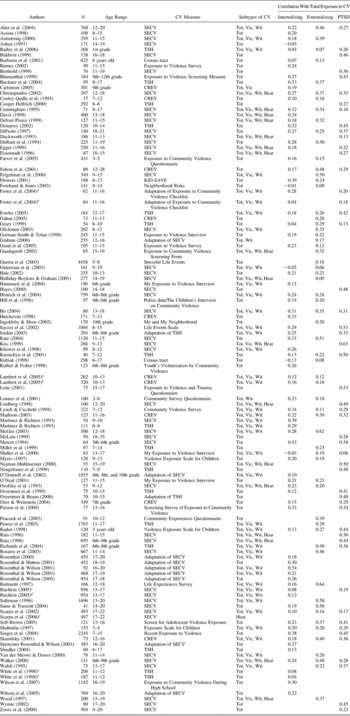
Johnson's (1993) DSTAT program is an effect size calculator than calculates a d statistic using a variety of different types of data. Most studies included in our sample provided Pearson's correlations; however, five studies presented only group means, standard deviations, and sample sizes. Using DSTAT, all study data was converted into a common d statistic, then for those studies that did not provide correlations, Pearson's correlations were calculated using the d statistic. (For more detail on the d statistic, see Hedges & Olkin, Reference Hedges and Olkin1985, pp. 78–81; for more detail on formulas used in the DSTAT program, see appendix A of Johnson, Reference Johnson1993.) Table 1 presents Pearson correlation coefficients for total and subtype of exposure on each outcome, as well as demographic information of each sample.
Effect sizes for studies of exposure to community violence

Note: CV, community violence; PTSD, posttraumatic stress disorder; SECV, Survey of Exposure to Community Violence; TSH, Things I Have Seen and Heard; CREV, Children's Report of Exposure to Community Violence.
aAll female sample.
bAll male sample.
cRussian sample.
dBelgian sample.
eScarpa et al. (Reference Scarpa, Hurley, Shumate and Haden2006) is the same sample as Scarpa et al. (Reference Scarpa, Fikretoglu, Bowser, Hurley, Pappert and Romero2002) with only the “hearing about community violence” results being published.
As a global test for outliers, one z distribution was calculated for total exposure to community violence by each outcome. Three effect sizes yielded z scores below −3.29 (none were above +3.29), one for each outcome and all coming from the same study. When contacted, the author of this study stated that she felt that this sample demonstrated an unusually low overall level of exposure to community violence, suggesting that this may account for the unusual findings (C. A. Shavers, personal communication, July 19, 2005). As this study made up a small percentage of the sample and may not have been representative of the effects of the predictor variable, these effects were eliminated from the remaining analyses.
To test for outliers by moderator, separate z distributions were calculated for each outcome by each value of the following moderators: publication status, lifetime versus recent exposure to community violence, discrepancy between community violence and outcome reporters, subtype of community violence, and age group. Only one outlier was identified, among published studies examining internalizing problems (Buckner et al., Reference Buckner, Beardslee and Bassuk2004; z = 3.41). Closer examination of this study revealed no unusual methodology or justification for exclusion. It was decided to retain this study, as it did not include subtypes of community violence and was of a mixed-age sample, and therefore was not included in regression analyses.
Analysis of effect sizes
Analyses were conducted based on Hedges and Olkin's (1985) approach to meta-analysis. We calculated the weighted average effect sizes using DSTAT. Total effect of community violence on each outcome was calculated first, followed by effects of each subscale on each outcome. The Q statistics were calculated to evaluate the homogeneity of effect sizes. The Q value of an average effect is an index of variability distributed as a chi square; Q B estimated the between-class effect, which has a chi-square distribution with p – 1 degrees of freedom (p is the number of classes). The homogeneity of effect sizes within each class was estimated by Q W that has a chi-square distribution with k – 1 degrees of freedom (k is the number of effect sizes within the class). A significant homogeneity statistic indicates that the effect sizes comprising the weighted-average effect size may be coming from different populations. Furthermore, a weighted regression analysis was run to test for the uniqueness of the potential moderators.
Results
Categorical analyses are presented first, to overview the main effects examined. Main effects of study characteristics are followed by main effects of proposed moderators including subtypes of community violence, and demographic characteristics of sample participants. Results of weighted regression analyses examining the independent contributions of select moderators are then presented.
Categorical analyses
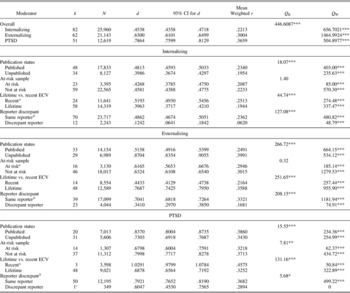
The three outcomes of interest were compared using DSTAT, and they are presented in Table 2. As predicted, total exposure to community violence predicted negative mental health symptoms, as indicated by positive and moderate effect sizes for each outcome. The strongest effects were found for PTSD, followed by externalizing, χ2 (1) = 85.74, p < .001, which in turn yielded stronger effects than internalizing, χ2 (1) = 165.95, p < .001. Several studies presented results for two or more of the outcomes examined, so all subsequent variables were analyzed separately for each outcome to avoid inflating effect sizes.
Outcomes and study effects

Note: Significant effect sizes are indicated by confidence intervals that do not include 0. Positive effect sizes refer to a direct relationship between higher levels of exposure to community violence (ECV) and higher levels of psychological symptoms. PTSD, posttraumatic stress disorder; k, number of effect sizes; d, mean weighted effect size; CI, confidence interval.
aLifetime vs. recent ECV: Lifetime, measure of ECV assesses lifetime or global exposure to community violence; Recent, measure of ECV assesses only recent exposure to community violence.
bReporter discrepant: Same reporter, ECV and outcome measures completed by same respondent; Discrepant reporter, ECV and outcome measures completed by different respondents.
cOnly one study examining PTSD had different reporters for ECV and outcome measures, making the discrepant reporter comparison here unreliable.
* p < .05. **p < .01. ***p < .001.
Study characteristics
Publication status
The following findings on study characteristics are presented in Table 2. Publication status significantly moderated the relationship between total exposure to community violence and all three outcomes, although the direction of moderation varied by outcome. Published studies demonstrated significantly stronger effects than unpublished work for both internalizing and PTSD, χ2 (1) = 18.01, p < .001; χ2 (1) = 15.55, p < .001, but unpublished studies yielded stronger effects for externalizing, χ2 (1) = 266.72, p < .001. These findings for internalizing and PTSD are consistent with the common “file-drawer” problem associated with meta-analysis. Studies that find interesting effects are more likely to be published than studies with null findings, leading to a publication bias toward stronger effect sizes (Lipsey & Wilson, Reference Lipsey and Wilson1993). It is not clear why studies examining externalizing outcomes would demonstrate the reverse effect, with published studies tending to demonstrate smaller effect sizes than unpublished studies. It is possible that authors and journal editors are more likely to find a smaller (or missing) association between community violence and personal violent behavior to be more interesting and therefore publishable. However, any explanation of why externalizing shows this atypical pattern is speculation.
At-risk sample
Both at-risk and non-at-risk samples demonstrated significant effects for all outcomes. Samples targeted as being at higher risk for exposure to community violence did not yield higher effects of exposure to community violence on mental health than did untargeted samples. There were no significant differences between at-risk and non-at-risk samples for internalizing or externalizing, but non-at-risk samples demonstrated significantly stronger effects for PTSD, χ2 (1) = 7.81, p < .01. These findings must be considered cautiously. Studies that failed to provide detailed information about participants' crime exposure were assumed to be not at risk, and thus, the non-at-risk category may actually include some at-risk samples. In addition, even within a high-crime neighborhood, the degree of personal exposure to community violence is likely to vary widely between residents.
Recentness of exposure
Measures of recent exposure were linked to significantly stronger effects than lifetime exposure measures for both internalizing and PTSD, χ2 (1) = 44.74, p < .001; χ2 (1) = 131.16, p < .001. However, lifetime exposure measures demonstrated significantly stronger effects for externalizing, χ2 (1) = 251.65, p < .001. This could suggest that although exposure to community violence may have stronger immediate effects of internalizing and PTSD, externalizing may be more likely to develop in response to the cumulative effects of exposure to community violence over time.
Reporter discrepancy
Having the same individual report both exposure to community violence and outcomes led to significantly stronger effects than those yielded by separate reporters. This contrast was significant across internalizing, χ2 (1) = 127.09, p < .001, and externalizing, χ2 (1) = 208.15, p < .001. Because of a smaller sample, this contrast could not be analyzed for PTSD.
Given that study characteristics were not the main focus of this meta-analysis and these characteristics were significant, study characteristics were included as covariates in weighted regression analyses.
Moderator analyses
Subtypes of community violence
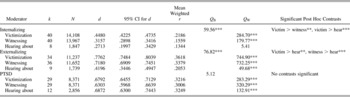
A separate database was constructed in DSTAT to examine only those studies that reported results by subtype of exposure to community violence. This was done to avoid inflation of effects for analyses that examined total exposure to community violence, as most studies that reported results for subtypes of exposure to community violence reported separate effect sizes for at least two subtypes. To counter the greater Type I error because of several studies contributing multiple effects to these subtype analyses, significance was set at p < .01 instead of p < .05 (Stevens, Reference Stevens2002). Results of community violence categorical analyses are presented in Table 3.
Subtypes of community violence

Note: Significant effect sizes are indicated by confidence intervals that do not include 0. Positive effect sizes refer to a direct relationship between higher levels of exposure to community violence and higher levels of psychological symptoms. k, number of effect sizes; d, mean weighted effect size; CI, confidence interval; PTSD, posttraumatic stress disorder.
*** p < .001.
Victimization predicted stronger effects than witnessing, χ2 (1) = 50.81, p < .001, or hearing about, χ2 (1) = 20.74, p < .001, community violence for internalizing, although there was no significant contrast between witnessing and hearing about community violence. Examining effects on externalizing, victimization predicted stronger effects than hearing about community violence, χ2 (1) = 76.20, p < .001, and witnessing predicted stronger effects than hearing about community violence, χ2 (1) = 53.69, p < .001, but there was no significant difference between victimization and witnessing. Although for internalizing, victimization stands out as a stronger predictor than the other two types of exposure to community violence, for externalizing victimization and witnessing are equally predictive, and it is hearing about community violence that stands out as the weaker predictor. These findings indicate that at least for internalizing and externalizing, the effects of proximity of exposure vary by outcome.
Surprisingly, although each of the three subtypes yielded significant effects for PTSD, there were no significant contrasts between the three subtypes in predicting PTSD.
Demographic moderators
Age
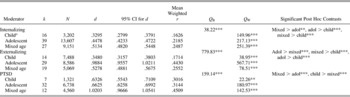
All studies were divided into three categories based on the age of the sample as described above: child, adolescent, and mixed-age samples. Age effects varied by outcome. Results are presented in Table 4. The mixed-age samples yielded stronger effects on internalizing than either adolescent, χ2 (1) = 10.46, p < .01, or child, χ2 (1) = 37.72, p < .001, samples, with adolescent samples demonstrating stronger effects than child samples, χ2 (1) = 17.58, p < .001. Adolescent samples yielded the strongest effect sizes for externalizing, followed by mixed-age samples, χ2 (1) = 308.23, p < .001, which in turn, were significantly stronger than child samples, χ2 (1) = 47.45, p < .001. There was no significant difference between adolescent and child samples on PTSD, but mixed-age samples yielded stronger effects on PTSD than either adolescent, χ2 (1) = 142.41, p < .001, or child samples, χ2 (1) = 68.11, p < .001. The primary findings of interest are the significantly stronger effects found for adolescent samples compared with child samples for both internalizing and externalizing. This evidence appears to support hypotheses that exposure to community violence would have greater effects on adolescents. Although not directly assessed, this may reflect adolescents' greater duration of exposure to violence compared to younger children.
Age effects

Note: Significant effect sizes are indicated by confidence intervals that do not include 0. Positive effect sizes refer to a direct relationship between higher levels of exposure to community violence and higher levels of psychological symptoms. k, number of effect sizes; d, mean weighted effect size; CI, confidence interval; PTSD, posttraumatic stress disorder. aAge groups: Child, mean sample age +1 SD < 12 years; Adolescent, mean sample age −1 SD ≥ 12 years; Mixed age, sample age range too broad for child or adolescent categories.
** p < .01. ***p < .001.
Gender
Primarily female samples yielded stronger effects than male samples for internalizing, χ2 (1) = 18.43, p < .001. Mixed-gender samples yielded stronger effects than female samples, however, χ2 (1) = 14.96, p < .001. There were no significant differences between male and female samples for either externalizing or PTSD. For externalizing, mixed-gender samples yielded significantly stronger effect sizes than either female, χ2 (1) = 33.30, p < .001, or male, χ2 (1) = 71.90, p < .001, samples, whereas female samples yielded stronger effects on PTSD than mixed-gender samples, χ2 (1) = 11.12, p < .01. However, the small number of single-gender samples (male k = 15, female k = 14) may have made it difficult to find differences. In addition, on closer examination it was found that a disproportionate number of studies using single-gender samples were conducted with targeted samples such as adjudicated youths, children referred for behavior problems, or residents of homeless shelters. In addition, 4 out of 14 primarily female samples were studies conducted by the same research group on college samples. These sampling disparities make gender differences difficult to interpret. It is possible that differences between genders or between single- and mixed-gender samples are because of differences in sampling rather than true gender effects.
Race
Each racial group had mean effect sizes significantly greater than zero for each outcome, although there were relatively few significant pairwise contrasts between race groups. On internalizing, mixed-race samples demonstrated significantly stronger effects than primarily African American samples, χ2 (1) = 18.84, p < .001. No significant post hoc contrasts were found for externalizing. For PTSD, Latino samples yielded the strongest effect sizes, significantly stronger than mixed-race samples, χ2 (1) = 32.00, p < .001. Mixed-race samples demonstrated stronger effect sizes than African American samples, χ2 (1) = 23.32, p < .001. Because of the relatively small number of Latino and Caucasian samples, results for these groups should be interpreted with caution. The finding that mixed-race samples yield stronger effects for internalizing and PTSD than African American samples is more robust, and appears to contradict research suggesting that African Americans may be more negatively affected by exposure to community violence. However, these results do not indicate differences in mean levels of exposure, so it is possible that African Americans may be disproportionately exposed to community violence, but that other factors reduce the strength of the direct relationship between exposure to community violence and negative mental health outcomes.
Weighted regression analyses
Two major variables of interest, subtypes of community violence and age groups, were examined using weighted multiple regression analyses. Regressions were weighted to account for the influence of sample size on the variance of each effect size, giving more weight to effect sizes that are estimated more reliably (Hedges & Olkin, Reference Hedges and Olkin1985). Each regression model examined only one outcome, with the effect size d as the criterion and w as the weighting factor. Standard errors for regression coefficients computed in SPSS were incorrect, by a factor of the square root of the residual mean square (see Hedges & Olkin, Reference Hedges and Olkin1985, p. 174), and therefore were corrected using Johnson's (1993) DSTAT program.
Each model included dummy codes for the three study characteristics that yielded significant effects in categorical analyses for all outcomes: publication status, recentness of community violence exposure, and exposure to community violence/outcome reporter discrepancy. To test our hypothesis that proximity of exposure to community violence would predict negative outcomes, the subtype of community violence was coded as a single vector, with –1 = heard about, 0 = witnessed, and 1 = victimized. As noted earlier, the assumption of independence was violated for all analyses of exposure to community violence subtypes because several studies contributed more than one effect size. Regression models partially account for variance shared within studies by controlling for some study characteristics, but to more stringently address this issue, a more conservative α level of .01 was calculated for analyses of subtypes of community violence. For age analyses, only the main contrast of interest (child vs. adolescent) was analyzed. Because no study contributed more than one effect size for age analyses, no alpha adjustment was required.
For each regression model, a significant Q R statistic indicated that the model explained a significant amount of variance in the criterion variable. However, all models also had significant Q E statistics, indicating that unmeasured variables could account for even greater amounts of variance.
Study characteristics
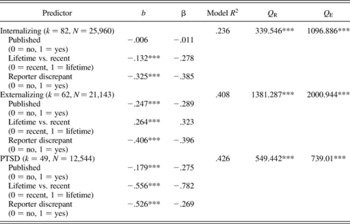
Three regression models were run examining only the three study characteristics, to determine their respective contributions when other study characteristics were controlled. Living in an at-risk community was also examined for PTSD; however, as this variable was nonsignificant when the other three study characteristics were included (β = −.007, p = .79), and did not alter the effects of other variables, it was excluded from the final model. Results are presented in Table 5. Publication status did not significantly predict internalizing effect sizes. Unpublished studies predicted significantly greater effects for both externalizing and PTSD. Although externalizing findings are consistent with the categorical findings for publication status, internalizing and PTSD results suggest that categorical findings may have been partly attributable to covarying effects of other study characteristics. When these other characteristics were controlled, publication status became either nonsignificant (in the case of internalizing) or reversed direction (PTSD). Consistent with categorical analyses, measures of more recent exposure to community violence were associated with stronger effect sizes for internalizing and PTSD. Measures of lifetime exposure to community violence were associated with stronger effect sizes for externalizing compared with measures of recent exposure to community violence. Again, consistent with prior findings, discrepant reporters was associated with weaker effect sizes for all three outcomes. Fluctuations in study characteristics in subsequent regression models are not discussed. The current three models contain the largest possible pool of independent effect sizes, and any fluctuations in models with smaller and/or intercorrelated effect size samples may be attributable to these sample differences.
Weighted regression analyses study characteristics

Note: PTSD, posttraumatic stress disorder.
*** p < .01.
Subtypes of community violence
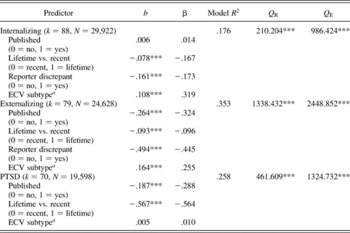
Results of regressions testing the effects of subtype of community violence are presented in Table 6. It is noted that for PTSD, no studies were available that presented exposure to community violence broken down by subtypes and that also presented data from discrepant reporters. As a result, for all subtype analyses, models predicting PTSD effects did not control for reporter discrepancy. Proximity of community violence (with victimization considered most proximal, and hearing about community violence least) significantly predicted internalizing and externalizing symptoms, but not PTSD symptoms. These findings support our hypotheses that proximity of exposure to community violence would be directly related to internalizing and externalizing, but do not support our hypothesis that similar effects would be found for PTSD. Consistent with the results of categorical analyses, these results indicate that the type of exposure to community violence is not associated with the severity of PTSD symptoms.
Weighted regression analyses comparing subtypes of exposure to community violence

Note: To account for violation of the assumption of independence, findings are considered significant if p < .01. PTSD, posttraumatic stress disorder.
aIn the dummy vector for the subtype of exposure to community violence (ECV), −1 = heard about, 0 = witnessed, and 1 = victimized.
*** p < .001.
To more closely examine the pattern of differences between types of exposure, weighted regressions using dummy-coded variables were conducted. For externalizing problems, victimization had a significantly greater effect compared to witnessing (victimization = 1, witnessing = 0; β = .09, p < .001) and hearing about (victimization = 1, hearing = 0; β = .45, p < .001) community violence, and witnessing violence predicted externalizing problems more than hearing about violence (witnessing = 1, hearing = 0; β = .37, p < .001). On internalizing problems, victimization had a significantly greater effect compared to witnessing community violence (β = .33, p < .001) or hearing about (β = .23, p < .001). However, the effects of witnessing and hearing about community violence did not differ (β = .03, ns).
Age
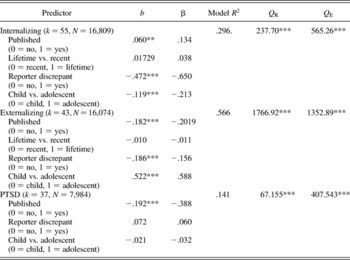
Results of regression analyses examining age effects are presented in Table 7. In the PTSD model, recentness of exposure was collinear with other variables and had to be dropped from the analysis. When study characteristics were controlled, internalizing effect sizes were stronger for child samples than for adolescents. Controlling for study characteristics reversed the age contrast found in categorical analyses for internalizing. Regression results were more consistent for externalizing, with adolescents demonstrating stronger effects than children. No significant age contrast was found for PTSD, consistent with categorical analyses.
Weighted regression analyses comparing child and adolescent samples

Note: PTSD, posttraumatic stress disorder.
*** p < .001.
Discussion
The purpose of this meta-analysis was to examine the impact of exposure to community violence on the psychological well-being of children and adolescents. More specifically, this study compared the relationships between exposure to community violence and internalizing, externalizing, and PTSD symptoms. In addition, a number of moderators on these relationships were tested, including type of exposure and age of sample, after controlling for the effects of methodological differences between studies.
Total effect of community violence by outcome
Total exposure to community violence had its greatest association with endorsement of PTSD symptoms. The effect was significantly larger than the relationship between community violence and externalizing as well as internalizing problems. This sizeable relationship may reflect the frequency and chronicity of community violence. That is, exposure to community violence appears to represent a unique form of trauma that is particularly associated with the development of PTSD symptoms, especially among children and adolescents.
Violent communities have been compared to war zones in which there is no foreseeable end to the combat (Garbarino, Dubrow, Kostelny, & Pardo, Reference Garbarino, Dubrow, Kostelny and Pardo1992; Horowitz et al., Reference Horowitz, Weine and Jekel1995; Horowitz, McKay, & Marshall, Reference Horowitz, McKay and Marshall2005). Youths living in violent neighborhoods may feel continually at risk for victimization by acts such as robberies, gang activity, beatings, stabbings, and shootings. In addition, this violence can pervade the lives of everyone in the neighborhood, causing youths to continually hear about and witness the victimization of family, friends, and neighbors. Thus, youths may constantly fear for their own safety as well as the safety of the people around them (Buckner et al., Reference Buckner, Beardslee and Bassuk2004; Overstreet & Braun, Reference Overstreet and Braun2000), and they may remain chronically emotionally and physiologically hyperaroused as a result (Schell, Marshall, & Jaycox, Reference Schell, Marshall and Jaycox2004; Wilson, Kliewer, Teasley, Plybon, & Sica, Reference Wilson, Kliewer, Teasley, Plybon and Sica2002). Furthermore, traumatized parents living in dangerous neighborhoods may foster unsafe feelings and traumatic responses to community violence among their own children (Linares & Cloitre, Reference Linares, Cloitre and Silva2004), whereas children of parents with PTSD are at greater risk to be victimized and develop PTSD as adults (Yehoda et al., Reference Yehoda, Halligan and Grossman2001). Thus, exposure to community violence, and related PTSD symptomatology, may set the stage for transgenerational effects on mental health. Exposure to community violence may have very long-term effects, but additional research is needed to further understand these processes.
A moderate effect size also existed between exposure to community violence and externalizing problems. Although not as large as the effect on PTSD symptoms, total community violence impacts externalizing problems significantly more than internalizing problems. Community violence may disrupt behavioral control more than emotional self-regulation (Cooley-Quille et al., Reference Cooley-Quille, Turner and Beidel1995). A number of reasons could contribute to why community violence disrupts behavioral control to such an extent. Social cognition theories propose that exposure to community violence normalizes the use of aggressive behavior (Guerra et al., Reference Guerra, Huesmann and Spindler2003; Ng-Mak et al., Reference Ng-Mak, Salzinger, Feldman and Stueve2002; Schwab-Stone et al., Reference Schwab-Stone, Chen, Greenberger, Silver, Lichtman and Voyce1999). As a result, youths learn that violence is an effective method of problem solving, and therefore, are more likely to engage in violent acts themselves. Initial research on physiological effects of exposure to community violence suggests that exposure to community violence leads to both hyperarousal at times of rest and hypoarousal during exposure to violence (Cooley-Quille et al., Reference Cooley-Quille, Boyd, Frantz and Walsh2001; Krenichyn, Saegert, & Evans, 2001; Perry, Reference Perry, Schetky and Benedek2001; Wilson et al., Reference Wilson, Kliewer, Teasley, Plybon and Sica2002). This hypoarousal may increase the likelihood of youths engaging in externalizing behaviors, even as some of the same youths may suffer from the symptoms of PTSD. Social cognition theories indicate that youths exposed to community violence are more likely to act out because of the effects of modeling of violence as an appropriate behavior, lack of emotional arousal during the act of violence itself, and a general feeling of threat (or hyperarousal) that may make youths more likely to attribute hostile intent (Dodge & Somberg, Reference Dodge and Somberg1987).
At the same time, there was a small and positive effect between exposure to community violence and internalizing problems. This effect is similar to that reported in Wilson and Rosenthal's (2003) meta-analysis of published studies on adolescent internalizing symptoms related to exposure to community violence. This effect, although small, accounts for as much variance as other recognized stressors (Paolucci, Genuis, & Violato, Reference Paolucci, Genuis and Violato2001; Rind, Tromovitch, & Bauserman, Reference Rind, Tromovitch and Bauserman1998; Wilson & Rosenthal, Reference Wilson and Rosenthal2003). It is also of note that this smaller effect does not include measures of PTSD, which as an anxiety disorder would otherwise be considered part of the internalizing category. Examining PTSD and internalizing effect sizes together, it is clear that exposure to community violence is a very important predictor of psychological distress.
The smaller effect size of community violence on internalizing problems may also reflect adaptation by children and adolescents growing up exposed to neighborhood violence. On the one hand, youths may become desensitized to the emotional effects of the violence that surrounds them (Farrell & Bruce, 1997; Fitzpatrick, Reference Fitzpatrick1993; Garbarino et al., Reference Garbarino, Dubrow, Kostelny and Pardo1992; Huesmann, Reference Huesmann1988; Lorion & Saltzman, Reference Lorion and Saltzman1993; Osofsky, Wewers, Hann, & Fick, Reference Osofsky, Wewers, Hann and Fick1993; Schell et al., Reference Schell, Marshall and Jaycox2004; Terr, Reference Terr1991; White, Bruce, Farrell, & Kliewer, Reference White, Bruce, Farrell and Kliewer1998). That is, youths chronically exposed to community violence may pathologically adapt to its effects by becoming emotionally numb. After a point of continual exposure to neighborhood violence, youths no longer react to such events, and rather expect violence and perceive it as normal (Terr, Reference Terr1991). This cognitive and emotional habituation to community violence may lead youths to no longer exhibit fear or sadness or avoid such circumstances, instead leading youths to act out in response. Garbarino et al. (Reference Garbarino, Dubrow, Kostelny and Pardo1992) suggest that similar effects are seen among youths growing up in war zones. On the other hand, children and adolescents may learn over time to cope with violence in their neighborhoods. Children may become distressed at initial exposure to community violence or to especially disturbing events, and as a result, exhibit internalizing symptoms. However, youths may quickly develop coping mechanisms to handle exposure to such violence (Dempsey, Overstreet, & Moley, Reference Dempsey, Overstreet and Moely2000; Rasmussen, Aber, & Bhana, Reference Rasmussen, Aber and Bhana2004). The smaller relationship between exposure to community violence and internalizing problems may reflect differences in youths' adaptation to such events, but more research is needed to identify these processes.
Moderators
The present study examined the moderating effects of type of community violence and age of sample on the relationship between exposure to community violence and mental health problems. Unfortunately, there were insufficient studies available to permit conclusions regarding the moderating effects of gender and race. There were only 29 studies that included a majority (70% or greater) of a single sex, and of those studies several were unusual samples such as college students or adjudicated adolescents. There were similarly few samples that had a significant majority of a single race other than African American, and comparisons of primarily African American samples with samples of varying mixes of racial groups were determined to be unreliable. After establishing the presence of an overall main effect in categorical analyses, regression analyses controlled for methodological differences between studies, including publication status, extent of exposure, and outcome reporter discrepancies.
When controlling for methodological variables, significant differences existed between forms of community violence on each outcome. Externalizing problems were predicted in the hypothesized pattern based on physical proximity of violence. More specifically, victimization predicted greater externalizing problems than witnessing, which predicted greater externalizing problems than hearing about community violence. These findings may reflect the effect of community violence on social–cognition (Guerra et al., Reference Guerra, Huesmann and Spindler2003; Ng-Mak et al., Reference Ng-Mak, Salzinger, Feldman and Stueve2002; Schwab-Stone et al., Reference Schwab-Stone, Chen, Greenberger, Silver, Lichtman and Voyce1999). Greater physical proximity to community violence may provide relatively stronger reinforcement of the effectiveness of violence as a problem-solving method, as well as lead to emotional numbing that facilitates aggressive responses. In combination, acting out and aggression may be normalized among these youths. Alternatively, closer proximity to violence may have greater impact on the familial functions that normally regulate youths' behavior (Gorman-Smith & Tolan, Reference Gorman-Smith and Tolan1998; Lynch & Cicchetti, Reference Lynch and Cicchetti1998; Patterson, Reference Patterson1982; Pettit, Bates, Dodge, & Meece, Reference Pettit, Bates, Dodge and Meece1999). For instance, families in which a member has been directly victimized may face greater challenges to monitor and reinforce appropriate behavior. Although our results support the existence of a relationship between proximity to community violence and externalizing symptoms, more targeted studies are needed to identify the mechanisms by which this effect is created.
Contrary to hypotheses, proximity of violence did not follow the predicted pattern for PTSD symptoms and other internalizing problems. Of interest, hearing about and witnessing community violence predicted PTSD symptoms to the same extent as victimization. Thus, the less physically proximal forms of violence predicted PTSD symptoms at similar levels to personal victimization. Hearing about and witnessing community violence may contribute to diffuse feelings of vulnerability or fear for safety, in a way direct victimization may not. Youths may feel as if violence pervades neighborhoods and no one is safe from its effects. “Collective traumatization” refers to the belief that one's safety is continuously in jeopardy because the community is unable to protect individuals from violence (Erikson, Reference Erikson1991; Horowitz et al., Reference Horowitz, Weine and Jekel1995). A generalized fear for safety may compel youths to remain continuously on guard and hyperaroused to their surroundings, and this hyperarousal may lead to and perpetuate other PTSD symptoms (Schell et al., Reference Schell, Marshall and Jaycox2004).
Another pattern of effects by form of violence existed for other internalizing problems. As expected, being the victim of community violence disrupted emotional regulation more than witnessing or hearing about such violence. However, no difference existed between seeing and hearing about others' victimization. As with PTSD, it is likely that hearing about and witnessing community violence contribute to collective traumatization. It should be noted that studies discriminating between anxiety and depression may find different effects for these subtypes of internalizing behavior (Lambert et al., Reference Lambert, Ialongo, Boyd and Cooley2005); unfortunately, the current meta-analysis did not identify a sufficient number of studies to permit such detailed analyses. Overall, the effects of proximity of exposure to community violence differed by type of outcome measured. For both externalizing and internalizing problems, personal victimization led to higher levels of symptoms than did less proximal exposure to community violence. However, no differences between types of exposure were found for PTSD symptoms, and the two less proximal types of exposure demonstrated equivalent effects on internalizing symptoms. Findings suggest a demarcation between victimization and less proximal levels of exposure to violence on developmental outcomes, yet less is known regarding the interaction between specific types of exposure. Exposure to multiple levels of violence may result in the strongest effects. It is also possible that differing causal pathways connect exposure to community violence and each outcome, and that the role of proximity of exposure has different significance within each of these distinct causal models. More work is needed to elaborate and test theoretical models of exposure to community violence that take into account the possible interactions of different proximities of exposure to different psychological symptoms.
The age of the sample also moderated the effects of community violence on internalizing and externalizing problems. Compared with adolescents, younger children exposed to community violence reported more internalizing symptoms, but fewer externalizing symptoms than teens. Age did not moderate the association between community violence and PTSD symptoms. Children may have more trouble regulating emotions associated with community violence given their limited verbal abilities. That is, children may be less able to express their thoughts and feelings about community violence compared to adolescents, and therefore, less able to develop cognitive coping strategies or actively seek comfort and support from adults (Farver et al., Reference Farver, Xu, Eppe, Fernandez and Schwartz2005). Furthermore, parents may fail to initiate coping processes with their children because they underestimate the extent of their young children's exposure, or because parents believe that young children are not affected by events in their neighborhoods (Kliewer et al., Reference Kliewer, Lepore, Oskin and Johnson1998). In addition, exposure to community violence increases with age, and thus, adolescents may be more likely to have developed better coping skills, or simply become desensitized to violence over time (Fitzpatrick, Reference Fitzpatrick1993; Weist et al., Reference Weist, Acosta and Youngstrom2001).
Adolescents may have had more time than younger children to accumulate experiences of exposure to community violence, as studies indicate that rates of exposure tend to remain somewhat constant throughout childhood (Gorman-Smith et al., Reference Gorman-Smith, Henry and Tolan2004; Lambert et al., Reference Lambert, Ialongo, Boyd and Cooley2005; Lynch & Cicchetti, Reference Lynch and Cicchetti1998). Their more chronic levels of exposure may explain their higher levels of externalizing problems compared to younger children. Adolescents who have been repeatedly exposed to community violence may imitate the behaviors they witness and may come to normalize the use of aggression (Guerra et al., Reference Guerra, Huesmann and Spindler2003; Ng-Mak et al., Reference Ng-Mak, Salzinger, Feldman and Stueve2002; Schwab-Stone et al., Reference Schwab-Stone, Chen, Greenberger, Silver, Lichtman and Voyce1999). Both of these developments may increase the likelihood of teens' perpetuating the cycle of violence by engaging in violent acts themselves. More research is needed that explicitly measures the initial and subsequent duration of exposure to neighborhood violence among youths. Studies may explicitly examine the direct and moderating effects of time and length of exposure on the development of psychopathology.
In addition, parental and peer influences in adolescence could play a role that should be further examined in future research. For instance, decreased parental monitoring and increased association with deviant peers may facilitate the development of externalizing behaviors among adolescents. During adolescence deviant peer groups, including youth gangs, are more likely to affect an increase in externalizing behaviors, and these behaviors are more likely to be serious or dangerous (Loeber & Hay, Reference Loeber and Hay1997). Teens are more likely to be in neighborhoods unsupervised and are therefore at greater risk for exposure to community violence. Reciprocally, exposure to community violence may disrupt parental monitoring and increase association with deviant peers, both of which are likely to increase externalizing behaviors (Patterson, DeBaryshe, & Ramsey, Reference Patterson, DeBaryshe and Ramsey1989; Pettit et al., Reference Pettit, Bates, Dodge and Meece1999). The combination of their maladaptive response to chronic community violence, as well as changes in parent and peer relationships, may explain why exposure to community violence has a stronger association with externalizing for adolescents than for young children.
The failure to find age moderation of the effects of community violence on PTSD symptoms suggests that differences in levels or chronicity of exposure are not related to development of PTSD. It may be that younger children exposed to even only a few episodes of community violence will experience hyperarousal and other symptoms of PTSD, whereas repeated exposure to community violence may reinforce feelings of hyperarousal in adolescents and perpetuate their PTSD symptoms (Schell et al., Reference Schell, Marshall and Jaycox2004).
Implications for future research
Overall, findings from this meta-analysis suggest that exposure to community violence presents a unique type of trauma that pervades the lives of youths, in particular, those growing up in urban United States. It is chronic and is especially detrimental in the development of PTSD. However, all tested models left significant amounts of variance in outcomes unexplained. Therefore, exposure to violence explains one risk to development, but more research is needed to better understand when and how community violence contributes to the development of psychopathology. To facilitate this understanding, future research may be extended in a number of areas, including, in its designs and analyses.
Future research may benefit from conceptualizing exposure to community violence as a latent construct. Findings from the present meta-analysis suggest that subtypes of exposure to neighborhood violence have unique effects on outcomes; however, experience with one form of community violence is often related to experiences with other forms. Confirmatory factor analyses may best identify these interrelated influences by empirically comparing alternative models that hypothesize different conceptualizations of neighborhood violence. Furthermore, exposure to community violence is often related to a number of other risk factors. Indeed, the effects of exposure to community violence may function in part through the presence of other potentiating and compensatory factors (Cicchetti & Lynch, Reference Cicchetti and Lynch1993). Although research is beginning to emerge on moderating and mediating processes (Lynch, 2000), findings at this point are too inconsistent within and across studies to draw firm conclusions on the developmental processes involved with exposure to community violence. Latent models that examine these often related meso- and macrosystem variables may foster our understanding of developmental processes, as well as bridge theoretical and empirical gaps in the literatures focusing on family violence, social disadvantage, and neighborhood disorganization (Grant et al., Reference Grant, Compas, Stuhlmacher, Thurm, McMahon and Halpert2003; Leventhal & Brooks-Gunn, Reference Leventhal and Brooks-Gunn2000; Margolin & Gordis, Reference Margolin and Gordis2000). Currently, these bodies of literature hypothesize interrelations to each other, but rarely examine these relations explicitly.
In particular, latent models that use longitudinal data provide the greatest opportunity to advance our understanding. Longitudinal research that assesses both levels of exposure to community violence and associated outcomes over time allows examinations of change in levels and types of exposure to neighborhood violence, as well as related change in other variables. It may be that critical periods of exposure to violence exist that predict specific trajectories of outcomes across childhood. In addition, latent growth models may be extended to latent class analyses that may help us understand whether subgroups exist on exposure to or effects of community violence. Some youths may be chronically exposed to many forms of violence, whereas others' exposure may be limited to more distal neighborhood occurrences, such as drug deals and arrests. The identification of subgroups would allow additional analyses to examine predictors of group membership based on various levels of development, such as gender, age, family processes, and neighborhood characteristics, as well as identify developmental trajectories that could be targeted in interventions.
Finally, the effects of exposure to community violence on other outcomes warrant more research. Because of a limited number of available studies, the present meta-analysis was unable to examine other relevant outcomes of exposure to community violence. For instance, future research must continue to examine the effects of exposure to community violence on psychobiological outcomes, including a careful study of the mechanisms of hyperarousal and emotional desensitization, especially over time. In addition, more research is needed to examine further the effects of community violence on academic success, future employability, and other life outcomes.
Implications for interventions
The present meta-analysis clearly shows that children and adolescents exposed to violence in neighborhoods while growing up are at great risk to suffer psychological costs. It appears especially important for interventions to address the posttraumatic stress associated with exposure to community violence, and interventions should target not only victims or witnesses of violence, but also youths who hear about such events in their neighborhoods. Evidence from specific studies also suggests that PTSD symptoms persist over time and may mediate the effects of community violence on other outcomes, emphasizing the importance of PTSD as a target for intervention (Kliewer et al., Reference Kliewer, Lepore, Oskin and Johnson1998; Mazza & Reynolds, Reference Mazza and Reynolds1999; Schell et al., Reference Schell, Marshall and Jaycox2004). Currently, however, few interventions exist that directly target those youths exposed to community violence who demonstrate symptoms of pathology (Ceballo, Reference Ceballo2000; Kataoka et al., Reference Kataoka, Stein, Jaycox, Wong, Escudero and Tu2003; Thornton, Craft, Dahlberg, Lynch, & Baer, Reference Thornton, Craft, Dahlberg, Lynch and Baer2000) and fewer have been systematically evaluated (Ceballo, Ramirez, Maltese, & Bautisa, 2006; Stein, Jaycox, Kataoka, Wong, et al., Reference Stein, Jaycox, Kataoka, Wong, Tu and Elliot2003).
Future research and action is needed at two levels to address the needs of youths exposed to community violence. At the first level, interventions are needed to serve youths who exhibit symptoms associated with exposure to violence in neighborhoods. It may be that existing programs may be tailored to meet adequately the needs of these youths; but the chronicity and pervasiveness of community violence may require the creation of unique interventions that address the many levels through which violence may impact the development of youths. Regardless, the efficacy and effectiveness of interventions must be systematically evaluated in order to build a body of knowledge of what works to help youths exposed to community violence (Weisz, Sandler, Durlak, & Anton, Reference Weisz, Sandler, Durlak and Anton2005). Given that community violence disproportionately affects ethnic minorities and often underserved communities, interventions should also consider and evaluate their accessibility as well as cultural sensitivity (Ceballo et al., Reference Ceballo, Ramirez, Maltese and Bautista2006).
At the second level, preventative efforts are needed to help youths exposed to community violence. The high prevalence of exposure to neighborhood violence in urban areas, as well as the profound impact on youths' mental health may quickly overwhelm the availability of direct treatments. Instead, future research should empirically design and evaluate programs targeting youths at risk for exposure to community violence (Weisz et al., Reference Weisz, Sandler, Durlak and Anton2005). For instance, school-based prevention programs may teach and model coping skills to reduce children's reactions to neighborhood violence (Greenberg et al., Reference Greenberg, Weissberg, O'Brien, Zins, Fredericsk and Resnik2003). Also, preventive efforts may train parents, teachers, school administrators, physicians, religious affiliates, and other important adults in youths' lives to identify initial symptoms associated with traumatic response to neighborhood violence. This may facilitate rapid response to problems and provide someone with whom youths may talk to and make sense of chaotic events. Again, preventative efforts, like treatment, must be empirically evaluated, including an assessment of accessibility and cultural sensitivity. Such preventative efforts often require the coordinated efforts of multiple systems in which children live, and therefore, necessitate advocacy for public policy that protects youths (Tolan & Dodge, Reference Tolan and Dodge2005).
Limitations
Several limitations of the current meta-analysis, as well as the studies analyzed, must be addressed. First, community violence was operationalized differently among the studies examined, and a number of instruments were used to measure exposure to community violence. These measures varied somewhat in the construction and in their definition of community violence. More research on the measurement of community violence might help establish which measures are the most reliable and valid, and could allow for greater comparability across future studies.
Second, the outcomes used in this meta-analysis failed to allow for more specific examination of the effects of community violence on particular outcomes. Within the broad categorization of internalizing, externalizing, and PTSD symptoms, a number of specific disorders exist that may have unique developmental sequelae. For example, the broad outcome of externalizing problems included symptoms of both aggressive and attention-deficit/hyperactivity disorder (ADHD) symptoms. Although aggression and ADHD are frequently comorbid, they represent distinct disorders of behavior and may be differentially affected by community violence. Future research may refine the broad findings for internalizing and externalizing by contrasting the associations between community violence and the subcomponents of these two broad categories.
Third, because of a limited number of studies, only age and type of community violence could be examined as moderators. Recently, much research has identified risk and protective factors, as well as the mechanisms through which community violence impacts youths (Gorman-Smith & Tolan, Reference Gorman-Smith and Tolan1998; Kliewer, et al., Reference Kliewer, Lepore, Oskin and Johnson1998; Lynch & Cicchetti, Reference Lynch and Cicchetti1998; Pettit et al., Reference Pettit, Bates, Dodge and Meece1999). As the body of research grows, perhaps a future meta-analysis could examine some of these additional risk and protective factors.
By systematically reviewing a broad representation of the literature, this meta-analysis has provided an important reference point for future research. It is hoped that future studies will complete some of the gaps left in our understanding of the effects of exposure to community violence, and that this meta-analysis may be useful both in identifying those gaps and in providing a summary of research in the area to date. We are just beginning to understand how community violence affects children.