


1. Introduction
As insightful compositional and thermal probes of their mantle sources and indicators of intracontinental tectonic regimes, continental mafic magmatism of different ages can provide a temporal proxy for documenting mantle–crust interaction and chemical–thermal evolution of the deep continental lithosphere and underlying mantle beneath plate margins (e.g. Farmer, Reference Farmer and Rudnick2003). In general, such magmas can be divided into two main types in terms of their typical geochemical characteristics: one bearing subduction-related geochemical signatures and the other with OIB-type geochemical features. Generation of the former can usually result from: (1) subduction of oceanic lithosphere (Hawkesworth et al. Reference Hawkesworth, Gallagher, Hergt and McDermott1993); (2) melting of metasomatically enriched subcontinental lithosphere with an inherited subduction signature (Turner et al. Reference Turner, Arnaud, Liu, Rogers, Hawkesworth, Harris, Kelly, Calsteren and Deng1996; Zhang et al. Reference Zhang, Sun, Zhou, Zhou, Fan and Zheng2003); or (3) extensive crustal contamination of MORB-like magmas (Turner et al. Reference Turner, Platt, George, Kelley, Pearson and Nowell1999). These magmas are commonly thought to reflect lithospheric response to rapid changes in upper mantle geometry, such as (1) lithospheric extension by orogenic collapse (Rey, Vanderhaeghe & Teyssier, Reference Rey, Vanderhaeghe and Teyssier2001 and references therein); (2) roll-back and detachment of subducted oceanic lithosphere (Davies & von Blanckenburg, Reference Davies and von Blanckenburg1995); (3) convective thinning of subcontinental lithosphere (England & Houseman, Reference England and Houseman1989; Platt & England, Reference Platt and England1993); or (4) delamination of subcontinental lithosphere (Kay & Kay, Reference Kay and Kay1993).
As one of the oldest cratons, the North China craton has experienced one of the most complex histories of any geological terrane on the planet, including an Archaean–Palaeoproterozoic stage of initial continental root formation, an intervening Palaeozoic quiescent stage and a Mesozoic–Cenozoic stage of orogeny, loss of continental root and decratonization (Kusky, Windley & Zhai, Reference Kusky, Windley, Zhai, Zhai, Windley, Kusky and Meng2007a). It is this Phanerozoic decratonization stage that distinguishes the North China craton from most other cratons in the world. The typical mantle and crustal expressions of this distinctive stage are best manifested in the Yanshan belt, an intra-continental orogen that strikes east–west through the northern margin of the North China craton. They include marked compositional changes of the lithospheric mantle from a cold, thick and refractory Palaeozoic lithosphere to a hot, thin and fertile Cenozoic lithosphere, widespread Mesozoic magmatism, and the development of a series of Early Cretaceous metamorphic core complexes and rifted basins (Wu et al. Reference Wu, Xu, Gao and Zheng2008 and references therein).
The eastern segment of the Yanshan belt, western Liaoning province, experienced multiple episodes of magmatism during Mesozoic time. Recently, numerous studies of Mesozoic mafic–intermediate igneous rocks from this region have yielded abundant information about lithospheric thinning in the Yanshan belt (e.g. Fan et al. Reference Fan, Guo, Wang, Zhang, Zhai, Windley, Kusky and Meng2007; Gao et al. Reference Gao, Rudnick, Yuan, Liu, Liu, Xu, Ayers, Wang and Wang2004, Reference Gao, Rudnick, Xu, Yuan, Liu, Walker, Puchtel, Liu, Huang, Wang and Yang2008; Guo et al. Reference Guo, Fan, Li, Li, Zhai, Windley, Kusky and Meng2007; Shao et al. Reference Shao, Chen, Lu and Zhou2006; Wang et al. Reference Wang, Gao, Liu, Yuan, Hu, Zhang and Wang2006; Yang & Li, Reference Yang and Li2008; Zhang et al. Reference Zhang, Sun, Zhou, Zhou, Fan and Zheng2003; Zhang, Reference Zhang, Zhai, Windley, Kusky and Meng2007). However, these studies have been mostly confined to volcanic rocks. In this contribution, we present geochronological and geochemical investigations for contrasting Middle Jurassic and Early Cretaceous mafic intrusive rocks from the Yiwulüshan range of western Liaoning, where recent structural and geochronological investigations have documented an Early Cretaceous metamorphic core complex (Zhang, Wang & Ma, Reference Zhang, Wang and Ma2003; Darby et al. Reference Darby, Davis, Zhang, Wu, Wilde and Yang2004). We aim to constrain the petrogenesis and characterize the evolution of the mantle sources of these rocks, thus probing possible mechanisms for the lithospheric thinning process of the Yanshan belt.
2. Geological background
The Yanshan belt, of the Beijing, northern Hebei and western Liaoning provinces, is located along the northern margin of the North China craton (Fig. 1a, b), which is bounded on the south by the Palaeozoic to Triassic Qinling–Dabie–Sulu orogenic belt (Meng & Zhang, Reference Meng and Zhang2000) and on the north by the Central Asian Orogenic Belt (Davis et al. Reference Davis, Zheng, Wang, Darby, Zhang, Gehrels, Hendrix and Davis2001).
(a) Major tectonic divisions of China, where YZ and SC denote the Yangtze craton and South China orogen. Also shown are the subdivisions of the North China craton (Zhao et al. Reference Zhao, Wilde, Cawood and Sun2001), where EB, TNCO and WB denote the Eastern block, Trans-North China orogen and Western block, respectively. (b) Simplified geological map showing the major tectonic units of the North China craton and its surrounding areas, with the study area indicated by a rectangle (modified from Davis et al. Reference Davis, Zheng, Wang, Darby, Zhang, Gehrels, Hendrix and Davis2001). Stippled fields denote the Mesozoic sedimentary basins. Dashed lines within the Mesozoic sedimentary basins are the trends of Jurassic–Cretaceous extensional faults. Between the Solonker Suture and the Mongolo-Okhotsk Suture is the Central Asian orogenic Belt (Şengör, Natal'in & Burtman, Reference Şengör, Natal'in and Burtman1993). (c) Simplified geological map of western Liaoning province and distribution of the Mesozoic intrusive rocks (modified after Wu et al. Reference Wu, Yang, Zhang and Liu2006). (d) Simplified tectonic map of the Yiwulüshan, western Liaoning province (adopted from Darby et al. Reference Darby, Davis, Zhang, Wu, Wilde and Yang2004), showing major structures and plutons. Pluton name abbreviations in (c) and (d): JCP – Jianchang pluton; JP – Jianlazi pluton; LP – Lüshan pluton; HP – Hengshan pluton, SP – Shishan pluton; YP – Yangjiazhangzi pluton; MCC – metamorphic core complex.
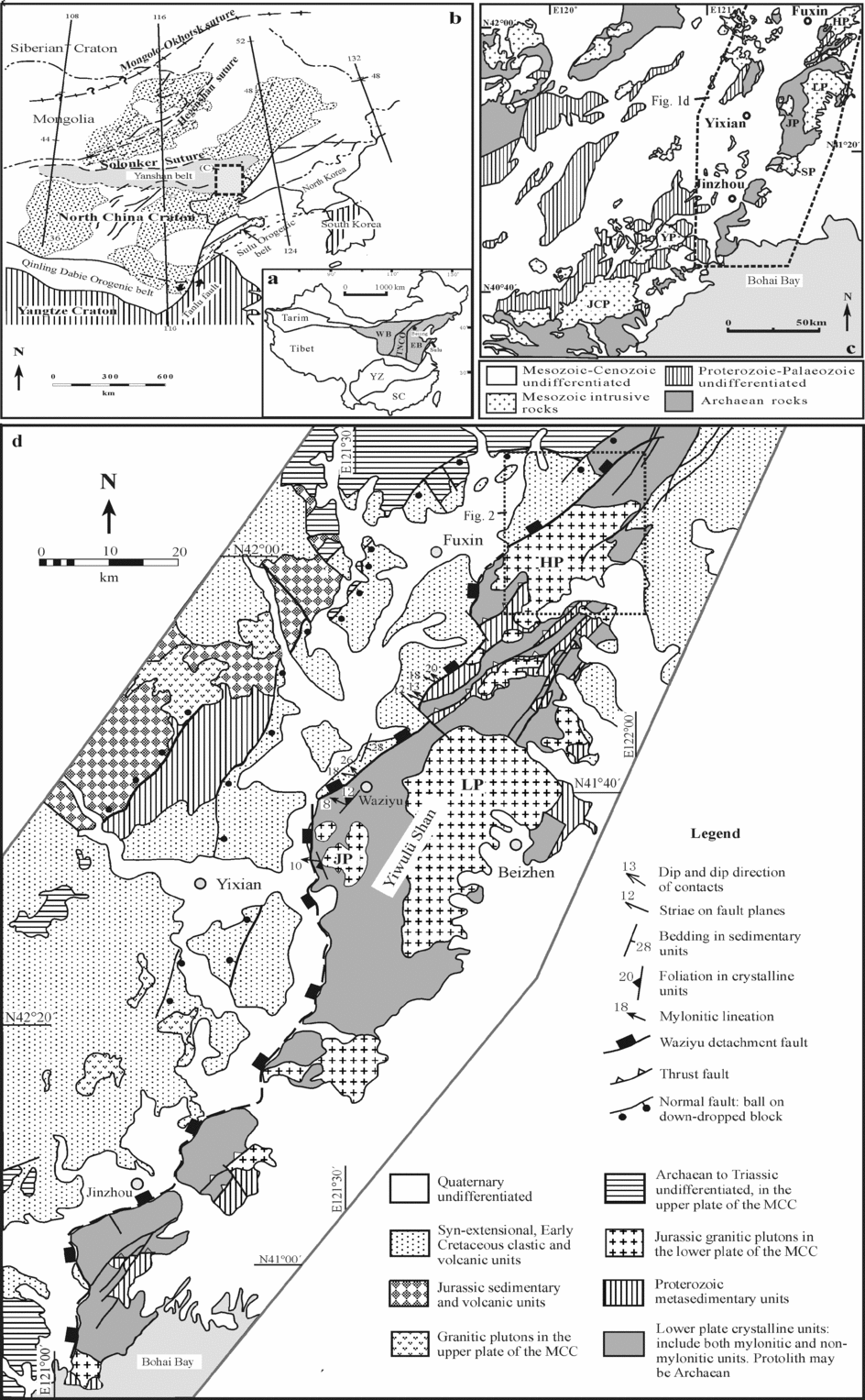
As shown by the presence of ≥ 3.6 Ga crustal remnants exposed at the surface or in lower crustal xenoliths (Liu et al. Reference Liu, Nutman, Compston, Wu and Shen1992; Zheng et al. Reference Zheng, Griffin, O'Reilly, Lu, Wang, Zhang, Wang and Li2004), the North China craton is regarded as one of the world's oldest cratons. It consists of two Archaean continental blocks, the Eastern Block and the Western Block, which are separated by the Proterozoic Trans-North China orogenic belt (Fig. 1a; Zhao et al. Reference Zhao, Wilde, Cawood and Sun2001). The basement of the North China craton is composed of amphibolite- to granulite-facies Archaean grey tonalitic gneisses and greenstones, Palaeoproterozoic khondalites and an overlying unmetamorphosed sedimentary cover from Mesoproterozoic onwards (Zhao et al. Reference Zhao, Wilde, Cawood and Sun2001; Kusky, Windley & Zhai, Reference Kusky, Windley, Zhai, Zhai, Windley, Kusky and Meng2007a). It is widely believed that the Eastern and Western blocks developed independently from the late Archaean to early Palaeoproterozoic and collided to form a coherent craton at c. 1.85 Ga (Zhao et al. Reference Zhao, Wilde, Cawood and Sun2001).
Unlike other Archaean cratons, the North China craton has experienced widespread tectonothermal reactivation since Palaeozoic time, mainly due to the compound influences of circum-cratonic orogenic belts. To the north of the craton, the generally EW-trending Central Asian Orogenic Belt mainly consists of island arcs, ophiolites, oceanic islands, accretionary wedges, oceanic plateaux and microcontinents comparable to that of circum-Pacific Mesozoic–Cenozoic accretionary orogens (Xiao et al. Reference Xiao, Windley, Hao and Zhai2003; Windley et al. Reference Windley, Alexeiev, Xiao, Kroner and Badarch2007). The Solonker suture marks the closure of the palaeo-Asian ocean and the collision between the North China craton and Mongolian composite terranes during Early Permian time (Zhang et al. Reference Zhang, Zhang, Tang, Wilde and Hu2008a). Amalgamation of these blocks resulted in a unified North China–Mongolian plate (Davis et al. Reference Davis, Zheng, Wang, Darby, Zhang, Gehrels, Hendrix and Davis2001).
From early Mesozoic time on, the Yanshan belt experienced multiple intracontinental tectono-magmatic events, mainly in response to continuing continental contraction along the northern and southern margins of the craton and the subduction along its eastern margin. At least two episodes of contractile tectonism are manifested by regional Jurassic unconformities (at c. 180 and 160 Ma) and cross-cutting relationships (Davis et al. Reference Davis, Zheng, Wang, Darby, Zhang, Gehrels, Hendrix and Davis2001). Each of these contractional deformation events was followed by several episodes of volcanism, granitoid emplacement and terrestrial deposition. In Early Cretaceous time, the orogenic fabric of the belt was overprinted by widespread extensional signatures, including a series of metamorphic core complexes (Davies et al. 2001) and rift basins (Cope & Graham, Reference Cope, Graham, Zhai, Windley, Kusky and Meng2007).
Western Liaoning province witnessed tectono-magmatic events consistent with the Yanshan belt during late Mesozoic time, such as multiple episodes of volcanism (Zhang et al. Reference Zhang, Sun, Zhou, Zhou, Fan and Zheng2003; Gao et al. Reference Gao, Rudnick, Yuan, Liu, Liu, Xu, Ayers, Wang and Wang2004, Reference Gao, Rudnick, Xu, Yuan, Liu, Walker, Puchtel, Liu, Huang, Wang and Yang2008; Wang et al. Reference Wang, Gao, Liu, Yuan, Hu, Zhang and Wang2006; Yang & Li, Reference Yang and Li2008) and plutonism (Liu et al. Reference Liu, Sun, Liu and Zhai2002; Wu et al. Reference Wu, Yang, Zhang and Liu2006; Zhang et al. Reference Zhang, Mao, Zhang and Wilde2008b), and an Early Cretaceous extensional infrastructure (that is, the Waziyu metamorphic core complex in the Yiwulüshan range: Zhang, Wang & Ma, Reference Zhang, Wang and Ma2003; Darby et al. Reference Darby, Davis, Zhang, Wu, Wilde and Yang2004).
According to a recent age data compilation by Wu et al. (Reference Wu, Yang, Zhang and Liu2006) and other geochronological studies (e.g. Luo et al. Reference Luo, Miao, Guan, Qiu, McNaughton and Groves2001), Mesozoic intrusions from Western Liaoning appear to occur in four episodes (Fig. 1c). The first episode is of rare Triassic dioritic magmatism (221 ± 2 Ma); the second and third episodes are of voluminous Middle–Late Jurassic granitic plutonism represented by the Jianchang (175–190 Ma) and Yiwulüshan batholiths (170–155 Ma); and the fourth episode is of scattered Early Cretaceous intrusions (e.g. Shishan pluton).
As shown in Figure 1d, the Waziyu metamorphic core complex has an east–west dimension of 25 km and a north–south dimension of 60 km. The core consists predominantly of Mesozoic granitoid plutons and their country rocks, which include high- to medium-grade migmatitic orthogneiss and amphibolites of the Archaean crystalline basement. Plutons are granodioritic to granitic and grade outward into augen gneiss or migmatite. At structurally higher levels is the well-developed NNE-trending Waziyu ductile shear zone that, together with the related normal fault above it along the eastern margin of the Fuxin basin, constitutes the Waziyu detachment fault (Darby et al. Reference Darby, Davis, Zhang, Wu, Wilde and Yang2004) and separates the core of the dome (the lower plate) from an upper plate of unmetamorphosed to low-grade metamorphosed middle–late Proterozoic Changcheng System and Mesozoic volcano-sedimentary rocks.
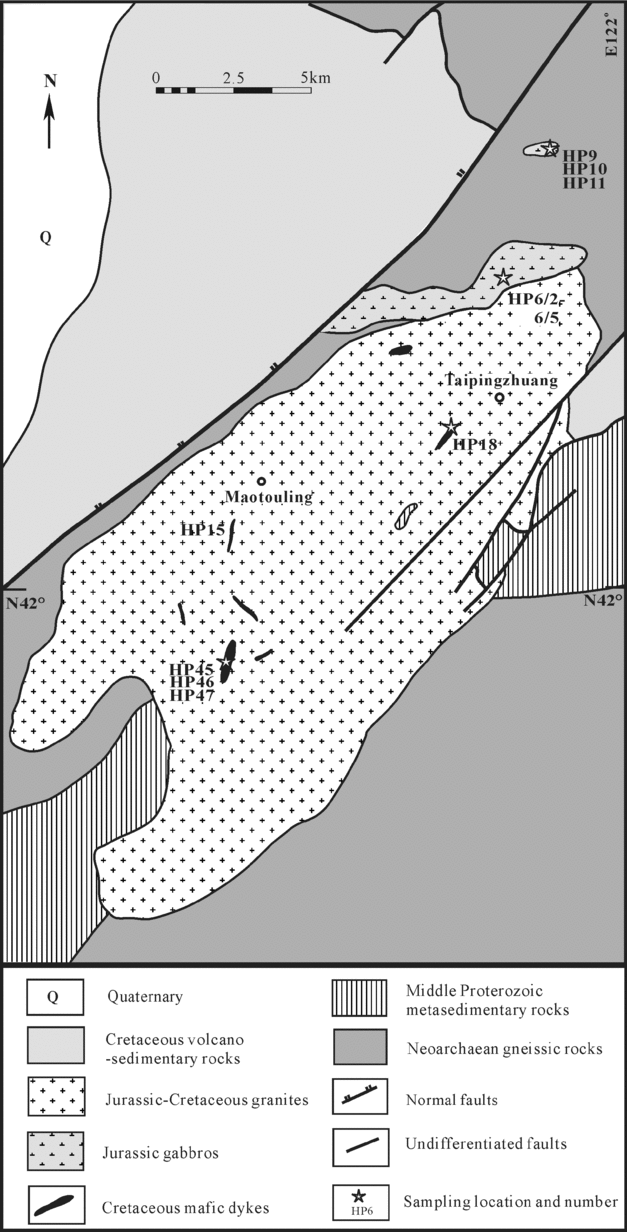
The Hengshan pluton, part of the Yiwulüshan batholith, is located 10 km to the east of Fuxin city and crops out over 140 km2 (Fig. 2). It bears a diffuse intrusive contact with the surrounding Archaean gneisses and Proterozoic meta-sedimentary sequences and is covered by Lower Cretaceous volcano-sedimentary strata of the Yixian Formation (Fig. 2). The pluton mainly consists of monzogranite, with subordinate granodiorite–monzonite and occasional gabbroic rocks. It is intruded by numerous late-stage mafic dykes. LA-ICPMS zircon U–Pb dating of two monzogranite samples from different parts of the pluton yielded ages from 163 to 152 Ma, while those on the late-stage mafic dykes gave a weighted mean 206Pb/238U age of 125 ± 4 Ma (Wu et al. Reference Wu, Yang, Zhang and Liu2006). In addition, SHRIMP zircon U–Pb dating on the mafic dykes from the neighbouring Paishanlou gold deposit resulted in ages of 124–126 Ma (Luo et al. Reference Luo, Miao, Guan, Qiu, McNaughton and Groves2001; Zhang et al. Reference Zhang, Liu, Ma and Wang2005).
Sketch geological map of the Hengshan pluton (modified after LBGMR, 1998) in western Liaoning province.
3. Petrography
The gabbroic rocks occur as small elongate epizonal bodies of the Hengshan pluton or as dykes intruding the Archaean gneisses (Fig. 2). They are fine- to medium-grained rocks with intergranular textures. Typical samples mainly consist of plagioclase (35–60 %), hornblende (25–50 %), pyroxene (0–5 %) and biotite (0–5 %) with minor amounts of alkali feldspar and quartz. Accessory phases include magnetite, zircon and apatite. Hornblende mainly occurs as subhedral to euhedral phenocrysts and is locally altered to chlorite. All hornblendes belong to the calcic group (Ca+Na ≥ 1 and Na < 0.5), according to the classification of Leake et al. (Reference Leake, Woolley, Arps, Birch, Gilbert, Grice, Hawthorne, Kato, Kisch, Krivovichev, Linthout, Laird, Mandarino, Maresch, Nickel, Rock, Schumacher, Smith, Stephenson, Ungaretti, Whittaker and Youzhi1997) and can be classified as magnesiohastingsite and magnesiohornblende. Plagioclase is mainly subhedral in shape and 2–4.5 mm in size.
The late-stage mafic dykes in the Hengshan pluton are several to tens of metres in width and tens to several hundred metres in length. They commonly have a gabbroic dioritic to dioritic composition, with a fine-grained porphyritic texture. The main minerals are plagioclase (40–50 %), hornblende (25–35 %), biotite (10–15 %), K-feldspar (5 %), and minor quartz and clinopyroxene. Accessory phases include magnetite, ilmenite, zircon and apatite. The phenocrysts consist mainly of euhedral plagioclase and subhedral hornblende, with a size of 2–3.5 mm. The groundmass is similar in mineral assemblage to that of the phenocrysts but has a higher population of quartz, with a size of 0.2–1.5 mm.
4. Analytical methods
Zircon grains, together with standard CZ3, were cast in an epoxy mount, which was then polished to section the crystals in half for analysis. Cathodoluminescence images were obtained for zircons prior to analyses, using a JXA-8100 microprobe at the Institute of Geology and Geophysics, Chinese Academy of Sciences (IGGCAS), to reveal their internal structures. Measurements of U, Th and Pb were conducted using the SHRIMP II (sensitive high-resolution ion-microprobe) at Curtin University of Technology under standard operating conditions (6-scan cycle, 2 nA primary O2− beam, mass resolution ~5000), following analytical procedures as described by Williams (Reference Williams, McKibben, Shanks and Ridley1998). Data were processed using the SQUID (1.02) and ISOPLOT (Ludwig, Reference Ludwig2001) programs. Corrections of Pb/U ratios were made by normalization to zircon standard CZ3 (206Pb/238Pb = 0.0914, corresponding to an age of 564 Ma). The data were corrected for common lead using the measured 204Pb. Individual analyses are reported with 1σ uncertainties, while weighted mean ages are reported at the 2σ confidence level.
For geochemical and isotopic analyses, samples were ground in an agate mill to ~200 mesh. Major oxides were analysed with a Phillips PW 2400 X-Ray fluorescence spectrometer (XRF) at the IGGCAS. Trace element abundances were obtained on a VG-PQII ICP-MS also at the IGGCAS. Samples were dissolved in distilled HF+HNO3 in 15 ml high-pressure Teflon® bombs at 120 °C for 6 days, dried and then diluted to 50 ml for analysis. A blank solution was prepared and the total procedural blank was < 50 ng for all trace elements. Indium was used as an internal standard to correct for matrix effects and instrument drift. Precision for all trace elements is estimated to be 5 % and accuracy is better than 5 % for most elements by analyses of the GSR-3 standard.
Sr and Nd isotopic compositions were measured on a Finnigan Mat 262 thermal ionization mass spectrometer at the IGGCAS, following the procedure as described in Zhang et al. (Reference Zhang, Zhang, Tang, Wilde and Hu2008a). Procedural blanks were < 100 pg for Sm and Nd and < 500 pg for Rb and Sr. 143Nd/144Nd was corrected for mass fractionation by normalization to 146Nd/144Nd = 0.7219, and 87Sr/86Sr ratios were normalized to 86Sr/88Sr = 0.1194. The measured values for the BCR-2 Nd standard and NBS-987 Sr standard were 143Nd/144Nd = 0.512613 ± 0.000012 (2σ, n = 3) and 87Sr/86Sr = 0.710251 ± 0.000011 (2σ, n = 5) during the period of data acquisition.
5. Analytical results
5.a. Geochronology
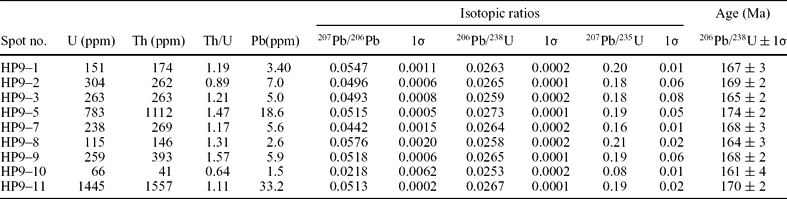
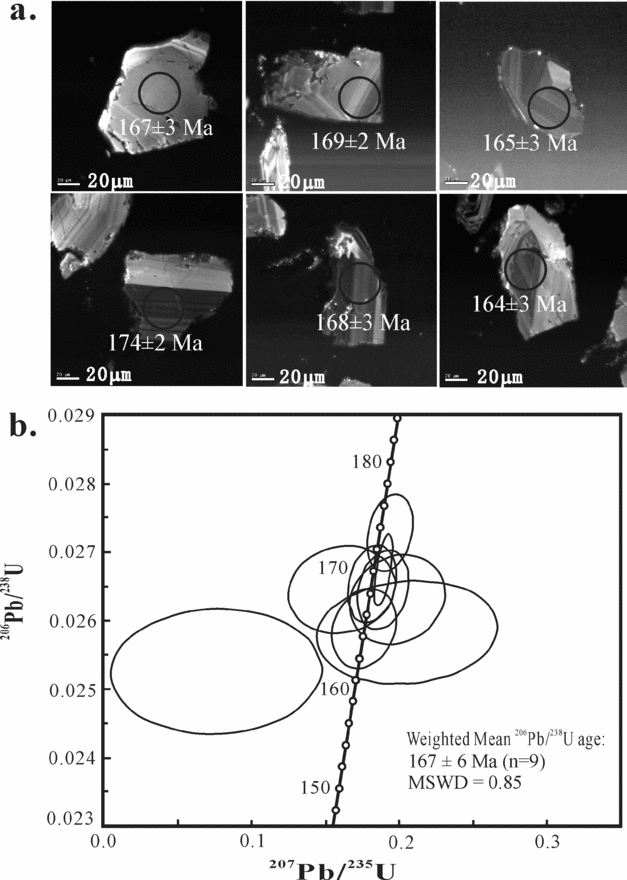
Sample HP9 was collected from the gabbro unit of the Hengshan pluton and the results of SHRIMP zircon U–Pb analysis are listed in Table 1. Zircons from this sample are mostly clear, subhedral columnar crystals, with a length range from 60 to 120 μm and length to width ratios between 2:1 and 3:1 (Fig. 3a). In cathodoluminescence images, they typically show low, homogeneous luminescence and occasionally display oscillatory zoning (Fig. 3a). Nine analyses from this sample were conducted on nine grains during a single analytical session. Measured U concentrations vary from 66 to 151 ppm, and Th from 41 to 1557 ppm. All analyses have Th/U ratios of 0.64–1.57 and yield a weighted mean 206Pb/238U age of 167 ± 6 Ma with an MSWD of 0.85 (Fig. 3b). We interpret this as the emplacement age of the Hengshan gabbros.
SHRIMP U–Pb isotopic data for zircons from the Hengshan gabbros (sample HP9)
(a) Cathodoluminescence (CL) images of dated zircons and (b) U–Pb zircon concordia diagrams for the Hengshan gabbros.
5.b. Major and trace elements
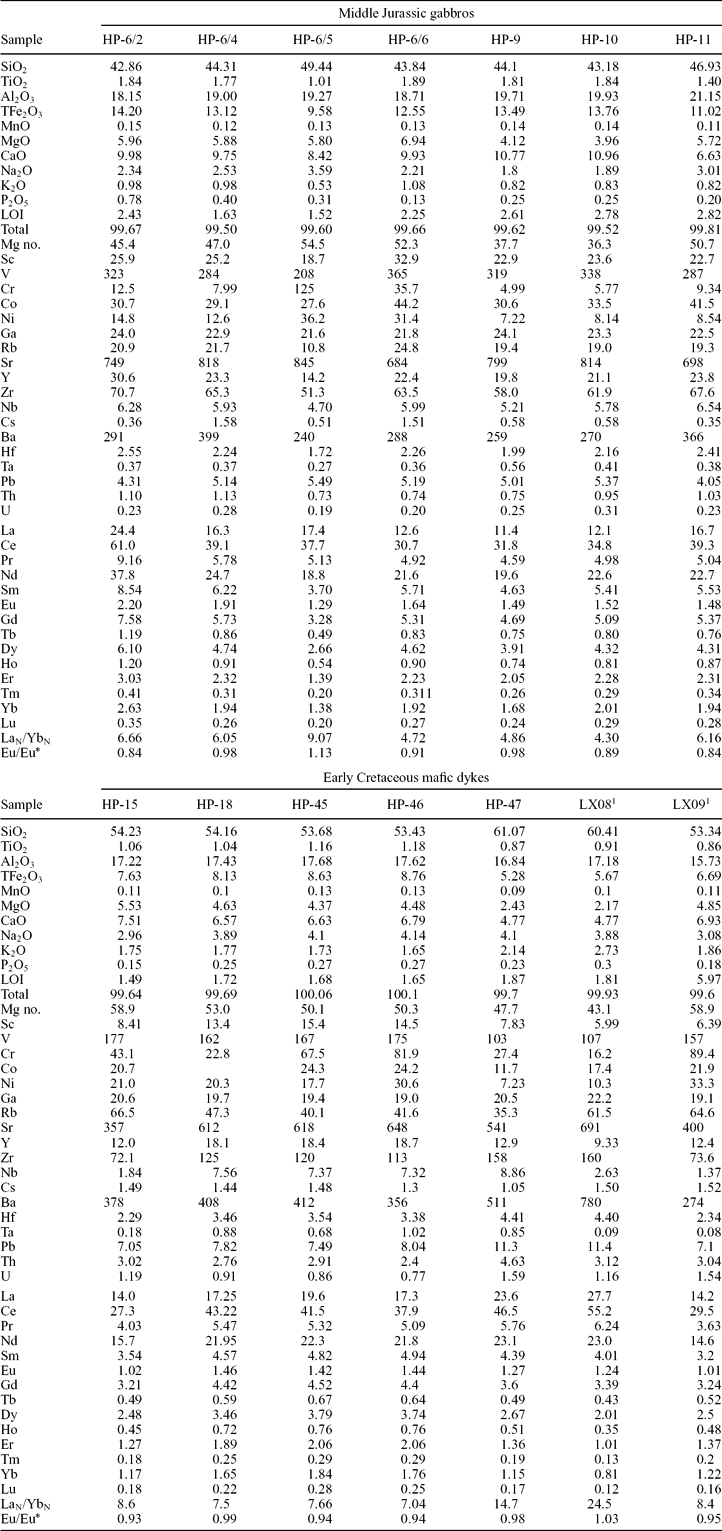
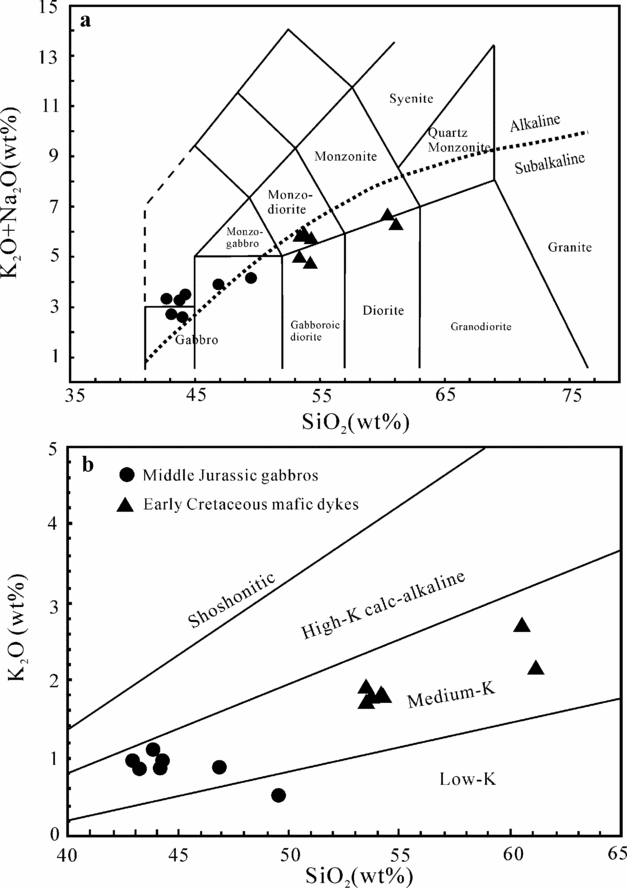
Major and trace element analyses are presented in Table 2. Samples from the Hengshan gabbros are mafic in composition (SiO2 43.2–49.4 %), with high abundances of total Fe2O3 (9.6–14.2 %), Al2O3 (18.2–19.9 %) and CaO (8.4–11.0 %), low contents of TiO2 (0.6–1.7 %), P2O5 (0.08–0.47 %) and K2O (0.5–1.1 %), and moderate MgO (4.0–6.9 %). In the total alkali versus silica plot (Le Maitre, Reference Le Maitre2002) (Fig. 4a), the samples mainly plot in the field of gabbro. They also exhibit a transitional character between low-K tholeiitic and medium-K calc-alkaline (Fig. 4b). As for trace elements, they have total REE contents ranging from 87.8 to 166 ppm, and are moderately enriched in LREE (LaN/YbN = 4.3–9.1) with slight negative or positive Eu anomalies (Eu/Eu* = 0.84–1.13; Table 3) (Fig. 5a). In the primitive mantle-normalized spidergrams (Fig. 5b), they exhibit positive Rb, Ba and Sr anomalies, and negative Nb, Ta, Zr and Hf anomalies.
Major and trace element data for the contrasting Middle Jurassic and Early Cretaceous mafic intrusive rocks from western Liaoning
1. Data cited from Liu et al. (Reference Liu, Sun, Liu and Zhai2002).
Plots (a) total alkali (Le Maitre, Reference Le Maitre2002) and (b) K2O v. SiO2 for the contrasting middle Jurassic and early Cretaceous mafic intrusive rocks from western Liaoning.
Rb–Sr and Sm–Nd isotopic compositions for the contrasting Middle Jurassic and Early Cretaceous mafic intrusive rocks from western Liaoning
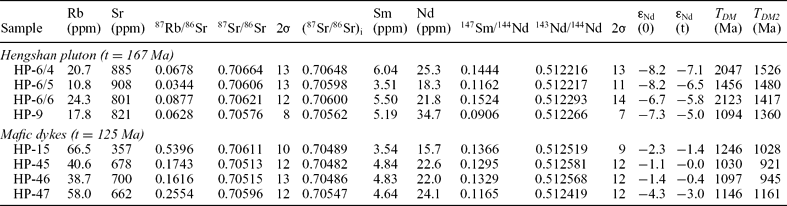
Chondrite Uniform Reservoir (CHUR) values (87Rb/86Sr = 0.0847, 87Sr/86Sr = 0.7045, 147Sm/144Nd = 0.1967, 143Nd/144Nd = 0.512638) are used for the calculation. λRb = 1.42×10⁻¹¹ year−1 (Steiger & Jäger, Reference Steiger and Jäger1977); λSM = 6.54×10⁻¹² year−1 (Lugmair & Marti, Reference Lugmair and Marti1978).
(a, c) Chondrite-normalized REE patterns, and (b, d) primitive mantle-normalized trace element spidergrams for the contrasting Middle Jurassic and Early Cretaceous intrusive rocks from western Liaoning. Normalization values are from Sun & McDonough (Reference Sun, McDonough, Saunders and Norry1989). The data for oceanic island basalt (OIB) and enriched mid-ocean ridge basalt (E-MORB) are also from Sun & McDonough (Reference Sun, McDonough, Saunders and Norry1989). Bulk continental crust compositions are from Rudnick & Gao (Reference Rudnick, Gao and Rudnick2003).
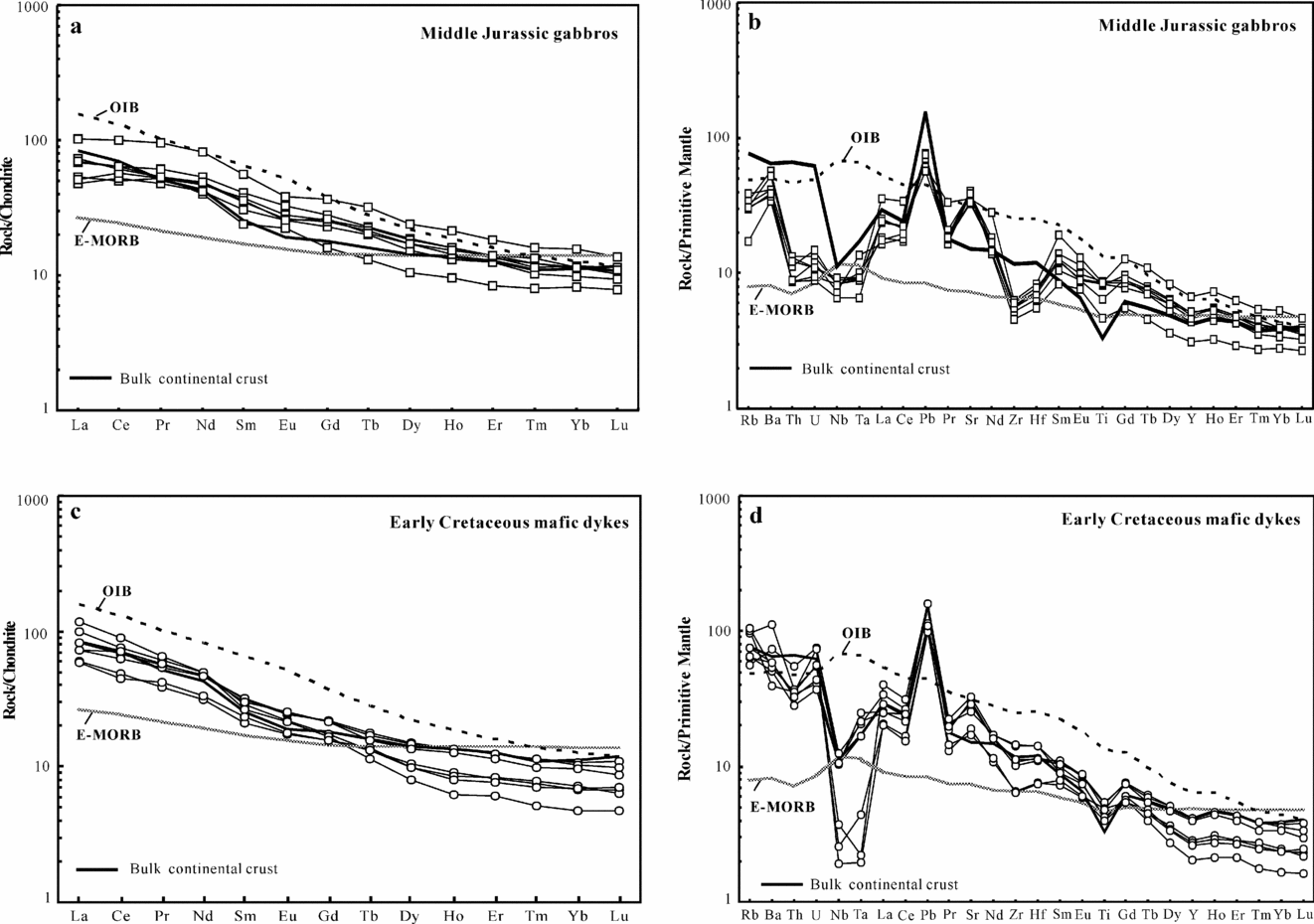
The mafic dykes are gabbroic dioritic to dioritic in composition (SiO2 = 53.34–61.07 %). They show high contents of Al2O3 (15.7–17.7 %), CaO (4.77–6.93 %) and Na2O (2.96–4.14 %), moderate contents of MgO (2.17–5.53 %) and K2O (1.65–2.73 %), and low concentrations of TiO2 (0.87–1.16 %), Cr (16.2–89.4 ppm) and Ni (7.23–33.6 ppm). In the total alkali versus silica plot (Le Maitre, Reference Le Maitre2002) (Fig. 4a), the samples mainly plot in the field of gabbroic diorite and monzodiorite. They show a medium-K calc-alkaline character (Fig. 4b). In terms of trace elements, they are enriched in LREE (LaN/YbN = 7.04–24.5) and are relatively depleted in HREE with no negative Eu anomalies (Fig. 5c). In the primitive mantle-normalized spidergrams (Fig. 5d), they are moderately enriched in large ion lithophile elements (LILE) with positive Ba, Sr, Th and U anomalies, and are depleted in high field strength elements (HFSE) with pronounced negative Nb, Ta and Ti anomalies.
5.c. Whole rock Sr–Nd isotopes
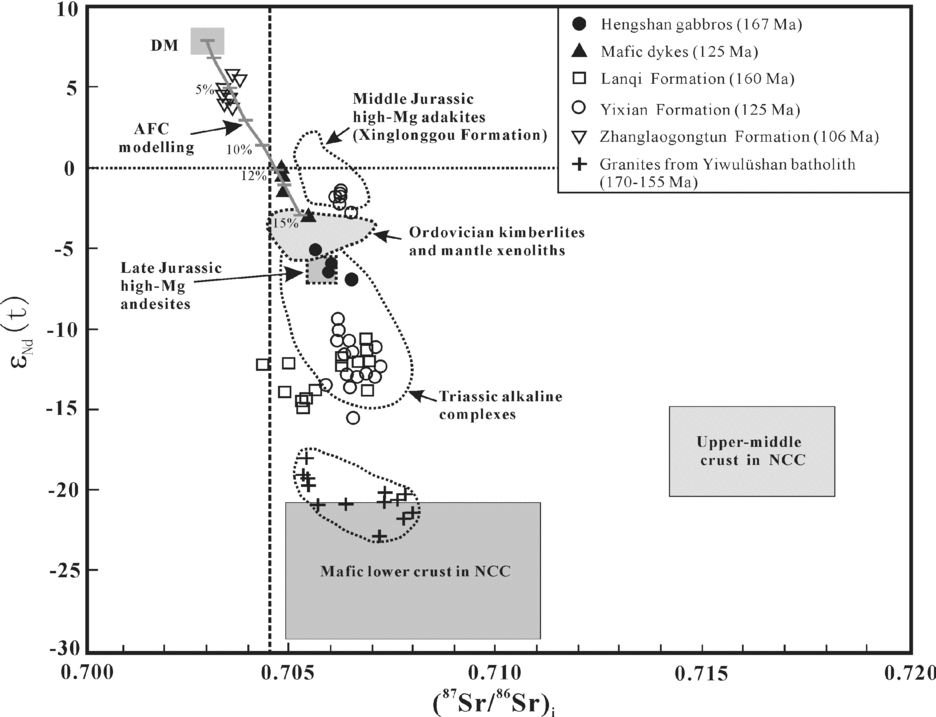
The results of whole-rock Sr–Nd isotope analyses, together with the calculated initial Sr–Nd isotopic compositions, are presented in Table 3. Depleted mantle model ages TDM1 and TDM2 are computed by following the model of DePaolo (Reference DePaolo1981). As shown in a plot of ɛNd(t) versus (87Sr/86Sr)i (Fig. 6), the gabbros exhibit a narrow (87Sr/86Sr)i range from 0.7056 to 0.7065, relatively high ɛNd(t) values of −5.0 to −7.1 and model ages (TDM2) of 1360 to 1526 Ma. Meanwhile, the mafic dykes have a narrow (87Sr/86Sr)i range from 0.7048 to 0.7055, zero to slightly negative ɛNd(t) values from 0 to −3.0 and younger model ages (TDM2) of 921 to 1161 Ma.
Plot of initial ɛNd(t) and (87Sr/86Sr)i for the contrasting Middle Jurassic and Early Cretaceous intrusive rocks from western Liaoning. Data sources: Lanqi formation – Yang & Li (Reference Yang and Li2008); Xinglonggou formation – Gao et al. (Reference Gao, Rudnick, Yuan, Liu, Liu, Xu, Ayers, Wang and Wang2004); Yixian formation – Shao et al. (Reference Shao, Chen, Lu and Zhou2006); Gao et al. (Reference Gao, Rudnick, Xu, Yuan, Liu, Walker, Puchtel, Liu, Huang, Wang and Yang2008), Yang & Li (Reference Yang and Li2008); late-Jurassic high-Mg andesite – Zhang et al. (Reference Zhang, Sun, Zhou, Zhou, Fan and Zheng2003); Zhanglaogongtun formation – Zhang et al. (Reference Zhang, Sun, Zhou, Zhou, Fan and Zheng2003); Yang & Li (Reference Yang and Li2008); granites from Yiwulüshan batholith – Zhang et al. (Reference Zhang, Mao, Zhang and Wilde2008b) and our unpublished data (online Appendix Table A1 at http://multimediafluids.uam.elogim.com/journals/geo). Data (calculated at 160 Ma) for the Ordvician kimberlites and mantle xenoliths from the North China craton are from Yang et al. (Reference Yang, Wu, Wilde, Liu, Zhang, Xie and Yang2009) and Zhang (Reference Zhang2009); for the Late Triassic alkaline intrusive rocks from Yan et al. (Reference Yan, Mu, Xu, He, Tan, Zhao and He2000). Depleted mantle (DM) is from Zindler, Staudigel & Batiza (Reference Zindler, Staudigel and Batiza1984). Lower crust and upper–middle crust of the North China craton are from Jahn et al. (Reference Jahn, Wu, Lo and Tsai1999). The assimilation–fractional-crystallization (AFC) modelling parameters used for lower crust-derived melts of North China craton are Sr = 300 ppm, 87Sr/86Sr = 0.708, Nd = 25 ppm, ɛNd = –25 and Sr = 150 ppm, 87Sr/86Sr = 0.703, Nd = 15 ppm, ɛNd = +8 for depleted mantle derived melts.
6. Discussion
6.a. Petrogenesis
6.a.1. Middle Jurassic gabbros
The Middle Jurassic Hengshan gabbroic rocks, with their distinctive low silica contents (SiO2 = 42.9–49.4 %) and higher concentrations of Fe2O3 (7.7–12.8 %) than those of any crustal materials (Rudnick & Gao, Reference Rudnick, Gao and Rudnick2003) or crustally derived melts (e.g. Patiño Douce & Beard, Reference Patiño Douce and Beard1995; Patiño Douce, Reference Patiño Douce1997), clearly argue for a mantle origin. On one hand, their hornblende-rich petrographic character is reminiscent of the high-level hornblende-rich mafic intrusions from the Mesozoic Sierra Nevada batholith (Sisson, Grove & Coleman, Reference Sisson, Grove and Coleman1996) and the appinite suite from the late Caledonian granitoids within Europe (Fowler & Henney, Reference Fowler and Henney1996). As documented in these localities, such petrological features commonly indicate that their parental magma was rich in H2O and arguably was derived from an enriched region of the mantle associated with subduction. On the other hand, the thick dyke occurrence of the Hengshan gabbros precludes a cumulate origin. This is consistent with the MgO, Cr and Ni contents in the gabbros, which are far below those expected for the rocks with a cumulate origin (MgO > 15 %, Cr > 2000 ppm, Ni > 300 ppm) (e.g. Roberts et al. Reference Roberts, Pin, Clemens and Paquette2000). Instead, their moderate Mg no. (40–59), low Cr (5–125 ppm) and Ni (13–31 ppm) concentrations indicate that they do not represent primary magmas, but may have experienced some crystal fractionation, most likely of olivine and clinopyroxene, as reflected by the positive correlation between Cr and Ni contents (not shown).
In terms of trace elements, the Hengshan gabbros are characterized by selective enrichment of LILEs and light REE, and depletion in HFSEs (e.g. Nb, Ta and Ti), thus leading to high values of La/Nb (2.08–3.89), Ba/Nb (46–67), Zr/Nb ratios (~11) and low Ce/Pb (5.9–14.1). These values bear close resemblance to those of arc volcanic rocks worldwide (e.g. Stern, Reference Stern2002). In general, such geochemical features can be attributed either to partial melting of an enriched mantle source that was previously spiked in LILE and LREE by slab-derived hydrous fluids or melts prior to magma generation, or to extensive crustal contamination of MORB-like magmas during magma ascent and emplacement. For the gabbros herein, their higher Sr abundance (684–845 ppm) than that of continental crust (Sr = 280–348 ppm: Rudnick & Gao, Reference Rudnick, Gao and Rudnick2003) and distinct Sr–Nd isotopic compositions ((87Sr/86Sr)i = 0.7056–0.7065, ɛNd(t) = −5.0 to −7.1) from those of the lower crust of the North China craton exclude crustal contamination from having played any significant role in their petrogenesis.
Therefore, an enriched sub-continental lithospheric mantle source is implied for the Hengshan gabbros, as in the cases of their coeval or slightly older mafic volcanic counterparts from the Yanshan belt. Recent geochemical studies on the latter have documented a moderately enriched lithospheric mantle beneath the Yanshan belt during Jurassic time (Wang et al. Reference Wang, Zhao, Zou, Li, Liu, Wu, Xu and Zhang2007; Guo et al. Reference Guo, Fan, Li, Li, Zhai, Windley, Kusky and Meng2007; Zhang et al. Reference Zhang, Sun, Zhou, Zhou, Fan and Zheng2003; Zhang, Reference Zhang, Zhai, Windley, Kusky and Meng2007). More specifically, as constrained by Late Jurassic high-Mg andesites (Zhang et al. Reference Zhang, Sun, Zhou, Zhou, Fan and Zheng2003) and primitive basaltic rocks (Zhou et al. Reference Zhou, Zhang, Yang, Chen and Sun2001), the Jurassic lithospheric mantle beneath western Liaoning had an EM1 character ((87Sr/86Sr)i ≈ 0.7060; ɛNd(t) ≈ −6.0), slightly different from that of the Palaeozoic refractory lithospheric mantle beneath the North China craton as constrained by the Ordovician kimberlites and mantle xenoliths (Fig. 6) (Yang et al. Reference Yang, Wu, Wilde, Liu, Zhang, Xie and Yang2009; Zhang, Reference Zhang2009).
Further information on this enriched lithospheric mantle can be inferred from the geochemical characteristics of the gabbros. First, the low Rb/Sr (0.01–0.04) and moderate Ba/Rb (13–22) ratios in the gabbros suggest an amphibole-bearing source (Furman & Graham, Reference Furman and Graham1999). Second, the high Al2O3 contents in them require a high proportion of Al2O3-hosting minerals (such as garnet, spinel, clinopyroxene and orthopyroxene) in the mineral constituents of the mantle source, whereas the relatively high HREE abundances (Y > 14 ppm, Yb > 1.4 ppm) reflect a garnet-absent or garnet-poor source. With spinel commonly occurring as an accessory phase of the lithosphere, the dominant Al2O3-hosting phase in the mantle source should have been pyroxenes. Therefore, we argue that the parental magmas for the Hengshan gabbros could have been derived from partial melting of amphibole-bearing pyroxenite veins that resided in refractory lithospheric mantle beneath the Yanshan belt, possibly at a garnet-spinel transitional stability field with a depth of 70–80 km (Watson & McKenzie, Reference Watson and McKenzie1991). Such a vein-rich mantle source may have been formed through multiple metasomatism events by the melts/fluids from subduction-related processes.
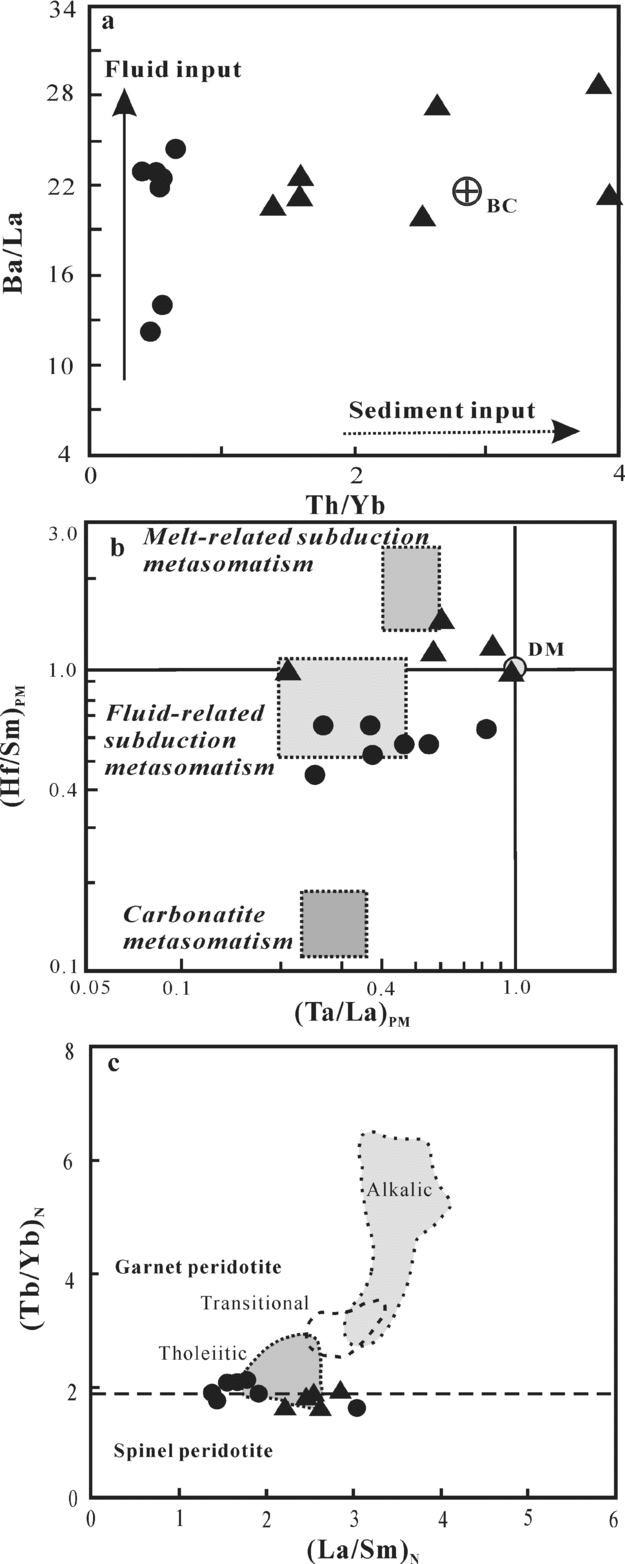
Different types of metasomatic agents (e.g. fluid, silicic or carbonatite melt) will yield distinctive trace element and isotopic compositions in metasomatized mantle (e.g. Menzies, Reference Menzies, Menzies and Hawkesworth1987). In general, the Ba/La fractionation can only be reasonably achieved by elemental mobility in hydrous fluids (McCulloch & Gamble, Reference McCulloch and Gamble1991), whereas Th and LREE are thought to be less mobile in aqueous fluids than the LILEs (Pearce et al. Reference Pearce, Kempton, Nowell and Noble1999). As a result, these variables can serve as reliable indicators of potential melt or fluid contributions to magma source regions (Woodhead et al. Reference Woodhead, Hergt, Davidson and Eggins2001). For the Hengshan gabbros, Figure 7a clearly shows this contribution mainly comes from slab-derived fluids. Meanwhile, the high (Hf/Sm)PM and low (Ta/La)PM ratios in the gabbros also point to a fluid-related subduction metasomatism (Fig. 7b). This is consistent with the fluid-dominated enrichment process recorded by the Mesozoic mafic volcanic rocks throughout the Yanshan belt (Fan et al. Reference Fan, Guo, Wang, Zhang, Zhai, Windley, Kusky and Meng2007, Guo et al. Reference Guo, Fan, Li, Li, Zhai, Windley, Kusky and Meng2007; Zhang, Reference Zhang, Zhai, Windley, Kusky and Meng2007).
(a) Ba/La v. Th/Yb, (b) (Ta/La)PM v. (Hf/Sm)PM and (c) (La/Sm)N/(Tb/Yb)N plots for the contrasting Middle Jurassic and Early Cretaceous intrusive rocks from western Liaoning. Sample symbols are the same as those in Figure 4. In (a), continuous vector – slab-derived fluids; dashed vector – sediment input in the source as represented and discussed by Woodhead et al. (Reference Woodhead, Hergt, Davidson and Eggins2001). Bulk crust (BC) compositions are from Rudnick & Gao (Reference Rudnick, Gao and Rudnick2003). In (b), ‘PM’ denotes the values normalized to the primitive mantle; the fields of the subduction and carbonatite-related metasomatism are from La Flèche, Camiré & Jenner (Reference La Flèche, Camiré and Jenner1998). In (c), the fields for Hannuoba tholeiitic, transitional and alkalic basalts are after Zhi et al. (Reference Zhi, Song, Frey, Feng and Zhai1990); the horizontal dashed line separates fields expected for melting garnet- and spinel-bearing peridotite as determined for the Cenozoic basalts in the Basin and Range province (Wang et al. Reference Wang, Plank, Walker and Smith2002); ‘N’ denotes the values normalized to the chondrite.
6.a.2. Early Cretaceous mafic dykes
As shown above, the late-stage mafic dykes from the Hengshan pluton have distinct elemental and Sr–Nd isotopic compositions from the Middle Jurassic gabbros, thus precluding a common source and similar petrogenesis. Instead, they resemble the coeval olivine basalts from the bottom of the Yixian formation (Shao et al. Reference Shao, Chen, Lu and Zhou2006; Gao et al. Reference Gao, Rudnick, Xu, Yuan, Liu, Walker, Puchtel, Liu, Huang, Wang and Yang2008), with their high Mg no. (> 50) and comparable ɛNd(t) values (0 to −3). These basalts have been interpreted to contain a depleted mantle component (ɛNd(t) = +8) (Shao et al. Reference Shao, Chen, Lu and Zhou2006; Gao et al. Reference Gao, Rudnick, Xu, Yuan, Liu, Walker, Puchtel, Liu, Huang, Wang and Yang2008). Another possible analogue is Late Triassic dolerite dykes from Eastern Liaoning (Yang et al. Reference Yang, Sun, Chen, Wilde and Wu2007), as indicated by their comparable incompatible trace element abundances and Sr–Nd isotopic compositions. The latter have been considered to be the product of high-degree partial melting of a relatively fertile asthenospheric mantle source in the spinel stability field, coupled with the subsequent upper crustal assimilation and crystal fractionation (Yang et al. Reference Yang, Sun, Chen, Wilde and Wu2007).
Strong crustal signatures are also evident in our mafic dykes. First, they display similar trace element patterns to bulk continental crust (Fig. 5c), with enrichment of LILEs and LREEs, and depletion of HFSEs. Second, they have comparable LaN/YbN (7–14.7), Ce/Pb (3.9–5.5), Th/U (2.0–3.4), Th/Yb (1.6–4.0) and Lu/Hf (0.03–0.07) ratios to those of the average continental crust with LaN/YbN (8.2–11.7), Ce/Pb (2.9–4.4), Th/U (3.8–6.0), Th/Yb (0.8–4.9) and Lu/Hf (0.06–0.13) (Rudnick & Gao, Reference Rudnick, Gao and Rudnick2003). Third, the presence of abundant c. 2.5 Ga inherited zircons in the dykes also indicates the involvement of ancient crustal components (Wu et al. Reference Wu, Yang, Zhang and Liu2006).
These geochemical attributes are generally regarded to be inherent in the melts either from an enriched mantle source that was formed by metasomatism of recycled crustal materials prior to magma generation or from a depleted mantle source that was contaminated by crustal material during magma ascent and emplacement. In our case, given the aforementioned consensus that the Mesozoic sub-continental lithospheric mantle beneath Western Liaoning is of EM-1 affinity with ɛNd(t) ≈ −6.0 and (87Sr/86Sr)i ≈ 0.7060, discernable higher ɛNd(t) values of the mafic dykes suggest that another end-member with more depleted isotopic compositions must have been involved in their formation. Therefore, we consider that this depleted end-member is most likely an asthenospheric derivative, as is the case with their possible analogues (Shao et al. Reference Shao, Chen, Lu and Zhou2006; Yang et al. Reference Yang, Sun, Chen, Wilde and Wu2007; Gao et al. Reference Gao, Rudnick, Xu, Yuan, Liu, Walker, Puchtel, Liu, Huang, Wang and Yang2008). Moreover, the relatively low (La/Sm)N (2.25–2.86) and (Tb/Yb)N (1.65–1.93), in combination with relatively flat MREE to HREE patterns for the mafic dykes, indicate that they may have been formed by a relatively high degree of partial melting of a mantle source in the spinel facies field and thus at depths shallower than 70 km (Fig. 7c).
To test this possibility, we adopted the assimilation–fractional–crystallization equation of DePaolo (Reference DePaolo1981) to model combined assimilation and fractional crystallization during magmatic differentiation. Given the intrusion of the mafic dykes into the deep-seated granitic batholith and their relatively low 87Sr/86Sr ratios, involvement of an upper crustal component seems to be insignificant. For the hosting Yiwulüshan granitic batholith including the Hengshan monzogranites, their peraluminous mineralogy, adakitic trace element signature, low initial 87Sr/86Sr ratios and strongly negative ɛNd(t) values (Fig. 6) argue for a felsic magma source that dominantly originated from partial melting of ancient meta-igneous lower crust, possibly in response to underplating of mafic mantle-derived magmas (Liu et al. Reference Liu, Sun, Liu and Zhai2002; Zhang et al. Reference Zhang, Mao, Zhang and Wilde2008b). Therefore, the two end-members chosen for the modelling are primitive melts from a depleted asthenospheric mantle (Zindler, Staudigel & Batiza, Reference Zindler, Staudigel and Batiza1984) and melts from the Precambrian mafic lower crust. The latter is typified by Archaean granulite facies gneisses of the North China craton (Jahn et al. Reference Jahn, Wu, Lo and Tsai1999). The adopted parameters are determined by referring to those used for other similar alkaline basaltic magma systems from the North China craton (ratio of assimilation to crystallization (r) of 0.2, DSr of 1.6, DNd of 1.2, e.g. Chen et al. Reference Chen, Tian, Jahn and Chen2008). As shown in Figure 6, the modelling results confirm that the mafic dykes could be generated by 12–15 % crustal contamination of the assumed parental magma coupled with significant fractional crystallization (r = 0.2).
6.b. Implication for lithospheric thinning
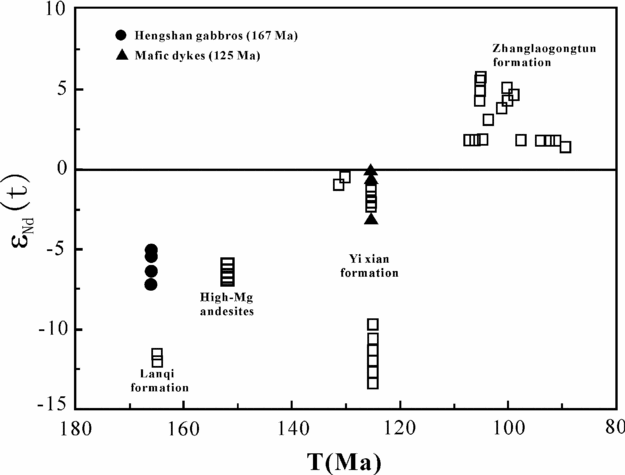
Continental mantle-derived mafic rocks of different ages from the same terrane are valuable archives for documenting secular chemical–thermal evolution of the deep continental lithosphere and underlying mantle. In the case of the Yanshan belt, the pioneering study on mantle xenoliths in several Palaeozoic kimberlite fields from Liaoning province documented a Palaeozoic lithosphere with an approximate thickness of 80–150 km (Menzies, Fan & Zheng, Reference Menzies, Fan, Zhang and Prichard1993), much greater than that of the present-day lithosphere beneath the Bohai Sea as revealed by geophysical evidence (Griffin et al. Reference Griffin, Zhang, O'Reilly, Ryan, Flower, Chung, Lo and Lee1998). Late Triassic alkaline ultramafic rocks from northern Hebei province (Yan et al. Reference Yan, Mu, Xu, He, Tan, Zhao and He2000) exhibit a silica-undersaturated character, indicating their derivation from subtly metasomatized lithospheric mantle when the lithosphere was greater than 80 km thick, as constrained by experiments for silica-undersaturated alkaline basalts (Falloon et al. Reference Falloon, Green, Harton and Harris1988; DePaolo & Daley, Reference DePaolo and Daley2000). Early Jurassic flood basalts of the Nandaling Formation and Middle Jurassic basalts of the Lanqi Formation, with their moderately enriched isotopic signatures, argue for an origin from moderately refertilized lithospheric mantle with a thickness between 70 and 80 km (Wang et al. Reference Wang, Zhao, Zou, Li, Liu, Wu, Xu and Zhang2007; Yang & Li, Reference Yang and Li2008). Early Cretaceous basalts of the Yixian Formation, with their transitional signatures between lithosphere and asthenosphere (Yang & Li, Reference Yang and Li2008), may have formed when the lithosphere was between 65 and 80 km thick (DePaolo & Daley, Reference DePaolo and Daley2000). Late Early Cretaceous basalts of the Zhanglaogongtun Formation possess MORB-like isotopic Sr–Nd–Pb signatures and thus have been derived from the asthenosphere when the lithosphere was less than 65 km thick (Zhang et al. Reference Zhang, Sun, Zhou, Zhou, Fan and Zheng2003; Yang & Li, Reference Yang and Li2008).
With their respective origins from enriched lithospheric mantle and asthenosphere, the contrasting Middle Jurassic and Early Cretaceous mafic intrusive rocks presented herein are largely compatible with the lithospheric thinning trend beneath the Yanshan belt, as recorded by multiple episodes of Mesozoic mafic volcanic rocks from western Liaoning (Fig. 8). Together, they constitute an insightful magmatic proxy record for plumbing the depth of the lithosphere, and record a secular lithospheric evolution from an 80–150 km thick Palaeozoic refractory cratonic lithosphere through a 65 km thick late Mesozoic fertile lithosphere into an 80 km thick Cenozoic oceanic lithospheric mantle.
Variations of ɛNd(t) with time of the mafic rocks from western Liaoning. Data sources: Lanqi formation – Yang & Li (Reference Yang and Li2008); Yixian formation – Shao et al. (Reference Shao, Chen, Lu and Zhou2006); Gao et al. (Reference Gao, Rudnick, Xu, Yuan, Liu, Walker, Puchtel, Liu, Huang, Wang and Yang2008), Yang & Li (Reference Yang and Li2008); high-Mg andesite – Zhang et al. (Reference Zhang, Sun, Zhou, Zhou, Fan and Zheng2003); Zhanglaogongtun formation – Zhang et al. (Reference Zhang, Sun, Zhou, Zhou, Fan and Zheng2003); Yang & Li (Reference Yang and Li2008).
At present, various models have been proposed for the mechanism of the lithospheric thinning of the North China craton. Most representative ones include delamination (Gao et al. Reference Gao, Rudnick, Yuan, Liu, Liu, Xu, Ayers, Wang and Wang2004), thermal-chemical erosion (Xu, Reference Xu2001) or replacement (Zheng et al. Reference Zheng, O'Reilly, Griffin, Lu, Zhang and Pearson2001; Zhai et al. Reference Zhai, Fan, Zhang, Sui and Shao2007), transformation through peridotite–melt interaction (Zhang et al. Reference Zhang, Sun, Zhou, Zhou, Fan and Zheng2003, Reference Zhang, Goldstein, Zhou, Sun and Cai2009; Zhang, Reference Zhang2005, Reference Zhang2009), or hydro-weakening (Niu, Reference Niu2005; Kusky, Windley & Zhai, Reference Kusky, Windley, Zhai, Zhai, Windley, Kusky and Meng2007b). The strengths and weaknesses of these models have been widely discussed (Kusky, Windley & Zhai, Reference Kusky, Windley, Zhai, Zhai, Windley, Kusky and Meng2007b; Menzies et al. Reference Menzies, Xu, Zhang and Fan2007; Wu et al. Reference Wu, Xu, Gao and Zheng2008; Zhang et al. Reference Zhang, Goldstein, Zhou, Sun and Cai2009; Zhang, Reference Zhang, Zhai, Windley, Kusky and Meng2007, Reference Zhang2009) and their scrutiny is beyond the scope of this paper. However, what is important to note is that this phenomenal lithospheric thinning is most likely not a consequence of any single thermal or mechanical event, but a combined result of peridotite–melt interaction, an enhanced regional thermal anomaly and lithospheric extension (Zhang, Reference Zhang2009). In this comprehensive mechanism, a precursory hydro-weakening or rock–fluid interaction is necessary for subsequent lithospheric thinning (Kusky, Windley & Zhai, Reference Kusky, Windley, Zhai, Zhai, Windley, Kusky and Meng2007b; Zhang, Reference Zhang2009). Without this prerequisite stage, later lithospheric extension and regional thermal elevation could not trigger large-scale partial melting and lithospheric extension as observed in the North China craton. This is especially true for the Yanshan belt, where a fluid-dominated metasomatic character is widely observed in Mesozoic lithosphere-derived mafic rocks (this study and Fan et al. Reference Fan, Guo, Wang, Zhang, Zhai, Windley, Kusky and Meng2007; Guo et al. Reference Guo, Fan, Li, Li, Zhai, Windley, Kusky and Meng2007; Zhang, Reference Zhang, Zhai, Windley, Kusky and Meng2007). The fluid-dominated metasomatism may have resulted in an amphibole- (or phlogopite-) bearing harzburgitic mantle (Wyllie & Sekine, Reference Wyllie and Sekine1982), which has a substantially lower solidus temperature than refractory lithospheric mantle and could be preferentially partially melted during the initial stages of thermal perturbation owing to extension.
6.c. Geodynamic implications
Recent general consensus is that the Mesozoic lithospheric thinning of the North China craton was not an isolated event, but a successive or multi-staged process that was closely related to the life cycles of the circum-cratonic orogenic belts (Fan et al. Reference Fan, Guo, Wang, Zhang, Zhai, Windley, Kusky and Meng2007; Guo et al. Reference Guo, Fan, Li, Li, Zhai, Windley, Kusky and Meng2007; Yang & Li, Reference Yang and Li2008; Zhang, Reference Zhang, Zhai, Windley, Kusky and Meng2007, Reference Zhang2009; Zhang et al. Reference Zhang, Goldstein, Zhou, Sun and Cai2009; Zhai et al. Reference Zhai, Fan, Zhang, Sui and Shao2007). Therefore, any model that attributes this prolonged lithospheric thinning to a single event or geodynamic setting seems to contradict the nearly continuous magmatism on the North China craton, which lasted from 180 to 90 Ma.
For the generation of the isotopically enriched continental mafic magmas like those in the Mesozoic Yanshan belt, at least two essential steps are required: an earlier hydro-weakening stage that imparts subduction-related signatures to a precursor refractory lithospheric mantle, and a later stage of lithospheric extension and elevated thermal anomaly that induces asthenospheric upwelling and triggers partial melting of the refertilized lithosphere.
Such a two-stage scenario is coincident with the life cycle of the circum-cratonic orogenic belts of the North China craton. It has been a graveyard for oceanic lithospheres since early Palaeozoic time (e.g. Niu, Reference Niu2005; Kusky, Windley & Zhai, Reference Kusky, Windley, Zhai, Zhai, Windley, Kusky and Meng2007a,Reference Kusky, Windley, Zhai, Zhai, Windley, Kusky and Mengb), as recorded by ancient subduction zones responsible for consuming the early Palaeozoic–Permian Palaeo-Asian ocean (Xiao et al. Reference Xiao, Windley, Hao and Zhai2003; Zhang et al. Reference Zhang, Zhang, Tang, Wilde and Hu2008a), the more northerly Mongol-Okhotsk ocean in the Jurassic (Tomurtogoo et al. Reference Tomurtogoo, Windley, Kröner, Badarch and Liu2005), and eastern Palaeo-Pacific oceanic crust from 200 to 100 Ma (Arakawa & Shinmura, Reference Arakawa and Shinmura1995). These subduction zones probably contributed large quantities of water-rich fluids and melts into the sub-continental lithosphere and asthenosphere beneath the Yanshan belt, which would have led to significant hydration-related weakening of the lithosphere and formation of a heterogeneously modified lithospheric mantle.
As revealed by numerous studies on the Jurassic to Cretaceous mafic volcanic rocks (Zhang et al. Reference Zhang, Sun, Zhou, Zhou, Fan and Zheng2003; Guo et al. Reference Guo, Fan, Li, Li, Zhai, Windley, Kusky and Meng2007; Yang & Li, Reference Yang and Li2008), the Middle–Late Jurassic adakitic granitoids (Liu et al. Reference Liu, Sun, Liu and Zhai2002; Davis, Reference Davis2003) and the Early Cretaceous alkaline plutons (Yang et al. Reference Yang, Wu, Wilde, Chen, Liu and Xie2008), Late Mesozoic magmatism in the Yanshan belt seems to experience a transition in character from an earlier, subduction-related calc-alkaline suite to a later continental intraplate-type alkaline suite. This trend is well documented by numerous post-collisional to within-plate magmatic associations worldwide (Coulon et al. Reference Coulon, Megartsi, Fourcade, Maury, Bellon, Louni-Hacini, Cotton, Coutelle and Hermitte2002; Bonin, Reference Bonin2004; Duggen et al. Reference Duggen, Hoernle, Van Den Bogaard and Garbe-Schönberg2005). In terms of crustal-level signature, the widespread occurrence of large-scale basin formation (Meng et al. Reference Meng, Hu, Jin, Zhang and Xu2003; Cope & Graham, Reference Cope, Graham, Zhai, Windley, Kusky and Meng2007) and metamorphic core complexes (Davis et al. Reference Davis, Zheng, Wang, Darby, Zhang, Gehrels, Hendrix and Davis2001, Zhang, Wang & Ma, Reference Zhang, Wang and Ma2003; Darby et al. Reference Darby, Davis, Zhang, Wu, Wilde and Yang2004) in the Yanshan belt during Early Cretaceous time also attests to a prevalent intraplate extensional regime at the very end of the post-orogenic stage (Bonin, Reference Bonin2004). Consequently, we suggest that the Yanshan belt might be under a post-collisional/orogenic geodynamic setting associated with the northern Mongolo-Okhotsk suture during Middle–Late Jurassic to Early Cretaceous times.
Post-collisional/orogenic regimes are rife with thermal anomaly pulses and lithospheric extension (Liégeois, Reference Liégeois1998). This may be driven by slab detachment or break-off (Davies & von Blankenburg, Reference Davies and von Blanckenburg1995), gravitational collapse (Rey, Vanderhaeghe & Teyssier, Reference Rey, Vanderhaeghe and Teyssier2001), delamination (Kay & Kay, Reference Kay and Kay1993) and/or convective removal of the lithosphere (e.g. England & Houseman, Reference England and Houseman1989). All these processes cause upwelling of the asthenosphere that would perturb the original thermal gradient and lead to magma generation and lithospheric extension (Bonin, Reference Bonin2004).
As opposed to the short-term mechanisms like slab break-off or lithospheric delamination, gravitational collapse has been widely accepted to account for various extension and thinning processes of the previously thickened crust in orogenic belts during the protracted waning stages of their orogenic evolution (Rey, Vanderhaeghe & Teyssier, Reference Rey, Vanderhaeghe and Teyssier2001; Vanderhaeghe & Teyssier, Reference Vanderhaeghe and Teyssier2001). It is commonly induced by other thermal and mechanical triggers, such as (1) a sudden increase of gravitational potential energy related to asthenospheric upwelling either caused by convective removal or by delamination of the lithospheric mantle root, (2) a decrease in tectonic force applied at the boundary of the system related to a decrease in plate convergence, or (3) a decrease in the strength at the base of the zone of thickened crust due to thermal weakening (Vanderhaeghe & Teyssier, Reference Vanderhaeghe and Teyssier2001). It often leads to the development of a broad low-strain extensional domain (rift basins) and localized high-strain extensional structures (such as metamorphic core complexes and associated plutonism), as in the case of Cenozoic North American Cordillera (Liu, Reference Liu2001). Hence, it is clear that the model of gravitational collapse could be compatible with the prevalent upper crustal extensional architecture in the Yanshan belt during Early Cretaceous time. This is also consistent with the lack of post-rift subsidence in Cretaceous basins of the Yanshan belt, which is against wholesale lithospheric delamination but could be attributable to the mitigating effect of middle–lower crustal flow (Meng et al. Reference Meng, Hu, Jin, Zhang and Xu2003; Cope & Graham, Reference Cope, Graham, Zhai, Windley, Kusky and Meng2007).
In conclusion, the Yiwulüshan case of western Liaoning province seems to present a specific example that internal-driven gravitational collapse, facilitated by thermal weakening of the lower crust due to protracted Late Mesozoic magmatism (c. 220–125 Ma), led to localized lithospheric thinning and the formation of upper crustal basin-and-range extensional structures during the waning stage of post-orogenic thermal and stress relaxation. It was not until the Cenozoic that the wholesale lithospheric thinning occurred in the Yanshan belt (Cope & Graham, Reference Cope, Graham, Zhai, Windley, Kusky and Meng2007).
7. Conclusions
Zircon U–Pb dating and geochemical investigation documented two episodes of mafic intrusions in Yiwulüshan of western Liaoning from the Yanshan belt, North China craton: the Middle Jurassic hornblende gabbros and the Early Cretaceous mafic dykes. Geochemical and isotopic tracing suggest that the former were most likely derived from partial melting of subcontinental lithospheric mantle metasomatically enriched by fluids from earlier subduction processes, while the latter could be explained by lower crustal assimilation and fractional crystallization processes of mafic magmas derived from partial melting of a fertile asthenospheric mantle source in the spinel stability field. These two contrasting mafic intrusive suites, together with multiple Mesozoic mafic volcanic rocks from western Liaoning, provide an ideal magmatic proxy record for documenting the localized Mesozoic lithospheric thinning in the Yanshan belt, possibly triggered by gravitational collapse within an evolved post-collisional to within-plate extensional regime.
Acknowledgements
We gratefully acknowledge He Li and Xindi Jin for their help in major and trace element analyses, and Chaofeng Li for help in Sr–Nd isotope analyses. This study was financially supported by the National Natural Science Foundation of China (Grant nos 90914008 and 40873026), the Knowledge Innovation Program of the Chinese Academy of Sciences (Grant no. KZCX2-YW-QN115), and the Major State Basic Research Program of the People's Republic of China (Grant no. 2006CB403504). We are also grateful to Dr Mark Allen and two anonymous reviewers for their constructive suggestions that substantially improved the manuscript. This is The Institute for Geoscience Research (TIGeR) publication no. 222.



