1. Introduction
The subscriptions to New Testament books, including the Gospel of Mark, are not part of the original writings but reflect later and sometimes competing traditions which, nevertheless, are significant for the history of interpretation. In this article, we will survey the subscriptions to Mark (or their absence) based on a fresh collation of 157 Greek manuscripts – the same selection as in the recently published Novum Testamentum Editio Critica Maior (ECM) of Mark.Footnote 1 We will present the evidence in a critical apparatus divided according to a tripartite typology. We will then attempt to trace the origin, character and development of the various traditions reflected in these subscriptions and how they might illuminate the history of interpretation of Mark, in particular, regarding questions of its date, place of origin, authorship, language and readership.
Although we are not primarily concerned with questions of historicity, the evidence in the subscriptions has played a certain role in the scholarly discussion of the dating of the Gospels. Thus, in the two opening articles of a volume devoted to fundamental questions about the Gospel of Mark, Martin Hengel and Günther Zuntz discussed its date and place of origin.Footnote 2 Interestingly, they both referred to the evidence in the subscriptions to Mark in Greek manuscripts, which suggest that the Gospel was written ‘ten years after the ascension of Christ’ implying a date around 40 ce. Hengel, who, for various reasons, dated Mark to 68–70 ce, nevertheless, attempted to find the ‘historical root of this peculiar tradition’ in the Greek manuscripts, but without success.Footnote 3 Zuntz, who did argue for an early date for Mark to ca. 40 ce, paid more detailed attention to the subscriptions to the Gospels, suggesting that they originated from an edition of the Gospels by Eusebius of Caesarea.Footnote 4
As we will see, however, the subscription that dates Mark to ten (or twelve) years after the ascension is certainly not the work of Eusebius, but rather is based on a scribal error on the part of an unknown medieval editor who introduced the dates for each Gospel from a source that we will here identify for the first time.
2. A Typology of Subscriptions to Mark
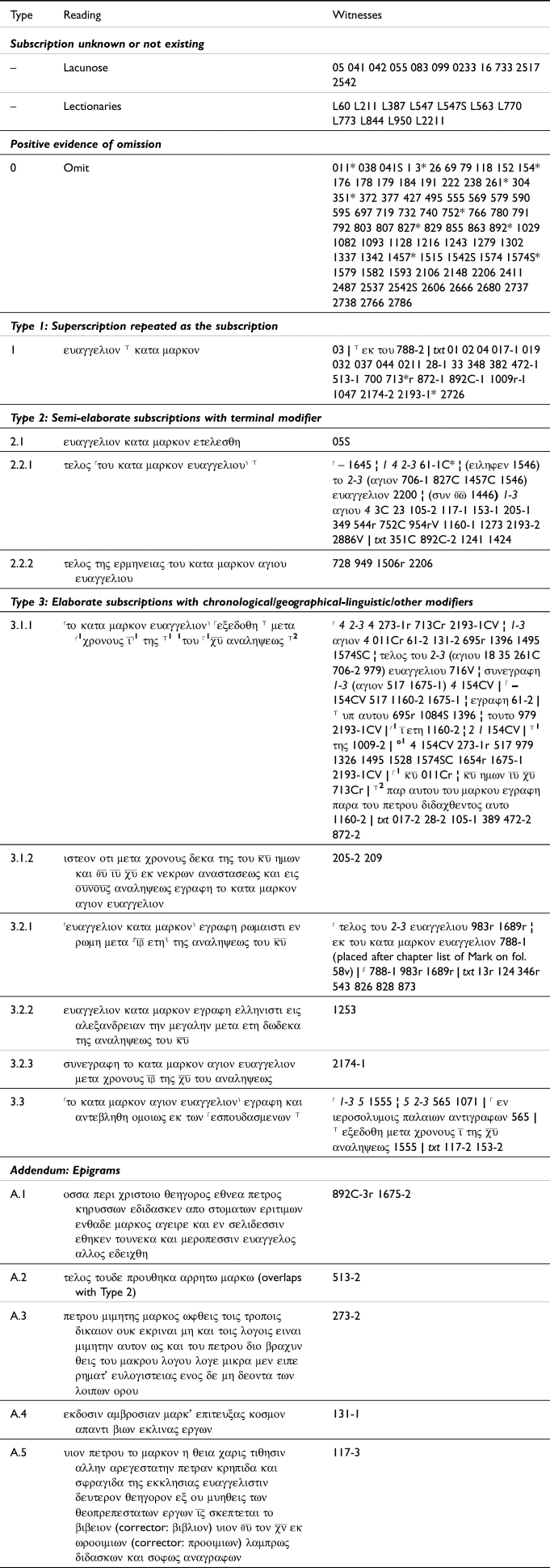
The subscriptions to the Gospel of Mark in the selected manuscripts are presented below in an apparatus, which is divided into three main types according to a typology developed by Tommy Wasserman, Linnea Thorp and Conrad Thorup Elmelund.Footnote 5
The typology largely corresponds to William H. P. Hatch's general description of how subscriptions developed over time.Footnote 6 In the early phase, the subscriptions are short and simple and often identical to the titles indicating the genre and author, e.g., ɛὐαγγέλιον κατὰ Μάρκον (Type 1). In a later phase, they become more elaborate, still only marking the end of the Gospel, e.g., τέλος τοῦ κατὰ Μάρκον ἁγίου ɛὐαγγɛλίου (Type 2). In the final phase, as Hatch explains, other elements are added:
Another kind of subscription is found in some uncial and many minuscule manuscripts of the New Testament. Subscriptions of this type differ from those mentioned above in that they give the reader in succinct form certain information concerning the book in question.Footnote 7
The additional information ‘concerning the book’ in various combinations in the subscriptions to Mark include the date (relative to the ascension), the place of origin and the language of composition. In addition, a few manuscripts contain a note about the authoritative manuscript exemplars used by the implied scribe – the so-called Jerusalem colophon – although the actual scribes of the manuscripts that attest to this note just copied the colophon from their exemplars, i.e., it entered the transmission in an archetype at some specific point no later than the ninth century when it is first attested in extant manuscripts.Footnote 8
In addition to these three types of subscriptions, the apparatus contains an addendum with a few Byzantine book epigrams found at the end of Mark. This category partly overlaps with subscriptions and is included for the sake of completeness.
3. Apparatus
The apparatus in Table 1 below contains 157 manuscripts, the same selection as in the ECM of Mark, but 192 entries, since one manuscript can occur several times, for example, if a subscription was added later (e.g., 011*/011C), or combine overlapping subscriptions (e.g., 017–1/017–2).Footnote 9 Lacunose witnesses and lectionaries that lack subscriptions have not been assigned to any type, but are listed in the first two rows of the apparatus. We have identified and corrected errors in the ECM edition of Mark in forty-five of the 157 included manuscripts (29%).Footnote 10
Apparatus of subscriptions to the Gospel of Mark

List of suffixes (after manuscript numbers)
*/C is used for original hand (*) and later correction/addition (C);
C* is used for a correction by the first hand (in scribendo);
− 1, −2, and −3 are used for compounded/overlapping subscriptions in the order they appear without any judgement on when and by which scribe the different elements were copied;
S is used for a supplement (the page on which the reading occurs was added later);
r is used for a regularised incorrect reading (e.g., a misspelling);
V is used for uncertain readings (ut videtur).
4. Analysis
4.1 Positive Omission of Subscription
Seventy-eight witnesses (41%) lack a subscription to Mark, i.e., they attest to a positive omission. The earliest witnesses date to the ninth century, e.g., Codex Koridethi (Θ 038). Nine of these witnesses are marked with an asterisk since a subscription has been added later. For example, the first hand of Codex Seidelianus I (G 011) omits the subscription (011*), but a different hand added one at a later stage (011C).
4.2 Titles as Subscriptions (Type 1)
Type 1-subscriptions belong to the early phase when the subscriptions were identical to the titles. Twenty-six witnesses (14%) contain a simple subscription of Type 1, e.g., Codex Sinaiticus (ℵ 01). In contrast to Hatch and others, we think that the genre modifier ɛὐαγγέλιον belongs to the initial form, and, hence, we propose that the reading ɛυαγγɛλιον κατα μαρκον reflects the earliest subscription rather than the reading κατα μαρκον (as in the ECM Mark). The longer form is actually attested by all the earliest witnesses except Codex Vaticanus (03) which has the short form.
In this connection, it is to be noted that P75, the sister manuscript of Vaticanus, attests to the subscription ɛυαγ’γɛλιον κατα λουκαν in Luke, and both P66 and P75 attest to the title ɛυαγγɛλιον κατα Ιωαννην (with orthographic variation) in John (they do not preserve Mark). Moreover, the flyleaf of P4 contains only the title of Matthew's Gospel written as ɛυαγγɛλιον κ̣ατ̣αμαθ’θαιον. The same title was likely also on a flyleaf of the bilingual P62, judging from the remaining Greek and Coptic letters.Footnote 11
Martin Hengel assumed that the titles of the individual Gospels originated already in the first century before the four Gospels were brought together in a collection sometime in the second century, since it would have been necessary to assign each writing to an author when read in worship.Footnote 12 Silke Petersen also argued that the version of the Gospel titles that includes ɛὐαγγέλιον must predate the collection of the four Gospels in a tetraevangelion codex in which ɛὐαγγέλιον could be dropped, but she suggests that titles were added at the beginning of the second century simply reflecting a consciousness of other Gospels that were circulating.Footnote 13
Whereas both Hengel's and Petersen's hypotheses allow for the reconstruction of differing titles (and subscriptions) for each Gospel as they circulated separately, David Trobisch has instead connected the unusual genre designation ɛὐαγγέλιον combined with the use of the preposition κατά, which is unusual in titles, to one canonical redaction and edition of the four Gospels.Footnote 14 Similarly, Simon Gathercole has argued, based on a broad range of textual evidence, that it is preferable to treat the titles en bloc because of the striking consistency ‘in the form of the title from one Gospel to another’.Footnote 15 At the same time, he is open to the possibility that the four Gospels were (re-)titled en bloc (presumably when they were brought together in a collection).Footnote 16 In a subsequent study, Gathercole is more confident that the authors’ names were appended at a later point.Footnote 17
Regardless of the origin of the titles, the uniformity of the evidence in early titles and subscriptions is remarkable and must reflect a consciousness of more Gospels and the need to distinguish between them. We think that these paratexts derive from the archetype of the extant textual tradition and that it is impossible to reach beyond it. Further, we agree with both Petersen and Gathercole who think that ɛὐαγγέλιον should be included in the titles in the Nestle-Aland-editions.Footnote 18 It is perhaps needless to say that the same goes for the ECM editions of the Gospels.
4.3 Subscriptions with Terminal Modifier (Type 2)
The semi-elaborated subscriptions of Type 2 are defined by their inclusion of a terminal modifier (τέλος or ἐτɛλέσθη) and by their lack of additional information. However, we have allowed for a few minor elements to be included in this type, such as the divine agency-modifier (σὺν θɛῷ) and the referential modifier (ἁγίου). In this corpus, the verbal forms ἐπληρώθη and ἐτɛλέσθη are used exclusively in the bilingual manuscripts with their Latin equivalents (e.g., in Codex Bezae which has ἐτɛλέσθη and explicit), but they are attested in other Byzantine manuscripts outside this corpus.Footnote 19 The corresponding verb form is also used in the subscriptions in the Old Syriac and the Peshitta traditions (see below).
The noun τέλος seems to have been introduced at a later stage in the subscriptions to Gospel manuscripts. On the other hand, it is attested in subscriptions in literary papyri at least from the third century ce in the formula τέλος ἔχɛι + nominative of the name of the work + genitive of the name of the author (where especially the last element may be implied from the context).Footnote 20 Moreover, the Old Syriac version, which probably dates to the third century, has a similar terminal modifier corresponding to τέλος. In conclusion, we think that both terminal modifiers in our subscriptions reflect influence from the broader book culture, Greek and Latin, respectively (possibly, the verbal forms originated in Latin book culture).Footnote 21
4.4 Elaborate Subscription Situating the Gospel of Mark (Type 3)
The Type 3-subscriptions place the Gospel of Mark in time and space by means of chronological and geographical-linguistic modifiers, and some subscriptions contain additional information as the type developed over time.Footnote 22 This type of subscription is particularly significant for the history of the interpretation of Mark.
4.4.1 Ten (/Twelve) Years After the Ascension
To begin with the chronological modifiers that indicate when the Gospel of Mark was written, there are two competing dates – either ten years (3.1) or twelve years (3.2) after the ascension of Christ (/the Lord). The indication of ten years is first attested by Codex Cyprius (K 017) dated to the ninth century, το κατα μαρκον ɛυαγγɛλιον ɛξɛδοθη μɛτα χρονους δɛκα της του χ̅υ αναληψɛως (3.1.1), whereas the indication of twelve years after the ascension is not attested until the eleventh century (in 124, 788 and 873) and likely reflects a secondary development.Footnote 23
In a discussion of the dating of Mark, Martin Hengel tried to reach the historical root behind this peculiar tradition of the ten or twelve years after the ascension, which he observed both in hypotheses in Gospel manuscripts and the commentary of Theophylact.Footnote 24 He suggested that the ten years might derive from Jerome's Latin translation of Eusebius’ Chronicle, where it is said that Peter came to Rome in the second year of Claudius’ reign, and that in the next year, the evangelist Mark became Peter's interpreter. This, Hengel suggested, would be in 42 ce and, thus, ‘around’ ten years after the ascension. Moreover, the note in Acts 12.17 that Peter, after his release from prison (presumably under Agrippa I ca. 42/43 ce), ‘left and went to another place’ could have been interpreted as him travelling to Rome. In addition, Hengel suggested that the round numbers ten or twelve were particularly suitable because they are holy numbers.Footnote 25 However, Hengel did not place any weight on this ancient tradition but dated Mark to ca. 68–70 ce on other grounds.
On the other hand, Zuntz dated Mark to 40 ce, and he did so mainly based on the internal evidence in Mark 13.14 – the note about ‘the desolating sacrilege’ set up in the temple which he connected with Caligula's threat to the Temple in Jerusalem.Footnote 26 Nevertheless, he discussed the ancient evidence found in hypotheses and subscriptions that apparently supported this early dating of Mark, namely to ‘ten [v.l. twelve] years after the ascension’, proposing that they were added to an edition of the Gospels by Eusebius of Caesarea (d. 339 ce).Footnote 27 Like Hengel, he pointed to the reference in Jerome's Latin translation of Eusebius’ Chronicle (lost in its Greek original) which says that Mark, the evangelist, became Peter's interpreter in Rome, further noting that the manuscript witnesses of the Chronicle contain variation concerning whether Peter arrived in Rome in the first, second, or even third year of Claudius' reign, i.e., 41, 42 or 43 ce – a variation which he assumed could explain the corresponding variation in the subscriptions between ten and twelve years after the ascension.Footnote 28
Zuntz further assumed that the dates for the other Gospels derived from the dating of Mark and according to canonical order (so Matthew a little bit earlier, Luke and John later), although wrongly from a historical point of view. In this connection, he acknowledged that the dating of John to thirty or thirty-two years after the ascension (ca. 60 ce), as indicated in the subscriptions, was quite remarkable.Footnote 29 In the end, however, Zuntz concluded that Eusebius’ chronology of the Gospels, in turn, depended on unreliable information from Papias, and, therefore, it could not be used as historical evidence for the early dating of Mark after all.Footnote 30
4.4.2 The Source of the Date in Subscriptions
We agree with Zuntz that the dating of each of the four Gospels relative to the ascension in the subscriptions must be the work of one editor, but we can safely exclude the idea that this was Eusebius. In the following, we will instead demonstrate that an unknown editor supplied dating for each of the four Gospels from one earlier source, which can be dated between the seventh century and 836 ce. In this process, he made a cascading error which resulted in this ‘peculiar tradition’ of early dates for Mark, Luke and, in particular, John. The error is attested first in Codex Cyprius (K 017) dated to the ninth century.
The earliest attested form of the source in question, we suggest, is preserved in Fragment IX a, attributed by Franz Diekamp to the Chronicle of Hippolytus of Thebes, who was a Byzantine author likely writing in the late seventh or early eighth century.Footnote 31 Diekamp found the fragment in the tenth-century catena manuscript GA 299 (Paris BN Grec. 177; Parpulov type e.2.iii.α) where it is appended by the same hand (in our judgement) to a longer excerpt from the Chronology of Hippolytus of Thebes placed at the end of the codex with three other brief texts.Footnote 32 For convenience's sake, we provide a transcription and translation of Fragment IX a from this manuscript:
Καὶ γὰρ τὸ κατὰ Ματθαῖον ɛὐαγγέλιον μɛτὰ ὀκτὼ χρόνους τῆς Χριστοῦ ἀναλήψɛως συνɛγράφη, τὸ κατὰ Μάρκον μɛτὰ δέκα, τὸ κατὰ Λουκᾶν μɛτὰ ιɛ΄, τὸ κατὰ Ἰωάννην μɛτὰ τριάκοντα δύο ἐπὶ Δομɛτιανοῦ.
For the Gospel according to Matthew was written eight years after Christ's ascension; that according to Mark after ten; that according to Luke after fifteen; that according to John after thirty-two in the reign of Domitian. (Paris BN Grec. 177 = GA 299; our translation)
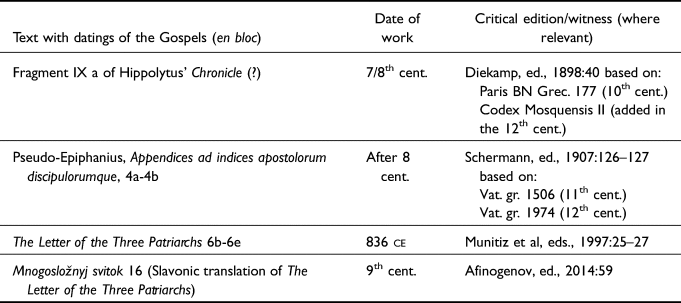
Diekamp further noted that the fragment is attested in Codex Mosquensis II (V 031), where it had been supplied in the twelfth century on the recto of a leaf followed by the same excerpt from Hippolytus’ Chronicle on the verso.Footnote 33 Finally, Diekamp mentioned that the fragment was later incorporated into The Letter of the Three Patriarchs, a work composed in 836 ce that we then, therefore, regard as the terminus ante quem of the Fragment IX a.Footnote 34 The Letter is preserved in three different Greek versions (apart from one fragment of what is regarded as the original version preserved in a ninth-century majuscule, Tiranensis gr. 25), but the Hippolytus Fragment IX a is preserved in all three versions and was therefore very likely part of the original letter.Footnote 35 Table 2 gives an overview of the text which dates all four Gospels en bloc.
Texts with datings of the Gospels en bloc

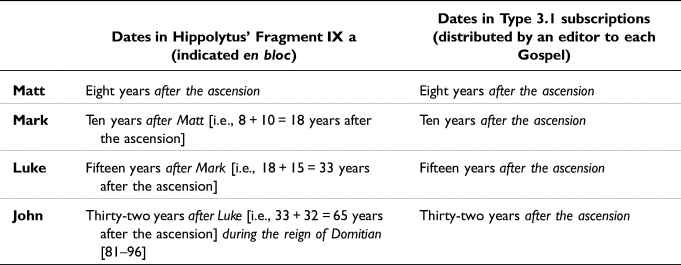
The medieval editor who used the text of Fragment IX a (the earliest attested form) for the subscriptions – whether he drew it from Hippolytus’ Chronicle or not – apparently did not realise, when he distributed dates to each Gospel, that only Matthew's Gospel was dated relative to the ascension in the source, but instead, he continued to repeat the reference to the ascension after each Gospel – and this is, of course, a natural interpretation of the sentence, except that it does not square with the final reference by the chronicler to John being written ‘during the reign of Domitian’ (81–96 ce); a time reference which was unknown or neglected by the editor. As seen in Table 3 below, this procedure resulted in a cascading error, where the dating of Mark's Gospel was changed to ten years, Luke to fifteen and John to thirty-two years after the ascension, indeed, resulting in this ‘eigenartige Tradition’, to use Hengel's words.Footnote 36 The date for Mark in the source was rather eighteen years after the ascension, i.e., around 48 ce – a date that evidently conflicts with Eusebius’ Chronicle.
Cascading error in Gospel subscriptions after distribution

The Type 3.1 subscriptions are first attested in Codex Cyprius (K 017) dated to the ninth century, which marks a terminus ante quem for distribution by the editor.Footnote 37 This tradition was later incorporated – with the cascading error – in the influential commentaries of Theophylact of Ohrid (11th cent.)Footnote 38 and Euthymius Zigabenus (12th cent.)Footnote 39 and therefore gained wide distribution. Extracts from Theophylact's commentary, including this note on the date of Mark, subsequently found their way into the catenae manuscripts.Footnote 40
Possibly, the dating of Mark to twelve years after the ascension (Type 3.2) reflects a subsequent copying error where the number two (β̅) was transferred from the dating of John to Mark so that we find the corresponding variation between thirty (λ̅) and thirty-two (λβ̅) in manuscripts of John. Interestingly, in Pseudo-Epiphanius, Appendices ad indices apostolorum discipulorumque, in a section first attested in Vat. gr. 1506 (11th cent.), we find again references to the dates of the four Gospels relative to the ascension and the combination of twelve years (Mark) and thirty years (John), the latter followed by the known phrase ἐπὶ Δομɛτιανοῦ τοῦ βασιλέως.Footnote 41 The unexpected sequence of the Gospels in this source, i.e., Matthew, Mark, John and Luke, increases the likelihood of such an error.
Although we do not know exactly how and when this error occurred in a similar source, the introduction of this secondary dating – twelve years for Mark and thirty for John – into the subscriptions may reflect the continuing influence of these various chronological fragments on the subscriptions, even as they were embellished over time and possibly incorporated by editors or scribes into various texts independently.
4.4.3 Mark Was Written in Latin in Rome
Some subscriptions contain a geographical-linguistic modifier (3.2.1–3.2.2). The main type (3.2.1) states that Mark ‘was written in Latin in Rome’, ῥωμαϊστὶ ἐν Ῥώμῃ. A single commentary manuscript (1253) instead indicates that it ‘was written in Greek to the great (city of) Alexandria’ (3.2.2), but this particular phrasing is, in fact, an intrusion from Luke where it is attested in many subscriptions.
This modifier is attested much earlier in subscriptions in the earliest Peshitta Gospel manuscripts. In the edition of P. E. Pusey and G. H. Gwilliam, they read (in our translation):
Finished is the holy Gospel, the preaching of Matthew the apostle, which he spoke in Hebrew in Palestine;
Finished is the holy Gospel, the preaching of Mark, which he spoke in Latin in Rome;
Finished is the holy Gospel, the preaching of Luke, which he spoke in Greek in the great city of Alexandria;
Finished is the holy Gospel, the preaching of John, which he spoke in Greek in Ephesus.Footnote 42
We assume that these forms derive from a Greek, or possibly Syriac, source which was used by the translator who created the Peshitta, whether Rabbula, bishop of Edessa (d. 435), as suggested by F. C. Burkitt, or someone else.Footnote 43 Hence, we think the geographical-linguistic modifier reflected in Type 3.2.1–3.2.2 is much older than the chronological modifier and that the two circulated separately but were conflated at some point as reflected in Byzantine Gospel manuscripts. The conflation is further attested in what Diekamp labelled Fragment IX c of Hippolytus’ Chronicle, attested in Turin, BL, B.VI.25, although we actually think this fragment, which has no connection to the Chronicle, was more likely copied from a Gospel manuscript because it incorporates the cascading error.Footnote 44
The geographical-linguistic modifier for Matthew can ultimately be traced back to Papias: Ματθαῖος μὲν οὖν Ἑβραΐδι διαλέκτῳ τὰ λόγια συνɛτάξατο, ἡρμήνɛυσɛν δ’ αὐτὰ ὡς ἦν δυνατὸς ἕκαστος, ‘So then Matthew compiled the oracles in the Hebrew language, but each interpreted them as they could’.Footnote 45 In the second century, Irenaeus picks up material from Papias concerning all four Gospels:
Ὁ μὲν δὴ Ματθαῖος ἐν τοῖς Ἑβραίοις τῇ ἰδίᾳ αὐτῶν διαλέκτῳ καὶ γραφὴν ἐξήνɛγκɛν ɛὐαγγɛλίου, τοῦ Πέτρου καὶ τοῦ Παύλου ἐν Ῥώμῃ ɛὐαγγɛλιζομένων καὶ θɛμɛλιούντων τὴν ἐκκλησίαν. Μɛτὰ δὲ τὴν τούτων ἔξοδον, Μάρκος, ὁ μαθητὴς καὶ ἑρμηνɛυτὴς Πέτρου, καὶ αὐτὸς τὰ ὑπὸ Πέτρου κηρυσσόμɛνα ἐγγράφως ἡμῖν παραδέδωκɛν. Καὶ Λουκᾶς δέ, ὁ ἀκόλουθος Παύλου, τὸ ὑπ’ ἐκɛίνου κηρυσσόμɛνον ɛὐαγγέλιον ἐν βίβλῳ κατέθɛτο. Ἔπɛιτα Ἰωάννης, ὁ μαθητὴς τοῦ Κυρίου, ὁ καὶ ἐπὶ τὸ στῆθος αὐτοῦ ἀναπɛσών, καὶ αὐτὸς ἐξέδωκɛν τὸ ɛὐαγγέλιον, ἐν Ἐφέσῳ τῆς Ἀσίας διατρίβων.Footnote 46
Then Matthew, indeed, published a written Gospel among the Hebrews in their language while Peter and Paul were preaching the Gospel and laying the foundation in Rome. Then, after their departure, Mark, the disciple, and translator of Peter, also himself handed over in writing to us what Peter had preached. Furthermore, Luke, the follower of Paul, put down the Gospel preached by him. Then John, the Lord's disciple, who was also reclining at his chest, also published the Gospel while residing in Ephesus of Asia. (Adv. Haer. 3.1.1; our translation).
Similar traditions from Papias were transmitted in the East by Origen and Eusebius.Footnote 47 However, the language of composition in these sources is still indicated only for Matthew, but apparently, this soon triggered someone to fill in the gaps for the other Gospels.Footnote 48 Mark was already closely connected to Peter and Rome, and John was known to have resided in Ephesus, whereas Luke was known as a follower of Paul, the apostle to the Gentiles, and at some point, his Gospel became associated with Alexandria.
Interestingly, at the end of Ephraim's Commentary on the Diatessaron, preserved in the fifth- or sixth-century Chester Beatty 709, there is an appendix titled ‘The Evangelists’ reflecting the Papias tradition as mediated via Eusebius.Footnote 49 In the Armenian recension of Ephraim's commentary, reflecting a different underlying Syriac text, the section is longer and indicates the language of composition: ‘Matthew wrote the Gospel in Hebrew, Mark in Latin from Simon in the city of Rome, Luke in Greek, John, finally, [v.l. also in Greek] wrote it because he remained in the world until the time of Trajan’ (our translation).Footnote 50 There is no reason to believe that Ephraim, who never mentioned the separate evangelists in his commentary on the singular Gospel, wrote this concluding section. Rather, it must have been interpolated at some point, and perhaps from a Greek source, but, as Matthew R. Crawford points out, even if the passage (in Chester Beatty 709) is not authentic, it reflects the influence of Eusebius’ Ecclesiastical History in the Syriac world at a very early stage.Footnote 51
Possibly, the translator of the Peshitta also depended indirectly on the Papias tradition when emphasising that the written Gospel was based on preaching and therefore spoken in Hebrew, Latin or Greek, respectively. Regarding the destinations of the Gospels, it is further to be noted that Gregory of Nazianzus wrote in his fourth-century poetical canon list, ‘Matthew wrote the miracles of Christ for the Hebrews, Mark for Italy, Luke for Achaia (Greece), John . . . wrote for all’.Footnote 52
At some later point, the geographical-linguistic modifier was combined in each Gospel with the chronological modifier from Hippolytus’ Chronicle. In this connection, it is to be noted that all the Greek manuscripts that attest to Type 3.2.1 (13 124 346 543 788-1 826 828 873 983 1689) belong to Family 13 in Mark, and thus descend from a common, now lost archetype, perhaps an uncial.Footnote 53 Based on the subscriptions (including the indication of ‘twelve years’ in Mark), however, we suggest that this archetype cannot be earlier than the eighth century. Finally, we note that Type 3.2.1 is not exclusive to Family 13, but is attested elsewhere, e.g., in GA 9 (= Paris, BN, grec 83), which brings together the subscriptions of all four Gospels on a single page (fol. 271v after John).Footnote 54
4.4.4 The Jerusalem Colophon
In contrast to a subscription, a colophon gives information regarding the book's production and the scribe's work rather than the work itself. In this connection, we note that five witnesses refer to authoritative manuscript exemplars containing a form of the so-called Jerusalem colophon (Type 3.3), first attested in the ninth century, stating that the text of Mark's Gospel in this manuscript ‘likewise [has been] copied and corrected from the best [manuscripts]’.Footnote 55 The ‘likewise’ refers back to the full form of the colophon which is normally found only after Matthew. Here the fuller form is attested by the ninth-century minuscule 565, which replaces ‘the best [manuscripts]’ with ‘the old manuscripts in Jerusalem’. Tommy Wasserman has considered the possibility that the popularity of the colophon is related to the ‘tradition [from Papias], recorded in many subscriptions, that Matthew wrote his Gospel in the Hebrew dialect in Jerusalem’.Footnote 56 The colophon validates the text of a particular manuscript by relating it to an authoritative source.
4.4.5 Byzantine Book Epigrams in Mark
Finally, we come to the addendum, the Byzantine book epigrams (A.1–5). Byzantine scribes or book owners loved to add these poems in metrical verses to important objects like Gospel books. The epigrams were usually added either before or after the end of the text, and most of the epigrams are written on a metric verse of twelve syllables (dodecasyllabikon) as in four of our five examples.Footnote 57 There are over 9,000 epigrams collected in the Database of Byzantine Book Epigrams, and all except one of our epigrams are already recorded in that database, namely A.2, ‘The end of that which was published by the inexpressible Mark’ (τɛλος τουδɛ προυθηκα αρρητω μαρκω) – an epigram and, at the same time, a subscription to Mark overlapping with Type 2.Footnote 58
5. Conclusions
We have surveyed the subscriptions to the Gospel of Mark in 157 manuscripts, noting their gradual development from being identical to the title in the earliest phase (Type 1); provided with a terminal modifier (noun or verb) in the second phase (Type 2); becoming more elaborate in a third phase providing additional information about the book (Type 3). The elaborate subscriptions are most interesting for the history of interpretation. The typical geographical-linguistic modifier for the Gospel of Mark stating that it was written (or spoken) in Latin in Rome is first attested in the Peshitta, which suggests that there were likely Greek manuscripts with similar subscriptions, perhaps as early as the fourth century. This information concerning the place of origin and language of the Gospels probably started with the Papias tradition about the Gospel of Matthew being written ‘among the Hebrews in their language’. Papias’ note, as incorporated by later patristic authors like Eusebius, triggered someone to fill in the corresponding gap for the other Gospels no later than the early fifth century.
In another Greek tetraevangelion, an unknown medieval editor decided to supply dating for each of the four Gospels from a source which has been attributed to Hippolytus of Thebes’ Chronicle (Fragment IX a), probably after the seventh century and no later than the ninth century. In this process, the editor made a cascading error which resulted in too early dates for Mark, Luke and John. Modern scholars, like Hengel and Zuntz, have acknowledged that these datings are peculiar (in particular for John), but yet, the evidence has played a certain role in their discussion about the dating of Mark. In a later manuscript, i.e., the archetype of Family 13, the chronological modifier was combined with the geographical-linguistic modifier in all four Gospels. This suggests that the archetype of Family 13 is no earlier than the eighth century.
A main factor behind this gradual growth of the subscriptions is authentication and authorisation. Although it is unclear whether the four canonical Gospels circulated with titles before they were collected together, we think that the earliest form of both the title and subscription, ɛὐαγγέλιον κατά + the name of an evangelist, emphasises the unity of the singular Gospel and, at the same time, associates each of the four versions with an important apostle or eye-witness of the first generation, and so legitimates its claim of apostolicity and orthodoxy.Footnote 59 In the case of the Second Gospel, it was associated early on with Mark who was known to be Peter's disciple and interpreter.
Another factor that explains further additions of information is probably plain human curiosity. In his study of the analogous growth of Christian tradition concerned with names, Bruce Metzger has pointed out that there are many people and places mentioned in the NT unaccompanied by their names, and because of curiosity about these characters and places early Christians sought to identify them.Footnote 60 ‘Tradition’, he says, ‘provided names for all of these – sometimes several different names’.Footnote 61
Finally, and in close relation to the above factors, we think that the situating of each Gospel in time and space through the subscriptions contributed to the construction of what Tobias Nicklas has termed as ancient Christian ‘landscape(s) of memory’, which served to express and preserve the collective memory of the social group, thus shaping and enhancing their identity.Footnote 62
Competing interest
The authors declare none.
 4)’ NovT 54 (2012) 209–35. More recently, Brent Nongbri, God's Library: The Archaeology of the Earliest Christian Manuscripts (New Haven: Yale University Press, 2018) 247–68, has argued that this manuscript may be as late as the fourth century. See, however, the response by Tommy Wasserman who argues for a date around 200