Environment and Culture, Medium and Forum
Even the most scientifically reductionist view of the individual reveals that we are complex systems nested within complex systems.Footnote 1 These interactions within and among systems are based and depend on numerous variables of our (internal and external) environment(s). If we define ethics as a system of moral decisionmaking, then it becomes clear that these decisions ultimately affect the situation(s) of managing our activities and relationships with others in our environment (in essence, our being in the world).Footnote 2 Given that ecology literally means “a study or system of wisdom and reasoning about the interrelation of organisms in their environment or place of inhabitance,”Footnote 3 Owen Flanagan's description of ethics as “human ecology” takes on considerable relevance and importance.Footnote 4
To approach the ethical issues, and various systems and techniques used to address and resolve these issues, then—pro Flanagan—it is crucial to recognize the effect of environment on persons’ situations and actions that constitute their life-world(s). In other words, a consideration of ethics cannot exclude regard for the environment as embodied by time, place, culture, and circumstance. This mandates an appreciation of culture as an important force in determining interactively biopsychosocial dimensions of persons’ being. At the most basic level, culture refers to a “medium for the development of living material,” and while usually reserved for connotations of experimental methods, it must be borne to mind that this definition is no less operative when considering what and how culture engages and sustains “the set of shared material traits, characteristic features, knowledge, attitudes, values and behaviors of people in a common place and(/or) time.”Footnote 5 This definition rightly reveals that culture establishes and reflects particular biological characteristics (that develop and are preserved in response to environments) that can be expressed through cognitions and behaviors. In this way, culture is a medium for biopsychosocial development and a forum and vector for its expression and manifestation.Footnote 6 Thus, any attempt to identify moral issues (and ethical approaches to resolving these issues) must appreciate the effects of and on culture—from biological to social levels.
In this essay we argue that any practical consideration of an ethics of pain medicine must also recognize (1) the effects of culture on the event, phenomenon, and experience of pain; (2) the distinctions that are evoked by the culture of medicine (vs. the culture of patienthood); and (3) how geographic, social, and temporal variances affect these cultural dynamics. We posit that one cannot extricate persons from culture, and any attempt to define issues, problems, values, potential solutions, and consequences that affect individuals and groups must frame this calculus within a cultural context, at least to some extent; otherwise it will likely be unrealistic.
Cultural Effects on Pain: Event, Experience, and Meaning
Even if pain is solely considered as a neurophysiological event, the putative effects of culture cannot be ignored. Anthropologically, the relationship of culture and ecology is often considered to be reciprocal.Footnote 7 Many environmental factors (e.g., geographical boundaries and limitations, climate, survival, and salutogenic characteristics) have been shown to effect genomic frequencies and the expression of particular phenotypes in aggregate groups of people. Selective pressures yielded elimination of certain genotypes in favor of others, expressing phenotypes that (through environmental, epigenetic modification) fortified these variations. These factors provided the basis for developmental trajectories that would (1) maximize the success of environmental interactions, (2) tend to produce predispositions to relatively common geno- and phenotypic patterns within defined regions that reflect this survivability, and (3) therefore be sustained and fortified within these environmental niches. Environment affects physiological development, maturation, and function, promotes particular phenotypes, and ultimately may shape common functions of certain phenotypic groups.Footnote 8 Put more colloquially, nature is expressed via nurtureFootnote 9, and common factors within the nurturing environment can affect patterns of neurologic activity and/or structure (i.e., “neurons that fire together wire together,” both in individuals and in groups of individuals).Footnote 10
In this way, environments can “culture” groups of individuals, and cultures develop in response to and meaningfully affect environments. Moreover, keeping in mind that the boundaries between internal and external environment are somewhat arbitrary and interactive on a number of levels, we must appreciate the effects of culture on individuals across biopsychosocial domains. Analyses of genetic and epigenetic influences have validated the effects of environment and culture on phylogenetic and ontogenetic patterns of certain physiological traits. The work of Mogil and colleagues has shed light on genotypic predispositions to neural substrates that can give rise to (susceptibility and expression of) certain types of pain.Footnote 11 Our ongoing characterization of pain as a spectrum disorder suggests that there are putative families (i.e., clades) of genotypes and phenotypes that are differentially sensitive to environmental influence(s) for the expression of pain (thresholds, experience, and most likely cognitive/behavioral manifestations).Footnote 12 Thus, although pain is a universal human experience, biopsychosocial influences of culture can alter the development of neural systems, cognitions, and behaviors that affect the sensation of pain, its experience, and its expression, respectively.
Such distinctions have been anecdotally noted since antiquity.Footnote 13 Zborowski's classic yet methodologically (if not philosophically) flawed study of pain thresholds, perceptions, and responses in various ethnic groups was nonetheless important in that it shed light on the possibility that various cultures could be susceptible to biopsychosocial influences that affect pain.Footnote 14 Several subsequent studies revealed differences in sensitivity to and expression of pain between various ethnic, social, and geographically distributed groups.Footnote 15 But it is important to heed A.L. Kroeber's warning not to confuse “culture” with “a culture,” as the latter is connotatively prejudicial.Footnote 16 Rather, we must consider culture as presciently described by E.B. Tylor over a century ago as being a “complex whole” that can dynamically shape almost all aspects of human experience.Footnote 17 Culture—as a complex whole—gives rise to identifiable groups that cluster together based on geographic isolation, niche occupation, physiological functions, kin selection, and social characteristics and activities. It is these biopsychosocial effects and artifacts that promote and sustain beliefs, knowledge, and the resultant behaviors of individuals and the groups to which they belong. These sociocultural characteristics can determine accepted interpersonal roles and modes of action and expression that can affect how the sensation of pain may be perceived, interpreted, communicated, and treated.Footnote 18
Cultural Orientations of Patients and Clinicians: Knowledge, Beliefs, and Realities
It is in this broader context that we must consider the effect(s) of culture on ways of understanding pain, the experience of patienthood, and the role(s) of pain medicine and the clinician. There is a reciprocal relationship between the sensation and meaning of pain.Footnote 19 The subjectivity of pain reflects distinctions in neurophysiological processing of pain as a sensation and neurocognitive interpretation of pain as an experience of the lived body.Footnote 20 Given that cognitive constructs (i.e., meanings) are socioculturally influenced, the perceived identity and impact of pain are often contextual.Footnote 21 Elaine Scarry has claimed that pain can deconstruct patients’ lives and defy language.Footnote 22 But to fully grasp the extent of these effects, it is important to understand (1) the life-world of the patient to determine how it has been deconstructed by pain and (2) that this life-world is inextricably bound to the patient's culture. As well, although pain may defy language, its experience compels communication in an attempt to communicate subjective suffering to others.Footnote 23 We opine that the effectiveness of this communication is semiotically and semantically constrained by sociocultural capacities and limitations.
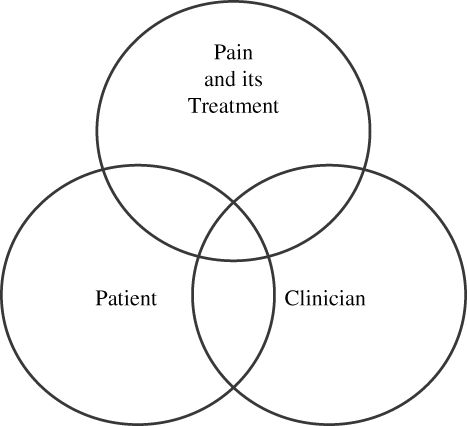
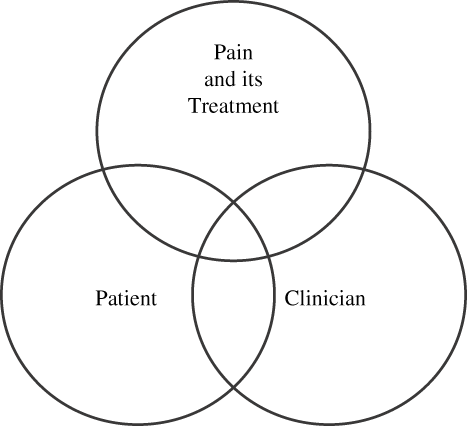
We can conceive this potential communication as a Borromean interaction: the interplay of three domains whose relative intersection reflects both the extent of commonality and the possibilities for mutual engagement.Footnote 24 As shown in Figure 1, such a Borromean interaction of (1) pain, (2) the pain patient, and (3) the clinician dictates both the patient's and the clinician's attitudes and activities. Clearly, the patient and clinician bring their respective cultural influences and effects to the fore within the fabric of the clinical encounter. In this way, both maintain and manifest beliefs, knowledge, and attitudes about the nature and meaning of pain, disease, illness, personhood, and responsibility. Beliefs should not be minimized; to paraphrase Augustine, to believe is to understand, such that our individual conceptualization of the world allows and guides our ways of knowing and colors our interpretations of life.Footnote 25 For the patient, these beliefs may incorporate considerable folk knowledge and may not be consonant with the beliefs on which the epistemology of medicine is based.Footnote 26 Thus, the beliefs of patient and clinician can ultimately enhance or disrupt the Borromean dynamics of the medical relationship.
A Borromean depiction of the relationship of patient, clinician, and pain and its treatment(s). Each one of the rings represents a sphere that constitutes the multidimensionality of the particular entity. For patient and clinician, it represents the totality of their respective life-worlds, inclusive of culture, experience, beliefs, knowledge, and attitudes. For pain and its treatment, the sphere reflects the objective entities, and its intersection with the patient and clinician represents the subjective (individual and cultural) characterization of this objectivity. The extent of alignment between patient, clinician, pain, and its treatment depend on commonality of beliefs, knowledge, experience, and expectations. Each and/or all can be affected by culture, either individually, or together.
With its defined set of values, attitudes, beliefs, meanings, and even language and behaviors, medicine must be viewed as a sociocultural force,Footnote 27 and its power creates, and is upheld by, biopsychosocial asymmetries in the clinician–patient relationship. We believe that one of the tasks of the clinician is to lessen this asymmetry by decreasing the vulnerability of the patient through the empowering provision of care. So, if pain medicine is to fulfill the good of its professed task (i.e., treating and healing the person made vulnerable by pain), then it is important for the clinician to not simply understand pain as object, but to understand how the objective event of pain is subjectively interpreted by, expressed in, and affects the culturally nested patient.Footnote 28
Pain as Subjective “Creation” in the Interplay between the Real, the Imaginary, and the Symbolic
What has been long underestimated in mainstream medicine is exactly this subjective dimension within the event of pain—especially in its close ties to intersubjective, culturally preformative patterns. It is the “subjectivity of pain” or “pain as the intimate subject” that has to be investigated in greater depth if patient-centered pain care is to make further progress toward a truly subjective-objective paradigm—not only in practice, but also in its philosophical and scientific foundations.Footnote 29 To achieve such progress, the double etymological sense of the term subject has to be considered in its value for the concrete event of pain: (1) pain as the ontological basis (i.e., from the Latin, sub-jectum, passive) of the ill subject, and at the same time (2) the “submission” (i.e., Latin, sub-iacere, active) of the subject.
As the French psychoanalyst Jacques Lacan has noted, the subject's experience seems indivisible from patterns of unconscious interpretation that are rooted in its sensitivity and (self-)perception by cultural predispositions.Footnote 30 There seems to exist, in fact, a second, even more narrowly conceived Borromean knot involved in the overall event of pain at the subjective level: the constitutive interaction and mutual relationship between patterns of imagination and symbolization that decisively contribute, if not create, the real event of pain. Both the imaginary and the symbolic order form the unconscious basis of the subject that experiences pain, and at the same time, both “submit” the experience of pain to largely meta-personal cultural laws.
In other words, how the subject's inherited culture produces an array of symbolic “concretizations” of the experience of pain—for example, in the form of images, language, or behavior, which vary from individual to individual and from culture to culture and can all be seen as forms of negotiation with the experience and as an attempt to integrate it into the realm of its own ontological real—influences the perception and the experience of pain itself. On the other hand, it has been long known that the personal imagery of the subject not only mirrors and embodies the events of pain in a dreamlike way, but can also actively influence it, if appropriately controlled and enacted, to the extent that it may alter the very outcome of the illness and the respective healing process.
But it is neither one nor the other dimension of the reality of pain that singularly seems to be of decisive value in a more holistic ethics of patient-centered pain care. Rather, we posit that it is the dialectic of these two dimensions that must be considered. The traditional ethics of medicine are derived from the “modern” concepts of 19th and 20th century rationality and therefore still tend to apply dualistic models in which the main critical productivity is the analysis of the disproportions between the imaginary and the real (i.e., between the subjective elaboration of pain and its—often not corresponding—objective physical bases and origins).Footnote 31 However, more recent postmodern approaches have added a third dimension to this constitutive dualism: the realm of the symbolic as being the decisive dimension for the subjective incarnation of pain.Footnote 32 Such a view can be sustained, at least partly, by considering that culture itself can be seen as a Borromean knot given that (1) it is constituted by those three dimensions of reality: namely, the real, the imaginary, and the symbolic, and (2) it produces a subject submitted to the interplay between the dialectics of these dimensions.Footnote 33
The Subject of Pain and the Lessons of the Placebo Experience
If pain identities are fundamentally created entities, then it becomes clear that patient-centered pain medicine will address treating cultural subjects of pain, rather than patients with an illness producing pain. One especially effective example of how such a culturally aware philosophy of pain care could be enacted may be revealed by study of placebo effects and responses.
At the most basic level, the placebo effect is a cascade of physical responses that are induced through some psychologically reactive (i.e., meaning) response to a circumstance, place, action(s), or person.Footnote 34 This seems to be possible exactly because of the central role of the personal imaginary of the subject and a desire to symbolically incorporate the “other” as part of a first-person experience.Footnote 35 Thus, it is a fake that is at the same time a reality.Footnote 36 At the center of its effect lies not the question of identity in the strict sense—that is, if it is a fake or a reality—but rather the transformative power that can be enacted between these two poles. Thus, identities reveal themselves as being entities of (low level) transformation rather than entities of “highest immutability.”Footnote 37
Furthermore, given that the placebo effects/responses make positive use of an unconscious attempt of the subject to unify the imaginary and the symbolic to create a viable reality, they can be seen as the epitome of art. The placebo effect is sort of an artifact, because it engages meanings attached to something artful and/or artificial to create something real. As such, these effects manifest a kind of zero value that exists in the interplay between the imaginary, the symbolic, and the real—dependent on the context and construal of the one who is experiencing the effect. As well, the placebo effect reveals somewhat cryptic mechanisms and functions that sustain the “existence” of subjective reality. The placebo experience can especially shed light on the intimate dimension of pain. It can be assumed that pain—as a subjective reality never totally expressible by the means of the symbolic and never able to be fully integrated in the canon of the imaginary present of a specific culture—is, in principle, created in a similar way as the placebo effect is generated and embodied within the subject (and, indeed, this may, in fact, be the case for the negatively valent nocebo responses and effects).Footnote 38
Perhaps then, the cultural competence of the healing encounter is a matter of attunement to the “art of placebo,” and as such can be seen as the “art of boundaries” between the imaginary, the symbolic, and the real, reflective of Martin Heidegger's definition of the term boundary: “Not that at which something stops, but as the Greeks recognized, the boundary is that from which something begins its presencing.”Footnote 39
This is particularly true in pain care, given the subjective presence of pain to transcend boundaries of past, present, and future; silence and voice, understanding and explanation, and self and other. These boundaries are embodied by the reality of the subjective experience of pain and its objectification, and are, in essence, what define the hermeneutic nature of pain medicine.
The Impact of Culture on Ethics
The conjunction of objective and subjective understanding provides a basis for (1) diagnosis, (2) considering those therapeutic options that are available, and (3) selecting those that maximize good outcomes in a specific patient.Footnote 40 Obviously, these choices must both determine the contextual meaning of good (for the patient's best interests) and direct its provision.Footnote 41 The relief of pain—as the tangible good of the clinical encounter and the relationship of pain clinician and patient—must extend beyond the limited proximity of the clinical environment and affect the daily realities of the patient's life-world. Therefore, it becomes apparent that each decision is at once therapeutic and moral, and the decisional process becomes one of ethical concern.Footnote 42 But given the cultural plurality of contemporary society, how can these ethical decisions be made with any reliability?
We have argued that the structure of pain medicine entails a particular framework of responsibilities and obligations that define its intellectual, moral, and practical articulation.Footnote 43 These rules define what the practice is all about and establish the requirements that one must accept if they are to enter the field. These are far-reaching statements that conjoin pain management to a general philosophy of medicine that is built on and defines a core epistemology (i.e., as a knowledge base and ways of knowing), anthropology (as consideration of the factors that are involved with the conduct of pain care as a human enterprise), and ethics (as a formal, systemized analysis of moral decisions and the systems and processes involved in moral decision making).Footnote 44 Hence, the “rules” explicate particular essentials of pain care, such as (1) the importance of knowing about pain and its effects, (2) an understanding of the multidimensionality of the person who is the patient, (3) the subjectivity of pain and the difficult yet critical necessity for intersubjectivity, and (4) a knowledge of ethics as both a process and a set of tools.Footnote 45 Simply, rules 1–3 determine what ethical processes and tools might be best suited for the specific circumstances, interpersonal relations, and task at hand. Obviously, any consideration or understanding of the person who is the patient must regard the relative effect of culture; but in actuality, the entire process, that is, the rules themselves and our need and reliance on them, does not transcend cultural influences.Footnote 46
The actual point of the described Borromean interaction is interpersonal, occurring between the clinician and patient. Given the clinician's roles as steward of knowledge and executer of knowledge and skill (in the patients’ best interest), we posit that it is the clinician's intellectual and moral responsibility to utilize those ethical approaches that (1) are resonant with his/her moral compass; (2) allow accurate account of each patient's biopsychosocial needs, and, in so doing, (3) define and direct the provision of (right and) good care. This necessitates an agent-based ethics, and although we have argued in favor of a virtue-oriented approach, we recognize that virtue ethics cannot work in isolation.Footnote 47 Thus, although particular intellectual virtues may allow for an understanding of culture and its effects and moral virtues may allow prudence to direct a habitual striving toward the good, virtues must be employed within some system(s) that meet the contingencies of circumstance and persons.Footnote 48 Clearly, a virtue ethics mandates examination of one's beliefs and values toward developing the cultural understanding necessary for ethical deliberation.
To be sure, self-awareness and -reflection are cornerstones of prudent, culturally sensitive care.Footnote 49 Such self-reflection fortifies the clinician's awareness of the importance that beliefs and values have in effecting the manifestations of illness and patients’ intentions and actions in the clinical encounter. In practicality, this enables a clarified lens with which to view the patient, may facilitate culturally sensitive communication, and allows insight to patients’ beliefs, values, and goals.Footnote 50 By enhancing ongoing dialogue, clinician and patient establish a problem-solving relationship that supports mutual decisionmaking, sustains the agency of patient and clinician, and may serve as a starting point for implementing values-based, and/or goal-directed pain care.Footnote 51 Such sharing of perspectives, beliefs, knowledge, meanings, and clinical expectations can create an alliance in which the patient is empowered and the clinician is enabled.
One of the critiques of this approach is that any full consideration of cultural effects and differences implies an ethical relativism or subjectivism.Footnote 52 On a somewhat deeper level, this is actually an ethical skepticism that questions whether any moral decision can be right or wrong and if the concept of what is good has any validity.Footnote 53 The point of contention is that once we consider or allow cultural and individual variation, then any claim to what is morally sound becomes little more than opinion or some attempt to advance and/or recruit others to a particular point of view. We disagree with this for several reasons. First, any approach to moral decisionmaking and use of ethical systems must begin by obtaining and analyzing facts relevant to the circumstances, issues, and/or problems.Footnote 54 Clearly, it is factual that culture can affect (the dispositions, beliefs, actions, etc. of) persons. Second, any moral deliberation must consider the agents involved, not simply as objects, but as subjects of responsibility.Footnote 55 Third, although moral deliberation considers and weighs the influence and importance of culture and its effects on individuals, the process itself seeks to prescind (i.e., step back in reflective distance) so as to evaluate these factors in balance.Footnote 56 Fourth, moral deliberation is actually aimed at describing and defining the case and molding attitudes toward certain actions. In this way, moral discourse and deliberation need not be about what is true or false, or even what is right or wrong, but rather what warrants rational consideration and supports reasonable action(s).Footnote 57 Accordingly, some ethical approaches are better suited to ameliorating the differences of culture and strengthening the voice of those who are marginalized.Footnote 58 Feminist ethics have particular merit in this regard, at least in part, in that the feminist perspective directly acknowledges the overt and covert effects of relational asymmetry and affords tools that both allow insight to this discordance and that may equalize capability and power.Footnote 59
But perhaps what is needed is a meta-ethics of pain medicine, a system that allows overview and analysis of the ethical issues in pain care and what, how, and why particular ethical approaches can be engaged to resolve these issues. The task is formidable and is the focus of our ongoing work.Footnote 60 As we approach specific pragmatic and moral issues in pain care, it is critical to ground each of these problems and their potential solutions to the realities defined by persons in culture. For if pain medicine is to be truly practical, it must acknowledge an increasingly global, pluralized world-culture and offer care that is sensitive to our symbols, realities, similarities, and differences.