Implication
This research is aiming at identifying possible welfare problems for sows and piglets when using nurse sows as a first step for suggesting strategies for managing piglets, which promote an efficient and welfare-friendly piglet production. By facilitating new strategies, taking into account welfare problems associated with current practise for use of nurse sows, animal welfare in sow herds will be improved.
Introduction
Litter size in Danish pig production has been increasing over decades (Pedersen et al., Reference Pedersen, Jensen and Thodberg2010). As a consequence a sow often gives birth to more piglets than she can rear successfully without help from other sows or by artificial feeding supplements. In the EU, piglets should not be weaned from the sow at <28 days unless weaned to disinfected and specialized housing using all in–all out procedures. Earlier weaning (down to 21 days) may also take place when necessary for health issues related to the sow or piglets (European Council Directive, 2008). The request for a 4-week nursing period has led to the introduction of nurse sows in some countries. A nurse sow is a lactating sow given younger foster piglets, when her own piglets have been weaned. Two main types of strategies are used (Baxter et al., Reference Baxter, Rutherford, D’Eath, Arnott and Turner2013); the nurse sow is given new born piglets when her own piglets have been weaned (the one-step strategy), or the nurse sow is given 1-week-old piglets when own piglets have been weaned (the two-step strategy).
Nurse sows may experience impaired animal welfare compared with non-nurse sows as a result of the extended confinement and lactation period for nurse sows. Extended lactation may deplete body reserves (Prunier et al., Reference Quinn, Boyle, KilBride and Green2010) and lead to a low body condition score and sows with a poor body condition score are prone to get shoulder lesions during lactation (Knauer et al., Reference Knauer, Stalder, Karriker, Baas, Johnson, Serenius, Layman and McKean2007). Further, the long time period in the crate with limited ability to move may be stressful to the sow (Jarvis et al., Reference Jarvis, D’Eath, Robson and Lawrence2006). The piglets may suffer from the transition from one sow to another during the nursing period. Cross fostering of piglets, particularly after the 1st day of life, results in transient instability in the teat order with more disrupted nursings (Horrell and Bennett, Reference Horrell and Bennett1981; Horrell, Reference Horrell1982; Price et al., Reference Prunier, Heinonen and Quesnel1994; Heim et al., Reference Heim, Mellagi, Bierhals, de Souza and de Fries2012) and finally affects survival rate and growth (Neal and Irvin, Reference Neal and Irvin1991; Price et al., Reference Prunier, Heinonen and Quesnel1994; Milligan et al., Reference Milligan, Fraser and Kramer2001). The aim of this study was to assess the welfare of nurse sows and their piglets with reference to non-nurse sows – with special emphasis on body condition, shoulder lesions, damage on udder and clinical signs of hunger in the piglets.
Material and methods
A cross-sectional study was made in 57 Danish sow herds. The study did not require ethical review according to Aarhus University, since it was purely observational. The selection of sow herds was based on a 538 herds responding to a questionnaire survey mailed out to 1730 pig herds in Denmark in June 2013. The 1730 herds included all pig herds in Denmark with at least 200 sows in June 2013. From the 538 herds, 155 herds were randomly selected. The farmers of the 155 herds were phoned and asked if they wanted to join the study and 59 of them accepted to participate. Two herds were subsequently removed because they had no nurse sows when visited. All 57 study herds had lactating sows in farrowing crates where the sow was confined and the piglets had access to a corner creep area with litter. The size of the farrowing crates differed between and within herd. The corner creep area was typically heated during the 1st week of life.
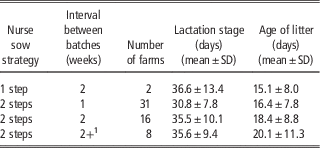
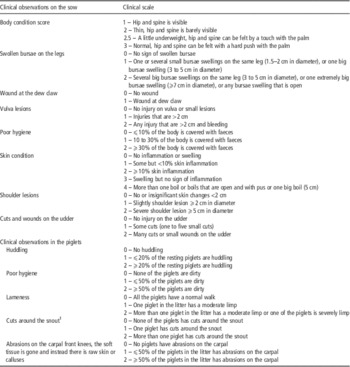
The cross-sectional study was conducted from 1 October 2013 to 1 May 2014. In each herd all nurse sows were examined as well as a sample of non-nurse sows. All herds included in the study except for two herds used a two-step nurse sow strategy. The included herds had either 1, 2 or 3 weeks between farrowing groups. A nurse sow weans her own litter at 4 to 5 weeks of age and receives typically 1-week-old piglets from a middle sow, which she keeps until weaning at 4 to 5 weeks of age. A middle sow provides all her piglets to the nurse sow at 1 week of age and receives surplus new born piglets from various litters. A control sow keeps the piglets she has (typically after litter equilibration during the first 2 days after farrowing) and keeps them until weaning at 4 to 5 weeks of lactation. This system reflects a herd with a two-step nurse sow strategy and 1 week between the farrowing groups. As shown in Table 1, 55 herds used a two-step strategy and two herds used a one-step nurse sow strategy, in which the nurse sow directly receives new born piglets. In herds with >1 week between farrowing groups the age of the piglets received by the nurse sow from the middle sow will be >1 week of age and the age of piglets given to the nurse sow thus varied both between and within herd (see Table 1). The distribution of herds within nurse sow strategy and weeks between farrowing groups, and the mean lactation age of sows and mean age of piglets is shown in Table 1. The control sows were sampled from the same farrowing section as the nurse sows in order to balance environment and age of piglets. Middle sows, that is sows receiving new born piglet after transferring own piglets to a nurse sow were omitted from the material. The clinical protocol for sows and piglets are shown in Table 2.
Age of litter and lactation stage of the sow in different management combinations of steps and interval between batches

1 2 or 3 weeks between batches.
Protocol for the clinical observations on sows and piglets

1 Cuts from snout end and until ~3 cm from snout end.
Statistical analysis
We classified all lactating sows into three categories: nurse sows, middle sows and control sows. In this analysis middle sows are omitted and only nurse sows and control sows are included. All sows identified as nurse sows in a herd were clinically examined and included in the analysis. In six herds with 1000 or more sows it was not possible due to time constraint to examine all nurse sows. The few nurse sows not examined in these herds were typically from the section with young piglets.
Subsequently the data set included 1734 sows: 714 nurse sows and 1020 control sows. The statistical analysis was performed by the GLIMMIX procedure in SAS version 9.3 (Anonymous, 2015). A two level mixed effect logistic regression was used to analyse effects at animal-level and include herd level as a random factor. Significance was considered to be P<0.05 but some tendencies (P<0.1) are presented. The effects on eight welfare parameters of nurse sows were dichotomized (problems present/absent) and analysed: thin (body condition score<2.5), swollen bursae on legs, dew claw wounds, vulva lesions, poor hygiene (>10% of the body covered with faecal material), poor skin condition (presence of inflammation, swelling, boils, eczema or discoloration), shoulder lesions and cuts and wounds on the udder. Except for body condition score prevalences include any score >0.
Likewise the effect on piglet-welfare of using nurse sows was analysed with five outcomes: huddling, poor hygiene (one or more dirty piglets in the litter), lameness, snout cuts and carpal abrasions. All sow welfare parameters (except skin condition and shoulder lesions) and all piglet welfare parameters were analysed as outcomes in the initial model:
 $${\rm Logit }\left( {Y_{{ij}} } \right)=\beta _{0} {\plus}\beta _{{\rm 1}} NS_{{ij}} {\plus}\beta _{{\rm 2}} PA_{{ij}} {\plus}\beta _{{\rm 3}} P_{{ij}} {\plus}e_{j} $$
where Y ij is the proportion of sows or piglet litters that were affected by the welfare problem being investigated; Logit the logit link function; NS ij the nurse sow status of the ith sow in the jth herd (0=non-nurse sow/1=nurse sow); PA ij the piglet age of the litter nursed by the Ith sow in the jth herd (piglet age=1 to 7 weeks old); P ij the parity of the Ith sow in the jth herd (parity 1 to 8+); β 0 is a constant; β 1 the fixed effect of nurse sow status; β 2 the fixed effect of piglet age; β 3 the fixed effect of sow parity; e j the random herd level residual variance. In addition, all first order interactions between nurse sow status, piglet age and parity were included in the initial model.
It was also analysed whether nurse sows had smaller or larger litters than non-nurse sows at the time of inspection. As nurse sows appeared to nurse significantly smaller litters than non-nurse sows, it was decided not to include litter size as an explanatory variable for welfare effects in the model.
One additional explanatory variable was included in the initial model for skin condition:
 $$\hskip -8pt{\rm Logit}\,\left( {Y_{{ij}} } \right)=\beta _{0} {\plus}\beta _{{\rm 1}} {\rm }NS_{{ij}} {\plus}\beta _{{\rm 2}} \,PA_{{ij}} {\plus}\beta _{{\rm 3}} P_{{ij}} {\plus}\beta _{{\rm 4}} {\rm }H_{{ij}} {\plus}e_{j} $$
where H ij is the hygiene level of the Ith sow in the jth herd, and β 4 the fixed effect of hygiene level. Two additional explanatory variables were included in the initial model for shoulder lesions:
 $$\eqalignno{ {\rm Logit}\,\left( {Y_{{ij}} } \right)=\beta _{0} {\plus}\beta _{{\rm 1}} \,NS_{{ij}} {\plus}\beta _{{\rm 2}} \,PA_{{ij}} {\plus}\beta _{{\rm 3}} P_{{ij}} \cr\quad{\plus}\beta _{{\rm 4}} \,H_{{ij}} {\plus}\beta _{{\rm 5}} SK_{{ij}} {\plus}e_{j} $$
where SK ij is the skin condition of the Ith sow in the jth herd and β 5 the fixed effect of skin condition.
In addition all analyses with both nurse sows and foster litters were repeated with a model including herd as fixed effect and the interaction between herd and nurse sow (instead of herd as random factor) to answer the question whether some herds managed their nurse sows and foster litters better than others. To ensure that the two herds with one-step-nurse-sow-system did not differ too much and could be included in the total data set, all analyses were repeated without these two herds. Those analyses resulted in the same final models as when these two herds were included and all 57 herds are therefore included in all results presented.
All initial models were reduced by backward elimination using the likelihood-ratio test at the 5% level as cut off for inclusion in the model. The logistic regression analyses were supplemented with descriptive statistics of the non-dichotomised welfare parameters to identify relevant tendencies.
Results
Nurse sows
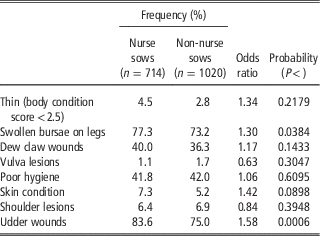
The numbers of piglets were significantly lower for the nurse sows compared with the non-nurse sows at the day of clinical examination (11.66 SE : 0.08 v. 11.28 SE : 0.05 piglets) (P<0.0001). The litter size decreased by 0.3 piglets/week of age of the piglets. The effects of being a nurse sow compared with a non-nurse sow, using models with herd as a random effect, are shown in Table 3. Of the 57 herds included in the study >70% of the sows had swollen bursae on legs, >75% of the sows had udder wounds and 42% of the sows were scored to have poor hygiene. The nurse sows had a significantly higher risk of swollen bursae on legs (P=0.038) and udder wounds (P=0.001). In addition, there was a non-significant tendency that nurse sows had a higher risk of poor skin condition (P=0.090). No differences were found between nurse and non-nurse sows regarding being thin, having dew claw wounds, vulva lesions, shoulder lesions or poor hygiene. There were some significant effects of sow parity and of piglet age. Higher parities had fewer vulva lesions and increased piglet age let to increased risk for the sow to be thin, having poor skin condition, having shoulder lesions and udder wounds while the risk of vulva lesions decreased.
Effects of being a nurse sow compared with a non-nurse sow on eight sow welfare parameters

Foster litters
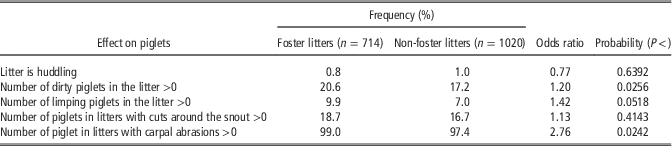
The effects of being in a foster litter, that is being nursed by a nurse sow instead of a non-nurse sow, are shown in Table 4 using models with herd as a random effect. From the data of all 57 herds, 98% of the litters had at least one piglet with a carpal abrasion, regardless of whether the litters were classed as foster or non-foster litters. Around 20% of the litters had at least one dirty piglet and at least one piglet with cuts around the snout. Foster litters had a significantly higher risk of being dirty (P=0.026) and getting carpal abrasions (P=0.024) than non-foster litters. There was a tendency for higher lameness in foster litters than in non-foster litters (P=0.052). No differences were found for risk of getting cuts around the snout and for huddling. No significant effects of the interaction between herd and nurse-sow were found in any of the models including herd as fixed factor (instead of herd as random factor). There were some significant effects of sow parity and of piglet age. Higher parity of the sow resulted in cleaner piglets, but more carpal abrasions, while the effect of increased piglet age was poorer hygiene of piglets, more cuts around the snout and more carpal abrasions.
Effects of being piglet in a foster litter v. in a non-foster litter on piglet welfare parameters

Discussion
Our study is a cross-sectional study based on clinical examinations. Behaviour observations in a longitudinal design would have improved the welfare assessment as not all welfare problems would appear from clinical observations. The selection of nurse sows is not made randomly by the farmer. In a questionnaire responded by 510 Danish sow herds the farmers were asked to indicate their selection criteria and they were given six possibilities: body condition score, number of active teats, number of piglets with sow (before weaning), size of the piglets weaned, age of the piglets about to be weaned and the temperament of the sow (Hansted, Reference Hansted2014). When asked whether each of the six selection criteria’s were important, the lowest level of response was 76% (sow temperament) and the highest was 95% (number of piglets at weaning). This indicates that farmers typically had several criteria for selecting nurse sows. Further analysis showed that selection criteria differed between farmers.
The predominant nurse sow strategy in the study was the so-called two-step strategy where piglets are moved to a foster sow at two stages – first piglets at birth are moved to a sow that has been nursing her own litter for ~1 week, and second her 1-week-old litter is moved to a newly weaned sow. The control sows were selected from the same farrowing section as the nurse sows in each herd. Middle sows, that is sows receiving new born piglets in a two-step nurse sow strategy were omitted from material. The comparison in each herd between nurse sows and control sows is thereby balanced as much as possible for bias due to different environment and different age of piglets. Age of piglets is further included in the statistical analysis.
The results show that nurse sows to some extent experience more welfare problems than non-nurse sows with piglets at a similar age. The risk of swollen bursae on legs and wounds on the udder was higher for nurse sows than non-nurse sows. Furthermore, a tendency towards a higher risk of skin lesions for nurse sows compared with non-nurse sows was found. Part of the explanation may be the longer lactation period for nurse sows. The results further indicate welfare implications for foster litters, as these had carpal lesions and were dirty more often than non-foster litters.
There are no investigations on behavioural responses of nurse sows and piglets. However, research on the behavioural effects of cross fostering of piglets shows that moving piglets into a new litter after the first 24 h of life results in disruption and a temporary instability of the teat order amongst the piglets and in a higher likelihood of teat fights during milk let down (Robert and Martineau, Reference Robert and Martineau2001). Such behavioural effects may also occur when an entire litter is transferred to a nurse sow since piglets will attempt to re-establish their previous nurse order, despite the fact that udder anatomy may be different with respect to position and number of functional teats. Cross fostering later than 24 h after farrowing, also results in more sows which direct aggression towards piglets (Pedersen et al., Reference Pedersen, Studnitz, Jensen and Giersing2008) and possibly also in a temporary stop in milk let down for up to 6 h (Price et al., Reference Prunier, Heinonen and Quesnel1994). These responses by the sow may be due to lack of acceptance of adopted piglets, disturbances and pain caused by increased teat fighting between piglets (Pedersen et al., Reference Price, Hutson, Price and Borgwardt1998) as well as stress caused by weaning of own offspring as suggested by Baxter et al. (Reference Baxter, Rutherford, D’Eath, Arnott and Turner2013). These negative effects of cross fostering are also, to some extent, present when cross fostering takes place the 1st day after birth, however, the response is significantly higher when cross fostering takes place later than 24 h after birth. A similar stop in milk let down has also been observed in nurse sows (Thorup, Reference Thorup2007), where an intact litter is transferred. Thus, the increased occurrence of carpal lesions and lameness in piglets of nurse sows and more dirty piglets among foster litters found in our study may be a result of piglet’s teat fights due to a combination of an attempt to re-establish the teat order and hunger. Detailed behavioural observations of suckling would help confirm this explanation.
These results should be seen in the context that nurse sows on average had fewer piglets than non-nurse sows. The difference in size of foster litters and other litters is intended as the farmers in general stated that they gave nurse sows fewer piglets than other sows.
The prevalence of carpal abrasions and lameness in piglets increases with age (Quinn et al., Reference Pedersen, Berg, Jørgensen, Bonde, Herskin, Knage-Rasmussen, Kongsted, Lauridsen, Oksbjerg, Poulsen, Sorensen, Su, Sørensen, Theil, Thodberg and Jensen2015). In our study we included piglet age as a covariate in our analysis. Carpal abrasions and lameness of the piglets are more prevalent in foster litters, which may be due to teat order fighting eventually reinforced by hunger experienced during the transfer period and is in accordance with our findings in this study. Hunger and teat order fighting may also cause the higher prevalence of dirty pigs in foster litters. The welfare implication for the nurse sow seen as an increased prevalence of wounds on the udder compared with non-nurse sows may also be explained by the occurrence of more teat fights in the litters of nurse sows, causing udder damage. Furthermore, a higher risk of swollen bursae on legs and a tendency towards a higher risk of skin lesions for nurse sows compared with non-nurse sows were found. The most likely explanation for the difference between nurse sows and non-nurse sows is the prolonged stay in the farrowing crate. Thus, the welfare risk of nurse sows relate not only to the transfer itself, but also to the extended confinement of the nurse sows. Jarvis et al. (Reference Jarvis, D’Eath, Robson and Lawrence2006) and Cronin et al. (Reference Cronin, Barnett, Hodge, Smith and McCallum1991) have demonstrated that extended confinement may lead to chronic stress responses. In general, the body reserves of lactating sows are depleted throughout lactation (Spencer et al., Reference Spencer, Boyd, Cabrera and Allee2003) and, it is known that poor body condition may increase the risk of shoulder lesions (Zurbrigg, Reference Zurbrigg2006; Knauer et al., Reference Knauer, Stalder, Karriker, Baas, Johnson, Serenius, Layman and McKean2007). Thus, we expected a higher incidence of shoulder lesions in nurse sows due to a longer lactation length and thus a higher risk of poor body condition. However, in the present study we did not find a higher risk of shoulder lesions in nurse sows compared with non-nurse sows. In a questionnaire survey in 888 Danish sow farms, 18% of the farmers mentioned good body condition of the sow as the major criterion for selecting a sow to be a nurse sow (Sørensen and Pedersen, Reference Sørensen and Pedersen2015). In addition, the body condition score of the nurse sow in the present study were similar to that of a non-nurse sow indicating that nurse sows, to counteract the negative effect of a long lactation period on body condition, may have been selected to be in good condition at transfer of the nurse litter.
Conclusion
The results show that nurse sows and their piglets to some extent experience more welfare problems than non-nurse sows with piglets at a similar age.
Acknowledgements
The authors wish to thank technician Pia Haun Poulsen for helping, planning and conducting recordings on farms and the participating 57 farmers in the study.