Introduction
Oak twig pruners, Anelaphus parallelus (Newman) (Coleoptera: Cerambycidae), oviposit at the ends of branches of living oaks (Quercus Linnaeus; Fagaceae), black walnuts (Juglans nigra Linnaeus; Juglandaceae), and other trees (Gosling Reference Gosling1978) from the eastern United States of America to Canada and westward to Texas, United States of America (Solomon and Payne Reference Solomon and Payne1986). Larvae feed on the woody portion of the stem, overwinter in the twig in a dormant state, and resume feeding in the centre of the twig the following spring. Early in the second summer, the larva will chew away the wood at the proximal end of the twig until it reaches the bark, fall to the ground within the distal portion of the twig when it is dislodged from the tree by the elements, and continue development inside the fallen twig (Gosling Reference Gosling1978, Reference Gosling1981). Larvae in fallen twigs may be depredated by vertebrates and arthropods, including parasitoids (Gosling Reference Gosling1978). Evolutionary explanations for pruning twigs are not resolved.
Here, we report emergence and parasitism rates from pruned oak twigs collected in 2012 in New York State, United States of America as well as the effect of twig diameter on larval mortality and adult emergence, which might aid understanding the evolutionary origins of pruning behaviour. Additionally, parasitoids and commensal arthropods collected from pruned oak and black walnut twigs in Pennsylvania, United States of America were documented and identified to species, when possible.
From 19 June to 5 September 2010, we collected 284 pruned twigs near the Borough of Kutztown, Berks County, Pennsylvania. A total of 61 pruned twigs, mostly from red oaks (Quercus rubra (Linnaeus)), were collected from Kutztown Park. Twigs were also collected from black walnuts (n=179) and oaks (n=23) along an access road on the west side of Lake Ontelaunee, 10 km southwest of Kutztown, from 20 June 2010 until 5 September 2010. The road was monitored two to three times per week. In all, 13 other pruned twigs were incidentally collected from areas near Kutztown.
Beginning 15 June through 22 July 2012, 118 pruned oak twigs were collected from the Penn Yan, Dresden, and Watkins Glen areas of New York State. All three sites were monitored at least twice a week for fallen twigs; the Dresden site was monitored almost daily. For both twig collections (2010 and 2012), we did not estimate how many individual host trees produced the collected twigs, nor were we able to determine where, in the tree, the twig originated. Any leaves were removed from collected twigs, diameter at the proximal end was recorded to the nearest 0.1 mm with digital calipers, and longer twigs were cut to a length of ~30 cm from the proximal end and placed in nylon mesh bags on the day of collection. The mesh bags were placed in plastic bins and stored in a basement at 12–20 °C for ~10 months. Twigs were dissected and examined for larvae, pupae, adults, parasitoids, or their remains, and commensal arthropods. Twigs that had cerambycid beetles other than the oak twig pruner emerge (see below) were removed from analyses on effects of twig diameter on emergence. Parasitoids collected in 2010 and 2012 were identified to species by J.J.D., manager of the Insect Diagnostic Laboratory at Cornell University (Ithaca, New York, United States of America). Voucher specimens were deposited in the Keuka College insect collection, Keuka Park, New York, and the Cornell University insect collection, Ithaca, New York.
The difference in twig diameter between oaks and walnuts collected in 2010 was compared with a t-test. The effects of twig diameter and date of collection on adult emergence and the incidence of dead larvae from twigs collected during 2012 were examined with binomial logistic regression. The difference in parasitism rates between twigs that contained at least one known oak twig pruner larva or pupa and those known to contain more than one beetle larva or pupa, of any species, were compared with a χ2 test.
There was no difference in the average diameter of twigs pruned from oaks (mean=9.3, SD=3.0, range 4.6–19.4 mm) or walnuts (mean=9.6, SD=1.9, range 5.4–18.3 mm) collected in Pennsylvania during 2010 (t 272=1.0, P=0.31). The mean diameter of oak twigs pruned in New York during 2012 was 8.5 mm (SD=3.0) and ranged from 3.1 to 15.6 mm.
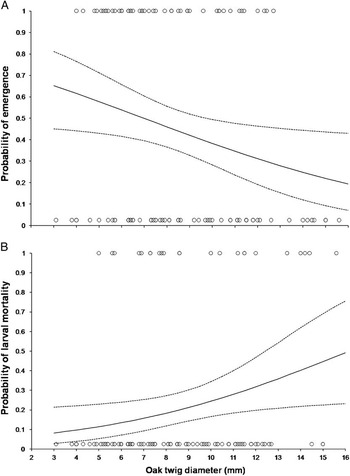
The overall emergence rate of oak twig pruner beetles from oak twigs during 2012 was 44%. As oak twig diameter increased, the likelihood of emergence decreased (Wald χ2=5.0, df=1, P=0.025; Hosmer and Lemeshow Goodness-of-fit: χ2=7.9, df=8, P=0.44; max-rescaled R 2=0.06; Fig. 1) and the likelihood of larval mortality increased (Wald χ2=5.1, df=1, P=0.024; Hosmer and Lemeshow goodness-of-fit: χ2=6.8, df=8, P=0.56; max-rescaled R 2=0.07; Fig. 1). The date of collection did not influence the likelihood of emergence (Wald χ2=0.02, df=1, P=0.54), the likelihood of larval mortality (Wald χ2=0.01, df=1, P=0.92), or twig diameter (F(1,108)=0.72, P=0.40).
The probability of oak twig pruner (Anelaphus parallelus) emergence (A) and larval mortality (B) in relationship to diameter of oak twigs in New York 2012 (n=118, note, some data points overlap).

Two parasitoids emerged from 87 oak twigs (2.3%) and eight parasitoids emerged from 187 walnut twigs (4.2%) collected during 2010. Three parasitoids emerged from 118 oak twigs collected during 2012 (2.5%). Collectively, twig pruners were attacked by parasitoids in Braconidae (Hymenoptera) (Atanycolus Förster, Eubazus denticulatus Martin, Hormiinae near Pambolus Haliday (a potentially new genus of wasp), and an unidentified species; all are new associations with the oak twig pruner), Cryptinae (Hymenoptera: Ichneumonidae), and Tachinidae (Diptera). Potential predators and commensal insects observed included Caenochrysis doriae (Gribodo) (Hymenoptera: Chrysididae), Trypoxylon frigidum Smith (Hymenoptera: Crabronidae), Pyticeroides laticornis (Say) (Coleoptera: Cleridae), Magdalis Germar species (Coleoptera: Curculionidae), Liopinus alpha (Say) (Coleoptera: Cerambycidae), Molorchus bimaculatus Say (Coleoptera: Cerambycidae), Anelaphus villosus (Fabricius) (Coleoptera: Cerambycidae), Mastogenius crenulatus Knull (Coleoptera: Buprestidae), and other arthropods (Araneae, Nabidae (Hemiptera), Forficulidae (Dermaptera), and Formicidae (Hymenoptera)).
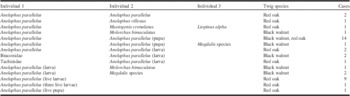
Occasionally, more than one larva or adult beetle, including co-inhabitants of different species, were collected from pruned twigs. Live oak twig pruner larvae were noted in twigs approximately a year after collection and, in three cases, parasitoids emerged from twigs that contained dead, intact larvae, indicating the presence of more than one larva in those twigs (Table 1). A small percentage of twigs were pruned at both ends, implying that multiple oak twig pruner larvae inhabited the same twig and completed sequential prunes. Considering only twigs known to contain one oak twig pruner at any stage of development during 2010 and 2012 (some twigs were empty when dissected), eight of 341 twigs (2.3%) were parasitised. Six of 26 twigs (23.1%) that held more than one beetle of any species were parasitised; this difference was significant (χ2=28.3, df=1, P<0.0001).
Descriptions of twig contents that contained more than one individual, live larva, or pupa.

Note: Individuals listed are adults unless otherwise indicated. Data are from 284 twigs collected in Pennsylvania in 2010 and 118 twigs collected in central New York State in 2012.
The lower rate of emergence in twigs of larger diameter in this study was correlated with a greater rate of larval mortality in such twigs. Similarly, twig girdlers (Oncideres cingulata (Say); Coleoptera: Cerambycidae) were more likely to emerge from honey locust (Gleditsia triacanthos Linnaeus; Fabaceae) twigs of smaller diameter (Coppedge Reference Coppedge2011) but this finding did not hold for the three other tree species examined. Larger twigs may provide more resources for developing larvae of twig girdlers (Cramer Reference Cramer1998) but no twig characteristic, of seven measured, was a strong predictor of the number of twig girdler eggs laid or hatched (Cramer Reference Cramer1998).
Forcella (Reference Forcella1982) found that the twig girdler (O. cingulata) chewed only through phloem tissues, which prevented nutrients from passing the girdling point. Because twigs were girdled when nutrients were being removed from leaves (September), timing of girdling resulted in optimal nutrient value of twigs (Forcella Reference Forcella1982). Nutrient reserves in twigs pruned by the oak twig pruner were not examined, but twigs are pruned by this species during July and August and fall to the ground rather immediately (Gosling Reference Gosling1978), precluding the buildup of nutrients. Alternate reasons, therefore, may better explain pruning behaviour in this species.
If larger twigs provide more resources for larvae – and support for female preference of large twigs is not universal (Cramer Reference Cramer1998; Coppedge Reference Coppedge2011; Paro et al. Reference Paro, Arab and Vasconcellos-Neto2014) – a possible explanation for reduced emergence from larger twigs is that they are better defended by the host plant (Palo et al. Reference Palo, Bergström and Danell1992). Girdling branches may help to overcome plant chemical defences (Paro et al. Reference Paro, Arab and Vasconcellos-Neto2014), including moisture levels and water potential (Hanks et al. Reference Hanks, Paine, Millar, Campbell and Schuch1999). The time required to complete a girdle is another likely cost associated with using larger twigs (Paro et al. Reference Paro, Arab and Vasconcellos-Neto2014), and larvae or adults might be pinched by twig or branch movements as the depth of the girdle increases (W.P.B., personal observation).
While the above considerations could not be addressed in this observational study, which included unnatural storage conditions and haphazard twig collection, the occurrence of multiple larvae in some twigs - including larvae of other species - suggest a complicated ecology. Gosling (Reference Gosling1978) collected cerambycids other than oak twig pruners from pruned twigs, but did not provide further details. Co-inhabitants of more than one species were also observed in other studies (Hovore and Penrose Reference Hovore and Penrose1982; Lemes et al. Reference Lemes, Cordeiro, Jorge, Anjos and Zanuncio2015). Interspecific competition for food or space within girdled twigs has been suggested or demonstrated many times (Linsley Reference Linsley1959; Rogers Reference Rogers1977; Hanks et al. Reference Hanks, Paine and Millar1993; Dodds et al. Reference Dodds, Graber and Stephen2001; Lemes et al. Reference Lemes, Cordeiro, Jorge, Anjos and Zanuncio2015). Intraspecific competition and cannibalism as a function of increased density has also been observed (Powell Reference Powell1982; Akbulut et al. Reference Akbulut, Stamps and Linit2004).
Our finding of a rate of parasitism an order of magnitude greater in twigs holding more than one larva or pupa is strongly suggestive of another general benefit of reducing larval density. Twig pruning behaviours might reduce costs of interspecific competition (Gosling Reference Gosling1978), intraspecific competition, and parasitism while securing adequate food resources, creating enemy-free or enemy-reduced space (Jeffries and Lawton Reference Jeffries and Lawton1984).
Acknowledgements
The authors thank Monika Zuefle for making the mesh storage bags and Brutus Brown, Matt Brown, and Jennie Heckscher for helping to collect pruned twigs. The editors and two anonymous reviewers helped improve the quality of this work.