


A major reassessment of the artistic achievements of William Herebert, one of the very few early fourteenth-century writers of lyric poems in Middle English that scholars can cite by name, has become necessary and timely in light of recent research that suggests the popular image of the friar as a dancing and singing preacher grew out of a system of education at the Franciscan Schools.Footnote 1 This article means to explore this theory by examining the painstaking and transformative means by which Herebert translated Latin chants into utterly characteristic English lyrics through his inspired deployment of music and scriptural exegesis. Specifically, we examine his two vernacular poems that exhibit the form of a carol, a genre that has undergone much reassessment in recent years, particularly with regard to how it was conceived and practised in England.Footnote 2 And because Herebert’s method of translation appears to have been guided by certain musical exigencies, we offer editions of two of his English songs, set to the music of their chants, along with critical study of his poetry. Studying these songs in their literary and historical context, we aim not only to settle the issue of whether or not Herebert intentionally transformed his chant translations into carols – an issue that has sparked one of the few scholarly debates concerning his work – but also to deal with the significant question of why a Franciscan homilist and theologian active around the turn of the fourteenth century might choose to create translations that resemble dance songs. In examining what he does to both texts and melodies, we find that we can reconstitute Herebert as far from an eccentric and lonely figure, privately jotting down unpolished verses in a highly personal Commonplace Book. Instead, evidence will show him to have been a pragmatic employer of his considerable education: on the one hand, as a participant in an international network of Franciscan intellectual and devotional community builders, and, on the other hand, as a conscientious priest engaged in his duties. His commitment to his priestly duties involving the care for souls led to, among other things, the creation of songs and other devotional texts similar to the ones preserved in contemporary pastoral miscellanies.
While we acknowledge the friars were not the only ones involved in compiling songs with materials that could be used in devotional settings,Footnote 3 their connection to the early monophonic carol is particularly strong, as David L. Jeffrey, Richard Leighton Greene, Frank Ll. Harrison and others have already shown.Footnote 4 We shall add to this discussion by arguing that during Herebert’s period of formation as a scholar and priest at Franciscan schools in Oxford and Paris, he would have been taught to emulate St Francis by thinking about preaching as an inherently musical form of art. Encountering stories about Francis’s genius for converting dance songs to religious use in florilegia that began to circulate in the 1240s almost certainly inspired Herebert to deploy an ingenious method of translation and contrafaction to popularise the spiritual content of an entire repertory of chants, refashioning them into forms readily accessible to his lay audience. In doing so, Herebert was moving in step, we believe, with the contemporary practices of his brothers on the continent, who were involved in the production of sacred dance songs.
Several bodies of contextual materials will need to be established before we can arrive at our editions and criticism of selected examples of Herebert’s musical and exegetical translations: first, the history and reputation of the carol and the literary traditions behind the materials in his Commonplace Book will need explanation, followed by a brief description of the historical circumstances in which the Franciscans operated. Then we shall arrive at the more specific reasons as to why Herebert might have decided to translate Latin chants into popular genres of English poetry. In so doing, we unequivocally cast Herebert as the hero of the story we are trying to tell; however, two other ruling spirits strongly influence this study: Francis, the intriguing founder of the order whom every Franciscan preacher was taught to emulate, and the remarkably incongruous figure of the dancing friar, who appears so often in the popular culture of the late medieval period that scholars must at least entertain the idea – and spectacle – of friars who dance. A further result of our investigation of Herebert’s translation methods, then, suggests a surprising displacement of dancing, or at least the concept of dancing, from the secular world into the very interior of the church, as a consequence of a radical reimagining of the liturgy as popular, immediate and stirring.
Herebert’s musical and poetic reimaginings would have had to engage with a largely hostile world. In an essay once attributed to John Wyclif titled ‘Of the Leaven of Pharisees’, written around 1383, the author scathingly criticises Franciscans for their sinful practices. He mocks them for whiling away their days with experiments, witchcraft and singing ‘veyn songis and knackynge and harpynge, gyternynge & daunsynge & oþere veyn triflis to geten þe stynkyng loue of damyselis, and stere hem to worldely vanyte and synnes; þei breken foule þer holyday and ben procuratours of þe fend’.Footnote 5 Who were these devil-baiting friars? Why would they provoke such vitriol? Certainly, by Wyclif’s day, the Franciscans were entrenched in English society as major contributors to its intellectual and spiritual life. The Franciscan movement that had swept across the European Continent in the early decades of the thirteenth century arrived in England in 1224 as,Footnote 6 in John V. Fleming’s words, ‘a “literary” apostolate, a ministry of song and story’.Footnote 7 Its economic and cultural influence soon took hold, and Wyclif’s observations concerning the friars’ full embrace of popular activities (and genres) seem to have some merit. The largest collection of Franciscan songs from his time is John Grimestone’s Commonplace Book (National Library of Scotland, Advocates’ Library, MS 18.7.21), dated 1372 – an author well known to scholars for his lullabies and Latin hymn translations and some of the earliest known carols.Footnote 8 But the love of song and dance that so vexed Wyclif did not begin here.
At least a generation earlier, the English Franciscans had become extremely prolific composers of homilies and songs in Latin and vernacular languages. The Red Book of Ossory, compiled by the Franciscan bishop Richard de Ledrede around 1316, includes no fewer than sixty examples of Latin and vernacular songs, which he instructed the clergy in his diocese to sing as contrafacta to the tunes of popular songs.Footnote 9 The friars of this period also included songs in examples of pastoral miscellanies, although they were by no means the only ones doing so.Footnote 10 The Fasciculus morum, for instance, a Franciscan preaching source copied around 1300, includes many rhymed couplets in Latin and Middle English.Footnote 11 Harley 913, known as the ‘Kildare Manuscript’, compiled in the 1330s by a Franciscan probably from Waterford, includes lyrics in Latin and Hiberno-English among its various homilies, moral and theological treatises and preaching exempla.Footnote 12 Oxford, Bodleian Library, MS Bodley 26, copied probably slightly before Herebert’s Commonplace Book, includes two English songs (without musical notation) among its many pastoral materials. ‘Honnd by honnd we schulle ous take’ appears between sermons, while ‘My doȝter, my darlynnge’ occurs within a sermon; both songs are in carol form.Footnote 13
Besides manuscripts with obvious Franciscan associations, others have survived, for instance London, British Library (hereafter BL), Arundel MS 248, that are remarkably similar to contemporary sources with more secure connections to Franciscans.Footnote 14 This collection dates from the late thirteenth century and includes twelve songs in Latin, French and English with musical notation, ten of them in a single quaternion nestled between various theological and moral treatises, sermons, exempla and other materials.Footnote 15 Several of the songs are contrafacta, including ‘Flur de Virginité’ and ‘Gabriel fram Evene King’ – loose verse translations of the Latin songs that immediately precede them in the manuscript, suggesting the vernacular was meant to be sung to the same music as the Latin. BL Sloane MS 2478 (c. 1300) contains a lengthy Middle English song surrounded by homiletic material in dramatic form.Footnote 16 In the middle of this feverish activity of lyric composition arises the compelling English poetry of friar William Herebert, whose chant translations show evidence of contrafaction, as he bends secular song forms to his rejuvenated didactic purposes.
Born probably in Wales no earlier than 1270, Herebert joined the Franciscans in Hereford. After a period of study at the University of Paris (c. 1290), he moved to the University of Oxford, where he incepted for his doctorate in c. 1317. He then served the Oxford Franciscans as lector in theology until around 1319.Footnote 17 The most important legacy of Herebert’s career is a Commonplace Book (BL Add. MS 46919). As Alan Fletcher has shown, such a compilation likely had a variety of purposes, one of them being a sourcebook for preaching.Footnote 18 Copied in Herebert’s own hand, it includes an Anglo-Norman grammar, six Latin sermons, six works on the knightly arts and twenty-three songs, most of them in Middle English, seventeen of them chant translations appearing in the final quaternion of the manuscript (fols. 205r–211v). As he notes himself, the majority of these songs are sense-for-sense rather than word-for-word translations of well-known Latin hymns, antiphons and responsories (see Figure 1).Footnote 19
Herebert’s Commonplace Book, image © British Library Board, BL Add. MS 46919 (1st half of the 14th century, before 1337), fol. 205r

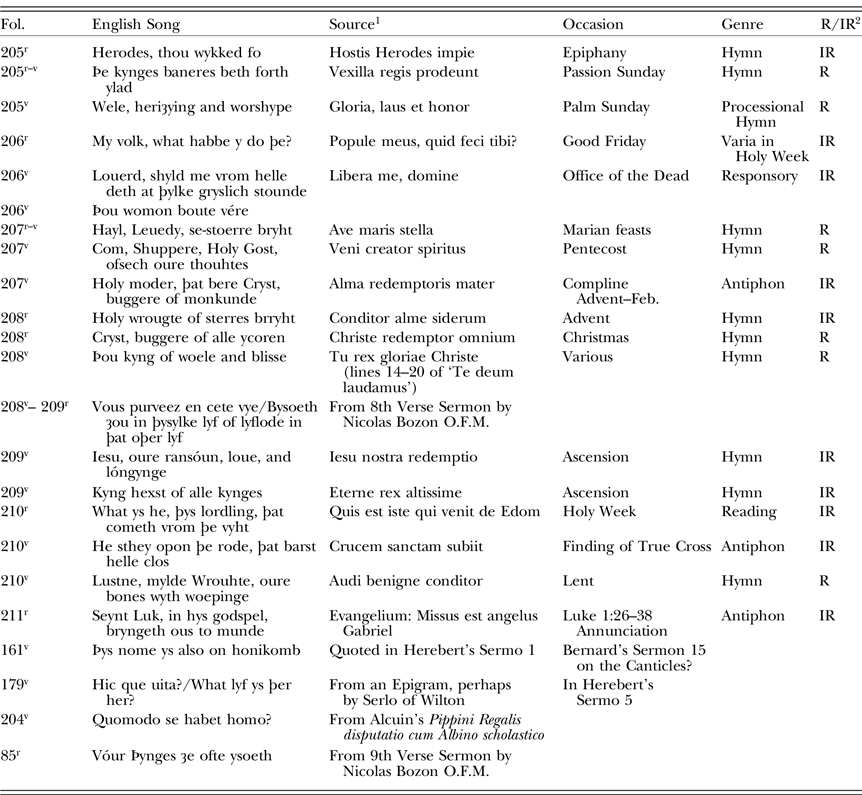
More than half of these English songs (see Table 1) cleave to the original form of the chant so closely that they may be sung to the original melody with little or no alteration. Yet Herebert also experiments with rhymes and poetic forms to yield songs that depart significantly from the original chant, reshaping them into song forms familiar in the secular world, like the carol and tail rhyme. Although he provides no instructions concerning how and where his chant translations might be used, songs in commonplace books usually seem to have provided material for use in preaching.Footnote 20 None of Herebert’s songs include music notation, but close inspection of his verse structures and of his process of translation reveals clues that suggest all of his songs were meant to be sung to some variation of the original chant melody. In this study, we shall focus on Herebert’s ‘Wele, heriȝyng and worshype’ and ‘My volk, what habbe y do þe?’
English Songs by William Herebert in BL Add. MS 46919

1 The music and texts for the Latin chants Herebert uses as sources for his translations are not found in BL Add. MS 46919.
2 R = Regular Contrafactum; IR = Irregular Contrafactum
Examination of these two examples will also contribute to the ongoing debate about Herebert’s adaptation of the carol form,Footnote 21 because they exhibit a burden-and-stanza structure similar to the virelai.Footnote 22 So far, critics have omitted to lay out the formal architecture of any of Herebert’s translations so that readers might see the nuts and bolts of a carol in the making. In contrast, we shall show that, when Herebert recasts ‘Gloria, laus et honor’ as ‘Wele, heriȝyng and worshype’, and ‘Popule meus, quid feci tibi?’ as ‘My volk, what habbe y do þe?’, he forges new texts that interrogate and otherwise interact with the texts he translates.Footnote 23 Furthermore, with his channelling of the music into his interpretive cause,Footnote 24 he revitalises generic pathways, cross-fertilising dialogues between sacred chant and secular dance song.Footnote 25 Both English songs reflect exegetical programs that reanimate their liturgical models in ways that were designed to appeal to a wide range of audiences, with varying backgrounds and levels of education, including (apparently) some audiences who could appreciate instances of rather sophisticated exegesis.Footnote 26
Turning to more musical terms, we argue that ‘Wele, heriȝyng and worshype’ might have been sung as a regular contrafactum (to use Friedrich Gennrich’s terminology), much as were the contrafacta in Arundel 248, because Herebert’s song has exactly the same form as the original chant.Footnote 27 The fact that the result is a chant that resembles an English carol might seem coincidental – after all, the Palm Sunday Processional and English song have the same refrain form. But ‘My volk, what habbe y do þe?’ explodes any theory of coincidence. Herebert achieves the transformation of this piece into a carol only by aggressively reshaping the Good Friday chant ‘Popule meus, quid feci tibi?’ In so doing he leaves clues that clearly indicate that his English translation was meant to be sung to a varied form of the original melody. In other words, this song was composed as an irregular contrafactum, to use Gennrich’s terminology.Footnote 28 So, if one places Herebert’s English songs in their proper historical context, one may see them as model participants in the burgeoning Franciscan mission of popular piety that used songs, especially dance songs, as a means of devotion to God through a restrategised secular genre.Footnote 29
The Carol form and its Reputation in England and France
Although French and English writers as early as the eleventh century had used the term ‘carole’ (kerole, quarole) to describe a variety of musical activities or ensembles, consensus appears to have rallied around the idea that chorus, chorea, carole etc. were related terms referring to a mode of dance.Footnote 30 John Gower’s Confessio Amantis (c. 1390) places the carol among other French lyric forms like the rondeau, ballade and virelai, which suggests it had a fixed form involving a refrain.Footnote 31 The carol is most closely related to the virelai, where the refrain functions independently of the stanza, whereas the refrain is integral to the stanza in the rondeau and ballade. According to Robert Mullally, there is no real evidence that the carole was a popular form of dance, but it is certainly the most common form of social dance mentioned in French literature of the late Middle Ages (c. 1150–1300).Footnote 32 Chrétien de Troyes and his generation of French court poets were among the earliest writers to depict the carol as a source of courtly diversion, and he portrayed it as practised and enjoyed by a wide range of social classes.Footnote 33
The origins of the carol in Britain and its place in medieval society has been the subject of much scholarly debate. Citing Herebert’s translation of ‘Gloria, laus et honor’, R. H. Robbins has argued that the English carol grew out of a liturgical tradition of singing processional hymns, while R. L. Greene asserts that the carol evolved from a popular form of dance song akin to the French virelai and Italian ballata.Footnote 34 Even in the polyphonic repertory of carols from the fifteenth century, David Fallows notes a ‘dancing manner’, the alternation between chorus and soloist and an overall sense ‘of a community taking part in the song’, which hearkens back to the monophonic repertory of the previous century.Footnote 35 The nearly five hundred songs Greene compiled in his Early English Carols exhibit remarkable uniformity amongst themselves and conformity with these continental dance songs, typically composed in strophic form, beginning with a refrain or chorus (what Greene calls a burden) whose text and music repeat after each solo verse.Footnote 36 In fact Greene goes so far as to proclaim, ‘That direct influence was exerted on the English song by the French may be taken for granted.’Footnote 37 Yet, despite the etymological relationship between the carol and carole, the existence of a vernacular refrain-form dance song in a pre-Conquest life of St Dunstan from Canterbury suggests it did not evolve directly under French influence.Footnote 38 Kathleen Palti’s research calls further into question French influence on the carol when she notes that, before the late fourteenth century, the term ‘carol’ was rarely used in English to define this type of song.Footnote 39 She writes, ‘The handful of carols that survive from the fourteenth century are too few and too disparate to represent a coherent genre, and are vulnerable to retrospective interpretation that seeks to find in them the origins of the fifteenth-century corpus.’Footnote 40 Recent critics have also challenged the idea that English carols had anything to do with dance; but their criticism largely concerns the polyphonic carols of the fifteenth and sixteenth centuries.Footnote 41 What of the earlier monophonic repertory?
When one reads the word ‘karole’ used in a sermon copied around 1360 (Oxford, Bodleian Library, MS Rawl. D.913) to refer to the well-known English song ‘Mayde yn the moore lay’, it would seem that the French term had by then made its way in English usage to refer to dance songs, which had already been thriving in English culture.Footnote 42 Copied earlier in the century, the text of the carol-form Christmas song in Bodley 26 evokes the concept of dancing, if not actual dancing, with the words ‘Honnd by honnd we schulle ous take’ – also suggesting this genre of dance song had made a transition from secular entertainment to a religious use. Louise McInnes reads this song as an example of ‘the Church’s attempt to incorporate popular song and dance traditions into the Church in order to exert control over a practice and engage the lay folk in the preachings of the Church’.Footnote 43 The practice has precedents. As Constant Mews has shown, by the late twelfth century, Sicard of Cremona and John Beleth witness ritual dancing among clerics using the Easter sequence ‘Victimae paschali laudes’ in round dances known as ‘chorae’ or ‘pila’.Footnote 44 The tradition appears to have continued in various places (e.g. Paris and Narbonne) for at least three hundred years, though it was not without its detractors. As Mews notes, ‘William Durand (1237–1296), canon of Narbonne and bishop of Mende, suggests that already there was unease about the practice being performed in the church.’Footnote 45
Likewise, reading descriptions of the carol in various twelfth- and thirteenth-century sources gives one the impression of a genre in flux, with a polarised and polarising reputation. Reactions to the genre move from fairly objective descriptions of courtly and urban spectacles to expressions of outrage at lapses in comport that amount, in the eyes of moralistic commentators, to sinful abominations. The literary evidence suggests that, in the cities, young men and girls of both low and noble birth danced and sang carols during times of celebration, and Ingrid Nelson notes that in some courts the ‘pleasures of song … were even deemed moral alternatives to sexual behavior’.Footnote 46 In urban settings, the open spaces of churchyards, cemeteries and city squares afforded carolers ideal opportunities to dance in circles holding hands, though tripping through narrow city streets or down pathways would suffice. In these more restricted situations, revellers could dance in linear processions in the style of a tresche;Footnote 47 in fact, the thirteenth-century Dominican Guillaume Perault describes the carol as a ‘procession’ in his Summae virtutum ac vitiorum (c. 1250).Footnote 48
As one can imagine, the sight of girls in motion, wearing lively costumes adorned with ribbons and gold, displaying faces gaily painted with cosmetics, provoked condemnation from many preachers, confessors and theologians of the era,Footnote 49 so that confessors’ handbooks in particular are full of criticism of carols as expressions of lust and vanity.Footnote 50 Perault, for example, abhorred the folly inherent in dancing the carol, while the English Dominican John Bromyard (d. 1352) decried carolling as a signal example of social evil in England.Footnote 51 The significance of dancers moving to the left in a clockwise fashion was not lost on moralists like Jacques de Vitry, who writes, ‘The chorea is a circle whose centre is the Devil, and in it all turn to the left, because all are heading towards everlasting death. When foot is pressed to foot or the hand of a woman is touched by the hand of a man, there the fire of the Devil is kindled.’Footnote 52
However, the accounts of carolling are not all one-sided or simplistic, and an important complicating factor in their evaluation may be the growth of Franciscan ministry in the West. For instance, in light of Perault’s heated invective one might be astonished to hear the music theorist Johannes de Grocheio extolling the virtues of carolling as a source of civic pride and moral rectitude in late thirteenth-century Paris. In his Ars musice (c. 1300) he writes,
a ductia is a cantilena light and swift in both ascent and descent, which is sung in caroles [in choreis] by young men and girls. … For this draws the hearts of girls and young men and takes them away from vanity and is said to be effective against that passion which is called love sickness [amor heroes].Footnote 53
Johannes here implies that a secular dance song actually has the potential to heal the soul. Is it any wonder, then, to observe a shift in prevailing trends in moral evaluation of the carole when one considers that its virelai form – what Guillaume de Machaut would later call a chanson baladée – was being adapted to religious use?Footnote 54
Reflecting on Wyclif’s invective against dancing, one might wonder whether the friars of Herebert’s and Johannes’s day ever participated in dances. The remarkable bas de page illustrations (Figure 2) from the Queen Mary Psalter (BL Royal MS 2.B.vii) of Franciscans and Dominicans dancing and playing instruments seem an irrefutable – if also fantastic – representation of just such a circumstance.Footnote 55 Remarkably, the Psalter’s images embody just the kind of joyous celebration described by Chrétien de Troyes, who writes particularly ‘puceles quarolent et dancent’.Footnote 56 In light of the climactic illustration of the series from the Psalter (Figure 3) – a choir of virgins carolling to an angel’s accompaniment on a Moorish guitar – one might conclude from the subject matter and progression of these illustrations that a form of dance song in a liminal phase of development from secular to sacred use not only existed but also was gaining some social acceptance around the turn of the fourteenth century, and significantly earlier.Footnote 57 Perhaps this is the transformation Johannes alludes to in his Ars musice – a transformation of the sort that brought spiritual comfort to the yearning soul. Considering this context, one might even expect to find among the works of Herebert early examples of sacred carols.
Queen Mary Psalter, images © British Library Board, BL Royal MS 2.B.vii (1310–20), fols. 176v, 177r

Queen Mary Psalter, image © British Library Board, BL Royal MS 2.B.vii, fol. 229r

However, overstating Herebert’s creative originality would misrepresent his achievement. It is tempting to position the variety of materials we have inventoried so far, such as anticlerical raving, genres in flux and fantastic-seeming and probably satirical images, against a seemingly isolated figure who records his translations as part of a vanity project like a scrapbook: an eccentric genius (or crank), alienated, atypical, even unique. Instead, a useful way to assess the Herebert phenomenon emerges from a full understanding of exactly why the Franciscans began to adapt dance songs akin to the virelai to their spiritual missions, a highly motivated program that is readily perceptible in the life of Francis himself together with the reactions of his followers to his deeds, sayings and attitudes. Through an examination of some of the earliest documents concerning the Franciscan movement, with a relatively narrow focus on instances of song and dance, we find that this program is embedded in the content of these foundational, multilayered records, as if the saint’s exemplarity were an acknowledged factor in even the first flowerings of the hagiography he inspired.Footnote 58 These stories were constructed by their authors as evidence of Francis’s sainthood, in part, but also as models of behaviour, as if events in his biography were being curated and carefully controlled so as to impel other Franciscans to imitate their patron in the writing of vernacular dance songs. Therefore, Herebert simply takes the most obvious saintly example for a composer of Herebert’s training, background and career choices to emulate and duly follows this lead.
Francis – Jongleur of God
Studying the vitae and florilegia compiled over roughly the century after Francis’s death in 1226 offer varying, sometimes competing, points of view that expose the Order’s struggle to grasp Francis’s complex spirituality. Yet his co-optation of vernacular song is a recurring and exemplary theme in the saint’s life and those of his companions. The first official vita, by Thomas of Celano, starts with Francis’s saintly persona caught in the grips of vanity.Footnote 59 But when he converted to a life of piety, as Thomas and other early biographers show time and again, Francis’s energy, wit, curiosity, outgoing behaviour, gift for singing and facility with fashionable cultural materials converted along with his soul so that he might wield them as powerful tools of his piety. Furthermore, seeing the Franciscan order from the perspective of the saint’s early biographers adds several dimensions to the evolving ideal of the Franciscan preacher.
Particularly informative are two stories that began to circulate through florilegia in the 1240s, which describe Francis’s use of French and Italian dance songs.Footnote 60 Holding these stories up for purposes of emulation, the biographers frequently invite readers to admire the saint’s ability to express spiritual ebullience through artful means. For instance, when his body exhibits the ‘melody of the spirit’ in the form of ‘a French tune’, he presents an example of how to channel the voice of God through multilingualism (French is not Francis’s native language), vernacular expression (versus Latin) and popular music.Footnote 61 His spontaneity in doing so enjoins others to deliver the Christian message at all times and in all places, while the omission of any text at this juncture invites followers to write the texts appropriate to the situations they encounter. When he picks up a stick from the ground, crosses it with another stick and mimes the act of playing a vielle while ‘sing[ing] in French about the Lord’, although his actions might seem at best eccentric and at worst absurd, he enacts spiritual reform through the spontaneous remaking of his followers into an audience, who could also dance to his new (and now sacred) French song.Footnote 62 His crossed sticks put the symbol of the cross into motion and more generally represent the spiritual repurposing of ordinary found objects, such as existing popular tunes. His ‘performing [of] all the right movements’, presumably of playing the vielle for a dance, ritualises through his saintly character an act of imitation, thus further implying that his followers should imitate him – and for the purposes of affect: when his ‘song of joy dissolved into compassion for Christ’s suffering’ he embodies the idea that the emotional appeal of a secular dance song in particular can be redirected into emotional reflection on the Lord’s suffering unto sacrifice.Footnote 63
Further events in the hagiography of Francis are, if anything, even more suggestive of exemplarity than the events already related. While recovering from an illness at San Damiano in 1224, he composed a ‘Cantico delle creature’, possibly in Italian, and taught it to his friars.Footnote 64 Then, in a state of exaltation after a spiritual epiphany, he sent for Brother Pacifico and, according to the authors of the Compilatio Assisiensis and the Speculum perfectionis, requested that Pacifico lead ‘a few good and spiritual brothers’ on a special mission to preach penance using the new song.Footnote 65 Almost certainly the saint’s choice of Pacifico occurs not only because the latter had led the order as provincial minister of France but also because he had been a professional musician.Footnote 66 At the end of his life and ministry, Francis now envisions someone else besides himself in the roles of performer and leader. No fewer than three florilegia report that the saint wished Pacifico to deploy his professional skills leading and perhaps even training his companions in methods of preaching and singing. The saint thus disposes the penitential message of reformed Christianity and skills in music as explicitly parallel to one another and identifies Pacifico as representing emulation: his inheritor, responsible for Francis’s reputation in posterity by spreading the word through followers. Presumably, penitents and followers would proliferate through the repetition of the saint’s message and other kinds of emulation of his conduct.
Francis’s power as a role model, particularly when he makes proselytising opportunities out of examples of vernacular dance song, grows as his life story unfolds, and reaches its apex when what one might call his jongleur-persona steps fully into the light: a complex story. Clearly his singing and dancing that we have examined so far appear to be modelled on something recognisable within the contemporary taste for French dance song; these actions also reflect Francis’s indulgent life prior to his conversion. His several song and dance performances suggest that he was mimicking the gestures of a jongleur, complete with an ‘air’ vielle, when Johannes de Grocheio identifies this instrument as the most common one used to accompany dance songs like the ductia, which is sung in caroles.Footnote 67 Two sources of Francis’s biography describe the process of formalising this jongleur-persona. His first explicit recognition of the persona appears as part of his reported instructions to his followers: he said, in the words of the Speculum perfectionis, ‘that he wanted that one among them who best knew how to preach, to preach first to the people’. After the sermon, all were to sing together the ‘Cantico delle creature’ (Francis’s recent composition) as ‘jongleurs of the Lord [joculatores Domini]’.Footnote 68 Matteo Leonardi argues, in his Storia della lauda, that the ‘Cantico delle creature’ was an important contribution to the late-medieval theology of praise, inspired perhaps by Francis’s reading of Psalm 148.Footnote 69 At the same time, it communicates in the nascent form of a lauda-ballata – formally related to the virelai – which, as Leonardi sees it, emerged from an artistic milieu in late-medieval Italy that included Latin hymnology, experiments with the vernacular among laity and translations of liturgy by the Benedictine monks of Montecassino.Footnote 70
Insisting that the friars win the souls of their audiences by using a lauda-ballata was not only innovative but also a crucial, pragmatic step in the evolution of a Franciscan preaching mission because, again, in Leonardi’s view, it made the spiritual content of the song more readily accessible to a lay audience.Footnote 71 In fact, it was a step the Franciscans would replicate in every culture they infiltrated in the course of their missionary work in late-medieval Europe.
Although Francis’s regard for and practice of preaching remain unrivalled, he makes a significant distinction in these late instructions. Instead of the sermon, the communal act of singing gathers his listeners together and hence hives them off from society as a separate group; instead of the sermon, a song stamps the growing order of friars with the founder’s famous adopted identity as a jongleur, which, for its second iteration (presumably its repetition occurs mainly for reasons of emphasis), appears in the saint’s own voice and thus gains even more authority for its community-making declaration: ‘we are joculatores Domini’. This paradoxical but resonant phrase demonstrates that psychologically realistic thought processes (unusual for a medieval work) are in evidence: the repetition of the phrase means that Francis’s choice of epithet seems calculated yet situational, intentional yet spontaneous and immediate yet part of a process. For instance, the saint moves from describing what his followers should do to describing what they should be, while he also seems aware that his pronouncements, like his singing and dancing, amount to performances.Footnote 72 He consecrates his own creation of a community by first giving it a name that would seem to emerge naturally as a descriptor of the tasks he wants his friars to perform: joculatores Domini. Yet the phrase is so striking (it is, among other things, a remarkable melding of sacred concepts of service with secular traditions of identifying profession and social class) that he seems to be understandably tickled with it, repeats it and illustrates its allegorical possibilities: ‘We are jongleurs of the Lord, and this is what we want as payment: that you [listeners] live in true penance.’Footnote 73 With the reference to payment, he confirms that his band of brothers is a confraternity, akin to a guild of professional jongleurs, and it is not far-fetched to picture Herebert thinking of himself as a member of this guild. Herebert, by transforming liturgical material into forms of secular dance song, was only following the example of his order’s founder, deliberately, methodically, painstakingly – and imaginatively.
Singing, Dancing, and Preaching after Francis
Herebert’s art had to channel other forces besides the influence and example of Francis. For instance, any friar of this era had to address the command of the tenth canon of the Fourth Lateran Council (1215). It required monks in conventual churches to contribute to the cura animarum, which set scholars at the Franciscan Schools in motion in order to prepare young friars for a career in the priesthood.Footnote 74 In the studium, Herebert would learn that music was essential to the study of theology and the mechanical sciences. He would also learn how to think about and practise the arts of preaching and singing chant.Footnote 75 For example, Bartholomaeus Anglicus’s De musica (part of the last book of his encyclopedic De proprietatibus rerum), composed some time between 1230 and 1247, taught students how to make analogical associations between several aspects of music and preaching, while Juan Gil de Zamora’s Ars musica and William of Middleton’s Opusculum super missam, both products of the 1250s, would support the liturgical reforms that Haymo of Faversham instituted a decade earlier.Footnote 76 Close scrutiny of the instructions William and Juan Gil offered students like Herebert in their treatises prove that they were following Francis’s model and putting his words into action, forging alliances between the practice of music and preaching.
William of Middleton completed his Opusculum probably in the mid 1250s while serving as regent master at the University of Cambridge. Clearly derived from Innocent III’s De missarum mysteriis and Alexander of Hales’s Summa theologica, William’s treatise has the look of a novice manual for ‘priests and simple clerics’Footnote 77 when he instructs the reader how to apply their knowledge of theology in order to open the minds of people (‘illuminatio populi’) to the events of Christ’s life by evoking the affect appropriate to each chant, prayer and reading.Footnote 78 Ars musica by Juan Gil de Zamora and Bartholomaeus Anglicus’s De musica are related treatises and offer even more convincing evidence that the Franciscans were integrating the study of music and preaching and passing this knowledge on to their students. Commissioned probably some time in the 1250s by the minister general of the order Giovanni da Parma, Juan Gil’s Ars musica informed Franciscan novices about the nature of music and offered them a primer on how to sing chant.Footnote 79 Discussion of the affective properties of music early in Juan Gil’s treatise leads to some detailed information about the church modes and other practical instructions about how to navigate the chant repertory using solfège.Footnote 80 The treatise concludes with an exact copy of Bartholomaeus Anglicus’s definitions of musical instruments from De musica, which Juan Gil probably read in light of its standard glosses, many of which concern preaching. Bartholomaeus originally composed De musica around 1240Footnote 81 for the students in his care at the studia in Paris and Magdeburg, but its broad dissemination throughout Europe in over two hundred and forty extant manuscripts suggests that its knowledge soon reached a wider audience, particularly in centres of learning like Paris and Oxford.Footnote 82 About a hundred of the manuscripts copied in the thirteenth and fourteenth centuries include over 11,000 marginal glosses, and of the fifty that accompany De musica, seventeen explicitly connect the science of music to preaching.Footnote 83 Reading Bartholomaeus’s text (much of it taken verbatim from Isidore of Seville’s Etymologies) through the eyes of the glossator puts us in Herebert’s shoes, learning to make subtle connections between disparate fields of science and preaching, navigating analogically the relationships between sound, human behaviour and biblical exegesis.Footnote 84
Armed with a rich understanding of the multivalent relationships between music and preaching, legions of young Franciscans would have entered their vocation as priests performing the cura animarum. Some of them, like Herebert, would cleave more closely to the model of Francis, assuming the role of the popular penitential preacher merged with the persona of the jongleur, rehabilitated as a singer of pious vernacular dance songs. And it was obviously a compelling model, judging from the number of followers who emulated it over the ensuing generations. Just as the order was experiencing its most precipitous period of growth in the cities of Europe, founding more than seven hundred convents within only sixty years of their inception,Footnote 85 one finds the Franciscans co-opting dance forms in Spain, Italy and England.
In the generation before Herebert, the number of Franciscan friars who are known to have combined a career of singing and preaching is small; just how they employed songs in devotional settings remains largely an open question. Still, there is at least one compelling story from the Chronicle of Salimbene de Adam that may serve as an example. Salimbene tells of events in 1233 surrounding a gathering he calls the Great Halleluia, where people of every social class, men and women, knights and soldiers, flocked to the cities of Italy to join processions celebrating various saints, to sing ‘songs and divine hymns’ and to hear preachers praise God.Footnote 86 In Parma, for example, they heard friar Benedetto, called ‘de cornetta’ because he carried with him a horn to animate his preaching.Footnote 87 Apparently, Benedetto belonged to no order, but, Salimbene says, he was ‘a very good friend of the Friars Minor’.Footnote 88 Dressed in black sackcloth, over which he wore a cloak in the manner of a priest’s chasuble painted with red crosses front and back, Benedetto would lead ‘great multitudes’ into the churches and city squares, ‘followed by children bearing branches of trees lighted with candles’.Footnote 89
On many occasions Salimbene says he observed Benedetto standing on the wall of the bishop’s palace in Parma, ‘preaching and praising God’ to the throngs in a responsorial fashion that adapted the form of the liturgical doxology to vernacular use. He would sing ‘Laudato et benedhetto et glorificato sia lo Patre!’, which the children repeated. And the vernacular paraphrase of the liturgy continued, with the children repeating the phrases: ‘sia lo Fijo!’; ‘sia lo Spiritu Sancto!’; and finally, ‘Alleluia! Alleluia! Alleluia.’Footnote 90 On this evidence alone Leonardi has argued that Benedetto and his audience were performing a kind of lauda, admittedly sui generis, without its usual metrical structure.Footnote 91 This performance began with a blast from the horn. Benedetto then gave a sermon, followed by a performance of the sequence ‘Ave Maria, Clemens et pia’ by Adam of St Victor. Salimbene records three stanzas of the sequence in Latin. However, Leonardi argues that the sequence, too, might have been performed bilingually, yielding yet another example of an early lauda. His evidence derives from a bilingual version of the same sequence copied in the 1230s in a preacher’s Commonplace Book.Footnote 92
For this and the other early laude that Leonardi examines, there emerges a recurring pattern of using such works in both paraliturgical and devotional contexts, and in both monastic and confraternal settings. He shows how these forms of sacred poetry evolved in the first half of the thirteenth century in the hands of Benedictine and Franciscan authors most particularly, so that by the time the famous Laudario of Cortona was compiled in the late thirteenth century, the genre had taken on a dramatic style and ballata form.Footnote 93 Surveying their contents shows that lauda composers were doing much more than translating Latin into the vernacular. They were actually creating a new kind of sacred dance song. In fact, by harmonising liturgical psalmody with the language of chivalry and courtly love,Footnote 94 and employing the musical style and strophic structure of sequences and hymns, authors of sacred laude drew at least some of the sacred and secular cohorts of society onto a common ground where they could interact. Moreover, as a sacred dance song, the lauda projected a rhetorical register that would suit the didactic purposes of Franciscan preachers. Leonardi writes, ‘transposing it into the form of a ballata, in fact, made the lauda easily accessible to the people, who already knew and valued the forms of dance song and often of the dance associated with it’.Footnote 95
Having established the broader circumstances under which Franciscan missions of music evolved on the continent, it is time to narrow our view to the unique set of historical circumstances that underpins our understanding of Herebert’s achievements. For his Latin translations must be examined in light of the clerical reforms John Pecham instituted shortly after his accession to the archiepiscopacy of Canterbury in 1279. Pecham, who joined the Friars Minor in Oxford around 1250, came to this post near the end of a storied career, having served as regent master of theology at the Universities of Paris (1269–71) and Oxford (c. 1272–6), provincial minister of the Franciscans, and lector at the papal curia (lector sacri palatii) in Rome.Footnote 96 His ‘Philomena praevia’ stands, from its time, as an outstanding illustration of the passionate, penitential style of Franciscan lyric exegesis.Footnote 97
With regard to how Pecham’s influence likely affected Herebert’s work, the archbishop is most significant for his commitment to clerical reform. To be clear, prelates of the English Church before Pecham’s time had already acceded to many requirements of the Fourth Lateran Council, having instituted reforms at the Council of Oxford (1222) and at councils held in London in 1237 and 1268. Yet it remained for Pecham to promulgate at the Council of Lambeth in 1281 a clear homiletic program for English priests. Known by its incipit, ‘Ignorantia sacerdotum’, the tenth chapter of the Lambeth Constitutiones would have ‘immediate and immense’ influence on didactic writing in England, says Decima Douie, and, according to M. D. Knowles, its effects would hold sway in England until the Reformation.Footnote 98
‘Ignorantia sacerdotum’ is a tersely worded piece of legislation aimed at reining in clerical corruption while at the same time taking a pioneering, radically progressive stance on the use of the vernacular. In the interest of disabusing priests of their errors and standardising their methods and styles of pastoral care, he commands them to expound among the masses at least four times a year the fourteen articles of faith, the ten commandments, precepts of the Gospel, acts of charity and the seven works of mercy, capital sins, principal virtues and sacraments.Footnote 99 And he explicitly states that priests must offer this bedrock of the faith in the vernacular. Lest anyone claim ignorance, Pecham touches briefly on each item.
Pecham’s qualifying statement that priests must preach in the vernacular ‘absque cujuslibet subtilitatis textura phantastica’ seems prescient. David Jeffrey argues that it gave the friars licence to include vernacular lyrics in their sermons, ‘to heighten the effect of their preaching’.Footnote 100 But Pecham’s caveat that priests should ‘explain to the people in the vernacular, without fanciful style of any subtlety’ requires further explanation. Why would Pecham offer such a warning? Were some priests of his time inclined to add fanciful embellishments to their sermons? One need look no further than the early biographies of Francis to find the answer. For, according to the author of the Compilatio Assisiensis, Francis was indeed wary of friars who might be tempted to abuse their learning for the sake of personal gain. Speaking, one suspects, from personal observation, the author warns of preachers who would embellish their sermons with stories about the deeds of Christian martyrs, the Emperor Charles, Roland and Oliver and the battles of paladins and knights, in order to puff themselves up rather than to illustrate the Lord’s many victories that resulted from these deeds.Footnote 101 Clearly, the model of Francis and the outpouring of Franciscan lyric from England and the continent shows that the friars in Pecham’s time considered the use of songs in their sermons (and potentially elsewhere) to be a virtuous art. So, perhaps one should read Pecham’s admonition another way – he actually meant that the content and style of priests’ sermons should be open and broadly accessible.
This is precisely the way writers understood Pecham in later recensions of ‘Ignorantia sacerdotum’. Archbishop Thoresby confirmed Pecham’s admonition of clergy at the Council of York in 1357, and John Gaitrik translated it in The Lay Folks’ Catechism. Thoresby writes, ‘capellanus parochialis et curatus alius, saltem diebus dominicis, sine exquisite verborum subtilitate exponent, seu exponere faciant, populo in vulgari’, and Gaitrik translates the passage as ‘Thurgh the consaile of his clergie,/That ilkane that vndir him has kepynge of saules,/Openly in Inglis upon sononndaies/Teche and preche thaim, that thai haue cure of,/the lawe and the lore to knawe god all-mighten.’Footnote 102 Yet, while Thoresby says priests must confine their usage to plain and unadorned speech, Gaitrik understands this to mean that the Archbishop ‘has ordained and bidden that thai be shewed/Openly on inglis o-monges the folk.’Footnote 103 Clearly, what English priests and lay people took away from Pecham’s instructions is that they were to use the vernacular, and that the style of their explanations must be plain-spoken and therefore accessible to the public.
As an English Franciscan priest, whose thinking had formed under Pecham’s immense influence, Herebert produced, we believe, English chant translations as creative and remarkably subtle responses to the commands of ‘Ignorantia sacerdotum’. His translations lay open to English audiences the content of seventeen liturgical chants by transforming them into didactic songs in a language nearly everyone could understand. And these songs would have encouraged people to sing. Indeed, at least two of them are in a form that most audiences would have recognized as dance songs – when, as Leonardi says of the laude, these were accessible and relatable to the public.
Herebert’s Carols
Debate over whether Herebert’s refrain-form songs should be called ‘carols’ has continued into the current criticism. R. H. Robbins, writing in the late 1950s, recognised the two songs we are examining as exhibiting incipient forms of the sacred English carol.Footnote 104 Kathleen Palti (writing much more recently) calls them carols, echoing R. L. Greene’s assessment that they have the necessary independent burden; but, because they do not ‘appear to imitate secular dance-songs’, Greene excluded them from his edition of Early English Carols. Footnote 105 Citing Greene, David Fallows also rejects ‘Wele, heriȝyng and worshype’ (Joy, praise and worship) as a carol because it is a straight translation – and indeed it is, of the Palm Sunday processional hymn ‘Gloria, laus et honor’ (see Table 2, p. 265 below).Footnote 106 However, we believe that Herebert, mindful of Francis’s example and creative bent and stretching the intellectual muscles his vocation and education had bestowed upon him, seized on the opportunity to translate this processional hymn precisely because it resembled the form of a secular carol. For, in his translation, he shows clearly that he was exploiting the resemblance between chant and dance song when making the content of the chant more accessible to a contemporary English community. Fallows also rejects ‘My volk, what habbe y do þe?’ (My folk, what have I done for you?) as a carol because it has irregular line lengths.Footnote 107 It is certainly a more complicated piece than ‘Wele, heriȝyng and worshype’, based as it is on the lengthy Improperia or ‘Reproaches’ sung on Good Friday during the Veneration of the Cross.Footnote 108 But irregular lines simply afford Herebert a challenge. By refashioning this chant into an English song that resembles a carol, he levers together two genres of music, popular and liturgical, even more forcefully than he does with the processional hymn, imposing a regular burden-and-stanza form on his translation that invites comparison with other carols.
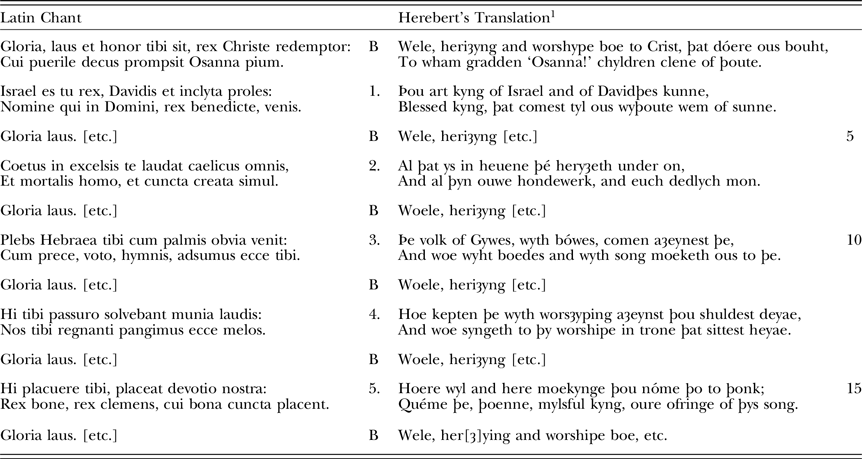
‘Gloria, laus et honor’ and Herebert’s ‘Wele, heriȝyng and worshype’

1 The Works of William Herebert, ed. Reimer, pp. 113–14.
Scholars after Robbins, beginning with Helmut Gneuss and R. L. Greene, have mostly argued against the possibility that these translations were sung, citing the general incongruence between English and Latin verse structures.Footnote 109 For any translator from Latin poetry into English poetry, the main technical challenge is to find a suitable English verse form for the translation. The search may involve many instances of trial and error because classical Latin poetic forms are based on quantitative metre, while English poetic forms are based on accentual metre and rhyme. E. J. Dobson and Frank Ll. Harrison follow Gneuss and Greene’s lead, offering Herebert’s translation of ‘Gloria, laus et honor’ as an example. They argue that
a translation need not be a contrafactum; an English verse translation of (say) a Latin song, even when on a superficial view it appears to be in the same sort of verse or stanza-form, may on a closer inspection prove to vary so much from the metre of its original that it could not possibly be fitted to the same music, any more than a prose translation could.Footnote 110
This argument neglects the wealth of evidence that medieval composers simply observed no such prohibition. Friedrich Gennrich, for example, has proven, using an abundance of evidence from the corpus of Latin, German and French songs, that medieval composers were surprisingly undeterred by differences in line length, rhyme or metre between their songs and the originals.Footnote 111 For the sake of comparison, we note that Helen Deeming had little difficulty creating her editions of the French and English contrafacta appearing in Arundel 248.Footnote 112 Reflecting on her process of adapting the syllables of ‘Gabriel fram evene king’ to the music of the Latin chant it translates (‘Angelus ad Virginem’) she writes, ‘slight adaptation for the English text … could easily be made by singers in performance … and is in keeping with practices in other English songs based on Latin originals’.Footnote 113 The research of Louis Peter Grijp on the large repertory of Middle Dutch contrafacta of the fifteenth and sixteenth centuries further shows that even a severe lack of correspondence between a new devotional song and its secular model proved no obstacle to contrafactors’ purposes. In fact, it appears they were more generally impressed with the subject matter of the original song than with the music, when literary content would have provided opportunities for clever and sophisticated textual interplay.Footnote 114
Gennrich’s examples of what he calls ‘irregular’ contrafacta – where the poetic structure of the new song differs from the original – show that, when singers required more notes, they simply divided longer note values, repeated notes or added more. Music could be removed to accommodate shorter texts; and when longer texts were applied to a song that had been melismatic, the extra syllables would take up the space of the melismas. What we see in Gennrich’s examples, then, are probably the remnants of an oral tradition among singers going back to time immemorial. The lack of any written instructions about how to create a contrafactum suggests the practice resulted from intuition. Yet, when publishers in the Netherlands began to bring their editions of devotional songs to market in the early sixteenth century, it appears that the laity who consumed them honestly required explicit instructions on how to adapt existing melodies to the varying exigencies of a new text. For this reason, such instructions as appear in devotional songbooks like Een devoot ende profitelyck boecxken (Antwerp: Symon Cock, 1539) may shed light on the practices singers had, to that time, been transmitting orally.Footnote 115 From these instructions, Grijp adduces four methods by which singers would create contrafacta, a practice that relies on simple repetition and omission of musical and verbal elements.Footnote 116 When the text of a contrafactum is longer than the tune to which it is assigned, rubrics instruct singers either to repeat lines of the melody or to omit lines of repeated text in the contrafactum. When the new song text is shorter than its model, rubrics instruct singers either to increase the length of the text by repeating lines of verse, or to omit repeated lines of music. On the basis of these instructions, Peter V. Loewen has recently reconstructed the devotional contrafacta of two Franciscan preachers active around the turn of the sixteenth century.Footnote 117 We propose that Herebert might have used a similar method to adapt chant melodies to his English translations, and this hypothesis has guided our editorial process in the figures below.
‘Wele, heriȜyng and worshype’
With the musical background and the genre of the carol considered, it only remains to address matters of Herebert’s compositional practice in the light of the literary history and poetic developments of the carol in England before proceeding to analysis of the reconstructed musical forms of his two carol chants. In general, decisions that he makes with regard to translation practice suggest he would not be shy in making bold decisions with regard to altering a poetic genre in order to produce his desired emotional and didactic outcomes. In fact, he often inserts whole meanings entirely of his own invention into his texts at rather consequential junctures,Footnote 118 and these interventions tend to produce finished, and quite complex, effects. For instance, in his translation of ‘Gloria, laus et honor’ (Table 2), composed by Theodulph of Orléans around 820, the changes to meaning in Herebert’s translation do not occur for merely technical reasons. Instead, these changes reflect more than usual thoughtfulness and care. Herebert shifts the overall mood of the original hymn from joyful celebration to a slightly more sober one. He then provides more emphasis on humanity’s need for God’s intervention into sin-prone lives than appears in the original. Christ’s role as redeemer in ‘Gloria, laus et honor’ is expanded to ‘[him who] dere us bought’ in the refrain of the translation, so that an acknowledgement of his suffering now intrudes into the original’s narrative. In the third stanza, ‘we … meketh us’ to Jesus appears, when there is nothing about humbling ourselves in Theodulph’s text. In the final stanza, God accepts the Jews’ ‘will and here mekinge’, when they simply ‘pleased’ him in the original. Thus the Middle English lines depict them as more subservient than the Jews that appear in the Latin lines.Footnote 119 The narrator’s request that the ‘offringe of this song’ please the ‘milsful king’ once again strikes a more submissive note than the original. So, for the most part, Herebert’s alterations to the original meaning of the hymn are strategic and follow a logical, thematic pattern.Footnote 120
In liturgical performances, ‘Gloria, laus et honor’ occurs when the Palm Sunday procession returns to the entrance of the church. Two cantors sing the refrain ‘Gloria, laus et honor, tibi sit rex Christe redemptor/Cui puerile decus prompsit osanna pium’ (lines 1–2) from inside the church, but behind closed doors, facing the rest of the processional group waiting outside (Figure 4). The hymn proceeds with the ensemble outside singing the verses in alternation with the cantors’ refrain. At the end of the hymn, the subdeacon knocks on the door of the church. The door opens, and the procession enters while singing the responsory ‘Ingrediente Domino.’Footnote 121 Obviously, these liturgical actions together with words and music enact a kind of re-marking out of sacred space,Footnote 122 and this ritual of conquest, an explicitly political and pseudo-military reconfirmation of the royal status of Jesus,Footnote 123 is expressed musically in the modal tension and parallel verse structures of ‘Gloria, laus et honor.’ Any overtly dramatic performances of the original chant would only heighten the emotions already on offer.
Herebert’s Commonplace Book, image © British Library Board, BL Add. MS 46919, fol. 205v: ‘Wele, heriȝyng and worshype’

Looking at the manuscript for Herebert’s Commonplace Book, one may observe evidence of the author working out his translation and rhymes (Figure 4). Beneath the Latin title ‘Gloria laus et honor etc.’, there are Latin incipits running down the right margin marking the beginnings of stanzas, offering a reminder of the chant source from which Herebert was working. Inside the Latin incipits are lines connecting the English rhymes of Herebert’s translation. The first incipit in the left margin indicates the insertion point for the original Latin refrain (‘Gloria laus’), just above the translation (‘Wele, heriȝyng’) that should be sung in its stead. Beneath them follow incipits for the new English burden (refrain) inserted after every subsequent stanza. Significantly, Herebert positions the refrains for his Middle English translations of hymns to the left of the main texts in his manuscript (in the fore margin), in the manner of other English transcribers of carols.
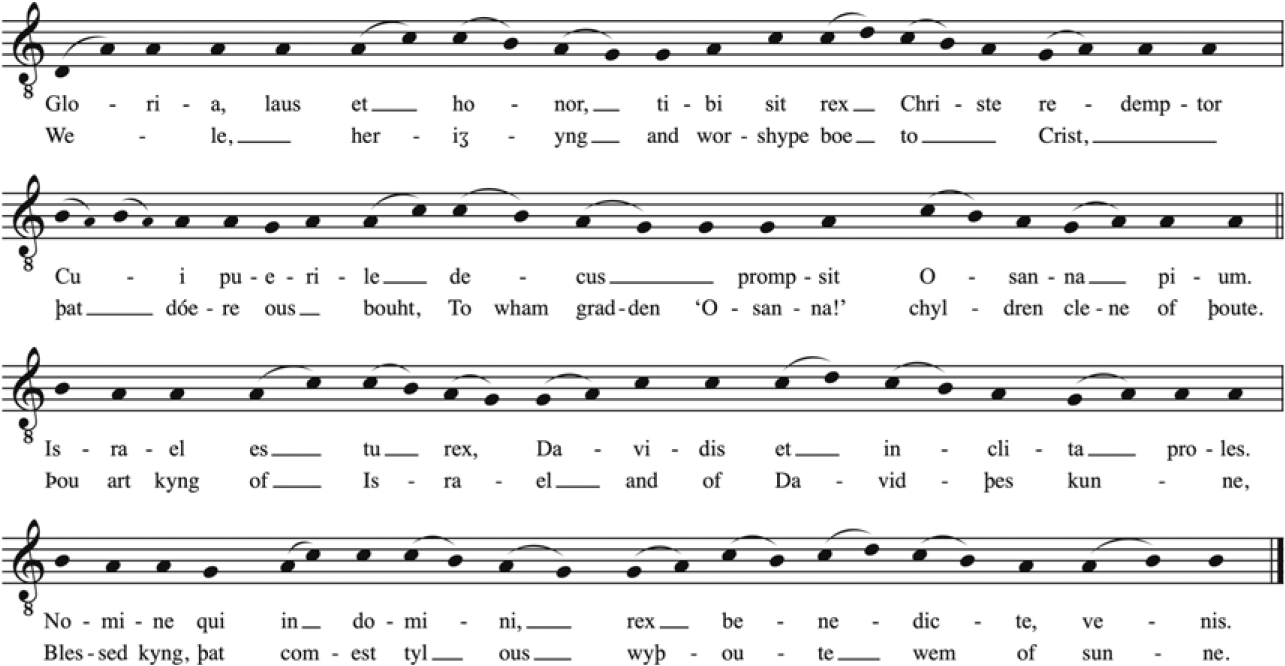
Our choice for an original chant source for ‘Gloria, laus et honor’ is Graz, Zentralbibliothek der Wiener Franziskanerprovinz, Cod. Fratrum Minorum Graecensis A 64/34 (fol. 64v–65r), a Franciscan gradual copied in the early fourteenth century (Example 1a), which reveals a largely syllabic text setting, with essentially the same phrase of music repeated, with variations, in each of the two verses.Footnote 124 Now, looking at Herebert’s translation, one can see that each line of ‘Wele, heriȝyng and worshype’ has only a slightly smaller number of syllables than the corresponding line of Latin. Therefore, singing Herebert’s translation to the melody for the Latin chant would have posed little difficulty. Making few adjustments, much as Deeming did in her contrafacta, we were able to place longer vocalisations on open vowels, where they also happen to occur in the Latin chant; and we have omitted repeated pitches, for example on ‘wele’ and ‘Crist’.Footnote 125 The result keeps the musical phrases of the Latin chant more or less parallel with the English, while preserving connections between poetic and musical ideas. Further adaptation of the chant melody to the exigencies of a dance led us to use rhythmic notation to emphasise the metre suggested by the English text (Example 1b).
‘Wele, heriȝyng and worshype’ to music of ‘Gloria, laus et honor’ in Graz, Zentralbibliothek der Wiener Franziskanerprovinz, Cod. Fratrum Minorum Graecensis A 64/34, fol. 64v

‘Wele, heriȝyng and worshype’ to music of ‘Gloria, laus et honor’ in Graz, Zentralbibliothek der Wiener Franziskanerprovinz, Cod. Fratrum Minorum Graecensis A 64/34, with rhythm

The music is in mode 1 – that is, ranging an octave above its finalis (d) and with a reciting pitch a fifth above (a). The refrain begins on d, but after a sharp leap up to a on ‘Gloria’, it continues to range between the reciting pitch and the octave above the finalis, climaxing on d′ in the second phrase on the word ‘Rex.’ Because of its repetitive musical structure, the same climax obtains at the end of each verse of the stanza, but on different words. In other recensions of the chant, the burden melody signals closure by ending on the finalis (d). But Franciscan chant books consistently end the burden on a, which builds continuity with the first note of each stanza and creates a feeling of suspense (or anticipation) at the end of the hymn. Saving the finalis for the beginning of the burden means that the musical gravity in the hymn falls on the word ‘Gloria’, and that the processional ends in anticipation of the finalis. The effect seems to emphasise the suspense of the moment in the Palm Sunday processional – awaiting the opening of the church doors and the d that opens the responsory ‘Ingrediente Domino.’
Contributing to the triumphant emotions surrounding this liturgical re-enactment of Christ’s arrival in Jerusalem is the hymn’s implication of the fulfilment of prophecy, an assertion that further draws attention to the hymn’s and procession’s performative articulation of the relationship between the Old Testament and the New, a relationship that helps to structure Theodulph’s original composition. Herebert goes even further. For his program of exegesis, he adopts the idea of the New Testament biography of Jesus as an interpretation and a rounding off of the narrative of the Old Testament; that is, as a perfecting or completion of the old law (Matthew 5:17–18).Footnote 126 Herebert then works the relationship between the Old Testament and the New into the very fabric of his poetry by employing one of his individual technical innovations: the past-to-present couplet. This is a pairing of poetic lines, parallel in their content, with the first line offering material from the past (usually sourced from scripture) and the second line offering material from the present day. The second line completes the couplet by rhyming with the first line and by recording a post-Resurrection concept that explains, fulfils or otherwise transforms the situation described in the previous line. The post-Resurrection idea that Herebert adds to the first verse, for instance, is that Christ ‘comest … sunne’ (line 4). In these lines and unlike in the original, Herebert emphasises the existence of a congregation in his own day by adding the phrase ‘tyl ous.’ He also adds to the original a reference to the Saviour’s sinlessness. This reference completely reinterprets the kingship of Jesus, mentioned in line 3, and works as an explicit echo of the messianic prophecies and descriptions of kings in the books of the Old Testament (line 4): ‘Thou art kyng of Israel and of Davidþes kunne’ (line 3; cf. Zechariah 14). Herebert further intensifies the parallelism between lines three and four by placing ‘Kyng’ in the same metrical position (the third syllable) in both lines. ‘Kyng’ also occurs on the same note in both lines.
In fact, ‘Wele, heriȝyng and worshype’ probably contains the most subtle use of Herebert’s past-to-present couplet. The original verse that describes the palm branches in the hymn that the Hebrews use to honour Jesus at his entrance into the city is ‘cum palmis obvia venit’, ‘with palms’ (lines 3–4; see Matthew 21:8, John 12:13).Footnote 127 In Herebert’s version, however, the palms become ‘bówes’, that is ‘boughs’. With Herebert’s spelling,Footnote 128 the term recalls the idea of bows as a means for shooting arrows,Footnote 129 and in any case, the term ‘boue’ conveys connotations much more reminiscent of weapons than palm branches or fronds would do (see 1 Maccabees 13:51).Footnote 130 Also, the ‘bówes comen ageinst’ Jesus. This is a remarkably aggressive image.Footnote 131 Such aggression is not in the Latin at all – not even implied. In ‘Gloria, laus et honor’, the Jews are not the persecutors of Jesus or otherwise negative in any way. At most one could observe that the Latin hymn implies in its fifth verse that the Jews at the Passion are in a different mood from the enthusiasm that they exhibited at the procession on Palm Sunday, but Theodulph does not stress the point. Herebert does. With the line ‘the folk of Jewes with bówes comen ageinst thee’, he recalls the various descriptions of the fractious tribes that fight against the people of Israel for the land that God has promised to his chosen people in the early books of the Old Testament (Genesis 15:7, 1 Chronicles 20:4–7). Then Herebert uses ‘ageinst’ (meaning ‘until’) in the line ‘Heo kepten thee with worshiping ageinst thou shuldest deye’ (line 4), as an intensifier of the Jews’ aggression. This term also functions as the verbal pivot of the line: ‘ageinst’ articulates an historical period of new knowledge against the old, in an example of biblical exegesis that endeavours to explain how perfected worship of Jesus can only occur after his death. Meanwhile, the term ‘kepten’ introduces the idea of routine into the Jews’ methods of honouring Jesus, while prefiguring in a cunning fashion his soon-to-occur captivity.
There are further instances of parallel structure in Herebert’s past-to-present couplets. By situating the Hebrews in a group that contrasts explicitly with the ‘we’ who sing the Lord’s praise in the line ‘And we singeth …’ (10), and by using the word ‘worship’ in lines 9 and 10, Herebert positions the Jews and his own singing community as parallel but contrasting.Footnote 132 He further refines his couplet structure when he places ‘worship’ as the sixth syllable of one line and the seventh syllable of the next one, so that each instance could be set to the same music, and further parallelism takes place when ‘worship’ appears at the seventh syllable in the second line of the refrain (line 2). Now that Herebert’s poetic technique has been at least partly explained, we need to identify the specific strategies behind his construction of carols.
In the burden and first verse of ‘Wele, heriȝyng and worshype’, Herebert makes two major changes to the sense of ‘Gloria, laus et honor’. In the first instance, he adds the idea that the children of the burden for this hymn are ‘clean of thought’ – a description utterly lacking in the original. He thus betrays a rather confessor-like concern with those who might be in a state of sin.Footnote 133 In contrast, the Palm Sunday greeters of Jesus in the Gospel have no particular reason to examine the cleanliness of their thoughts before singing ‘Hosanna’ – presumably, this new king has come to relieve political oppression for everyone.Footnote 134 So, with this addition, Herebert sharpens awareness of the liturgical context of the hymn at the expense of the historical context. The second instance has already been mentioned, and it reinforces the concern behind the first one: Herebert adds to the first verse of the hymn that the ‘Blessed kyng’ comes ‘till us withoute wem of sunne’ (line 4). Again this change helps him to mark out the structure of his past-to-present couplet. The original singers of ‘Hosanna’ could not have known (though they might have believed) that Jesus was God incarnate and hence without sin. Only the subsequent Resurrection and redemption of humankind could prove that he was more than the promised new king of the Jews. So, Herebert comes over as remarkably interested in what one might call the technical aspects of the state of innocence, while he explicitly connects the children of the refrain to Christ when both are accounted sinless (lines 2 and 4). Meanwhile, childhood is important to the idea of the connection of Herebert’s Middle English text to carols and dancing, because these are often associated with children and young people in the Middle Ages.Footnote 135
The original hymn includes many terms for voiced worship of the Lord: ‘laus’, ‘prece’ (both terms mean ‘praise’), ‘voto’ (‘prayer’), ‘hymnis’ etc. Significantly, in all of his English translations, Herebert tends to consolidate these kinds of terms (and others) down to ‘song’,Footnote 136 a term that has connotations of celebration (lines 10, 13 and 16), while, in its vernacular form, the music adds to the new rhetorical effect of the song itself by essentially converting it from a liturgical hymn into a sacred carol – a new genre. Indeed, Nelson concludes that Herebert’s reinterpretation and resanctification of song in this and other translations demonstrates ‘song’s potential for’ immensely powerful ‘affective expression’.Footnote 137 According to her, song is ‘able’ no less than ‘to reverse’ the letters in Eve’s name, ‘Eva’, which produces ‘Ave’, ‘hail’, and hence announces and participates in the advent of Christianity to the world and to the individual soul with the first word of Gabriel’s annunciation to Mary that she will become pregnant with the Christ child.Footnote 138 Thus, the incarnation can be interpreted as the ruling image of devotional poetry (and often of music), here working as a specific example of the way in which Herebert’s verse is able to meld spiritual and secular material, to integrate vernacular verse techniques with Latin ones and to pivot and move back upon itself in devices such as the past-to-present couplet. Mary as the new Eve was a favourite literary, theological and teaching device of the Franciscans.Footnote 139
Clearly, the music of ‘Wele, heriȝyng and worshype’ helps to shape Herebert’s interpretation of the Latin text. The combining of sacred with secular dance song – a powerful tool of Franciscan proselytising going back to Francis himself – must have helped Herebert communicate with his lay audience as he used music that re-sounded the authority of liturgy on behalf of a vernacular text that communicated spiritual values.Footnote 140 Therefore, it seems likely that Herebert includes the Latin incipits from the original Latin chants in the margins of his poems in his Commonplace Book in order to remind himself of the original texts, in both semantic and musical terms, while he read and (likely) sang his translations (more on his use of music later). Meanwhile the process of translation also produces laboriously structured verses, careful attention to liturgical chronology and exegesis that is explicit, multi-layered and sophisticated.
‘My Volk, What Habbe y do þe?’
Our second example of Herebert’s carols is ‘My volk, what habbe y do þe?’, his translation of the Improperia or ‘Reproaches’, sung during the adoration of the cross on Good Friday.Footnote 141 Looking at ‘My volk, what habbe y do þe?’ in Herebert’s Commonplace Book (Figure 5), one may appreciate the complications of Herebert’s translation, beginning with the layout of his folio. Under the heading ‘Popule meus quid feci etc. … in parasceve’, we see the English translation with marginalia on the right. The first of these – ‘Gyn nouþe [begin now] a[n]d onswere þou me’ – is actually the last line of what will become the song’s burden. Beneath it follow incipits for the first line of the burden, with lines indicating its insertion point after each stanza of the translation. Slashes in the left margin mark beginnings of stanzas, and to the right of the text one may observe lines connecting rhymes, much as Herebert does in ‘Wele, heriȝyng’.
Herebert’s Commonplace Book, image © British Library Board, BL Add. MS 46919, fol. 206r: ‘My volk, what habbe y do þe?’

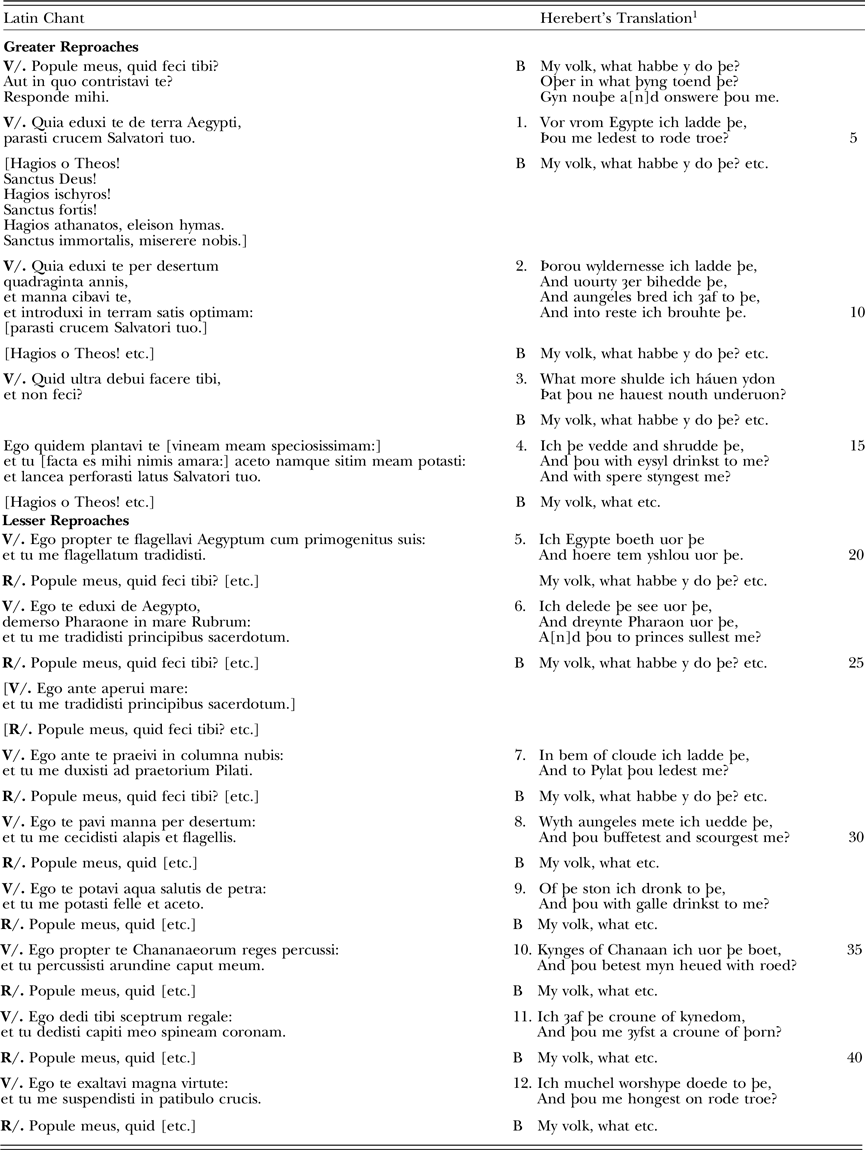
An overview of the original chant reveals a poignant drama, where Christ reproaches his followers for their ingratitude, and impresses upon them their guilt for having caused his suffering. The chant unfolds in two large sections, known generally as the Greater and Lesser Reproaches (Table 3). The Greater Reproaches begin with two cantors singing ‘Popule meus, quid feci tibi?’ (My people, what have I done for you?) and a verse beginning ‘Quia eduxi te de terra Aegypti’ (Since I led you from the land of Egypt).Footnote 142 There follows the Trisagion – a three-fold acclamation to God sung in both Greek and Latin by alternating choirs (‘Agios, o Theos/Sanctus Deus’). The Trisagion then forms the refrain sung between the following two verses: ‘Quia eduxi te per desertum quadraginta annis’ (Because I led you through the desert for forty years etc.) sung by two cantors in the second choir; and ‘Quid ultra debui facere tibi’ (What more ought I to have done for you? etc.) sung by two cantors in the first choir. After this point, the style of chant changes to simple recitation for the Lesser Reproaches. These verses are brief and formulaic, with recriminations beginning ‘Ego’ (I), sung by two cantors of the second choir; and ‘et tu’ (and you), sung by two cantors of the first choir. Between them, the choirs come together to sing ‘Popule meus …’ like a refrain.
‘Popule meus, quid feci tibi?’ and Herebert’s ‘My volk, what habbe y do þe?’

1 The Works of William Herebert, ed. Reimer, pp. 115–16.
As a piece of lyric exegesis, Herebert’s chant translation is entirely in keeping with the Franciscan tradition of Latin works like Pecham’s ‘Philomena praevia’, because it reflects the passionate, penitential style of typical Franciscan lyric exegesis. While ‘My volk’ may at first appear to be a surprising subject for a dance song, penance was the common theme of a growing body of sacred dance songs on the continent that followed in the footsteps of Francis’s ‘Canticle’.Footnote 143 A more extensive comparison of their form and content must remain for another occasion, though one might note that the Cantigas de Santa Maria and Laudario of Cortona were compiled around the time of Herebert’s period of activity and bear close ties to Franciscans in Spain and Italy. Juan Gil de Zamora contributed significantly to the corpus of cantigas, certainly as a theologian and perhaps also as a composer, while the friar Jacopone da Todi, the author of ninety-two authentic laude, was a contemporary of Herebert’s.Footnote 144
Just as Herebert does with ‘Wele, heriȝyng’, in ‘My volk, what habbe y do þe?’ he exhibits a pragmatic attitude to the content of the work that he is translating, though one must admit that critics have generally preferred the Latin to Herebert’s English version.Footnote 145 Certainly his translation of ‘principibus sacerdotum’ to ‘princes’ suggests a limited imagination at work: Herebert seems to be willing to alter the sense of a passage significantly just for the immediate convenience of employing an English word, ‘princes’, that parrots the sound of the original. Then, the organisation of Herebert’s translation is difficult to follow because he uses two-line, four-line and even three-line verses as opposed to a regular length of stanza, when the construction of regular stanzas would certainly be possible. Indeed, Herebert seems to feel the need to clarify his stanza lengths in his manuscript by enclosing the lines of his stanzas within a bracket at the end of each grouping of lines. Once, he also uses a double line in the left margin to show where a stanza would begin and therefore seems to contradict the intentions he indicated with the corresponding bracket. In short, the chant’s verse pattern would seem to be randomly varied, and Herebert seems to have been aware of its potential for causing confusion.
If this were not enough, both of Herebert’s three-line stanzas have their third lines beginning with ‘And’, and these ‘extra’ lines are both independent clauses that have only the barest narrative or logical connection to the previous ones. Nor is there anything in the two previous lines of these stanzas that would indicate that a third line is on the way. Moreover, the constant ‘ee’-rhymes and repetition of ‘thee’ would surely render the ending of a stanza’s structure even more difficult to predict, perhaps even impossible. In fact, this pattern of open vowels at the end of almost every line and such seemingly unsophisticated reliance on one sound in order to link the lines of the poem together would seem to confirm the critical views that dismiss Herebert’s poetry as ungainly, even incompetent.Footnote 146
By simplifying the musical form of the Greater Reproaches (see Examples 2a and 2b below), Herebert ameliorates the textual irregularities of his translation. Specifically, his strategic employment of a single refrain – a structural device he did not have to use – enhances one’s impression of a cyclical musical structure akin to the carol.Footnote 147 In fact, Herebert signals this more cyclical structure by adding ‘gyn nouþe’ (begin now) before ‘Onswere þou me’ (answer me) in the refrain. This addition implies that a series of Reproaches begins all over again after each reiteration of this command by Christ, which is exactly what the music indicates through repetition that occurs after ‘gyn nouþe.’ The concept of a series of beginnings as opposed to a progress fits the form of Herebert’s recasting of the Reproaches perfectly. The most obvious way that the series ‘begins again’ is with its repetition of items in the list of good deeds God has performed for the Israelites during their travails in the desert: the accounts of God leading the Israelites (lines 4, 7), feeding them with angel’s bread (lines 9, 26) and defeating tribal enemies (lines 15, 27) all appear twice in the series, when it is easy to imagine other favours being inventoried instead – the Old Testament is almost inexhaustible on this subject, even if one is limited to events that occur during the flight of the tribes of Israel from slavery. Repetitions, while a commonplace of liturgical practice, here help to suggest a situation of stasis, of being trapped in a cycle of the same material appearing over and over again. When relating the New Testament material, Herebert repeats the idea of leading several times. The ‘rode troe’ appears twice, as does the giving of vinegar to Jesus for drink (lines 13, 25). This strategic use of repetition is even more evident when the music repeats its patterns, too.
‘My volk, what habbe y do þe?’ to music of ‘Popule meus, quid feci tibi?’ in Graz, Zentralbibliothek der Wiener Franziskanerprovinz, Cod. Fratrum Minorum Graecensis A 64/34, fols. 78r–79v

‘My volk, what habbe y do þe?’ to music of ‘Popule meus, quid feci tibi?’ in Graz, Zentralbibliothek der Wiener Franziskanerprovinz, Cod. Fratrum Minorum Graecensis A 64/34, with rhythm

This situation is psychologically and liturgically appropriate for the reproaches. Jesus commands his followers to answer all the while that they presumably fail to do so, and Herebert’s Middle English version of the hymn stresses this aspect of the ‘dialogue’: the Latin Christ sings ‘Responde mihi’ (answer me), while in English Herebert underscores the imperative mood of the Latin saying ‘Gyn nouþe [begin now] a[n]d onswere þou me.’ A direct relationship between Jesus and the singers is intensified by his emphasizing of direct address: ‘þou’. Apparently getting no answers to his questions, he is impelled into the repetition of them, so that he complains like the rejected lover in troubadour lyrics about all the services he has rendered to his love object, with appeals to the love object’s presumed abilities to show pity, mercy and loyalty.Footnote 148 He not only wishes to seek answers, but also – exhausted, desperate and perhaps understandably unable to think of anything new – to delay his death through continuous speech. A further touch of psychological realism in the description of a dying man is that both of his recollections of his previous power, when he openly provides the Israelites with relief from obvious physical needs, nostalgically recall a time when he could lead them in a more undisputed and uncomplicated manner than occurred during his ministry on earth as a teacher, prophet and miracle worker. He identifies himself during the Reproaches unambiguously as the God of Israel and of the Old Testament (lines 4–8). He omits to refer to the feeding of the five thousand or any other of the miracles he performed during his earthly ministry. Nor does he claim himself as the Messiah.Footnote 149 The burden, along with participating in a kind of high-level exegesis, intensifies, with its relationship to the rest of the poem, the overall effect of Herebert’s repetition of material and promotes a stronger organic relationship between the parts of the original chant melody.
Furthermore, Herebert’s presenting of repetitions is not as artless as it appears at first blush. They continue, for instance, his apparent intention to render the relationship between Christ and his flock as more personal than might otherwise be the case. Jesus’ humanity, and hence the empathy of Christians for his suffering, receives emphasis when the second and last reference to the cross signals an important change to the original: ‘Ich muchel worshype doede to þe/And þou me hongest on rode troe?’ (lines 30–1). The action finally ceases to circle back on itself and advances: the crowd has moved from leading Jesus to the cross to hanging him upon it (lines 5, 31). His body has been pierced, there is now no possibility of further delay, and his death is now inevitable. The music expresses this turn by moving along a bit more quickly at this juncture than previously. The last three minor reproaches reflect the easing of the entire series into this major development in events by moving away from the doings of the Old Testament God to the much more generalised idea of worship (line 30).
This movement of the poem from considering the suspension of the concept of Jesus between human being and God to worship of his resurrected person is reflected in Herebert’s use of past-to-present couplets. In ‘My volk, what habbe y do þe?’, the clearest sign that Herebert produces the past-to-present couplet consciously as a poetic technique appears when he changes the tenses of all of the instances of Christ’s declarations of what humanity has done to him into the present tense.Footnote 150 Herebert writes, for instance, ‘Kynges of Chanaan ich uor þe boet;/And þou betest myn heued with roed’ (lines 35–6). The Latin is: ‘Ego propter te Chananaeorum reges percussi:/et tu percussisti arundine caput meum.’ Instances of actions in the past tense, as occur in the Latin Improperia, imply that the questions are spoken by a Christ who has already lived through his Crucifixion and been resurrected, and who then can redeem humanity and encompass all of Judaeo-Christian history in his person. Herebert, in contrast, recognises that, both from a historically accurate and a liturgically sensitive point of view, the Lord should speak his Reproaches, at this point in his life and in the liturgical calendar, in the present tense from the cross; that is before he has confirmed his divinity and status as Saviour through the Resurrection. For this reason, we believe, he methodically changes the verb tenses in the original.
Each verse of ‘My volk, what habbe y do þe?’ contains a particular event (or more rarely, more than one event) from the Crucifixion. Herebert segments Christ’s torture into a series of acts only loosely connected together, though tightly connected to corresponding Old Testament signs of God’s previous favour to the people of Israel. For example, in the first stanza, the past-to-present shift occurs on the verb ‘to lead’: ‘Vor vrom Egypte ich ladde þe,/Þou me ledest to rode troe.’ Not only are the leadership abilities of the Almighty contrasted with those of humanity with the use of the same verb for each half of each line, but also the music for each instance of the verb is identical and unusually elaborate. Herebert thus takes considerable pains to draw attention to the two parallel verbs and hence their tense change. The following stanza then sets ‘ladde’ once again to the same music, and further spotlights this verb through an echoing pattern of internal rhymes: ‘bihedde’ and ‘bred’. In the ninth stanza, the text parallels ‘dronk’ with ‘drinkst’; in the tenth, ‘boet’ with ‘betest’; in the eleventh, ‘ȝaf’ with ‘ȝyfst’. None of these examples of verbal parallelism have the same preponderance of emphasis as occurs at the second stanza’s use of ‘ladde.’ However, by this time, the past-to-present point has been made, so that audiences can be trusted to detect the remaining instances of verb patterns in the song without further prompting. In addition, Herebert omits the phrase ‘Salvatori tuo’, which appears as the climactic line in all three of the Greater Reproaches in Latin, again emphasising the humanity of Christ as opposed to his many miraculous powers.Footnote 151
By making these omissions and tense changes, Herebert depicts the events as happening more immediately: in the here and now. He portrays the Crucifixion as a more acutely performative act than any retrospective account suggests and as an immersive experience for any listener, an experience akin to the performances of the cycle plays, later in the fourteenth century.Footnote 152 However, use of the present tense is unusual in lyrics of this day, though an immediate, emotionally impressive Crucifixion is a frequent subject of compositions in the lyric genre. Almost all Middle English lyrics that deal with the tortures and sorrows of the Crucifixion portray them as steps toward forgiveness of sin. Particularly during the lyric dialogues between Mother and Son, Jesus often tries to comfort Mary with the information that, without his Crucifixion and death, there would be no saving of the world,Footnote 153 and, not surprisingly, almost all of Herebert’s twenty-three lyrics deal with redemption (‘Þe kynges baneres beth forth ylad’, line 7; ‘Herodes, thou wiked foe’, line 8; ‘What is he, this lordling’, line 6; etc.). In contrast, during the singing of any version of the Reproaches, an unspoken assertion looms over the proceedings: the implied reply to Jesus’ repeated question, ‘What more could I do that I have not done?’, is ‘You could take on humankind’s sins on yourself; you could die.’ But nowhere in the Reproaches does Jesus propose that he die, or acknowledge his redemptive power, or his ability to rise from the dead. Herebert, then, rightly recognises through his systematic changes of tense and his use of the past-to-present couplet that the Reproaches depict Jesus dying on the cross as messianic, not yet the Messiah; a great teacher, prophet and miracle worker, continuing to preach the lessons of the Old Testament even from the cross – but not yet the God of early and established Christianity who can only be recognised as God through his Resurrection. Thus, Herebert’s decision to alter the text’s tense comes over as a sophistication of the existing Responses rather than a simplification of them. For such sophisticated thinking and sensitivity to the divine to be in the repertoire of a well-known preacher, theologian and lecturer such as Herebert is not surprising.
Sophisticated thinking is also behind Herebert’s reconstruction of the musical aspects of the Improperia – again, not surprisingly, because, formally speaking, it is a much more complicated chant than ‘Gloria, laus et honor’. Transforming it into a carol requires drastic re-articulation of the original chant by imposing a regularly recurring burden on the entire verse structure. Therefore, singing ‘My volk’ to a varied form of the original chant melody requires more imagination than it does for the previous example.
The modifications Herebert makes to the form of the original text and chant clearly simplifies its refrain form. He does this by removing the verse beginning ‘Hagios o Theos!’ (i.e. the Trisagion) as the burden for the Greater Reproaches, and replaces it with the opening verse, which then returns later and regularly as the burden for the Lesser Reproaches. This has several important effects. First, it unifies the voice of the text. The Trisagion urges believers into an expression of worship and hence a very specific context for the Reproaches: faith, familiarity and community where one may consider and contemplate the meanings and consequences of the Saviour’s words with the benefits of hindsight. In Herebert’s Middle English version, Jesus’ thoughts totally dominate the discourse. Secondly and more consequentially, the genre of ‘My volk, what habbe y do þe?’ turns from a liturgical chant to a lyric poem. One may now see it as, for instance, a dialogue among the several aspects of Jesus, as opposed to a more generalised liturgical discourse including a typical instance of worshipful praise for the deity. Thirdly, this removal and replacement unifies the musical structure of the entire piece, removing the complication of having to sing two refrains, while giving the composition a form akin to the Middle English carol. Certainly, with this change, Herebert is making a self-consciously artistic alteration to his source.
Herebert’s rhetorical strategy becomes increasingly clear as one disposes individual syllables from his translation to the original chant melody, again taken from the Franciscan gradual from Graz (fols. 78r–79v).Footnote 154 Example 2a reflects our adaptation of Herebert’s text to the unaltered original chant melody to expose the problems we encountered while creating our contrafactum. Then in Example 2b we follow the same method we used when editing ‘Wele, heriȝyng and worshype’ as a dance song: altering the music wherever exigencies of the text required, and applying rhythmic notation to emphasise the metre inherent in the English verses for ‘My volk, what habbe y do þe?’
Admittedly, adapting the English text to fit the melody of the Greater Reproaches is more difficult than it is in the Lesser Reproaches, particularly in the first and fourth stanzas. During his translation of the three-line refrain for ‘Popule meus’, Herebert alters the sense of some lines, and these changes result in poetry that may seem rough on the surface,Footnote 155 but in the process of modifying the chant melody to fit the English text, one comes to view the chant differently, perhaps even as Herebert did – not as a series of reproaches suited to the vagaries of liturgical performance, but as a varied strophic song with one burden, like a carol.Footnote 156 Still, the close parallels Herebert forges between the chant and his translation show clearly, from the outset, that his choices were also governed by the structure of the original music. For example, the new English burden of twenty-six syllables adapts readily to the Latin refrain ‘Popule meus’, because it exceeds its model by only three syllables. These extra English syllables are easily disposed in the melismas so that, when sung, the English burden would come over as sounding exactly like the opening verse of the chant.
After establishing ‘My volk, what habbe y do þe?’ as the burden, there follow two stanzas, beginning ‘Vor vrom Egypte’ (stanza 1) and ‘Þorou wildernesse’ (stanza 2). While they may vary in length from each other, these English stanzas match almost exactly the length of their corresponding Latin verses, which makes text underlay obvious in most cases. Music from the verse beginning ‘Quia eduxi te de terra Aegypti’ is repeated in the corresponding line of the following verse, ‘Quia eduxi te per desertum’, which would confirm the impression of a strophic form in Herebert’s song. Applying the chant melody to the remaining text in the first two stanzas would give substantially different music. The auditory effect of new music, not to mention the varying number of lines, disrupts one’s impression of a strophic form. Herebert’s departure from his model at this point, inserting the burden from the beginning of the song, may be aimed at smoothing over this disruption by restoring one’s impression of a cyclical musical structure. The verse beginning ‘Quia eduxi te per desertum’ is longer than the previous verse, which requires more music to cover its thirty-six syllables of Latin. Yet, Herebert’s translation produces exactly the same number of English syllables, which means the second verse could easily have been sung to its Latin model without alteration.
The first stanza runs six syllables shorter than its corresponding Latin verse of twenty-three syllables, which might suggest the need for omitting repeated pitches and melismas. For example, some of the musical content for the word ‘crucem’ returns in the setting of ‘Salvatori tuo’, which suggests the music in this passage might be truncated while preserving the cadential phrase. When dispensing English syllables to the music earlier in the first stanza, one notices that the words ‘ladde’ and ‘ledest’ coincide with the distinctive ascending motif (c–e–g–a–b–a–g, first heard in the burden) on ‘ter(ra)’, which repeats on ‘(pa)ras(ti)’. Accordingly, the structure of Herebert’s translation suggests one should retain these repeating melismas (taking care to place them on open English vowels) to reflect the parallel relationship between these verb forms. In fact, deploying parallel musical motifs to draw the listener’s attention to the relationship between these words would add momentum to Herebet’s past-to-present rhetoric, heightening the drama inherent in Jesus’ monologue. The argument for Herebert’s strategic deployment of musical motifs for rhetorical purposes only grows stronger in the second stanza when one replaces the liturgist’s Latin with Herebert’s English, syllable-for-syllable. As one can see, the same ascending c–e–g–a–b–a–g motif from the first stanza would recur in the second stanza on ‘ladde’, offering further evidence that Herebert’s musical and poetic concerns are integral one with another.
One might wonder why Herebert departs from his plan at this point. After translating the first line of the third Latin verse ‘Quid ultra debui facere tibi’ to create the third stanza of his translation, he breaks the verse at ‘Ego quidem plantavi te’ to create the fourth stanza, with the burden inserted between them. He further alters the original chant by omitting the vineyard lines (‘vineam … amara’) that describe the planting of people as grapes in God’s vineyard, and how they have become bitter. Certainly, it makes sense to split the Latin verse at this point for rhetorical reasons, to emphasise Christ’s accusation ‘Ich þe vedde and shrudde þe’ (I fed and clothed you) at the beginning of a new stanza (4). But, again, Herebert’s decision to alter the original chant might also have been motivated by musical exigencies.
The chant melody beginning ‘Quid ultra debui’ fits Herebert’s English translation for the third stanza rather well. The music begins on c, like the burden, and shows other unifying features with earlier stanzas when it repeats some of their musical motifs: notably, the rising figure from e to g on ‘debui/Ich haven ydon’ is similar to the ones at ‘quid feci/habbe y’ (burden), ‘eduxi/vrom Egypte’ (stanza 1), and ‘eduxi/wyldernesse’ (stanza 2). The cadential figure in the third stanza is similar to the ending of the second, only this time it occurs with the mode-1 finalis (d). Dispensing the longer, eighteen-syllable English text to music occupied by fifteen syllables of Latin means that some pitches might be repeated, on ‘shulde’ for example, while two clives – a two-note descending neume – might be filled in, for example at ‘háven’ and ‘havest’. Using music rhetorically in this way draws attention to these two instances of the verb, as it did for verb forms in the previous stanzas. When the first line of the burden immediately follows the third stanza, so does yet another form of the same verb: ‘habbe’, which occurs at a prominent position in the line.
Recovering the melody to which the fourth stanza was sung requires more guesswork on our part because Herebert omits portions of the chant text in his translation. The music for the parallel Latin text is mostly unlike that of the previous stanzas, but there are two important similarities, which, when applied to his translation, would have helped him to unify it with previous stanzas. Most significant, and perhaps the strongest indication that Herebert’s translation method was guided by musical exigencies, is that when he begins the fourth stanza with ‘Ich þe vedde’, he fragments the Latin chant at ‘ego quidem plantavi te’, precisely where music repeats the opening phrase of the first two stanzas, thus helping to indicate the imposition of a varied strophic form. More difficult choices obtain when deciding how to splice together the remaining parts of Herebert’s translation and the accompanying music. Hewing closely to the original would yield short, mainly two-note, neumes if sung exactly like the original. Some notes could be omitted, particularly repetitions. Following the instructions for creating contrafacta available in the later Dutch publications, as Loewen has recently done,Footnote 157 one might omit the music for ‘potasti … perforasti’, because much of it is the same as the music beginning at ‘latus’. Preserving the cadential figure from the chant seems logical, again, because it repeats music from the end of the first stanza. Accordingly, our solution would give ‘Salvatori tuo/styngest me’ (stanza 4) the same music as ‘Salvatori tuo/rode troe’ (stanza 1).
Turning now to the music of the Lesser Reproaches, one encounters fewer problems in adapting the new English text to the original chant than one does in adapting the chant of the Greater Reproaches. Because the rhyming English couplets parallel the Latin verse form, and because the music is by nature formulaic and repetitive, adjusting it to meet the needs of the shorter English texts poses few difficulties. Following the inspiration of the chant composer, whose Latin verses also vary in length, one might adjust the number of repeated pitches as required by the text. This ensures that the essential rise from the initial c to e, the medial flex from e to d and the cadential descent from g to c are preserved. Even the longer sixth stanza has a similarly long English text to cover the essential melodic motifs. The effect of simple recitation at this point seems to emphasise the dramatic tone of the Saviour’s reprimand: ‘I (Ego) did this for you; and you have done this to me.’
Up to the end of Herebert’s translation of the Greater Reproaches, the text and music enact the drama inherent in the ritual of singing the chant. Having imposed on his translation the form of the carol, though, one might reasonably imagine motion in front of the cross: a dance of penitents, as it were, much as ‘Wele, heriȝyng and worshype’ evokes the procession or dance to the church on Palm Sunday. At this point, Herebert’s translation takes the character of a refrain and a simple recitation together, with initial, medial and cadential phrases made up mostly of repeated pitches. The recitation is not melodic in the same sense as the burden is in its interaction with the previous verses, but the overall effect of this remarkably original composition surely suggests both song and dance in the spirit of Francis’s playful yet profound devotion.
Conclusion
Siegfried Wenzel has argued against the possibility that medieval sermons could have accommodated singing because he believes they were essentially a spoken genre.Footnote 158 But we have shown that musical exigencies must have guided Herebert in the process of translating these chants into English, and we agree with Nelson that at least some of the time Herebert’s translation of Latin hymns had as its aim ‘the transform[ing of] the hymn into a workable text of performance’.Footnote 159 In Herebert’s translation process, the English carol emerges as another prevailing archetype of sacred dance song, one related to friar Benedetto’s vernacular adaptation of the doxology and a Latin sequence to the purposes of his preaching. The chant model for ‘Wele, heriȝyng and worshype’ already bears the burden-and-stanza form of the carol, not to mention its performance practices as a procession; the original music adapts readily to the new English text. But in ‘My volk, what habbe y do þe?’ Herebert changes his chant model radically, splitting stanzas and imposing a single refrain on his translation in order to create a song more akin to the form of a carol than to the original chant. Why go to such lengths if not to imitate a popular genre of dance song? Conjuring in the minds of his listeners the gestures of a carol would probably have resonated with his fellow friars, with his students and with the audiences for his sermons. Moreover, by composing sacred dance songs, Herebert was emulating the founder of his order, just as were the friars in Italy, Spain and presumably elsewhere in Europe.
Now, having shown that ‘My volk, what habbe y do þe?’ could have been sung to the melodies for the Reproaches, one would have to admit that it would have made for an unusual sounding carol. Looking again at the text and music in Examples 2a and 2b, one can see that the fifth through twelfth stanzas would sound completely convincing as a carol, on account of their strophic form with burden. With the imposition of the same burden on the translation of the Greater Reproaches, this section sounds like a carol, too, but with a highly varied strophic form, wholly unlike the Lesser Reproaches. Yet, in light of the roughly contemporary experimentation going on in Italy, involving the lauda-ballata, one might recognize in Herebert a kindred spirit, experimenting with rhymes, verb tenses, irregular stanzas and other musical and literary devices at an incipient stage of development in the sacred carol. There is no clear indication of how he might have performed his translations in the context of a sermon, but the varied form of ‘My volk, what habbe y do þe?’, broken into two distinct but unified parts, gives one pause to consider whether it might have been sung in more than one go. Certainly, this is the way Brother Benedetto’s performance unfolded, with the translated doxology sung before the sermon, followed by the sequence ‘Ave Maria, Clemens et pia’ (perhaps sung bilingually). And, as it happens, this is the case for many religious vernacular dramas from the continent, which often consist of interlocking strophic songs,Footnote 160 while there is at least one example of a dramatic sermon from Herebert’s time that interposes Middle English song: ‘The Caiphas Song.’Footnote 161
Earlier we proposed that an analysis of Herebert’s recasting of chants as carols provides a model that readers may use to interpret his other English hymns, antiphons and responsories. Our research thus far indicates that many of them are like ‘Wele, heriȝyng and worshype’, where the strophic form of the chant model readily adapts to Herebert’s English translation. For example, ‘Hayl, Leuedy, se-stoerre bryht’ could easily be sung to the Marian hymn ‘Ave maris stella’; ‘Þe kynges baneres beth forth ylad’ could be sung to its chant model, ‘Vexilla regis prodeunt’ – a hymn for Passion Sunday. But other chants that Herebert translated yield a varied form, like ‘My volk, what habbe y do þe?’, which makes the problem of adapting the chant melody much more difficult. For example, ‘Holy wrougte of sterres brryht’ deviates only slightly from the versification of the ninth-century Advent hymn ‘Conditor alme siderum’. But, formally, Herebert experiments extensively with lines and stanzas of varying lengths. Some stanzas have tail rhymes, which suggests that Herebert might have modified the chant melody to repeat like a canso or bar form (AAB), a remarkable corollary for the courtly tone of Herebert’s poetry.Footnote 162 And, just like his process of transforming hymns into carols, the partial secularisation of the form of his translation seems to have been inspired by the original’s content and by his innovative translation of that content. Certainly, he translates from Latin at a highly proficient level. He is willing to look for the exact sense and effects that he wants to achieve from outside of his original text. He is sensitive to context and connotations. In a more intellectual vein, he is willing to show off his theological and affective dexterity, for instance, interrogating the nature of God and trying to understand how his bodily nature relates to his immortal one, and how both of these relate to earthly time.
We realise that our argument is likely to prompt questions concerning practice. Did Herebert expect his English chants to be performed? If so, how? And does his use of carol form suggest dancing or evoke the concept of dancing? The short answer to these questions is that one cannot know for certain: there is no evidence of performance. In fact, there is no evidence for the reception of any specific example of his work, though presumably he had some success as a preacher and lecturer.Footnote 163 A reader may well then assume that the Commonplace Book was a private undertaking by Herebert, recording notes, jottings and more substantial pieces that were meant for his eyes alone. It is quite likely that he recorded the marginal notes of Latin incipits beside his English texts in order to remind him of the chants, and these now remain as remnants of his translating process. Nevertheless, any variation in stanza length or line length as occurs in ‘My volk, what habbe y do þe?’ has important consequences for imagining musical performances of Herebert’s Middle English chants – though trying to reconstruct performances of his texts is almost pure speculation. Furthermore, the imagining of a performance of one of his carols at one of his sermons, a logical extension of Pezzini’s characterisation of Herebert’s literary translations as related to the typical Franciscan’s vocation as a preacher, seems impractical.Footnote 164 Besides the adjustments an oral audience would have to make to each line owing to the varying numbers of lines in the stanzas of ‘My volk, what habbe y do þe?’, any such audience hearing this work for the first time would not know exactly when the refrain should be sung: after two lines of verse, three lines or four. Moreover, the poem moves from a two-line stanza to a four-line one, and then back to a two-line one: the most confusing possible pattern for performers and audiences, who would have to expect to insert a refrain at either position. A song with a simpler poetic construction like ‘Wele, heriȝyng and worshype’ is much more suitable than ‘My volk, what habbe y do þe?’ for spontaneous participation by an audience.Footnote 165 One is forced to consider the possibility, then, that Herebert might have sung these carols alone, perhaps in private, while musing over the associations he had crafted between these chants and secular dance songs.
However, one has to admit that group consumption of manuscripts was by far the most usual kind of consumption in the Middle Ages, and Herebert asks that whoever has the use of this volume after himself pray for him, suggesting that he had a wider audience in mind for his Commonplace Book when he wrote and copied its content.Footnote 166 Meanwhile, the subject matter of the hymns that he translates often describes or implies communal singing (‘Þe kynges baneres beth forth ylad’, line 26; ‘Holy wroughte of sterres brryht’, line 25; ‘Hayl, Leuedy, se-stoerre bryht’, line 25; ‘Crist, buyere of all icoren’, line 27). Nelson suggests that pseudo-liturgical performances of some of Herebert’s hymns in English were at least possible.Footnote 167 Helen Deeming seems to agree when she suggests that songs recorded in English pastoral miscellanies might have been sung liturgically ‘when local custom or necessity demanded’.Footnote 168 Or perhaps Herebert found an audience for his songs in his monastery or college, reading them aloud in the refectory, as Deeming has suggested for the performance of songs in other pastoral miscellanies.Footnote 169 There is also to consider the instance of friar Benedetto’s public sermon, which offers an example of how an audience might have participated. After some prompting and cajoling from the preacher, they might have joined in singing the burden after each solo stanza, as they were used to doing when performing a secular dance song.Footnote 170
Recovering the musical content of this early collection of English carols opens up a whole new repertory of music: not only can readers now more readily contemplate musical performances of Herebert’s emotionally wide-ranging lyrics, but they can also use interpretation of his practice of translating liturgical chants with their music as a model with which to interpret hymns, antiphons and responsories by other authors. Moreover, the gathering together of Herebert’s sacred English carols with the cantigas and laude broadens the picture of Franciscan musical achievement in the late thirteenth century. Adapting a melody created for one text to the purpose of another text was a practice tried and true among pre-modern composers. And so it hardly seems surprising, given what we know now about the creative spirit behind the Franciscan musical enterprise, that the order’s composers would refashion liturgical chants into sacred vernacular dance songs. This task would bring together two genres of music in which the friars were deeply invested, emblematic of their unique social status with feet firmly planted in both the secular and religious worlds. It is clear to us that Herebert engaged with both of these worlds in a thorough and thoughtful manner. He adopted the pedagogical model of Francis while also realising the legislation of John Pecham in pseudo-secular terms. Presumably from a motivation to teach people how to lead a better spiritual life, Herebert translated liturgical chants into Middle English lyric poems and thus made liturgical material familiar and homely, opening up difficult concepts to potentially a wide range of audiences. In the cases of ‘Wele, heriȝyng and worshype’ and ‘My volk, what habbe y do þe?’, the results of his translation process turned out to be carols – unusual examples of the genre, but carols nevertheless, another striking legacy of fourteenth-century Franciscan lyric production.