1 INTRODUCTION
This paper presents a combination of qualitative and quantitative analyses of general extenders in European French. General extenders (henceforth also referred to as ‘GEs’) are phrase- or clause-final constructions such as et tout and et tout ça in the following examples:
(1) (il) faut imaginer un petit peu ce que les gamins vont dire / parce que les gamins sont vachement méchants et tout / avec les noms prénoms et tout ça [‘Names’; Thomas, M25, R08]Footnote 1
(2) ma mère elle adore euh / rencontrer des gens que je connais et tout [‘Mother’; Emma, F27, R09]
The referent to which the GE is appended is also referred to as ‘operand’ (Dubois, Reference Dubois1992: 181) or ‘anchoring constituent’ (Ward and Birner, Reference Ward and Birner1993: 208), pertaining to a word or a set of words to which the general extender refers and which it extends. The operand can be either a specific nominal item (from a set), such as les noms, prénoms in (1), or another type of constituent over which the GE has scope, such as vachement méchants in (1), or rencontrer des gens que je connais in (2).
In recent decades, studies of spoken language have noted the importance of general extenders in discourse, shifting the focus of analysis from the structural to the interpersonal level in order to understand their role (Dubois, Reference Dubois1992 and Reference Dubois1993; Overstreet and Yule, Reference Overstreet and Yule1997; Cheshire, Reference Cheshire2007). Despite the growing interest, the literature has been largely preoccupied with general extenders in varieties of English, but their French counterparts remain understudied. Using the term particules d'extension, Dubois (Reference Dubois1993) examines extender variants in Québec French (e.g. des affaires comme ça, ci puis ça, tout le reste, tout ça), analysing their distribution and sociodemographic conditioning in apparent time. Studies of European French have been essentially qualitative, analysing GEs as a broader set of ‘terminating particles’ (Andrews, Reference Andrews1989) or as expressions positioned on a continuum between literal phrases and discourse markers (Ferré, Reference Ferré, Yoo and Delais-Roussarie2011). Due to the lack of quantitative studies, however, questions remain as to the distribution and preferred frequencies of GE forms in this variety. This study seeks to fill this gap, by (i) analysing the distribution of different GEs in three corpora of spoken French and making a brief diachronic comparison to show how the preferred forms might have changed (Section 4.1); (ii) examining the functions of GEs, focusing particularly on the most frequent form in young people's speech, et tout (Sections 4.2–4.3); (iii) considering whether et tout is grammaticalising from et tout ça (and possibly other longer forms starting with et tout, e.g. et tout le reste), whether shorter variants are more grammaticalised than longer variants, and whether the differential uses exhibit any particularities with respect to age (Section 5).
2 PREVIOUS STUDIES
General extenders have been described as constructions typical of spoken language in which they perform varied discourse functions. They also exist in written genres (e.g. etcetera, and the like, and so on), but tend to be much less frequent and less informal than in spontaneous speech. There is a consensus among most researchers that extenders are expressions serving to extend the set of referents announced by the previous word or phrase, or by a group of words or phrases. For certain variants, however, the set-marking function is reported to be attenuated / recessive (see Cheshire, Reference Cheshire2007; Pichler and Levey, Reference Pichler and Levey2011; Levey, Reference Levey2012). It is generally assumed in the literature that the existence of common knowledge shared by the speaker and listener is inherent in the use of general extenders (e.g. Dubois, Reference Dubois1993), and the role of the addressee is to identify the intended category behind them by drawing on pragmatic information (Channell, Reference Channell1994). However, invoking the existence of mutual understanding among the speakers has been called into question. As Overstreet (Reference Overstreet1999) explains, extender use marks an assumed reciprocity of perspectives rather than an actual piece of shared knowledge. General extenders are also often examined in relation to the degrees of formality in particular contexts. Stenström et al. (Reference Stenström, Andersen and Hasund2002: 86) explain that the less formal the situation, the more vagueness there may be. Jucker et al. (Reference Jucker, Smith and Ludge2003) argue that vagueness in language should not be understood as a deviation from precision and clarity, because vague expressions may be ‘more effective than precise ones in conveying the intended meaning of an utterance’ (2003: 1737). A vague utterance should therefore not be regarded as ‘approximately true’, because all utterances can only be an approximation to whatever thought the speaker has in mind, but rather as a set of ‘processing instructions that guide listeners to the most relevant interpretation of an utterance’ (Jucker et al., Reference Jucker, Smith and Ludge2003: 1742). In this regard, GEs are sometimes equated with discourse markers, especially because of their similar epistemic role and their non-truthconditional value in discourse. Some scholars therefore treat GEs as belonging to a larger set of discourse markers (Dubois, Reference Dubois1993; Aijmer, Reference Aijmer1985; Lemieux, Fontaine and Sankoff, Reference Lemieux, Fontaine, Sankoff and Sankoff1987) or that of ‘pragmatic operators’ (Overstreet, Reference Overstreet1999). Like discourse markers, GEs may be semantically/grammatically optional, and serve a pragmatic role by helping to express the speaker's epistemic stance, to mark inter-speaker solidarity as well as to punctuate individual segments of discourse.Footnote 2 However, discourse markers and GEs differ somewhat with regard to their structural position: GEs are less syntactically mobile than other discourse markers, and occur either phrase- or clause-finally.
The use of general extenders has sometimes has been associated with working-class speech, and in popular opinion has been stigmatised as vague, inexplicit or even inarticulate (Dines, Reference Dines1980). It is clear from other reports, however, that general extenders occur also in middle class speech and that the preferences for particular variants are usually socially conditioned (see Dubois, Reference Dubois1992; Cheshire, Reference Cheshire2007). The casual and colloquial character of GEs is among the possible reasons why their use is also systematically associated with youth speak. Winter and Norrby (Reference Winter, Norrby and Henderson2000 and Reference Winter and Norrby2001) show that the use of extenders (or, as they say, ‘set marking tags’) is a common youth feature, displaying parallel patterns across different languages: they are used in innovative ways, especially to express ‘meanings of participation, interaction and identity’ (2000: 8). This seems consistent with other quantitative studies, which revealed that the use of GEs sometimes displays the effect of age-grading (i.e. change in the individual speaker as s/he progresses through life), whereby their frequency peaks at adolescence and diminishes with increasing age (Dubois, Reference Dubois1992). Tagliamonte and Denis (Reference Tagliamonte and Denis2010) noted a case of restructuring in Toronto English which they define as ‘lexical replacement’, with the short variant and stuff becoming markedly predominant, especially among young people, and replacing variants with thing, which are preferred by older speakers. In fact, and stuff is claimed to be on the increase also in urban varieties of British English (see Cheshire, Reference Cheshire2007; Levey, Reference Levey2012). Note that although apparent-time studies (e.g. Tagliamonte and Denis, Reference Tagliamonte and Denis2010; Pichler and Levey, Reference Pichler and Levey2011) usually make hypotheses about language change based on age distributions, only studies involving the necessary real-time component (e.g. Dubois, Reference Dubois1992) can make solid claims about age grading and language change.
Like discourse markers, general extenders have come to be identified as a category commonly subject to grammaticalisation – a subset of linguistic changes whereby ‘a lexical item or construction in certain uses takes on grammatical characteristics, or through which a grammatical item becomes more grammatical’ (Hopper and Traugott, Reference Hopper and Traugott2003: 2). This process is usually associated with a series of changes such as decategorisation, phonetic reduction and semantic-pragmatic change (Bybee, Reference Bybee, Brian and Richard2003; Cheshire, Reference Cheshire2007; Pichler and Levey, Reference Pichler and Levey2011). Decategorisation, ‘involving the loss of morphosyntactic characteristics of source forms, and their extension beyond their originally defining morphosyntactic contexts’ (Pichler and Levey, Reference Pichler and Levey2011: 445), has routinely been measured in terms of the grammatical relationship of the GE and the referent to which it is appended. Assuming that the original function of GEs was the marking of a set, its ‘expected’ operand would be a noun phrase with the same characteristics as the GE (especially in terms of number, animacy and countability). Phonetic reduction, characterised by the loss of phonetic substance, may be assessed in terms of a hypothetical evolution of some variants that have structurally similar longer counterparts (et tout / et tout le reste). Examining three varieties of British English, Cheshire (Reference Cheshire2007) provides a list of short extender forms which, as she points out, may have grammaticalised from longer ones (and that / and all that, and stuff / and stuff like that, and everything / and everything like that, and things / and things like that, or something / or something like that). The application of the notion of phonetic reduction to general extenders has sometimes been criticised. Firstly, because the derivation of short variants from longer variants is questionable since some short variants feature among the earliest attestations of GEs (Pichler and Levey, Reference Pichler and Levey2011: 448), and secondly, because phonetic reduction in grammaticalisation is habitually characterised in terms of ‘segmental loss concomitant with shifts in morpheme boundaries (e.g. going to > gonna) rather than in terms of the loss of whole morphemes’ (see Pichler and Levey, Reference Pichler and Levey2011: 449, but also Tagliamonte and Denis, Reference Tagliamonte and Denis2010).
Finally, semantic-pragmatic change can be measured on a scale of functional extension, whereby some GE variants progressively develop new pragmatic and textual functions in addition to, or perhaps instead of, the putatively original set-marking function. Examining a geographically peripheral variety of Berwick English, Pichler and Levey operationalised this shift on a three-stage scale of functional extension: Stage (0) – set-marking (contingent on intersubjectivity); Stage (1) – set-marking and inter- personal/textual; Stage (2) – interpersonal/textual; and Stage (3) – punctor devoid of referential and pragmatic meanings (for details and examples, see Pichler and Levey, Reference Pichler and Levey2011: 452).
As shown below, extenders used by young adults in France exhibit several of the phenomena attested for English GEs, including a preference for particular variant(s) reflecting a possible effect of age-grading, but also signs of decategorisation, semantic bleaching and increased multi-functionality.
3 DATA
This paper analyses three separate corpora of spoken French, described as follows. The qualitative part of the analysis (Section 4) draws primarily on a previous study of selected discourse features used by young adults from or living in Paris (Secova, Reference Secova2011). The Secova corpus consisted of 14 native speakers of French (8 females and 6 males) whose conversations were recorded between 2007 and 2009. In order to achieve spontaneity and informality, participants were selected from an already known source rather than randomly; thus the so-called ‘friend-of-a-friend’ approach (see Milroy, Reference Milroy1980: 47) was adopted. Maximum effort was made to minimise potential effects of the Observer's Paradox (Labov, Reference Labov1972: 61), especially by conducting interviews in a known, comfortable environment, and usually with single-sex groups. The protocol was aimed at eliciting the speakers’ vernacular, i.e. ‘the style in which the minimum attention is given to the monitoring of speech’ (Labov, Reference Labov1972: 208). The speakers were therefore prompted to relate narratives of personal experience on topics such as family life, interpersonal relationships, housing problems, leisure or travelling. Importantly, the conversation was made to evolve according to the speaker's own interests and (s)he was never interrupted by the interviewer. The collected corpus constitutes a broad inventory of vernacular features associated with informal speech. In total, it consists of approximately 11 hours of casual speech representing 57,000 words in its transcribed form.
The selected participants were all French nationals, had a relatively similar socio-economic background (upper working class and lower middle class), were of the same ethnicity (white French) and of similar age (18–30).Footnote 3 The choice of this age range was partly influenced by the goal of the project, i.e. to examine certain frequent discourse features likely to be used among young adults. Speakers in young adulthood (Eckert, Reference Eckert and Coulmas1997: 157) are presumably less influenced by the – often arbitrary – linguistic fashions of the adolescent years, but probably continue to use pragmatic features typically associated with adolescence to a relatively large extent. As noted above, some innovative discourse features tend to display age-grading with an adolescent peak (see Dubois, Reference Dubois1992; Tagliamonte and Denis, Reference Tagliamonte and Denis2010), but these features, especially if they are below the level of social awareness, are still likely to be extensively used by young adults (see Wagner, Reference Wagner2008). This age group may thus be perfect for observing change if indeed it takes place and if innovative features spread in adolescence (for a discussion of the linguistic life course, see Eckert, Reference Eckert and Coulmas1997).
In order to situate the analysis within a wider context, the quantitative results of the analysis of the Secova corpus are compared with those drawn from two other corpora of spoken French: the Corpus de Français Parlé Parisien (‘corpus of Parisian spoken French’, see Branca-Rosoff et al., Reference Branca-Rosoff, Fleury, Lefeuvre and Pires2007) and the Beeching corpus (see Beeching, Reference Beeching1980). As explained below, the former is used for both distributional and multivariate analyses, while the latter is used only for a distributional analysis.
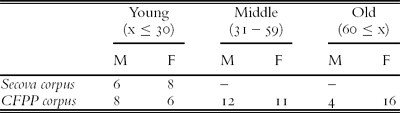
The Corpus de Français Parlé Parisien, henceforth also referred to as the ‘CFPP’ – is an ongoing project, with data collection beginning in 2006 in Paris and the adjoining suburbs. To date, it counts 535,000 words (37h75). The data were collected using the protocol designed for the Dynamique de l'agglomération parisienne (‘Dynamics of the Paris metropolitan area’, see Branca-Rosoff et al., Reference Branca-Rosoff, Fleury, Lefeuvre and Pires2007) research project, aiming to solicit information about the speakers’ experiences of and attitudes towards the city, and indirectly to gather information concerning their linguistic practices. The interviews were collected in self-selected pairs in participants’ homes, and their quality shows that the effects of the Observer's Paradox (Labov, Reference Labov1972: 61) were successfully attenuated. The speaker sample includes 57 speakers (24 males and 33 females) who have lived in Paris for most of their lives. Table (1) above provides a breakdown of speakers in the Secova and the CFPP corpora according to age and gender:
Speaker sample
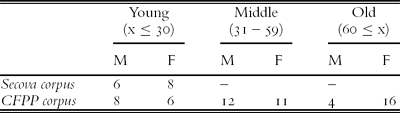
The corpora presented in Table (1) are comparable on the following grounds:
1) Geographical focus. Even though not all the participants in these corpora were native Parisians, they have lived in Paris for most their lives.
2) Timescale. The corpora were collected at approximately the same time, between 2006 and 2009.
3) Fieldwork techniques. The corpora were collected using similar protocol and data collection methods, which is also evidenced by the degree of spontaneity and informality of the interviews. Both corpora contain a rich repository of discourse-pragmatic features associated with casual speech (e.g. discourse markers, quotatives, general extenders etc.).
In addition, I discuss the general extender distribution in a diachronically older corpus of spoken French – the Beeching corpus, gathered between 1980 and 1990, and consisting of 95 interviews of varying length. The speaker sample includes 45 men and 50 women aged from 7 to 88. Even though a systematic statistical comparison cannot be made in this case due to the different geographical scope (the Beeching corpus includes interviews from several parts of France), these data provide a window onto the GE use several decades ago. To date there has been no diachronic study of general extenders in European French, and even though historical comparisons present many difficulties due to the diversity of collection methods and the extreme ‘context-sensitivity of discourse features’ (Pichler, Reference Pichler2010: 584), distributional comparisons can be made at least in order to establish whether innovative forms were present in speech at a given moment in the past.
4 GENERAL EXTENDERS IN FRENCH: FORMS AND FUNCTIONS
4.1 Formal aspects and distributional results of French GE forms
The selection of expressions that were included in the category of general extenders was based on the following criteria: a) in structural terms, they usually consist of a combination of <et/ou> + quantifier/generic noun + <comparative> (with brackets indicating optionality); b) they extend some set of referents (although this meaning may be bleached); c) they usually occur in a terminal position (i.e. in a phrase-, clause- or turn-final position); d) they are typically divided into adjunctives (et tout, et tout ça) and disjunctives (ou un truc comme ça, ou quelque chose comme ça);Footnote 4
In the data, there were numerous vague words (e.g. machin or truc) which met the selection criteria for general extenders and were therefore included in the analysis:
(3) (‘Mortgage’; Léa F25, Chloé F26; R05)
C: tu peux vivre sans ça toute la vie si tu veux
L: ben oui (.) mais bon après / quand tu vas avoir des gosses machin (. .) non mais / tout le monde rêve à (. .) à l'accès à la propriété je veux dire (. .) tout le monde a envie d'accéder à ça quoi (.) avoir son logement sa maison (. . .)
The term machin is ordinarily described as a vague lexical term referring to something or someone whose name does not come immediately to mind (e.g. tu peux me passer le machin là bas? – ‘can you pass me the thingy over there?’). In this case it is commonly used with an article and can be found in a subject or object position. However, when used without a determiner and in a clause-terminal slot, as in (3), it has the same semantic, prosodic and syntactic characteristics as a general extender, and is thus used functionally rather than lexically. In this case, machin seems to have undergone semantic bleaching and decategorisation.
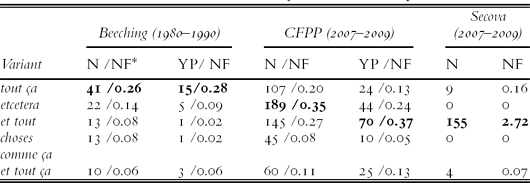
Table (2) below provides the distribution of the five most frequent forms in each corpus (the variants were ranked by frequency, and then listed as a subset of the most frequent forms having at least 40 tokens in either corpus). The exhaustive list of the GE forms in each corpus can be found in the appendix.
Overall distribution of variants across corpora

*N – total number for the entire corpus; NF – normalised frequency (p/1000)Footnote 6;
YP – total number for the young people subsample.
The table shows that the most productive variants are similar across the board, even though the frequencies differ. This is especially the case with et tout being prevalent in the Secova corpus overall, and among the youngest age group in the CFPP corpus. Interestingly, as evidenced by the Beeching corpus, et tout was not the predominant form several decades ago. We must be cautious in interpreting this as indicative of change, since the Beeching corpus may not be fully comparable to the two recent Parisian corpora (as explained in Section 3). However, it sheds light on the preferential patterns of GE use in a historically older corpus, which is instructive in itself given the lack of diachronically comparable data in European French.Footnote 5
The distribution above also concurs with previous studies that pinpointed the great variability and unbalanced distribution of general extenders, with a minority of variants being highly productive while numerous others occurring with very low frequencies (see Pichler and Levey, Reference Pichler and Levey2011).
In addition, general extenders have been reported to display great geographical variability. For example, there seem to be many differences between extender variants in Quebec French, as described by Dubois (Reference Dubois1992), and European French, presented here. Some very common Quebec variants (des affaires comme ça, toute l'affaire, choses de même, tout le kit, see Dubois, Reference Dubois1992: 202‒203) have not been found in the corpora analysed here. The other difference is that, unlike Dubois (Reference Dubois1992), I analysed the superficially similar tokens (e.g. tout ça / et tout ça) as separate variants, based on the assumption that shorter variants might be more grammaticalised than longer variants. Dubois analysed the variants collectively under the umbrella of their generic or quantifier (e.g. affaire, tout). The latter technique would be problematic for the present study as it would obscure the preferred frequencies and the possible grammaticalisation of particular forms such as et tout (since this variant was examined by Dubois under the generic tout). Dubois’ list also includes formulaic phrases such as j'en sais rien or tout ce que tu veux; phrases such as these occurred rarely in the present data and were excluded from the present analysis on formal grounds.
I now turn to a functional analysis of GE forms, followed by a detailed discussion of a particularly interesting form: et tout.
4.2 Functions of French GE forms
Politeness, familiarity and inclusion
General extenders form a distinct set of pragmatic expressions which usually reveal intersubjective links between speakers and contribute to a feeling of familiarity. Even though extenders seem to assume common knowledge between the speaker and the addressee by inviting the latter to extrapolate a larger category from what has been said, common knowledge is far from a being prerequisite for their use. Consider the following story that the speaker relates to someone whom he has met for the first time:
(4) (‘TV series’; Nathan, M28; Katy F26; Alex M28; R07)
N: tous les jours j'étais / chez ma grand-mère / voilà / et je regardais les petits épisodes / et j'avais ma petite banane et tout / j'avais les petits mikado (. .) et dès que ça partait je chantais_ je me souviens plus des paroles et tout mais avant je chantais_
A: xxx _ sans famille et je m'appelle Rémi (. . .)
As the context reveals, one can find attempts at creating rapport and constructing common experience even among speakers who do not know each other. This is consistent with Overstreet's (Reference Overstreet1999) observation that speakers use general extenders based on an implied assumption of shared knowledge rather than its actual existence. This characteristic also fits with Dines’ (Reference Dines1980) previous observation that the interlocutors never question or request clarification after hearing a general extender, but instead offer supportive feedback suggesting that they are following the conversation. Since extenders may be used to engender solidarity rather than invoke existing knowledge, they are inherently associated with positive politeness (see Brown and Levinson, Reference Brown and Levinson1987). The following extract is again illustrative of cooperation between speakers, but probably of very little shared awareness:
(5) (‘Questionnaires’; Fabien M24, Thomas M25, Researcher F27; R03)
F: mais je te dis (.) vraiment (.) tu fais des formulaires et machin / je l'envoie à quelques potes en France
T: moi je veux bien que tu me l'envoies
F: ils vont rigoler hein
The speaker suggests that his addressee (the researcher) make some ‘forms’ (e.g. questionnaires) for native speakers of French. He is not familiar with the design and the exact topic of the study and offers help with whatever machin (‘thingy’) the study might involve, thus inviting the listeners to interpret the general extender in their own way.
Hedging
General extenders often function as hedges serving to mitigate or weaken the strength or directness of the utterance they punctuate, or add another possibility to the one that was raised. In cases like (6) below, the statements would seem too categorical and specific without the general extender. Here the speaker offers her friend a medicine or possibly other alternatives (e.g. food, drink, other medicines), or perhaps she simply does not remember the exact name of the medicine she has at her disposal:
(6) tu veux pas prendre des efferalgans ou un truc comme ça ? [Emma, F27, R05]
General extenders usually accomplish hedging on two levels. First, as is often the case with adjunctive general extenders, the information conveyed in the utterance may be irrelevant or tedious to relate so the speaker may want to shorten it and move on with the topic, thus saving the face of the interlocutor, i.e. from imposition or unnecessary details (as seems to be the case with et tout in (4) above). Alternatively, as with disjunctive GEs such as ou un truc comme ça in (6), the speaker remains inexplicit by offering other possibilities for interpretation, thus saving his/her own face (see also Cheshire, Reference Cheshire2007 on positive and negative politeness).
Vagueness
General extenders cannot be considered as adding no contribution to communication. Jucket et al. (Reference Jucker, Smith and Ludge2003) argue that vagueness can successfully convey non-referential information, and should not be regarded solely as a deviation from clarity. However vague, GEs serve important pragmatic functions in discourse by providing cues for the interpretation of thoughts and concepts that may be too complex to define explicitly. Consequently, they have an impact on the unfolding of the conversation and on the negotiation of speaker relationships. Their absence in speech could possibly result in socio-pragmatic failure, i.e. utterances devoid of at least some degree of vagueness may appear too specific, categorical and blunt, and would thus place significant constraints on the interpretation of the message expressed. Recall example (3) above; if the speaker had not used the word machin, the message could have been interpreted differently, suggesting that the addressee will definitely have children in the future. Therefore, like discourse markers, GEs serve as instructions for interpretation and their meaning may thus be described as ‘procedural’ (see Mosegaard Hansen, Reference Mosegaard Hansen1998; Blakemore, Reference Blakemore1987). The fact that they may become bleached (i.e. devoid of lexical content) and adopt new discourse functions highlights a new division of labour that lies at the intersection of semantics and pragmatics; the pragmatic cues that GEs provide may override their referential function.
4.3 The rise of et tout: a case of change in progress?
Recall Table (2) above presenting the overall distribution of the most frequent extender variants in the compared corpora. While in the older corpus (Beeching) et tout was a productive but less frequent variant, it becomes the most productive form among the youngest age group in the two other – more recent – corpora. In the Secova corpus, et tout is not only the most frequent form used among the participants overall, but sometimes also the most frequently repeated expression in an individual turn, almost verging on redundancy:
(7) (‘Clothes’; Jeanne, F/24, R03)
J: elle voulait faire tout comme moi / et elle reprenait des expressions en fait / que que j'utilisais et tout / et genre elle s'habillait pareil et tout / genre elle me dit “mais pourquoi tu t'habilles pas pareil que moi” et tout
As I discuss below, this variant seems to exhibit the largest functional range and the most signs of having been grammaticalised. It is among the phonologically shortest forms (possibly a reduction from et tout ça and other forms starting with et tout), which may have extended their functional range to include a set of discourse-pragmatic functions and simultaneously undergone semantic bleaching. The examples reveal that et tout is a highly polyfunctional term whose different, context-dependent functions are not mutually exclusive (multifunctionality is an inherent characteristic of discourse particles in general). Let us discuss some of the most relevant characteristics of this form.
Like discourse markers, GEs appear to be inherently linked to the multiple ways in which speakers manipulate chunks of discourse. As we saw in (7), the structuring of discourse is particularity salient in contexts such as narratives and descriptions of phenomena external to the situation, i.e. where speakers do not talk about the ‘here and now’. This strategy can be accounted for using the typical structural frame of narrative discourse (see Labov and Waletzky, Reference Labov, Waletzky and Helm1967) in which speakers ‘work their way’ towards some most important event (i.e. climax) while the less important sections serve to prepare the scene for this event (this is usually called orientation). Et tout seems particularly useful in the construction of a narrative or an external description, in helping speakers interpolate chunks of descriptive discourse, demarcate individual units and shorten them in order to move on. Et tout may therefore be viewed as a segmentation signal dividing discourse into smaller, more easily processed units, and thus be considered as a punctor (see also Traverso, Reference Traverso2007: 45, Vincent and Sankoff, Reference Vincent and Sankoff1992). The use as a punctor has typically been considered as the final stage of the grammaticalisation process whereby the variant becomes completely desemanticised (see Pichler and Levey, Reference Pichler and Levey2011).
The non-specific character of et tout also makes it well suited for use in quoted speech, where speakers seek to reproduce someone's words in an authentic manner, even when they are unable to reproduce them verbatim:
(8) (‘Male friends’; Léa F25; R04)
L: mais t'as vu il m'a répondu sur MS- (. .) sur Facebook / ouais je dis “mais c'est qui ce keumé” Footnote 7et touteuh “Emma tu me caches des mecs” et tout / et le mec il répond il fait “oui c'est normal que tu ne me connais pas / ça fait dix ans que (.) avec Emma on s'est pas vu”
Making use of et tout to punctuate utterance units in narrative discourse can also be viewed as a floor-holding strategy. In the data, this construction seems systematically exploited as part of a scene-setting procedure, where speakers situate the background information and prepare the way for the main event or for the main point of their argument (the GE punctuates individual discourse units which may be produced as digressions from the main point at issue). If speakers need to be fluent and concise to hold the floor, then using longer variants such as etcetera or et tout ça as punctors may be more cumbersome for this purpose.
Et tout is not always used as a category-implicative expression, but may be used to highlight the importance of an idea by presenting something notable, surprising or excessive, and thus intensifying the effect of the preceding phrase upon the hearer. In this case, other variants such as etcetera, et tout ça or machin would be unsuitable:
(9) (‘Music’; Léa F25, Emma F27, R10)
L: <SINGING> (. . .) ouais c'est la chanson mais faites comme si j'étais pas là hein!
E: mais si / tu nous bien fais rigoler et tout!
(10) (‘Relationships’; Nathan, M28, R08)
N: donc c'est comme quoi / même quand t'es pas là et tout il fait des compliments sur toi (. .)Footnote 8
In this respect, et tout is similar to the English general extenders and all and and everything in having the role of intensifiers (see Overstreet, Reference Overstreet1999 and Reference Overstreet2005), possibly because they contain universal quantifiers (English all / everything, French tout) which have routinely been associated with intensification (Labov, Reference Labov and Schiffrin1984). Perhaps unsurprisingly, et tout may thus be favoured by young people as they have been reported to use more intensifiers overall (see Tagliamonte, Reference Tagliamonte2008; Macaulay, Reference Macaulay2006; Stenström, Reference Stenström, Hasselgard and Okesfjell1999, Reference Stenström and Kirk2000).
The data also reveals that et tout is often followed by mais. This association is, again, reminiscent of English and everything, which often co-occurs with but in order to emphasise the speaker's previous discourse and justify its result with respect to the presumed expectations of the listener (see Overstreet and Yule, Reference Overstreet and Yule2002):
(11) (‘Relationships’; Emma F27, R09)
E: non mais il était présent c'est-à-dire il m'appelait tous les soirs / enfin j'avais quelqu'un qui pensait à moi et donc on parlait et tout mais / quand- quand tu comptes que sur toi-même / c'est pas facile
By using et tout, the speaker demonstrates an acknowledgement of some fact (e.g. ‘everything you can imagine is true’), followed by an explanation of why the situation was contrary to what might have been expected. It thus presents an attempt to justify the speaker's own views, and may thus be an effective argumentation strategy.
Like most extender variants, et tout serves as a hedge, and can be accompanied by other particles with a similar function (e.g. enfin or bref) which indicate hesitation as well as the fact that the speaker may feel uncomfortable with the topic, either because it is unpleasant in itself or there are no better words to describe it appropriately. In this case, the piece of information preceding et tout tends not to be the most emphatic segment in a given utterance, and serves solely as background information for a more salient following segment. This function is also frequently exploited in narratives:
(12) (‘Theft’; Emma F27, Aurélie F28, Chloé F26; R01)
E: et en fait y'avait un gars à coté de moi qui était en / comment
un mec qui avait pas de papiers là (. . .) et du coup moi je lui ai parlé
j'ai dit “ah ça va” et tout / “t'es tout seul” machin
A: [quel] con
C: [NON] tu lui as PARLÉ mais c'est la première fois de ma vie que j'entends ça
E: ah si je lui ai PARLÉ au mec
C: c'est pour ça qu'il nous a braqué nos trucs là
E: et il m'a dit “ouais” machin chais pas quoi et après on a commencé à danser parce qu'on était ivres et tout (. .) et après–
C: ah mais tu abuses je savais pas ça / je croyais que c'était un inconnu qui est venu et qui nous a braqué (. .)
E: si je– non je lui ai parlé comme ça / mais bon
C: oh t'es naïve
E: et il m'a pris mon sac à l'arraché
The clauses concluded by et tout serve as a backdrop to the overall events that the speaker is about to relate, and replaces all the notions that would possibly be too long to describe or cannot be remembered clearly. The general extender offers the possibility of punctuating stretches of speech and moving on towards a more important point (in this case, perhaps, towards the climax and the resolution of the story). Et tout thus serves to maintain a certain level of conciseness and rapidity, sparing the listeners the unnecessary details that may hinder the overall effect of the narrative.
The versatile uses described here highlight the fact that et tout has very nuanced and largely overlapping functions, and it is therefore not unreasonable to speculate that it has increasingly become the preferred variant displaying signs of semantic-pragmatic change which is most conspicuous among young speakers. The comparison of distributional results in Table (2) above points in this direction; specifically, in the Beeching corpus, the term tout ça was considerably more frequent than the others, while the youngest age cohort in the more recent corpora (Secova and CFPP) shows a neat preference for et tout. Moreover, the detailed analysis of recent uses shows that this term has a wide array of discourse-pragmatic functions which other GE forms do not always have, and that it is semantically bleached in many of its uses. But while the qualitative investigation of spoken examples suggests that et tout may be subject to change, this hypothesis also needs to be tested statistically in a number of ways. In the next section, I discuss the results of several multivariate analyses of the Secova and the CFPP corpus with a view of gaining further insight into the external (social) and internal (linguistic) conditioning of the use of et tout.
5 MULTIVARIATE ANALYSIS
5.1 Methodology
The quantitative part of the study presented in this section adopts a ‘variationist’ approach (see Labov, Reference Labov1972, Reference Labov1980) aiming to correlate linguistic features with various extra-linguistic variables; a method which is used to establish regular sociolinguistic patterns and to shed some light on the processes of potential language change. It is based on a series of variable rule analyses, used in sociolinguistics in order to ‘separate, quantify, and test the significance of the effects of environmental factors on a linguistic variable’ (Guy, Reference Guy and Preston1993: 237). Furthermore, this type of analysis has frequently been used to assess variation and change in general extenders (see, for example, Dubois, Reference Dubois1992; Tagliamonte and Denis, Reference Tagliamonte and Denis2010; Pichler and Levey, Reference Pichler and Levey2011). The analysis was conducted using the variable-rule statistical program Goldvarb X (Sankoff et al., Reference Sankoff, Tagliamonte and Smith2005). Since the two recent corpora (CFPP and Secova) were collected within the same time-scale following broadly the same methodology, the coded tokens were examined together. Since one of the goals of the study was to examine one variant in particular, et tout, this part of the analysis concerns only adjunctive general extenders.
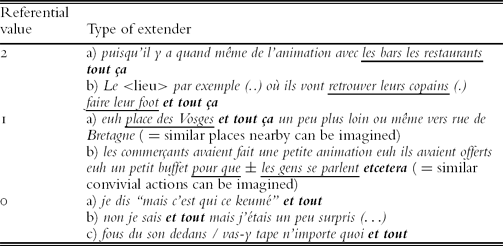
The internal – or linguistic – factors were coded with the aim of uncovering indices of potential grammaticalisation and change. Following previous studies (Cheshire, Reference Cheshire2007; Tagliamonte and Denis, Reference Tagliamonte and Denis2010; Pichler and Levey, Reference Pichler and Levey2011), it was hypothesised that extender variants implicated in ongoing semantic-pragmatic change may show changing properties with respect to the grammatical character of the antecedent and to the variant's referential value. Thus, in order to test for decategorisation, each token was coded for the type of antecedent: a) nominal (noun or noun phrase) b) non-nominal (adjective, verb phrase, quoted speech etc.). This was based on the hypothesis that the putatively original function of general extenders was the marking of a set and they would thus initially be used mainly with nominal constituents. Simultaneously, the hypothesis was that the referential value would, for some variants, decrease over time. In other words, the GE would become increasingly desemanticised, especially if it adopts new pragmatic functions. This phenomenon was operationalised along the scale of 0-2; tokens which were clearly used with a list (i.e. at least two items plus extender) had the maximum referential value of 2. Extenders which were used with a specific item where a list could be inferred / imagined based on the context, had a referential value of 1, while extenders that attached to vague notions, quoted speech or unexpected contexts, i.e. cases where no specific list could be imagined, had a referential value of 0.Footnote 9 Note that the factors of referential value and antecedent type are independent of each other: there are indeed many cases where a non-nominal list was present, as can be seen in the examples in Table (3):
Coding of the token's referential value
In order to test whether the co-occurrence of discourse features had an effect on the character of the GE used, each token was also coded for the type of a co-occurring feature, i.e. a discourse marker (e.g ben, genre, enfin, tu sais) or another general extender (e.g. etcetera, et tout) in the utterance (i.e. in a semantically and phonologically complete unit containing a clause).
Finally, since the use of general extenders is typical of spontaneous speech rather than of written language, each token was coded for syllabic – rather than syntagmatic – length. Hence there were 2-syllable forms, et tout (/e-tu/) and tout ça (/tu -sa/), 3-syllable forms et tout ça (/e-tu-sa/), choses comme ça (/ʃoz-kɔm-sa/), and 4-syllable forms such as etcetera (/ɛ-tsɛ-te-ʁa/) or des choses comme ça (/de-ʃoz-kɔm-sa/). Coding for syllabic length was hoped to provide an indication of whether shortened variants may be increasingly preferred (overall or among specific age group) and whether shortened variants may have new pragmatic functions and/or a bleached meaning. Even though longitudinal phonetic reduction is not easily measurable, and its application to the grammaticalisation of general extenders has been criticised, the test for syllabic length was merely designed to contribute to showing whether short forms are more grammaticalised and in which contexts they are preferred.
Additionally, the speaker sample was coded for: a) age, b) education and c) sex. The speakers were divided into three age groups (0-30, 31-59, 60+) in order to track directions of possible change in progress. The education level was coded as follows: (1) – below BA degree (up to two years of university or apprenticeship); (2) – BA degree and above.
5.2 Results
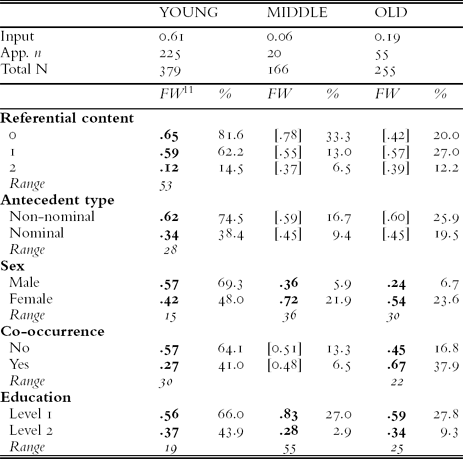
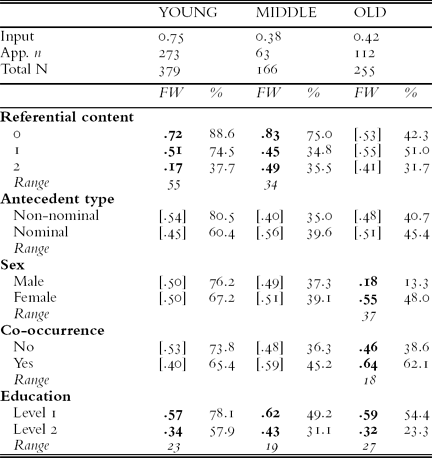
As seen in Table (2) above, et tout is the dominant variant in the Secova corpus displaying an overwhelming frequency of 2.72 tokens per 1000 words.Footnote 10 In the CFPP corpus, the most frequent variant overall is etcetera, which is surpassed by et tout among young people. In the Beeching corpus, the most frequent variant is tout ça. I now turn to the multivariate analysis designed to test the grammaticalisation hypothesis with regard to et tout which, as I will indicate, has progressively extended its functional scope, diverged from a purely referential role, acquired multiple discourse functions and, in semantic terms, become increasingly bleached. Table (4) above presents three independent multivariate analyses of factors contributing to the application of et tout versus other adjunctive variants.
Three independent multivariate analyses of factors contributing to the probability of et tout vs. other adjunctive variants across age groups
The input and application values reveal that et tout, compared to other variants, occurs most frequently among younger speakers (0-30) who use this form more than half the time. Also important are the factors of referential content and antecedent type, both involved in semantic bleaching and pragmatic extension. The results shows that young people tend to use et tout with little or no referential content. In other words, et tout is disfavoured in contexts where a list is present or could be imagined, and its set-marking function thus seems weakened. Young people also significantly favour non-nominal or ‘unexpected’ contexts (verb phrases, adverbs, quotatives, negative phrases etc.) rather than expected, i.e. nominal, contexts. This finding points in the direction of decategorisation, whereby there is a morphosyntactic mismatch between the extender and its operand. The factors of referential content and antecedent type, however, turned out not to be significant for the other age groups, perhaps because et tout is not yet fully decategorised and semantically bleached among these groups.
With regard to sex, it is worth mentioning the interesting female lead in the use of et tout among the middle-aged and older speakers, reminiscent of previous variation studies where females were found to be ‘leaders’ of linguistic change (see Labov, Reference Labov1990 and Reference Labov2001). This trend is reversed in the youngest age group with males favouring the form (FW.57) and females disfavouring it (FW.42). This factor is, however, the weakest of all (range 15) and the reverse trend might simply mean that the sex differences become neutralised as et tout spreads and adopts innovative functions (for similar observations, see Ferrara and Bell, Reference Ferrara and Bell1995 on be like) or that there has been a social re-evaluation of et tout across the age cohorts (see Pichler and Levey, Reference Pichler and Levey2011 on an that).
Interestingly, et tout in the young age group disfavours the co-occurrence of other discourse features in its immediate surroundings, which seems to concur with Cheshire's (Reference Cheshire2007) hypothesis that variants with a range of pragmatic functions no longer need the support of other discourse features with a similar role. It seems, at least among young people, that et tout need not co-occur with these features since it already performs many equivalent discourse functions. Note, however, that co-occurrence is significantly favoured among the oldest speakers, which may mean that the variant did not yet have the full array of pragmatic functions it has now.
Education shows a consistent and significant pattern across all age groups, with less educated people favouring et tout and more educated people disfavouring it. A comparison of the application values across age groups also shows that token numbers are quite low in the middle-age group (only 20 tokens of et tout) but that the number of speakers in this group is higher than in the old-age group (refer to Table 1 again). Does this indicate an overall decrease in the use of informal discourse features among middle-aged people? As Tagliamonte (Reference Tagliamonte2012: 47) explains, and as is also suggested by these results, the use of ‘standard or prestige forms peaks between the ages of 30 and 55 when people experience maximum social pressure to conform to the norms of the standard language.’ As has been suggested (Labov, Reference Labov1994; Cheshire, Reference Cheshire, Ammond, Dittmar and Mattheier2005; Tagliamonte, Reference Tagliamonte2012), these non-prestigious forms may resurface in old age as people move out of the workforce and into a more relaxed life phase again.
Finally, consider Table (5) which outlines the contribution of factors to the probability of short (2-syllable) versus longer variants.
Three independent multivariate analyses of factors contributing to the probability of short variants
The input and proportion values reveal that young people neatly prefer and are the most frequent users of short variants (for similar findings, see Cheshire Reference Cheshire2007; Pichler and Levey, Reference Pichler and Levey2011; Levey, Reference Levey2012). This again may be related to the fact that linguistic shortening as a discourse strategy has often been attributed to young people (see Gadet, Reference Gadet2003; Billiez and Trimaille, Reference Billiez, Trimaille, Galazzi and Molinari2007). Further, the results show that shorter items are significantly more favoured in contexts with zero referential content, i.e. most probably because they are used on account of their pragmatic functions (e.g. hedging, intensifying, expressing solidarity). Items with such functions may be more frequent among young people whose speech is generally considered as closer to the vernacular (Holmes, Reference Holmes2008; Tagliamonte, Reference Tagliamonte2012), and may thus contain more informal particles such as discourse markers and general extenders than the speech of middle-aged and older speakers. Nevertheless, the zero referential content factor is significant also among the middle age cohort, suggesting that the set-marking function was already attenuated in short variants and reserved for their longer counterparts. Education is again a significant predictor across the board, with less educated people favouring shorter variants such as et tout, tout ça and machin. Interestingly, the oldest age cohort shows a significant female lead in the use of shorter variants, as well as a high rate of co-occurrence of other discourse features with these variants. I speculate that this could be indicative of change if, as suggested by Cheshire (Reference Cheshire2007), short variants grammaticalise and progressively develop pragmatic functions similar to those of discourse markers. We would expect in this case, again according to Labov (Reference Labov2001), that women would lead the change. However, as Pichler and Levey (Reference Pichler2010) point out, changes in co-occurrence patterns need to be contextualized with reference to broader discourse-pragmatic changes and interpreted cautiously.
6 DISCUSSION AND CONCLUSION
The aim of this study has been to advance our understanding of possible change in the French general extender system through, on one hand, a close qualitative analysis of GE use among young people, and on the other, a set of multivariate analyses of the use across age groups. The initial investigation of spoken examples revealed that one variant of particular interest, et tout, is used for discourse-oriented rather than reference-oriented purposes. As shown by the indices of grammaticalisation uncovered by the multivariate analysis, the pragmatic functions of et tout seem particularly active in the speech of young people who use this form much more extensively than other age cohorts. The most relevant functions of this form discussed above include hedging, creating rapport, intensifying remarkable facts, punctuating narrative discourse as well as sparing the interlocutor unnecessary detail. Even though these functions are, to a varying degree, also found in other extender forms, et tout seems to be the preferred pragmatic variant performing manifold functions simultaneously and thus well suited for different discourse purposes.
Distributional and multivariate analyses have confirmed that et tout is among the most productive variants in the recent corpora, and is significantly favoured by young people. The results have further shown that this variant is used on account of its pragmatic – rather than set-marking – function, as indicated by a decrease in its referential value and a morphological mismatch with its antecedent. All the factors associated with decategorisation and semantic bleaching of et tout were significant among young people but not significant among the other age groups, certainly because, among the latter groups, this variant did not behave exceptionally or differ from the others in terms of function and frequency.
The findings presented here accord with some previous studies of discourse markers (e.g. like) and general extenders (e.g. and stuff, and that, and everything) which show that pragmatic operators at the level of discourse tend to be grammaticalised through frequent use, with young people being the early adopters of these forms and the primary motors of change (see Romaine and Lange, Reference Romaine and Lange1991; Tagliamonte and D'Arcy, Reference Tagliamonte and D'Arcy2004; Cheshire, Reference Cheshire2007).
Arguably, the ‘youth’ frequency could simply be ascribed to the effect of age-grading, but while this effect seems strong in the present data, the functions of et tout do appear to have changed. Moreover, while age-grading and language change tend to be considered as mutually exclusive, it has been argued that some phenomena displaying the effect of age-grading can also be implicated in certain types of change (Labov, Reference Labov1994; Sankoff and Blondeau, Reference Sankoff and Blondeau2007). As Labov (Reference Labov1994: 97) argues, in trying to decide ‘which model is correct for a given process, we may have been setting up a misleading opposition between age-grading and generational change.’ Given the results presented in Section (5), it is not unreasonable to assume that even though the preferential use of et tout for pragmatic purposes may be an age-graded feature, this variant may incrementally change over time to reflect the same functions in other age groups.Footnote 12
The preliminary findings presented here break new ground in accounting for variation in extender use in spoken French, and now need to be confirmed by a more complete diachronic study of the available large-scale corpora. The corpus of informal spoken French being collected in Paris as part of the study of Multicultural London English and Multicultural Paris FrenchFootnote 13 may provide ample and fruitful data for a detailed analysis of semantic-pragmatic change at the discourse level. The present study has not only suggested that et tout may be grammaticalising and undergoing some possibly universal tendencies that are part of that process (e.g. semantic bleaching, shortening, decategorisation), but also highlighted the need to examine specific aspects of spoken French which remain understudied.
APPENDIX
Full inventory of General Extenders