


Introduction
Prostate cancer is one of the most prevalent malignant diseases in men with a worldwide incidence of more than 1·2 million per year. Reference Bray, Ferlay and Soerjomataram1 Considering results of screening trials, it can be expected that in the near future, more patients will be diagnosed with low- or intermediate-risk stages. Reference Schroder, Hugosson and Roobol2,Reference Parker, Castro and Fizazi3
There are several curative treatment options for low- and intermediate-risk prostate cancer including radical prostatectomy, external beam radiotherapy (EBRT) or interstitial brachytherapy. Reference Grimm and Wenz4,Reference Wenz, Martin and Böhmer5 Low-dose-rate interstitial brachytherapy (LDR brachytherapy) has been shown by many studies to yield excellent patient outcomes in freedom from biochemical recurrence (BCR) with mild side effects. Reference Rodrigues, Yao and Loblaw6–Reference Pons-Llanas, Roldan-Ortega and Celada-Alvarez10
This retrospective study reporting a single institution experience aimed to investigate long-term outcome of treatment with interstitial LDR prostate brachytherapy. Therefore, the data of patients treated in the Ortenau Cancer Center Offenburg (OZO) were analysed with the endpoints freedom from BCR and side effects. Additionally, possible predictive factors for outcomes and side effects were investigated: preoperative planning technique (PPT) versus intraoperative real-time planning (IOR), initial prostate-specific antigen (PSA) levels, PSA nadir levels, Gleason score and total activity implanted (number of implanted seeds × single seed activity) substituting prostate volume.
Patients, Material and Methods
Trial registry and ethics
The study was registered with the German Registry of Clinical Trials (DRKS) under the number DRKS 00016919. The study was voted positively by the Ethics Committee of the Albert-Ludwigs University Freiburg, Freiburg/Germany vote number 28/18, 20 March 2018.
Patients and treatment
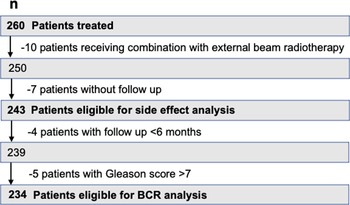
From March 2002 until July 2016, a total of 260 patients were treated in the OZO for histologically proven prostate cancer with LDR brachytherapy using Iodine-125 seeds. Patient numbers and patient eligibility are depicted in Figure 1.
Patient numbers and eligibility.

All patients were staged histologically pT1c. Consistent with ASCO guidelines, Reference Chin, Rumble and Kollmeier11 clinical staging of the primary tumour was not carried out.
For side-effect analysis, all patients appearing for at least one follow-up visit were evaluated (n = 243).
At the OZO, two different LDR brachytherapy techniques were applied by two independently founded teams:
-
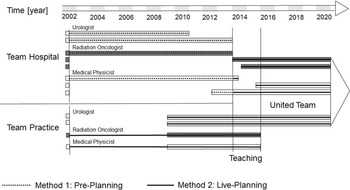
(1) Single seed implantation technique (Eckert & Ziegler, BEBIG GmbH, Berlin/Germany) was performed on 55 patients by the hospital’s own team (Team Hospital, Fig. 2). The treatment was preplanned (PPT) with ultrasound imaging for prostate contouring and an X-ray for seed deposition verification. These patients received a prescribed dose of 145 Gy to the prostate planning target volume (prostate + 2 mm margin) (method 1). The Mick® applicator system and sonographic control were used for seed application.
Figure 2.Historical development of and experience with LDR brachytherapy for prostate cancer in the Offenburg Cancer Centre (black and grey bars): Unification of Team Hospital and Team Practice, implementation of live planning.

-
(2) Stranded seed treatment methodology (BARD/BD, Karlsruhe/Germany) was applied to 188 patients by an external team that used the hospital’s facilities and amenities (Team Practice, Figure 2). These patients received an IOR and a prescribed dose of 160 Gy with no margin to the prostate volume (method 2).

The dosimetric thresholds used for the intraoperative planning technique and recording (method 2) were recommended by the PROBATE group of Groupe Européen de Curiethérapie – European Society for Radiotherapy and Oncology, and for the preplanning technique (method 1), the American Brachytherapy Society recommendation was implemented. Reference Salembier, Lavagnini and Nickers12–Reference Polo, Salembier and Venselaar14
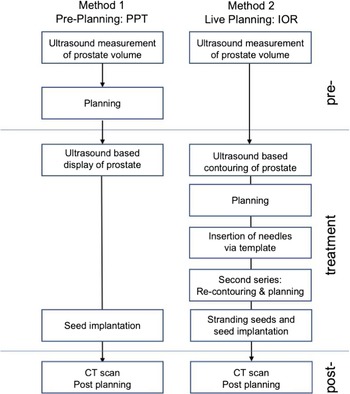
The institutional experience with both techniques over time is depicted in Figure 2, and the standard treatment steps of both techniques are depicted in Figure 3.
Standard treatment steps of method 1 (PPT, preplanning) versus method 2 (IOR, live planning).

All patients complied with the dose constraints listed in Table 1. For post-planning based on CT scans, the given dose constraints were met with PPT as well as IOR techniques.
Dose constraints for both planning methods (PPT and IOR)

Data collection
Treatment and follow-up data were collected retrospectively from the patient records of the radiation oncology department. The records were complemented with data from collaborating urologists. Data were analysed using Microsoft Excel 2010 software.
Endpoints and statistics
Data for the freedom from BCR were analysed. BCR was defined as an increase of the blood PSA level of more than 2 ng/mL above the post-treatment PSA nadir level as recommended by the Radiation Therapy Oncology Group – American Society for Radiation Oncology consensus. Reference Roach, Hanks and Thames15
Data (age, PSA nadir, initial PSA, PSA decline rate, brachytherapy technique, total implanted activity [number of seeds implanted × single seed activity {mCi}], Gleason score) of patients with BCR were compared to data of patients without BCR as appropriate, either by two-sided t-test for independent data or by Chi-square test. The same procedure was conducted with patients treated with PPT versus patients treated with IOR. Freedom from BCR over time for all patients and different patient groups was analysed by the Kaplan–Meier method and tested for significance by log-rank test (Microsoft Excel Version 16·57, Microsoft 2021).
Data for side effects from the clinical records were converted into the EORTC Common Toxicity Criteria score (Version 2.0, 1999; https://www.eortc.be/services/doc/ctc/ctcv20_4-30-992.pdf) by a radiation oncologist. Data for the most frequent side effects (urge to urinate, dysuria) were analysed for potential risk factors (total implanted activity, brachytherapy technique). The significance of differences was tested as appropriate with the methods reported above.
Results
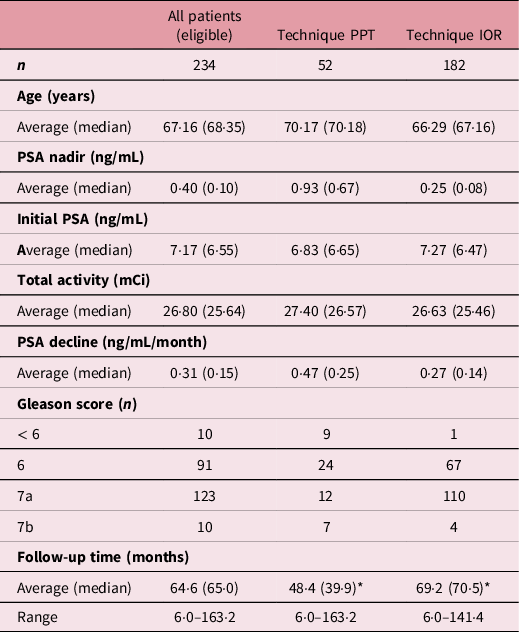
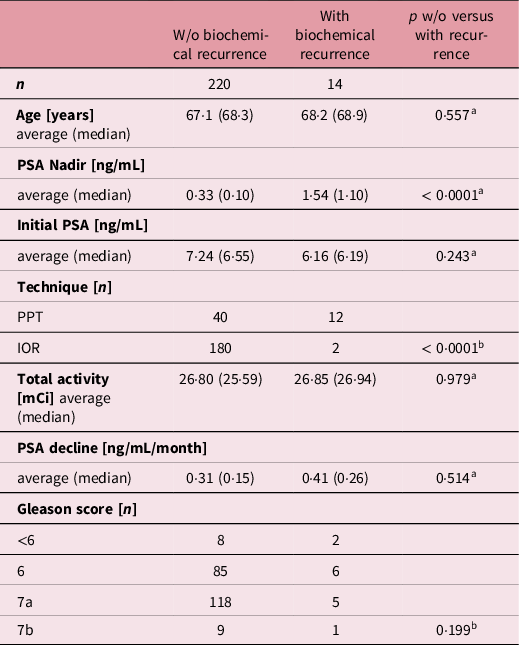
The demographic and disease data as well as follow-up time of patients treated with IOR versus PPT are reported in Table 2.
Demographic, tumour, therapy and follow-up data for all patients and patients grouped by planning method (PPT and IOR)

* Significant difference IOR versus PPT: t-test p < 0·001.
Biochemical recurrence
In total, 14 patients had a BCR. The patients with and without BCR did not significantly differ in age, initial blood PSA level, total implanted activity (correlating with prostate volume), PSA decline over time and Gleason score. Significantly more patients with BCR had been treated with PPT (method 1). Patients without BCR had a significantly lower PSA nadir (median 0·10 ng/mL versus 1·10 ng/mL) (Table 3).
Demographic, tumour and therapy data for all patients with and without BCR

Significance by at-test and bChi-square test.
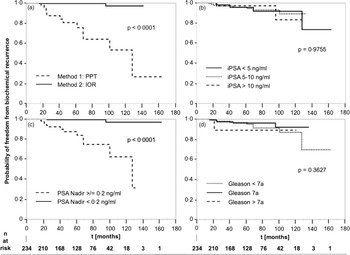
To pay attention to different follow-up times, the patient groups were compared for freedom from BCR by the Kaplan–Meier method. For patients treated with IOR (method 2), BCR was significantly less probable than for patients treated with PPT (method 1) (Figure 4A), even with a significantly longer average follow-up time in the IOR group (Table 2: IOR 69·2 months versus PPT 48·4 months, t-test p < 0·001). Patients reaching a PSA nadir of < 0·2 ng/mL had a significantly lower risk to develop a BCR than patients with a PSA nadir ≥ 0·2 ng/mL (Figure 4B). No patient reaching a PSA nadir under 0·1 ng/mL developed a BCR. The Gleason score and the initial blood PSA level at diagnosis (iPSA) did not significantly influence the risk for a BCR (Figure 4C and D and Table 3), neither did PSA decline rate over time, patients’ age and total implanted activity (Table 3).
Kaplan–Meier plots: probability of freedom from biochemical recurrence over time: different grouping, p: log-rank test.

Side effects
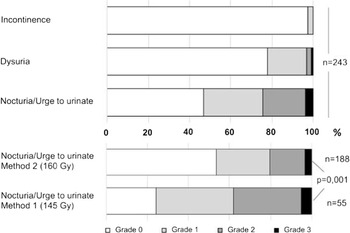
For each patient, the highest grade of each reported side effect was evaluated (Figure 5). After brachytherapy, almost 98% of patients showed no incontinence at all and no incontinence > grade 1 was reported. Dysuria grade 3 was developed by 0·8% of patients, grade 2 by 2·4% and grade 1 by 18·8%. The most important side effect was nocturia/urge to urinate, which was shown by 53·2% of the patients: grade 1 28·8%, grade 2 20·8% and grade 3 3·6%. The patients treated with IOR planning showed significantly less nocturia/urge to urinate compared to patients treated with PPT (Figure 5). After 1 year of follow-up, no side effects > grade 1 were reported.
Occurrence of side effects, p: Chi-square test.

For all patients, implanted total activity (number of seeds × single seed activity [mCi]) correlating with prostate volume was recorded. Patients suffering from high-grade toxicities had a significantly higher implanted total activity (Figure 6).
Total activity in patient groups with different grades of side effects, p: t-test.

Demographic data, such as age, or diagnostic data, such as initial PSA value, did not have any influence on side effects.
Patients showed other side effects that could not be graded by the retrospectively evaluated records: 14 patients (5·8%) were reported to suffer from haematuria post-implantation, which resolved quickly, 22 patients (9·1%) reported erectile dysfunction and 7 patients (2·9%) reported urge to stool.
Discussion
Treatment outcome
In patients treated for low- or favourable intermediate-risk prostate cancer, survival does not represent an adequate parameter for treatment outcome. Therefore, several groups decided to choose BCR as the primary endpoint in this situation. Reference Kindts, Stellamans and Billiet16,Reference Badakhshi, Graf and Budach17 In order to compare our data with literature, we also decided to evaluate this endpoint as defined by ASTRO Phoenix consensus. Reference Roach, Hanks and Thames15
Our data confirm the results of other groups for freedom from BCR. Reference Kindts, Stellamans and Billiet16–Reference Goldner, Pötter and Battermann18 All papers report about 95% or more freedom from BCR over more than 5 years. Differences in outcome between the individual reports in literature may be due to patient selection, follow-up time, brachytherapy technique or operator experience.
Brachytherapy technique
IOR planning has been shown to be advantageous in brachytherapy for prostate cancer. Reference Pons-Llanas, Roldan-Ortega and Celada-Alvarez10,Reference Goldner, Pötter and Battermann18,Reference Raben, Chen and Grebler19 One other study was also performed in a single institution and directly compared different brachytherapy planning techniques. Reference Pons-Llanas, Roldan-Ortega and Celada-Alvarez10 This study did not find a significantly better biochemical control in patients treated with 160 Gy and IOR than in patients treated with 145 Gy and preoperative planning. Further, no increase in side effect rates despite the dose escalation of 15 Gy was found. This is explained by keeping and still meeting the dose limitations for urethra and rectum. In our study, IOR and the possibilities of directly responding to volume changes improved therapy outcome in both tumour control and therapy side effects. These results can be explained by strictly respecting the dose limitations for urethra and rectum (Table 1) and better geometric mapping. For example, this means to intraoperatively observe and respect the changes in the shape of the prostate or the position of the urethra directly caused by inserting the needles and thus bulging the prostate (Figure 3: ‘Second series’: Recontouring and planning).
Another point to be discussed is the use of stranded seeds in the IOR method. Compared to individual seeds, stranded seeds keep their position more precisely over time and, therefore, are likely to follow the plan prediction more accurately. Reference Karius, Lotter and Kreppner20
Better results for the patients with IOR planning may also be explained by a shorter learning curve with the IOR method. Compared to PPT, in IOR planning additional, onsite teaching by experienced physicians and physicists was carried out (Figure 2).
Still, our data might be characterised by a time bias with parts of the team being already more experienced in brachytherapy when starting with the IOR method (Figure 2). All of this may explain the weak results of the PPT group in freedom from BCR compared to other data in literature generated with preplanning techniques. Reference Pons-Llanas, Roldan-Ortega and Celada-Alvarez10
Gleason score
Consistent with other results in the literature, Reference Kindts, Stellamans and Billiet16,Reference Badakhshi, Graf and Budach17,Reference Martell, Meyer and Sia21,Reference Morris, Keyes and Spadinger22 the Gleason score grading of the patients’ prostate cancer did not have a significant impact on the freedom from BCR outcome. Localised prostate tumours could be treated efficiently with the prescribed dose of 145 or 160 Gy, irrespective of grading. The few patients (n = 10) with a Gleason score of 7b and thus at higher risk of advanced prostate cancer did not significantly differ from the patients with Gleason score of <7a or 7a (Figure 4D).
Blood PSA levels
For our patients, blood PSA levels at diagnosis, as well as post-therapeutic decrease of PSA over time, did not influence freedom from BCR outcome (Figure 4C, Table 3). This may be due to PSA response being additionally dependent on parameters other than BCR. Reference Martell, Meyer and Sia21
In contrast, the reached PSA nadir level under PSA nadir of 0·2 ng/mL was a strong predictor for freedom from BCR (Figure 4B). All patients reaching a blood PSA level of <0·1 ng/mL (mean PSA nadir) did not suffer from BCR. Therefore, the absolute PSA blood level, not its rate of decrease, turned out to be a better measure for follow-up of prostate cancer patients treated with LDR brachytherapy.
Side effects
Consistent with other studies, Reference Emara, Chadwick and Nobes23,Reference Ash, Bottomley and Al-Qaisieh24 our patients reported mild side effects. It could be shown that patients with higher grades of dysuria and urge to urinate had significantly higher total implanted activity corresponding with prostate volume (Figure 6). For the LDR brachytherapy of a prostate with a big volume of >40–50 mL, seeds with a higher activity have to be used. This results in difficulties with dose modulation at the organs at risk and, therefore, in potentially increased side effects. Reference Delouya, Bahary and Carrier25–Reference Wust, von Borczyskowski and Henkel27 Furthermore, in some cases with a large prostate and pelvic bone interference, implantation of seeds to the most lateral parts of the organ is hampered. Then, in the process of aiming at an acceptable dose distribution within the prostate, the sphincter, urethra, and central and medial zone of the prostate turn out to be overdosed. Our data confirm reasonable clinical practice regarding LDR prostate brachytherapy patient selection with prostate volumes less than 40–50 mL to avoid side effects. Reference Martell, Meyer and Sia21
Limitations
The main limitation of this study is the retrospective, single-centre setting, which is prone to selection bias and a lack of data completeness. Comparing demographic, tumour and therapy data with literature, a wide consistency is found. Reference Rodrigues, Yao and Loblaw6,Reference Pons-Llanas, Roldan-Ortega and Celada-Alvarez10 This means that there was no unexpected selection of patients. Further, the selection of treatment technique (PPT versus IOR) is based on the history of the two independent brachytherapy teams working at the centre with patients randomly allocated by different urologists (Figure 2).
In a clinical therapeutic retrospective study, side effects are difficult to evaluate. However, the study was based on patient records of follow-up visits without a specified trial structure. The clinical description of the side effects in these records was converted into the clinical toxicity criteria score by a radiation oncologist. The highest grade of every side effect reported was evaluated for each patient. Patient records may be incomplete by patients not attending follow-up visits or not reporting their symptoms or by physicians not documenting the side effects appropriately. Nevertheless, the data seem to be acceptably accurate to show the patients’ clinically relevant urological problems after brachytherapy.
Future possibilities
Several groups consistently found monotherapy LDR brachytherapy a highly effective treatment for localised prostate cancer. Likewise, several studies have shown the effectiveness of the treatment modality in combination with EBRT for intermediate- and high-risk patients. Reference Chao, Joon and Khoo28,Reference Lee, Barocas and Zhao29 Additionally, there have been investigations in combination with anti-hormonal therapy as a systemic treatment. Reference Morris, Tyldesley and Rodda30 Interesting future study areas relating to LDR brachytherapy are high precision-focussed therapies for patients with low- and favourable intermediate-risk prostate cancer based on highly specialised MRI and/or PET/CT scans. Reference Mason, Adiotomre and Bownes31–Reference Maenhout, Peters and Moerland33 LDR brachytherapy may also serve as a part of dose escalation concepts. Reference Zelefsky, Pei and Chou34
Conclusions
For our patients, along with a closer inspection of the endpoint of freedom from BCR, LDR brachytherapy was a highly effective treatment for low- and favourable intermediate-risk prostate cancer. The technical effort of intraoperative real-time treatment planning, combined with the use of stranded seeds as well as a consequent teaching management when implementing the technique, generated an improved outcome and reduced side effects. Reaching a blood PSA nadir of <0·2 ng/mL was an excellent predictor for freedom from BCR, whereas PSA levels at diagnosis and Gleason score did not influence the outcome in the selected group of patients.
In total, patients showed mild therapy side effects (dysuria, nocturia/urge to urinate). High implanted total activity and concomitant large prostate volumes seem to promote an increase in the urge to urinate, nocturia and dysuria.
Acknowledgements
We thank Skadi Dreller, Nadja Hemmler, Nathalie Hermann and Melanie Bruder for their help with data collection.
Financial support
The study was funded by budget resources of the Ortenau Klinikum Offenburg-Kehl, Department of Radiation Oncology.
Competing interests
DL and GL received fees from BARD, Karlsruhe/Germany for onsite teaching in brachytherapy. All other authors declare no conflicts of interest.