Introduction
Military mutinies are a constant and recurring issue throughout Africa. Of the 460 mutinies that occurred worldwide between 1945 and 2018, about 43 percent took place in Africa (Johnson Reference Johnson2018). Côte d’Ivoire alone has experienced at least a dozen mutinies since the first one in 1990, of which three occurred in the first half of 2017 (Schiel et al. Reference Schiel, Powell and Faulkner2017). This prevalence of mutinies constitutes a serious threat to stability and civil peace. As observed in Mali and Nigeria, revolts among soldiers may further weaken the counter-insurgency capabilities of African governments. A 1996 case in the Central African Republic also demonstrated that, by weakening the government’s counter-insurgency capabilities, mutinies might facilitate the outbreak and the prolonging of civil conflicts (Johnson Reference Johnson2018). Mutinies have evolved into coups in Togo in 1963 (Skinner Reference Skinner2020), Côte d’Ivoire in 1999, and Mali in 2012 (Schiel et al. Reference Schiel, Powell and Faulkner2017). The 2002 conflict in Côte d’Ivoire shows how a mutiny among soldiers can quickly escalate into a civil war. Finally, mutinies in the Central African Republic and Côte d’Ivoire have each resulted in large numbers of civilian casualties (Dwyer Reference Dwyer2015).
Despite the threats they pose, mutinies have been given little scholarly attention (Dwyer Reference Dwyer2015). The few studies that investigate mutinies in Africa and elsewhere almost exclusively focus on their causes and trends. Little attention has been paid to the role of the government in addressing mutinies.Footnote 1 This is an important gap in the study of this security issue. Understanding political violence broadly requires us to explore not just the motivations that account for the uprising of the rebels but also the conditions that shape the government’s response (Codjo Reference Codjo2017). Ultimately, it is the government’s attitude that will determine whether a rebellion results in civil peace or protracted violence.
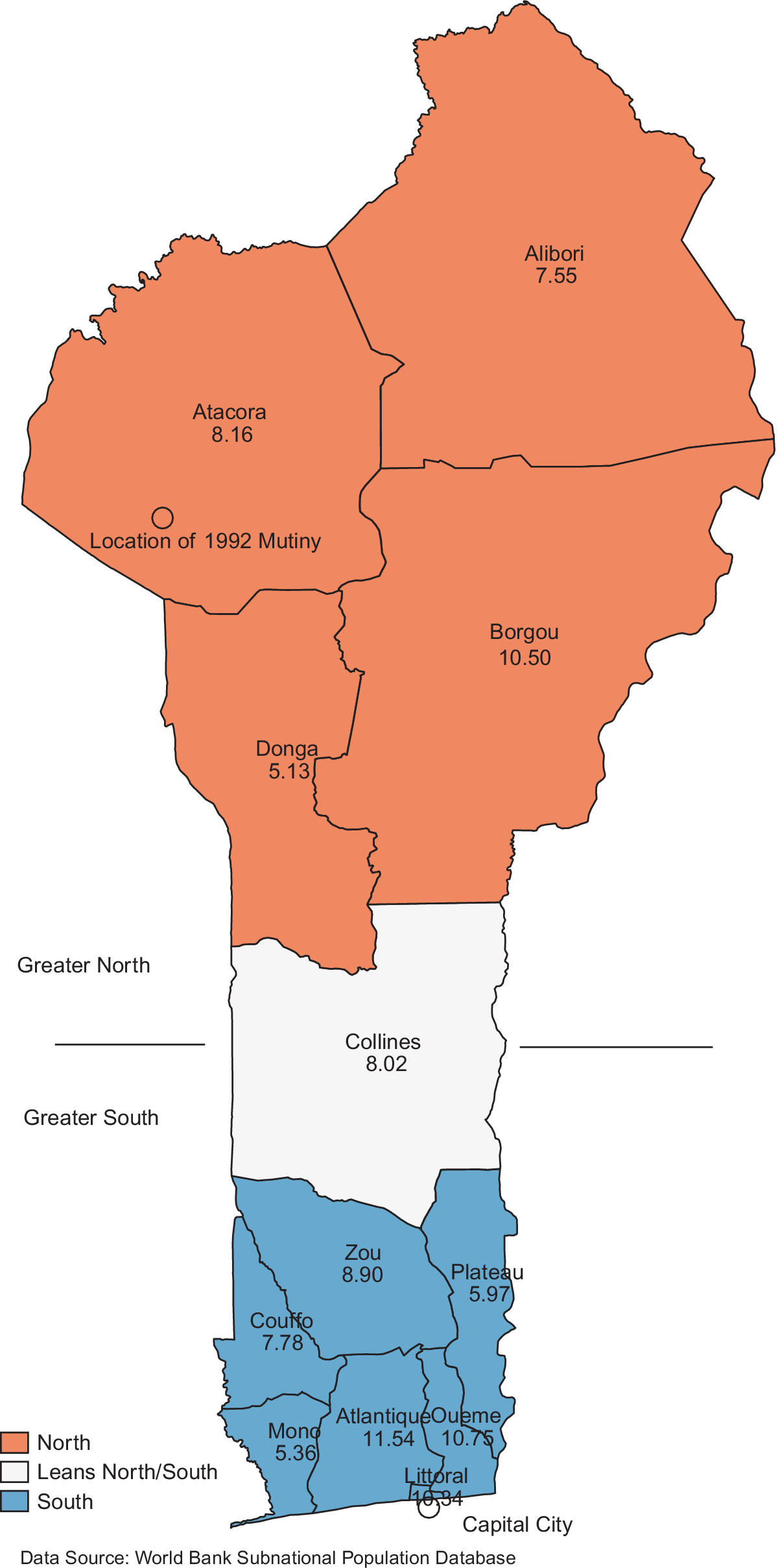
To help shed much needed light on government response to this and other forms of political violence, this article examines a case of mutiny in Benin (former Dahomey). The revolt occurred in August of 1992, as a group of soldiers attacked an army post in a town located about six hundred kilometers north of the capital city (see map, Figure 1). Led by Captain Pascal Tawès, the mutineers demanded that President Nicéphore Soglo, who had just been elected two years earlier, reverse what they perceived as an “ethno-regionalist management of the armed forces” and release soldiers who were detained in connection with previous alleged coup plots. The attack officially marked the beginning of a rebellion that would persist until the end of Soglo’s term in 1996. The crisis was eventually brought under control after Mathieu Kérékou, who succeeded Soglo, reached out to the parliament to grant amnesty to the mutineers.
Benin’s Administrative Departments (Population in Year 2000, % of Total)

While this study’s main purpose is to examine the government’s response, the first section explores the causes of the revolt. Understanding the sources of the crisis will help contextualize the analysis of government response. This is particularly necessary because the circumstances of the revolt have never been investigated in the literature. The examination of the origins of the rebellion relies on theoretical insights from existing scholarship on the causes of mutinies (Rose Reference Rose1982; Dwyer Reference Dwyer2014; Johnson Reference Johnson2018) and on the process tracing approach (George & Bennett Reference George and Bennett2005; Collier Reference Collier2011) to draw inferences from interviews with protagonists and from government archives. The second section then compares the two consecutive administrations’ responses to the mutiny. Building on existing scholarship that highlights the role of leadership and institutional context in elite behavior, this section of the article uses comparative historical analysis (Slater & Simmons Reference Slater and Simmons2010) to distinguish between the critical antecedents and the critical junctures in each administration’s reaction.
The last section discusses the findings and the implications for policy. The main takeaway from this study is that politically motivated mutinies are a complex issue to resolve. For governments confronted with such revolts, a key to success is not only about determining whether punishment or accommodation is more appropriate, but it is also about how to execute the selected course of action. Involving political actors beyond the administration in charge appears to be critical in providing a long-term resolution for this type of crisis. The Benin case revealed that, depending on the leadership style of the officials in charge, governments confronted with a politically motivated mutiny might have multiple response options available. These are legalistic or consensual coercion, and legalistic or consensual accommodation. Further studies beyond this case are, however, required in order to determine the true value of each option. Overall, the study makes promising contributions to our understanding of government response to mutiny. It yields a theoretical framework that can be useful to future studies of government management of armed rebellions more broadly.
The Sources of the Benin 1992 Mutiny
This section draws on existing scholarship on the causes of military mutinies, which often revolve around two key arguments. The first emphasizes “material grievances” or “mundane material issues” related to pay, living conditions, and food (Rose Reference Rose1982). In her study of military mutinies in West and Central Africa, Maggie Dwyer (Reference Dwyer2014) determined that demands for payments or material items account for roughly 70 percent of the stated grievances. Most of these material demands involve complaints about the military leadership believed to have a role in withholding pay or other material items. The second argument on the causes of mutinies focuses on non-material issues such as “unfair treatment” by or “irresponsible behavior” of the military hierarchy (Dwyer Reference Dwyer2018). In this latter sense, mutinies are a means to communicate “an objection to particular individuals or forms of behavior” within the military hierarchy (Dwyer Reference Dwyer2018:5).
Guided by the above literature, the investigation will proceed using a process tracing approach (George & Bennett Reference George and Bennett2005; Collier Reference Collier2011). The purpose of this method is to trace the relationships between potential causes and outcomes. Researchers using process tracing rely on historical and archival documents, interview transcripts, and other sources to test hypotheses (George & Bennet Reference George and Bennett2005:6). This section draws on data from several sources. The first consists of government archives in the form of official orders and personnel files from the Benin Army. The second is a series of personal communications with Retired Colonel Pascal Tawès, the leader of the rebellion, in combination with his unpublished pamphlet (Tawès Reference Tawès1998). The pamphlet is a document that was publicized in Reference Tawès1998 by a religious organization in Burkina Faso, where Tawès found refuge after the mutiny. It was written with the purpose of providing his account of the events. To minimize potential biases associated with this source, many of the statements contained in the document are vetted using personal communications with other military officers with firsthand knowledge of the events.
A close examination of the data suggests that the Benin 1992 mutiny was deeply rooted in the outcome of the country’s 1991 presidential election between incumbent President Mathieu Kérékou and then-Prime Minister Nicéphore Soglo. After Soglo was declared the winner of the runoff election on March 24, 1991, some members of Kérékou’s presidential guard, the Bataillon de la Garde Présidentielle (BGP), openly expressed their dissatisfaction. Loyal to a man they had served for nearly eighteen years, these members of the privileged BGP were reluctant to accept Soglo’s victory. They threatened to block the transfer of power to the newly elected president. It took Kérékou’s personal intervention to bring the situation under control. As one of the BGP commanders recalls, “President Kérékou met with us and personally instructed us to back down. He did not want any violence.”Footnote 2
While the 1991 transfer of power eventually took place without further incident, the defiant attitude of the Kérékou loyalists triggered a series of events that paved the way for the 1992 mutiny. On April 11, 1991, one week after assuming power, President Soglo signed a decree that dissolved the BGP (Décret nº 91-71). The new president and his advisors must have perceived the old guard as a threat to the safety and security of their regime. Considering the threats previously issued by some of the guard members, dissolution was a safer solution. Thus, the new administration released all members of the BGP from their presidential guard duty and placed them under the command of the army leadership to be transferred to new positions.
For reasons that are still unclear, the military leadership took no immediate action to transfer members of the dissolved guard. For nearly three months, members of the former BGP remained without duty assignments and had to periodically report to the army headquarters. When the army finally issued its transferring orders on July 1, it gave the soldiers seven days to report to their new stations (Note de Service nº 316/S1/CH/D1/EMAT). After waiting for a transfer for nearly three months, a seven-day notice was perceived by many of the former BGP soldiers as unfair and abusive. To make things worse, the army leadership soon ordered another transfer for some of the soldiers on December 20, 1991, just a few months after their initial transfer of July 1.
The army leadership’s handling of the transferring further antagonized many of the former guard members. One of the most outspoken was Captain Pascal Tawès, formerly deputy commander of the BGP. After the dissolution of the guard in March 1991, he was ordered two transfers within four months. While the July 1 order assigned him to a unit in Cotonou, the December 20 orders assigned him to the Deuxième Bataillon Inter-Armes, an army unit located about 450 kilometers away. It must be noted that this second transfer decision followed rumors of a coup plot that had allegedly been in preparation. In his pamphlet, Tawès complains that “On the unsubstantiated ground of rumors of alleged coups d’état, some soldiers, including myself, have been transferred to their regions of origin and put under the command of their subordinates without any precise function, like criminals” (Tawès Reference Tawès1998:3).
Like many of his comrades, Tawès perceived the army’s management of the transfers as a humiliation and retaliation for their loyalty to Kérékou. This, however, was only the tip of the iceberg. A much deeper grievance was a latent sentiment of bitterness over the outcome of the 1991 presidential election. Although the results of the election were widely considered to be transparent, Tawès could not contain his rage about Kérékou’s defeat. He constantly blamed his fellow citizens for “accepting the verdict of opaque ballot,” adding that “my disgrace started with the process of opaque (not transparent) ballot during elections in my country in 1991” (Tawès Reference Tawès1998).
These strikingly political judgements from a military officer suggest that Tawès had a personal stake in the 1991 political outcome. In fact, prior to Kérékou’s defeat, the young captain had been accumulating power. For instance, President Kérékou appointed him in 1989 as chair of two important special commissions to investigate corruption in state-owned companies (Décret s nº 89-400, nº 89-401). In each of these two instances, Captain Tawès and his deputies, all of whom were civilians, were given full power by President Kérékou to conduct the investigations and “recover [all the money] by all necessary means.” Each of the two commissions had the authority to “call upon or hear any person whose competency or audition it judges necessary for the proper execution of its mission.” As the chair of each of the two commissions, Captain Tawès was to report directly to President Kérékou himself. For a young captain, this sign of full confidence from the president was of great value. Therefore, Soglo’s electoral victory in 1991, the very moment when Tawès was enjoying Kérékou’s full trust, was certainly not a situation the captain welcomed.
Beyond self-interest, former BGP soldiers’ resentment of the Soglo regime was also driven by what they described as an “ethno-regionalist management” of military affairs. They specifically denounced ethno-regional inequalities in the distribution of key military leadership appointments. Referring to the new administration as “a system based on regionalism and tribalism,” Tawès, who is from the country’s northern region, believed that President Soglo favored his fellow southerners and family members in his appointments (Tawès Reference Tawès1998:6).
Historically, instrumentalization of the North-South cleavage for political purposes was not a new phenomenon in Benin. It dated back to the 1951 creation of the Groupement Ethnic du Nord, a political organization born out of “the desire to challenge the hegemony of the ‘evolved’ southerners by the few emerging northerners” in the 1940s and 1950s (Bako-Arifari Reference Bako-Arifari2006:16).Footnote 3 Figure 1 displays a map that highlights a geographic representation of the North-South divide as generally conceived in the political imaginations of the populations in Benin.Footnote 4 Tawès, well aware of the power of this political construct, was now hoping to use it to mobilize support, both within the military as well as from political leaders, given that Kérékou was also a northerner.
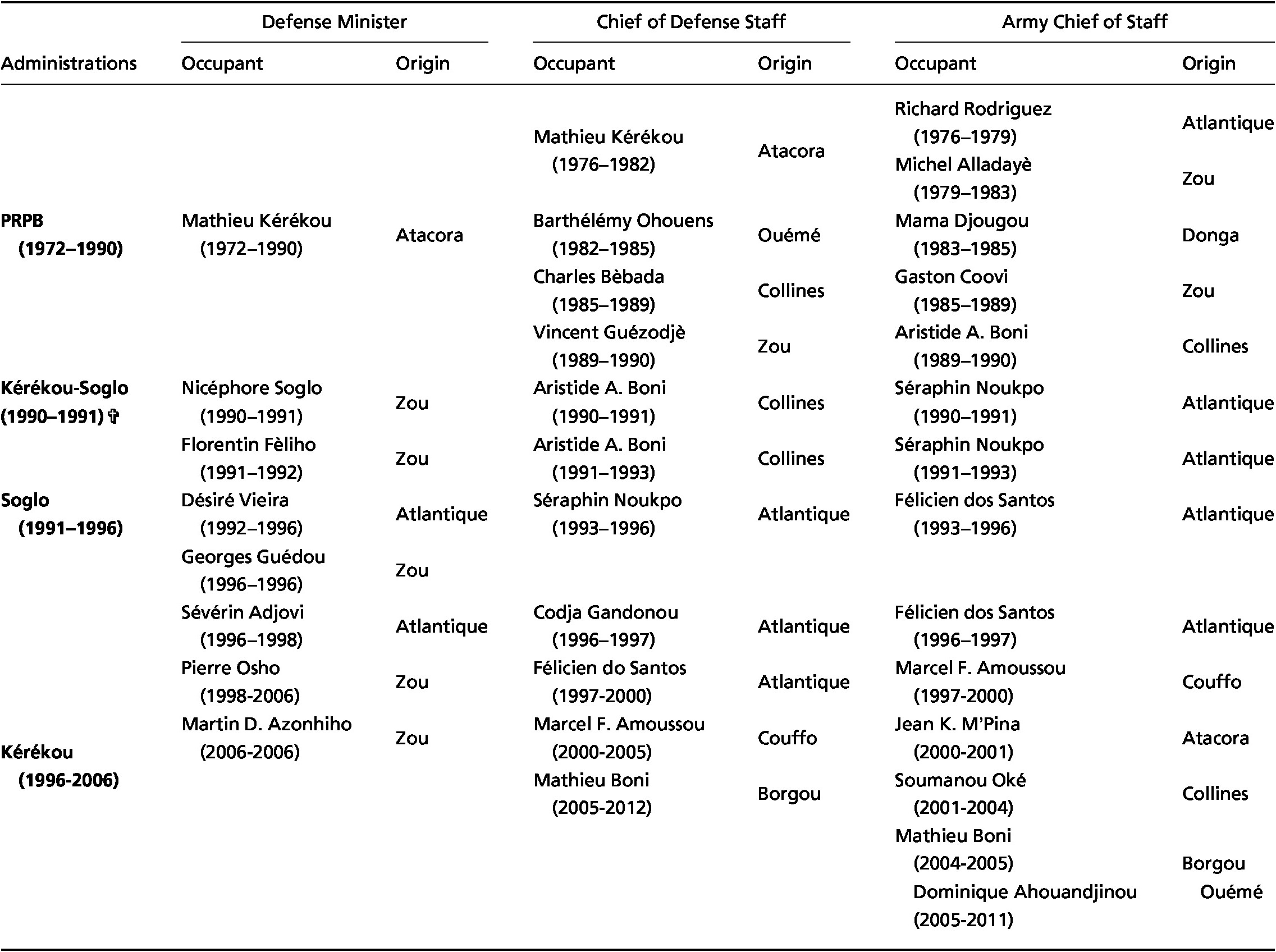
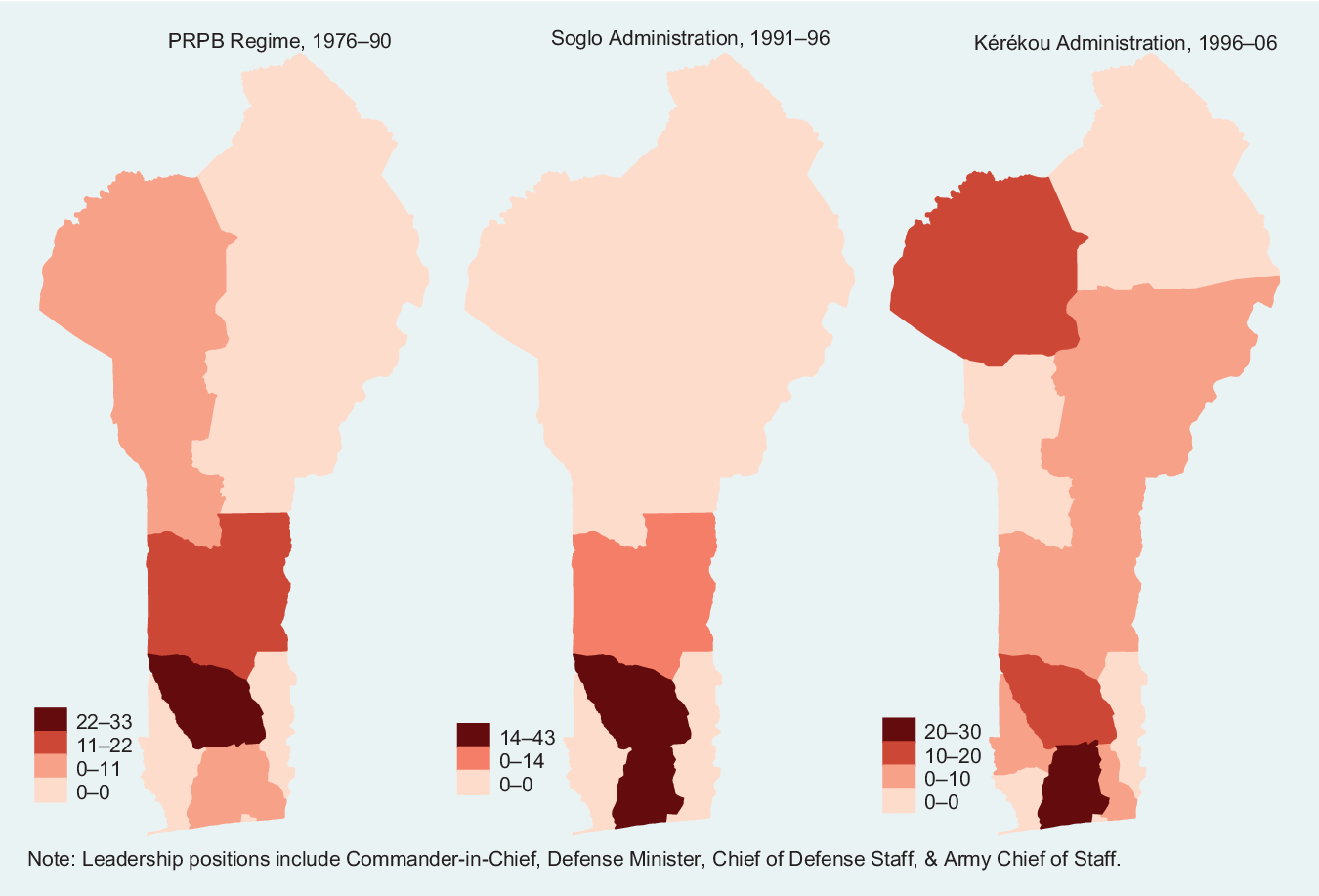
The evidence examined sadly confirms Tawès’ allegations of ethno-regional biases and nepotism. Table 1 presents the ethno-regional origins of the key defense decision-makers (defense ministers, chiefs of defense staff, and chiefs of staff of the army) from 1976 through 2006. As the comparison in Figure 2 shows, the Soglo administration was the least diverse of the three regimes over this 30-year period. Decisions about military affairs, including the management of the events leading up to the 1992 mutiny, were almost exclusively handled by southern leaders, all of whom were from Soglo’s or his wife’s region. The only exception was a northerner chief of defense staff, who was actually appointed by the transition government and who retired two years into Soglo’s term. This was a sharp contrast to previous practice under the Parti de la Révolution Populaire du Bénin (PRPB) regime led by Kérékou (1972–1990). Of the eight officials appointed to key defense positions during the last fifteen years of the authoritarian rule, six were from the Greater South and two from the Greater North. In short, the commander-in-chief under the PRPB regime was surrounded by key decision-makers who were not from his home region. Under the Soglo administration, 86 percent of the key decision-making positions in defense affairs, commander-in-chief included, were held by leaders from the same geographic region (see Figure 2). Adding to his critics’ charge of nepotism, Soglo’s second defense minister was his own brother-in-law.
Key Decision-Makers in Military Affairs in Benin, 1976-2006

Sources: Benin Ministry of Defense, General Staff Headquarters, and Army Headquarters.
✞ During this transition period after the collapse of the one-party system, Kérékou was the Head of State and Soglo the Chief Executive.
Cross-Regional Distribution of Defense Leadership Appointments in Benin, 1976-2006 (%)

The optics of the ethno-regional configuration of Soglo’s national defense team were instrumental in the mobilization of the resentful members of the dissolved BGP. By early 1992, about a year into Soglo’s term in office, Captain Tawès and many of his fellows from the former BGP had not only individual, self-interested incentives, but also collective motives to strike. They began to translate their discontent into actions as early as May 27, 1992, when they initiated what the government described as a coup attempt. The army had to intervene to stop the movement of soldiers heading to Cotonou from a garrison in Ouidah (Assemblée Nationale 1997a, 1997b). In early June, the administration formed a special commission to investigate the incident. The commission soon summoned Captain Tawès and other BGP soldiers and ordered their detention in a military facility in Cotonou.
In late July, after about two weeks in detention, Captain Tawès escaped and headed to his hometown in the northwestern region. Within a few days, he mobilized like-minded soldiers to strike. In the early morning of August 2, while the troops were still recuperating from the celebration of Benin Independence Day, the captain and his team attacked a military post located in Natitingou, the hometown of former President Kérékou. The mutineers took several hostages, including the commander of the garrison, although no casualties were reported during the attack (Assemblée Nationale 1997a, 1997b). This strike officially marked the beginning of a mutiny that required a response from the military hierarchy and the political leadership. As the next section will show, it would take several years and two administrations to fully resolve the crisis.
Government Responses to the 1992 Mutiny
Theory and Methodology
Given the lack of comprehensive theories on government response to mutiny, this section draws on extant scholarship on political violence and democratic transition in Benin and elsewhere to determine the key variables that will guide the empirical inquiry. This literature highlights three variables that might play a critical role in the management of mutinies. The first is the type of actions taken by government officials in response to rebellion. Students of political violence have suggested two possible strategies: coercion and accommodation (Gurr Reference Gurr1968; Singh Reference Singh2014; Codjo Reference Codjo2017). Governments might use coercive means such as repression or sanctions to compel rebels to submit to the established order. Alternatively, state officials may engage in negotiated settlements (accommodation) to satisfy the rebels’ demands.
A second important variable is the leadership style exercised by the officials in charge. Examining the cases of Benin and the Republic of Congo, Bruce Magnusson and John Clark (Reference Magnusson and Clark2005) have determined that the contrast between Soglo’s legalistic style and Pascal Lissouba’s reluctance to submit to the rule of law accounted for the different trajectories observed during the political crises in Benin and Congo-Brazzaville in the 1990s. Similarly, the difference between Kérékou’s compromising approach and Gnassingbé Eyadéma’s unilateralist style played a role in the diverging outcomes of the democratic transitions in Benin and Togo. The authors thus conclude that “the quality of leadership also has a huge impact on the prospects for democratic consolidation, especially during crises that threaten the rule of law” (Magnusson & Clark Reference Magnusson and Clark2005:565).
Third, students of elite behavior in democratic transitions in Africa and elsewhere have identified the normative and institutional context as a key element in understanding leaders’ behavior and choices (VonDoepp & Villalòn Reference VonDoepp, Villalòn, Villalòn and VonDoepp2005). Part of this context has to do with elite consensus on governance rules and norms, often defined as “an explicit, but not always publicly explicated or justified, agreement among a select set of actors which seeks to define (or better, to re-define) rules governing the exercise of power on the basis of mutual guarantees for the ‘vital interests’ of those entering into it” (O'Donnell & Schmitter Reference O’Donnell and Schmitter1986:37; see also Karl Reference Karl1990:9). Scholars argue that such consensus is critical in shaping the behavior of leaders during democratic transitions. For instance, John Higley and Michael Burton (Reference Higley and Burton1989) have highlighted the critical role of “elite settlements” in providing political stability in preindustrial Europe. Guillermo O'Donnell and Philippe Schmitter (Reference O’Donnell and Schmitter1986) emphasize the positive impacts of “elite pact” in democratic transitions in Latin America (see also Karl Reference Karl1990). Likewise, examining the prospects for democratic consolidation in Benin and Congo-Brazzaville, Magnusson and Clark (Reference Magnusson and Clark2005:566) argue that “The level of consent to the new regimes by ethno-regional political leaders is certainly crucial.”
Together, these propositions by extant literature suggest that the outcome of Benin’s 1992 mutiny could have been shaped by three main factors, among others: (1) the type of measures adopted by the government in response to the rebellion, (2) the leadership style of the officials involved, and (3) the normative and institutional context that surrounded or preceded the response.
Methodologically, this section will rely on a special process tracing technique that distinguishes between “critical junctures” and “critical antecedents” in explaining outcomes (Slater & Simmons Reference Slater and Simmons2010). Critical junctures refer to specific periods in a historical case when the presence or the absence of a specified causal factor or mechanism drives the case onto a new political trajectory. While critical junctures might be decisive in producing the observed outcomes, one should not underestimate the effects of other factors that may have preceded them (Slater & Simmons Reference Slater and Simmons2010:888; Pierson Reference Pierson2004; Cappoccia & Kelemen Reference Capoccia and Kelemen2007). Thus, Dan Slater and Erica Simmons recommend examination of critical antecedents, which they define as “factors or conditions preceding a critical juncture that combine with causal forces during a critical juncture to produce long-term divergence in outcomes” (Reference Slater and Simmons2010:889, emphasis in original).
This method of comparative historical analysis is an appropriate tool for this study, as it will help determine, not just the post-1992 critical junctures that shaped the trajectory of the mutiny, but also the pre-mutiny normative and institutional context and its impact on the outcome under two different administrations. The data used include government archives in the forms of presidential decrees, official records of legislative debates in Benin’s parliament, and records of the country’s criminal and constitutional court decisions regarding the 1992 mutiny. This dataset was supplemented by personal communications with political leaders with firsthand knowledge of and involvement in the resolution of the crisis.
Critical Antecedent: The 1989–90 Elite Consensus on Norms of Governance
A critical antecedent in understanding the outcome of the Benin 1992 mutiny has to do with the historical context of the country’s consensual transition to democracy in 1989–90. The specifics of the transition are well documented (Seely Reference Seely2009; Magnusson & Clark Reference Magnusson and Clark2005; Villalòn & VonDoepp Reference Villalòn and VonDoepp2005; Decalo Reference Decalo, Clark and Gardinier1997; Clark Reference Clark1994; Robinson Reference Robinson1994; Heilbrunn Reference Heilbrunn1993). During this phase of Benin’s political history, the elite forged consensus on three institutional and normative elements that would later be decisive in shaping the course of events following the mutiny.
The first norm was a shared acceptance of democratic governance based on the rule of law. In 1989, faced by internal and external pressures for political and economic reforms, the authoritarian regime led by Mathieu Kérékou decided to convene a “national conference of all living forces of the nation,” commonly referred to as the National Conference. Thus, in February 1990, a total of 520 delegates from different backgrounds—soldiers, lawyers, politicians, educators, farmers, students, and other members of civil society—gathered for a ten-day deliberation. The result of the discussions was an agreement on a set of democratic rules to guide politics and state affairs, followed by the creation of several institutional bodies to bring the envisioned system into being. These included, among others, a new constitution adopted by referendum, a constitutional court whose decisions were to bind all branches of government, multi-party elections, and an independent judicial system. This new system of governance was not only a major shift from the authoritarian rule of the previous eighteen years, but it was also the result of a bargaining and consensus among the country’s elites.
The second institutional component of the 1989–90 elite consensus was the acceptance of the subordination of the military to civilian control. These principles were the result of a bargaining that took place between the National Conference delegates and the military hierarchy (Houngnikpo Reference Houngnikpo2001; Allen Reference Allen1992; Seely Reference Seely2009). During discussions about the future role of the military, some delegates blamed the armed forces for their excesses under Kérékou’s autocratic regime and consequently called for the military to “retreat to the barracks” (Seely Reference Seely2009). Some of the attending military officials quickly responded by threatening a coup. This prompted negotiations behind the scenes between Monsignor Isidore de Souza, the Conference chairperson, and President Kérékou. The military later backed down, and Colonel Vincent Guézodjè, the top commander of the armed forces, subsequently pledged to support the Conference in its proceedings. As he later recalled, “We could have stopped the Conference; sent everyone away…but the army didn’t want to oppose, or to stop a course of change that we felt was the will of the people” (Seely Reference Seely2009:70).
The military’s pledge to “respect the will of the people” would later be codified in the form of civilian control of the military, formally established by the December 1990 constitution. According to the new constitutional provisions, members of the armed forces who wish to run for political office must first resign from their military duties. The constitution also prescribed, in article 65, that “Any attempts by the personnel of the armed forces or the public security [agencies] to reverse the constitutional order will be considered a forfeiture and a crime against the nation and the state, and will be punished in accordance with the law.”
A third pillar of the consensus among Benin’s elites during the democratic transition was a collective adherence to a spirit of forgiveness and compromise in order to give national reconciliation a chance. One of the demonstrations of this spirit was the decision by the PRPB regime to allow all political dissidents who had been forced into exile to return home. Another step in this direction was the liberation of all political prisoners. A third important step was the shared agreement to grant amnesty for all previous crimes against the security of the state, including previous coup attempts. To this end, the transitional legislative body passed a bill in 1990 that pardoned all the people involved (Loi nº 90-028).
These three pillars of the 1989–90 elite consensus had clear implications for the future. One was the validity of the rule of law to protect the established constitutional order. A second implication was the shared repudiation of military involvement in politics, especially through coups d’état. Third, the spirit of forgiveness and compromise implied a public rejection of retribution when addressing wrongdoings in state affairs. Unlike the other two pillars, which were formally coded within legal prescriptions, this pillar followed from a normative element of the elite consensus that was not formally prescribed in the country’s laws. Together, these three pillars of the elite consensus and their implications constituted a critical institutional and normative context that would later shape the behavior and choices of different actors in the aftermath of the 1992 mutiny, most prominently those of Soglo in 1992–96, Kérékou in 1996–99, and members of the parliament in 1997–98.
Critical Juncture 1: Soglo’s Legalistic Response
When Captain Tawès and his team took control of the army garrison in Natitingou on August 2, 1992, they issued two demands to the Soglo administration. The first was to free all soldiers who had been detained in connection with the previous alleged coup attempt. Second, they demanded “termination, within the Benin Armed Forces, of a system based on regionalism and tribalism” (Tawès Reference Tawès1998:6). While these demands could have been satisfied by the administration, the soldiers’ attitude was in clear violation of the 1989–90 elite consensus described above. Most importantly, the soldiers’ armed revolt was a violation of the 1990 constitution. In addition, given the contentious nature of the 1991 transfer of power, the Soglo administration understandably perceived the mutiny as a direct threat to its survival in office. Honorable Guy Soglo, a member of the regime, summarized the administration’s perception in the following terms:
For some of our fellow citizens, tribal patriotism prevails over national patriotism, and I believe that is why they find it impossible to accept a [political] order, however democratically established, that it is not incarnated by a citizen from the [ethno-regional] community of their origin.
(Assemblée Nationale 1997a:4)Having assessed the soldiers’ actions as a threat to regime survival, the Soglo administration’s officials excluded all possibilities of a dialogue with the mutineers. Instead, they took a series of coercive measures aimed at compelling them to submit to the established order. The officials’ first reaction was to use force to retake control of the military base in Natitingou and capture the mutineers. After days of preparation, the military leadership deployed troops from Cotonou to liberate the military post located about six hundred kilometers away. According to now-retired Colonel Gabriel Tamadaho, who was a captain and the leader of the counterattack unit in 1992, it took the military leadership three days to mobilize the forty men who comprised his team (Gabriel Tamadaho, phone communication, April 13, 2018). When they reached Djougou, a town located about sixty kilometers south of the target destination, Tamadaho and his soldiers stopped to spend the night and finalize their plan for the assault. Before they could launch their counterattack the next day, they received reports that the mutineers had fled and abandoned the army post and the hostages.
In addition to the military operation, the Soglo regime took another coercive action. In a meeting on October 21, 1992, Soglo and his Cabinet discussed an administrative measure introduced by the newly appointed defense minister, Désiré Vieira, who also happened to be the president’s brother-in-law. In accordance with existing legal and administrative rules, the measure proposed that the mutineers be discharged from the military. A month later, on November 25, the president signed a decree that effectively discharged Tawès and his deputy, Captain Raymond Saghi. Both officers had their ranks revoked. The regime ordered a retroactive implementation of the sanctions, starting on September 3, 1992. Legally, this measure was justified because both officers were “absent from their units for more than two months and on the run outside the national territory” (Décret nº 92-319).
The Soglo regime’s administrative sanctions further fueled the rebels’ determination to undermine the administration. Between late 1992 and early 1994, a series of terrifying incidents took place that aggravated the anxiety about the threat posed by Tawès. Some of these events have been documented as “Domestic Terrorism” by Bruce Magnusson (Reference Magnusson2001:223–24). For instance, in February 1994, Pamphile Houessou, a southern administrator of Tawès’ hometown of Boukoumbé, was abducted and reportedly detained in Togo. Shortly after the abduction, leaflets distributed in parts of the northern region warned southerners to leave. Some officials saw their cars burned and their houses robbed (Magnusson Reference Magnusson2001). Benin officials attributed the kidnapping and related incidents to Tawès and blamed the Togolese government for providing him support and protection (Lettre du Continent 1994).
In response to these terror attacks, the Soglo administration initiated judicial proceedings in 1994 to prosecute Tawès and his comrades for what the regime believed was their involvement in attempts to destabilize the country. Tawès and his companions denied any legitimacy to the court to rule on their case. They claimed members of the court were all appointed by the Soglo administration and were thus part of the ethno-regionalism they were denouncing in the first place. Sadly, just as was the case for the military leadership, the evidence shows that the ethno-regional composition of the court was indeed skewed in favor of southerners. For example, the court was presided over by a judge, Guy Martin Correia, and two assistant judges, Pascal Ahouangonou and Jerôme Assogba, all three of whom were from the southern region. The legal defense team representing the mutineers was composed of two state-appointed attorneys and five legal counsels, most of whom were also from the south. Moreover, the four jurors randomly selected by lot were from the southern region (Procès-verbal nº 63; Arrêts nº 64, 65, 66, 67, 68).
The mutineers’ criticisms of ethno-regional bias did not stop the court proceedings. On August 16, 1994, the Criminal Court in Cotonou prosecuted twenty-seven military personnel for the “preparation or execution of acts qualified as plots” (Procès-verbal nº 63). Sixteen of them, including Captain Tawès, failed to appear before the court. On September 5, 1994, after less than three weeks of proceedings, the court rendered a decision that convicted twenty-four of the soldiers and acquitted three (Procès-verbal nº 63; Arrêts nº 64, 65, 66, 67, 68). The convicted soldiers were found guilty of “planning a plot, around 1991 and 1992, at unspecified time and on the national territory, with the purpose of destabilizing or overthrowing the government in place in Benin” (Arrêt nº 68).
The initiation of judicial proceedings in 1994 appeared to have encouraged further antagonism against the Soglo regime. The government soon reported several instances of arms thefts from military installations in Cotonou and neighboring towns. A group of previously detained soldiers also escaped from prison in Ouidah. In March and April 1994, rumors of a military coup in preparation erupted; the coup was delayed only because the junior officers planning the plot could not agree on the political model that would subsequently be put in place (Magnusson Reference Magnusson2001:223–24). Following the court rulings, several artisanal bombs detonated in different locations in the south, including a downtown restaurant in Cotonou, a marketplace, the airport, the home of the minister of rural development, and the customs headquarters (Magnusson Reference Magnusson2001). In November 1995, an attempted plot against the regime was reported, and several people were arrested, including military officers and a French citizen (Assemblée Nationale 1997a, 1997b, 1998a). In the same month, rockets were fired into the International Conference Center in Cotonou. While the attacks are commonly attributed to Tawès and his supporters (Magnusson Reference Magnusson2001), no specific groups have ever claimed responsibility for the strikes. The situation did not improve until Soglo was voted out of office in March 1996.
Critical Juncture 2: Kérékou’s Consensual Response
After returning to power in April 1996, Mathieu Kérékou inherited the Tawès crisis. By then, the rebels had been living in exile for almost four years. They had been discharged from the army and deprived of all related advantages, and they had been convicted in courts for crimes against the state. The new administration had several options to choose from. First, it could uphold its predecessor’s coercive measures, thus maintaining the mutineers in exile or forcing them to return home to carry out their sentences. Second, Kérékou had the constitutional power to grant a presidential pardon to the mutineers, thus allowing them to return home without fearing incarceration.
While upholding the coercive measures would have been a major blow to the mutineers, who were exiled or jailed for actions committed out of loyalty to Kérékou, a presidential pardon from Kérékou had the potential of antagonizing Soglo’s supporters. Ultimately, the new president opted for a still accommodative, but different option. In early 1997, he sent a bill to parliament, requesting amnesty for all people involved in the incidents related to the mutiny. If adopted, the bill would pardon and rehabilitate soldiers convicted of stealing arms and ammunition during the night of May 27, 1992, and firing rockets upon the International Conference Center in 1995. The bill would also extend amnesty for felonies and crimes perpetrated during all elections held between 1990 and 1996 (Assemblée Nationale 1997a). The new administration announced that the purpose of the bill was to “create better conditions for political détente in order to enable true national reconciliation” (Assemblée Nationale 1997a:1). Kérékou’s outreach to parliament for an amnesty was not only inspired by the third pillar of the 1989–90 elite consensus, namely the spirit of forgiveness and compromise, but it also rested on the first pillar, the prevalence of constitutional order.
Like any other legislation, examination of the amnesty bill in parliament started at the committee level. The Commission des Lois, which was a parliamentary committee charged with the tasks of studying the bill and making recommendations to the plenary, called in the military leadership to testify about its position on the bill. The commanders, who were from a different region than the president, told the committee that they supported the amnesty bill as a peace initiative because it would help avoid a “Kabila effect” (Assemblée Nationale 1997a:30).Footnote 5 They noted, however, that they disapproved of the rehabilitation measures that would readjust the mutineers’ career situation to match that of their colleagues who had remained in the military (Assemblée Nationale 1997a:32).
After listening to the military leaders, members of the Commission des Lois were divided about the bill. While some called for amendments before its introduction to the plenary session, others were opposed to the idea of amnesty for rebels. The latter group thus tried to block the process entirely. After several rounds of intense debates and political maneuvers, the committee eventually reached a consensus, thanks to Rosine Vieyra-Soglo, the former first lady who also happened to be a member of the committee. Reports from the committee indicate that the bill would not have been moved to the floor had it not been for her “personal efforts and intellectual honesty” (Assemblée Nationale 1997a).
On September 2, 1997, the parliament’s leadership introduced the amnesty bill for open debates on the floor. Unsurprisingly, several members were opposed to the bill. One of them was Honorable Emile Kpikpidi, a member of Soglo’s party, the Renaissance du Bénin. A strong supporter of President Soglo, Honorable Kpikpidi endorsed the principle of forgiveness for the sake of peace, but he feared the proposed measures would weaken the military. “If soldiers can join a rebellion today, wander around and come back in three or four years,” he asked, “are we consolidating the military?” (Assemblée Nationale 1997a:3). He subsequently urged the parliament to leave the management of the crisis to the military leadership.
Other parliamentarians were also opposed to the bill for security concerns. They argued that granting amnesty without recovering the weaponry that had been stolen in 1992 would be a threat to national security rather than a solution for lasting peace. This view was expressed on the second day of the first round of debates by Honorable Candide Azannai, another member of Soglo’s party. In reference to Kérékou, he explained that “I do not understand why a president, who is a military officer by profession, who knows the gravity of national security … [wants to] provide amnesty for these incidents even though the country is still facing threats because the [stolen] weapons have not been recovered” (Assemblée Nationale 1997b:30).
Amid these disagreements regarding how to resolve the crisis, the legacy of the 1989–90 spirit of reconciliation and forgiveness played a decisive role. A supporter of the bill pleaded that, “by introducing the bill [to Parliament], … the [Kérékou] administration wanted to waken in you, the representatives of our population, a sense of consensus that everyone envies us for.” The ultimate goal, he argued, was to overcome “the devil of division [and] ethnocentrism” (Assemblée Nationale 1997b:51). Throughout the debates, supporters of the bill constantly drew on the precedents of reconciliation and forgiveness established eight years earlier. For instance, they often referred to an executive action that was voluntarily signed by President Kérékou on August 30, 1989, granting amnesty to all exiled citizens, and thus allowing them to return home without fear of having to face charges for the criminal acts they might have committed (Assemblée Nationale 1997a, 1997b).
Supporters of the amnesty bill also constantly referred to another law that extended amnesty for all national security crimes, including the mercenary invasion of January 16, 1977, which sought to overthrow Kérékou’s regime. Drawing on this critical precedent, Honorable Pascal N’Dah-Sékou urged his colleagues to “listen to the voice of wisdom and vote for this bill.” If President Kérékou could forgive and extend amnesty to the people who invaded the country trying to overthrow his regime in 1977, N’Dah-Sékou argued, members of parliament had no reason to deny a similar gesture to Tawès and his comrades (Assemblée Nationale 1997a:31–33).
The most powerful evidence for the pacifying role of the legacy of the 1989–90 precedents appeared in statements made by some representatives of Solgo’s party. On September 3, 1997, Honorable Albert Chinkoun, one of Soglo’s supporters in parliament, urged his colleagues to vote for the amnesty bill. He pleaded that “we wish that the spirit of the National Conference continues to prevail” (Assemblée Nationale 1997b:51). These words, coming from a member of the opposition party, were particularly effective in rallying support for the bill. Fully aware of the impact he was having on the audience, Honorable Chinkoun kept pressing:
Since our historic National Conference of February 1990, Benin has astonished [the peoples of] Africa and the world. By adopting the proposed bill, we would give liberty and justice to other citizens of Benin. We will thus continue to astonish [the peoples of] Africa and the world.
(Assemblée Nationale 1997b:4)On September 3, 1997, after two days of debates, the bill passed 59–2, with twelve abstentions. In his closing statements, Honorable Marcellin Dégbé, chair of the discussions, praised President Kérékou for his sense of consensus. He explained that Kérékou could have used his executive authority to pardon the convicted fellows, yet he chose not to, and instead offered an opportunity for dialogue with members of parliament. Had the president used his constitutional right of pardon, Honorable Dégbé argued, “we would not have achieved our goal, that of creating an environment of peace [and] national cohesion” (Assemblée Nationale 1997b:51).
This legislative victory was, however, short-lived. On September 9, 1997, just a day after President Kérékou signed the amnesty bill into law, it was challenged in court. Honorable Nathaniel Bah, a member of Soglo’s party, filed a complaint before the constitutional court arguing that, among other things, the executive branch did not follow proper procedure when introducing the bill to parliament. On October 7, 1997, the court declared the amnesty bill unconstitutional (Cour Constitutionnelle 1997:221–25). After passing a new vote in February 1998, followed by a second challenge in court by Honorable Bah, a third version of the bill was eventually signed into law on December 22, 1998, almost two years after it was first introduced (Loi nº 98-028; Cour Constitutionnelle 1998:199–203).
After signing the amnesty bill into law, President Kérékou needed to take executive action to implement the measures prescribed by the parliament. Rather than relying on his administration officials for advice, he formed an ad hoc commission charged with proposing an administrative path to reinsertion and rehabilitation of the mutineers (Décret nº 99-310). Based on the commission’s recommendations, he signed a presidential decree on August 5, 1999, to overturn the previous administration’s order that had discharged the mutineers from the military (Décret nº 00-377). By December 30, 1999, all protagonists of the 1992 mutiny were officially reintegrated into the military and rehabilitated (Décret nº 99-633).
Contrary to what was feared by opponents to the bill, the rehabilitation of the mutineers did not provoke any open hostile reactions within the military. The most striking illustration came from Tawès and Tamadaho, the officer who had led the counterattack against Tawès in 1992. After his reinsertion in the army in 1999, Captain Tawès was appointed as a deputy to now-Major Tamadaho. A year later, both officers were assigned to a different unit where the roles were reversed. Tawès, newly promoted to the rank of Lieutenant-Colonel as a result of the rehabilitation measure, was now the commander, and Tamadaho, his previous boss, became his deputy. Both officers recall no hostile incidents between them (personal communications with both actors). Tawès later rose to the rank of colonel and retired from official duty in 2013 without any reports of stigmatization. This peaceful outcome within the military was certainly a byproduct of the inclusiveness of the rehabilitation process.
The consensual accommodation of the former mutineers also contributed to a lasting peace in Benin. In fact, no violence as experienced under the previous regime was observed throughout Kérékou’s ten-year term. While the spontaneous return to peace in 1996–97 might be attributable to the mutineers’ loyalty to him, the lasting peace, however, had to do with the consensual nature of the government’s post-1996 response. A collaborative amnesty process gave potential opponents an opportunity to openly express their dissent in a non-violent way. Honorable Marcellin Dégbé was thus right to predict after the 1997 vote on the amnesty bill that “the fear of civil war is over” (Assemblée Nationale, 1997b:51).
Discussion of Findings and Implications
Empirical analysis reveals that the Benin 1992 mutiny had its immediate source in what some soldiers of a dismantled presidential guard unit perceived as an unjust treatment by the military leadership. This sentiment was reinforced by a sense of persecution on ethno-regionalist grounds. This finding is in line with existing explanations that emphasize non-material grievances such as perceived “unfair treatment” or “irresponsible behavior” by superiors as a potential cause of mutiny (Dwyer Reference Dwyer2014, Reference Dwyer2015). However, the investigation revealed also that a deeper origin of the mutiny in Benin had to do with a latent, self-interested concern that was not related to how the soldiers were treated at the time. In fact, many of the soldiers were simply bitter over Kérékou’s loss of power in 1991, and their treatment by the army leadership provided them with a collective motive to act on. This finding should prompt scholars and policymakers to distinguish between indirect (latent) and direct (immediate) causes of military mutinies. Such distinction is particularly important for determining how governments should respond.
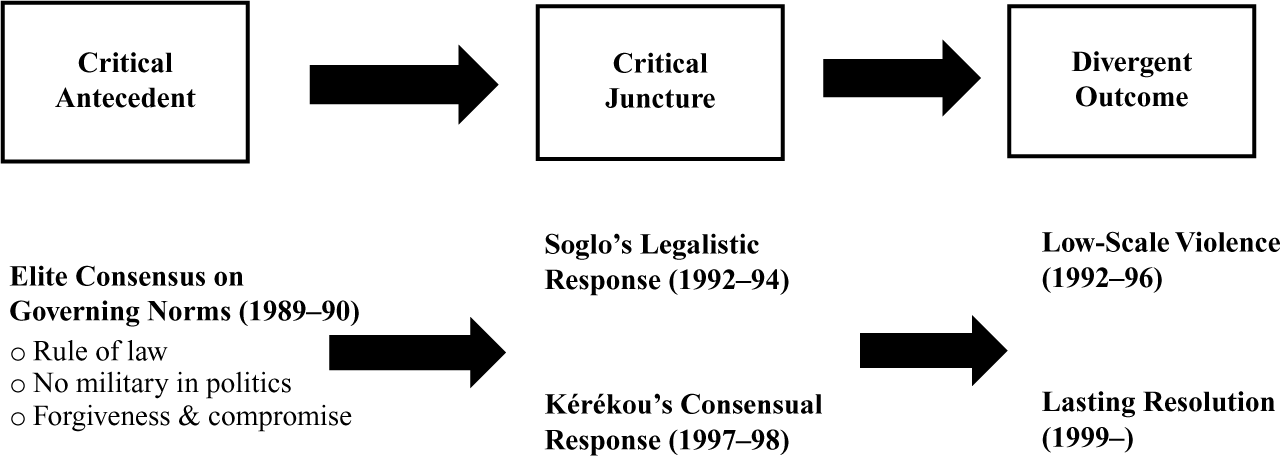
Figure 3 summarizes the findings of the investigation about the government’s responses to the mutiny. As expected from the theoretical arguments in the previous section, the outcome of the mutiny was decisively shaped by three main factors: (1) the type of measures adopted by the government in response to the rebellion, (2) the leadership style of the executive leaders in charge, and (3) the normative and instructional context of the responses.
Determinants & Impacts of Government Response to the Benin 1992 Mutiny

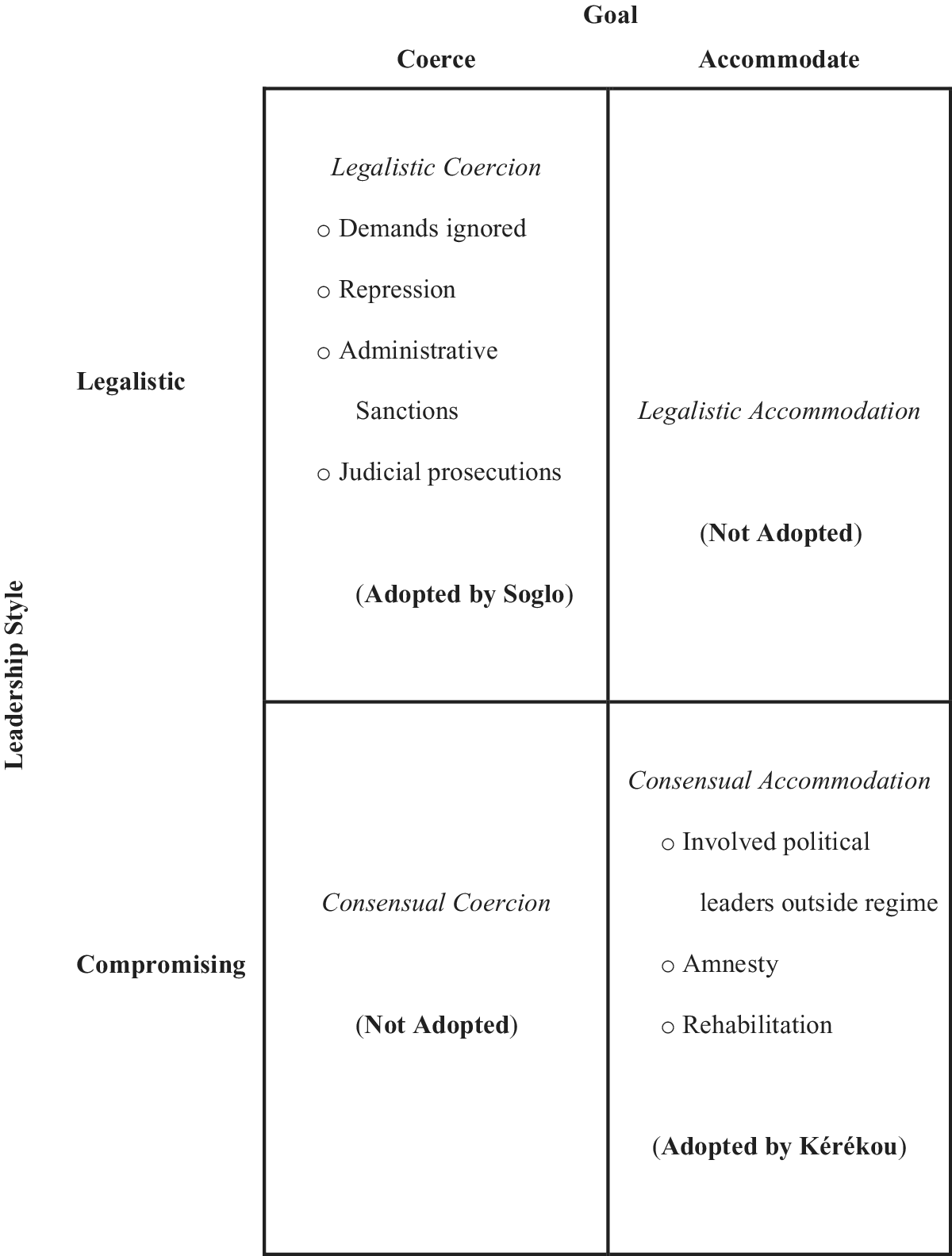
The nature of the response adopted by each of the two administrations directly influenced the duration and ultimate conclusion of the mutiny. Both administrations pursued two different goals in their response. While Soglo sought to coerce the mutineers to submit to the established order, Kérékou aimed at accommodation and reconciliation. Figure 4 summarizes the specific measures taken by each regime. As previously highlighted in Figure 3, Soglo’s coercive measures resulted in the persistence of the rebellion, with a continuation of low-scale violence throughout his term in office. The situation took a different trajectory after Kérékou returned to power in 1996, especially after the parliament granted amnesty to the mutineers. It must, however, be stressed that the impacts of coercion and accommodation in this case cannot be fully understood in the absence of the two other factors: the leadership style and the institutional and normative context.
Government Response to the Benin 1992 Mutiny: Available Options

The results of the empirical analysis presented in the previous section provide further confirmation of the importance of leadership at times of crises (Magnusson & Clark Reference Magnusson and Clark2005). The two executive leaders in charge exercised two contrasting leadership styles. On one hand, Soglo relied on a legalistic approach that excluded any possibility of compromise with the mutineers. This style, at times perceived by his compatriots as arrogance (Assembleé Nationale 1998b), was not effective at deescalating the tensions. Kérékou, on the other hand, adopted a more compromising style. Although he was faced with different circumstances than his predecessor, his decision-making process regarding the crisis involved other actors beyond his administration. For instance, he chose to reach out to the parliament, even though he had the constitutional authority to pardon the mutineers. Similarly, when considering executive actions to implement the amnesty, he deferred to an ad hoc commission rather than relying on his own advisors. If nothing else, this consensual style provided more legitimacy to the accommodation, which, if imposed unilaterally, could have been unpopular.
Last, the outcome of the mutiny was also shaped by the 1989–90 institutional and normative context. Specifically, elements of the 1989–90 elite consensus on the rules and norms of governance influenced leaders’ response while also shaping the impacts of their respective actions on the outcome. For instance, Soglo’s choice not to accommodate the mutineers’ demands was, in part, determined by the first two pillars of the elite consensus: collective adherence to the rule of law and the shared acceptance of the need to keep the military out of politics. Arguably, these two pillars might have also prevented the rebellion from gaining traction among the elite and the general population, thus avoiding the outbreak of a large-scale civil conflict.
Similarly, the 1989–90 spirit of forgiveness and compromise for the sake of reconciliation, a normative component of the elite consensus, certainly shaped Kérékou’s choice to reach out to parliament. More importantly, this 1989–90 spirit was later decisive in enabling leaders in parliament to agree on the proposed amnesty bill in 1997–98. Without the precedents established in the democratic transition period, the bill might have failed to pass in parliament. These findings about the legacy of the 1989–90 elite consensus confirm constructivist arguments about the importance of norms, context, and values (VonDoepp & Villalòn Reference VonDoepp, Villalòn, Villalòn and VonDoepp2005). They also provide further evidence of the pacifying role of what some scholars have called “elite pacts” (O'Donnell & Schmitter Reference O’Donnell and Schmitter1986), “elite consent” (Magnusson & Clark Reference Magnusson and Clark2005), or “elite settlements” (Higley & Burton Reference Higley and Burton1989).
Despite the robustness of the evidence presented in this study, one alternative credible explanation of the outcome of the mutiny might be that the mutineers were brought to heel only because a leader they favored returned to power.Footnote 6 This competing argument would weaken confidence in this article’s main claim that the observed peaceful outcome was the consequence of the nature of the responses, the leadership styles involved, and the 1989–90 elite consensus. However, this counterargument cannot explain why the mutiny failed to gain traction under President Soglo. This alternative account would also have to assume that, had Kérékou upheld his predecessor’s measures, the mutineers would have been satisfied and would have had no objection living as fugitives with no chance of rejoining the army. Similarly, dismissing the critical role of Kérékou’s compromising leadership style in providing conditions for a lasting peace following the rehabilitation of the mutineers would require an assumption that a unilateral action by his administration to accommodate the mutineers would have prompted no counter-reactions—possibly violent ones—from Soglo’s supporters. These assumptions are, however, too strong to be accepted. Thus, the explanations offered here seem more powerful than the alternative one.
The present study yields some important implications for both future policy and research regarding government response to mutiny (and possibly other forms of political violence). First, greater attention must be paid to the conditions that enhance elite consensus on rules and norms of governance (see Codjo Reference Codjo2016 for a political model in this direction). Second, if the type of government actions and the executive leadership style decisively shape the trajectory of political violence, multiple options appear to be available to leaders confronted with mutiny and armed rebellion broadly (as shown in Figure 4). These are legalistic coercion, consensual coercion, legalistic accommodation, and consensual accommodation. The four options are based on two possible goals for government response (coerce vs. accommodate) and on the two contrasting leadership styles highlighted in this study (legalistic vs. compromising). Only legalistic coercion and consensual accommodation were adopted in the Benin case. Arguably, Soglo could have embraced consensual coercion by sticking to punitive measures but involving political actors beyond his regime. Conversely, Kérékou could have adopted legalistic accommodation by using his constitutional authority to pardon the mutineers and not turn to the parliament. While it is unclear how each of these counterfactuals would have affected the outcome, further studies can help determine the value and the conditions of success of each of these options.
Acknowledgments
I would like to thank several current and former members of the Benin Army, especially Colonels (Retired) Pascal Tawès, Gabriel Tamadaho, and Pierre Anani. Although they may not agree with all of the interpretations and/or conclusions of this article, they provided insight, expertise, and primary documents that greatly assisted the research. I am grateful to three anonymous reviewers and several faculty members of the Security Studies Program at Kansas State University, including Emizet Kisangani, Andrew Orr, Carla Martinez Machain, Jeffrey Pickering, and Andrew Long, whose comments greatly improved the manuscript. I would also like to show my gratitude to the editorial team at the African Studies Review for the support and accommodation they provided throughout the process.