Things have no peace.
—Arnaldo AntunesSome of the objects from this old world (and our home was full of them, even seeming to rest on them, like hen's legs) had made a place for themselves in the new world.
—Maria StepanovaIntroduction; or, “If You Had a Fire in Your Home, What Objects Would You Save?”
In his book Translation and Globalization, Michael Cronin looks at translation in a world transformed by the forces of globalization and claims that “it is impossible to conceive of translation outside the object-world it inhabits” (10). The author remarks that very little attention has been paid to “translation and things” (in contrast to “translation and texts” and “translation and translators”) and asks, What is the relationship between translation and things? Cronin's main concern, however, is with “things” as they refer specifically to the role of tools in the activity of translation. Tools, he says, should not to be conceived as mere accessories to the activity of translators; rather, tools are central to the definitions of what translators do. “The very definition of translation,” he argues, “relies on a particular understanding of how the translating activity relates to tools, namely, the writing instrument (stylus, quill, pen) and its material support (wood, parchment, paper)” (23). No translation is done without tools. More recently, Karin Littau has further contended that scholars need “to be attentive to materiality and its cognates, mediality and technicity” (84); in other words, to use the unavoidable pun, matter matters—physical forms (including digital forms) not only allow the grasping of meaning but indeed shape and construct that meaning. Media, Littau argues, are not simply the instruments with which writers and translators produce meaning: they actually “set the framework within which something like meaning becomes possible at all” (83). Important studies such as those by Littau, A. E. B. Coldiron, and others have urged us to consider physical media, the nonhuman, and the material if we are to understand the total experience of translating.
And what about the other things? Not the tools involved in the long translatorial engagement with technologies mentioned above, but rather the material traces of the object world that appear and reappear, as well as disappear, in translation. There has been a return to things over the last few decades, and things are everywhere nowadays in the social sciences and humanities, from history and geography to literature studies, philosophy, and sociology.Footnote 1 There are books on the history of socks, the refrigerator, the golf ball, and the kitchen sink.Footnote 2 Many changes in our contemporary object world—from the dematerialization of the digital world to the latest disaster effected by the COVID-19 pandemic—have foregrounded the various ways in which objects mediate our lives, our identities, and our relations to ourselves and to other human beings. Consider, for instance, the set of new objects, as well as old objects with new roles, that emerged during the pandemic—face masks, thermometer guns, touchless door openers and button pushers, Burger King social distancing crowns, and hug tunnels, to mention just a few. These objects, among several others, have been organizing and shaping the new reality of illness, lockdown, and social distancing since 2020, revealing time and again what Mihaly Csikszentmihalyi and Eugene Rochberg-Halton suggested in their studies from Chicago in the 1970s, when they asked their interviewees, “if you had a fire in your home, what objects would you save?”—namely, that human and material lives are routinely intertwined, and that “to understand what people are and what they might become, one must understand what goes on between people and things” (1).
Translation studies has not always been very curious about its things, which seem to have been mostly taken for granted. Things have tended to fall under the generic term of realia and thus have often been regarded as a problem to be solved (more on this below). Yet if, as Brower Stahl states, “human life worlds are made as much of matter as ideas—consisting of ‘bundles’ or ‘gatherings’ of people, things, and thoughts” (150),Footnote 3 then the study of translation might benefit from digging up its things. This essay then is about things in translation, in the sense of what translation does to things, of what happens to things in their trajectory in translation. It offers an approach to translation studies after the material turn and brings materiality studies, more specifically “thing theory,” into conversation with translation.
I focus here on three brief case studies drawn from English retranslations of the nineteenth-century landmark Brazilian novel Memórias póstumas de Brás Cubas (The Posthumous Memoirs of Brás Cubas), by J. M. Machado de Assis, as well as retranslations of biblical Hebrew narratives. My general claim here is that the investigation of material culture as it emerges in translation, and particularly in retranslations, generates unique, valuable knowledge. Attention to things in translation—attention to objects, materialized forms in the physical world represented in translation—can offer us powerful insights not only about the various ways in which translation has engaged with things but also indirectly about the relations between people and things. I start by discussing in the following section how things have commonly surfaced in translation studies.Footnote 4
On Realia
We often take things around us for granted. “Some things are so omni-present that we stop seeing them, they become background or frame or medium,” writes Ian Hodder (6). Daniel Miller has argued that much of material culture acts as a frame around a picture, providing a setting and acting as a background. In his chapter “The Humility of Things,” Miller in fact claims that objects are important not because they are evident but often because we do not seem to see them (85–109). And the less we see them and are aware of them, the more forcefully they may set the scene and direct our expectations.
Very little has been written on how translation engages with its objects, perhaps precisely because of what was remarked earlier—namely, our tendency to take things for granted, to not “see” them and to ignore their potential force and significance in translation. Unless, however, things are placed under the category of “realia.” Realia is the generic term often invoked in translation studies to refer to words and expressions—typically nouns or noun phrases—that have a referential link with reality and denote more generally “culture-bound notions and phenomena” (Leppihalme 126). Realia comprises not only objects of material culture but also more broadly the geographic environment, ethnographic concepts, and folklore considered to be culture-specific.Footnote 5 Realia is the plural noun form of the medieval Latin adjective realis (“real”)—the implication being that realia or “real things” are opposed to abstract things, or that “real things” contrast with everything that is “not real” in translation.
Following usage in Eastern European translation studies (Leppihalme 126), the modern Western sense of realia mostly refers to culture-specific items that by their specific nature pose a bigger challenge for translation. Realia moreover are often presented as a translation problem to be overcome, a cultural bump, a translation crisis point. Various important typologies in the last fifty years include specific strategies, methods, techniques, and procedures for tackling the realia problem in translation.Footnote 6 For example, Andrei Fedorov in 1953 provided three specific ways to render realia (which in this tradition encompasses “all foreign terms and names,” among them objects of material culture): transliteration, the creation of a new word on the basis of the source's word components, and the use of a target-language word with an approximate function (Pym 46).
“The problem of translating realia,” writes Ritva Leppihalme, “has been described as resulting from target-language lexical gaps or from flaws or gaps in the translator's cultural and encyclopaedic knowledge” (127). The translation discourse dealing with realia commonly revolves around lexical items in a source language that have no adequate equivalents in the target language and consequently require special treatment in translation. Eugene A. Nida, to give one example, discusses the translation problems posed by the New Testament Greek word for “gate” when writing about the translation of biblical material culture into Aboriginal languages (198). Realia, from this perspective, thus often refers to a translation problem to be strategically tackled through various translation solutions. There is much to be said for these translation solutions and the importance of typologies and categorizations of translation strategies for various pedagogical or analytical purposes. Pekka Kujamäki has argued further that a study of translation strategies for realia provides a window into the cultural, ideological, and linguistic profile of the translated product (“Finnish Comet” and “Ubersetzung”).
Yet the approach in this essay is different; I am interested in thinking about things in translation not as a problem but rather as a possibility. In what follows I look specifically at material culture in translation not to evaluate or propose translation strategies for realia, but rather to analyze particular artifacts in translation in order to reveal how translation engages with things and represents person-thing relations, and how things circulate in translations.
Digging Up Things in Translation
Hannah Arendt claims that the human condition implies a very particular relation to things. The Human Condition indeed opens with an object created by humans, Sputnik, the first artificial satellite launched into space in 1957.Footnote 7 Arendt is concerned that language can no longer keep up with know-how, that words have lost their power because the mathematical statements behind this know-how “can in no way be translated back into speech” (137). It is nonetheless the things of the world, according to Arendt, that
have the function of stabilizing human life, and their objectivity lies in the fact that—in contradistinction to the Heraclitan saying that the same man can never enter the same stream—men, their ever-changing nature notwithstanding, can retrieve their sameness, that is, their identity, by being related to the same chair and the same table. (137)
How can humans retrieve their sameness, their identity, by being related to the same chair and the same table? It is by no means my pretension to answer this question, but I would like to suggest that attention to things in translation may allow us to examine, in a very particular way, Arendt's claim regarding the stable and stabilizing force of things in human life.
This section and the following look at some of the transformations things might actually undergo in translation. I argue that the linguistic analysis of translations allows us to observe from a unique perspective not only what kind of force things may have at different times in different societies but also, echoing Nicholas Thomas in anthropology (Entangled Objects 125) and Bill Brown in literary studies (“Thing Theory” 9), how materially stable objects can actually be different things in different translation scenes.Footnote 8 This may be particularly conspicuous when studying the translation of things in retranslations, both diachronically and synchronically produced. Indeed, the three case studies in this essay are all concerned with retranslations. As I show below, retranslations provide a particularly fertile ground for looking at how things in translation may undergo strangely abstract dematerialization and even disappear completely: things may be blurred or transformed into something else, things may be foregrounded and awarded full attention, and things may likewise be fetishized. These transformations are surely interesting in themselves, and they may offer insights into how person-thing relations emerge in translation. Regardless of one's theoretical approach, it remains true that “[t]he ways in which individual and social identities are realized and cognized, manifested or concealed, negotiated or imposed, reproduced or transformed, through the realm of things are peculiarly complex and embedded” (Tilley 10).
So the question of how things are translated turns out very often to be the question of how the person-thing relation is represented in translation. I would like to suggest, furthermore, that translation not only exposes different ways of mediation between persons and things but may at times shape the person-thing dynamic. The first two case studies below, both dealing with clothing—the “tanga” worn by Black enslaved women in the nineteenth-century novel The Posthumous Memoirs of Brás Cubas, by Machado de Assis, and the “tunic” given to Joseph by his father in the biblical story (Genesis 37)—display the intricate relationship between things and people while illustrating two different ways in which translation may manifest and negotiate this relationship. Both cases raise broader issues. The translation of “tanga” involves the central issue of how the translation of things represents “other” cultures and the “otherness” of other cultures. It also shows how thing translations sometimes do silent cultural work that is by no means neutral but is often elided. The trajectory of the “tunic” in translation uncovers an intriguing path whereby material culture not only circulates but is likewise significantly shaped in translation.
Other People's Things: Who Wears “Tanga” in English Translations of Machado de Assis?
First published in 1881, Machado de Assis's novel The Posthumous Memoirs of Brás Cubas is a milestone in Latin American literary history. Two translations of The Posthumous Memoirs were published in 2020, one by Flora Thomson-DeVeaux (Penguin Books) and the other by Margaret Jull Costa and Robin Patterson (Liveright). There are now five English translations of the novel, making The Posthumous Memoirs the most translated Brazilian novel into English. The first three translations were undertaken by William Grossman in 1952, E. Percy Ellis in 1955, and Gregory Rabassa in 1997.Footnote 9
Over the course of 160 short, fragmented chapters, Brás, the narrator of The Posthumous Memoirs, a member of the upper class, introduces himself, hallucinates, is born, falls in love, feels deeply, recovers instantly, fails bombastically, scorns, complains, endlessly digresses, dissects the flaws of others, affronts the readers, proposes a “theory of human editions,” and all along reflects on human existence, corruption, greed, and hypocrisy. The key discovery of Roberto Schwarz, the eminent Machado scholar, is that the capriciousness of Machado de Assis's style in this novel reflects the capriciousness of the upper class. There is a crucial correspondence, he argues, between the narrator's voice and the particularities and contradictions of nineteenth-century Brazilian society, slave-owning and bourgeois at the same time. Slavery haunts the novel,Footnote 10 and there are significant references, albeit indirect, to its pernicious effects on Brazilian society.
At one point, Brás describes his domestic environment (ch. 11) and writes about his Uncle João, “era um homem de língua solta, vida galante, conversa picaresca” (“a man with a loose tongue, a merry life, and an endless supply of roguish conversation” (Memórias póstumas 64; Posthumous Memoirs [trans. Thomson-DeVeaux] 32):
Em casa, quando lá ia passar alguns dias, não poucas vezes me aconteceu achá-lo, no fundo da chácara, no lavadouro, a palestrar com as escravas que batiam roupa; e ahi é que era um desfiar de anecdotas, de ditos, de perguntas, e um estalar de risadas, que ninguem podia ouvir, porque o lavadouro ficava muito longe de casa. As pretas, com uma tanga no ventre, a arregaçar-lhes um palmo dos vestidos, umas dentro do tanque, outras fora, inclinadas sobre as peças de roupa, a batê-las, a ensaboá-las, a torcê-las, iam ouvindo e redarguindo às pilherias do tio João, e a comentá-las de quando em quando com esta palavra:
—Cruz, diabo! . . . Este sinhô João é o diabo! (64; my emphasis, ellipsis in original)At home, when he happened to spend a few days with us, I found him more than a few times behind the house, in the laundry, chatting with the slave women as they beat at the clothes; then there would come a string of jokes, japes, questions, and bursts of laughter that nobody could hear, since the laundry was quite far from the house. The slave women, their dresses tucked into the tanga-clothes round their waists, some wading in the laundry tank, others outside it, leaning over the clothes as they beat, soaped, and wrung them, would take in and snap back at Uncle João's witticisms, punctuating them now and again with the following exclamation: “Lord help us! Massa João here is the devil himself!” (33)
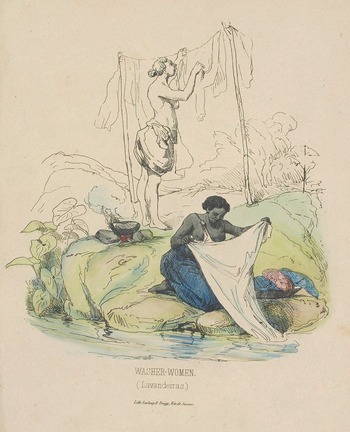
Uncle João is depicted here chatting and joking with the Black enslaved women (“as pretas”) behind the house, in the laundry, as the women are washing the clothes. They are wearing “tanga” around their waist over their dresses. “Tanga” is believed to be a Portuguese word of Bantu origin, which designates in Machado de Assis's novel the piece of cloth worn around the hips by the Black enslaved women. In the Diccionario da lingua brasileira (Dictionary of the Brazilian Language) of 1832 by Luiz Maria da Silva Pinto, “tanga” is defined as “o panno com que os pretos cobrem as partes vergonhosas da cintura atè os joelhos” (“the cloth with which black people cover their intimate parts from the waist to the knees”; “Tanga”; my trans.), in line with several extant photographs and lithographs depicting Black washerwomen in nineteenth-century Rio de Janeiro (see fig. 1).Footnote 11 It is a racially coded word, but it turns out to be more than that in translation.
Washer-Women (Lavandeiras). Ludwig and Briggs, 1845, objdigital.bn.br/acervo_digital/div_iconografia/icon70370/icon70370_28.jpg.

There is abundant research on cloth showing the various ways in which cloth gives material form to social categories and hierarchies.Footnote 12 Cloth may denote variation in age, sex, status, and group affiliation,Footnote 13 as well as express complex ethical issues related to dominance and autonomy, wealth and poverty, gender and sexuality. In the example of “tanga” it is important to keep in mind some of the elements encapsulated in this particular cloth—namely, its signaling of a particular group, its expression of specific social and power relations, its displacement because of slavery, its recontextualization, and its linking of past to present. Here is the trajectory of this cloth object in the five extant English translations (I have added emphasis to particular words and phrases):
With apron-belts tied in such a way as to raise their dresses a few inches, the coloured women—some of them in the washing-tank and some outside, bent over the pieces of clothing, beating them, soaping them, wringing them . . . (trans. Grossman [1952] 42)
These blacks, with a tanga on to hitch their clothes up a span or two, some in the tank, others out of it, bending over the clothes they were washing, soaping and wringing . . . (trans. Ellis [1955] 40)Footnote 14
The black women, with clothes around their middle, their dresses hiked up a little, some inside the tank, others outside, leaning over the articles of clothing, beating them, soaping them, twisting them . . . (trans. Rabassa [1997] 26)
The women wore their dresses caught up around the waist, revealing quite a lot of leg, and while some stood in the washing tank and others outside it, bent over the clothes, beating and soaping and wringing them out . . . (trans. Jull Costa and Patterson [2020] 33)
The slave women, their dresses tucked into the tanga-cloths round their waists, some wading in the laundry tank, others outside it, leaning over the clothes as they beat, soaped, and wrung them . . . (trans. Thomson-DeVeaux [2020] 33)Footnote 15
The trajectory of this particular object in translation starts with a juxtaposition, a hyphenated hybrid object combining apron and belt (“With apron-belts tied in such a way”). Grossman's 1952 translation recontextualizes the scene so that the focus seems to be the object's functional role in the washing service; the new object is adapted to a new context, thereby concealing more than revealing the social identity of the “coloured women.” Next, Ellis's 1955 version magnifies and exoticizes this object in translation (“The blacks, with a tanga on to hitch their clothes”). Ellis carries over the Portuguese-Bantu word “tanga” onto the English text and stresses further its foreignness through italicization. The effect is a kind of spotlight on the claim this particular thing might have on the reader's attention. Although we are not told what exactly a “tanga” is, the translation strongly highlights the relationship between the Black women and the object “tanga.” Rabassa in 1997 chooses rather to blur the object by making it part of the general category of clothes (“The black women, with clothes around their middle”); the object thus reveals nothing about its material specificity and irons out any relationship it might have with the collective identity of the enslaved Black women.
The two English translations of this passage published in 2020 engage with this particular thing in significantly opposing ways. Jull Costa and Patterson's translation makes the object disappear altogether, yet the women are objectified in phrases like “quite a lot of leg.” Indeed, over the course of the translations, the increasingly raised skirts seem to promote a nearly eroticizing objectification of the women themselves: from “a few inches” (1952) to “a span or two” (1955; a span is about nine inches) back to “a little” (1997) to the most objectifying “quite a lot of leg” (2020). In Jull Costa and Patterson's translation, the Black women who wear the tangas disappear, leaving behind generic “women” who are not said to be wearing tangas. The racially marked object and the women's race are elided there. In Thomson-DeVeaux's translation, though, this tanga-object receives an unexpected dimension, almost a redemptive reification (“The slave women, their dresses tucked into the tanga-cloths round their waists”): the translator keeps the Portuguese-Bantu word “tanga,” thus dramatizing its otherness, and adds the tag “cloths” so as to clarify as well as sharpen its materiality. Thomson-DeVeaux is the only one to translate “as pretas” (literally “the blacks”) as “slave women,” confronting the anglophone reader with the social status of these Black women.Footnote 16 The additional detailed endnote on “tanga” brings out the word's various past and present designations in Portuguese, thus offering a glimpse of the object's intricate historical trajectory and hinting at how this specific object bears the weight of a collective memory.
Objects in the world may change their meaning as they circulate from one place to another; consider Peter Burke's description of the three hundred million Chinese porcelain items exported to Europe after the Portuguese reached China, which became in Europe signs of an exotic culture (627). Objects in translation, too, are often displaced—decontextualized and recontextualized, to use Burke's terms—in their material translation. Moreover, the translation of things, glimpsed in this example and even more prominent in the case of Joseph's tunic, is often inextricably linked to the complex and rich relation people have with the material world, to the central role things have in organizing and sustaining human life, and to the ways in which individual and social identities are realized, negotiated, or transformed through the realm of things. “Our dialogue with the material world,” writes Bjornar Olsen, “is a sophisticated discourse about closeness, familiarity, about bodily belonging and remembering” (97). The example of the “tanga” points to the subtle role translation may have in the mediation of this dialogue between things and persons. The various translations above engage with things differently, and each discloses a different approach to things. What is more, through the realm of things and their translation, the dialogue between things and persons is significantly transformed in each of these translations. Thomson-DeVeaux's engagement with the material culture in Machado's nineteenth-century novel, for instance, where things are neither blurred nor generalized but invested with full attention and appreciation, allows for a distinct and strong relationship between things and persons to emerge in her translation.
“Tanga,” within the approach advanced in this essay, is not necessarily a problem to be solved in translation, an item of realia that needs to be linguistically mastered through different strategies, a potential lost object, a thing that one either domesticates or foreignizes—although I am aware that one has the choice of reducing it to this well-known binary. Translators tend to ask, in fact, the most fundamental questions about their source texts—not only the practical and instrumental “what should I do with this object in translation?” but also “what is this object?,” “why is this object in this text?,” and “what are the associated meanings and functions of this object in the source text and culture?” Their various answers—with all their underlying norms and cultural, ideological, and historical implications—are reflected in the many intriguing ways translations engage with things. Hence, once these answers are analyzed they are likely to offer us a special kind of knowledge. For translations may conceal or reveal material things; translations may bury things in the blur of familiarity or alternatively retrieve them from invisibility or oblivion; translations may emphasize the object's function, amplify its materiality, foreground its otherness, or focus on the emotion it prompts or the narrative it recalls or the collective memory it bears. And all across these various transformations, translation is mediating the complex relation between things and persons in multiple fascinating ways.
Fetish and Translation: Joseph and the Amazing Technicolor “Tunic”
In this second case study I propose to follow a longer trajectory of an object in translation—Joseph's famous tunic. The story of Joseph and his brothers in Genesis 37 is a superb example of how objects mediate our relation to ourselves as well as to other human beings. The story of Joseph's tunic dramatizes beautifully what research on material culture has shown in the last decades—namely, the multiple ways in which our cultural, social, and individual lives depend on and are constituted by our interconnections with things. Moreover, the various translations of Joseph's tunic in English raise several important issues concerning the circulation of objects in translation, their “inheritance” through retranslation, and their potential for fetishization.
Here is the biblical Hebrew text of Genesis 37.3:
וְיִשְׂרָאֵל אָהַב אֶת יוֹסֵף מִכָּל בָּנָיו כִּי בֶן זְקֻנִים הוּא לוֹ וְעָשָׂה לוֹ כְּתֹנֶת פַּסִּים׃
In the King James Bible (1611), Genesis 37.3 reads, “Now Israel loved Joseph more than all his children, because he was the son of his old age: and he made him a coat of many colours.”Footnote 17 Genesis 37 recounts the story of Jacob's (Israel's) favor for his son Joseph and how Joseph's brothers conspire to rid themselves of him. Jacob's special affection for Joseph is expressed through a gift Jacob offers Joseph, an object, a specific garment that triggers jealousy among his other sons as they perceive that their father loves Joseph more than all his brothers. The brothers then plot against him, strip him of this garment, throw him into a pit, sell him into slavery, dip his garment in animal blood, and send it to their father so he can recognize it as Joseph's garment and assume his son was devoured by a beast.Footnote 18
In his essay “The Cultural Biography of Things: Commoditization as Process,” Igor Kopytoff invites us to imagine writing “a life story of objects,” focusing attention on the object's biography beyond its role as a commodity exchange. According to Kopytoff's biographical approach to things, one can write a life story of objects by asking questions similar to those one asks about people: “[W]here does this thing come from and who made it? What has been its career so far, and what do people consider to be an ideal career for such things? What are the recognized ‘ages’ or ‘periods’ on the thing's life?” (66). He offers the example of a “typical biography of a hut” among the Suku of Zaire that begins its ten-year life span as a house for a married couple and, as it ages, successively turns into a guesthouse, a house for a widow, a teenager's hangout, a kitchen, and finally a goat or chicken house until at last the structure collapses. To write the biography of a thing involves recognizing the temporal, cognitive, and cultural elements in the thing's trajectory. The material lives of things are not static, and the lives of things circulating in translation are no different. What would the biography of a thing in translation look like? Tracing the movement of the garment in Joseph's story, following this object throughout its various uses, performances, and changes, allows us to illuminate the role it plays in its human and social context. What is this thing, referred to as כְּתֹנֶת פַּסִּים (ketonet passim) in biblical Hebrew, that Jacob had made for Joseph? What do we know from biblical and nonbiblical sources about this particular thing?
We know it is a piece of clothing and also, as Robert Alter writes in a note in his English translation of Genesis, that “the only clue about the nature of the garment is offered by the one other mention of it in the Bible (2 Samuel 13) . . . there we are told that the ketonet passim was worn by virgin princesses. It is thus a unisex garment and a product of ancient haute couture” (Genesis 207). We also know that there is a cuneiform text with a cognate phrase that possibly refers to an ornamented tunic (Speiser 289–90) and that scholars have associated this biblical piece of clothing with a fourteenth-century Egyptian fresco showing “captive Canaanite noblemen adorned with tunics made of longitudinal panels sewn together” (Alter 209). In 2009 the United Bible Societies published a robust volume in their series Helps for Translators entitled The Works of Their Hands: Man-Made Things in the Bible.Footnote 19 We learn there that the tunic was a long garment worn next to the skin; it was usually made of wool but could also be of other materials, such as linen; it often had sleeves, and it was worn by both sexes (Pritz 329). The one material quality strikingly absent from these descriptions of ketonet passim is color, let alone the multicolored attribute that so prominently appears in the English translations of this object. I come back to this point when discussing the translations below.
“The question of things,” writes Brown, “is inseparable from a question about what they do, or what can be done with them” (Other Things 222; my emphasis). In the following paragraphs I look briefly at what this garment thing does in the biblical narrative in order to set the scene for examining what can be done with or rather what has been done with this thing in translation.Footnote 20
The term for the garment occurs eight times in the biblical Hebrew text of this chapterFootnote 21—a remarkable repetition for a text known for its economy and concision. It furthermore seems to mediate a whole gamut of social and emotional relations; the ketonet passim is definitely doing work that goes far beyond what we would consider its “intrinsic function,” revealing thereby the entangled relationships between people and things. The garment has several functions: (1) as Jacob's medium to convey love and preference toward Joseph; (2) as material evidence of Jacob's preference for Joseph, the garment is what sets him apart from his brethren; (3) for the brothers, the garment stands for their discrimination and exclusion; (4) through the stripping of the garment, the brothers bring on humiliation and submission; (5) by dipping the garment in blood, they transform the thing into material evidence of something else, not of preference anymore but of slaughter; (6) the garment is next used as a form of identifying its wearer, Joseph; (7) the garment dipped in blood enacts a lie (both revealing and demonstrating that Joseph was devoured by a beast); and finally, (8) the recognition of the garment by Jacob induces mourning and grieving.
Now, when we follow this object as it moves in translation we observe a very curious and revealing turn. In the biblical Hebrew text, the emphasis is on the otherness that the garment bestows on Joseph, as well as on the social entanglements constructed between the garment and the persons—namely, the crucial relational role played by the tunic in mediating and shaping the dynamics of the people's relationships and emotions. In many English translations, however, an interesting shift takes place and the material object itself is foregrounded and magnified, thus making its material uniqueness and specialness markedly and concretely evident. The otherness or uniqueness has now become more of an intrinsic quality of the garment itself rather than its relational and affective role in the scene. In fact, the garment acquires an additional curious extra material quality as it moves—namely, color. The ketonet passim, in these translations, is physically not just any tunic or robe or coat, either long or short, with sleeves or not, but, in the words of some of these translations: a “multicolored,” “distinctive,” “special,” “fancy,” “spectacularly colored” object. It becomes an object that, within the anglophone target culture, will stand out physically (rather than relationally) and be easily identified as materially exceptional; it is now an object that can “speak for itself.” This unique materiality will, very importantly, not only add legitimacy and force to the object's prominent role in the narrative but probably also make the relationship between the object and the persons involved in the scene more understandable in the new contexts. Here are a few examples of such English language translations (the italics are mine):
English Standard Version
Now Israel loved Joseph more than any other of his sons, because he was the son of his old age. And he made him a robe of many colors.
Contemporary English Version
Jacob loved Joseph more than he did any of his other sons, because Joseph was born after Jacob was very old. Jacob had given Joseph a fancy coat.
International Standard Version
Now Israel loved Joseph more than all his brothers, since he was born to him in his old age, so he had made a richly-embroidered tunic for him.
Amplified Bible
Now Israel (Jacob) loved Joseph more than all his children, because he was the son of his old age; and he made him a [distinctive] multicolored tunic. (brackets in original)
New American Standard Bible
Now Israel loved Joseph more than all his sons, because he was the son of his old age; and he made him a varicolored tunic.
Jewish Publication Society
Now Israel loved Joseph more than all his children, because he was the son of his old age: and he made him a coat of many colours.
Douay Rheims Bible
Now Israel loved Joseph above all his sons, because he had him in his old age: and he made him a coat of divers colours.
Easy-to-Read Version
Joseph was born at a time when his father Israel was very old, so Israel loved him more than he loved his other sons. Jacob gave him a special coat, which was long and very beautiful.
The Voice
Now Israel loved Joseph more than any of his other children because he came along when he was an old man. So Israel presented Joseph with a special robe he had made for him—a spectacularly colorful robe with long sleeves in it.
Where do all the “spectacularly colorful,” “multicolored,” and “varicolored” qualities come from in most of these translations? The first translation to introduce the color quality in Joseph's garment was apparently the Greek translation of the Hebrew Bible in the third century BCE, known as the Septuagint (LXX). In the LXX, ketonet passim is translated as χιτῶνα ποικίλον, meaning “various-colored coat.”Footnote 22 This Greek translation has echoes in numerous English translations of Genesis 37, not necessarily through direct translation from the Greek but actually through the adoption of the multicolored quality ascribed to the coat by the King James Bible, which acquired a canonical-like status in the tradition of English Bible translations and thus had an effect on all future English translations. There is a sense in which the King James Bible's rendering of “a coat of many colours” haunts later translations (more on the issue of retranslation below).Footnote 23 I wish to suggest that these are all important stations in the object's trajectory in translation, distinct stages in its biography if you like. Together they throw light on a particular course an object may have in translation, how it may be handed down through retranslations, the subtle ways it is transformed, and how it moves between social contexts and gains additional meanings through successive recontextualizations.
And what do these colors do for the object? In “The Colours of Things,” Diana Young suggests that “the qualities that Western science has called ‘colour’ animate things and are therefore crucial in determining the role of things and persons in a social context” (182). What is the effect of colors in these translations where the garment emerges as a multicolored thing? There is no reference in these translations to any particular color or group of colors; the reference is always to the multiplicity of colors. I think that colors taken together in these translations contribute to the amplification of the object, to the empowering of its presence, the heightening of its visibility and, very significantly, the intensification of its force. It is this powerful force that may allow the object to become something else, a charged object, an object of fascination and desire, a kind of fetish. The tunic was also made famous in American popular culture in Tim Rice and Andrew Lloyd Webber's musical Joseph and the Amazing Technicolor Dreamcoat.
The word fetish apparently derives from the Portuguese word feitiço (“a charm” or “sorcery”), a name for talismans in the Middle Ages that were often illegal or heretical (Pietz 6). It was used by Portuguese sailors in the fifteenth century to refer to witchcraft, and in the eighteenth century it became the term used for religious practices of worshipping objects. In “Fetishism and the Social Value of Objects,” Tim Dant writes about how in modern societies “the fetish quality of cars, works of art, mobile phones, shirts and Italian food is not an intrinsic or stable quality of the object. It is assigned through cultural mediations, a circulation of signs that includes the objects themselves” (516). Translation is precisely one of these cultural mediators in the movement of objects between social contexts. My argument here is that just as translation may blur, recast, or even conceal objects, as we saw in the previous example, translation may also—in specific contexts and often involving retranslations—have the effect of investing objects with fetish qualities.
Accordingly, colors along with the various magnifying properties attributed to Joseph's garment in these translations enhance the garment's specialness, charging the garment with sensory vividness and expanding its value. It is through the cumulative effect of these translations that the tunic may be said to attain a fetish quality. Thus, while the garment surely had from the start of its trajectory an important role to play in the biblical Hebrew narrative—performing an array of crucial functions in the story and revealing yet again the intricate relationship between people and things—it was through translation that the object itself, its materiality and physical presence, got invested with special force and extraordinary properties, becoming a performance in itself. As the garment was celebrated and exalted through specific practices of translation, it emerged as a fascinating object with exceptional qualities, acquiring eventually a unique fetish status.
An important issue raised by the discussion in this section, and which recurs in the following section, is the role of previous translations in the shaping of things in retranslations. In fact, in all three brief case studies in this essay, I employ retranslations as a window to map some of the ways in which things circulate in translation. For when I talk about a particular course an object may have in translation, or how it may be handed down through retranslations, or the subtle ways it is transformed through successive recontextualizations, it is clear that the textual dynamics of retranslations play a crucial role in the area of research I am proposing here. And whereas retranslations are certainly not a new activity, the study of retranslation within translation studies is relatively recent. In Retranslation, Sharon Deane-Cox considers various approaches to retranslation since the 1990s and discusses the various forms of dialogue and engagement that can exist between “what are essentially multiples of one, that is texts which share a common point of origin” (15).Footnote 24 She mentions how the dialogue can be antagonistic, revelatory, or reverential but also how there might not be a dialogue at all, concluding that “the textual lines of influence that might hold between (re)translations are varied, if not wholly speculative” (188). To study retranslations, writes Lawrence Venuti, is “to realize that translating cannot be viewed as a simple act of communication because it creates values in social formations at specific historical moments, and these values redefine the source text and culture from moment to moment” (107). The traces and changes of material culture in retranslations are precisely part of these target-culture values that redefine the source text. Indeed, Deane-Cox includes a short section on “the material world” when analyzing George Sand's description of the Berry region in British English retranslations. Her focus, however, is on “the extent to which these totems of cultural identity survive when the narrative is replanted abroad” and, more broadly, on how this evidence supports or does not support Antoine Berman's postulate (known as the Retranslation Hypothesis), according to which later translations tend to be closer to their source texts (Deane-Cox 182). Deane-Cox proposes to look at the phenomenon of retranslation in a dynamic, nonlinear, and nondeterministic way—retranslations as instantiations of the interpretive potential of the source text. In line with her approach to retranslation, my study of the changes and movement of things in translations hopes to likewise shed light on “the transformative potentiality inherent in retranslation” (193).
I have traced in this section one possible way in which an object is handed down in its translation course, and I have tried to show how the biblical object “tunic” is recontextualized and eventually fetishized in its successive English retranslation trajectory. In the final section of this essay I examine a different trajectory, a trajectory in which the object at stake is transformed in such a way as to reshape the context and potentially destabilize the canonized interpretation.Footnote 25
When Abraham Took Out the “Cleaver” to Kill Isaac
The passage is a famous one, recounting Abraham's near sacrifice of Isaac in the book of Genesis. Here is the passage (Genesis 22.1–5) in Alter's recent English translation:
And it happened after these things that God tested Abraham. And He said to him, “Abraham!” and he said, “Here I am.” And He said, “Take, pray, your son, your only one, whom you love, Isaac, and go forth to the land of Moriah and offer him up as a burnt-offering on one of the mountains which I shall say to you.” And Abraham rose early in the morning and saddled his donkey and took his two lads with him, and Isaac his son, and he split wood for the offering, and rose and went to the place that God had said to him. On the third day Abraham raised his eyes and saw the place from afar. And Abraham said to his lads, “Sit you here with the donkey and let me and the lad walk ahead and let us worship and return to you.”
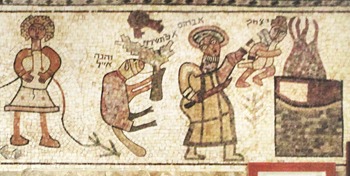
Abraham and Isaac reach Mount Moriah, and we then have a turn in Alter's translation that entirely depends on the translation of an object, an artifact, in Hebrew מַאֲכֶלֶת (ma'akhelet), which almost all previous English translations have rendered as “knife.” The Greek Septuagint (third century BCE), translates ma'akhelet as máχaira, which means “a large knife” or “a small sword,” and so does the Targum, the earliest rabbinic translation into Aramaic. Jerome's Latin Vulgate has glaudium, or “sword,” which is what we find also in the English Douay-Rheims Bible. The biblical scholar Hillel Halkin suggests that Jerome may have imagined a long slaughterer's knife with a curved tip such as is portrayed in the sixth-century CE synagogue mosaic of the binding of Isaac at the Israeli site of Beth Alpha (see fig. 2).
Detail from a modern reproduction of the sixth-century mosaic The Sacrifice of Isaac. Image courtesy of Dr. Avisai Teicher Pikiwiki Israel. Reproduced under the Creative Commons Attribution 2.5 Generic License.

Here is the Hebrew text of the passage:
וַיִּקַּח אַבְרָהָם אֶת עֲצֵי הָעֹלָה וַיָּשֶׂם עַל יִצְחָק בְּנוֹ וַיִּקַּח בְּיָדוֹ אֶת הָאֵשׁ וְאֶת הַמַּאֲכֶלֶת
Alter's translation reads as follows: “And Abraham took the wood for the offering and put it on Isaac his son and he took in his hand the fire and the cleaver, and the two of them went together” (my emphasis). “The cleaver?” asks Halkin aghast in his review of Alter's translation. “Alter doesn't ask in his commentary why Abraham has brought along a cleaver instead of a knife . . . is Abraham about to go berserk? Will he, having saddled his donkey, and split wood for an offering, and gone to Mount Moriah, and sacrificed Isaac on the altar he builds . . . chop him into pieces? Will all his terrible resolve, now that Isaac is dead, erupt in an orgiastic fury?”
Alter explains his translation choice in a footnote, saying that the Hebrew noun ma'akhelet in this passage is not the usual biblical term for “knife” but is rather a butcher's knife, hence not a simple knife but a cleaver (105). It is not the purpose of this essay to deliberate on whether ma'akhelet designates the object “cleaver” or “knife.” Instead, I want to identify once again the role of previous translations in the shaping of “things” in retranslations. In this particular trajectory, the unexpected change in a translated material object from the rather canonized “knife” to a “cleaver” produces important effects both in the text and in its reception. As mentioned earlier, a new translation involves some degree of dialogue and negotiation with previous translations, be it by way of assimilating, defying, contesting, or consciously ignoring its predecessors. Moreover, the reception of retranslations is a complex and fascinating issue. My specific concern, however, is not with the often strong and resistant reaction to new turns in retranslations, but rather with the specific flux and movement of material objects in retranslations. This knife-cleaver case nicely dramatizes the ways in which attention to the object world can trigger unexpected translation scenes. Thus, the Genesis story of the binding of Isaac involving a “knife” is not the same story of the binding of Isaac involving a “cleaver.” This is indeed the main implication of Halkin's criticism regarding Alter's “cleaver”: with a knife, Halkin says, “Abraham will slit Isaac's throat as one slaughters an animal”; with a cleaver he will “chop him into pieces” and “erupt in an orgiastic fury.” The choice of object definitely matters: the different objects characterize the events differently and set the scenes in a different perspective, partly because of the varying degrees of agency involved—a greater agency on Abraham's part seems to be assumed once a “cleaver” is used. It is one thing for a father to sacrifice a son; it is another for him to butcher that son into pieces. The choice of object in translation, then, may have a significant effect on the context, shaping the kind of event described as well as the degree and kind of agency involved.
The example in Genesis 22 further suggests that by reiterating the presence of a specific object, successive retranslations crystallize an expected or normative object. A “knife” becomes the canonized object in the binding of Isaac scene in English, given the weight and authority of the King James Bible in the tradition of English Bible translations. When, alternatively, the Jerome's Vulgate version is taken as the canonical previous translation, then various Catholic translations such as the English Douay-Rheims and the Catholic Public Domain Version feature a “sword” instead of a “knife” in Genesis 22. Once more the force of previous canonical translations, as well as genealogies of successive reiteration, shape material culture in translation.
Now, whereas certain things are inherited in translation, an interesting situation arises when a new translation chooses to “disinherit” an object, so to speak, by introducing a new translation of the object, an unexpected translation, a retranslation that disrupts and does not conform to previous translations, thus creating a discontinuity, as in Alter's translation of “cleaver.” In principle, several responses are possible—the new thing may be rejected or contested, or assimilated and praised.
In this example, the immediate effect of the new translated thing is to draw attention to the object and spotlight the artifact involved in this foundational biblical scene. In other words, the effect is to defamiliarize the object. The new thing in translation transforms the scene by triggering new associations and introducing new perspectives, even new interpretations of the larger narrative and characters in it. There is a sense in which the new translation makes the object world come to life. And inasmuch as the new translation turns the familiar object into an unfamiliar one, it achieves precisely the effect of estrangement described by Viktor Shklovsky when he famously wrote that “habitualization devours work, clothes, furniture, one's wife, and the fear of war” and declared that “art exists that one may recover the sensation of life; it exists to make one feel things, to make the stone stony” (12; my emphasis).
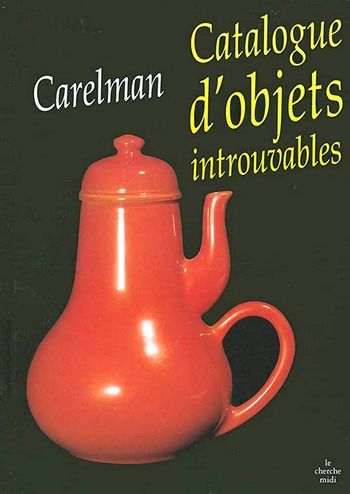
I have looked at things in translation primarily in order to think about translation—about how translation engages with things and what translations do to things, as well as the different ways in which the relationship between people and things is dramatized in translation. Yet I have likewise used translation to think about things—about how things circulate in translation, about their flux and transformation, about how in defiance of their material stability they may become different things in different translation scenes. In 1969 the French artist Jacques Carelman created Catalogue d'objets introuvables, which has been translated into English as Catalogue of Impossible Objects, Catalogue of Unfindable Objects, and Catalogue of Extraordinary Objects. The catalog was a parody of a French mail-order company and was eventually translated into nineteen languages. The most famous item in this catalog was Carelman's Coffeepot for Masochists (fig. 3), a coffeepot with a handle and spout on the same side, which either would be impossible to pour at all or would scald the user. This single object became the symbol of an entire critical approach to the design of things in everyday life. The “objets introuvables” were deliberately dysfunctional and outrageous. Many of these objects were in fact rebuilt into other objects, making them not only strikingly strange and fascinating but also wonderfully capable of challenging our familiarity with the objects around us. Objects in translations, like Carelman's objects, are objects displaced from somewhere else, decontextualized and recontextualized—built and shaped from previous objects, entangled with other people in other times—and very often they have the marvelous capacity of making us examine anew the transformative processes that shape the material world in translation.
Cover of Catalogue d'objets introuvables, by Jacques Carelman. © Le Cherche Midi Éditeur, 1999, for the new edition.