

INTRODUCTION
Cattle are kept for various purposes on all inhabited continents and in a large variety of environments (Epstein & Mason Reference Epstein, Mason and Mason1984; Rath Reference Rath1998). This has created more sub-populations than in any other livestock species (Felius Reference Felius1995; Buchanan & Dolezal Reference Buchanan, Dolezal, Fries and Ruvinsky1999). These are commonly – and also in the present paper – referred to as ‘breeds’, a term that in its broadest sense indicates populations in which reproductive matings were or are completely or partially under human control. Most breeds are bred separately from other animals of the same species and share typical characteristics. Depending on the degree of organization, animals are evaluated according to standardized breeding objectives and herdbooks are maintained.
Breeds are generally assumed to represent unique contributions to the diversity of livestock. Monitoring diversity, the European Federation of Animal Science (EAAP), the Food and Agriculture Organization of the United Nations (FAO) and other organizations record the breed as a ‘unit of conservation’ (Hall Reference Hall1994; FAO 2007). Extinction of any breed is considered as an irreversible loss of genetic resources (Oldenbroek Reference Oldenbroek2007; Hiemstra et al. Reference Hiemstra, De Haas, Mäki-Tanila and Gandini2010). However, how realistic are these perceptions? Does conservation of the diversity of cattle require the maintenance of all breeds as distinct components of the diversity of the species? The term breed needs to be clarified and at the same time put into perspective.
In the present paper, the breed concept is considered in the light of the history of livestock species. Focusing on cattle, for which breed differentiation is more pronounced than for any other livestock species, the molecular-genetic studies of breed diversity are discussed and the breed categorization used by the FAO is refined. The breed is described as a social concept, including the urban legends on the origin of breeds and the role of nomenclature. It is concluded that breeds do not always represent unique genetic resources and suggested that the breed concept can be instrumental for conservation purposes if considered as genetic management units.
NEVER THE SAME
Breeds of cattle are the result of a most dynamic history from the earliest domestication to modern times (Zeuner Reference Zeuner1963; Ajmone-Marsan et al. Reference Ajmone-Marsan, Garcia and Lenstra2010). After the development of agriculture about 10 000 BP in Mesopotamia and the Indus valley, domestic cattle spread over Eurasia and Africa together with sheep, goats, pigs and various crop species (Zeder et al. Reference Zeder, Emshwiller, Smith and Bradley2006; Groeneveld et al. Reference Groeneveld, Lenstra, Eding, Toro, Scherf, Pilling, Negrini, Finlay, Jianlin, Groeneveld and Weigend2010). In the Neolithic period, this led to the establishment of sedentary pastoral societies and then to a progressive cultural development. For cattle this initiated a series of evolutionary, genetic and demographic events (Ajmone-Marsan et al. Reference Ajmone-Marsan, Garcia and Lenstra2010), which are relevant for understanding the genetic constitution of the current breeds:
-
• Accompanying human civilization on all inhabited continents, cattle adapted to extreme climates and agricultural environments.
-
• Preferential use of sires conferring favourable characteristics led to changes that diffused to surrounding cattle populations. For instance, as early as prehistoric times heat-tolerant zebu replaced taurine cattle in subtropical and tropical zones. Specialized dairy cattle developed in different European regions and spread to other regions long before the development of breeds in the 18th century (Edwards et al. Reference Edwards, Ginja, Kantanen, Pérez-Pardal, Tresset, Stock, Gama, Penedo, Bradley, Lenstra and Nijman2011).
-
• In most regions, cattle decreased in size from the Neolithicum until the Middle Ages (Zeuner Reference Zeuner1963; Benecke Reference Benecke1994) and grew again after the 15th century by the improvement of fodder crops and farming practices (Markham Reference Markham1614; Fussell Reference Fussell1972; Russell Reference Russell1986; Felius Reference Felius1995).
-
• Local livestock populations often suffered from epidemics, famines or wars and were replaced by imports from neighbouring regions (Haring et al. Reference Haring, Hammond and Johansson1961; Armitage Reference Armitage1982).
-
• Taurine cattle accompanied the colonization of America and Australia (Rouse Reference Rouse1977). They were followed by zebu, after which new breeds emerged by mixing and further development of the imports.
-
• Breed formation in cattle by systematic selective breeding started in Europe in the 18th century in Great Britain with the pioneering development of the Longhorn by Robert Bakewell and of the Shorthorn by the Colling brothers (Haring et al. Reference Haring, Hammond and Johansson1961; Armitage Reference Armitage1982; Russell Reference Russell1986; Felius Reference Felius1995). Many of the present breeds originate from the 19th century. Major changes as compared with earlier breeding practices were the use of controlled inbreeding (‘breeding in-and-in’) and crossbreeding, the introduction of explicitly formulated breeding objectives and the documentation of pedigrees in herdbooks. However, this did not at all ‘fix’ the genetic constitutions of breeds.
-
• Continuing selection of top sires, facilitated by artificial insemination since the mid-20th century, has increased productivity by the introduction of traits such as the dairy conformation of the Holstein–Friesians and the muscular hypertrophy in several beef breeds.
-
• Breeding objectives shift over time. For instance, mechanization of agriculture ended the selection for draught power. Dairy cattle are now selected for milk with less fat, while a new fashion prescribes a black coat colour in several American beef breeds.
-
• From the 18th century onward, popular breeds spread more and more outside their region of origin. In the 19th century an ‘anglomania’ (Béranger & Vissac Reference Béranger, Vissac, Gibon and Flamant1994) led to the widespread use in Northwestern continental Europe of sires of the British Shorthorn, the first breed for which a herdbook was established. This was followed by the export of Black- and Red-Pied, Baltic Red, Ayrshire, Brown-Mountain and spotted triple-purpose cattle, several English beef breeds and in the 20th century also French beef breeds. Much more consequential was the spread in the late 20th century of the Holstein–Friesians, now the most numerous cattle breed worldwide. Such exports led to either the development of regional varieties with their own names or the establishment of cosmopolitan breeds with international exchange of breeding material.
-
• The cattle breeds inspired Wright (Reference Wright1969) to develop the classical theory of population subdivision. However, genetic isolation of breeds is rarely absolute. Crossbreeding is reported in the history of most breeds, ranging from sporadic introgression of surrounding cattle to intentional upgrading with more productive breeds (Felius Reference Felius1995). Even most local breeds, often considered to be authentic and rustic, have multiple roots, such as the Dutch Lakenvelder breed, which was influenced by the Belted Galloway and Gurtenvieh, and the Portuguese Minhota, which is now almost identical to German Yellow cattle (Groeneveld et al. Reference Groeneveld, Lenstra, Eding, Toro, Scherf, Pilling, Negrini, Finlay, Jianlin, Groeneveld and Weigend2010).
-
• In spite of an intense gene flow within and across national borders, a genetic contrast still separates North- and South-European cattle (Edwards et al. Reference Edwards, Ginja, Kantanen, Pérez-Pardal, Tresset, Stock, Gama, Penedo, Bradley, Lenstra and Nijman2011).
-
• Several European breeds were crossed with their American offspring, which by selection for productivity had acquired a modified appearance (‘allopatric development’, Felius et al. Reference Felius, Koolmees, Theunissen and Lenstra2011) and thus differ markedly from their European ancestors. American top sires brought about profound changes in European breeds such as the Black-Pied Friesian, Aberdeen-Angus, Hereford, Guernsey and Swiss Brown (Felius Reference Felius1995).
-
• Several successful breeds have absorbed minor neighbouring local populations or a number of minor breeds were merged. For instance, the reputed French beef breed Blonde d'Aquitaine emerged as an amalgamate of several South-French local breeds (Amigues et al. Reference Amigues, Boitard, Bertrand, Sancristobal and Rocha2011).
-
• Conversely, breeds were split into populations that are managed separately in different countries or regions. Within several breeds (e.g. Simmental) different lines were selected for different purposes (milk, beef, dual). The Dutch Burnt Red cattle have only recently been selected from Meuse–Rhine–Yssel (MRY) cattle for their dark colour and are now kept as a new breed (Hiemstra et al. Reference Hiemstra, De Haas, Mäki-Tanila and Gandini2010).
-
• New ‘synthetic’ or ‘composite’ breeds were formed by crossbreeding of breeds of different origins. Examples are the several American and taurine cattle breeds, the Heck cattle, heralded as a revival of the wild aurochs, and the modern Viking Red, that emerged from a cross of Finnish Ayrshire, Swedish Red-and-White and Danish Red.
-
• Several efforts to revive old breeds such as the Belgian Campine and the German Highland Red have led to ‘counterfeits’: cattle with reconstructed phenotypes but with only spurious links to the original population with the same name.
-
• Although less severely than in horses and dogs, inbreeding has narrowed the genetic basis of isolated populations. Examples are an isolated Betizu population, the Mallorquina, Menorquina (Martin-Burriel et al. Reference Martin-Burriel, Rodellar, Lenstra, Sanz, Cons, Osta, Reta, De Arguello, Sanz and Zaragoza2007), Jersey island breeds (although less extreme, Chikhi et al. Reference Chikhi, Goossens, Treanor and Bruford2004), the various subpopulations of fighting cattle (Canon et al. Reference Canon, Tupac-Yupanqui, Garcia-Atance, Cortes, Garcia, Fernandez and Dunner2008), and the genetically almost homogeneous Chillingham (Visscher et al. Reference Visscher, Smith, Hall and Williams2001).
In general, breeding is less advanced in the developing world where breed phenotypes are often less strictly defined and pedigrees are generally not recorded. Differences between breeds are more gradual and intermediate breed types are generated by tribal migrations and nomadic movements (Joshi et al. Reference Joshi, McLaughlin and Phillips1957). Moreover, changes are less dynamic while a longstanding adaptation to local conditions and extensive management is preserved.
Similar processes also influenced breeds of other livestock species (Groeneveld et al. Reference Groeneveld, Lenstra, Eding, Toro, Scherf, Pilling, Negrini, Finlay, Jianlin, Groeneveld and Weigend2010). Because of the demand for high-quality wool, sheep have been crossbred even more intensively than cattle with a major influence of several English breeds and Spanish sheep all around the world (Wood & Orel Reference Wood and Orel2001; Kijas et al. Reference Kijas, Lenstra, Hayes, Boitard, Porto Neto, San Cristobal, Servin, McCulloch, Whan, Gietzen, Paiva, Barendse, Ciani, Raadsma, McEwan and Dalrymple2012). In contrast, microsatellite genotyping indicates that goats have maintained a strong phylogeography (Canon et al. Reference Canon, Garcia, Garcia-Atance, Obexer-Ruff, Lenstra, Ajmone-Marsan and Dunner2006; Nomura et al. Reference Nomura, Ishii, Dadi, Takahashi, Minezawa, Cho, Sutopo, Faruque, Nyamsamba and Amano2012) with possibly a more complex domestication history than previously assumed (Nomura et al. Reference Nomura, Yonezawa, Mano, Kawakami, Shedlock, Hasegawa and Amano2013). Breed differentiation in river buffalo is weak and even absent in swamp buffalo, but in the latter species a low gene flow between regions has maintained genetic differences between regions (Yindee et al. Reference Yindee, Vlamings, Wajjwalku, Techakumphu, Lohachit, Sirivaidyapong, Thitaram, Amarasinghe, Alexander, Colenbrander and Lenstra2010; Zhang et al. Reference Zhang, Vankan, Zhang and Barker2011). Asian as well as European pigs are derived from local wild boars (Larson et al. Reference Larson, Liu, Zhao, Yuan, Fuller, Barton, Dobney, Fan, Gu, Liu, Luo, Lv, Andersson and Li2010). European pig breeds have been influenced by introgression of Asian domestic sows (Clop et al. Reference Clop, Amills, Noguera, Fernandez, Capote, Ramon, Kelly, Kijas, Andersson and Sanchez2004; Amaral et al. Reference Amaral, Ferretti, Megens, Crooijmans, Nie, Ramos-Onsins, Perez-Enciso, Schook and Groenen2011), while production animals are often bred by crossing of parents from divergent lines (Wiseman Reference Wiseman1986). Several horse breeds exchange breeding sires, but there is a differentiation according to breed type and geographical origin (Van de Goor et al. Reference Van de Goor, van Haeringen and Lenstra2011; Petersen et al. Reference Petersen, Mickelson, Cothran, Andersson, Axelsson, Bailey, Bannasch, Binns, Borges, Brama, da Camara Machado, Distl, Felicetti, Fox-Clipsham, Graves, Guerin, Haase, Hasegawa, Hemmann, Hill, Leeb, Lindgren, Lohi, Lopes, McGivney, Mikko, Orr, Penedo, Piercy, Raekallio, Rieder, Roed, Silvestrelli, Swinburne, Tozaki, Vaudin, Wade and McCue2013). Breed differentiation is strongest in fancy dog breeds with typical and often unhealthy morphologies and extreme inbreeding.
WHAT'S IN A BREED?
The present paper considers as a breed any population that is bred (see the Introduction). Thus, the definition does not comply with the criterion of ‘purebred pedigree provenance’ [L. Alderson, personal communication (presentation available at http://www.globaldiv.eu/Livestock_Biodiversity_Workshop/Presentations/6th%20May%202010/Alderson.pdf)]. Formal definitions are discussed by Buchanan & Dolezal (Reference Buchanan, Dolezal, Fries and Ruvinsky1999), Hall (Reference Hall, Lenstra and Deeming2004), Woolliams & Toro (Reference Woolliams, Toro and Oldenbroek2007) and Sponenberg (Reference Sponenberg2011). More informal definitions such as ‘A breed is a breed if enough people say it is’ (K. Hammond, cited in Woolliams & Toro Reference Woolliams, Toro and Oldenbroek2007) and ‘A breed is a breed if the breeders can get along’ (after K. Oldenbroek, personal communication) illustrate the volatility of the breed concept (see also Sponenberg Reference Sponenberg2011).
The survey of the history of cattle support the notion, that breeds have never been static entities. Changes are continuing; both highly productive and local breeds are not what they were 50 years ago. Further changes are to be expected in the near future and their rate may increase as a result of genomic selection.
Results of molecular studies are consistent with a young history of the breeds and their incomplete genetic isolation. In spite of clear differences in appearance, animals from different breeds differ only marginally more than animals belonging to the same breed (Giovambattista et al. Reference Giovambattista, Ripoli, Peral-Garcia and Bouzat2001; McKay et al. Reference McKay, Schnabel, Murdoch, Matukumalli, Aerts, Coppieters, Crews, Dias Neto, Gill, Gao, Mannen, Wang, Van Tassell, Williams, Taylor and Moore2008; Martinez et al. Reference Martinez, Gama, Canon, Ginja, Delgado, Dunner, Landi, Martin-Burriel, Penedo, Rodellar, Vega-Pla, Acosta, Alvarez, Camacho, Cortes, Marques, Martinez, Martinez, Melucci, Martinez-Velazquez, Munoz, Postiglioni, Quiroz, Sponenberg, Uffo, Villalobos, Zambrano and Zaragoza2012). Within continents there is little segregation of mitochondrial DNA haplotypes between breeds (Groeneveld et al. Reference Groeneveld, Lenstra, Eding, Toro, Scherf, Pilling, Negrini, Finlay, Jianlin, Groeneveld and Weigend2010). Breeds differ in their frequencies of alleles of autosomal markers, but these are certainly not an ‘identifiable package of specific genes’ (Sponenberg Reference Sponenberg2011).
Genetic distances between breeds indicate regional clusters of breeds, which reflect former or present gene flow between neighbouring populations (Decker et al. Reference Decker, Pires, Conant, McKay, Heaton, Chen, Cooper, Vilkki, Seabury, Caetano, Johnson, Brenneman, Hanotte, Eggert, Wiener, Kim, Kim, Sonstegard, Van Tassell, Neibergs, McEwan, Brauning, Coutinho, Babar, Wilson, McClure, Rolf, Kim, Schnabel and Taylor2009; Felius et al. Reference Felius, Koolmees, Theunissen and Lenstra2011). These clusters either combine breeds with similar appearance (Lowland Pied dairy, Baltic-Highland Red, Central Spotted, Central Brown and Podolian cattle) or breeds with a different appearance but a common local ancestry (British, Nordic, South-French or Iberian cattle). The effects of crossbreeding and local ancestry are illustrated by the Baltic Red cluster, which contains the Eastern-European derivatives but not the Flemish Red (Felius et al. Reference Felius, Koolmees, Theunissen and Lenstra2011).
Decrease of genetic diversity is predicted for sub-populations in which no new gene variants emerge (Wright Reference Wright1969), a trend that is supposed to be exacerbated by modern breeding methods (Taberlet et al. Reference Taberlet, Valentini, Rezaei, Naderi, Pompanon, Negrini and Ajmone-Marsan2008). However, according to the theory of selection-induced genetic variation (SIGV, Eitan & Soller Reference Eitan, Soller and Wasser2004; Carlborg et al. Reference Carlborg, Jacobsson, Ahgren, Siegel and Andersson2006), adaptation to selective breeding and feeding regimes continuously changes the spectrum of alleles with new variants emerging or the frequency of rare alleles increasing. Thus, while the repertoire of gene variants keeps shifting, overall diversity and response to selection are maintained. As mentioned above, crossbreeding, often promoted by migrations (Ajmone-Marsan et al. Reference Ajmone-Marsan, Garcia and Lenstra2010) may also counteract the decrease of diversity by genetic isolation.
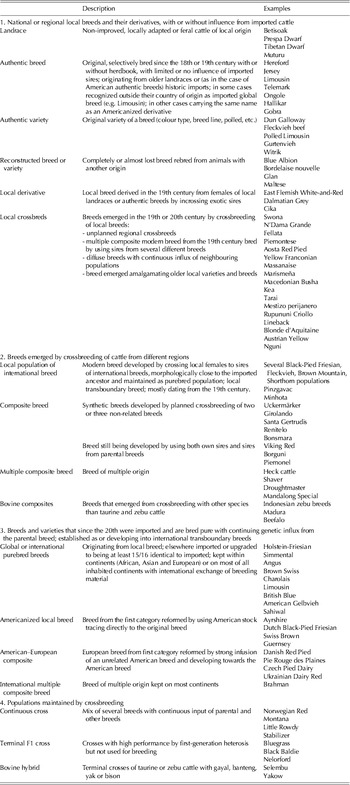
On the basis of foregoing data and considerations, breeds are suggested to be seen as primary units for the genetic management of livestock. The FAO Domestic Animal Diversity Information System (DAD-IS) database (Groeneveld et al. Reference Groeneveld, Lenstra, Eding, Toro, Scherf, Pilling, Negrini, Finlay, Jianlin, Groeneveld and Weigend2010) lists 951 breed names in 47 European or West-Asian countries, including several imported populations. A distinction is made between truly ‘local’ breeds that appear in one country only, ‘regional transboundary’ breeds found in different countries, and the more widespread ‘international transboundary’ breeds (FAO 2007). As indicated above, local breeds are not always authentic and may have multiple origins. In practice, cattle derived from imports before 1960 are often perceived as being local. In accordance with a definition originally formulated by the British Rare Breed Survival Trust (www.rbst.org.uk/watchlist-criteria.pdf), in 2011 an FAO working-group defined a breed as endemic if it had been present in a country for more than 40 years plus six generations (K. Oldenbroek, personal communication). Table 1 presents a more refined categorization of breeds on the basis of their recent history. This categorization is independent of the integrated and genetic classifications of cattle breeds on the basis of breed relationships (Felius et al. Reference Felius, Koolmees, Theunissen and Lenstra2011; Buchanan & Lenstra in press). Four categories of breeds may be defined, which differ gradually and can each be divided in subcategories:
-
1. Local cattle, which originate from cattle present in the region in the 18th century or earlier and may have been influenced by cattle from other regions.
-
2. Cattle that emerged later by crossbreeding with cattle from other regions. Even though their genetic roots derive mainly from outside the region, there are many examples of crossbreds from the 19th century that are commonly perceived as belonging to the local heritage (Felius Reference Felius1995).
-
3. Highly productive imported cattle with continuing international exchange of breeding material.
-
4. Cattle that are still maintained by crossbreeding with breeds of other origin or with other bovine species.
Breed categories and subcategories on the basis of recent history(Sub)category

For all four categories, ‘modern’ indicates a breed originating after the 18th century but before World War II and ‘recent’ those originating after 1945. A comprehensive overview per country of the breeds from the different (sub)categories, ranging from well-known cosmopolitan breeds to local breeds not known outside their region of origin, is given in the first part of the supplementary online Appendix (go to http://journals.cambridge.org/AGS).
CLUB ICONS
Management of a breed depends on the combined effort of breeders and the breeding organization. Understandably, breeders are proud of their animals and breeding plays an important role in their social life. This makes a breed a genetic as well as a social concept: a group of animals that confers an identity to the breeders, who share the appreciation of the breed, via the breed name. The perceived value of a breed is derived from its performance, but also from its role in the local tradition and from ideas about its (supposed) origin: the breed may function as an integral part of the breeders’ cultural heritage. In the Dutch province of Friesland, for instance, the Black-Pied Friesian breed was believed to be more than 1000 years old. The sturdy, well-rounded and reliable dual-purpose Friesian cow of the mid-20th century was referred to as ‘our mother’, not only because she was the source of prosperity, but also because her characteristics reflected the farmers’ view of their Friesian identity. When the dual-purpose Friesian came under attack in the 1960s for their decreasing productivity, many Friesian breeders took this as an attack on their ideology of farming and way of life (Theunissen Reference Theunissen2008, Reference Theunissen2012). Hall (Reference Hall, Lenstra and Deeming2004) described cultural aspects for several African and European breeds and Hiemstra et al. (Reference Hiemstra, De Haas, Mäki-Tanila and Gandini2010) for European local breeds.
In particular, breeders of traditional breeds tend to project the origin of their breeds into the remote past (Trow-Smith Reference Trow-Smith1959). However, the history of breeds before the 18th century has been documented only partially or not at all. This has created room for ideas on an ancient origin, which often have been amplified into urban legends and are now perpetuated via the new web-based sources of information. To give a few examples of ‘mythical breeds’:
-
• Long-horned and long-haired Scottish Highland cattle, which are related to other British cattle (Decker et al. Reference Decker, Pires, Conant, McKay, Heaton, Chen, Cooper, Vilkki, Seabury, Caetano, Johnson, Brenneman, Hanotte, Eggert, Wiener, Kim, Kim, Sonstegard, Van Tassell, Neibergs, McEwan, Brauning, Coutinho, Babar, Wilson, McClure, Rolf, Kim, Schnabel and Taylor2009; Edwards et al. Reference Edwards, Ginja, Kantanen, Pérez-Pardal, Tresset, Stock, Gama, Penedo, Bradley, Lenstra and Nijman2011) are promoted to be akin to aurochs, fitting their use for ‘natural’ landscape management.
-
• Similarly, the long-horned French Salers is supposed to be derived from the aurochs depicted 17 500 BP in the Lascaux caves (Rath Reference Rath1998). This is contradicted by the arrival of domestic cattle 10 000 years later and a close genetic relationship of the present Salers to other South French breeds cattle (Decker et al. Reference Decker, Pires, Conant, McKay, Heaton, Chen, Cooper, Vilkki, Seabury, Caetano, Johnson, Brenneman, Hanotte, Eggert, Wiener, Kim, Kim, Sonstegard, Van Tassell, Neibergs, McEwan, Brauning, Coutinho, Babar, Wilson, McClure, Rolf, Kim, Schnabel and Taylor2009; Edwards et al. Reference Edwards, Ginja, Kantanen, Pérez-Pardal, Tresset, Stock, Gama, Penedo, Bradley, Lenstra and Nijman2011; Felius et al. Reference Felius, Koolmees, Theunissen and Lenstra2011).
-
• Also the feral Spanish Mostrenca/Marismeña from Doñana National Park is claimed to descend from primigenius cattle (Rodriguez Reference Rodriguez2010). Yet it is known to have descended from local cattle (Sanchez Belda Reference Sanchez Belda1984).
-
• For British White Park cattle, the 19th-century ideas are kept alive on a descent from white cattle introduced by the Romans and assumed to have survived as feral cattle (Wilson Reference Wilson1909; Ludwig et al. Reference Ludwig, Alderson, Fandrey, Lieckfeldt, Soederlund and Froelich2013). In fact, the current white herds did not exist until the 17th century (Cheese Reference Cheese1979) and White Park is related to other British breeds (Decker et al. Reference Decker, Pires, Conant, McKay, Heaton, Chen, Cooper, Vilkki, Seabury, Caetano, Johnson, Brenneman, Hanotte, Eggert, Wiener, Kim, Kim, Sonstegard, Van Tassell, Neibergs, McEwan, Brauning, Coutinho, Babar, Wilson, McClure, Rolf, Kim, Schnabel and Taylor2009).
-
• Similar conjectures (www.lincolnredcattlesociety.co.uk) link the Lincoln Red to cattle imported by Viking invaders, ignoring the late 18th-century development of the red cattle (Skehel Reference Skehel1995).
-
• Speculations on an Asian (Tubbs Reference Tubbs1947) or African (Bangham & Blumberg Reference Bangham and Blumberg1958) origin of Channel Island cattle have been refuted by mitochondrial DNA, microsatellite and single nucleotide polymorphism (SNP) analysis (Troy et al. Reference Troy, MacHugh, Bailey, Magee, Loftus, Cunningham, Chamberlain, Sykes and Bradley2001; Decker et al. Reference Decker, Pires, Conant, McKay, Heaton, Chen, Cooper, Vilkki, Seabury, Caetano, Johnson, Brenneman, Hanotte, Eggert, Wiener, Kim, Kim, Sonstegard, Van Tassell, Neibergs, McEwan, Brauning, Coutinho, Babar, Wilson, McClure, Rolf, Kim, Schnabel and Taylor2009; Edwards et al. Reference Edwards, Ginja, Kantanen, Pérez-Pardal, Tresset, Stock, Gama, Penedo, Bradley, Lenstra and Nijman2011).
-
• A recent compilation of French breeds (Dervillé et al. Reference Dervillé, Patin and Avon2009) still mentions a medieval Spanish-Arabian origin of the 19th-century amalgamate Bazadaise, Roman roots of the Tarentaise and a primigenius origin of the Camargue, respectively, while Bazadaise is closely related to other South-French breeds (Decker et al. Reference Decker, Pires, Conant, McKay, Heaton, Chen, Cooper, Vilkki, Seabury, Caetano, Johnson, Brenneman, Hanotte, Eggert, Wiener, Kim, Kim, Sonstegard, Van Tassell, Neibergs, McEwan, Brauning, Coutinho, Babar, Wilson, McClure, Rolf, Kim, Schnabel and Taylor2009; Felius et al. Reference Felius, Koolmees, Theunissen and Lenstra2011).
All these stories lack the support of reliable historical documentation, but fortify the perception of the breed as a genetic resource of old origin.
ON THE NAMES OF CATTLE
Most breed names refer to a region of origin, coat colour, colour pattern or horn size. However, a name is not just a convenient denotation for a local kind of cattle; as indicated it evokes the inherent perceptions and feelings that its breeders associate with it.
Several breeds are essentially identical and even exchange breeding sires but carry different names. This is the case if a breed is kept by people speaking different languages such as national breeds in bilingual countries (e.g. Hérens and Eringer in Switzerland), local transboundary breeds in neighbouring countries (e.g. Spanish Berciana and Portuguese Mirandesa) or imported breeds with translated names (e.g. La Brune, Bruna Alpina and Parda de Montanã for Swiss Brown). Nevertheless, these breeds are often perceived as being different and listed separately in the FAO surveys.
New names may be coined for existing breeds because of a marketing strategy (‘branding’, Rouge des prés in 2003 for Maine-Anjou, formerly Durham-Mancell; Istrian for the Croatian Buje since 1954) or for new amalgamations (Blonde d'Aquitaine in France). Varieties that are being developed also derive their status from a new name, such as the Dutch Burnt Red (Brandrood, also Deep Red) variety of the MRY red-pied breed. Names of recent ‘synthetic’ breeds as Beef Machine, Beefmaker and Tropicarne leave no doubt for what purpose they have been developed.
The second part of the online Appendix (http://journals.cambridge.org/AGS) presents a survey of 5574 names of cattle breeds and their varieties in the local languages and in English and including the many synonyms. These names are arranged according to the integrative geographic, morphological and historic classification (Felius Reference Felius1995; Felius et al. Reference Felius, Koolmees, Theunissen and Lenstra2011). The third part also gives an alphabetical list with references.
TO CONSERVE OR NOT TO CONSERVE
It is well-recognized that the continuing replacement of traditional local cattle by highly productive international breeds may lead to a loss of the original genetic resources (Groeneveld et al. Reference Groeneveld, Lenstra, Eding, Toro, Scherf, Pilling, Negrini, Finlay, Jianlin, Groeneveld and Weigend2010). This has initiated several initiatives to compile and analyse the current state of livestock diversity. Methods developed for a rational prioritization of breeds for conservation on the basis of a set of selectively neutral genetic markers (reviewed by Boettcher Reference Boettcher, Tixier-Boichard, Toro, Simianer, Eding, Gandini, Joost, Garcia, Colli and Ajmone-Marsan2010) did not reach the stage of practical applications (European Cattle Genetic Diversity Consortium 2006). However, for several breeds DNA studies with neutral markers do indicate a high conservation priority (FAO 2011):
-
• Breeds with a high diversity in the neutral markers are also likely to have retained adaptive variation. For instance, cattle originating from the first domestication site may have retained the diversity of their wild ancestor.
-
• Several Asian breeds have a unique species composition with input from banteng, gayal or yak.
-
• Breeds for which the molecular phylogeny (Felius et al. Reference Felius, Koolmees, Theunissen and Lenstra2011) indicates a long separation from other breeds are likely to have developed unique features. For instance, Jersey from the Isle of Jersey has not been crossbred since 1789 and has a special milk composition; Siberian Yakut developed an adaption to the cold (Granberg et al. Reference Granberg, Kantanen and Soini2009), and African N'Dama survived in West-Africa by its trypanotolerance (Joshi et al. Reference Joshi, McLaughlin and Phillips1957). A special case is the Chillingham cattle in which centuries of complete isolation in a small group have created an extreme degree of homozygosity, a most unique feature with considerable scientific interest (Visscher et al. Reference Visscher, Smith, Hall and Williams2001).
Since selectively neutral genetic markers are generally not informative about adaptation (Hall et al. Reference Hall2012), an adaptive index is considered as a criterion for conservation (Bonin et al. Reference Bonin, Nicole, Pompanon, Miaud and Taberlet2007). Unique and valuable morphological breed-specific traits are still the most obvious arguments for conservation, even if the breeding for phenotypic distinctiveness and strict genetic isolation decrease its contribution to the molecular diversity.
However, considerations of this kind do not guide decisions about conservation for all breeds. Given the short history of many breeds and their intensive contacts, it cannot be taken for granted that each breed has retained valuable features not present in other breeds. A more detailed insight in the uniqueness of breeds is to be expected from a molecular characterization of the adaptive variation, which is being catalysed by affordable genomic sequencing.
BREEDS AS MANAGEMENT UNITS
In the current view, breeds are the units of conservation that each contribute independently to the diversity of the species. Since a considerable part of the diversity is not unique for a single breed but is dispersed over several others, a different role of the breeds and breeding organizations is proposed, which also conforms to practical reality. Instead of units of conservation, breeds may be considered as what they really are: units of management. In line with the historical and molecular evidence, a breed is not a unique reservoir of diversity, but may be considered as a ‘genetic reserve’, managed separately from other breeds and containing a portion of the livestock variation that is either specific for the breed or shared by others.
Effective genetic management is being achieved by maintaining herdbooks, which, by recording of pedigrees and documenting admixture, allows for an estimation of the level of inbreeding and keeps track of the phenotype by monitoring relevant traits. This allows for an identification of authentic breeding lines that need to be conserved, but also facilitates the discovery of spontaneous new variants to be evaluated as new additions to the genetic repertoire. Breed standards are to be maintained, but preferably in the context of a broad genetic basis.
Keeping populations purebred according to herdbook records appeals to a sense of order, but inbreeding leads to a decrease of biodiversity and also invites a higher prevalence of genetic diseases, lower fertility and a decrease in disease resistance. Moreover ‘genetic purity’ in a diploid species eludes a clear definition in molecular terms. Controlled cross-breeding has been practised for centuries and is not always and in itself undesirable. In practice it has never diminished the role of a breed in the local tradition and its place in the cultural heritage as long as the typical breed features were conserved.
Last but not least, breed societies should interact with scientists for applying the state-of-the-art technology of molecular monitoring and for a scientifically rewarding characterization of their genetic resources.
SUPPLEMENTARY MATERIAL REFERENCE
Suppl Mat 1. Felius, M., Theunissen, B. & Lenstra, J. A. Felius Appendix.pdf Journal of Agricultural Science, Cambridge 2014; Suppl. Mat. 1 (http://journals.cambridge.org/AGS).
The supplementary material for this article can be found at http://www.journals.cambridge.org/AGS