INTRODUCTION
Cancer remains the number two cause of death in the United States. In 2006, cancer was responsible for over 560,000 deaths or 1 of every 4 deaths (American Cancer Society, 2006). In response to the need for improved end-of-life care, the modern American hospice movement began, and, since 1985, the number of patients served has grown significantly. In 2006, in excess of 1 millions patients were served by hospice, with the majority of them being cancer patients (National Hospice and Palliative Care Organization, 2008). Satisfaction with hospice is extremely high among patients, their caregivers, and health care providers, with a large majority of survey respondents (>90%) giving high ratings (Stillman & Syrjala, Reference Tang1999; Ogle et al., Reference Schockett, Teno and Miller2003).
Despite the advantages of hospice care for cancer patients, many are enrolled late in the course of their illness or not at all. In a landmark study of 6,451 Medicare beneficiaries enrolled in hospice, the median survival for cancer patients ranged from 23 to 50 days and the percentage that died within 7 days of enrollment ranged from 7% to 22%, depending on type of cancer (Christakis & Escarce, Reference Christakis and Escarce1996). Since this report was published, the median length of stay in hospice has declined to just 20 days (National Hospice and Palliative Care Organization (2008)). Although cancer patients represent the majority of hospice patients, most cancer patients do not utilize hospice care at the end of life. The overall estimated rate of hospice use is 43.4 hospice users per 100 cancer deaths. The rate of hospice use is consistent across all cancers, despite varying trajectories of decline for different malignancies (Virnig et al., Reference Weggel2002).
There is a general consensus in the medical literature that many patients are enrolled too late in hospice programs to obtain maximum benefit and that patients enrolled very close to death (“shotgun admission”) may actually be harmed (Christakis & Escarce, Reference Christakis and Escarce1996; Ogle et al., Reference Ogle and Mavis2002). An abrupt shift from the goal of cure to the goal of comfort using a hospice program when a patient is already close to death can result in discontinuity of care and decreases the opportunity for development of a patient- and family-centered comprehensive end-of-life care plan. Research has demonstrated significantly less caregiver satisfaction with a length of hospice stay less than 30 days (Ogle et al., Reference Ogle, Mavis and Wang2002; Schockett et al., Reference Stillman and Syrjala2005). Additionally, late transfers are financially harmful to hospices, which are reimbursed by Medicare on a per diem basis and carry the significant up-front costs of equipment, medications, and staff time (Ogle et al., Reference Ogle, Mavis and Wang2002).
Previous research has investigated various aspects of physicians', patients', and caregivers' attitudes toward hospice enrollment. Retrospective studies have demonstrated that patient demographics, type of insurance, and certain clinical and social descriptors are associated with the length of stay in hospice (Chen et al., Reference Chen, Haley and Robinson2003; McCarthy et al., Reference McCarthy, Burns and Davis2003a, Reference McCarthy, Burns and Ngo-Metzger2003b; Tang, Reference Virnig, McBean and Kind2003). Qualitative studies have shown that psychological factors, such as a patient's acceptance that the disease is terminal, are associated with hospice enrollment (McNeilly & Hillary, Reference McNeilly and Hillary1997), although patients in general are reluctant to accept a terminal prognosis and tend to be overly optimistic about the likelihood of survival (McCarthy et al., Reference McCarthy, Phillips and Zhong2000).
Surveys of physicians find that most (90%) are aware of and favorably impressed by hospice care, yet many do not refer to hospice (Gochman & Bonham, Reference Gochman and Bonham1988; Weggel, Reference Weggel1999). Physicians report that hospice is underutilized (78%), but few feel they personally underrefer (15%; Brickner et al., Reference Brickner, Scannell and Marquel2004). Significant health care system barriers may include the Medicare hospice benefit eligibility requirements of a physician-predicted survival less than 6 months (Brickner et al., Reference Brickner, Scannell and Marquel2004) and relinquishment of reimbursement for possible curative therapies in exchange for payment of comfort-focused therapies provided through the hospice agency (i.e., the “either-or” structure of the benefit; Hyman & Bulkin, Reference Hyman and Bulkin1990).
Late enrollment remains problematic despite the fact that hospice may provide substantial benefits for end-of-life care and is well received by cancer patients/caregivers and physicians. The purpose of this research was to conduct a preliminary study of caregivers of lung cancer patients' perceptions regarding enrollment and timing of hospice enrollment and to assess physicians' perceptions regarding hospice care and enrollment timing.
METHODS
Setting and Participants
The study was conducted in South Carolina. The invited 1600 physicians were those who self-reported themselves as internal medicine or a medicine subspecialty (e.g., oncology, pulmonary medicine, etc.) to the South Carolina Medical Licensing Board. The 200 caregiver participants were recruited through a partnership with one local hospice. Caregivers were eligible if the enrollee had a lung cancer diagnosis and died while receiving hospice care between 2000 and 2004.
Survey Design and Measures
A review of published literature was conducted (MEDLINE, Psychinfo, and CINAHL) to help identify barriers to hospice enrollment. Because no survey instruments were identified that served the needs of this study, the investigators developed two preliminary questionnaires. Domains of interest were culled from expert opinion in the published literature. These emphasized potential patient/caregiver and physician barriers to enrollment. Two of the authors (D.F., G.S.) with expertise caring for lung cancer patients and in palliative medicine identified additional potential barriers based on their clinical experiences. From the hypothesized barriers, preliminary survey questions were developed using a 5-point Likert response scale (Devallis, Reference Devallis1991). The preliminary questions were tested in focus groups of caregivers of deceased lung cancer patients and with physicians using semistructured interviews. After focus group review, one item was added to both questionnaires. Several questions were rewritten to improve readability and face validity. A total of 16 items remained on the physician survey questionnaire and a total of 19 items on the caregiver survey questionnaire. Where possible, items related to referral decisions were similarly worded in both versions. The caregiver survey was written such that it could be understood by those having a sixth grade reading level using the Flesch–Kincaid Grade Level scoring formula incorporated into Microsoft Word.
The caregiver survey elicited responses across several areas, including initial source of hospice information, selected characteristics of the patient (age, gender, race, marital status, and education) and the caregiver's relationship to the deceased. Seven items on the caregiver survey inquired about specific reasons regarding the timing of hospice enrollment, two asked about satisfaction and whether the patient would have preferred hospice care earlier and if so how much.
The physician survey contained questions addressing demographics, practice type and setting, satisfaction with hospice, and seven reasons why the physician might be reluctant to recommend hospice care. The major difference between the surveys is that the caregivers are reporting a personal experience whereas physicians are reporting an aggregate impression about hospice care.
Data Collection
Surveys were mailed to physicians and caregivers by the Medical University of South Carolina (MUSC) Survey Research Unit (SRU). A cover letter signed by Drs. Ford and Silvestri was included that explained the purpose of the survey, and respondents were provided with a stamped envelope addressed to the institutional SRU. Neither survey nor the return envelope had subject codes. There were no incentives provided to the respondents. There were no follow-up reminder mailings. The project was approved by the MUSC Institutional Review Board.
Data Management and Analysis
The surveys were produced in a scannable format, and the SRU scanned responses into a Microsoft Access database.
Upon examination of the frequencies associated with various questionnaire item responses, the 5-point Likert responses were collapsed into two categories: strongly agree/agree versus no opinion/strongly disagree/disagree. Because the surveys were not designed to obtain summary or domain scores, analyses focused on individual item responses. For items that were similar on the two surveys, comparisons between caregiver and physician responses were made using chi-squared tests. For caregiver surveys, a series of logistic regression models was used to determine which questionnaire items were most strongly and independently associated with a length of stay in hospice <30 days prior to death. All factors exhibiting marginal significance (p < .15) in unadjusted (univariate) models were placed into multivariable logistic regression models to develop a better sense of their level of independent association with having a length of stay in hospice <30 days. Analyses of physician responses were descriptive, aimed at determining which barriers to hospice enrollment were of greater concern than others. All analyses were performed using SAS version 9.1 (Cary, NC).
RESULTS
Fifty-three caregivers (27% response rate) returned surveys. Caregivers' reports of deceased lung cancer patients' demographic characteristics were 60% (n = 28) male, 82% (n = 42) Caucasian, 14% (n = 7) African-American, and 4% (n = 2) other. Deceased patients' marital status, as reported by the caregiver, was 71% (n = 36) married, 22% (n = 11) widowed, and the remainder divorced or never married (7%, n = 4). A majority of deceased lung cancer patients had at least a high school education (77%, n = 40), with a substantial percentage having above a high school education (48%, n = 25). However, a significant minority had less than a high school education (23%, n = 12). The most common relationship to the deceased lung cancer patient was spouse (63%, n = 33), followed by child (27%, n = 14) and sibling (10%, n = 5).
For the physician survey 273 physicians (17% response rate) returned surveys. Eighty percent were male (205 of 255 that responded to question gender data). Of 262 subjects who provided race/ethnicity data, 82% were Caucasian (n = 215), 6% Asian-American (n = 17), 5% African-American (n = 14), 2% Hispanic (n = 4), and 5% other (n = 12). Of 268 respondents that reported a specialty, internal medicine was the most commonly reported at 52% (n = 139), followed by pulmonary medicine (13%, n = 34) and oncology (12%, n = 31).
Most physicians reported a private practice setting (64%), but a significant minority were university physicians (20%). The annual number of lung cancer patients seen by physician respondents was relatively small (62% reported fewer than 10 lung cancer patients per year).
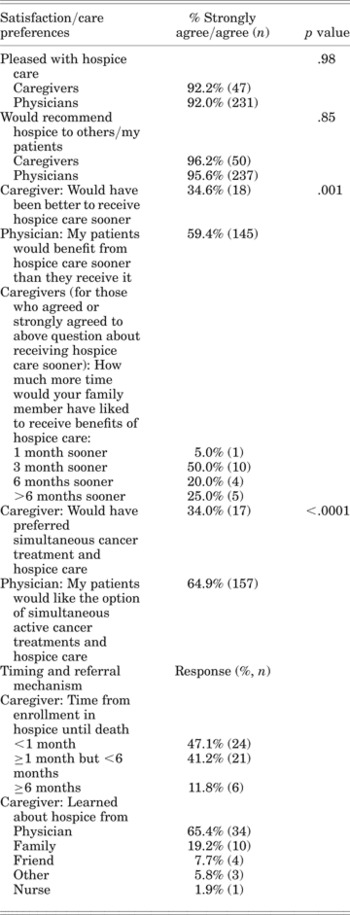
Satisfaction with hospice was high among caregivers and physicians, and most would recommend it for lung cancer patients (Table 1). Caregivers and physicians differ in their perceptions about whether hospice care should be provided earlier (p = .001), but among caregivers who favored earlier hospice care, 95% would have preferred it at least 3 months sooner. Physicians favor combined cancer treatment and hospice care (65%), whereas only a minority (34%) of caregivers did (p < .0001).
Caregiver (n = 53) and Physician (n = 273) Reports on Hospice Care and Timing of Enrollment

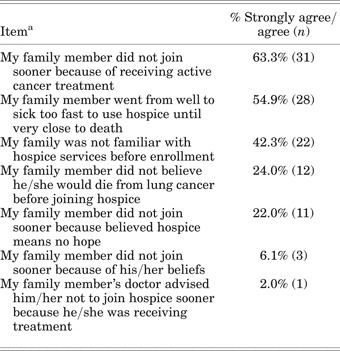
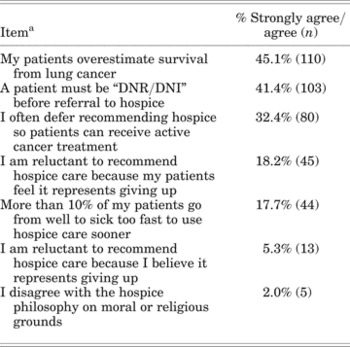
The items designed to assess hypothesized barriers to hospice enrollment among caregivers are presented in Table 2. Top barriers reported by caregivers of lung cancer patients included receiving active cancer treatment, rapid transition from well to sick, and not being familiar with hospice services. Among physicians, impediments reported with highest frequency to earlier hospice enrollment included patients overestimating survival from lung cancer, DNR/DNI required prior to hospice enrollment, and active cancer treatment (Table 3).
Caregiver Reports on Deferring Hospice Enrollment (n = 53)

aCaregiver questionnaire items (5-point scale).
Physician Reports on Deferring Hospice Enrollment (n = 273)

aPhysician questionnaire items (5-point scale).
The bivariate (unadjusted) logistic regression models indicated two variables in the caregiver survey that were potentially associated with enrollment in hospice for less than 1 month prior to the patient's death: transitioning from well to sick too quickly (unadjusted odds ratio = 11.3, 95% confidence interval [CI] = 2.9 to 43.9, p < .001) and the patients' belief that hospice means no hope (unadjusted odds ratio = 3.7, 95% CI = 0.8 to 16.7, p = .085). In a multivariable logistic regression model with both of these explanatory variables included, the results remained relatively unchanged: transitioning from well to sick too quickly (adjusted odds ratio = 12.1, 95% CI = 2.8 to 52.3, p < .001); patients' belief that hospice means no hope (adjusted odds ratio = 4.9, 95% CI = 0.8 to 30.0, p = .086).
DISCUSSION
This study offers several important insights into the timing of enrollment and why lung cancer patients do not enroll earlier in hospice care. Several of the findings support the notion that lung cancer patients—even those with advanced disease and who are eligible for hospice—do not perceive themselves as terminally ill, do not feel they will die of lung cancer, desire to continue active cancer treatment, and feel hospice represents giving up hope. A common requirement that active lung cancer treatments stop prior to hospice enrollment prevented a large proportion of patients from enrolling earlier, yet, paradoxically, most would not have desired simultaneous cancer treatment and hospice care. However, another group of respondents appears to feel that hospice care should have been offered sooner (at least 3 months) than it was, although reasons behind this cannot be deduced from these data. Finally, lack of knowledge of hospice services represents a barrier to some lung cancer patients, and the fact that 35% of lung cancer patients did not learn about hospice from their physicians suggests doctors caring for these patients could better serve them with a more proactive approach to educate patients regarding hospice care.
Because the physician survey was a general attitude assessment it cannot be directly compared to the caregiver survey regarding barriers to hospice enrollment. However, physicians generally report patients overestimate survival from lung cancer and would benefit from earlier hospice care. There is some irony in this observation, as it is typically a physician's responsibility to effectively communicate prognosis and reasonable goals of care with lung cancer patients. One knowledge deficit that was revealed by the physician survey is the perception that patients must be “DNR/DNI” prior to hospice enrollment.
Certain discrepancies in caregiver versus physician perceptions regarding hospice enrollment for lung cancer patients are suggested by these results. Caregivers feel ongoing cancer treatment precludes earlier enrollment, yet only half as many physicians report this as a reason to defer hospice enrollment. Also, as compared to caregivers, fewer physicians report a rapid transition from well to sick as a reason for delayed enrollment in hospice.
This study has several limitations, most notably low response rates, which were likely due to several factors. The caregiver survey was retrospective and done in conjunction with a single local hospice, which had to go back 5 years to obtain the names of 200 caregivers of deceased lung cancer patients. This was, in part, because the study focused only on lung cancer patients rather than including all cancer diagnoses. This also meant that the recall period for respondents was wide and variable. Some respondents may have felt the event was too distant in time to complete the survey. There were also no reminders or follow-up surveys conducted, nor were incentives included. This study may also have overlooked some important barriers to earlier hospice enrollment because of the limited number of items explicitly designed to explore possible barriers. Another limitation is that this study only addresses lung cancer patients that do eventually enroll in hospice care and leaves unexplored why some lung cancer patients never do.
Despite these limitations, this study provides some important insights into the perceptions lung cancer patients have toward hospice that may be impeding earlier enrollment. The belief that enrolling in hospice means giving up hope is regrettable but may reflect the need for physicians to more effectively communicate prognosis and treatment options, including hospice, as lung cancer approaches a terminal phase. The perception that lung cancer patient rapidly transition from well to sick—and thus do not need hospice sooner—is in some ways reassuring, implying this group experiences a good quality of life until near the very end. Among this group, early introduction to the concepts of hospice care even without enrollment may provide an adequate starting point for an end-of-life care plan. This study also demonstrates some opportunities to improve knowledge about hospice care among both patients and physicians. Finally, this study highlights the fact that lung cancer patients and physicians defer hospice enrollment to continue active cancer treatments and suggests that modifying the current either-or structure of the Medicare benefit might improve end-of-life care for a substantial number of lung cancer patients by allowing earlier enrollment. Future studies should focus on prospective accrual of caregiver/physician pairs and include any cancer diagnosis to compare directly the perceptions of cancer patients and physicians and explore in greater detail the issues of hope and the either-or structure of the Medicare benefit.
ACKNOWLEDGMENTS
The authors thank the Hospice of Charleston in Charleston, South Carolina, for obtaining caregiver focus group participants and mailing surveys to caregivers of deceased lung cancer patients. The authors thank Rickey Carter, Ph.D., for scientific review of the manuscript. This study was supported by an American Cancer Society Institutional Research Grant. Portions of this work were presented in abstract form at the American Association for Hospice and Palliative Medicine 2005.