Like the BIA model (Dijkstra & van Heuven, Reference Dijkstra, van Heuven, Grainger and Jacobs1998; van Heuven, Dijkstra & Grainger, Reference van Heuven, Dijkstra and Grainger1998) and the BIA+ model (Dijkstra & van Heuven, Reference Dijkstra and van Heuven2002), the Multilink model is a symbolic, localist-connectionist, interactive model for lexical processing in the visual domain. In our view, the symbolic nature of Multilink makes it attractive and easily interpretable, even in relation to brain activity (Page, Reference Page2000, p. 501; Reference Page2017). Symbolic localist-connectionist models have a long tradition and have been applied to many different areas of cognitive research (e.g., Grainger & Jacobs, Reference Grainger and Jacobs1998). As a consequence, a lot is known about their properties and limitations (e.g., Bowers, Reference Bowers2009). These models can also easily be organized hierarchically in a cognitive functional way, and they have a reasonable degree of flexibility while still being falsifiable. Thus, despite the availability of other sophisticated frameworks for modeling language processes, a lot can still be gained from localist models.
In the following, we respond to comments on Multilink by researchers from many disciplines, including linguists, psychologists, researchers in AI and education, and others. We first position Multilink relative to BIA and BIA+, and present our plans for model development. In the core of our reply, we zoom in on reviewer comments regarding the nature of the reading bilingual or L2 learner, the scripts they have, task demands, and the organization of the bilingual lexicon. Together, these comments constitute a research agenda going considerably beyond the original intentions of the Multilink model.
Positioning Multilink in the research domain relative to BIA and BIA+
Although Multilink is also applicable to aspects of monolingual word retrieval, it puts a special focus on bilingual processing. As Goral (Reference Goral2018) states, there is much to be said for “the view taken in Libben, Goral, and Libben (Reference Libben, Goral and Libben2017) that the bilingual lexicon – not the monolingual – should be considered as the default.” And as Li and Grant (Reference Li and Grant2018) point out, Multilink has a considerably sized lexicon that extends the 4-letter-word lexicons of BIA / BIA+ to include 3-to-8 letter words in both English and Dutch. To allow maximal contrast with BIA and BIA+ for the evaluation of underlying mechanisms, we differentiated the present version of Multilink with respect to the earlier models in several respects. For instance, sublexical segmental representations were skipped to allow recognition of words of different lengths, word frequency was implemented without using a rank ordering procedure (cf. Duyck, Vanderelst, Desmet & Hartsuiker, Reference Duyck, Vanderelst, Desmet and Hartsuiker2008), lateral inhibition was switched off, and only lexical-phonological and -semantic representations were incorporated. As such, Multilink has no ‘nesting’ relation to (i.e., is not embedded in) the BIA or BIA+ models (Grainger & Jacobs, Reference Grainger and Jacobs1998). However, the three models are nevertheless closely related and can be considered as members of the same general class of models.
An advantage of this cross-model similarity is that, for instance, verbal accounts of context effects and task/decision level effects formulated for BIA / BIA+ can be easily transferred to Multilink. Thus, in contrast to Van Hell (Reference Van Hell2018), we argue that Multilink does not “leave behind an important theoretical advancement that was touched upon in extending BIA to BIA+ (Dijkstra & van Heuven, Reference Dijkstra and van Heuven2002): how linguistic context influences word processing.” In fact, the interactive mechanisms operating between semantic sentence context and lexical retrieval proposed by Dijkstra, Van Hell, and Brenders (Reference Dijkstra, Van Hell and Brenders2015), and supported by the meta-review of Lauro and Schwartz (Reference Lauro and Schwartz2017), can be fully combined with Multilink. We propose that Multilink inherits these important insights from BIA+. In addition, in our paper, we demonstrated that the similarity of the three localist connectionist models allows for close model-to-model comparisons relative to shared datasets (like DLP, ELP, and diverse empirical studies). Nevertheless, as van Heuven and Wen (Reference van Heuven and Wen2018) say, it is also important to contrast different variants of Multilink itself, covering multidimensional parameter variations, in order to better understand the consequences of architectural, processing, and parameter assumptions in the various models.
Model development strategy
Reviewer suggestions for model extension and differentiation are in line with the construction and development strategy we have in mind for Multilink. We began the project by roughly following advice on modelling by Jacobs and Grainger (Reference Jacobs and Grainger1994) and Grainger and Jacobs (Reference Grainger and Jacobs1996, Reference Grainger and Jacobs1998). Specifically, we have implemented a network architecture based on considerations in the empirical literature, subsequently tested its processing with baseline parameter settings, and applied it to existing empirical studies. In the next development phase, we will extend the model and test its predictions in new research. In terms of parameter settings and special provisions, we are moving from a simple baseline model to more complex variants. For instance, we began by exploring only one setting of all parameters across various empirical studies, without any lateral inhibition or word association, and we simplified lexical-semantic, phonological, and language membership representations. Thus, we implemented our computational model not as an attempt in achieving a tight approximation of reality, but also (or rather) as a tool for better understanding of it. We aimed for necessary simplifications yet sufficient adequacy in generating explanatory value and new hypotheses.
In this light, we do not disagree with many points the reviewers make. For instance, we are not so foolish as to deny the importance of lateral inhibition or learning aspects, having investigated these phenomena in our own research. However, with a ‘null model’ for bilingual lexical processing as a baseline, anchor, or reference, we are now in a position to extend it step by step to more complex model variants.
Multilink: theoretical issues and desired extensions
Overall, the reviewers point out many attractive aspects of Multilink. As we hoped, at the current model development stage, they appear to consider research generativity as a more useful model evaluation criterion than goodness of fit. Indeed, the reviewers themselves generate several new hypotheses based on the presented theoretical framework. They also deepen our insight into many theoretical issues by suggesting adaptations and extensions of the current model. Thus, they formulate many desiderabilia that constitute important points of a research agenda for the bilingual domain at large.
We will discuss these in the following sections by focussing on model dimensions that stretch from more general to more specific. We will discuss how simulations could be set up for various (1) populations of bilinguals and L2 learners, (2) script types, and (3) task demands, cognitive control, and dependent variables; and (4) how the lexicon should be organized with respect to (4a) orthography, (4b) phonology, (4c) semantics, and (4d) language membership information.
(1) Populations of bilinguals and L2 learners
We built Multilink to simulate word reading and translation performance of balanced and relatively L2 proficient unbalanced adults. Frankly speaking, with respect to unbalanced bilinguals, we had a population of participants in mind that is rather standard in this vein of research: university students in psychology or linguistics. Our reviewers ask us to consider how performance might take place in heritage speakers, populations with limited literacy, and young L2 learners.
As a starting point, it seems obvious that, in order to capture individual differences in performance in simulations, we must precisely characterize the mental lexicon of each individual or group of individuals involved (but see Tokowicz, Reference Tokowicz2018, for some suggestions that can already be explored). Only when such empirical evidence is available, can it be properly modelled. Li and Grant (Reference Li and Grant2018) rightly point out that language proficiency cannot and should not be reduced to just differences in the size and frequency of words in the lexicon, and for L2 many aspects such as instruction method and social context, working memory (Tokowicz, Reference Tokowicz2018), and learning strategies should be taken into account (see Sianipar, Middelburg & Dijkstra, Reference Sianipar, Middelburg and Dijkstra2015; Xiang, Dediu, Roberts, Van Oort, Norris & Hagoor, Reference Xiang, Dediu, Roberts, Van Oort, Norris and Hagoort2012; Xiang, Van Leeuwen, Dediu, Roberts, Norris & Hagoort, Reference Xiang, Van Leeuwen, Dediu, Roberts, Norris and Hagoort2015, for studies on the classroom L2 learner). We also agree with Li and Grant (Reference Li and Grant2018) that an important step ahead is to characterize the L1/L2 lexicon of learners without resorting to the lexicons of native speakers of the L1 and L2 (e.g., by using L2 learners’ subjective ratings). The use of bilingual rather than native norms to define the bilingual lexicon is indispensable especially when the lexicons of bilinguals are not independent.
Nevertheless, in relation to the Revised Hierarchical Model (Kroll & Stewart, Reference Kroll and Stewart1994), Kroll, van Hell, Tokowicz, and Green (Reference Kroll, van Hell, Tokowicz and Green2010, p. 374) wrote that ‘. . . the assumption of functional separation of the bilingual's lexicons [. . .] may in fact better accommodate the wider range of evidence for parallel access in same-script, different-script, and sign-speech bilinguals. At best, the evidence is equivocal on this issue.’ Although we are in favor of an integrated lexicon, we initially set the lateral inhibition parameter in Multilink to zero (see below) to see how far this notion could bring us.
As Costa and Pickering (Reference Costa and Pickering2018) point out, when we are learning a second language, we do not ignore the first language, but use available information from the first language in a sensible interactive way to facilitate learning (Meade & Dijkstra, Reference Meade, Dijkstra, Libben, Goral and Libben2017). In the case of cognates, for instance, their definition as ‘translation equivalents with form overlap’ already points at L1 information sources that will affect L2 learning: their cross-linguistic overlap in semantics, orthography, and phonology (see Dijkstra, Haga, Bijsterveld & Sprinkhuizen-Kuyper, Reference Dijkstra, Haga, Bijsterveld, Sprinkhuizen-Kuyper, Altarriba and Isurin2011, for demonstrations in a distributed connectionist framework). Multilink whole-heartedly subscribes to the assumption of mutual influences between languages during learning and processing, even when these are as yet limited in the current base-line model. At the same time, the activation of a particular word does not affect all other words in the same or different lexicon, so the limits of cross-talk need to be established (also see Lemhoefer, Dijkstra, Schriefers, Baayen, Grainger & Zwitserlood, Reference Lemhoefer, Dijkstra, Schriefers, Baayen, Grainger and Zwitserlood2008).
As suggested by Li and Grant (Reference Li and Grant2018), and Jiang (Reference Jiang2018), simulating lexical processing in heritage speakers also requires a close consideration of their mental lexicon architecture and processing aspects. In our own work (e.g., van Rijswijk, Reference van Rijswijk2016, with Muntendam and Dijkstra), we saw some evidence that in heritage speakers the very first language (learned only one or two years earlier than the second) dominated during the formation of the L1/L2 lexicon architecture, while processing aspects were sensitive to the word frequency in the later dominant L2. Because Multilink makes a clear distinction between structure and process, this aspect could be implemented in terms of representations and parameter settings.
Even so, the important point remains that heritage speakers use some vocabulary only in some situations and not in others (e.g., Turkish in the mosque, Dutch in the street). Perhaps a context-dependent adjustment of relative language activation could be arranged via the task/decision system or via language membership nodes (e.g., Hoversten, Brothers, Swaab & Traxler, Reference Hoversten, Brothers, Swaab and Traxler2015).
There are some other groups of language users for whom we know even less about their lexicon architecture. Mishra (Reference Mishra2018) points out that the mental lexicon of speakers with limited literacy has been developed without the presence of orthographic codes. In the absence of orthographic-phonological interactions, the phonological system might develop differently from that in literate bilinguals for one or both languages. Furthermore, how to characterize the lexicon of bilinguals using sign language in combination with another language is also not fully clear. Evidently, until precise information about these aspects is available, simulations are not possible. We will come back to this point later.
(2) Bilinguals reading in alphabetic and non-alphabetic scripts
Multilink can currently only perform bilingual simulations for language combinations that share a Latin alphabetic script. Goral (Reference Goral2018), Jiang (Reference Jiang2018), and van Heuven and Wen (Reference van Heuven and Wen2018) raise the question of whether bilingual activation is fundamentally different between same-script and different-script bilinguals.
There is evidence that perceptual similarity between scripts is an important factor underlying co-activation in reading bilinguals. For instance, when two scripts partially overlap, words in the languages involved may be co-activated to some extent by the input (Iakovleva, Piasecki & Dijkstra, Reference Iakovleva, Piasecki, Dijkstra, Pirelli, Marzi and Ferro2015; Van Kesteren, Dijkstra & De Smedt, Reference Van Kesteren, Dijkstra and De Smedt2012). For instance, Iakovleva et al. (Reference Iakovleva, Piasecki, Dijkstra, Pirelli, Marzi and Ferro2015) showed that in English word processing, Russian–English bilinguals activate lexical candidates that are similar to the input word in both Russian and English (language non-selective lexical access). English–Russian cognates were recognized more quickly than English control words (cognate facilitation effect; Dijkstra, Miwa, Brummelhuis, Sappelli & Baayen, Reference Dijkstra, Miwa, Brummelhuis, Sappelli and Baayen2010). Interestingly, cognates with ambiguous orthography, i.e., shared letters mapping onto different phonemes in the two languages, were processed more slowly than cognates with mismatching orthography, due to decreased facilitation deriving from the other cognate member.
There is also evidence that even for reading bilinguals with non-overlapping scripts, phonological and semantic representations of both associated languages can still be co-activated at some time during lexical access (e.g., Gollan, Forster & Frost, Reference Gollan, Forster and Frost1997, for Hebrew–English; Kim & Davis, Reference Kim and Davis2003, for Korean–English; Nakayama, Sears, Hino & Lupker, Reference Nakayama, Sears, Hino and Lupker2012, for Japanese–English; Wen & van Heuven, Reference Wen and van Heuven2018, for Chinese–English). For instance, in line with the study by Kim (Reference Kim2017) that Jiang (Reference Jiang2018) refers to, Miwa, Dijkstra, Bolger, and Baayen (Reference Miwa, Dijkstra, Bolger and Baayen2014) discussed an extension of the BIA+ model that explains cognate effects in Japanese–English bilinguals processing English words. The model proposes that English letters do not only activate English phonemes, but also similar-sounding Japanese counterparts. In this way, the English word coffee /khɔfi/ can sublexically activate part of its Japanese equivalent /koohii/ (with the double vowels representing a moraic long vowel). In other words, cognate effects still arise, but their locus may be different from that in alphabetic scripts (see Wen & van Heuven, Reference Wen and van Heuven2018, for a symbolic implementation of repetition priming effects between Chinese and English). Thus, in contrast to Mishra (Reference Mishra2018), we argue that Multilink (as well as BIA+) is clearly relevant “for those researchers who are trying to understand the psycholinguistics and cognitive processes of bilinguals whose languages often belong to different language families.”
Evidence that even largely separate modalities converge at least partially at more central levels of processing comes from bimodal bilinguals using sign language and spoken language (Morford, Occhino-Kehoe, Pinar, Wilkinson & Kroll, Reference Morford, Occhino-Kehoe, Pinar, Wilkinson and Kroll2015; Ormel, Hermans, Knoors & Verhoeven, Reference Ormel, Hermans, Knoors and Verhoeven2012). In our view, an interpretation of underlying activation processes may benefit from assuming symbolic representations even for these bilinguals.
Our conclusion is that, in order to include a non-alphabetic input representation in a Multilink-type of computational model, a precise specification of the orthographic input for the script at hand is needed, as well as a similarity index for items within and across languages. Currently, there is a lack of both for most language and script combinations in bilinguals.
(3) Task demands, cognitive control, and dependent variables
In our keynote paper, we applied Multilink to a limited number of tasks, in particular lexical decision, word naming, and word translation. Recently, we conducted new simulations on bilingual lexical decision data kindly provided by our colleagues. First, we tested Multilink with log frequency resting level activations but no lateral inhibition on data provided by De Groot (30 September 2016; see keynote Simulation Series 3 for word naming simulations using the same set of 440 words). For English lexical decision (LDE-A), we obtained a correlation of 0.59 (N=419). For Dutch lexical decision (LDD-A), this correlation was 0.55 (N=429). Next, we simulated the Dutch (L1) lexical decision task by Van Assche, Duyck, Hartsuiker, and Diependaele (Reference van Assche, Duyck, Hartsuiker and Diependaele2009). This led to r = 0.30 for identical and non-identical cognates (N=34) and r = 0.60 for control words (N=24). Similar simulations of the English (L2) lexical decision task by Van Assche, Drieghe, Duyck, Welvaert, and Hartsuiker (Reference van Assche, Drieghe, Duyck, Welvaert and Hartsuiker2011) led to r = 0.61 for identical and non-identical cognates (N=24) and r = 0.68 for controls (N=26). Finally, we simulated other unpublished lexical decision data by Dirix, resulting in r = 0.63 (N = 77) for Dutch and r = 0.55 (N = 66) for English.
Although simulations are not yet available, Multilink is also equipped to mimic orthographic and semantic priming tasks. This is possible because Multilink allows read-out of orthographic, phonological, semantic, and language membership codes. Furthermore, we have considered different response criteria, applying recognition thresholds, Luce's choice rule, and probability-based lexical selection. Nevertheless, Multilink's task/decision system needs to be extended in terms of how it handles different task demands and cognitive control issues. This is certainly also necessary to account for mechanisms like semantic checking and cognitive control in a trilingual system (Biloushchenko, Reference Biloushchenko2017), as mentioned by Ivanova and Kleinman (Reference Ivanova and Kleinman2018).
We were happy that Mishra (Reference Mishra2018) referred to the aspect of cognitive control. At present, practically all available models for word retrieval lack a specification of how processing depends on task demands, stimulus list composition, and stimulus properties. However, as has been argued by several colleagues and ourselves in the past (Grainger & Jacobs, Reference Grainger and Jacobs1996; Green, Reference Green1998; Dijkstra & van Heuven, Reference Dijkstra, van Heuven, Grainger and Jacobs1998), we believe that lexical selection and read-out are critically dependent on such factors.
Two examples of the importance of task demands and stimulus list composition are concerned with cognates and interlingual homographs. In our keynote paper, we simulated lexical decision results by Vanlangendonck (Vanlangendonck, Reference Vanlangendonck2012, Experiment 1; Vanlangendonck, Peeters, Rueschemeyer & Dijkstra, submitted) on cognate facilitation. In a second experiment, she was the first to show that such effects can be turned into mirrored inhibition effects when Dutch words replace half of the pseudowords. It was argued that this can be explained by an effect of competition by the other cognate member on response selection. As a second example, consider the processing of interlingual homographs in the word translation task. Suppose a French–English bilingual encounters the French word COIN (cf. Beauvillain & Grainger, Reference Beauvillain and Grainger1987). How is this word translated into the English word CORNER instead of being repeated as the English word COIN? The input COIN will activate orthographic, semantic, and phonological representations in both languages. Without a task/decision system that makes smart use of language membership information with respect to input and output, the problem cannot be solved.
We are currently implementing a task/decision account in Multilink based on newly collected data that can simulate the performance of cognates and interlingual homographs (Goertz, Wahl & Dijkstra, in preparation; also see Christoffels, Ganuschchak & Koester, Reference Christoffels, Ganuschchak and Koester2013). Our basic assumption is that the task/decision system can use complex task-sensitive criteria for read-out based on several representations, e.g., semantic, phonological, and language membership representations. As in BIA+, the task/decision system monitors and uses activation in the lexical processing system, but does not change it.
At present, models like BIA, BIA+, and Multilink, mostly apply a simple decision rule: when the activation of a word surpasses a recognition threshold, the item is considered to be recognized. Simulations are thus focussed on the dependent variable of reaction time. However, Tokowicz (Reference Tokowicz2018) points out that important information about representation and processing can also be gained from considering errors and error rates. Especially because we also intend for Multilink to have some relevance for individual differences and learning, the model should take into account the errors that bilinguals make during processing. As the proverb says: “To err is human”. It is interesting to note that Multilink can (and does) already produce errors. An error arises if, after a certain number of time cycles, a competitor word rather than the target word reaches its recognition threshold, or when no threshold is reached. It is possible to simulate error performance also by using a stochastic recognition threshold (see Jacobs & Grainger, Reference Jacobs and Grainger1992) or variations in temporal deadline. Thus, there are various decision criteria relating to error rates that can be explored in future simulations with Multilink. Furthermore, the nature of the errors Multilink makes is revealing. For instance, for certain parameter settings, the model translated English ANT (Dutch: ‘mier’) into Dutch TANTE (‘aunt’) because ANT is embedded in both AUNT and in TANTE.
(4) Issues with respect to lexical organization
Orthography and lateral inhibition
Several reviewers consider the absence of lateral inhibition in Multilink as problematic. They hold that inhibition between lexical neighbors and by language membership representations (e.g., language nodes and tags) down to lexical representations is a necessary feature for models of word recognition, both monolingual and bilingual.
Van Heuven and Wen (Reference van Heuven and Wen2018) point out that inhibition effects in the masked (orthographic) priming task were simulated quite well by BIA due to the presence of lateral inhibition. With lateral inhibition switched off, Multilink essentially treats orthographic primes as if they were nonwords, whereas, for instance, Dijkstra, Hilberink-Schulpen, and van Heuven (Reference Dijkstra, Hilberink-Schulpen and van Heuven2010) observed clear inhibitory effects of orthographic overlap for word primes in a masked priming task.
Furthermore, as argued by Declerck, Meade, and Grainger (Reference Declerck, Meade and Grainger2018), reducing the activation if two nodes converge on the same semantic representation in the current model might be superfluous with lateral inhibition at work.
We do not disagree with the usefulness of lateral inhibition, which we have indeed exploited in earlier work. As Declerck et al. (Reference Declerck, Meade and Grainger2018) indicate, “lateral inhibition is already implemented in Multilink, but was deactivated in the current version”. The present baseline model without lateral inhibition allows a maximally contrastive comparison to models with lateral inhibition, such as BIA and BIA+. Nevertheless, we still obtained surprisingly high correlations between simulations and empirical data for just one parameter setting across different tasks. Van Heuven and Wen (Reference van Heuven and Wen2018) point out that different model variants should be compared against each other, and contrasting Multilink without and with lateral inhibition is one important possibility (see below).
Although it is evident that inhibitory mechanisms must be built into the model, how to do this and in which parts of the model is not clear at all. For instance, Ivanova and Kleinman (Reference Ivanova and Kleinman2018) state that “inhibition of any kind seems problematic for the facilitatory effect of translation equivalent distractors in picture-word interference studies”. In addition, there are many options that require the modellers’ consideration before they can be implemented. First, should we include only lateral inhibition (within the identification system) as a competitive mechanism or also inhibition in terms of response level competition (in the task/decision system)? And, within the word identification system, should it be lateral inhibition, inhibition in terms of the Luce choice rule, or bottom-up mismatch? Bard (Reference Bard and Altmann1990) has already argued that it may be difficult to distinguish lateral inhibition from other competitive mechanisms; it might be best to consider these in their interaction with high and low frequency words. Sorting out this interaction requires considerable simulation work.
Second, following the localist connectionist paradigm, lateral inhibition should probably be implemented for both orthographic and phonological representations, but what about semantic representations? Should we forge connections “only between translation equivalents, between synonyms as well, or between all words in a speaker's lexicon” (Ivanova & Kleinman, Reference Ivanova and Kleinman2018)? If we move to distributed semantic representations (or smaller grain size representations), lateral inhibition might be unwanted or unnecessary.
Third, should lateral inhibition be implemented in both comprehension and production, using the same parameter settings? As Mishra (Reference Mishra2018) wonders: “Does inhibition work similarly for non-selective activation in naming, translation, and spoken word recognition?” On the basis of production studies, it could be argued that not just resting level activation, but also connection strengths between representations should be adapted (cf. the “weaker link” hypothesis by Gollan, Montoya, Cera & Sandoval, Reference Gollan, Montoya, Cera and Sandoval2008).
Finally, there is complex evidence from behavioral and brain studies that a distinction must be made between several different types of inhibition effects, for instance, domain-general or specific to language (de Bruin, Roelofs, Dijkstra & FitzPatrick, Reference De Bruin, Roelofs, Dijkstra and FitzPatrick2014), sustained or transitory, and global or local (Peeters & Dijkstra, Reference Peeters and Dijkstra2017). The consequences for modelling are as yet unspecified.
We propose to study these questions within a systematic program of simulation studies. Currently, at the beginning of the program, many parameters, including lateral inhibition, are set at a baseline value of zero.
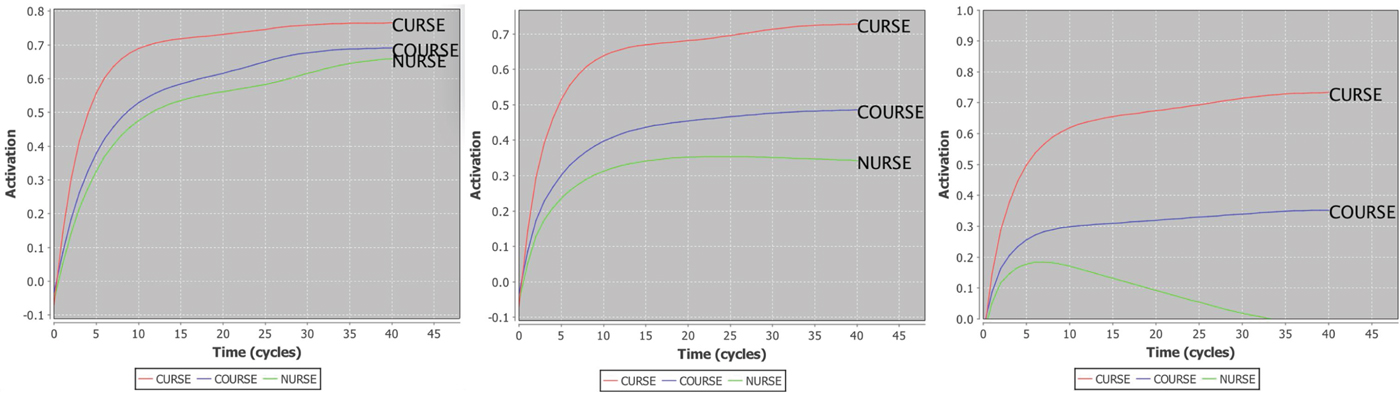
Multilink's activation of the input word CURSE and neighbors COURSE and NURSE when no lateral inhibition is present (left panel) and when lateral inhibition set at −0.05 (middle panel) or at −0.10 (right panel).

Simulations including lateral inhibition
The three panels in Figure 1 illustrate how strength differences in lateral inhibition affect the activation of translations of the input word CURSE and its competitors COURSE and NURSE. The panels clearly show a difficulty in finding proper parameter settings for orthographic (called OO_gamma) and phonological (PP_gamma) lateral inhibition: its effects are non-linear. Very small changes in parameter value result in strongly increasing orthographic recognition times (in Figure 1: from about 15 to over 30 time cycles with a threshold set at 0.72) in interaction with word frequency. Cycle times for phonological output are increased even more. When lateral inhibition is set at high values, non-target candidates are knocked out and simulation results approach those reported without lateral inhibition. For the data by Pruijn, Peacock, and Dijkstra (in preparation) (Simulation Series 3), we obtained correlations of 0.57 for Dutch to English and 0.68 for English to Dutch translation, similar to those in the keynote, for small values of lateral inhibition (using a large lexicon of 1367 word pairs). The consequences of these promising results for fitting neighborhood effects and priming tasks remain to be assessed. In contrast to what Declerck et al. (Reference Declerck, Meade and Grainger2018) suggest, the ‘cognate patch’ could not (yet) be replaced by lateral inhibition: identical cognates suffered disproportionally from lateral inhibition relative to non-identical cognates and control words. Only after suitable settings of the lateral inhibition parameter have been determined, can we start to simulate the masked translation priming studies mentioned by van Heuven and Wen (Reference van Heuven and Wen2018; e.g., Wen & van Heuven, Reference Wen and van Heuven2017), as well as orthographic priming studies.
Phonology and sublexical representations
Several reviewers consider the mapping relation between orthography and phonology, and the implementation of the latter. As Jiang (Reference Jiang2018) rightfully points out, a restricted mapping from orthographic to phonological representations at the lexical level will not suffice for simulating the many tasks in which sublexical representations play an important role. We did neither expect this nor intend it to do so. Implementing sublexical orthographic and phonological representations (like in SOPHIA, see Thomas & van Heuven, Reference Thomas, van Heuven, Kroll and De Groot2005) will be unavoidable in the long run. To do so, informed decisions must be made on how to represent auditory input in terms of sublexical units of different lengths.
Mishra (Reference Mishra2018) points out that spoken words also influence orthographic processing (e.g., Dijkstra, Roelofs & Fieuws, Reference Dijkstra, Roelofs and Fieuws1995). Although the Multilink model does not accept spoken input, the implied interactivity between phonological and orthographic representations is implemented.
Jiang (Reference Jiang2018) further argues that the current version of Multilink assumes language-specific phonological representations, whereas “there are good reasons for postulating a partially integrated (rather than a language-dependent) system of phonological representations.” For instance, L2 segments may be parasitic on L1 segments and interact with their L1 counterparts (also see Post da Silveira, Reference Post da Silveira2016). Because we specified the phonological representations in Multilink by using those for L1 speakers in CELEX, each language is currently indeed characterized in terms of its native phonological distinctions, without any accommodation for bilinguals. In a future version of Multilink, this must surely be changed. We therefore call upon researchers in the domain of bilingual speech recognition to provide precise characterisations of particular L1/L2 phonetic-phonological systems and their phonemic inventories. Important insights into these matters have been gained in the context of, for instance, BIMOLA (Léwy & Grosjean, Reference Léwy, Grosjean and Grosjean2008), BLINCS (Shook & Marian, Reference Shook and Marian2013), and SOMBIP and DEVLEX (Zhao & Li, Reference Zhao and Li2010, Reference Zhao and Li2013). As a simple temporary modelling solution, we might try to capture cross-linguistic similarities or differences in phonological segments in terms of Levenshtein distance or ratings (Levenshtein, Reference Levenshtein1966). Less overlap between phonological representations across languages should result in less co-activation (e.g., /f/ and /v/ might be considered to lead to partial activation depending on feature overlap).
The nature of orthographic and phonological representations also has consequences for the processing of translation equivalents with form overlap between languages (cognates). Similarly sounding cognates occur in language pairs all over the world, and, in contrast to Mishra (Reference Mishra2018), we believe they are important to clarify effects of simultaneous (auditory) form and meaning similarity on bilingual processing. Whereas orthographic similarities are restricted to overlapping scripts, phonological similarities can be found everywhere. We do agree on the importance of studying the consequences of an absent orthographic system in (bilingual) speakers with limited literacy, e.g., to assess the stability and ‘fuzziness’ of the phonological system – this is a problem for most if not all existing models. Again, empirical studies providing an adequate representation of the mental lexicons of these individuals must open the door to meaningful simulations.
Semantics and word associations, features, and vectors
The present version of Multilink incorporates an admittedly oversimplified representation of semantics: lexical concepts are represented as holistic units. In line with the suggestions by Li and Grant (Reference Li and Grant2018), Multilink has already been prepared for simulating spreading activation via semantic associations (De Deijne & Storms, Reference De Deijne and Storms2008; see Dijkstra & Rekké, Reference Dijkstra, Rekké, Jarema, Libben and Westbury2010, for a picture). Our bilingual lexicons include English items that were selected on the basis of their presence in an association database (Nelson, McEvoy & Schreiber, Reference Nelson, McEvoy and Schreiber1998). Thus, simulations can easily be prepared to study language-independent and -dependent effects of association at form and meaning levels. Implementation of multiple mappings (in relation to context sensitivity) would also be desirable (Tokowicz & Kroll, Reference Tokowicz and Kroll2007). In line with symbolic model extensions, the Distributed Feature model proposed by Van Hell and De Groot (Reference Van Hell and De Groot1998) could be implemented. By means of distributed features, language-specific connotations or concepts could be incorporated in the model.
More thorough model adaptation would involve replacing the current semantic representations by subsymbolic representations or vector representations, even if this might mean the model is no longer purely localist connectionist. Such work is currently being done for SOPHIA (collaboration van Heuven / Dijkstra).
Language membership: tag, functional representation, or lexical property
Multilink's architecture incorporates two language membership representations, each of which can be activated by orthographic and phonological representations of the words of that language (as well as via sentence context information). There are several interesting issues linked to the notion of ‘language membership’, as also pointed out by Johns and Putnam (Reference Johns and Putnam2018).
Current symbolic models mostly assume that language membership can be seen as a specific, separate type of linguistic representation (in addition to word form, lexical concept, and lemma). However, even if language information has its own representation, it is unclear how this interacts with other types of representations (cf. Hoversten et al., Reference Hoversten, Brothers, Swaab and Traxler2015). With respect to language production, should language membership be considered as just a label (tag) or as a more functional node, such as a separate semantic representation (Ivanova & Kleinman, Reference Ivanova and Kleinman2018) or a lemma? Or is the intention to speak in a particular language an integral aspect of the message? With respect to recognition, to what extent does non-linguistic context activate language membership representations either directly or indirectly?
Consider an experiment in which French and English flags are used as background context for French and English words (Grainger, Declerck & Marzouki, Reference Grainger, Declerck and Marzouki2017). A blue-white-red flag might activate the concept “French”, but is this concept identical to the French language membership representation of a word? Furthermore, the task/decision system might decide to use the flag information as a response cue depending on whether this information is beneficial to task performance or not (see Casaponsa, Carreira & Duñabeitia, Reference Casaponsa, Carreiras and Duñabeitia2015; Van Kesteren et al., Reference Van Kesteren, Dijkstra and De Smedt2012). It is also conceivable that language membership itself is used as a cue by the task/decision system depending on its usefulness. Thus, obtaining behavioral context effects in this situation might not constitute direct evidence against BIA+ or Multilink; perhaps EEG or fMRI-data could help to disentangle effects of interactive activation during identification or decision-making. Given what we see as a lack of convincing empirical evidence, we agree with Declerck et al. (Reference Declerck, Meade and Grainger2018) that future work should investigate the facilitatory or inhibitory role of language membership representations in the recognition of words in isolation and in sentences. We currently do not favor the BIA-model's assumption that the language membership label of a target word is linked up to each and every word of all other languages of the bilingual to make inhibition possible.
As an intriguing alternative, Johns and Putnam (Reference Johns and Putnam2018) propose to represent language membership as a property of the lexicon resulting from gradient emergent principles in cross-situational learning. The learner might come to associate words probabilistically with particular contexts and feature sets. An abstract representation of language membership could arise ‘grounded in overlapping sets of features as opposed to singular concepts’. Implementation of word association and semantic priming would then be done in quite a different way than following a symbolic view of language membership. At present, this alternative is clearly out of Multilink's scope.
Conclusions
The interest in implemented models such as BIA, BIA+, and Multilink shows that researchers in the field of bilingualism like to have explicit frameworks for theoretical interpretation and embedding of their studies and as inspiration for empirical research. Even when such models are relatively underspecified (e.g., BIA), have coding problems (e.g., position-coding in BIA / BIA+), or missing components (e.g., sublexical representations in Multilink), thought experiments and simulations often have heuristic value for future research by clarifying research questions, quantifying results, and generating research ideas. Working in a unifying framework like the symbolic, localist-connectionist paradigm is useful for bringing different approaches and viewpoints into contact (we note that human communication itself is symbol-oriented). The multilingual network of representations in Multilink allows for the capture of quite diverse bilingual phenomena. It has clearly delineated representations, is context-sensitive, and relatively flexible.
On the basis of the various reviews, we conclude that the null-model version of Multilink underestimates the degree of cross-language interaction: bilingual processing must be made sensitive to phenomena like lateral inhibition effects, merged phoneme representations, and L1-dependent learning strategies. Nevertheless, given that the present version of Multilink led to high correlations between simulation and empirical data, it already appears to capture some fundamental characteristics of the bilingual's lexicon architecture. In addition, several of the problems indicated by the reviewers can be solved easily in future Multilink variants.
In all, we argue that the present version of Multilink is a promising first step towards a more complex model that even better accounts for the intriguing complexity, context sensitivity, interactivity, and variability of languages. In a modest vein, it seems appropriate to end this paper with a variation on some famous lines from Rigoletto by Giuseppe Verdi: “La lingua è mobile, qual piuma al vento, muta d'accento, e di pensiero” (‘Language is flighty. As a feather in the wind, it changes in voice and in thought.’)