Introduction
Abnormal movements in the setting of antipsychotics were first described in 1957, but the term tardive dyskinesia (TD) was not known until 1964. Treatment for this sometimes poorly characterized condition lagged decades as it was labored by medico-legal implications. TD has often been lumped with other medication-induced disorders and incorrectly classified as extrapyramidal symptoms (EPS). TD is likely to be under-recognized for many of these reasons. Though diverse in its presentations, TD is distinct in terms of time course, pathophysiology, and phenomenology.
What is TD?
The fifth edition of the Diagnostic and Statistical Manual of Mental Disorders (DSM-V) defines TD as involuntary choreiform or athetoid movements caused by an exposure to dopamine receptor-blocking agents (DRBAs) that persist beyond 4–8 weeks. Prior DSM definitions included a time criterion of exposure >3 months.1 However, case reports document the development of TD after a short exposure to DRBA. TD often persists even after the discontinuation of DRBAs.Reference Chandra, Sheth and Mehta2 Remission rates are <20% in the population that discontinues DRBAs, with follow-up varying from 40 weeks to 5 years.Reference Cloud, Zutshi and Factor3 –Reference Zutshi, Cloud and Factor8 The majority of TD is caused by neuroleptics, though other medications have been implicated, including antiemetics such as metoclopramide and prochlorperazine, as well as others such as lithium, selective serotonin reuptake inhibitors, and tricyclic antidepressants.Reference Hunter, Kenney and Mejia9
Tardive syndromes include a spectrum of hyperkinetic movements, including oro-buccal lingual “classic TD,” dystonia, myoclonus, tics, and akathisia. TD manifests as involuntary movements typically involving the face, but can involve the neck, trunk, extremities, and even laryngeal, pharyngeal, diaphragmatic muscles. The movements can range from subtle to severe.Reference Waln and Jankovic10 Additionally, it is important to differentiate TD from other medication-induced movement disorders commonly referred to as EPS. EPS often presents shortly after starting or increasing neuroleptics and may include acute or subacute akathisia, acute dystonia, or tremor.
TD must be distinguished from drug-induced Parkinsonism, which includes bradykinesia, stooped posture, cogwheel rigidity, and masked facies. Parkinsonism can occur at any time during an exposure to DRBAs. Withdrawal from DRBAs might reduce EPS or parkinsonian symptoms; however, a reduction in DRBA dose may unmask TD or precipitate withdrawal-emergent dyskinesia.Reference Fahn, Jankovic and Hallett11
Several pathophysiologic theories attempt to explain TD. The most widely discussed theory involves dopamine blockage, resulting in D2 receptor upregulation and sensitization. Another theory highlights that an exposure to DRBAs might result in abnormal synaptic transmission and disinhibition of the basal ganglia output. Other theories point to γ-aminobutyric acid (GABA) neuron dysfunction, oxidative stress, and progressive neurodegeneration. Currently, no single theory explains TD onset, persistence of movement, and response to treatment.Reference Casey12
Risk of Developing TD
The main risk factor of developing TD is exposure to neuroleptics. Patients on neuroleptics showed a 25.3% prevalence of TD regardless of the class of mediation. The advent of second-generation antipsychotics (SGAs), with an overall improved safety profile, was expected to significantly reduce TD. A systematic review confirmed a reduced risk of TD, but found a higher incidence than reported by the initial shorter-duration trials of SGAs,Reference Correll and Schenk13 likely due to the increased use of SGAs for broader indications, including bipolar disorder, refractory depression, etc. First-generation antipsychotics (FGAs) posed the greatest risk, with a TD prevalence of 30%, and SGAs reduced TD prevalence to 20%. Combined exposure to FGAs and SGAs showed a TD prevalence rate of 22.7%.Reference Carbon, Hsieh and Kane14
In another meta-analysis of 57 studies, SGAs reduced the annualized TD incidence to one-third compared with FGAs. FGAs showed a 6.5% annualized incidence, whereas for SGAs, 2.6%. Among the SGAs, aripiprazole had the lowest risk of TD with an annualized incidence of 1.7%. Of note, however, clinicians must be cautious when interpreting the annualized incidence rates given the patients’ long-term exposure to neuroleptics.Reference Carbon, Kane and Leucht15 In a real-world study across various clinical settings, 27.6% of patients chronically exposed to neuroleptics had abnormal movements suggestive of TD.Reference Cutler, Caroff and Tanner16 While not conferring a definitive diagnosis of TD, the number is within the prevalence range seen for TD in meta-analyses. Computer models estimated a gradual increase in the incidence and prevalence of TD from 2016 to 2025 with an increasing use of neuroleptics. Other factors that impact the development of TD are age, duration of neuroleptic use, potency of neuroleptic use, concurrent mood disorders, and substance abuse.Reference Dhir, Schilling and Abler17
The most widely used scale for the evaluation of TD is the Abnormal Involuntary Movements Scale (AIMS). The scale is standardized and reproducible.Reference Gharabawi, Bossie and Lasser18 The American Psychiatric Association (APA) recommends that patients be assessed with AIMS at baseline prior to initiating neuroleptics and be monitored at regular intervals. Individuals on FGAs should be screened every 6 months, and those on SGAs should be screened every 12 months.Reference Jain and Correll19 However, there are no widely available methods to teach TD screening.
Treatment of TD
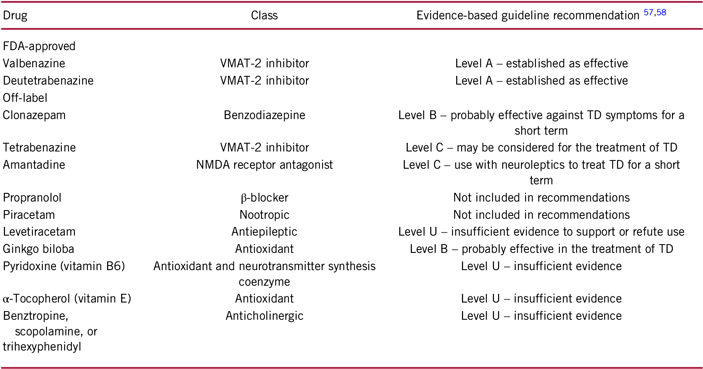
The treatment of TD has presented a significant challenge to clinicians for decades (Table 1). Though the initial intuition of many clinicians may be to interrupt the use of offending DRBAs, this approach is typically difficult due to worsening mental health symptoms. In addition, there is limited evidence supporting the idea that the withdrawal of neuroleptics might lead to the cessation of TD symptoms. Furthermore, there have been incidences of worsening TD symptoms in the initial period after neuroleptic withdrawal.Reference Lerner and Chanoch Miodownik20 Increasing the dose of DRBAs will result in a substantial suppression of dyskinesia for a short term, but the benefit fades and yields long-term worsening of symptoms.Reference Cloud, Zutshi and Factor3, Reference Lerner and Chanoch Miodownik20, Reference Aia, Revuelta and Cloud21 Similarly, there is a lack of evidence to suggest that switching to an atypical DRBA might help in the treatment of TD.Reference Cloud, Zutshi and Factor3, Reference Lerner and Chanoch Miodownik20
Summary of therapeutics for the treatment of TD and current evidence-based guideline recommendations

Off-Label Therapies
Until recently, there was a lack of any approved therapy for the treatment of TD. This often led to clinicians utilizing a wide array of off-label therapeutics, with variable degrees of supporting evidence and benefits.
Amantadine
Amantadine was first used as an antiviral drug in the 1960s, but gained attention as an antiparkinsonian agent shortly after. Since then, the drug has found several uses in the field of neurology, including for the treatment of TD. The main action of the drug is believed to be its ability to block N-methyl-D-aspartate (NMDA) receptors. Although no clear evidence exists regarding its mechanism on TD, the facilitation of dopaminergic activity via reuptake inhibition and receptor modulation is suggested to be the key.Reference Mizoguchi, Yokoo and Yoshida22 A number of studies have described the efficacy of amantadine in the treatment of TD; two studies in the recent decades, which were both small, randomized, double-blind, placebo-controlled (RDBPC) studies, demonstrated a significant reduction in abnormal involuntary movements by 15% and 21%, respectively, compared with placebo.Reference Angus, Sugars and Boltezar23 , Reference Pappa, Tsouli and Apostolou24
Anticholinergics
The use of anticholinergic medications for the reduction of EPS, including TD, among those receiving neuroleptics is common. While the mechanism of action of these medications is unclear, literature is bereft of evidence of their efficacy in the treatment of TD. Many studies have examined both treatment with as well as discontinuation of anticholinergics, with no clear proof of benefit from either approach.Reference Tamminga, Smith and Ericksen25 –Reference Bergman and Soares-Weiser28
Tetrabenazine
Approved originally for the treatment of Huntington disease (HD) chorea in the United States, off-label tetrabenazine (TBZ) has been used for decades for the treatment of other hyperkinetic movement disorders. TBZ acts as a high-affinity, reversible inhibitor of monoamine uptake into the vesicles of presynaptic neurons by binding selectively to the vesicular monoamine transporter-2 (VMAT-2), leading to the depletion of monoamines in the synaptic cleft. A number of studies over the past few decades have examined the use of TBZ in the treatment of TD, with largely positive results,Reference Chen, Ondo and Dashtipour29 –Reference Ondo, Hanna and Jankovic31 although its use has been limited by compliance to three-times-a-day dosing as well as sometimes severe dose-dependent adverse effects, including parkinsonism, akathisia, depression, and suicidality.Reference Leung and Breden30
Clonazepam
Clonazepam is a GABA agonist of the benzodiazepine class. Its use in the treatment of TD has been reported since the 1970s, though a randomized, placebo-controlled study was not conducted until 1990 by Thaker et al. In the small-scale, 12-week, double-blind trial, the authors studied the drug on a cohort of 19 participants with chronic TD. They reported a 35% reduction in dyskinesia ratings, with a more robust response in the subset of patients with predominant dystonic symptoms. TD symptoms recurred within 2 weeks upon discontinuation of the medication. Notably, five patients in whom the drug was used beyond the initial 4-week trial period exhibited tolerance to the medication’s antidyskinetic effects.Reference Thaker, Nguyen and Strauss32
Levetiracetam
Levetiracetam is an antiepileptic medication that is preferred by clinicians for the treatment of seizures for its favorable safety and pharmacokinetic profile.Reference Wright, Downing and Mungall33 It is an analog of the nootropic drug piracetam, and is structurally unrelated to any other antiepileptic. The mechanism by which levetiracetam exerts its action is not clear, but it is known to bind to the synaptic vesicle protein SV2A, leading to the modulation of synaptic vesicle exocytosis and neurotransmitter release.Reference Wright, Downing and Mungall33 Several positive case reports on levetiracetam use have been described in the literature.Reference Chen and Liu34 , 35 A single RDBPC trial was conducted by Woods et al., involving a total of 50 participants, evaluating TD symptom severity as measured with AIMS. The authors reported a 43.5% reduction in AIMS scores for the levetiracetam group compared with 18.7% for the placebo group. The drug was found to be safe and well tolerated at the doses administered.Reference Woods, Saksa and Baker36 In addition, a 2006 open-label observational study on 16 patients by Meco et al. found levetiracetam to be safe and effective.Reference Meco, Fabrizio and Epifanio37
Piracetam
Piracetam is a GABA derivative with putative nootropic properties, which is approved in the United Kingdom for the treatment of myoclonus, though it has been used off-label in a wide range of other neurologic indications. The mechanism of action of piracetam is not fully elucidated, though it has been shown to have a modulating action at the serotonergic, noradrenergic, and glutamatergic systems with an excellent safety and tolerability profile.Reference Winblad38 A single RDBPC crossover study in 2007 undertaken by Libov et al. with 40 participants demonstrated a mean decrease in the TD subscale of 3.0 points for the piracetam group compared with a worsening of −0.2 point for the placebo group (p = 0.003).Reference Libov, Miodownik and Bersudsky39 These results have not been replicated in any large-scale RDBPC studies.
Propranolol
Propranolol is a β-adrenergic receptor blocker widely used for the treatment of hypertension, arrhythmias, essential tremor, and migraine. During the 1980s, there was significant interest in the use of propranolol for the treatment of TD, with multiple case reports and a single placebo-controlled study showing significant improvements after its use.Reference Perényi and Farkas40 , Reference Schrodt, Wright and Simpson41 However, enthusiasm extinguished upon a discovery of increased plasma levels of DRBAs with propranolol use, possibly linking the improvement in TD symptoms with the suppressive effect of DRBAs.Reference Silver, Yudofsky and Kogan42 Though, more recently, improvement in TD symptoms with propranolol on patients not on active DRBAs has been demonstrated,Reference Factor43 no rigorous controlled studies have appeared to date.
Vitamin E (α-Tocopherol)
α-Tocopherol is an orally available form of lipid-soluble vitamin E, an antioxidant which binds to the cell membranes and neutralizes free radicals produced by the enzymes. Vitamin E for the treatment of TD has been studied extensively in the past several decades. A meta-analysis examining 12 studies, conducted in 1998 by Barak et al., concluded that a significant proportion of TD patients given vitamin E (28.3%) exhibited modest improvement in symptoms.Reference Barak, Swartz and Shamir44
Vitamin B6 (Pyridoxine)
Pyridoxine is a dietary form of water-soluble vitamin B, an essential nutrient for many biological processes. In its active form, pyridoxal 5-phosphate is an important co-enzyme for the synthesis of amino acids, neurotransmitters (dopamine, aminobutyric acid, serotonin, norepinephrine), sphingolipids, and aminolevulinic acid.45 It is this mechanism of neurotransmitter synthesis, as well as its more recently discovered free-radical scavenging ability,Reference Cabrini, Bergami and Fiorentini46 that made pyridoxine a potent candidate molecule for TD treatment. Two RDBPC studies have examined the use of vitamin B6 at doses up to 1200 mg/d, which confirmed its safety at the prescribed doses without any neurotoxic effects even on a long-term treatment of up to 8 years.Reference Lerner, Miodownik and Kaptsan47 , Reference Lerner, Miodownik and Kaptsan48
Ginkgo Biloba
Ginkgo biloba is a tree species native to Mainland China, which has been used in traditional medicine for centuries. The leaves of the tree contain both terpenoids and flavonoids, which confer significant antioxidant properties. A recent meta-analysis by Zheng et al., involving three randomized controlled trials with a total of 299 participants, evaluated the efficacy of Ginkgo biloba extract (EGb) in the treatment of TD via measuring the AIMS scores. The results indicated that EGb outperformed the placebo with a weighted mean difference of −2.30 (95% CI, −3.04, −1.55), p < 0.00001.Reference Zheng, Xiang and Ng49
Approved Therapies
The era marked by a lack of approved therapies for TD came to an end in mid-2017 with the successive approvals of two novel VMAT-2 inhibitors in the United States: valbenazine (VBZ) and deutetrabenazine (DBZ).
Valbenazine
VBZ (NBI-98854) is a novel, highly selective, reversible VMAT-2 inhibitor, with a favorable safety and tolerability profile at once-daily dosage. In April 2017, VBZ became the first FDA-approved therapy for TD in the United States. Its selective affinity to VMAT-2 receptors, along with a lack of affinity to VMAT-1 or any other neurotransmitter receptors, helps reduce untoward adverse effects and contributes to its favorable safety and tolerability profile.Reference O’Brien, Jimenez and Hauser50
KINECT 3 was a phase III RDBPC trial.Reference Hauser, Factor and Marder51 A total of 234 individuals aged 18–85 with neuroleptic-induced TD were randomized in a 1:1:1 ratio to VBZ 40 mg daily, VBZ 80 mg daily, or placebo for 6 weeks. The primary efficacy endpoint of change in AIMS dyskinesia score from baseline to 6 weeks was met by the 80 mg/d group, with a change of −3.2 for the 80 mg/d group compared to −0.1 for the placebo group (p < 0.001). The same was true, to a lesser degree, for the 40 mg/d group, with a change of −1.9 compared with −0.1 for placebo (p = 0.002). Scoring on the Clinical Global Impression of Change–Tardive Dyskinesia (CGI-TD), the secondary efficacy endpoint, missed statistical significance for both dosage groups in the intent-to-treat population, though there was a significant difference for the 80 mg/d group in the per-protocol population in which those who were assigned to VBZ but had undetectable serum levels (i.e., were non-adherent) were excluded. The drug was overall well tolerated. The most common adverse events (AEs) were somnolence in 5.3% of both VBZ groups combined compared to 3.9% in placebo; akathisia in 3.3% of VBZ groups compared to 1.3% in placebo; and dry mouth in 3.3% of VBZ groups compared to 1.3% in placebo. Suicidal ideation was more common in placebo at 5.3% compared to 2.6% for the VBZ groups. A total of 13 serious AEs (SAEs) were reported during the study, with seven resulting in study withdrawal, two of which were in the placebo group. All of the SAEs were judged to be unrelated to the study drug and had resolved, except for a case of hepatitis that was possibly related to the study drug. One death, of a patient belonging to the VBZ 80 mg/d group, was reported during the study due to multiple cardiovascular risk factors, and the death was judged to be unrelated to the study drug. No significant changes were observed in baseline vital signs, baseline laboratory tests, or 12-lead electrocardiogram in any of the participants.
An extension of KINECT 3 examined the safety and efficacy of VBZ.Reference Factor, Remington and Comella52 In the 1-year study, a total of 198 of the original 205 participants who completed the 6-week RDBPC phase of KINECT 3 re-consented to remain in the extension study. All those on the active drug were maintained on existing doses of VBZ, and the placebo was re-randomized into either VBZ 40 or 80 mg. All the participants and examiners remained blinded through the extension study, which took place for 42 additional weeks followed by a 4-week washout period. During the extension period, SAEs were reported in 14.6% of participants, though syncope was the only event reported in >2 participants. There was one death, which was judged to be unrelated to the study drug. Overall at least one AE was reported in 69.2% of participants, though generally mild and did not lead to drug discontinuation. The only AEs leading to discontinuation in >2 participants were somnolence reported in three participants in the 80 mg/d group and suicidal ideation in three cases, which resolved with hospitalization and were judged to be unrelated to the study drug. Laboratory values, vital signs, and ECG remained stable throughout the extension, and VBZ did not appear to induce or worsen parkinsonism or akathisia. Treatment benefits were maintained or increased through the end of the 48-week extension period, though TD symptoms returned to baseline levels after the 4-week washout.
Deutetrabenazine
DBZ is a highly-selective VMAT-2 inhibitor similar to TBZ, with the key difference being the hydrogen isotope, deuterium, incorporated into the sites of primary metabolism resulting in slower metabolic clearance and favorable pharmacokinetics with twice-daily dosing.Reference Solmi, Pigato and Kane53 , Reference Stamler, Bradbury and Brown54 It was the second approved therapy for both TD and Huntington’s chorea, and the first deuterated drug to be approved for any condition in the United States.
AIM-TD,Reference Anderson, Stamler and Davis55 a pivotal, phase III RDBPC trial, included 298 patients with TD for >3 months, randomized into four equal groups to receive placebo or DBZ 12, 24, or 36 mg/d. The primary efficacy endpoint was change in AIMS severity score from baseline to week 12. DBZ 36 and 24 mg/d groups met the primary endpoint with an improvement of −3.3 points and −3.2 points, respectively, compared to −1.4 for placebo. The 12 mg/d dose missed statistical significance for the primary endpoint. The number of patients with a >50% reduction in AIMS score was significantly higher compared to placebo (12%), with 24 mg/d (35%) and 36 mg/d (33%). The key secondary endpoint of investigator-assessed treatment success at week 12, rated with Clinical Global Impression of Change, did not meet statistical significance for any group.
The drug was overall safe and well tolerated. In AIM-TD, AEs occurred in similar rates across all groups, with 47% incidence in the placebo group and 48% in the combined treatment groups, the most common AEs being headache and somnolence. The rates of reported SAEs were low, with 5% in the 36 mg/d group, 8% in the 24 mg/d group, 3% in the 12 mg/d group, and 6% in the placebo group. There were two reports of suicidal thoughts, both judged to be unrelated to the study drug, and one report of suicidal ideation, which was possibly related. There were two deaths in the study, neither of which were judged to be related to the study drug. Parkinsonism was reported in one patient on the 36 mg/d dose, and akathisia was reported in one person on the 24 mg/d dose. There were no significant changes in the vital signs, laboratory results, or ECG in any of the groups treated with DBZ.Reference Anderson, Stamler and Davis55 With a low incidence of new or worsening depressive symptoms in AIM-TD as well as the prior ARM-TD trial,Reference Fernandez, Factor and Hauser56 the FDA did not issue a black-box warning regarding an increased risk of depression or suicide in TD patients, in contrast to those with HD. The safety of DBZ was further validated in an open-label, single-arm, 2-year extension. In the extension study, 343 patients who completed ARM-TD or AIM-TD were started on DBZ 12 mg/d and titrated up to 48 mg/d based on symptom control and tolerability. Through week 106, exposure-adjusted incidence rates were comparable to or lower than those observed in the short-term trials.Reference Fernandez, Stamler and Davis57
Approach to Managing TD
A discussion on TD management must first address the need for accurate diagnosis. Clinicians must be vigilant in screening patients on neuroleptics as per the APA guidelines. Additionally, it is important to note that patients on chronic anticholinergics may have their TD mischaracterized as EPS. AIMS is the most widely used scale to evaluate and monitor response to treatment, though it is important to note that it is one among the several scales that can monitor involuntary movement. Currently no recommendation exists on using AIMS or any other specific tool to track TD symptoms beyond diagnosis. It is helpful to objectively quantify response to intervention directed at reducing TD symptoms. Clinicians must learn how to correctly and consistently perform AIMS scoring.
The 2013 evidence-based guidelines of the American Academy of Neurology (AAN) for the treatment of TD did not have any level A recommendations.Reference Bhidayasiri, Fahn and Weiner58 The 2018 update of the AAN guidelines reflects the change in treatments and includes the two newly approved VMAT-2 inhibitors, VBZ and DBZ, as level A recommendation (must be recommended). Less proven therapies such as clonazepam and ginkgo biloba are level B (probably considered). Amantadine and TBZ are level C and could be considered for the treatment of TD. Similarly, deep brain stimulation is level C and could be considered for refractory cases of TD. There is insufficient evidence (level U) to support or refute either changing or discontinuing neuroleptics or using anticholinergics for the treatment of TD.Reference Bhidayasiri, Jitkritsadakul and Friedman59
Treatment Differences Between VBZ and DBZ
While both VBZ and DBZ share a common mechanism of action, are now approved therapies for TD in the United States, and enjoy a level A recommendation from the AAN, there are a few important clinical distinctions that must be taken into account when considering which drug to choose for initiating treatment.
Due to their varying molecular structures, these two novel VMAT-2 inhibitors exhibit distinct pharmacokinetic profiles. VBZ may be taken orally after or before food60 and is rapidly absorbed. It has two major metabolites, R,R,R-dihydrotetrabenazine ((+)-α-DHTBZ, NBI-98782) and a mono-oxy metabolite (NBI-136110), with a half-life of approximately 20 h, allowing for once-daily administration.Reference Grigoriadis, Smith and Hoare61 Conversely, DBZ must be taken after food62 and is rapidly absorbed and converted into active metabolites α-HTBZ and β-HTBZ, with a half-life of approximately 9 h, allowing for twice-daily dosing.Reference Stamler, Bradbury and Brown54 The initial titration of each drug also differs. DBZ is initiated at 6 mg/d and titrated at weekly intervals by 6 mg/d up to a maximum recommended daily dosage of 48 mg divided into twice daily.62 VBZ is initiated at 40 mg once daily and then, after a week, is increased to 80 mg once daily.60 However, for those who are on CYP2D6 or CYP3A4 inhibitors, the recommended dose of VBZ is 40 mg daily.60
There are also important safety considerations that must be taken into account for each drug. While both drugs may cause an increase in QT interval, only DBZ carries specific recommendations for QT interval assessment for patients at risk of QT prolongation.60 , 62 In addition, while no contraindications are specified for VBZ, the label for DBZ carries specific contraindication for patients with hepatic impairment or those taking reserpine, MAOIs, or other VMAT-2 inhibitors.Reference Grigoriadis, Smith and Hoare61 Both drugs are generally well tolerated, though the AE profile is somewhat different. The most commonly reported AEs for DBZ, in descending order, are somnolence, anticholinergic effects, balance disorders, headache, akathisia, vomiting, nausea, and arthralgia.60 The FDA label for DBZ lists the most common AEs for TD patients, in descending order, namely, nasopharyngitis, insomnia, depression, and akathisia/agitation/restlessness.62
Finally, it should be noted that all the studies on both VBZ and DBZ have been sponsored by the manufacturing pharmaceutical companies (Neurocrine Biosciences, Inc., San Diego, California; and Teva Pharmaceutical Industries, Petach Tikva, Israel, respectively).
Final Thoughts
For nearly half a century, TD has presented significant challenge to clinicians. Understanding the mechanism and pathology of TD remains elusive. Therapy for TD has remained much in the dark until 2017, when not one but two therapeutic agents came as a rescue. The discovery and approval of these therapeutics has renewed the need for differentiating TD from other drug-induced movement disorders and reinvigorated the TD dialogue among clinicians and researchers. Both VBZ and DBZ have demonstrated safety, efficacy, and tolerability at various dosages, frequencies, and titration levels in TD patients.
It is hoped that TD will eventually gain the needed public attention. Despite recent advances, diagnostic and treatment challenges remain. The widespread use of DRBAs continues to widen the indications, undoubtedly leading to an increase in the incidence of TD. Lack of early surveillance, regular screening, and adequate treatment are the present hurdles. Educating the public and spreading awareness can be a powerful tool to overcome these challenges.
Disclosures
Laxman Bahroo has the following disclosures: Consultant/advisor, Speakers’ Bureau from Abbvie; Consultant/advisor, Speakers’ Bureau from Acadia; Consultant/advisor, Speakers’ Bureau from Acorda; Speakers’ Bureau from Adamas; Consultant/advisor, Speakers’ Bureau from Amneal; Speakers’ Bureau from Ipsen; Consultant/advisor, Speakers’ Bureau from Neurocrine; Consultant/advisor from Revance; Speakers’ Bureau from Sunovion; Consultant/advisor, Speakers’ Bureau from Teva; Speakers’ Bureau from UCB Pharma; and Consultant/advisor, Speakers’ Bureau from US World Meds.
Mazen Elkurd has the following disclosure: Consultant/Advisor, Ambu.
Optional Posttest and CME Certificate
CME Credit Expires: April 12, 2022
Posttest Study Guide
The posttest can only be submitted online. The below posttest questions have been provided solely as a study tool to prepare for your online submission. Faxed/mailed copies of the posttest cannot be processed and will be returned to the sender. If you do not have access to a computer, contact NEI customer service at 888-535-5600.
Mark is a 43 year-old with tardive dyskinesia (TD) who has been taking tetrabenazine to treat his symptoms. Tetrabenazine is approved in the United States for the treatment of which movement disorder?
A. Huntington’s disease
B. Tardive dyskinesia
C. Parkinson’s disease
Which of the following novel vesicular monoamine transporter 2 (VMAT2) inhibitors, approved for tardive dyskinesia in the US, must be taken with food?
A. Deutetrabenazine
B. Valbenazine
C. Both of the above
D. None of the above
The main risk factor for developing tardive dyskinesia is…
A. Exposure to neuroleptics
B. Gene polymorphisms
C. Younger age
Optional Online Posttest and CME Certificate Instructions
Read the article
Complete the posttest, available only online at www.neiglobal.com/CME (under “CNS Spectrums”)
Print your certificate (passing score = 70% or higher)
Questions? call 888-535-5600, or email CustomerService@neiglobal.com