The mere casting of a ballot is a trifle; it is the influences which lead up to it and surround it that are chiefly to be considered.
—“Sex and the Ballot,” Frank Leslie’s Illustrated Newspaper, April 3, 1880
The editors of Frank Leslie’s Illustrated Newspaper in April 1880 sought to remind their readers that it was not necessary to have the ballot to effect political change. Yet the act of voting continued to be the focus of those seeking to gain or maintain their political agency. Late twentieth-century and early twenty-first-century campaigns to expand limited suffrage rights to noncitizens in cities like San Francisco, Chicago, and New York mirror nineteenth-century campaigns to extend partial suffrage rights to women in particular on matters related to public education.Footnote 1 Supporters insist that noncitizens with direct interest in the public schools either as parents or taxpayers should have the right to vote on school matters. Moreover, just as in the nineteenth century, opponents claim opening school voting to those who do not already have the right to vote would dilute the voting of “proper” citizens, the most radical advocates indicate that obtaining school suffrage for noncitizens is the first step in their gaining broader political rights.Footnote 2 Gaining even partial suffrage continues to be seen as the opening wedge for gaining full citizenship rights.
Extending suffrage rights relative to public schools and expanding qualifications for holding educational office are not new phenomena. About the same time that public common schools became tax-supported, questions occurred about who had the right to make decisions about raising and expending those taxes. Although, beginning in 1838, certain classes of women gained the right to vote on local school matters, the term school suffrage did not enter the lexicon until the 1879 Massachusetts campaign to allow taxpaying women to vote for school officers.Footnote 3 Many of those actively campaigning for the extension of school voting rights to women explicitly attempted to distance their efforts from the campaign for full woman suffrage. Yet because some of the prominent advocates were also active in woman suffrage efforts, school suffrage became historically linked to the broader campaigns for full woman suffrage.Footnote 4 A closer examination of the historical record finds a much more complicated story, with the extension of voting rights as they related to public schools more closely linked to education policies than to election laws and thus not what has been often considered as woman suffrage writ small. It also revealed that voters elected women to educational offices during the last half of the nineteenth century.
This article explores school suffrage provisions and the ancillary citizenship right of educational office-holding—as documented in legislative records, court cases, and contemporary newspaper accounts—to show that school suffrage, by extending voting rights on limited educational issues to specific classes of residents, was actually an allied, but often unrelated, tool in extending citizenship rights.Footnote 5 Despite a growing national interest in developing a public education system, each state had autonomous control in developing the character of its own system.Footnote 6 Centering school suffrage within the extension of public schooling also reveals a previously unexplored avenue of women’s nineteenth-century political agency. After briefly discussing the historiography related to school suffrage, voting rights, and women’s educational office-holding, I will examine the legislative adoptions of school suffrage and women’s educational office-holding during the last half of the nineteenth century.
Historiography
Although frequently considered a mechanism for gaining full suffrage rights for women, school suffrage has received little scholarly focus.Footnote 7 Scholars generally take their dates for female school suffrage events from the multivolume History of Woman Suffrage, primarily edited by Susan B. Anthony (who edited all but the last volume).Footnote 8 Historian Lisa Tetrault, in The Myth of Seneca Falls, argues that while Anthony was probably the premier female historian of her era, she and her allies made determined efforts to gain control of both the woman suffrage movement and the movement’s history by deliberately excluding competing women’s rights initiatives, including property rights.Footnote 9 Anthony’s personal and professional desires obviously shaped what information the volumes included. Between the publication of the third volume in 1886 and the fourth volume in 1902, Anthony changed her support for partial suffrage provisions because she had come to believe that they were a “hindrance rather than a help toward securing full enfranchisement.”Footnote 10
Much of the information in all six volumes came not from official records but from informants across the nation. Many states did not have active suffrage organizations until the late nineteenth century, particularly those states and territories outside New England and the Mid-Atlantic, leading to missing, inaccurate, and incomplete information. Before the late 1870s, school suffrage provisions were adopted exclusively outside New England and often predated the establishment of woman suffrage organizations.Footnote 11 At times, they were included in legislation without active lobbying and without prior notice.Footnote 12
Woman suffrage organizations and the scholars who study them have provided the most common interpretations regarding school suffrage adoptions. Analyzed through the lens of general woman suffrage, the failure to explore why many western states and territories adopted school suffrage provisions before formal woman suffrage organizations were even established has resulted in overlooking how it was related to public education. Legislatures considered school suffrage and educational office-holding as education matters, given that the clear majority of such provisions appears in legislation connected to states’ public education systems rather than their electoral practices. The misperception that educational office-holding was a component of school suffrage has limited the understanding of the extent of women’s actual role in public education.Footnote 13 More important, it has meant that understanding the breadth of women’s political agency during the nineteenth century has been limited.
Corrine McConnaughy, in The Woman Suffrage Movement in America, makes the case that the history of woman suffrage has come almost exclusively from the perspective of the woman suffragists and that the discussion needs to be broadened to include the perspectives of political parties and legislative decision-makers. McConnaughy’s critique provides a better starting point for understanding why woman suffrage found favor at some times and in some places but not at others.Footnote 14 Like most scholars of woman suffrage, McConnaughy sees school suffrage as either leading to woman suffrage adoption or as a politically acceptable replacement for full woman suffrage. Because she looks at all suffrage extensions through the lens of woman suffrage, she fails to consider that school suffrage adoptions might have occurred for reasons completely unrelated to woman suffrage. Stepping outside the traditional historical narrative that links school suffrage to woman suffrage, as McConnaughy goes outside the traditional narrative about woman suffrage, provides valuable insight into school suffrage and additional understanding about the nineteenth century’s shifting definition of citizenship rights. Extending McConnaughy’s methodology to school suffrage helps reveal these facts: understanding the political decisions behind adopting school suffrage in various states provides insight into how political leaders saw their role in developing the state’s educational systems.
Voting rights, including school suffrage, have long been the purview of the individual states, even after the passage of the Fourteenth Amendment. Historian Alexander Keyssar, in his seminal work, The Right to Vote, provides strong evidence that voting rights were actively limited across the nation after the Civil War ended. Not only were southern states attempting to disenfranchise African American voters through intimidation, but states across the nation adopted literacy and/or educational qualifications, expanded residency requirements, and created registration requirements that made it difficult for individuals to vote, effectively limiting their franchise.Footnote 15 Yet, at the same time, states were expanding school suffrage rights to include women, with many extending these rights to noncitizens as well. What political benefits were expected by granting school suffrage to noncitizens even as they were denied voting rights on other issues? Was this because legislators and other policymakers had different political expectations for school elections?
Gaining the right to vote was the primary focus of the woman suffrage movement. Ancillary citizenship responsibilities, including political office-holding and jury duty, received less focus. In reality, attaining school suffrage rights did not automatically mean that women also had the right to run for and be elected to school offices.Footnote 16 Michael Pisapia provides clear evidence that women’s involvement in education provided women, particularly white women, entrance into the American political landscape as well as an avenue to shape public policy within governmental structures rather than from the outside.Footnote 17 In trying to determine why women were elected in high numbers in some states but not others, he demonstrates that political and geographical circumstances shaped women’s ability to obtain elective (and appointive) educational offices, which, in his opinion, was in large part linked to a state’s adoption of school suffrage. However, Pisapia assumes that school suffrage was a pivotal aspect in women gaining political policy-making positions, and he overlooks the fact that seventeen states and territories gave women the right to hold school offices without granting them the right to vote. As elected officers, they were responsible for making decisions regarding schools without any suffrage rights. The total number of women elected to educational offices in these states is difficult to determine because of the lack of school district records. Limited records do exist for women elected as county superintendents in states where women could not vote for the office. In many of these states (such as California, Illinois, Iowa, and Montana), voters elected women at similar rates as states where women could vote for county school superintendents.Footnote 18 For some states women had the right to hold elective school offices, including county school superintendencies, at least a generation before they were given the right to vote in school or other elections.Footnote 19
School Suffrage in the Nineteenth Century
School elections could pertain to the election of school officers, the voting on school-related taxes, and/or the decisions about such school-related issues as textbooks, school discipline, and the school calendar. The right to vote for one of these did not necessarily mean the right to vote for any of the others. Most frequently, school suffrage campaigns focused on the right of certain classes to vote for individuals seeking local school offices. By the end of the nineteenth century, local school trustees in the United States made up the largest class of public officials in the world, at times even outnumbering the number of public school teachers in a state.Footnote 20 These local trustees—not the courts, legislatures, or state officials—were responsible for making key decisions regarding the operation of local schools.Footnote 21 Frequently, they were the only elected representatives in a community who had daily contact with their constituents and who, by the nature of their position, were responsible for overseeing the education of the community’s most important resource—its children.
During most of the nineteenth century, legislators, other policymakers, and community members often had different political expectations for school district elections than for general elections. Usually held at different times from general elections, they were often nonpartisan and conducted through voice vote, particularly in rural areas. An editorial writer from Minnesota complained in 1876 that despite the fact that the school district’s officers were responsible for managing more tax monies than the village council, school elections could be conducted in a “happy-go-lucky style,” while village elections had to follow strict guidelines relative to time, place, voter registration, and balloting procedures.Footnote 22 Florida amended its school laws in 1869 to clarify that school officers, including school trustees, members of any board of public instruction, and teachers, were not officers within the meaning and intent of the state’s constitution.Footnote 23 California’s state superintendent of public instruction reported that requiring school elections to abide by the state’s election laws meant that the state would have no school elections. In fact, he declared that “school meetings, though called under the general name of ‘elections,’ are not held to be ‘elections’ in a constitutional sense.”Footnote 24 It is likely the superintendent recognized that school elections did not stand on formality and accepted all community members interested in the schools as participants. A newspaper in Washington Territory noted in 1875 that three women voted for school trustees in Amador County, California, electing their preferred candidate by one vote.Footnote 25 This was a full thirty-five years before women received the right to vote in the state.
While some states made no distinction between rural and city districts, other states did. This resulted in school elections being held under different provisions within a state, depending on whether a district fell within state control or not. Wisconsin’s male voters passed a constitutional amendment in 1886 that gave women the right to vote on school matters, including school officers, except for city schools.Footnote 26 This was also the case in Idaho. Even before granting women full suffrage rights, Idaho amended its school laws to recognize the right of all citizens to vote for county superintendent, regardless of sex, but this right did not extend to residents of city school districts.Footnote 27
School Suffrage and Taxpayer, Citizenship, and Parental Status
The earliest extensions of voting privileges relative to schools occurred before the Civil War, and although some of the legislation gave specific classes of women such extensions, these rights were not granted because of their gender but because of their status as a taxpayer or parent. For example, the provisions Kentucky adopted in 1838, held up as the first to extend some form of suffrage to women, actually gave widows, single women, and guardians (regardless of gender) who owned or controlled property subject to school taxes the right to vote on issues relative to school taxes.Footnote 28 Indiana’s 1861 school suffrage provisions specifically granted voting rights on school issues to anyone attached to a school district for school purposes, including widows with children.Footnote 29 Oregon passed legislation in 1862 allowing widows with taxable property and children to vote on school matters.Footnote 30
Although woman suffrage supporters used Kentucky’s 1838 law as evidence of women’s increasing voting rights, they overlooked both the Indiana and Oregon laws, despite the fact those laws were among the earliest to broaden suffrage rights for specific classes of women.Footnote 31 Nebraska’s 1867 school laws allowed all taxable residents within a school district, regardless of citizenship status, to vote at school elections.Footnote 32 By 1881, Michigan parents and legal guardians of any child included in the school census could vote on nontax school matters.Footnote 33 Even the Massachusetts school suffrage provisions, well documented as gains for woman suffrage, in actuality only opened voting to women who had paid a poll tax or who had direct interest in real property on which current taxes were paid.Footnote 34
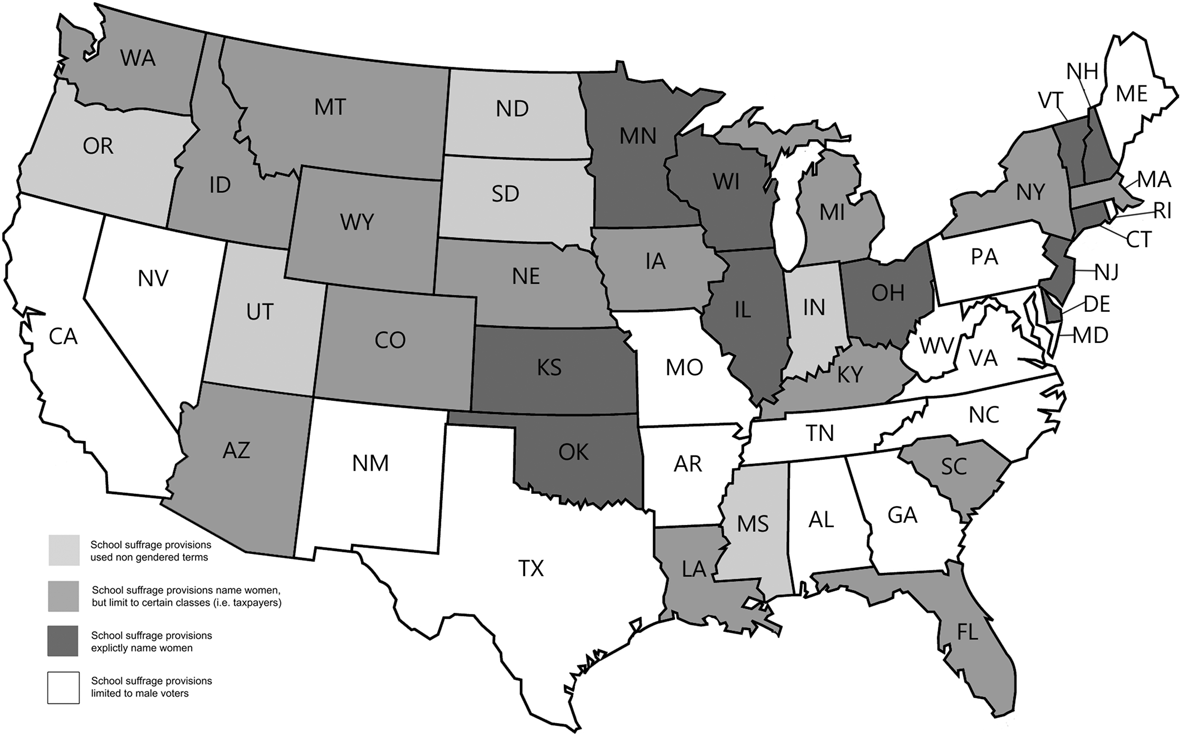
Even though the traditional narrative is that school suffrage extended voting rights for women, a significant majority of these provisions actually extended school voting rights to only certain classes of women, and these limitations generally applied to taxpayers’ right to vote on school matters (Fig. 1).Footnote 35 Moreover, due to the common-law tradition of coverture in which a married woman’s legal rights and obligations were subsumed by her husband, generally only widows and single women paid taxes. Southern states, beginning in 1839, were the first to adopt laws granting married women specific property rights separate from their husband.Footnote 36 In addition, as more women took out homestead lands in the West and, to a lesser extent in the South, their proportion of the taxpaying public increased. Studies have found that in many places unmarried women (single or widowed) “proving up” homestead land accounted for over 10 percent of the homesteads, with the number rising to nearly 20 percent in some regions.Footnote 37
Variations in voter qualifications for school issues and/or officers during the nineteenth century.

While some of these provisions referred specifically to widows and other single women, as in the case of Kentucky, others only specified “taxpayers,” without reference to gender or citizenship status, as did Michigan in 1855.Footnote 38 The definition of taxpayer varied from state to state, with some states granting school voting rights only to those individuals who owned taxable real property, while in other states a taxpayer was anyone who paid taxes in any form.
Other school suffrage provisions limited school voting to school patrons, as was the case in Mississippi in 1878.Footnote 39 Arizona (1885), Nebraska (1881), and Oregon (1889) extended the right to parents of schoolchildren after originally defining education voters as taxpayers. States also differentiated between elector requirements, depending on whether the schools were rural or urban, with some limiting women’s voting to only rural settings (as in Idaho and Wisconsin) and others granting it only for urban schools. Oregon’s state legislature limited voting by female taxpayers to communities with populations greater than a thousand individuals.Footnote 40 Like Oregon, Kansas limited women’s voting on school issues to cities and towns, but without qualifying the size of those communities.Footnote 41
Researching when and where women gained the legislative right to cast ballots on educational matters also revealed that extending these voting rights was not just limited to women. In some states, it was not even limited to U.S. citizens. Most taxpayer provisions had no requirements relative to U.S. citizenship, with only two states, Montana and Massachusetts, specifically requiring U.S. citizenship to vote on school matters.Footnote 42 Although more common in the west, states in other regions also did not limit school voting to U.S. citizens. During the 1880s, Kentucky granted “aliens” the right to vote in school elections in specifically defined city districts.Footnote 43 Few states statutorily limited school suffrage based on the race of the elector, with only Kentucky having such provisions after the Civil War, and even those changed during the 1880s.Footnote 44
With local school taxes making up the single largest component of the tax burden, protecting the right of taxpayers to guard their tax-related economic interests continued in some places even after the adoption of full woman suffrage. Wyoming, the first state or territory to grant full woman suffrage to white women in 1869, modified its school suffrage laws the same year, limiting electors at school meetings to all citizens over twenty-one, meeting residency requirements, and liable for school district taxes.Footnote 45 Oregon passed full woman suffrage in 1912, but five years later, in 1917, the state reinstituted voting limitations on all school matters, except for the election of school officers, to individuals who had taxable property within the district. An exception was made for heads of families with children attending school in small rural districts, even if they did not pay property taxes.Footnote 46 It appears that this change was made to guarantee that only those with economic interests (i.e., taxpayers) or direct interest in the school (as a parent) could vote on school tax issues. New York State did not drop the requirements to either own real, taxable property within the district or be a parent of a child attending school in the district to vote at certain school elections until 1969, when the U.S. Supreme Court found that such provisions violated the Equal Protection Clause of the Fourteenth Amendment.Footnote 47
Women and School Suffrage
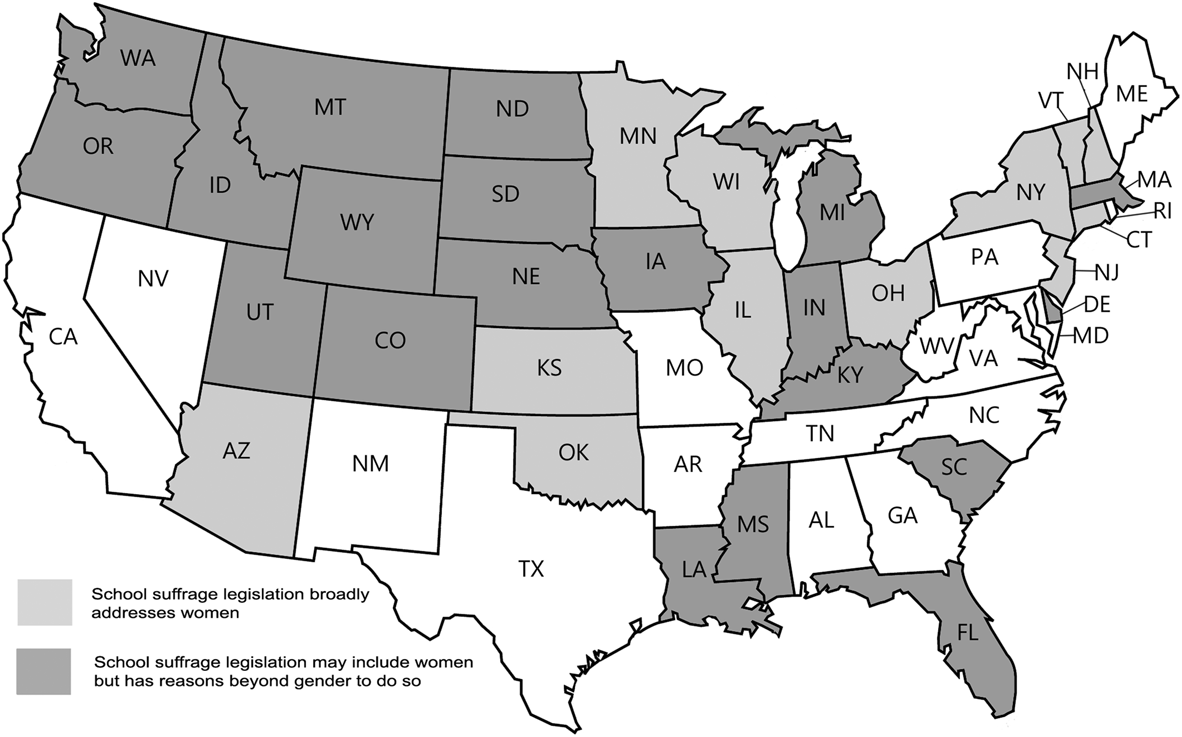
While efforts to extend school voting rights to taxpayers and parents often went unnoticed, campaigns to extend those rights specifically to women received significantly more press. This was at a time when efforts to gain full woman suffrage were also on the rise. Although there are exceptions, states with active woman suffrage associations were more likely to have school suffrage provisions specifically addressing the rights of women to vote on school matters (Fig. 2). There were two separate agendas for those campaigning to extend voting rights for women relative to schools: while some hoped to ultimately gain full citizenship rights for women, others only hoped that women’s voting on school matters would lead to school reform.Footnote 48 These competing efforts, and resulting legislative responses, can be seen in how provisions were incorporated into legislative action, within acts either related to public education or related to elections and voting rights. At times, legislatures changed their focus. This was the case in Colorado in 1870, where the initial extension of voting rights was for taxpayers (including women) as part of the education code. In 1876, however, the provision allowing women to vote for and hold local school district offices was included in the constitution as a suffrage provision. Even then, the actual state codes in 1883 required electors at school elections to swear an oath that they had paid their school taxes.Footnote 49
Initial school suffrage legislation referenced women relative to their gender versus provisions that included women because of their relationship to a particular class, such as taxpayer or parent.

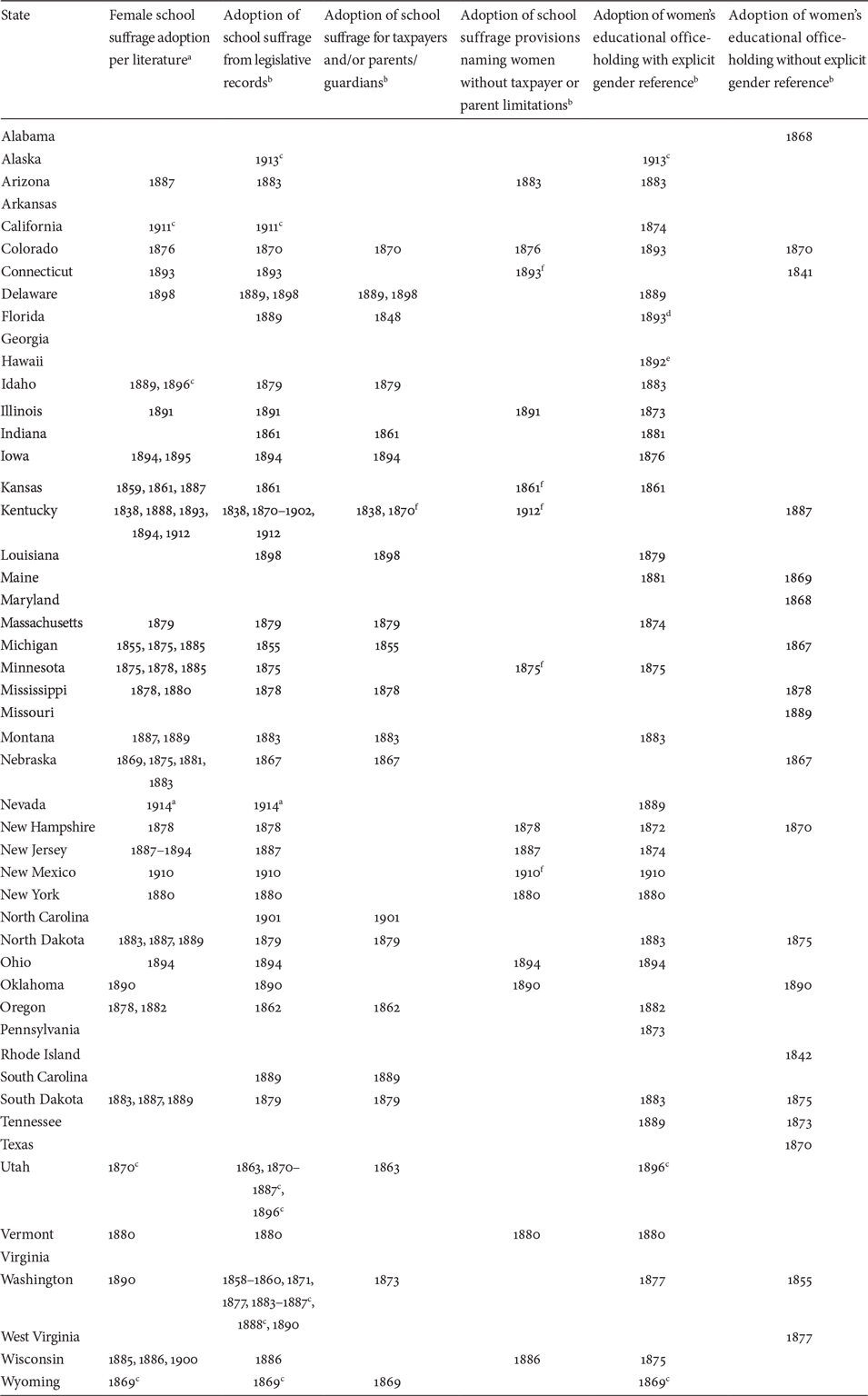
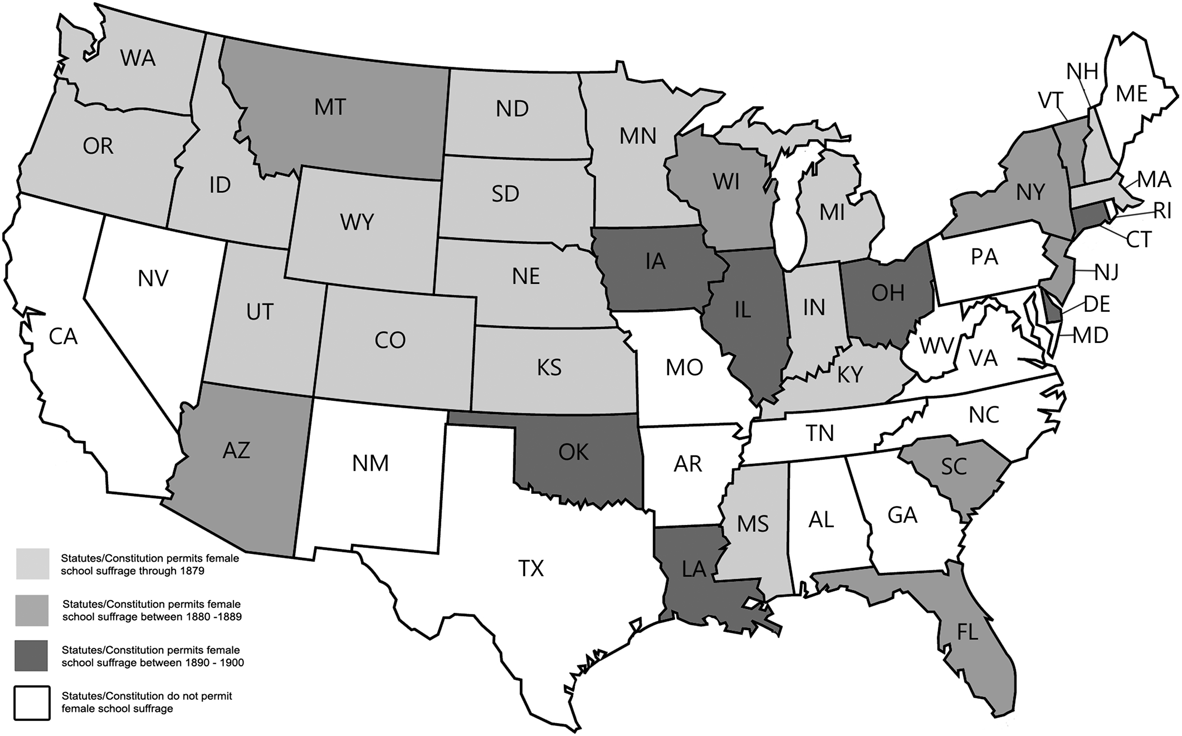
The dates of school suffrage adoptions prior to 1900, as drawn from the History of Woman Suffrage, make it appear that school suffrage adoptions through 1900 were predominately a western phenomenon, a pattern paralleling that of full woman suffrage (Table 1).Footnote 50 However, an extensive review of legislative records revealed that school suffrage provisions actually occurred across the nation. School suffrage was generally included in legislative policies defining or redefining a state’s educational system. Only ten states included it as a specific suffrage provision rather than as a public education provision, with only four states—Minnesota (1875), Colorado (1876), Wisconsin (1885), and North Dakota (1889) — including school suffrage stipulations in their state or territorial constitutions.Footnote 51 Figure 3 provides a broad overview of school suffrage adoptions and includes provisions that specifically mention women as well as provisions that specify voters as being residents, parents, school patrons, and other similar terms.
Comparison of school suffrage and women’s educational office-holding adoption dates from a variety of sources prior to adoption of the Nineteenth Amendment.

Note: This table compares the data found in scholarly literature with the earliest legislative dates for both women’s educational office-holding and female school suffrage. These are differentiated as to whether adoptions exclusively mention women without further qualification or use terms such as taxpayer, parent, person(s), resident, inhabitant(s), or parent to define qualifications. Even when legislative or constitutional provision explicitly granted women the right to vote on school matters or hold educational offices, conflicting provisions and court challenges may have limited their actual effect.
a Alexander Keyssar, The Right to Vote: The Contested History of Democracy in the United States (New York, 2009), 365; and Michael Callahan Pisapia, “The Authority of Women in the Political Development of America,” Studies in American Political Development 24 (April 2012): 24–56.
b These are the earliest dates found by the author. Multiple dates reflect major changes in a state’s school suffrage provisions. Earlier dates may exist. Women were likely elected to local school offices before they were legislatively granted the right to hold such offices, even in states where no such privilege ever legally existed.
c Adopted full woman suffrage.
d Report by the commissioner of education indicated widows or female guardians of children have the right to serve as school trustees. Report of the Commissioner of Education for the Year 1894–95, vol. 1 (Washington, D.C.: Government Printing Office, 1896), 960. No such provision located in Florida legislative or court records to verify.
e Provisions adopted in 1892 were preserved when Hawaii officially became a U.S. territory in 1900.
f Legislation included restrictions related to citizenship, race, literacy, time, and/or place of election.
States permitting at least some classes of women the right to vote on educational issues or officers throughout the nineteenth century.

Even as states began to legislate women’s right to vote on school matters and school officers, aggrieved parties turned to the courts for satisfaction. Court decisions regarding the extension of suffrage relative to school matters frequently dealt with the right of women to vote for school officers. Examination of those decisions finds that, for the most part, they can be split into two groups: those that support women’s right to vote for local school officers and those that find it unconstitutional for them to vote for regional or state education officers. The factor in both was whether the office was specifically included in a state’s constitution. The response of the Massachusetts Supreme Court justices in 1874 to the question whether, under the state constitution, women were eligible to be school committee members foreshadowed judicial responses regarding women’s right to vote on school matters. By grounding their response in constitutional silence relative to school matters and the common-law tradition of women holding administrative offices, the justices opened the door for women to legally participate as both voters and officeholders.Footnote 52
During the closing decades of the nineteenth century, the adoption of school suffrage was not without contention, even within suffrage organizations, with those supporting full woman suffrage often opposing school suffrage, and those opposing full woman suffrage supporting school suffrage. In some states without organized suffrage associations, like Vermont, suffragists participated in school suffrage campaigns, seeing it as the wedge necessary for the adoption of full suffrage.Footnote 53 Leading suffragists, including Susan B. Anthony, originally saw school suffrage as one of the “great many points of considerable importance” that would eventually lead to women gaining full suffrage.Footnote 54 However, by the 1890s, after several failed campaigns—including one in Kansas that attempted to extend women’s voting rights beyond their current partial rights—woman suffragists began to see it as a hindrance to securing full suffrage.Footnote 55 In other states, like Illinois and California, the Women’s Christian Temperance Union was responsible for drafting school suffrage legislation, hoping that granting this would increase the adoption of temperance legislation as well.Footnote 56
At the same time, school suffrage did not guarantee the adoption of full woman suffrage. Of the thirty-two states adopting at least some form of school suffrage before 1920, only twelve adopted full woman suffrage prior to the passage of the Nineteenth Amendment. Nearly two generations, thirty-seven years on average, passed between the initial adoption of school suffrage provisions that included at least a limited class of women and either a state or a territory’s adoption of full woman suffrage or the adoption of the Nineteenth Amendment in 1920. For Michigan and Kansas, more than fifty years passed between the initial adoption of voting rights for at least a limited class of women and the adoption of full woman suffrage. Four states—Alaska, California, Nevada, and Wyoming—passed full woman suffrage without ever previously adopting some form of school suffrage that included even limited classes of women. Fourteen states never adopted any form of school suffrage prior to adopting the Nineteenth Amendment.
Women’s Education Office-Holding in the Nineteenth Century
When considering the full extent of women’s political involvement as it related to nineteenth-century public education, the continuing focus on suffrage rights in the literature has meant insufficient attention to women’s office-holding. Just as school suffrage did not necessarily lead to full woman suffrage, gaining school suffrage did not automatically mean that women also had the right to run for and be elected to school offices.Footnote 57 Because local school district offices (trustees, school board members, school visitors, etc.) were created through legislative action rather than constitutional mandate, officially opening those offices to women only required legislative and governor approval. Other offices, like county superintendent of schools, were defined constitutionally, under either education or municipal government provisions. As with school suffrage, a chronological difference exists between adopting nongendered language leading to women’s right to be elected to school offices and explicitly including women in such legislation. Although there is some crossover, particularly with nongendered language relative to educational office-holding appearing late in the century, gendered language appeared in legislative actions after the 1875 U.S. Supreme Court ruling in Minor v. Happersett, which clearly left it to the states to explicitly define citizenship rights relative to suffrage and office-holding (see Table 1).Footnote 58 Except in cases like Massachusetts in the 1870s and Ohio in 1894, few records indicate the active role of woman suffrage organizations seeking legislation regarding women’s educational office-holding.Footnote 59
The historical record includes many examples of women using nongendered terms to their advantage. In 1873, the Montana Territorial Legislature overrode the territorial governor’s veto of territorial election law modifications, adding the provision that “All persons of the same age, who shall have declared their intension of becoming such citizens” to the qualifications necessary to be a territorial elector [emphasis added].Footnote 60 The following fall, a foreign-born woman was elected and qualified for the position of county constable, despite the fact women who were citizens neither had the right to vote for nor hold public office.Footnote 61 The 1876 Kansas Supreme Court unanimously clarified the right of Kansas women to run for county school superintendent finding that “there is not only no express, constitutional disqualification of females, and no affirmative state of qualifications which would exclude them, but there is nothing in the language of the section creating the office, nor in the duties imposed by law upon the officer, which would imply the necessary or intended exclusion of either sex.”Footnote 62 At times, both in practice and in the courts, indefinite language was found to support broadening of political rights.
Just twelve states included in their school suffrage legislation the right of women to hold school offices. Seventeen states adopted the right of women to hold educational offices before they granted even limited classes of women school voting rights. Only in the South did most states fail to adopt legislation allowing women to hold even local school offices. Those that did were unlikely to elect or appoint women to such a position. A few states incorporated into their constitutions women’s right to hold educational offices without providing them the right to vote on those offices. Louisiana’s post-Reconstruction constitution in 1879 included the right of women to hold any office of control or management under school laws, despite the fact most of the positions were appointed.Footnote 63 This provision was removed when the constitution was rewritten in 1898. Like Louisiana, both the Pennsylvania (1873) and Nevada (1889) constitutions contained provisions that allowed women to hold (but not vote on) school offices, including, in the case of Nevada, the office of state superintendent of public instruction.Footnote 64
While women’s educational office-holding was contentious in some states, some educational professionals supported women’s appointment or election to such offices. In the 1840s, Mary Peabody Mann, the wife of Horace Mann, a leading advocate of the common school movement, recommended that women serve on school committees. She felt that, because of their understanding of children, women would alter school expectations to better fit the physical and mental needs of young children.Footnote 65 As women began to hold educational offices, their contributions were almost immediately recognized. The fact that many women had served as teachers meant they could better judge the schoolwork of others, including appreciating its difficulties. The assumption was that because they generally did not have other employment responsibilities, they had more time to devote to schools than men.Footnote 66 As early as 1874, eleven years before Wisconsin passed legislation formally recognizing women’s right to hold educational offices, the state’s superintendent of public instruction reported that allowing capable, educated, and earnest women to hold educational offices would provide “more assiduous supervision in districts and towns; better teachers would in many instances be secured; school buildings and grounds that outrage all taste and comfort, and too frequently all decency, would be less common.”Footnote 67
Surprisingly, educators were not the only ones to support women’s election to educational offices. Although women in the active suffrage movement did not necessarily support seeking school suffrage, many in the antisuffrage movement saw women’s educational office-holding as being appropriate for women. Kate Gannett Wells, an ardent antifeminist, felt that women serving on school boards was “a natural and logical office for women,” and while she was concerned about women being sullied by politics, “fortunately, most women serving on School Boards are single-hearted in their labors, and enjoy the privilege of working for their State, city or town without compensation, as their contribution to the service of their country.”Footnote 68
Not only were women antisuffragists supporting local school suffrage, they were also serving on local school boards. Elizabeth Cabot, president of the Massachusetts Association Opposed to the Further Extension of Suffrage to Women, found her candidacy supported by the Brookline Equal Suffrage Association. She served on the board of education in Brookline, Massachusetts, for twelve years.Footnote 69 According to newspapers across the country, antisuffrage women were behind the successful election of Mrs. Amelia Allen to the Salina, Kansas, school board in 1890. Allen, an African American, had been nominated for the position at a mass meeting held by African Americans living in Salina’s First Ward.Footnote 70
Elections for school officers varied with the office and the size or location of the school district, with regulations related to school district elections appearing in a state or territory’s school laws. Those associated with schools in municipalities or county school officers were controlled by either statute or constitution through election codes. Beginning in the last decade of the nineteenth century, women began serving as state superintendents of public instruction as well as local and county officers.
Except in cases where a school district was considered part of a municipality, school district elections were often held separately from other elections.Footnote 71 Generally held sometime in the spring or at the beginning of the fall school session, these elections usually occurred at the local schoolhouse. While some states mandated formal ballots, most of these elections were conducted by voice vote. School elections where district boundaries mirrored municipal boundaries were generally more formal, even if elections occurred at different times than the general election. Candidates for city school district trustee as well as educational offices outside of school trustee often ran on party tickets, as they did for other municipal, county, or township offices. Those running for county (or township) school superintendent followed the same election process as candidates for other county positions: they were nominated by one or more party and their election occurred at the general election in November.
Educational office-holding, whether elective or appointive, should not be confused with what are now considered educational administrative positions. During the latter part of the nineteenth century, city and district school superintendents saw themselves as teacher-scholars and attempted to distance themselves from partisan politics and the business aspects of the schools. The majority of their job duties related to mentoring teachers and advocating for school reforms, while administrative details related to budget and school management were left to a business manager or members of the school board.Footnote 72 Appointed by school boards, they only had to answer to those individuals to maintain their position. Outside of city schools, school boards and county school superintendents not only had responsibility for teacher supervision and mentoring as well as education advocacy, they also had a variety of administrative duties.Footnote 73 Voters controlled whether they continued in office. In some places, their failure to meet their legislated duties led to monetary penalties. More important, they functioned as governmental agents acting as intermediaries between the state, county, or local government and local communities, teachers, and school patrons. Scholarly traditions related to the development of school administration have defined these governmental positions as being purely partisan and administrative in nature overlooking the fact that the duties of nineteenth-century school boards and county school superintendents also included the same duties relative to supervision and education advocacy as their city school superintendent colleagues, particularly in the western part of the nation.
Consideration of women’s right to hold school offices yields surprising results. While local, regional, and state-level educational positions did become available as part of some school suffrage provisions, more states and territories across the nation granted women only the right to hold education offices. In some cases, despite no mention of gender in legislation, the actual provisions left open opportunities for women. Connecticut passed legislation in 1841 allowing the inhabitants of school districts to serve on school committees and as school visitors.Footnote 74 The 1842 Rhode Island Constitution exempted school committee members from the requirement that they be qualified voters.Footnote 75 In 1874, California made it possible for women to hold all educational offices not specifically mentioned in the constitution.Footnote 76
In actuality, women were holding elective educational offices long before they were given legislative approval to do so. Emma Willard, founder of Troy Female Seminary and a leading proponent of women’s education, was elected town superintendent in Kensington, Connecticut, in 1840.Footnote 77 In 1855, two women were elected as school trustees in Ashfield, Massachusetts. One, Lydia Hall, served in the position for four years, a full twenty years before the Massachusetts legislature granted women the right to hold office.Footnote 78 Women’s election to several school committees in Massachusetts in 1868 made newspapers across the nation.Footnote 79 Between 1868 and 1871, school committees gained women as members in most of New England.Footnote 80 Only after the Massachusetts Supreme Court supported the Boston School Board’s right to refuse to seat the four women elected to the board in 1873 did the state pass legislation granting women the right to hold elective school district offices.Footnote 81 In 1871, without clear legislative policy specifically granting the right to hold such office, the entire school board of Tiverton, Rhode Island, was composed exclusively of women.Footnote 82 Given only brief notice locally, Tiverton’s election appears to have received little national notice. When the same thing occurred again in Tiverton in 1894, papers across the nation wrote about it.Footnote 83 It is unknown how many women served as school trustees without their gaining attention outside of their home communities.
Women were not just holding local school offices without statutory approval; they were being elected as county school superintendents. Mrs. E. F. Allison was elected superintendent of common schools for Maury County, Tennessee, in the spring of 1868, only to be denied the office. When asked to consider Allison’s right to hold office, John Eaton, Tennessee’s appointed superintendent of public instruction, found her election unconstitutional.Footnote 84 In 1869, after Julia Addington was elected as county school superintendent, she wrote Iowa’s state superintendent for clarification of her right to hold the office. After checking with the state’s attorney general, the superintendent wrote that he could find no reason for her not to serve as “no better opportunity could be afforded [her] for elevating schools, and the vocation which [she had] chosen.”Footnote 85 By 1875, ten women were serving as county superintendents in Iowa when their right to hold office was contested by an unsuccessful male candidate. The following year, Iowa passed legislation declaring, “No person shall be deemed ineligible by reason of sex, to any school office in the state of Iowa.”Footnote 86 Kansas began electing women as county superintendents in 1872, with six serving in the position by 1875, when a male candidate from Coffey County who lost contested the right of women to be elected to the office. In that case, Wright v. Noell, the Kansas Supreme Court found in Mary P. Wright’s favor, she having received the highest number of votes, because nothing in the state’s constitution, the language creating the office, or in the enumerated duties of the office implied exclusion based on sex.Footnote 87
Often laws giving women the right to hold these education offices ended up being adjudicated by the courts. The Oregon legislature opened county school superintendencies to women in 1893.Footnote 88 Women had previously been successfully elected, and at least one woman served her full term despite talk contesting her election.Footnote 89 In 1894, Nellie Stevens outpolled her opponent, J. L. Carter, in the election for Union County school superintendent. In 1895, the county court, after originally denying Carter’s complaint regarding election improprieties, declared that not only was Stevens ineligible for the office, but she, and other women, were ineligible to serve as appointed deputy superintendents. In 1898, the Oregon Supreme Court ruled against her, citing the unconstitutionality of the law.Footnote 90 Stevens had already completed her term.
During the period under study, not all states elected their educational officers. Although Maryland’s 1870 school laws provided for the election of school trustees for the white schools, for the “colored schools” the county superintendent appointed the trustees from among the parents of the children attending those schools.Footnote 91 Jeanne Carr served as California’s appointed deputy state superintendent of public instruction for four years during the 1870s, often substituting for the state superintendent at national meetings.Footnote 92 Beginning in 1874, the U.S. Congress required that the District of Columbia’s board of education be racially integrated, and by 1894 required the appointment of both African Americans and women.Footnote 93 The following year, Mary Church Terrell, the daughter of former slaves and an active suffragist, was appointed to the board, where she served for eleven years.Footnote 94 She was the first African American woman to serve as a school trustee for any of the nation’s urban school districts.
It is difficult to determine how many women were actually appointed or elected to educational offices during the nineteenth century. Records for the hundreds of thousands of rural school districts, if they exist at all, are scattered in a wide variety of locations. Evidence exists proving that women were elected to school offices in southern states.Footnote 95 Only Georgia was adamant that women could neither vote for nor hold any offices without direct legislative approval.Footnote 96
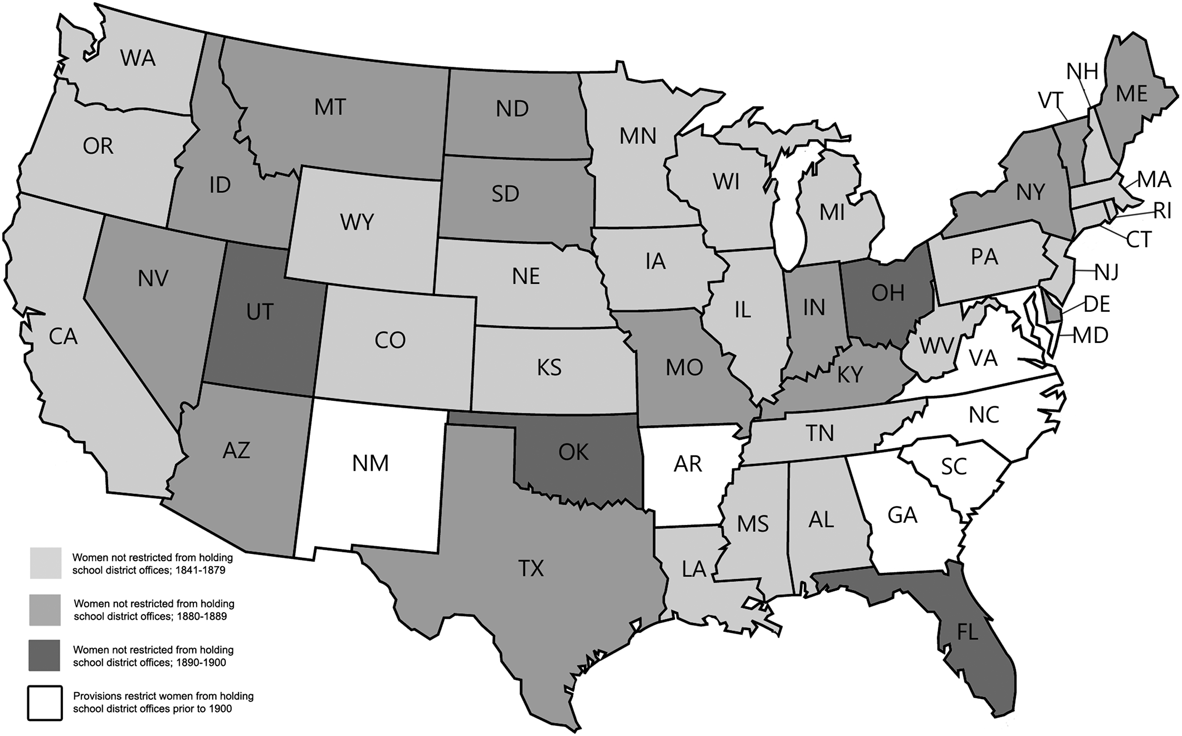
Limited available data does provide clues as to the extent of women’s actual involvement as elected officials. Before 1900, they were explicitly granted the right to hold local school offices in thirty states, with evidence indicating women’s election to educational offices in forty-four states, including states like Virginia, where the constitution explicitly limited office-holding to male electors (Fig. 4).Footnote 97 The editor of the Overland Monthly Magazine reported in 1888 that, in 1881, ninety-eight women had served on school boards in seventy-two Massachusetts towns.Footnote 98 Meanwhile, about a thousand women were serving on rural school boards in California, filling about 25 percent of the available positions.Footnote 99 In 1917, a survey of 104 cities found that women made up about 7 percent of the cities’ school board trustees, with a higher proportion (12 percent) serving in the larger cities than in the smaller cities (5 percent).Footnote 100
States in 1900 where women were not restricted from election or appointed to local school district offices.

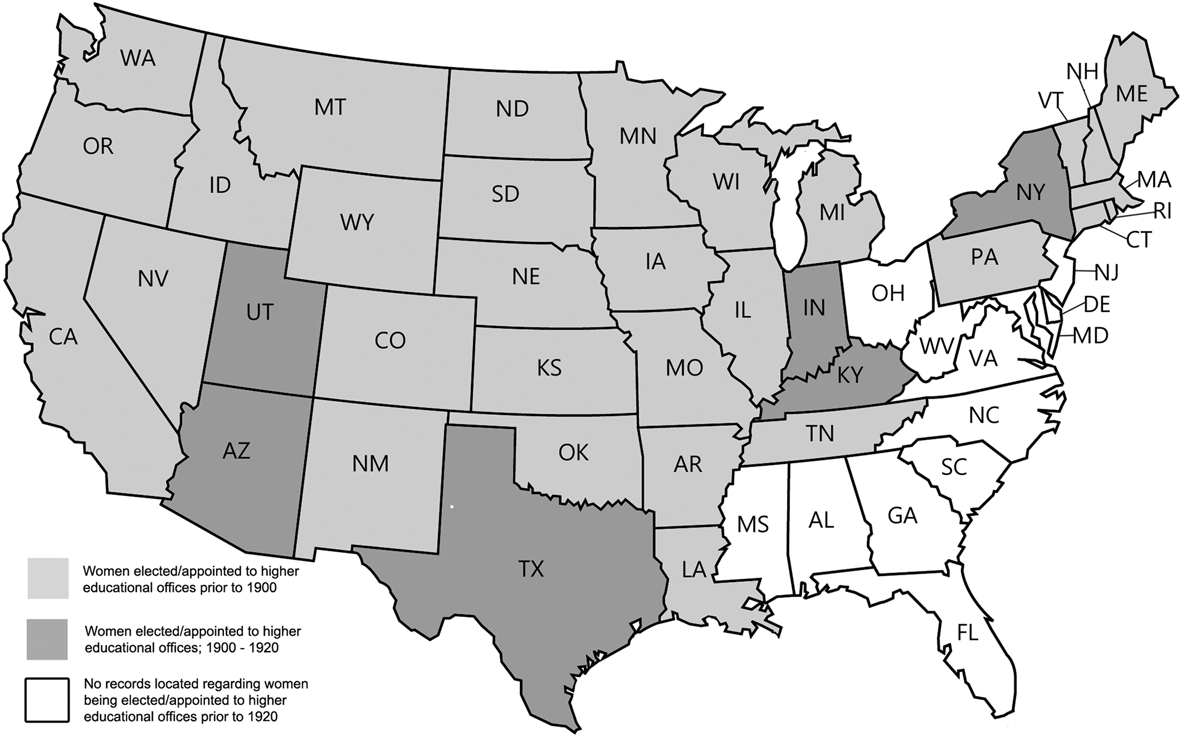
Just as most states and territories explicitly allowed women to serve as school visitors, school trustees, and other school district officers, other records provide evidence that women were elected to regional school offices in at least thirty-one states before 1900 (Fig. 5). In most of these states, women served as county or township superintendents, with women filling nearly all of the positions available in states like Wyoming and Montana. Information regarding the number of women elected as county school superintendents is difficult to locate because state education department reports are often incomplete and fail to mention who held the position in the various counties or townships. Systematic collection of such data at a national level did not start until 1904,Footnote 101 but the data that does exist shows that in 1900 at least 276 women served as county school superintendents.Footnote 102
States where women were elected or appointed to higher education offices (above local school district level) before 1920.

The number of women serving as state superintendent of public instruction is easier to determine because of their official reports and records. In 1892, North Dakota elected the first woman state superintendent in the nation. By 1900, four states (Colorado, Idaho, North Dakota, and Wyoming) had elected women to this office, and by the fall of that year a woman had been appointed to fill the position in Utah.Footnote 103
These educational offices above the local school district level required election at the same time as other city or county offices, following the same election procedures, with women negotiating the same nomination process as their male colleagues. This meant going before the various political party nominating conventions to have their names included on party ballots, although their nominations frequently occurred nominated without their knowledge.Footnote 104 There is little evidence that any single political party nominated women for educational offices more often than any other party. In some western states, successful nominations occurred through “People’s Conventions,” where citizens came together to nominate a nonpartisan slate of city or county candidates.Footnote 105 Beyond being overwhelmingly of northern European ancestry and generally sharing a history as classroom teachers prior to their nomination, the women nominated and elected shared few commonalities. Women ranged in age from their late teens to well into their fifties. While some women came from family traditions of active political involvement, others had no such background. Some were recent university or normal school graduates. Others had no formal education beyond their own common school education.
An examination of Washington Territory’s election returns finds that half of the women either nominated by a political party or by a People’s Convention were elected.Footnote 106 Although women had been nominated to run for county school superintendent in the territory since 1874, the number of women elected to the office increased dramatically the year after full woman suffrage was adopted in 1883, nearly doubling the number elected the previous election. This occurred despite the fact women’s votes represented fewer than 19 percent of the total votes cast.Footnote 107
More research is needed to definitively say that women having the opportunity to vote increased the number of women being elected to office. Historian Paula Baker, in her examination of voting records in rural New York in 1893, found that even in districts where women did not win the election, women were more likely to vote for a woman candidate than her male opponent.Footnote 108 Whether this is true in other states and how this may have influenced election outcomes is not clear. North Dakota’s 1889 constitution granted women the right to vote on all school offices, and in 1892 the voters elected the first woman in the nation to a statewide office. Laura Eisenhuth, running on the Fusion ticket, received just over 52 percent of the vote; nine women were elected to just under 20 percent of the county school superintendencies.Footnote 109 In neighboring Montana, where women could only vote at local school elections and only if they were taxpayers, 75 percent of the county school superintendents were women, elected only by men the same year.Footnote 110
Although many might classify the states that allowed women to both vote for and hold educational offices as a single group, in fact, some of these states limited this right to local levels only. Other states allowed women to vote for and/or hold higher educational offices, such as county and, later in the century, state school superintendencies. Two states, Kansas and Colorado, frequently used as examples of women’s increasing political opportunities during the nineteenth century, actually initially limited women’s electoral involvement to local issues. Kansas limited women’s involvement to white women voting on local school elections; Colorado restricted women’s role to voting in their local school districts, as long as they were taxpayers until later in the century.Footnote 111
Moving away from the assumption that school suffrage was only a stepping stone to full woman suffrage expands and complicates the discussion of women’s political influence. Legislative and court records indicate that, before 1900, forty-four states and territories adopted provisions—whether specifically providing that right or interpreted in a manner that allowed them to do so—legally granting women’s political involvement in educational decision-making through electoral participation. Only twelve of these states granted women the right to vote for and to hold at least school district offices at the same time. For those states initially granting women only the right to hold school office that later added school suffrage provisions, it took nearly twenty years on average to do so. Twelve states granting women the right to hold school offices would not grant women the right to vote at school elections until sometime after the passage of the Nineteenth Amendment in 1920. Only two states prior to 1920 granted some form of school suffrage without ever granting women the right to hold school offices.
Conclusion
While some wanting to expand women’s political rights actively sought school suffrage, in most states it actually represented a broad tool that allowed community members to shape local public schools by voting on school officers and school-related taxes. Yet focusing the discussion solely on school suffrage has meant that women’s election to governmental offices during the nineteenth century has been too frequently overlooked. Across the nation, women were nominated for and elected to educational offices before they had the right to vote. The most common theme found in arguments supporting their election during the period was that it would help remove the schools from politics.Footnote 112 It is important to remember that women’s initial election as school officers most often occurred without legislative approval during a time when only men nominated and voted for governmental officials. Obviously, they differentiated the oversight of public education from other governmental duties. A similar differentiation occurs today, as those seeking educational office as school trustees are generally more interested in community service and making good public policy than gaining political power than those running for other offices.Footnote 113 Understanding this differentiation could help explain why during the nineteenth century those women elected to educational offices— including those with government salaries—have, for the most part, been forgotten.
The landscape of public education has changed dramatically over the past century. Instead of more than 150,000 school districts in 1900, fewer than 14,000 independent school districts exist.Footnote 114 Public elementary and secondary school funding is the single largest governmental expense, with local, state, and federal governments contributing more than $500 billion annually. Although it varies by locale, less than 10 percent of these funds come in the form of federal aid. The majority come from state and local funds, generally from property taxes and other taxes often determined by local voters. Noncitizens, even if they are responsible for paying those taxes, are currently excluded from voting on school tax proposals in most places. This mirrors the situation faced by women responsible for paying property taxes to support their local schools during the nineteenth century but had no right to vote.
Additionally, elected school trustees continue to make up the largest single category of elected public officials. These trustees have significant control over how education is delivered within their school districts. Forty-four percent of current board members are women, more than double the number of women serving in other elected bodies.Footnote 115 Charged with implementing state education policy, trustees are responsible for developing policies, rules, and regulations relative to the local school district, including school finances, staffing, and curriculum. They are an essential link between the community, its schools, and the state.Footnote 116 Just as states determined during the nineteenth century that women serving as school trustees or women taxpayers voting on school-related taxes was good for the community, expanding these positions to noncitizens in the twenty-first century increases the chances that the schools will more closely reflect the broader community’s continuing educational desires.