The anomalous origin of a pulmonary artery from the aorta as a major cardiac lesion is a rare anomaly, which was originally described by Fraentzel in 1868.Reference Fraentzel1 The right pulmonary artery is more often the abnormally arising vessel and it usually arises from the posterior aspect of the ascending aorta within a few centimetres of the aortic valve. An anomalous left pulmonary artery is less common, usually arising from the ascending aorta and is commonly associated with a right aortic arch.Reference Prifti, Bonacchi and Murzi2 In some patients the abnormal pulmonary artery is connected to the aorta via the ductus arteriosus. Even though the embryology and anatomy of both forms differ, the clinical presentation is similar. Most patients develop early signs of cardiac failure due to a high flow to both lungs. The lung that is supplied by the pulmonary artery originating from the right ventricle, carries the full systemic cardiac output, whereas the lung receiving its blood supply directly from the aorta accommodates a considerable left-to-right shunt occurring at the arterial level. The echocardiographic diagnosis of this lesion is challenging since the intracardiac anatomy is normal in most patients. This condition should be distinguished from patients having tetralogy of Fallot, discontinuous pulmonary arteries and a single lung supplied by a duct-like collateral. The clinical presentation of this group usually reflects the severity of the tetralogy of Fallot.
The natural history of an anomalous origin of one pulmonary artery from the aorta includes early death and the development of progressive pulmonary vascular disease in a significant number of patients.Reference Pool, Vogel and Blount3 Therefore, early diagnosis and surgical intervention are important in managing these patients.
The purpose of this study is to review our experience with the diagnosis of an isolated pulmonary artery from the aorta, describe the physiological findings of this anomaly, our surgical experience, and the physiological changes that occur following surgical intervention.
Patients and methods
Between February, 1985 and November, 2007, 12 children were diagnosed at Schneider Children’s Medical Center of Israel as having an anomalous origin of one pulmonary artery from the aorta. All the children underwent surgical repair.
A retrospective review of the clinical, echocardiographic, and operative records was performed.
In 10 children the right pulmonary artery rose from the aorta, whereas two children had an anomalous origin of the left pulmonary artery associated with a right aortic arch.
Age at diagnosis ranged from 5 to 180 days with a median age of 15 days. Patient weight ranged from 700 grams to 5 kilograms with a median of 3 kilograms.
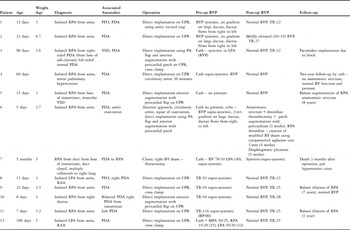
Demographics, characteristics, and associated anomalies of the children are presented in Table 1.
Demographic and surgical data of patients operated for anomalous origin of one pulmonary artery from the aorta.

LPA = left pulmonary artery; MPA = main pulmonary artery; PDA = ductus arteriosus; PFO = patent foramen ovale; RAA = right aortic arch; RPA = right pulmonary artery; RVP = right ventricular pressure; TR = tricuspid regurgitation; VSD = ventricular septal defect
Pre-operative evaluation
An Initial diagnosis was made with two-dimensional echocardiography in all patients and cardiac catheterisation was performed in six patients to confirm the diagnosis.
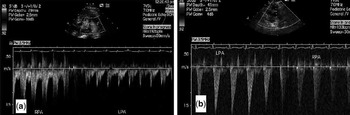
Initial echocardiographic evaluation showed systemic (four patients) or supra-systemic (seven patients) pressures in the right ventricle and in the normally connected lung. The flow patterns as detected by Doppler tracings in the normally connected pulmonary artery were consistent with elevated pulmonary vascular resistance in this lung compared to the abnormally connected pulmonary artery (Fig 1a).
Doppler flow tracings of a child having isolated right pulmonary artery from the ascending aorta. The “normal” left pulmonary artery shows a high-resistance signal when compared with the isolated right pulmonary artery flow (a). Few days after reconstructive surgery, in a newborn, doppler tracings show normalisation of the signal in both pulmonary arteries (b).

Surgical technique
Surgery was performed on the cardiopulmonary bypass either with or without cross clamping. Cannulation was initiated by using either a single or two venous cannulas and a single arterial cannula positioned in the aorta distal to the anomalous pulmonary artery. Immediately after the initiation of the cardiopulmonary bypass the anomalous pulmonary artery was temporarily occluded and the ductus arteriosus was ligated and divided in order to prevent pulmonary steal, and in order to permit adequate cardioplegic delivery to the heart.
Several techniques, according to the anatomy, were used to repair the anomalous pulmonary artery and are summarised in Table 1.
Briefly, in children who did not require aortic cross clamping, the operation was performed on a beating heart. The anomalous pulmonary artery was detached from the aorta by using a side-biting clamp and the aortic defect was primarily sutured. Subsequently, the anomalous pulmonary artery was anastomosed to the main pulmonary artery, either directly or by using a tissue flap technique similar to the one that has been previously described.Reference Amer, Shumaker and Klatte4–Reference Peng, Shanmugam, Macarthur and Pollock8
In children in whom aortic cross clamping was deemed necessary (five), cooling to 25°C was initiated. The aorta was cross-clamped distal to the defect, whereas the abnormal pulmonary arteries were snared and occluded. The heart was arrested by injecting a cold blood cardioplegic solution into the ascending aorta. A vent was placed in the right upper pulmonary vein. The following associated procedures were performed: ductus arteriosus ligation and division (11 patients); ventricular septal defect closure (one patient), and coarctation repair (one patient).
Results
Eleven of the twelve patients underwent re-anastomosis of their pulmonary arteries to the main pulmonary artery. This group had a reconstruction providing native tissue continuity at least to part of the newly connected pulmonary artery. All the reconstructed children survived and achieved normal right ventricular pressures within days after surgery. The flow pattern in both pulmonary arteries as depicted by Doppler tracing was normalised (Fig 1).
One of the patients diagnosed at 5 months of age had a severely hypoplastic right pulmonary artery visualised only by a wedge injection in the right pulmonary vein. We speculate that this artery was previously supplied by an open ductus, which underwent the usual natural history of ductal closure. Since at the time of the diagnosis, he had a diminutive right pulmonary artery, a shunt was performed in an effort to promote growth. Unfortunately, pressures in his normally connected left pulmonary artery remained at a systemic level, resulting in death following an inter-current infection before achieving complete anatomic repair.
One patient had an early anastomotic stricture and underwent the right pulmonary artery patch augmentation. He subsequently developed a right pulmonary artery thrombus and underwent repeated right pulmonary artery reconstruction as well as an addition of a modified BT shunt using a 5-millimetre cryopreserved saphenous vein graft in the stenotic area. By late follow-up – three patients developed stenosis of the anastomotic region 1, 7, and 8 years after initial surgery, and underwent successful balloon dilatation. All patients are doing well clinically with normal right ventricular pressures in all but one patient, who still has mildly elevated pulmonary pressure. This patient underwent pulmonary artery repair at 2 weeks of age as a 780-gram pre-term neonate.
Discussion
The anomalous origin of the pulmonary artery is a rare cardiac anomaly;Reference Prifti, Bonacchi and Murzi2 less than 150 cases have been reported in the medical literature since the first successful surgical correction.Reference Amer, Shumaker and Klatte4 This probably reflects some under-estimation; nevertheless, the largest reported series include 9, 12, and 16 children.Reference Kutsche and Van Mierop5–Reference Peng, Shanmugam, Macarthur and Pollock8 Our series is one of the larger series reported, and it includes the successful surgical correction of this rare congenital cardiac anomaly in a low-birth premature infant weighing 780 grams.
The diagnosis of an abnormally arising pulmonary artery from the aorta should be suspected when normal intra-cardiac anatomy is shown by echocardiography with unexplained pulmonary hypertension and cardiac failure. At this point meticulous echocardiographic assessment should include detailed visualisation of both pulmonary arteries, colour flow mapping, and Doppler interrogation in order to depict flow differences between the two arteries. Cardiac catheterisation should follow when diagnosis is not clear. Prompt diagnosis is of particular importance, since if left untreated, the anomalous origin of one pulmonary artery from the aorta will lead to congestive cardiac failure and pulmonary hypertension with 30% of the infants dying within 3 months.Reference Fontana, Spach, Effmann and Sabiston9, Reference Trapali and Thanopoulos10
The initial clinical ramifications and physiology of both the anomalous origin of one pulmonary artery from the aorta and the isolated pulmonary artery from a ductus atreriosus, are often similar, but the embryologic basis leading to each lesion and the clinical sequelae may differ. The anomalous origin of one pulmonary artery from the aorta is a conotruncal defect, while the pulmonary artery from a ductus arteriosus is usually associated with bilateral ductuses and discontinuity of the branch pulmonary arteries (sixth arch development abnormality).Reference Kutsche and Van Mierop5 A patient having an anomalous origin of one pulmonary artery from the ascending aorta will present with pulmonary hypertension both in the normally and the abnormally connected pulmonary arteries, while in patients having a ductus arteriosus feeding the poorly connected pulmonary artery the ductus usually closes with time leading to a gradual reduction in the flow and pressure in the system. Gradual involution of the abnormally rising pulmonary artery may follow with concomitant pulmonary hypertension in the normally connected lung.
In the newborns, systolic pressure in the abnormally connected pulmonary artery depends on the diameter of the ductus or proximal pulmonary artery. When large, systolic pressure in the abnormal pulmonary artery may assume systemic levels. At the same time, the pressure in the normally connected pulmonary circulation, which carries the full right ventricular output, is in most cases at either systemic or supra-systemic levels. Doppler flow signals in the normally connected pulmonary artery reflect the physiological effects of the elevated pulmonary vascular resistance in this vascular bed, while flow patterns in the abnormally rising pulmonary artery are consistent with higher flow and lower resistance. This phenomenon was seen in all our newborn patients having this condition (Fig 1). Several mechanisms have been postulated, but none has been proved: high pulmonary blood flow, circulating vasoconstrictor substances, and neurogenic crossover from the unprotected lung were all mentioned as possible mechanisms.Reference Prifti, Bonacchi and Murzi2, Reference Trapali and Thanopoulos10
It appears that the normal fall in pulmonary vascular resistance does not occur in the normally connected pulmonary bed. This may be the result of the high volume delivered to the normally connected pulmonary circulation, which is essentially the full right ventricular cardiac output. If normal circulation is re-established by connecting the abnormal pulmonary artery to the normal main pulmonary artery, pressure in the reconstructed pulmonary circulation assumes normal values. At the same time, the Doppler signal in each pulmonary artery assumes a similar and normal pulmonary flow pattern, indirectly indicating that the abnormally high vascular resistance previously seen in the normally connected pulmonary artery has declined (Fig 1b). One may speculate that this process of pulmonary vascular resistance resolution is facilitated if repair is carried out in the neonatal period. Moreover, some evidence exists in the literature suggesting that increased pulmonary blood flow to a single lung from the time of birth could cause pulmonary hypertension and pulmonary vascular disease in most cases. Pool et alReference Pool, Averill and Vogel11 compared the effect of unilateral pulmonary artery ligation within 24 hours of birth in calves and dogs to results in adult animals. They found that, contrary to results in adult animals, ligation of one pulmonary artery in newborn animals leads to severe pulmonary hypertension and pulmonary vascular disease. This finding is further supported by the clinical observation that complete pneumonectomy is poorly tolerated in neonates and infants while same procedure is well tolerated in older children and adults. Interestingly enough, death in these children was sporadically reported as occurring due to cardiac failure,Reference Ayed and Owayed12, Reference Schwartz and Ramachandran13 while pulmonary pressure in adults following pneumonectomy is normal or only mildly elevated.Reference Foroulis, Kotoulas and Kakouros14
Another condition associated with severely increased pulmonary pressure in newborns is premature ductal closure in the foetus.Reference Aslam and Christou15, Reference Downing and Thibeault16 However, a ductus connected to the normally arising pulmonary artery was present in most of our patients, excluding this mechanism as the leading cause of elevated pressures in the normally connected lung.
When a ductus supplies the abnormally connected pulmonary artery, the natural spontaneous ductal closure may result in the involution of the abnormally connected pulmonary artery and the artery may become severely hypoplastic to a point at which it cannot be reconstituted. In addition to losing a lung, elevated pressure in the normally connected pulmonary artery may persist; subsequently, some patients proceed to developing progressive pulmonary vascular disease in the normally connected lung as we have seen in our only mid-term mortality. In our series, the only infant who did not survive, had a severely hypoplastic right pulmonary artery that was previously supplied by an open ductus. This infant was diagnosed at 5 months of age and showed the expected involution of a ductal-dependent pulmonary artery following the normal spontaneous ductal closure. At the time of diagnosis, he had a diminutive right pulmonary artery and a shunt was performed in an effort to promote growth of this diminutive pulmonary artery. A ductal ligament was identified as being connected to the small pulmonary artery. The creation of a confluent pulmonary artery and the recruitment of an additional pulmonary arterial bed connected to the right ventricle is the mainstay of repairing this lesion. This goal was not achieved in this patient. His basic physiology of full cardiac output going to a single lung was not altered by surgery and his right ventricular and pulmonary pressure remained at a supra-systemic level, leading to his death several months after the shunt operation.
In conclusion, the anomalous origin of one pulmonary artery from the aorta should be suspected when unexplained pulmonary hypertension is diagnosed and no structural intracardiac defects are observed. Prompt early diagnosis is of essence, so that early reconstructive surgery can be performed. Early repair is feasible even in newborns and premature infants, using native tissue flaps for at least part of the anastomosis. Complete resolution of the pulmonary hypertension occurred in all children following early reconstructive surgery.