Introduction
Depression in later life strongly impacts older adults’ quality of life and functional ability. However, studies have shown that depression in later life is often under-recognized and under-treated (Pignone et al., Reference Pignone2002; Charney et al., Reference Charney2003). Researchers have long suggested the need to screen routinely for depressive symptoms in older adults due to the high prevalence of depression in this population (Lebowitz et al., Reference Lebowitz1997; Blazer, Reference Blazer2003). It is especially important in people with cognitive impairment (Steffens et al., Reference Steffens2006; Brown et al., Reference Brown, Raue, Halpert, Adams and Titler2009), who have a very high risk of developing depression (Steinberg et al., Reference Steinberg2008). A recent review article indicated that the prevalence of major depression in people with Alzheimer's disease ranged from 4.8% to 50% (Modrego, Reference Modrego2010).
Owing to the high comorbidity rates between depression and dementia, the use of a valid and reliable tool such as the Geriatric Depression Scale (GDS), a 30-item tool to screen for depression in this population, is clinically important. However, researchers have questioned whether individuals with dementia can accurately report their depressive symptoms due to cognitive impairment and have found conflicting results related to the reliability and validity of the GDS in individuals with dementia (Burke et al., Reference Burke, Houston, Boust and Roccaforte1989; Reference Burke, Rangwani, Roccaforte, Wengel and Conley1997; O'Riordan et al., Reference O'Riordan, Hayes, O'Neill, Shelley, Walsh and Coakley1990; Teri and Wagner, Reference Teri and Wagner1991; Feher et al., Reference Feher, Larrabee and Crook1992; Bédard et al., Reference Bédard2003; Snow et al., Reference Snow2005; Muller-Thomsen et al., Reference Muller-Thomsen, Arlt, Mann, Mass and Ganzer2005; Korner et al., Reference Korner2006). While a recent study found that people with mild to moderate dementia can reliably complete the GDS (Lach et al., Reference Lach, Chang and Edwards2010), other circumstances may also make it difficult to obtain an older adult's own report of their depressive symptoms. These circumstances include illness, lack of insight, injury, or reluctance of the individual to provide information. Therefore, additional mechanisms for depression screening would be helpful to clinicians.
In response to the need for alternative ways of screening for depression, a collateral source version of the GDS (CS-GDS) was developed to gather reliable information regarding the occurrence of recent depressive symptoms from an informed collateral source (Nitcher et al., Reference Nitcher, Burke, Roccaforte and Wingel1993). The CS-GDS uses alternate wordings of the original GDS questions. The questions are answered by a knowledgeable informant or collateral source based on a face-to-face or a telephone-administered format (Nitcher et al., Reference Nitcher, Burke, Roccaforte and Wingel1993; Burke et al., Reference Burke, Rangwani, Roccaforte, Wengel and Conley1997). With the large body of literature examining the performance of the GDS, only two studies were found that evaluated the validity of the CS-GDS, and these showed slightly different results.
Nitcher et al. (Reference Nitcher, Burke, Roccaforte and Wingel1993) reported a balanced sensitivity (68%) and specificity (68%) for the 30 item CS-GDS in geriatric patients using a cut-off score of 21, while another study (Burke et al., Reference Burke, Rangwani, Roccaforte, Wengel and Conley1997) found that the CS-GDS had good reliability and validity in detecting depressive symptoms with a balanced sensitivity (61%) and specificity (58%) at a cut-off of 19. Both of these studies included older adults with and without dementia. However, additional concerns persist about the use of collateral sources to report depressive symptoms, and the CS-GDS has not been widely adopted in clinical practice.
Researchers found discrepancies in reporting depressive symptoms between patients and collateral sources in several studies. Collateral sources using the collateral form of the GDS (CS-GDS) reported many more depressive symptoms than individuals using the GDS (Nitcher et al., Reference Nitcher, Burke, Roccaforte and Wingel1993; Burke et al., Reference Burke, Roccaforte, Wengel, McArthur-Miller, Folks and Potter1998). Such discrepancies may be influenced in part by caregiver burden, patient's lack of insight due to cognitive impairment, and the severity of the patient's illness (Burke et al., Reference Burke, Roccaforte, Wengel, McArthur-Miller, Folks and Potter1998). Furthermore, increased caregiver burden and caregiver depression are associated with higher rating of patients’ depressive symptoms (Teri and Truax, Reference Teri and Truax1994). Despite this, collateral sources are often relied upon to provide diagnostic information about patients and have shown high agreement with clinical judgments (Nitcher et al., Reference Nitcher, Burke, Roccaforte and Wingel1993; Cacchione et al., Reference Cacchione, Powlishta, Grant, Buckles and Morris2003).
The Collateral Geriatric Depression Scale would be a helpful tool for clinicians, but it is rarely reported in the literature or seen in practice. As a result, this study was conducted to further explore the use of this tool and to make recommendations about its use. Specifically, this study had several aims: (a) to evaluate the psychometric properties of the different forms of the CS-GDS, (b) to compare collateral responses on the CS-GDS with clinician diagnosis and older adult's own scores on the GDS, and (c) to examine factors associated with any discrepancies between the CS-GDS and the GDS.
Methods
We conducted this study as a secondary analysis of data from a study on the reliability and validity of the original Geriatric Depression Scale. The dataset included information from a chart review of 170 patients who attended a consultative, university-based interdisciplinary outpatient geriatric assessment clinic. According to clinic procedures, the patient completed GDS forms prior to their clinic appointment and a knowledgeable informant completed the CS-GDS and also attended the appointment. During the appointment, an advanced practice nurse or social worker interviewed the patient and the collateral source to review their responses on the GDS and CS-GDS. Additional data were collected on caregiver burden, severity of dementia and functional status. A physician also interviewed the patient and collateral source separately and completed a comprehensive medical evaluation, where a diagnosis of depression was assigned based on the DSM-IV-TR criteria (American Psychiatric Association, 2000).
The chart review was conducted by two healthcare professionals and included charts for a 15-month period. Prior to the data extraction, a standard data collection form was created to collect demographic and clinical data and both data collectors reviewed and agreed on the use of the form. Cases were included if the GDS data were available. After reviewing the data, we excluded the data from six cases after finding that collateral sources failed to complete the CS-GDS. We also excluded nine patient/caregiver dyads because the care-recipients had severe dementia (Clinical Dementia Rating (CDR) = 3) at the time of the evaluation, and their ability to answer the questions was questionable. Thus, 155 patients and collateral source dyads with complete records were included in this study.
Measures
The 30-item long form of the Collateral Source Geriatric Depression Scale (CS-GDS) (Nitcher et al., Reference Nitcher, Burke, Roccaforte and Wingel1993) was used in this study This form was used to create 15- and 5-item versions of the scale. The CS-GDS includes the same items as the original GDS, but they are reworded to be filled out by a collateral source (e.g. “Are they basically satisfied with their life?”). The items equivalent to those in the GDS short forms were extrapolated for creation of 15- and 5-item collateral short forms. We used the original 30-item patient version GDS for comparison with the CS-GDS to examine factors that may have an impact on any discrepancies in scores.
Severity of dementia was identified using the CDR scale (Morris, Reference Morris1993; Berg et al., Reference Berg1998). The CDR identifies five levels of dementia: 0 = normal, 0.5 = very mild/questionable, 1 = mild, 2 = moderate, and 3 = severe dementia. A score for each patient was determined by the geriatric assessment team together after evaluating the patient and interviewing the collateral source.
Care recipients’ functional status was measured using the Older Adult Resource and Service (OARS) Multidemensional Functional Assessment Questionnaire scales for Activities of Daily Living (ADL) and Instrumental Activities of Daily Living (IADL) (George and Fillenbaum, Reference George and Fillenbaum1985). The six-item ADL scale measures ability to perform bathing, dressing, toileting, eating, continence, and feeding independently. The eight-item IADL scale includes ability to cook, keep house, do laundry, use a telephone, shop, use transportation, take medications, and handle finances.
The Caregiver Burden Inventory (CBI) was developed by Novak and Guest (Reference Novak and Guest1989). It uses a five-point response format (0 to 4), with a higher score indicating a higher perception of burden. In this study, the 24-item CBI was completed by the collateral sources. The CBI has five subscales including time-dependent, developmental, physical, social, and emotional burdens. Cronbach's α on subscales of the CBI was reported to range from 0.73 to 0.86 (Novak and Guest, Reference Novak and Guest1989).
Data analysis
All data management and analyses were conducted using SPSS Version 17. Descriptive statistics were used to describe patient characteristics. One-way analyses of variance (ANOVA) were used to determine differences across dementia severity groups (CDR) followed by post-hoc Tukey tests. Internal consistency analyses were computed separately for each CS-GDS scale using Cronbach's α statistic. To assess the performance of the CS-GDS in detecting depression in dementia, we excluded 23 caregivers whose relatives had CDR = 0. Thus, a final sample of 132 collateral sources was included for psychometric evaluation of the CS-GDS. Logistic regression and receiver operating characteristic (ROC) curves were computed to determine optimal cut-off points. Based on these cut-off points, sensitivity, specificity, positive predictive values (PPV), negative predictive values (NPV), and overall misclassification rates (OMR) were determined for each CS-GDS scale. Patients were classified as depressed or not depressed based on the physician's DSM-IV diagnosis.
A matched-pair t-test was used to determine significant differences between the CS-GDS and the GDS scores. We employed Pearson's correlation and one-way ANOVAs to test whether care-recipient's functional status, caregiver burden, care-recipient's CDR level, and collateral's relation to care-recipient were associated with the discrepancy between CS-GDS and GDS scores (CS-GDS minus GDS). Finally, simple linear regression was used to examine the predictors of the discrepancy between CS-GDS and GDS scores.
Results
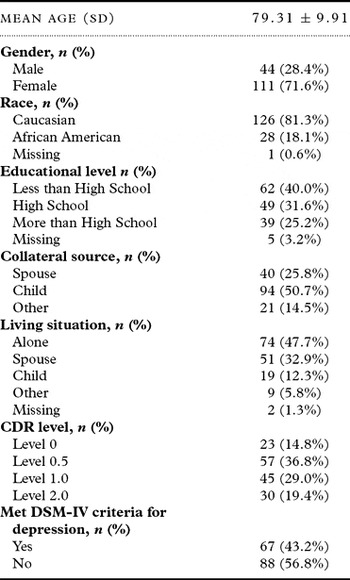
The demographic characteristics of the 155 care recipients are summarized in Table 1. Few had normal cognition (14.8% CDR = 0), while most had cognitive impairment (CDR level = 0.5 to 2). Care-recipients were primarily women (71.6%) and Caucasian (81.3%). The sample's mean age was 79.31 (SD = 9.91 years), and nearly half had high school or college degrees. Nearly half lived with their spouse (32.9%) or children (12.3%), and 47.7% lived alone. Most collateral sources were an adult child (50.7%) or spouse (25.8%). Additionally, 43.2% of the care-recipients were diagnosed with a depressive disorder using DSM-IV-TR criteria.
Patient demographic characteristics (n = 155)

CDR = Clinical Depression Rating; DSM-IV = Diagnostic and Statistical Manual of Mental Disorders (4th edn).
Internal consistency as measured by the α statistic for the 30-item, 15-item, and 5-item versions of the CS-GDS was 0.94, 0.87, and 0.7 respectively. The criterion validity indices for the three forms of the CS-GDS are shown in Table 2. Optimal cut-off scores for the forms were identified. For the 30-item CS-GDS, a cut-off score of 18 yielded a balanced sensitivity (78.2%) and specificity (74%). A cut-off score of 9 was identified for the 15-item version (sensitivity = 76.4%; specificity = 74.0%). The five-item version cut-off score of 3 provided a sensitivity of 89.1% and specificity of 63.6%.
Validity indices (%) of three different CS-GDS forms (n = 132)

***p < 0.001.
PPV = positive predictive value.
NPV = negative predictive value.
OMR = overall misclassification rate.
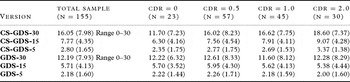
The mean scores and standard deviations of the three CS-GDS scales are shown in Table 3. A series of one-way ANOVAs were computed to determine significant differences across CDR groups for each version of the CS-GDS. The only significant differences across CDR groups was observed with CS-GDS-30 (F = −6.904, p = 0.019). For this scale, Tukey post-hoc comparisons of the four groups indicated that significant differences occurred between the CDR = 0 and CDR = 2 groups. The collateral sources of persons with moderate dementia (CDR = 2) reported more depressive symptoms (18.6 vs. 11.7) than the collateral sources of the group with no dementia. The care-recipients’ self-rated GDS scores did not increase with dementia severity.
Means and standard deviations on different versions of CS-GDS and GDS (N = 155)

CDR = Clinical Dementia Rating.
The discrepancies between the CS-GDS and GDS are shown in Table 4. Overall, collateral sources reported more depressive symptoms than care-recipients. The results of matched-pair t-test analyses indicated that CS-GDS scores were consistently and significantly higher than GDS scores on all three forms (CS-DGS-30: t = 0.646, p = 0.000; CS-GDS-15: t = 0.672, p = 0.000; CS-GDS-5: t = 0.661, p = 0.000). There is a trend for collateral sources to over-report symptoms of depression in all three versions of the CS-GDS. In fact, among care-recipients without cognitive impairment (CDR = 0), collateral sources reported a similar number of depressive symptoms, but the discrepancy between CS-GDS and GDS increases as cognitive impairment increases.
Discrepancy between different versions of CS-GDS and GDS

CDR = Clinical Dementia Rating.
Next, we tested whether functional status, caregiver burden, CDR level, or relationship of the collateral source to the care-recipient were associated with differences in scores between CS-GDS-30 and GDS-30. Pearson correlation coefficients indicated that caregiver burden was significantly related to a discrepancy in scores (r = 0.29, p = 0.002), but functional status was not (r = −0.084, p = 0.301). One-way ANOVA revealed that collateral relationship to the care-recipient did not influence the discrepancy scores (F = 1.59, p = 0.195), but the discrepancy score differed significantly across the four CDR groups (F = 6.11, p = 0.001). Tukey post-hoc comparisons indicated that the discrepancy scores for patients with a CDR rating of 1or 2 were significantly higher than those who were cognitively intact (CDR = 0). However, among those with cognitive impairment (CDR = 0.5, 1, and 2), the discrepancy scores did not differ from each other. We further examined whether caregiver burden influenced discrepancy in scores. Simple regression analysis revealed that greater caregiver burden reported by the collateral source was associated with a larger discrepancy between GDS and CS-GDS scores (β = 0.147, p = 0.004).
Discussion
Clinical guidelines emphasize the significance of depression screening in primary care in order to improve early detection as well as to facilitate treatment (Kurlowicz and Harvath, Reference Kurlowicz, Harvath, Capezuti, Zwicker, Mezey, Fulmer, Gray-Micili and Kluger2008; Brown et al., Reference Brown, Raue, Halpert, Adams and Titler2009). Collateral sources who accompany older adults when they visit healthcare providers can provide useful information regarding patients’ lives and behaviors. Information obtained from a collateral source is especially important when patients are not able to detail their own symptoms. Valid and reliable tools for depression screening with collateral sources can increase the likelihood of screening. Collateral versions of the GDS are not widely used in practice but have promise for increasing depression screening in older adults. This study aimed to evaluate the reliability and validity of different forms of the CS-GDS. We also provide the optimal cut-off scores for the different versions of the CS-GDS in order to guide depression screening in clinical practice. Our findings indicate that 43.2% of the care-recipients were diagnosed with a depressive disorder using DSM-IV-TR criteria. These results are consistent with prior work in patients with dementia (Modrego, Reference Modrego2010). This high level supports the need to screen for depression in this population so that appropriate evaluation and treatment are completed.
Congruent with the findings of previous studies (Nitcher et al., Reference Nitcher, Burke, Roccaforte and Wingel1993; Burke et al., Reference Burke, Rangwani, Roccaforte, Wengel and Conley1997), our results provide convincing evidence that collateral sources can provide reliable and valid information about depression for their relatives with mild to moderate dementia. Our findings suggest a cut-off of 18 with a balanced sensitivity and specificity for the 30-item CS-GDS, which is comparable to the cut-off of 19 reported by Burke and colleagues (Reference Burke, Rangwani, Roccaforte, Wengel and Conley1997). However, the sensitivity and specificity in our study are higher than those in Burke et al. (Reference Burke, Rangwani, Roccaforte, Wengel and Conley1997).
We also provide new information about the psychometric properties for the 15-item and 5-item CS-GDS versions. Systematic screening is most likely to be implemented by healthcare providers if the process can be streamlined to meet the time and resource demands of the busy healthcare environment. We found that the cut-off scores, validity indices and area under ROC curve of all three forms of the CS-GDS were acceptable for depression screening.
The findings of this study are consistent with prior research in that collateral sources tend to report more depressive symptoms than do patients (Nitcher et al., Reference Nitcher, Burke, Roccaforte and Wingel1993; Burke et al., Reference Burke, Roccaforte, Wengel, McArthur-Miller, Folks and Potter1998). The cut-off scores for optimal sensitivity and specificity of the CS-GDS were quite a bit higher than those typically used for the original GDS longer forms. Therefore, clinicians need guidance in evaluating scores when screening with these alternate forms of the GDS to determine appropriate cut-off scores to identify patients in need of further evaluation for depression. Our cut-off score of 18 on the CS-GDS is significantly higher than the usual cut-off score of 11 for the patient-completed GDS (Lach et al., Reference Lach, Chang and Edwards2010). A cut-off of 9 is recommended for the 15-item CS-GDS compared with the typical cut-off of 4 of 5, and a cut-off of 3 is recommended for the 5-item version rather than 2.
Researchers have pointed out that caregivers may be biased in detailing patient's behaviors when caregiving demand increases (Burke et al., Reference Burke, Roccaforte, Wengel, McArthur-Miller, Folks and Potter1998). As a result of their own burden, caregivers often report more depressive symptoms. Similar to previous studies, our findings indicate that among older adults with mild to moderate dementia, collateral rating of depression was significantly higher than the care-recipient's rating. The discrepancy between collateral and patient ratings is larger in caregivers who had a greater sense of caregiving burden. Awareness of this discrepancy allows clinicians to evaluate scores on collateral versions of the GDS more accurately.
Our study builds on other research showing that family members or caregivers can accurately report depressive symptoms. Using the same questions in alternate form makes it easy to remember the questions, making administration in the practice setting easier than having two completely different questionnaires. In addition, the collateral short forms performed as well as the long form using the same items as the original patient short forms to decrease time for screening. Written versions of the forms could be completed prior to appointments, completed at home and mailed in, filled out by collateral sources while the patient is seen in an office setting, or even completed in the acute care setting, making the time to conduct depression screening very efficient.
The CS-GDS provides a simpler alternative to the Cornell Scale for Depression in Dementia (CSDD) (Alexopoulos et al., Reference Alexopoulos, Abrams, Young and Shamoian1988), another depression screening tool originally designed for administration by trained clinicians. The CSDD scale is completed after interviewing a knowledgeable collateral source (e.g. nursing staff or family caregiver) and the patient, based on signs and symptoms observed over the prior week. Although the CSDD is a valid and reliable tool in assessing depression in dementia (Kurlowicz et al., Reference Kurlowicz, Evans, Strumpf and Maislin2002; Muller-Thomsen et al., Reference Muller-Thomsen, Arlt, Mann, Mass and Ganzer2005), it requires a clinician's time to complete. In addition, since the scale was not developed for the lay public, the language and wording are clinical and not suitable to be completed by lay collateral sources.
The study has several limitations. First, this study was limited by the use of secondary data. Little information was collected from the charts about the collateral sources, other than their relationship to the patient and level of burden. Because individuals with severe dementia were not included in the analysis, the generalizability of our findings was limited to individuals with mild and moderate dementia. While the proportion of African Americans in this study was only 20%, this reflects the population of the metropolitan area where the data were collected. Our findings were limited to Caucasian and African American populations. In addition, because the data were collected as part of a clinical program, the physician making the diagnosis of depression was not necessarily blinded to the GDS scores. During the patient visit, the physician typically interviewed the patient and the collateral source and independently rated the DSM-IV-TR criteria. A different health professional reviewed the GDS forms with the patient in a separate interview. It is possible, but unlikely, that the professionals discussed the case and GDS scores during the clinic visit. However, the physicians did not routinely examine the GDS scores or use them during their assessment and rating of the DSM-IV criteria. A strength of the study was the comparison of the CS-GDS scores with clinician diagnosis using the DSM-IV-TR, a standard for depression diagnosis, rather than another depression screening tool.
Conclusion
Little research has been reported on the clinical utility of the CS-GDS. Our findings support its use, particularly when patients are unable to complete the form themselves. However, appropriate cut-off scores should be used, as collateral sources tend to over-rate symptoms. Furthermore, the short forms of the CS-GDS can be administered in a variety of ways, as a reliable and valid tool for screening depression in busy clinical settings.
Conflict of interest
None.
Description of authors' roles
Yu-Ping Chang analyzed the data and wrote the paper. Dorothy Edwards designed the study and wrote the paper. Helen Lach designed the study, collected the data, and wrote the paper.