INTRODUCTION
Social animals are particularly prone to parasite infections. Indeed group living may favour parasite infection; consequently, parasitism is considered as one of the most important costs of group living (Schmid-Hempel, 1998). Several authors have predicted that the costs linked to parasite transmission may modify social systems (Freeland, 1976; Hamilton, 1987; Schmid-Hempel, 1998). On the other hand, O'Donnell (1997) hypothesized that under certain conditions, parasites can favour the expression of social behaviour in their hosts. Indeed several parasites are known to reduce or disrupt host fecundity (Strambi and Strambi, 1973; O'Donnell, 1997); in social species, where there is severe intra-colony competition for reproduction, reduced reproductive potential induced by parasites in some individuals may promote a non-competitive division of labour.
Polistes dominulus (Christ) is a social wasp which is a host of the strepsipteran parasites Xenos vesparum (Rossi). These wasps have an annual colony cycle. In spring, mated queens initiate new colonies, often cooperatively. When polygynous colonies are founded, a linear hierarchy is established by agonistic interactions successively maintained by ritualized dominance behaviour (Pardi, 1942, 1946). In the summer, reproductive individuals (males and future foundresses) emerge, mate, and leave natal nests. After abandoning natal nests, several species of polistine wasps spend the non-nesting phase (winter in temperate climates) aggregated in clusters. In the Northern Hemisphere, the aggregating stage starts in September-November (pre-hibernating stage) when wasps, often belonging to different colonies, aggregate in sheltered quarters (Pardi, 1942; Starks 2003; Dapporto and Palagi, 2007). In the spring, wasps terminate diapause and found new colonies.
Strepsiptera are obligate endoparasites of various insects (Kathirithamby, 1989). These parasites exhibit extreme sexual dimorphism: the short-living (usually less than 5 h) winged adult males and the first instar larvae are the only free-living stages, whereas the neotenic, larviform, adult females are permanently parasitic. Infection by X. vesparum begins with the entry of the first instar larva (triungulin) into a P. dominulus larva. The female extrudes its cephalothorax and becomes a neotenic adult; conversely, the male pupates, emerges and flies off to search for a female. Females are viviparous, and the triungulin larvae emerge via a brood canal which opens in the cephalothorax. Colony infection occurs after a wasp parasitized by a gravid female X. vesparum releases triungulins on flowers after which the triungulins are transported to the nest via foraging wasps. Moreover, in spring, infected wasps can land on temporarily undefended nests and triungulins directly infect the host larvae (Hughes et al. 2003). Only X. vesparum females overwinter (inside their hosts). Hosts carrying empty male puparia usually die before spring (Hughes et al. 2004a).
As X. vesparum induce sterility in their Polistes hosts (Strambi and Strambi, 1973), infection could result in a host division of labour (O'Donnell, 1997). However, foundresses affected by female X. vesparum do not found colonies. Although parasitized females usually rest close to nests, they do not join colonies and do not participate to any colony task (Beani et al. 2004). Similarly, workers infected by male and female X. vesparum do not engage in typical worker tasks on the natal nest. Indeed infected workers and future foundresses leave natal nests in the first week after emergence, forming precocious extranidal aggregations. Hughes et al. (2004b) suggested that the formation of such aberrant aggregations is an example of manipulation in order to facilitate X. vesparum encounters and mating.
The unparasitized future foundresses leaving natal nests at the end of the summer enter parasitized wasp aggregations resulting in mixed groups. As autumn proceeds, aggregations are composed by a rising number of unparasitized future foundresses (Hughes et al. 2004b). As parasitized females leave natal nests and do not engage successively in nest foundation, the autumn and winter aggregations are the only phase where unparasitized and infected wasps live together for a relatively long time.
In pre-hibernating aggregations female P. dominulus wasps exhibited most of the rank-dependent behaviours (ritualized dominance and food request behaviours, RDB; attacks, ATT; trophallaxis, TRP) (Dapporto et al. 2005a, 2006). The frequency of these early behaviours reflects the physical and physiological characteristics of pre-hibernating wasps and their capability to become the alpha female in spring (Dapporto et al. 2006). A few wasps helped the others in aggregations by performing external foraging and providing food to the cluster mates; helpers generally die before spring (Dapporto et al. 2005a). We examined infertile parasitized wasps to determine whether they perform helping behaviour in aggregations more frequently than unparasitized females, as predicted by O'Donnell (1997). In alternative hypotheses the infection could not have observable effects on wasp behaviour in clusters or could lower the frequency of altruistic and other energy-wasting interactions.
According to Hughes et al. (2004b), parasitized females are not attacked on colony by nestmates after their emergence, probably because they are not infecting. On the other hand, also in spring, during the first colony phase, when parasitized females are strongly infective, they release triungulins while resting beside nests without being a target of aggression by resident wasps at least in captivity (Beani et al. 2004). In Polistes wasps cuticular hydrocarbons (CHCs) play a pivotal role in recognition (Lorenzi et al. 1996; Gamboa, 2004). The composition of cuticular mixtures is characteristic for species, sex, colony and population and also depends on social and physiological status (Bonavita-Cougourdan et al. 1991; Dapporto et al. 2004a,2005b). Since parasitized females display strongly altered physiology and behaviour (Strambi and Strambi, 1973; Strambi et al. 1982; Beani et al. 2004; Hughes et al. 2004b; Beani, 2007), they may also present alterations in CHC composition that could be used by conspecifics to recognize them. On the other hand, if female parasites alter wasp physiology very little to favour overwintering, no great differences in CHC composition would be expected between unparasitized and parasitized females.
MATERIALS AND METHODS
Subjects and housing
In September, 2005, at the beginning of the pre-hibernating stage, we collected 62 Polistes dominulus females from Reggello (Tuscany, Italy) from an aggregation partially exposed to sunlight. As aggregating wasps belong to several neighbouring nests (Starks, 2003), a cluster can be considered a representative unit of a population. Five females died during the first days of observation and we removed them from the analyses. The studied aggregation was then composed of 41 unparasitized females and 16 females parasitized by Xenos vesparum (11 by male and 5 by female parasites). We marked the wasps on the wings with enamel paint using a different colour combination for each individual. We caged them in containers (50×50×50 cm) consisting of a large wood frame closed by 3 glass and 2 net sides. The net sides avoided overheating in the cages. The corners of the large frame offered appropriate shelters for the wasps. The containers were placed in a garden where the animals received direct sunlight in the early afternoon. This setting was similar in terms of temperature, humidity and light exposure to those of the site from which the aggregation was collected. The wasps were supplied with water and sugar lumps at the centre of the cage.
Behavioural observations
We examined the 7 behavioural items recorded in wasp aggregations by Dapporto et al. (2006) i.e. ritualized dominance behaviour (RDB) performed and received, attacks (ATT) performed and received, trophallaxis (TRP) obtained and given, and foraging on the sugar (FOOD). In RDB, the dominant wasp climbs on and antennates the subordinate wasp, often seeking for food by mouth-to-mouth contact. TRP occurs when one wasp gives liquid food to another. ATT includes lunges, bites, aggressive mounts, chases, falling fights, and stings. We recorded behaviour, actor, and receiver by the ‘all occurrences’ sampling method and we used the scan sampling method at 5 min intervals to record the individuals foraging on the sugar (Altmann, 1974). We observed wasps from 10.00 a.m to 04.00 p.m between September 5 and October 2 during warm and sunny days.
Chemical analyses
All females were sampled for cuticular hydrocarbons using pieces of filter paper (5×10 mm2) with a procedure similar to that used by Dapporto et al. (2004a). Filter paper was held with dissecting forceps and gently rubbed on the wasp's thoracic scutum for 30 sec. The filter paper was then placed directly onto a clean aluminium sheet. Epicuticular compounds were extracted from the filter paper in 300 μl of pentane for 10 min. The solution was dried in a nitrogen stream and re-suspended in 25 μl of heptane for gas chromatography-mass spectrometry (GC-MS) analysis. We injected 2 μl of solution into a Hewlett Packard (Palo Alto, California) 5890A gas chromatograph coupled with an HP 5971A mass selective detector. A fused silica capillary column coated with 5% diphenyl-95% dimethyl polysiloxane (Rtx-5MS, 30 m×0·25 mm×0·5 μm; Restek, Bellefonte, Pa.) was used in the GC analysis. The injector port and transfer line were set at 280 °C and the carrier gas was helium (at 12 psi). The temperature protocol was: 70–150 °C at a rate of 30 °C/min (held for 5 min), and 150–310 °C at 5 °C/min (held for 11.3 min). Analyses were performed in splitless mode. Cuticular compounds were identified on the basis of their mass spectra produced by electron impact ionization (70 eV).
Statistical analysis
Possible correlations among the frequencies of the behavioural items were examined using principal components analysis (PCA). We retained PCs with eigenvalues of more than 1. Bartlett's test was used to check for homogeneity of variances and Kaiser–Meyer–Olkin (KMO) was used to measure sampling adequacy. We varimax-rotated the components. We used Kruskall Wallis test to search for differences in the frequencies of single behaviours between unparasitized females and females affected by male and female X. vesparum. In cases of significant difference, we employed the multiple comparison tests (post-hoc test) to determine which pairs of wasp classes differed significantly (Siegel and Castellan, 1988).
For the analysis of chemical data, the areas of each peak (representing one or more compounds) of the epicuticular gas chromatogram of each wasp were transformed into percentages and statistically analysed using the Kruskall Wallis test and Stepwise Discriminant Analysis with SPSS® 9.05 for Windows. We used the Kruskall Wallis test to search for differences in the percentages of single chemicals between unparasitized females and females affected by male and female X. vesparum. Stepwise Discriminant Analysis (DA) was used to determine whether pre-defined groups and categories (unparasitized females and females affected by male and female X. vesparum) could be discriminated on the basis of a variable data set (in this case cuticular compounds). By stepwise analysis of variables it was possible to identify a reduced set of compounds particularly important for discrimination among groups.
RESULTS
Behavioural data
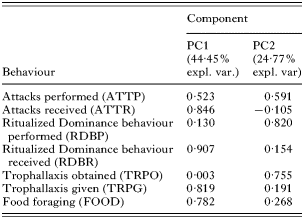
We collected 22 hours by ‘all occurrences’ observations. Principal component analysis extracted 7 PCs (KMO=0·782, Bartlett's test P<0·001) from the 7 behavioural variables. PC1 and PC2 were the only ones that had eigenvalues greater than 1 (3·05 and 1·34). PC1 (explained variance=44·45% after rotation) was positively represented by ATT and RDB received, TRP given, and FOOD while PC2 (expl. var.=24·77% after rotation) was positively represented by RDB performed and TRP obtained (Table 1), thus confirming the results of Dapporto et al. (2005a, 2006).
Table 1. PCA loadings for the two rotated components (PC1 explaining 44·45% of variance after rotation is positively represented by attacks performed and received, ritualized dominance behaviour received, trophallaxis given, and food foraging. PC2 explaining 24·77% of variance after rotation is positively represented by attacks performed, ritualized dominance behaviour performed and trophallaxis obtained.)

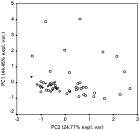
Regression values of PC1 and PC2 for unparasitized and parasitized females are shown in Fig. 1. It is possible to highlight the presence of some wasps that showed high values on PC1; these individuals (helpers) spent a long time on the sugar, and when they returned to the aggregations, other gynes solicited food from them and sometimes obtained it (Dapporto et al. 2005a). Conversely, other individuals with high PC2 values were characterized by high frequency of RDB performed and they obtained food more frequently. Values for PC1 and PC2 were low for parasitized females. They do not perform helping behaviour and they show low frequencies of dominance and food request interactions (Fig. 1).

Fig. 1. PCA regression factor values. PC1 represents trophallaxis given and foraging activity (helping behaviour). PC2 represents ritualized dominance behaviour (RDB), and trophallaxis obtained. Both PCs were low in parasitized females. Circles – unparasitized wasps; empty triangles – male-parasitized wasps; black triangles – female-parasitized wasps.
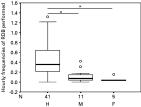
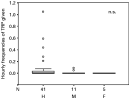
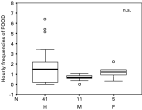
Frequencies of RDB and ATT performed were lower in wasps parasitized by male and female Xenos vesparum (Kruskall Wallis n1=41, n2=11, n3=5, RDB performed: chi-square=16·851, P<0·001; ATT performed: chi-square=9·131, P=0·010; post-hoc tests revealed no differences in ATT performed between any classes of wasps; conversely, for RDB performed, both wasps parasitized by males and females differed from unparasitized females but they did not differ from each other, Fig. 2). There were no differences for the remaining interactions and food foraging (Kruskall Wallis n1=41, n2=11, n3=5, TRP performed: chi-square=2·538, P=0·281; TRP obtained: chi-square=2·538, P=0·281; ATT received: chi-square=0·079, P=0·961; RDB received: chi-square=2·046, P=0·359; FOOD: chi-square=3·391, P=0·183; Figs 3 and 4).

Fig. 2. Hourly frequency of RDB performed by unparasitized wasps (H) and wasps parasitized by male (M) and female (F) Xenos vesparum.

Fig. 3. Hourly frequency of trophallaxis given in unparasitized wasps (H) and wasps parasitized by male (M) and female (F) parasites. The outliers in the unparasitized female group are helpers.

Fig. 4. Hourly frequency of foraging for food by unparasitized wasps (H) and wasps parasitized by male (M) and female (F) parasites.
Chemical analysis
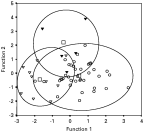
Two GC-MS analyses (on 1 unparasitized female and 1 female affected by male Strepsiptera) failed and were removed from the statistical analysis. We detected a total of 25 cuticular hydrocarbons. The cuticular mixture in hibernating P. dominulus was dominated by a series of linear, mono-methyl branched, dimethyl-branched saturated and linear unsaturated hydrocarbons with chains ranging from 26 to 35 carbon atoms. The chemical diversification among unparasitized and parasitized females was weak. Indeed, DA assigned only 83·3% of cases to their correct group (Function 1: Wilks λ=0·367, P<0·001; Function 2: Wilks λ=0·652, P<0·001, explaining 100% of variance), and there was no clear separation between groups (Fig. 5). One alkene (n-C31[ratio ]1), 1 alkane (n-C31), and 1 mono-methyl branched compound (7-meC31) were responsible for the discrimination.

Fig. 5. Discriminant Analysis of the CHC composition of 39 unparasitized Polistes females, 10 Polistes females parasitized by Xenos males and 5 Polistes females parasitized by Xenos females. Circles – unparasitized wasps; empty triangles – male-parasitized wasps; black triangles – female-parasitized wasps.
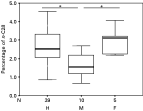
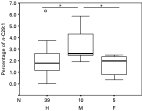
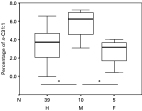
By examining differences in percentages of individual compounds, there were 5 peaks with significant differences among different wasp classes (Kruskall Wallis n1=39, n2=10, n3=5 in each case: n-C26: chi-square=10·00, P=0·007; n-C28: chi-square=10·813, P=0·004; n-C29[ratio ]1: chi-square=8·952, P=0·011; n-C31[ratio ]1: chi-square=13·831, P=0·001; 7-meC31: chi-square=13·076, P=0·001). Post-hoc comparisons revealed that for 3 of these compounds (n-C28, n-C29[ratio ]1, n-C31[ratio ]1), there were no significant differences between unparasitized wasps and wasps parasitized by female Xenos, but wasps affected by male parasites were different from the other two classes (Figs 6, 7 and 8). Regarding n-C26 and 7-meC31, we found significant differences only between unparasitized and male-parasitized wasps.

Fig. 6. Percentage of n-C28 in the cuticular samples of unparasitized wasps (H) and wasps parasitized by male (M) and female (F) parasites.

Fig. 7. Percentage of n-C29[ratio ]1 in the cuticular samples of unparasitized wasps (H) and wasps parasitized by male (M) and female (F) parasites.

Fig. 8. Percentage of n-C31[ratio ]1 in the cuticular samples of unparasitized wasps (H) and wasps parasitized by male (M) and female (F) parasites.
DISCUSSION
Although parasitized females showed behavioural modifications, they did not engage in helping behaviour in clusters. This result does not support O'Donnell (1997), who predicted that infected individuals would specialize in worker-like helping behaviour. Infected females performed less dominance and attack interactions than unparasitized individuals, but foraged and obtained food from helpers with comparable frequencies. The mechanism by which the behavioural modifications occurred is probably very simple, i.e. a direct consequence of castration resulting in ovary reduction. Aggressiveness in wasps depends mainly on juvenile hormone (JH) secreted by the corpora allata and on ecdysteroids secreted by the ovaries; dominant wasps have larger ovaries and corpora allata (Röseler, 1991), and the application of JH and/or ecdysteroids induces increasingly aggressive behaviour (dominance and aggression). In aggregations, wasps with a high RDB frequency had larger ovaries than the other wasps (Dapporto et al. 2006).
Regarding parasitism, there is a heated debate about the host behavioural modification hypothesis. Indeed, it is difficult to ascertain whether a phenotypic change in the host is really adaptive for parasites or hosts, or whether it is a pathological effect (Poulin, 1995, 2000; Thomas et al. 2005). Behavioural modifications increasing host and parasite fitness are well known in bumblebees affected by canopid flies (Poulin, 1992; Muller and Schmid-Hempel, 1993; Muller, 1994). In the first days after infection, bumblebees spend the night and a large part of the day outside the nest to retard the parasite's development (Muller and Schmid-Hempel, 1993) and keep the infection away from kin (Poulin, 1992). On the other hand, a few days before emergence, the parasite induces digging behaviour in the host to maximize the possibilities of overwintering as a buried pupa (Muller, 1994). Xenos vesparum parasites manipulate the behaviour of infected Polistes dominulus females by inducing them to leave the maternal nest and form precocious aberrant aggregations (Hughes et al. 2004b). However, in view of the lack of further information about the Xenos-Polistes system, it is impossible to fully understand whether the behavioural modifications we found should be considered parasite manipulation, host defence or simple effects of pathology.
Nevertheless, we tried to evaluate the potential benefits of the altered behaviour of parasitized wasps for hosts and parasites. In fact, parasitized females are de facto ‘dead’ from a reproductive point of view. They do not obtain either direct fitness (females parasitized by males die before spring, females parasitized by females do not found nests) or indirect fitness (they leave the natal nest early, do not help in aggregations, and do not join spring colonies as subordinates). On the other hand, the ‘inactive strategy’ could favour the parasite since it may increase survival of the host over winter by avoiding energy-wasting behaviours (helpers die before spring). This strategy could also favour parasites by allowing the infected females to climb onto a nest in spring. In this phase of the colony cycle, before the occurrence of pupae, foundations are very unstable (Reeve, 1991; Starks, 2001; Dapporto et al. 2004b), and although only 1 female usually starts the construction of the nest, other individuals may join later. However, usurpations are frequent and alien foundresses often aggressively steal nests. A less aggressive, parasitized foundress may be readily accepted by resident females, permitting the parasite to release triungulins directly on the nest. These hypotheses, however, remain highly speculative.
The different physiological modifications induced by Xenos males and females reveal a clear manipulative pattern. Indeed, although wasps parasitized by Xenos females are also castrated (Strambi and Strambi, 1973), they survive winter along with unparasitized foundresses. Moreover, Beani (2007) found that fat bodies are reduced only in wasps with male parasites. These observations suggest that Xenos females do not alter some physiological characteristics of their host so that they can overwinter.
Intriguingly, this similarity matches the differences in CHCs that we found. The cuticular hydrocarbon composition differed slightly between unparasitized and Xenos-female parasitized wasps.
Parasitized and unparasitized females were attacked and dominated with comparable frequencies, suggesting that the former are accepted in clusters. We do not know if wasps are unable to perceive the slight differences in CHC composition induced by the parasite infection or if they detect the presence of the infected females but accept them in the aggregation. Cluster formation is advantageous for wasps, and unparasitized females probably would not benefit from driving off their temporarily benign cluster mates (production of triungulins and infection will start 6 months later in spring). However, if parasitized females are actually recognized, the behaviour of helpers that give food with comparable frequency to parasitized and unparasitized females is difficult to explain. Since parasitized females will not reproduce in the following spring, helper efforts toward them cannot provide any increase in indirect fitness.
In conclusion, it is premature to decide whether behavioural and biochemical modifications of aggregating Polistes females caused by Xenos should be considered true parasite manipulation. However, by castrating their hosts, Xenos may obtain a coincidental advantage (Thomas et al. 2005) by putting the wasps in a low social condition, which may increase the likelihood of engaging in energy-wasting behaviours in autumn and the possibility of being accepted as a nest-joiner in spring. Similarly, the slight modifications of CHC composition may favour Xenos females, which could remain unnoticed in autumnal clusters and on spring nests when direct infection occurs. Also in this case, the similarity between unparasitized and Xenos-female infected wasps may not be parasite manipulation; the CHC composition could simply reflect the similarity in some physiological characteristics (e.g. well developed, fat bodies) typical of unparasitized hibernating wasps.
This study was inspired by λagr´θε βιohgr´σαshgr; “Live hidden”, a quotation from Epicurus IV Century BC. We thank Laura Beani and two anonymous referees for reviewing the manuscript. We thank Lambrusco di Sorbara for clarifying some difficult questions. This study was funded by the Universities of Pisa and Florence. All the experimental procedures conformed to Italian law.