Implications
Removal of known risk factors may not be enough to overcome the tail biting problem seen when producing, especially undocked, finisher pigs. Thus, a different strategy could be early detection of tail biting through behavioural changes seen before tail damage such as pen level activity or manipulation of objects. The current study showed that both are most probably related to ongoing tail biting. However, spotting changes would demand a more detailed observation than done in this study and thus automatic monitoring systems for both pen level activity and object manipulation.
Introduction
Tail damage caused by tail biting in finisher pigs is a welfare problem for the pigs and an economic problem for the farmer. Several negative consequences of tail damage have been reported, including stress and pain (Heinonen et al., Reference Heinonen, Orro, Kokkonen, Munsterhjelm, Peltoniemi and Valros2010; Munsterhjelm et al., Reference Munsterhjelm, Brunberg, Heinonen, Keeling and Valros2013), decreased growth rate (Sinisalo et al., Reference Sinisalo, Niemi, Heinonen and Valros2012; Harley et al., Reference Harley, Boyle, O’Connell, More, Teixeira and Hanlon2014) and risk of infections leading to carcass condemnations at slaughter (Huey, Reference Huey1996; Valros et al., Reference Valros, Ahlström, Rintala, Häkkinen and Saloniemi2004; Kritas and Morrison, Reference Kritas and Morrison2007). Thus, methods to prevent tail damage are needed. Currently, many pigs are tail docked to decrease the risk of tail damage. Even though tail docking is effective as a preventive measure against tail damage, it does not entirely prevent tail damage. The same is true for other measures such as providing straw as enrichment and more space (Larsen et al., Reference Larsen, Andersen and Pedersen2018). Since it seems difficult to completely prevent tail damage by removal of known risk factors, particularly in a conventional production system with pigs with undocked tails, another important strategy is to develop and implement methods that can detect tail biting at an early stage and, through temporary interventions, prevent tail damage. The first step in developing such a strategy is to identify relevant early detectors, which could be, for example, changes in behaviour observed before tail damage. This was the focus of a review by Larsen et al. (Reference Larsen, Andersen and Pedersen2016) who concluded that activity level and exploratory behaviour may have the potential both to be an early detector of tail biting and to be monitored automatically for future implementation. Exploring is considered a behavioural need for the pig, and tail biting has been suggested to be explorative behaviour redirected to pen mates’ tails (Taylor et al., Reference Taylor, Main, Mendl and Edwards2010), occurring due to an internal frustration in the pigs arising from lack of proper enrichment or lack of other important resources. Thus, pigs may also change their explorative behaviour before tail damage (Ursinus et al., Reference Ursinus, Van Reenen, Kemp and Bolhuis2014). Further, the increased internal frustration could also result in increased activity (Statham et al., Reference Statham, Green, Bichard and Mendl2009). However, for pen level behaviour, more research is needed more days before an event of tail damage investigated in a study also including control pens and a larger sample size. This is needed to establish when the differences arise and whether changes are limited to pens with tail damage or occur in all pens. Further, pigs’ activity has been shown to follow a diurnal pattern with the highest level during the afternoon (Andersen et al., Reference Andersen, Jorgensen, Dybkjaer and Jorgensen2008), to decrease with age and to increase with the provision of straw (Pedersen et al., Reference Pedersen, Herskin, Forkman, Halekoh, Kristensen and Jensen2014); all of which may also be true for pigs’ exploratory behaviour. Thus, several other factors may affect these types of behaviour, other than merely ongoing tail biting, and should be taken into consideration.
The aim of the current study was to investigate whether activity level and object manipulation evolved differently between finisher pens scored with tail damage and pens not scored with tail damage during the last 7 days before the day of the tail damage scoring. The hypothesis was that activity level would increase before the scoring of tail damage and that the level of activity would be higher in pens scored with tail damage compared to the pens not scored with tail damage. Further, object manipulation was expected to either decrease before tail damage due to a shift to tail manipulation or increase due to an overall increase in explorative behaviour and to be either lower or higher in pens scored with tail damage compared to pens not scored with tail damage for the same reasons as stated above.
Material and methods
Video recordings of 112 finisher pens have been obtained from an experiment presented in Larsen et al. (Reference Larsen, Andersen and Pedersen2018) conducted from 2015 to 2016. The video material used in the current study was from pens scored as tail damage pens and their matched control pens, which had video available 7 days before the scoring of tail damage.
Animals, housing and management
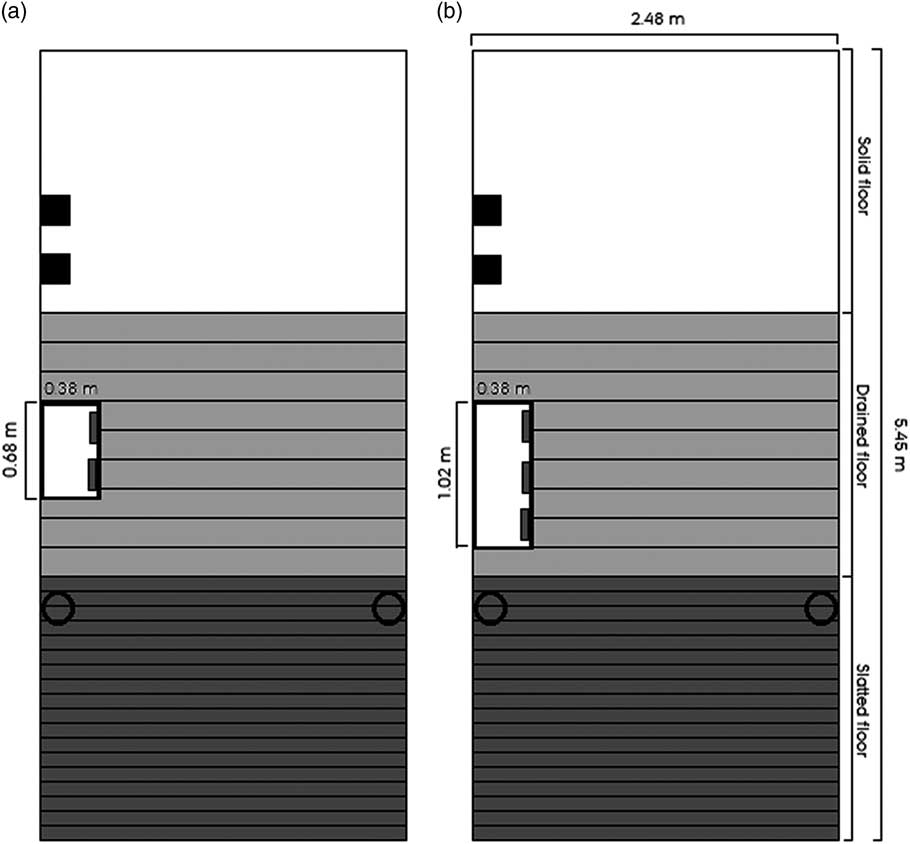
The current study was conducted in the experimental stables at the Department of Animal Science, Aarhus University, Denmark. All pigs arrived after weaning from the same herd, bred from dams of Danavl Yorkshire×Danavl Landrace, all inseminated with Danavl Duroc semen. The study only concerned pigs housed as finishers from approximately 30 kg until slaughter (a study period of 10 weeks). At insertion to the finisher section, the pigs weighed on average 31.6±6.6 kg. Pigs were mixed across weaner pens and not according to gender or weight. Further, all tails were examined to ensure that no pigs with bleeding tail wounds already present were included. The finisher pens were divided between four batches covering different seasons of the year. To investigate activity level and object manipulation under different environmental conditions, finisher pens were randomly divided within each batch between one level of each of three factors: (1) TAIL: pens with pigs with undocked tails v. docked tails; (2) STRAW: pens not provided with straw v. provided with 150 g of straw/pig per day on the solid floor; (3) STOCK: pens with a stocking density of 0.73 m2/pig (18 pigs/pen) v. 1.21 m2/pig (11 pigs/pen). Tail docking occurred according to Danish legislation within the first 4 days after birth with a hot-iron cutter to half of the tail’s original length. Pigs with undocked and docked tails were housed separately from birth. Pens including 18 pigs had one dry feeder with three feeding spaces, while pens including 11 pigs had one dry feeder with two feeding spaces. Thus, the amount of feeder space per pig was approximately similar for the two stocking densities. The feeding spaces were completely separated at the head and shoulder. Pigs were fed ad libitum with a commercial dry feed (15.1% to 15.6% CP), and the feeders were filled three times per day at 0300, 1000 and 1830 h. All pens were identical with the floor divided between one-third solid, drained and slatted flooring. The dimensions and design of the pens can be seen in Figure 1. Further, all pens were provided with two hard wooden sticks in separate vertical racks as manipulable material (see Figure 2). Further information about the animals, housing and management can be found in Larsen et al. (Reference Larsen, Andersen and Pedersen2018).
Drawing of pen dimension and design for (a) pens with a stocking density of 1.21 m2/pig (11 pigs) and (b) pens with a stocking density of 0.73 m2/pig (18 pigs). The white rectangle represents the feeder, the hollow black circles represent drinking cups and the solid black squares represent the two hard wooden sticks in separate vertical racks. All pens had the same dimensions.

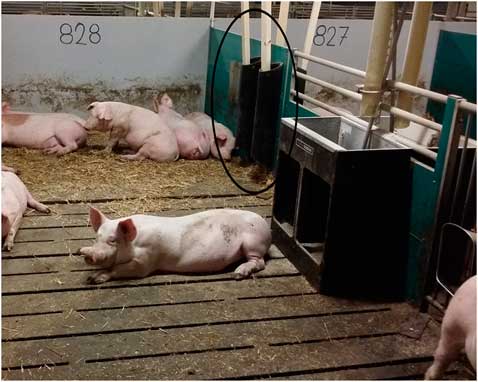
Picture illustrating the place and design of the object observed for changes in explorative behaviour in finisher pigs: the two hard wooden sticks in separate vertical racks. Their position in the picture is indicated by the black circle. Stick 1 was the stick closest to the feeder, and Stick 2 was the stick furthest into the solid floor.

Tail damage scoring, definition and management
Each individual pigtail was scored by eight trained observers (two per scoring day) each Monday, Wednesday and Friday in each of the 10 weeks of the finisher period. During these observations, the observers entered the pen. A pen was recorded as a tail damage pen if at least one pig in the pen was observed with a bleeding tail wound defined as: ‘the tail had one or more openings of the tissue, could vary from scratches to a shortened tail with a deep opening, and the tail had fresh blood on the surface from the opening with either a brown, dark red or red colour, which felt wet and resulted in exudate sticking to the finger’. The other days of the week, the stock people performed the tail scoring from outside the pen, using the same definition as described above. When observing a pig with a red tail, the stock people also entered the pen to check whether the exudate was sticking to the finger. Thus, tail scoring was performed daily. The day when a pen was recorded as a tail damage pen was termed ‘day 0’ for that specific pen. Only the first incidence of tail damage (a bleeding tail wound) in a pen was recorded. After the first incidence, the pig(s) with bleeding tail wound(s) were moved to sick pens and the pen was no longer included in the study.
Behavioural observations
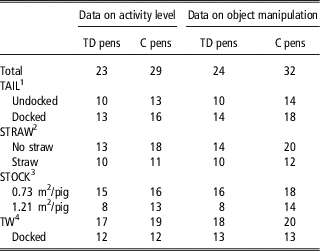
For behavioural observation from video, a camera (Monacor, TYPE-TVCCD-170S, Bremen, Germany) was installed about 3 m above the solid floor in each pen. The camera was placed close to the back wall of the pen, providing a full view of the entire pen. For each tail damage pen, matched control pens with the same treatment combination of TAIL, STRAW and STOCK within the same batch were observed on the same days and within the same observational periods. The control pens were never recorded as tail damage pens throughout the study period. A tail damage pen could have one to three matched control pens, depending on the availability within the batch, and the same pen could be a matched control pen for more than one tail damage pen. The exact number of tail damage and control pens and their division between the three factors TAIL, STRAW and STOCK can be found in Table 1.
Number of tail damage (TD) pens and their matched control (C) pens within the data sets on activity level and object manipulation in finisher pigs

1 TAIL=pens with either undocked pigs or docked pigs.
2 STRAW=pens either not provided with straw or provided with 150 g of straw per pig per day.
3 STOCK=pens with a stocking density of either 0.73 m2/pig (18 pigs) or 1.21 m2/pig (11 pigs).
4 TW=pens scored with at least one non-bleeding tail wound the last 7 days before tail damage and the number of these pens with docked pigs.
Activity level
Activity level was observed by three observers from video recordings the last 7 days before day 0 within three observational periods: (1) morning from 0600 to 0800 h (the pigs are waking up); (2) afternoon from 1600 to 1800 h (assumed to be within the most active period); (3) evening from 2200 to 2400 h (a resting period). As the light was turned off in the stable during the evening observational period, the video quality was occasionally too poor to ensure reliable observations. If more than 20% of the scans within the observational period were not usable, the full observational period for that pen was excluded from the data set. Thus, only 14 tail damage pens and 19 control pens were included for the evening observational period. Activity level was observed by scan sampling every 10 min with 12 scans/observational period. The observer recorded how many pigs were active in the pen defined as the pig being either sitting, kneeling, standing, eating or drinking.
Object manipulation
Explorative behaviour was, in the current study, measured as object manipulation directed towards the two hard wooden sticks in separate vertical racks (see Figure 2). These less rewarding objects were chosen since the goal was to measure the frustration experienced by the pigs before tail damage and not to remove it. Further, these objects moved in a controlled manner within their vertical racks when manipulated, thus increasing the possibility of measuring manipulation of these objects automatically in the future. Object manipulation was observed from video recordings by two trained observers the last 7 days before day 0 within two observational periods: (1) morning from 0600 to 0800 h and (2) afternoon from 1600 to 1800 h. It was planned to also include a resting period from 2200 to 2400 h as for activity level. However, it was evaluated that the video quality in the area where the sticks were positioned was too poor to ensure reliable observations during these hours despite the use of IR light. Object manipulation was observed as an event by behavioural sampling by counting the number of times the two wooden sticks were manipulated within each observational period. A manipulation event was defined as: a pig touches the object with the head, and the object moves either to the right or to the left. If the object has not been manipulated for 5 s, or a new pig starts to manipulate the object, it is rated as a new manipulation event. It was also recorded which of the two sticks that were manipulated and whether the pig was lying down or standing while manipulating it. Stick 1 was the stick closest to the feeder and Stick 2 was the stick furthest into the solid floor (see Figures 1 and 2).
Statistical analysis
Before the analysis, the development in activity level and object manipulation over the last 7 days before day 0 was investigated descriptively. No linear relationship or other specific pattern was found, thus it was decided to simplify the results by creating a day category variable (DAY) with three categories: ‘day 7 to day 6’, ‘day 5 to day 4’, ‘day 3 to day 1’. Further, to include the possible effect of low severity ongoing tail biting in both the tail damage and control pens, a binomial tail wound variable was created (TW). TW was assigned 1 if the pen had been scored with at least one non-bleeding tail wound during the 7 days before day 0 and was assigned 0 if the pen had not been scored with any non-bleeding tail wounds during these 7 days. This was different from being recorded as a tail damage pen where at least one pig in a pen should have been scored with a bleeding tail wound. From these steps, two data sets were created with one observation (proportion of active pigs or number of manipulation events) per pen per observational period per DAY category. All statistical analyses were performed in R Version 3.2.4. (R Core Team, 2017), using the package ‘lme4’ (Bates et al., Reference Bates, Maechler, Bolker and Walker2015) for generalised linear mixed models, and all models were reduced according to a 5% significance level (P<0.05).
Activity level
Data on activity level was not normally distributed, thus activity level was instead analysed by a generalised linear mixed effect model with a binomial distribution (logistic regression using the function ‘glmer’ with family set to binomial). The response variable was the proportion of active pigs in the pen. Separate models were created for the three observational periods (morning, afternoon and evening). Data on the morning and afternoon observational period contained 156 observations, while data on the evening observational period contained 99 observations. All three models included the same main effects, interactions and random effects. The main effects were pen type (tail damage v. control), DAY, TW, period number (1: weeks 1 to 3; 2: weeks 4 to 6; 3: weeks 7 to 10) and the three factors TAIL, STRAW and STOCK. The interactions were all two-way interactions between pen type and the main effects DAY, TW, TAIL, STRAW and STOCK. Random effects were pen number (batches 1, 3 and 4 : 1 to 32; batch 2 : 1 to 16) nested within pair number (1 to 23, independent of batch; to match tail damage and control pens) nested within batch number (1 to 4). Estimated results are presented as the probability of being active (in %), and differences are presented as odds ratios (OR) with connected 95% confidence intervals (CI).
Object manipulation
Neither the number of manipulation events nor the number of manipulation events per pig in the pen could be considered as normally distributed. Instead, it was chosen to treat the number of manipulation events as count data, and due to overdispersion it was chosen to use a generalised linear mixed effect model with a Negative Binomial distribution. The response variables were the number of manipulation events (1) for both sticks, (2) for Stick 1 and (3) for Stick 2. Thus, three models were created, all including the same main effects, interactions and random effects. The main effects were pen type (tail damage v. control), DAY, observational period (morning v. afternoon), TW, period number (1: weeks 1 to 3; 2: weeks 4 to 6; 3: weeks 7 to 10) and the three factors TAIL, STRAW and STOCK. The interactions were all two-way interactions between pen type and the main effects DAY, observational period, TW, TAIL, STRAW and STOCK. Random effects were pen number (batches 1, 3 and 4 : 1 to 32; batch 2 : 1 to 16) nested within pair number (1 to 24 independent of batch, to match control and tail damage pens) nested within batch number (1 to 4). All models further included an offset variable: the number of pigs in the pen on the respective day multiplied by the number of days in the day category. This variable was included to account for the fact that the number of manipulation events was expected to depend on both the number of pigs in the pen and on the number of days in the day category. Thus, estimated results from the models are not presented as total counts but as a manipulation rate with the number of manipulation events per pig per observational period per day. Differences are presented as manipulation rate ratios (MRR) with connected 95% CI.
Results
The number of tail damage and control pens scored with at least one non-bleeding tail wound during the last 7 days before tail damage can be found in Table 1. The majority of both the tail damage and control pens were scored with non-bleeding tail wounds before day 0, and the majority of these were pens with docked pigs.
Activity level
During the morning
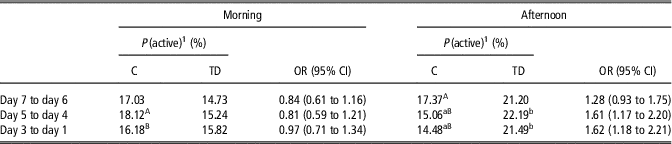
A two-way interaction was found between pen type and DAY (P<0.001), and detailed results can be seen in Table 2. Within this interaction, no differences were found between tail damage and control pens within any of the day categories, but small changes between the day categories were seen for both tail damage and control pens. No effect was found of TW (P=0.41), period number (P=0.97), TAIL (P=0.45), STRAW (P=0.32) or STOCK (P=0.89).
Differences in the probability of being active during the morning and afternoon between control (C) and tail damage pens (TD) and between the three day categories (day 7 to day 6; day 5 to day 4; day 3 to day 1) in finisher pigs

Differences are presented as odds ratios (OR) and their connected 95% confidence intervals (CI).
a,bDifference in lower case letters indicates a significant difference on a 5% level between pen types (C v. TD pens).
A,BDifference in upper case letters indicates a significant difference on a 5% level between day categories.
1 P(active)=the probability of being active.
During the afternoon
A two-way interaction was found between pen type and DAY (P<0.001), and detailed results can be seen in Table 2. Within this interaction, the probability of being active was higher in the tail damage pens compared to the control pens the last 5 days before day 0, although arising due to a decrease in the probability of being active in the control pens. Further, tail docked pigs had a higher probability of being active if they subsequently developed tail damage than those that did not (P<0.05). No effect was found of TW (P=0.86), period number (P=0.18), STRAW (P=0.61) or STOCK (P=0.65).
During the evening
A higher probability of being active was seen in pens scored with at least one non-bleeding tail wound during the last 7 days before day 0 (19.24%) compared to pens not scored with any (12.64%; OR=1.65, 95% CI [1.02 to 2.67]; P<0.05). No effect was found of pen type (P=0.59), DAY (P=0.16), period number (P=0.75), TAIL (P=0.80), STRAW (P=0.63) or STOCK (P=0.91).
Object manipulation
For both sticks combined, a two-way interaction was found between pen type and TAIL (P<0.01), showing a lower manipulation rate (number of manipulation events per pig per observational period per day) in tail damage pens (1.08) compared to control pens (1.71), but only in pens with undocked pigs (MRR=0.63, 95% CI [0.47 to 0.85]). The manipulation rate neither increased nor decreased before day 0. Further, a generally higher manipulation rate was seen during the afternoon (1.32) compared to the morning (0.85; MRR=1.54, 95% CI [1.38 to 1.72]; P<0.001), and a decrease in manipulation rate was seen from weeks 1 to 3 (1.32) to weeks 4 to 6 (0.92; MRR=0.70, 95% CI [0.54 to 0.89]) and from weeks 4 to 6 to weeks 7 to 10 (0.63; MRR=0.68, 95% CI [0.48 to 0.96]; P<0.001). Out of the total number of manipulation events, 53% were performed while the pig was lying down. Similar results and differences were also seen for Stick 1 only. In addition, a lower manipulation rate was seen in pens with straw (0.43) compared to pens not provided with straw for Stick 1 (0.69; MRR=0.63, 95% CI [0.44 to 0.88]; P<0.01). For Stick 2, a two-way interaction was instead found between pen type and STOCK (P<0.05), showing a lower manipulation rate in tail damage pens (0.47) compared to control pens (0.75), but only in pens with the low stocking density of 1.21 m2/pig (11 pigs in the pen; MRR=0.62, 95% CI [0.46 to 0.84]).
Discussion
Differences in activity level between tail damage and control pens
As expected, a higher activity level was seen in tail damage pens compared to control pens during the afternoon on the last 5 days before day 0. This indicates that pen level activity could be an early detector of tail biting in finisher pigs during specific periods of the day. Statham et al. (Reference Statham, Green, Bichard and Mendl2009) also found a higher activity level in tail damage pens compared to control pens with undocked finisher pigs in the last 96 h before day 0; although this result was based on full-day observations. Results from the current study suggest to focus observations of activity to the afternoon period, which has been found to be the pigs’ most active period during the day (Andersen et al., Reference Andersen, Jorgensen, Dybkjaer and Jorgensen2008). In contrast, Lahrmann et al. (Reference Lahrmann, Hansen, D’Eath, Busch and Forkman2018) found no differences in activity level between tail damage and control pens during the last 3 days before day 0 in weaner pigs, neither from 0800 to 1100 h nor from 1700 to 2000 h. The difference in results may be explained by the different definitions used for tail damage. Lahrmann et al. (Reference Lahrmann, Hansen, D’Eath, Busch and Forkman2018) defined tail damage pens to be those with at least four pigs with tail wounds, irrespective of the freshness of the wound but where the average number of pigs with tail wounds was eight on day 0. Thus, control pens could have been scored with bleeding tail wounds (less than four) as well, thus activity level may have increased in these pens due to ongoing tail damage. This was less likely to be the case in the current study where control pens had never been scored with bleeding tail wounds. However, both tail damage and control pens did show signs of ongoing tail biting in the current study in the form of non-bleeding tail wounds, which may explain why the differences found were relatively small. This ongoing tail biting behaviour, even when not resulting in bleeding tail wounds, may result in changes in activity level as indicated in the current study by a higher activity level during the evening in the pens scored with at least one non-bleeding tail wound during the 7 days before day 0. Overall, the above-discussed results do indicate that pen level activity is related to ongoing tail biting. However, it will probably be difficult to identify future tail damage pens based on the difference found, as this arose due to a decrease in the activity level in the control pens, while the activity level stayed constant at a higher level in the tail damage pens. Perhaps a stressor triggered tail biting both in the tail damage and control pens before the initiation of the observations in the current study. This is supported by the fact that almost the same number of tail damage and control pens showed signs of ongoing tail biting. If so, then tail biting was initiated further back than investigated in the current study. This could explain the similar activity levels seen in the tail damage and control pens 1 week before day 0 as well as why the activity level was decreasing in the control pens due to them coping with the stressor. This suggests that detecting changes in activity before tail damage demands observations for a longer time before tail damage in order to detect even earlier signs of tail biting.
Differences in object manipulation between tail damage and control pens
Object manipulation did differ between tail damage and control pens but only in pens with undocked pigs where a lower manipulation rate was seen in the tail damage pens. This may indicate that pigs with undocked tails change to tail manipulation before tail damage (Statham et al., Reference Statham, Green, Bichard and Mendl2009), and it further suggests that the tail biting leading to tail damage in the pens with undocked pigs was two-stage tail biting (Taylor et al., Reference Taylor, Main, Mendl and Edwards2010). However, the majority of the pens with non-bleeding tail wounds before tail damage were the pens with tail-docked pigs, indicating that tail manipulation also occurred in these pens. Paoli et al. (Reference Paoli, Lahrmann, Jensen and D’Eath2016) suggested that the undocked tail is damaged more seriously than the docked tail due to the pigs being able to bite the longer undocked tail with their cheek teeth. If so, then the docked pigs with non-bleeding tail wounds may be as frustrated as the undocked pigs with a bleeding tail wound. Further, many control pens with tail-docked pigs were also scored with non-bleeding tail wounds before day 0 and may be as equally frustrated as their respective tail damage pens. This could explain why no differences were found between tail damage and control pens with tail-docked pigs.
Object manipulation, as observed in the current study, did neither increase nor decrease before tail damage. If considering the two wooden sticks as part of the pen inventory, or as a less rewarding enrichment material, this fits well with the results of Zonderland et al. (Reference Zonderland, Schepers, Bracke, den Hartog, Kemp and Spoolder2011). They found no development in pen manipulation (pen partitions or feeder) or enrichment manipulation (hanging chain or rubber hose) the last 6 days before tail damage when observing three focal pigs, all involved in tail biting. Thus, it is still unknown when the overall lower manipulation rate found in the tail damage pens compared to the control pens was initiated. The difference between tail damage and control pens could be general so that the pens that generally perform less object manipulation, and perhaps more tail manipulation, are the ones that later become tail damage pens. However, this contradicts to the results found by Ursinus et al. (Reference Ursinus, Van Reenen, Kemp and Bolhuis2014) who saw a positive relationship between enrichment chewing (ball in a chain and a jute sack) in the weaner unit and the occurrence of tail damage in the finisher unit. Alternatively, the differences could arise due to a more or less sudden stressor in environment, initiating differences in object manipulation further back than 7 days before tail damage. The results mostly advocate for the last scenario since some control pens also showed signs of tail manipulation (in the form of non-bleeding tail wounds) before day 0, thus the difference is probably not general. This argues that even though differences were seen between tail damage and control pens, the stressor may be working at section or herd level instead of pen level. Thus, it may not be appropriate from an animal welfare point of view to focus only on the pens with bleeding tail wounds. Instead, the focus could be on identifying section level stressors that may lead to serious tail damage.
The results further suggest that object manipulation was both affected by the space provided and by the provision of a more rewarding enrichment material. Tail damage pens with the low stocking density of 1.21 m2/pig manipulated Stick 2 (furthest into the solid floor) less than their control pens. This was not seen in pens with the high stocking density of 0.73 m2/pig where the control pens did not show the same high level as the control pens with the low stocking density. Thus, this indicates that the pigs may be blocking Stick 2 at the high stocking density, perhaps due to the stick being further into the lying area of the pen (the solid floor). This also suggests that the location of the stick is an important factor to consider, particularly if the stick aims to serve as an enrichment object in itself under production conditions. Straw provision affected the manipulation of Stick 1 (closest to the feeder), but not the manipulation of Stick 2. Straw can be considered more rewarding for the pigs to manipulate than the sticks due to the straw being both complex, changeable, destructible and manipulable (Studnitz et al., Reference Studnitz, Jensen and Pedersen2007). Thus, the pigs will probably choose the straw over the sticks. The reason that this was not seen for Stick 2 can probably be explained by the fact that this stick was manipulated simultaneously with the straw due to its location. Ursinus et al. (Reference Ursinus, Van Reenen, Kemp and Bolhuis2014) only found a relationship between enrichment chewing and tail damage in barren pens not provided with straw or wood shavings as their enriched pens. However, the current study shows that even in pens with straw provided, a relation is seen between object manipulation and tail damage.
Object manipulation was also affected by the observation time on the single day with a higher level of manipulation seen during the afternoon compared to the morning. This may reflect pigs diurnal activity pattern with the highest level of activity during the afternoon (Andersen et al., Reference Andersen, Jorgensen, Dybkjaer and Jorgensen2008). Andersen et al. (Reference Andersen, Jorgensen, Dybkjaer and Jorgensen2008) found a decrease in both pigs lying and pigs lying inactively during the afternoon. Thus, this may reflect the higher level of object manipulation seen during the afternoon in the current study, as approximately half of the manipulation events were performed while lying down. Object manipulation also decreased with weeks into the study period. This could be explained by the pigs decreasing their activity level with age (Pedersen et al., Reference Pedersen, Herskin, Forkman, Halekoh, Kristensen and Jensen2014), by the pigs blocking the sticks more as they grow and take up more space, or by the pigs getting bored of the sticks with time.
Future perspectives
In conclusion, results from the current study do indicate that pen level activity is related to ongoing tail biting with control and tail damage pens showing different patterns of activity. However, no consistent increase in activity was seen in tail damage pens during the last 7 days before tail damage, which complicates the identification of tail damage pens from these deviations, thus observations going further back are needed. Object manipulation also differed between tail damage and control pens before the scoring of tail damage and thus did seem promising as an early detector of tail biting in pens with undocked pigs. However, the initial change in object manipulation may have been induced further back than 1 week before tail damage and again demands observation going further back.
Thus, it is suggested that future research within early detection of tail biting from behavioural changes should focus on describing the normal diurnal pattern of the behaviour in question and deviations from this normal pattern during tail biting. Doing that demands continuous observation of the behaviour in question and for a longer time to be able to establish this normal diurnal pattern for each pen. Such detailed observations of both activity level and object manipulation demands automatic monitoring. For activity level, this could be, for example, through image analysis (Nasirahmadi et al., Reference Nasirahmadi, Edwards and Sturm2017) or an accelerometer on the single pig. Optical flow, a measurement of movement, could also be a possibility and has been shown to be able to predict feather damage due to feather pecking in laying hens (Lee et al., Reference Lee, Roberts, Drake and Dawkins2010). For object manipulation, Feddes et al. (Reference Feddes, Fraser, Buckley and Poirier1993) tested a chewing sensor for softer materials, while Zonderland et al. (Reference Zonderland, Vermeer, Vereijken and Spoolder2003) tested a play sensor measuring the movement of hanging materials. A moderated version of the play sensor may as well work for measuring the movement of the two wooden sticks in separate vertical racks. Alternatively, it may be possible to attach an accelerometer to the top of the wooden stick out of reach of the pigs. It is suggested that future research should focus on developing such automatic monitoring systems for activity level and object manipulation and apply algorithms that establish and detect deviations from the normal diurnal behaviour pattern of the pen.
Acknowledgements
This study was supported by the Green Development and Demonstration Programme under the Ministry of Food, Agriculture and Fisheries, Denmark (project IntactTails j.nr. 34009-13-0743). The authors thank Betty Skou, Carsten Kjærulff Christensen, Birthe Houbak, John Misa Obidah, Anna Gustafsson, Johanne Jespersen, Louise Bendixen and Maja Bertelsen for priceless help with scoring of pigtails and video observations. Moreover thanks to Leslie Foldager for statistical assistance.
Declaration of interest
The authors have no conflicts of interest.
Ethics statement
The study was conducted in accordance with a protocol approved by the Danish Animal Experiments Inspectorate (Journal no. 2015-15-0201-00593).
Software and data repository resources
None of the data and models are deposited in an official repository.