Introduction
Adolescence, the transitional period between childhood and adulthood, is an opportunity to identify and minimize nutritional problems which can be related to chronic diseases in adulthood. Many modern health and life quality threats, like cardiovascular problems, obesity and poor productive capacity, already start to appear among adolescents. Even though nutritional susceptibility during adolescence is seen as less important than in the earlier years of life, adolescence is demanding in terms of diet and nutrition, and adolescents are especially exposed to risks of undernutrition, micronutrient deficiency and obesity (Heald, Reference Heald1985; Wang et al., Reference Wang, Monteiro and Popkin2002). Besides the high energy and nutrient requirements, environmental and individual factors also influence adolescents' nutritional health (WHO, 2005). Thus, the assessment of adolescents' nutritional status represents an important tool to identify groups at risk and is decisive in guiding the creation of public health policies and adequate health promotion programmes to their needs.
In Brazil, reliable reports on growth and the nutritional profile of adolescents from rural areas are scanty. Even though there are studies discussing the health and nutritional conditions of Caboclo children and adults (Murrieta & Dufour, Reference Murrieta and Dufour2004; Silva & Crews, Reference Silva and Crews2006; Silva, Reference Silva, Adams, Murrieta, Neves and Harris2009), there is limited information about adolescents living in the rural areas of the Amazon.
Although there is some controversy over the use of the term Caboclo (Wagley, Reference Wagley1974; Parker, Reference Parker1985; Lima-Ayres, Reference Lima-Ayres1992; Nugent, Reference Nugent1993; Rodrigues, Reference Rodrigues2006; Pace, Reference Pace2006), there is an academic understanding that the word refers to tri-hybrid, rural, peasant, Amazonian groups that originated in the past 200 years from the admixture of the Native South Amerindian populations, the Africans brought as slaves to Brazil and the European colonizers (Adams et al., Reference Adams, Murrieta, Neves and Harris2009). These are the majority of the inhabitants and they live in all the ecosystems of the Brazilian Amazon Basin (Silva, Reference Silva2001). In the same manner as other traditional rural populations in Latin America, most Caboclos have limited access to income and public services such as schools, health care facilities, health education programmes, sanitary and other environmental health services, and water treatment, and this makes them a vulnerable group (Silva et al., Reference Silva, James and Crews2006; Piperata & Dufour, Reference Piperata and Dufour2007).
The seasonality of the Amazon environment is characterized by two distinct periods of rainfall: the dry season, from July to November, with sparse rain; and the wet or rainy season, from December to June, characterized by abundant rainfall. Variation in the amount of rain and flooding is known to influence diet, working conditions, lifestyle and several bioanthropological variables among Caboclos of the Amazon (Silva et al., Reference Silva, James and Crews2006; Murrieta et al., Reference Murrieta, Bakri, Adams, Oliveira and Strumpf2008; Adams et al., Reference Adams, Murrieta, Neves and Harris2009).
This paper describes the anthropometric characteristics and nutritional status of Caboclo adolescents living in two environmentally diverse areas of the Brazilian Amazon, during the dry and rainy seasons. This information will help to fill an important gap in the auxological literature and it is expected that it will contribute to the development of adequate public health programmes for this vulnerable group. Considering the global socio-political-ecological importance of the Amazon Basin and its traditional populations, the limited information about the Caboclo, and particularly their adolescents' health, needs to be extended, especially in the light of the current worldwide concern over nutritional diseases.
Populations and Methods
The study populations and their environment
As part of a large bioanthropological investigation (Silva, Reference Silva2001), a survey gathering data on demography, socio-ecologic situation, nutrition, epidemiology and health was carried out in Caboclo groups living in two different environments in the state of Pará, Amazon Basin, Brazil. A detailed description of the methodological procedures, study populations and their environment is presented elsewhere (Silva & Padez, Reference Silva and Padez2006; Silva & Crews, Reference Silva and Crews2006; Silva et al., Reference Silva, James and Crews2006; Silva, Reference Silva, Adams, Murrieta, Neves and Harris2009), and for this reason only a brief description is necessary here.
The study design consisted of two surveys conducted during the wet and dry seasons of 1996–97. Most individuals were investigated twice, that is, they were followed up over a 12-month period. The study population was comprised of inhabitants of the Caxiuanã National Forest and the Ituqui Island.
Caxiuanã National Forest is a 330,000 ha protected area situated in a black water ecosystem located in the municipalities of Melgaço and Portel (1° 42′ 30″ S, 51° 31′ 45″ W), 400 km west of Belém, the capital of Pará. Subsistence in Caxiuanã is based on slash-and-burn agriculture, fishing, hunting and extraction of natural products such as Brazil nuts (Bertholletia excelsa) and açaì (Euterpe oleracea). The main sources of cash income in the area include retirement pensions, small-scale timber extraction outside the protected zone, and daily work at the Ferreira Penna Research Station of the Museu Paraense Emìlio Goeldi (Piperata, Reference Piperata2007). The Brazil nut, a traditional extraction product native of the Amazon, is rich in energy, protein, fat and micronutrients, and is used by local populations for home consumption and sale in the local markets. The açaì berry is the fruit of a palm tree known as a major source of energy, protein, fat, fibre and calcium (Schauss et al., Reference Schauss, Wu, Prior, Ou, Patel, Huang and Kababick2006; Murrieta et al., Reference Murrieta, Bakri, Adams, Oliveira and Strumpf2008); it is consumed by Amazon populations prepared as a porridge. Murrieta et al. (Reference Murrieta, Dufour and Siqueira1999) describe açaì as one of the most important plants in the Amazon Basin.
The diet in Caxiuanã is based on manioc, fish, hunted game, bananas and other tropical fruits, and Brazil nuts. Whenever possible, the diet is complemented with industrialized, processed, products such as coffee, sugar, crackers, canned meats, rice and also with free-range chicken, duck or pig. There are no major changes in food intake between the dry and wet seasons, except for an increase in açaì, other fruits (papaya, watermelons, mangoes) and sugar cane consumption during the dry season (Murrieta et al., Reference Murrieta, Bakri, Adams, Oliveira and Strumpf2008).
The Caxiuanã population was investigated because it is a geographically and economically isolated rural group when compared with the Ituqui population, and it is part of a growing number of people living in or around protected areas in the Amazon Basin. At the time of fieldwork there were 212 people divided in 40 families who lived in houses near the main rivers, scattered throughout the forest area. This study included 62 individuals between 10 and 19 years of age, representing 90% of the adolescents residing in the area, of which 43 (69%) individuals were examined twice.
Ituqui is an island on the Tapajós River, in the municipality of Santarém, at 900 km from Belém (2° 30′ S, 54° 30′ W), and it is part of a floodplain and white water ecosystem. Main subsistence activities in Ituqui include fishing, gathering of local fruits for consumption and sale, subsistence agriculture of manioc, beans and other crops for consumption and sale, small-scale cattle raising, small commerce and administrative, health and teaching jobs at public schools. Income is complemented by retirement pensions and the men's occasional wage work in several rural activities in other areas of the Amazon Basin (Silva, Reference Silva2001; Murrieta & Dufour, Reference Murrieta and Dufour2004).
In contrast to Caxiuanã, the island of Ituqui is almost entirely flooded seasonally, which causes substantial changes in the life conditions during the rainy season. The diet on the island consists mainly of manioc flour, fish and rice, and is complemented with chicken, pork, beans, pasta, coffee and sugar. During the wet season, the food intake is complemented with seasonal fruits and some imported industrialized, processed, items such as crackers, tinned meats and powdered milk (Silva, Reference Silva2001; Murrieta & Dufour, Reference Murrieta and Dufour2004).
The inhabitants of Ituqui were chosen for this study because of their demographic and environmental characteristics, as they provide a good composite picture of Amazonian floodplain communities. In this area there were 857 individuals, distributed in 83 families. Of those, 185 adolescents from 10 to 19 years of age (over 75% of the adolescent population) participated in the research and 97 boys and girls (52%) were investigated both in the wet and in the dry season. The difference in the reported average family size between Ituqui and Caxiuanã is probably due to out-migration of young adults from the latter to the cities in search of jobs, and also to the proximity of Ituqui to Santarém, which facilitates travelling of family members in and out of the communities, making the number of people in any given household fluctuate frequently.
Data collection and analysis
In Caxiuanã, data were gathered during November 1996 in the dry season and July 1997 in the wet season, comprising a mean of 8.1 months between the two sets of measurements. In Ituqui, the data corresponding to the dry season were collected in September–October 1996, and for the wet season, in March–April 1997; the mean interval between the two field sessions was 6.3 months.
Weight was measured using a Health-O-Meter® scale with 150 kg capacity and 100 g precision. Stature was measured with a Gnuepel® stadiometer accurate to 0.5 cm. Arm circumference was measured with a standard metal tape. Skinfolds were measured with a Lange® skinfold caliper on the right arm. The adolescents wore light clothes and no shoes.
Body mass index (BMI=weight/stature2) was used to define overweight, applying the criteria proposed by the Childhood Obesity Working Group of the International Obesity Task Force. This definition is based on age- and sex-specific curves derived from data of nationally representative growth studies developed in six countries. The cut-off points to define overweight and obesity are set at 25 kg/m2 and 30 kg/m2, respectively, at age 18 (Cole et al., Reference Cole, Bellizi, Flegal and Dietz2000). In our study, overweight and obese adolescents were grouped as the ‘overweight’ group since the prevalence of obesity alone was generally low. The WHO criterion was applied to define underweight (WHO, 1995). This criterion uses age- and sex-specific BMI fifth percentiles, developed by Must et al. (Reference Must, Dallal and Dietz1991) from the United States National Health and Nutrition Examination Survey I (NHANES I) distribution. The adolescents were classified as normal weight when their BMI was above the criterion for underweight and below the limits for overweight.
The chi-squared test for proportions was used to compare nutritional situation considering sex, place of residence (locale) and season. Fisher's exact test was applied when the expected frequency of individuals in any of the categories analysed was smaller than five.
The adolescents were grouped by sex and two age strata (10–14 years and 15–19 years), a strategy to separate the adolescents according to their maturational stage. Smaller categories were not possible due to the small number of adolescents in each age group. In general, from the age of 10 until 15 years old, most adolescents are at the phase of accelerated growth; conversely, the majority of adolescents above 15 years are in a period when the velocity of the growth process is already decreasing.
The median differences between the measurements taken during the wet season minus the ones taken in the dry season were calculated for the individuals measured twice. The Wilcoxon signed rank test was performed to verify the statistical significance of the differences between the measurements distributions.
To investigate the relationship between seasonality and place of residence with the anthropometric measurements, mixed effects linear regression models were developed using the LME (Linear Mixed Effects) procedure from the SPLUS 2000® statistical software (Pinheiro & Bates, Reference Pinheiro and Bates2000). The dependent variables used in the models were weight, BMI, arm circumference and triceps, subscapular and suprailiac skinfolds. Each model included as independent variables: the time between the two measurements in days, age (as a continuous variable), sex, place of residence, season, and the two stature measurements, which allowed adjustment by stature increment between the visits. A p-value <0.05 was used to indicate significance in all statistical tests.
The use of LME models has become increasingly common in scientific research (Pinheiro & Bates, Reference Pinheiro and Bates2000) as this class of models can accommodate time-dependent and time-independent covariates and unbalanced time intervals, a data structure that is very common in public health, biology and other areas, and also allows different correlation structures among the repeated measures, such as in this study. This class of models can overcome several drawbacks that are present in other analytical procedures, including the need for exclusion in the cases with only one observation; instead, LME models incorporate all available information. Furthermore, these models allow a much higher precision in the estimates, since fixed and random effects are considered simultaneously, allowing increasing precision of estimated parameters. In addition, as random effects vary from person to person, this procedure is recommended to be used in unbalanced studies, i.e. with different time intervals between measurements, which are common in observational investigations as this one. Nevertheless, despite all advantages described above it is important to remember that all statistical procedures are affected by some type of error.
This research complied with the ethical principles outlined in the Helsinki Declaration (World Medical Association, 2004) and the Resolution 196/96 of the Brazilian National Health Council. All participants were volunteers. Those who agreed to be examined (or their parents or guardians) provided informed consent after receiving explanation about the research objectives, procedures and possible benefits and risks. The participants' information and identity were treated with confidentiality. The participants received information about their health and if medical assistance was needed they were either directed to the first author, who is a physician, or sent for specialized medical assistance in the nearest public health service.
Results
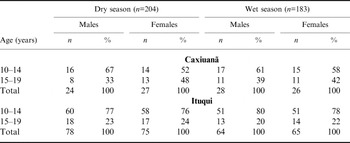
The 247 adolescents included in the study ranged from 10 to 19 years of age. In the dry season, 204 adolescents were evaluated, of which 51 (25%) lived in Caxiuanã and 153 (75%) lived on Ituqui Island. In the wet season, 183 adolescents were examined: 54 (30%) were from Caxiuanã and 129 (70%) from Ituqui (Table 1). There were no statistically significant differences in the distribution according to age groups and sex between dry and wet seasons within the locations. Nevertheless, proportions of females according to age groups were different between Caxiuanã and Ituqui in both seasons (dry season p=0.01; wet season p=0.04; χ 2 test) (Table 1).
Characterization of the Caboclo sample according to place of residence and season, Brazilian Amazon, 1996–97

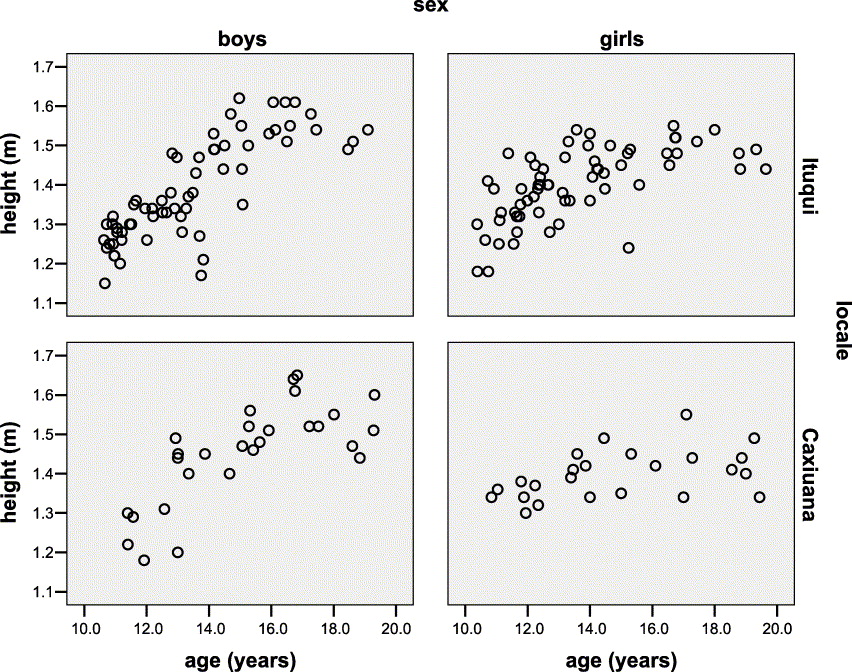
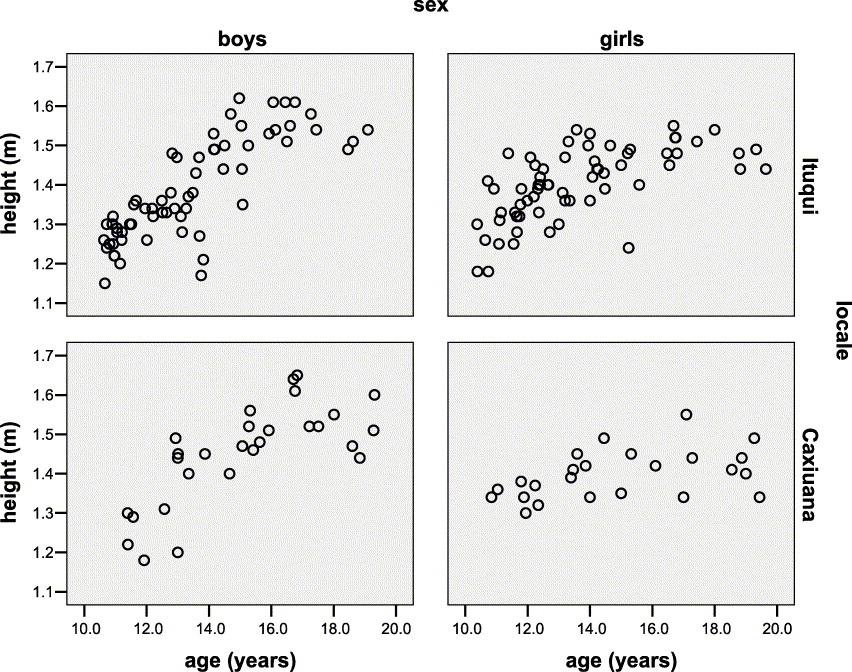
The distribution of stature according to sex, age group and place of residence is shown in Fig. 1. As expected, stature increases with age. However, the increase is slightly higher for boys than girls, and for Ituqui than for Caxiuanã.
Scatter plots of boys and girls of the two populations showing differential increase in stature with age between sexes and places of residence.
In the dry season sample, girls from Caxiuanã (mean=15.2 years; standard deviation (SD)=3.3) were significantly older than those from Ituqui (mean =13.3 years; SD=2.6) (t-test p=0.013), but there were no significant differences in the boys' mean ages in this season. On the other hand, in the wet season, boys from Caxiuanã (mean =14.5 years; SD=2.5) were significantly older than boys from Ituqui (mean =13.0 years; SD=2.4) (p=0.012), but the difference for girls was not statistically significant (results not shown). As Caboclo adolescents are usually very shy, these differences represent simply the availability of volunteer youths to participate in the study during the period of data gathering in the field. Older adolescents are very difficult to include in these studies as they literally run away when called since, besides being naturally shy, they often do not perceive themselves as being in need of any health service or information and fear becoming the object of jokes by their peers. The statistical procedures used took into account these differences when dealing with comparisons between groups.
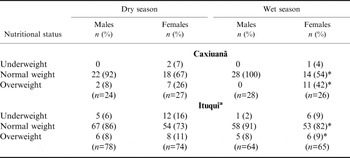
Comparing the proportions of underweight, normal weight and overweight did not show significant differences according to season within each area, not even for overweight among Caxiuanã girls, which increased from 26% to 42% between the two measurements (p>0.05). Comparing these proportions between the two areas, girls from Caxiuanã presented higher prevalence of overweight than those from Ituqui, although statistically significant difference was only observed for the wet season (42% vs 9%; p<0.01). Underweight prevalence varied from 4% (Caxiuanã, wet season) to 16% (Ituqui, dry season), with the proportion of underweight girls being consistently higher than that of boys (Table 2).
Distribution of Caboclo adolescents according to nutritional status, season, place of residence and sex, Brazilian Amazon, 1996–97

a Loss the stature data for one girl in the dry season.
* The proportions of normal weight and overweight girls during the wet season were significantly (p<0.01) different between Caxiuanã and Ituqui (χ2 test for proportions; Fisher's exact test for overweight comparisons).
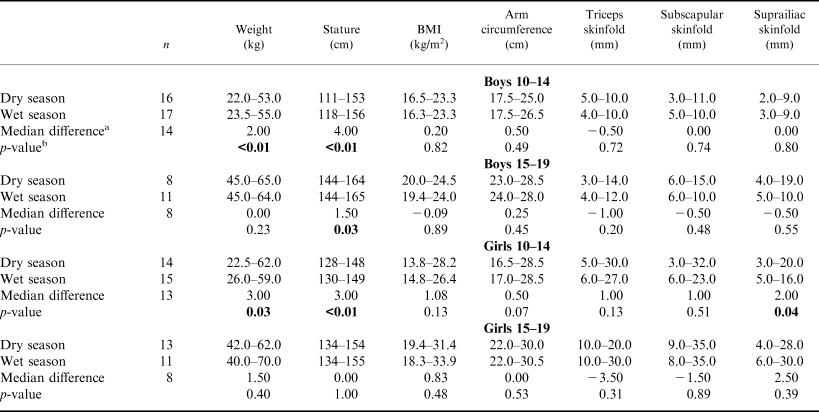
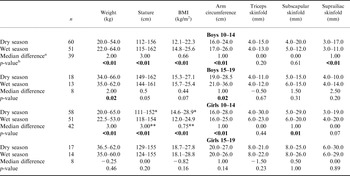
Tables 3 and 4 present the range (minimum and maximum values) and the median differences of the anthropometric measurements, according to place of residence, sex, age group and season. In both the forest and the floodplain areas there were no statistically significant differences in the anthropometric measurements of the 15- to 19-year-old girls between the seasons. It is noteworthy that the BMI of 15- to 19-year-old girls from Caxiuanã reached values over 30 kg/m2, while in Ituqui the highest BMI was 28.9 (Table 3). Among the sampled boys there was no BMI above 27.1 (Tables 3 and 4). In Caxiuanã, the weight of boys and girls from 10 to 14 years old varied positively between the 8 months that separated the two measurements; in the girls the suprailiac skinfold also increased. For the 15- to 19-year-old boys, besides stature, no other variable presented statistically significant differences between the seasons (Table 3).
Range (minimum and maximum values) and median differences of anthropometric measurements taken in dry and wet seasons from Amazonian Caboclo adolescents (10–19 years old) living in the Caxiuanã area (black water ecosystem) according to sex and age group, 1996–97
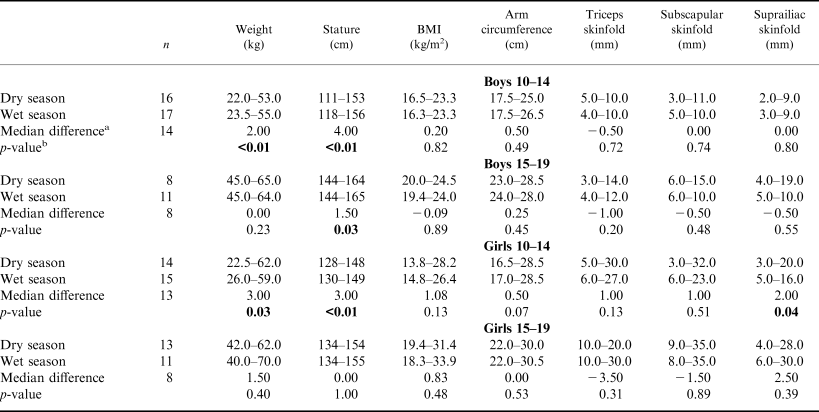
a Median difference: wet season minus dry season; the ‘n’ corresponds to the number of boys and girls that had the anthropometric measurements taken on both occasions.
b p-value refers to Wilcoxon's signed rank test for the differences between measurements taken in dry and wet seasons.
Range (minimum and maximum values) and median differences of anthropometric measurements taken in dry and wet seasons from Amazonian Caboclo adolescents (10–19 years old) living in the Ituqui area (white water ecosystem) according to sex and age group, 1996–97

a Median difference: wet season minus dry season; the ‘n’ corresponds to the number of boys and girls that had the anthropometric measurements taken on both occasions.
b p-value refers to Wilcoxon's signed rank test.
* n=57;
** n=41.
In Ituqui, 10- to 14-year-old boys and girls presented statistically significant differences between the measurements of stature, weight, BMI and arm circumference taken in the dry season and the ones taken 6 months later. In the wet season the boys showed a significant increment in the suprailiac skinfold, and the girls, in the subscapular skinfold. Among boys from 15 to 19 years of age, the weight and arm circumference were significantly higher for the measurements done in the wet season compared with those done in the dry season (Table 4).
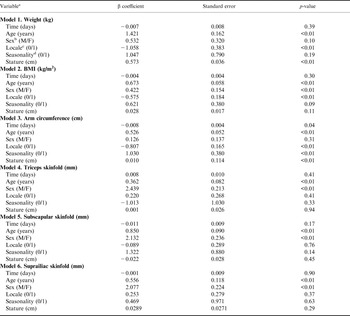
Table 5 presents the results of the final longitudinal linear regression models for each one of the six dependent variables analysed. As expected, there was a general effect of age and sex on skinfolds, and girls had larger increments in these measurements than boys. Weight was influenced by age, place of residence (Caxiuanã adolescents presented higher increase in weight than those from Ituqui) and, as expected, variation in stature. BMI was affected by age, sex (girls have greater increase) and place of residence (the variation was higher in Caxiuanã). Arm circumference was affected by the majority of variables analysed and increased between the dry and wet seasons (β=1.03 cm; p<0.01). The variation between these measurements was smaller in Ituqui than in Caxiuanã, and increased with age and variation in stature.
Longitudinal linear regression models for anthropometric variables, Brazilian Amazon, 1996–97

a 389 observations for 247 groups.
b Sex: 0 Male (M), 1 Female (F).
c 0 Caxiuanã, 1 Ituqui.
d 0 dry season, 1 wet season.
Discussion and Conclusions
This study presents epidemiological data bringing evidence of malnutrition among rural Amazonian adolescents, which is likely to be associated with environmental and socioeconomic constraints currently experienced by the Caboclos. Analysis by season shows that in the dry period the prevalence of underweight was significant, particularly among the females from the white water and floodplain ecosystem (up to 16%); among the girls of the black water and forest ecosystem, the prevalence of overweight was markedly high in both seasons (26% in the dry season and 42% in the wet season); none of the boys investigated was obese while some girls presented BMIs above 30, a finding of public health concern.
The increment in the anthropometric measurements between the two periods of data collection was mainly observed in individuals under the age of 15 years in both places, which could be associated with faster overall growth during this period of life. After considering the effect of age, sex, place of residence, season and stature, it was observed that the arm circumference increased significantly between the dry and wet seasons, but this variation was less pronounced in the floodplain group. In this case, arm circumference showed higher sensitivity to seasonal changes, regardless of age groups, than the skinfolds.
The tendency towards overweight observed among the Caboclo adolescents sampled is in accordance with the national and international surveys (WHO, 2005; Popkin, Reference Popkin2007), and in agreement with other studies, which have shown an increase in prevalence of overweight in adolescents from some rural groups in Brazil (Dutra et al., Reference Dutra, Araújo and Bertoldi2006; Leite et al., Reference Leite, Santos and Coimbra2007; Sampei et al., Reference Sampei, Canó, Fagundes, Lima, Rodrigues, Sigulem and Baruzzi2007). This should serve as an alert for the possible effects of poor economic and socio-ecologic conditions in the development of overweight/obesity and associated diseases later in life (Ziol-Guest et al., Reference Ziol-Guest, Duncan and Kalil2009). The higher prevalence of overweight among the Caxiuanã girls is a novel and worrisome finding considering that they live in a relatively isolated rural region and their subsistence pattern is more traditional than that of the Ituqui population (Silva, Reference Silva2001).
The importance of following up the nutritional and health status of Amazon riverine adolescents is evident particularly in view of the fast changes taking place in the area, bringing in novel circumstances to the traditional populations, including new dietary practices, working habits and transformed socioeconomic environments (Silva et al., Reference Silva, James and Crews2006; Piperata, Reference Piperata2007), which might have serious repercussions in their development, metabolism and health.
Previous anthropometric studies of children and adults from Caxiuanã and Ituqui (Silva & Crews, Reference Silva and Crews2006; Silva et al., Reference Silva, James and Crews2006; Silva, Reference Silva, Adams, Murrieta, Neves and Harris2009) have shown different patterns of nutritional status from those observed in the adolescents. In the studies related to children and adults, the Caxiuanã population presented more nutritional distress than the Ituqui group. Even though the participants represent a large percentage of the teenage population in both areas, it is possible that some selection bias has occurred in the sample studied since the overall sample size at Caxiuanã is small and the sample loss between seasons was higher in adolescents than among children and adults as the adolescents are usually shy. Also, different timings in the sexual maturation process might contribute to the observed differences between adolescents from Caxiuanã and Ituqui, since the mean ages were significantly distinct between the adolescents of the two study areas and it was not possible to conduct a pubertal age investigation.
Another potential limitation of this study is the fact that adolescent growth and nutritional characteristics are more difficult to analyse and interpret than those of children or adults due to the onset of puberty and the accompanying physiological changes which greatly influence their body habitus (Heald, Reference Heald1985; Cameron, Reference Cameron2007). This study did not collect information on the adolescents' sexual maturation because it is not feasible to use the Tanner criteria to identify sexual maturation status in the field. Recording of the Tanner criteria would be interpreted as an invasive procedure among these rural groups. To minimize the effect of body transformations due to puberty, the multivariate analyses were adjusted by age, time elapsed between visits, and stature variation between the measurements.
On the other hand, Wirsing (Reference Wirsing1985) points out that women react to social and environmental changes faster than men, gaining more fat. In spite of triggering poor health effects later in life this phenomenon can be adaptively important in situations of high insecurity/instability such as fast ‘acculturation’ or intense westernization pressures, where there is a rapid process of nutritional transition, as is happening in the Amazon (Piperata, Reference Piperata2007; Lourenço et al., Reference Lourenço, Santos, Orellana and Coimbra2008). In an uncertain environment, faster fat gain in girls may lead to earlier menarche and hence earlier reproduction, which could represent an adaptive advantage, at least in the past when there were no government assistance programmes, life expectancy was low and food instability was the norm.
Despite the worldwide rising interest in nutritional diseases of children and adolescents (Wang et al., Reference Wang, Monteiro and Popkin2002; Zambon et al., Reference Zambon, Antonio, Mendes and Barros Filho2008), adolescence has not been considered a priority for nutritional investigation and intervention (WHO, 2005). Adolescents represent an important part of the Brazilian population for whom information on nutritional conditions is still limited, particularly in regards to Amazon groups, including the Caboclos, the Quilombolas and other vulnerable rural populations who have not been consistently sampled in the national households surveys (IBGE, 2006). Even though the data were gathered over a decade ago, this paper is the first to analyse anthropometric measurements and nutritional status of Caboclo adolescents living in the wet and dry seasons of two different areas of the Brazilian Amazon. Despite some limitations, the results should be useful for monitoring the nutritional situation of riverine groups from Pará and other Amazon areas.
Finally, as the subsistence scenario in the Amazon is extremely complex, the findings presented here also pose some questions related to different environmental and socioeconomic conditions to which the two groups are submitted. The Ituqui population, in spite of having more access to Western goods and services, suffers the effect of seasonality more intensely than Caxiuanã, even though the white water ecosystems are considered ecologically richer than the black water ecosystems (Morán, Reference Morán1991). Since the island becomes almost totally flooded in the rainy season, during this period the diet is mainly constituted of items bought in the local markets. Therefore access to food is more dependent on monetary income, which is limited and irregular in this population (Murrieta et al., Reference Murrieta, Bakri, Adams, Oliveira and Strumpf2008). In Caxiuanã, the environment is more stable throughout the year, but it is poorer in terms of natural resources and the socioeconomic conditions of the population are more precarious, yet the girls sampled presented higher adiposity than the girls from Ituqui. This study showed that both environment and seasonality play an important role on the nutritional status of the Caboclo, therefore, it is relevant to consider these conditions when conducting nutritional surveys and developing public health policies in the Amazon region.
Acknowledgments
This research could not have been completed without the collaboration of the communities of Caxiuanã and of the Ituqui Island, the Museu Paraense Emìlio Goeldi (MPEG), the Brazilian Institute of the Environment and Natural Resources (IBAMA), the Projeto Várzea/UFPA/IPAM and many individuals who collaborated during fieldwork and data analysis. HPS thanks especially Dr Douglas E. Crews, Dr Frank Poirier, the Department of Anthropology of the Ohio State University, and CNPq/Brazil for support during his graduate studies. G. Kac and G. Veiga are CNPq research fellows. The authors acknowledge the work of Camilla Medeiros Macedo da Rocha in supporting in data file management and analysis, and the anonymous reviewers for their insightful comments.