INTRODUCTION
The starting point for this paper was a reflection on the “radiocarbon revolutions” and the implications they have had on archaeological narratives generally, and studies of Neolithic material culture in Britain specifically. There have been at least four radiocarbon (14C) “revolutions”: the introduction of the method, the recognition of the need for calibration, the reduction in sample size facilitated by accelerator mass spectrometry, and Bayesian statistical analysis of radiocarbon measurements (Bronk Ramsey Reference Bronk Ramsey2008; Bayliss Reference Bayliss2009). The recent application of Bayesian modeling to Neolithic prehistory in Britain and Ireland has led to a significant leap forward in understandings (e.g. Whittle et al. Reference Whittle, Healy and Bayliss2011; Whitehouse et al. Reference Whitehouse, Schulting, McClatchie, Barratt, McLaughlin, Bogaard, Colledge, Marchant, Gaffrey and Bunting2014), however beyond the development of more precise chronologies I argue that the introduction of Bayesian modeling has wide ranging importance for the kinds of archaeology that we write. Two reactions to the introduction of radiocarbon dating—those of David Clarke and Colin Renfrew—are particularly relevant for current archaeological practice in the light of the “Bayesian revolution.”
I suggest that the logical repercussions of the Bayesian revolution have not yet been fully worked through by many in the archaeological community, and the use of Bayesian analyses has wider significance for the kinds of archaeologies we write. Specifically, I argue that aspects of prehistory in Britain maintains a culture historic approach, decades after the rejection of Childe’s model (see Thomas Reference Thomas1996, 1997), with archaeological evidence reified into chronologically and culture historically predefined entities divorced from the material basis. The result is that the narratives that we generate adopt what Thomas (Reference Thomas1996) describes as a totalizing or idealized nature, which are not as sophisticated as they might be.
DESCRIPTIVE BACKGROUND
Dating the Neolithic of Ireland and Britain
Recent research into Neolithic Britain and Ireland (Whittle et al. Reference Whittle, Healy and Bayliss2011; Whitehouse et al. Reference Whitehouse, Schulting, McClatchie, Barratt, McLaughlin, Bogaard, Colledge, Marchant, Gaffrey and Bunting2014) has provided precise, robust and probabilistic chronologies for an area of prehistory that previously was described in only the most imprecise chronological schemes. At the general national scale, it has provided an appreciation of the tempo of changes in material culture and site types that was wholly absent before the application of Bayesian analyses. At the regional scale, fine-grained chronology allows us new understandings of the context of change. This has included for example the demonstration for the first time of chronological overlap between people using hunter-gatherer-fisher Mesolithic material culture and people engaging with Neolithic farming strategies in the same landscapes (Griffiths Reference Griffiths2014a, Reference Griffiths2014b), and has identified regions where processes of neolithization were more complex than are previously recognized (Griffiths Reference Griffiths2016).
The implications of the application of Bayesian modeling in Neolithic studies can be directly compared to the responses to the development of the radiocarbon technique in the mid-20th century, which noted Neolithic scholar Glyn Daniel (Daniel Reference Daniel1986) declared the greatest breakthrough in the history of archaeology. The initial application of 14C rendered null-and-void diffusionist theses about the development of northwestern European Neolithic tombs from Mediterranean examples (see Daniel Reference Daniel1941, Reference Daniel1970), and was revelatory in demonstrating the antiquity of sites. The impact was so profound that some intial measurements were regarded with suspicion; the eminent prehistorian Stuart Piggott famously declared the emerging prehistoric chronology for the Stonehenge landscape as “archaeologically unacceptable” (Piggott Reference Piggott1959:289).
The revised “long chronology” for the British Neolithic that 14C produced challenged both the causal processes (the diffusion model of British Neolithic monuments from the Mediterranean) and the narrative structure (the duration of prehistory), which provided the organizational structure for previous archaeological thought. Archaeological data—observations about stratigraphic relationships, schemes of material culture, isotopic measurements on organic materials and so on—are always heavily enmeshed in the context in which knowledge is produced; the reordering of prehistory using radiocarbon data provided independent means of assessing the magnitude of our situated approach to our knowledge production.
Scientific Dating and Theory
The context of the first and second radiocarbon revolutions was one of change in archaeological theory in the mid-20th century, occurring at the disjunction between “Culture History” archaeological approaches and “New” or “Processual” archaeological approaches (Trigger Reference Trigger2006; Johnson Reference Johnson1999). Calibrated 14C dates were at the vanguard of archaeological approaches which emphasized the discipline as science. In Britain, the reactions of two Cambridge scholars—Colin Renfrew and David Clarke, both proponents of “Processual” or “New” approaches (Daniel Reference Daniel1981:192)—to radiocarbon have important implications for the discipline in the light of the “Bayesian revolution.”
Beyond the classification of Renfrew and Clarke as “New” archaeologists, I believe it is possible to identify wider themes in their reactions and approaches with reference to Enlightenment and Romantic histories of intellectual thought (Sherratt Reference Sherratt1996:141). These two personalities responded in markedly different ways, with subtle distinctions in emphasis. Both these scholars were interested in the role of “Science” in archaeology, but also—in different ways—in “Revolutions” in intellectual thought and archaeological understandings.
Colin Renfrew produced his Neolithic Investigations in Orkney in Reference Renfrew1979. Renfrew’s work emphasized the importance of writing generally about the process of constructing Neolithic monuments, and his interest in providing sequence and order using 14C data privileged the standard application of the technique. Onto these data Renfrew hung a model of social change from a territory-based, segmentary society to a centralized chiefdom society with associated changes in material culture. Renfrew worked from chronological sequence, to causality, narrative, and interpretation, emphasizing the importance of data. In another key work Renfrew outlined the belief at the time that “all that was needed was a couple of ounces of charcoal... and science would do the rest…” (Renfrew Reference Renfrew1976:53; author’s emphasis). Renfrew’s chronologies were by no means as precise as those now available for certain periods through Bayesian modeling, but the impact of sequence especially on understanding was comparable to the recent changes in British and Irish Neolithic studies.
A couple of years before Renfrew’s review of the role of 14C in archaeology, a very different emphasis was outlined by David Clarke. Clarke published his paper on the loss of intellectual innocence, noting that the “chronological consequences of isotope and other dating methods... have infiltrated archaeological thinking in a manner which has largely concealed the significance of their repercussions” (Clarke Reference Clarke1973:10; author’s emphasis). What Clarke recognized, among other things, were the challenges these new chronologies presented to archaeological practice, not simply in terms of accounting for a better ordered sequence of events, but in how to situate these new data within received models of the past, and moreover whether received models were appropriate settings: the structure of archaeological knowledge. Clarke noted the inherently situated nature of archaeological temporal models, and the importance of chronology as loaded and subjective interpretations even if they may appear to be neutral and unbiased. In Clarke’s (Reference Clarke1973:10; author’s emphasis) words:
Under the ultra-short chronologies, archaeological time was confused with historical time and seemed packed with data and events; large-scale phenomena appeared to take place in swift interludes—hence the prevalence of “invasion” explanations... A fundamental lesson emerges—the consequences arising from the introduction of new methodologies are of far greater significance than the new introductions themselves... The first thing we may deduce from this revision is that many of our taxonomic entity divisions are defined by lines drawn through gaps in the evidence and zones of greatest ignorance; this does not make these taxa invalid but it does gravely alter what constitutes meaningful manipulation and explanation of such entities.
Clarke’s key observation is that archaeological chronologies are not composed of neutral “facts.” The seemingly benign sequences, which we seek to populate with data, are charged with interpretative value, they structure our thinking. This can be seen at its most obvious in a brief comparison of analytical concepts in prehistory. For example, the term “Neolithic” was first coined by John Lubbock (Reference Lubbock1865:3), who distinguished between Neolithic polished stone tools and Paleolithic implements. V G Childe (Reference Childe1940) identified the Neolithic by the radical (revolutionary) break in economic or subsistence modes from hunter-gatherer ways of life. Piggott (Reference Piggott1954) populated the Neolithic with a series of “cultures” indicative of different origins, and which changed over time. Key to all these theses was the basis of classification, in Clarke’s terms the taxonomy of the material under study. The definition of this term changes but the concept as analytical unit is enough to continue as chronological entity.
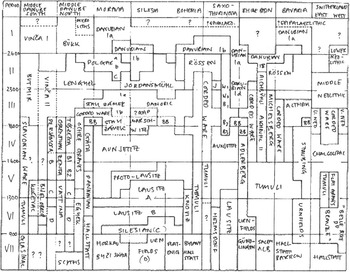
Childe’s mastery of the discipline was in part because he was able to synthesize a wide range of evidence from across Europe into clearly defined tables or models of cultures (Figure 1). This clarity comes from drawing lines through evidence, of defining and domesticating it, and of doing away with ambiguity. As Andrew Sherratt (Reference Sherratt1996) noted, in 1938 Childe actually had two schemes for European Neolithic material culture, the one suggesting that European evidence predated Near Eastern examples was rejected because “European cultures were always retarded in relation to Near Eastern ones... Thus his chronology was already implicit in his choice of model” (Sherratt Reference Sherratt1996:181; author’s emphasis). But of course Childe’s systemization of European prehistory also codified it (Sherratt Reference Sherratt1979:198).
One of Childe’s (Reference Childe1929) models of the organization of cultures in time and space. The ways the iconic models can structure archaeological interpretations were noted by Clarke.

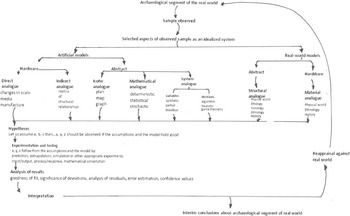
In 1972, Clarke discussed the roles of models in archaeological thinking. At the broadest level, he differentiated between “operational” and “controlling” models. Operational models are those conceptual tools we employ in interpretations of archaeological data. The largely subconscious controlling models are those that are accumulated over time and which reflect personal approaches and predispositions, but which owe much to the prevailing intellectual approaches of the time. Clarke (Reference Clarke1972:5; see Lucas Reference Lucas2016) defined controlling models with reference to Kuhnian paradigms, “encapsulating” archaeologists within our operational practices. Within Clarke’s operational class is a whole subset of models (Figure 2) that should allow archaeological practice to test hypotheses. Some of these operational models can have profound implications, challenging the legitimacy of controlling models (in Clarke’s terms), or paradigms (see Lucas Reference Lucas2016); this can be seen for example in the use of ethnographic analogies and challenges to the fundamental approaches to interpretation which occurred as part of the Binford-Bordes Mousterian debate (Binford Reference Binford1972). As Clarke notes (Reference Clarke1972:40), this has epistemological implications for the remit of archaeological interpretation—“the overwhelming justification for the need to explore rather than ignore the use of models in archaeology” (Clarke Reference Clarke1972:40; author’s emphasis).
Clarke’s (Reference Clarke1972) taxonomy of archaeological models, including the identification of representations of the distribution of archaeological evidence in of time and space (plans, maps, graphs and so on) as iconic analogues, designed as frames to test relationships.

Within Clarke’s operational models, it is possible to identify model types from those that Orton (Reference Orton2004) defined as simplifications of physical entities (such as Harris matrices) to those providing much broader representations of social organization. Operational models may have different characteristics—the degree of abstraction or inclusion of “real life” evidence, but they are unified in that they should be used as devices to interrogate evidence (Figure 2). Within these models are Clarke’s “iconic analogues,” a class which includes plans, maps and graphs. These might seem to be simple abstractions of physical entities. However, because of their effectiveness and pervasiveness as abstractions, such models can become “of the thing themselves.” As iconic analogues, these devices can take on a tangible reality; in the most dangerous cases archaeological interpretative constructs can become mistaken for the objects of inquiry.
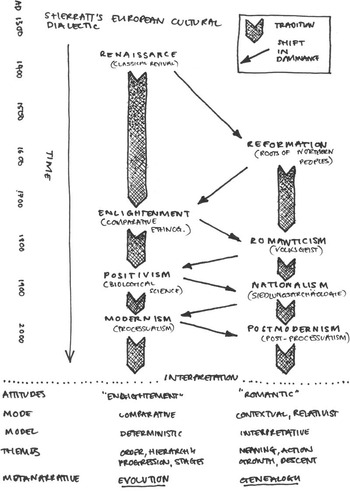
In Renfrew’s response, which focuses on the ordering aspects of 14C data and emphasis on the collection of data, I believe we can see more “Enlightenment” tendencies (in Sherratt’s model). In Clarke’s response, I believe we see an emphasis on the relative, contextual nature of the production of knowledge that in Sherratt’s terms cast Clarke as a Romantic (Figure 3).
Sherratt’s (Reference Sherratt1996) model of the development of intellectual thought. Romantic, contextual aspects can be seen in Clarke’s responses to the first two radiocarbon revolutions, and ordered, comparative aspects can be seen in Renfrew’s responses to the same changes.

I suggest that many chronological models can be classed as Clarke’s iconic analogues (Figure 2). They are representations of time and space, with time and space scales on which to sit our data. Sometimes in chronological models archaeologists mistake the scales for what is being measured; a radiocarbon “date” has no inherent temporal quality, it is a measurement. As Clarke (Reference Clarke1972:13) noted, time and space “exist because of the observed phenomena and not vice versa...”. Everything else—all the variability in the distribution of material in time and space—is just “culture,” or a filtering of the distribution of material by cultural processes. Material culture only works as a unit of study—as things to research and find out more about—if “culture” is not defined dependent on its position in time or space. If culture is defined as “period” then there is a logical fallacy. If we seek to explore change, like the transition from one way of life to another, but we predetermine that one form of activity occurs during one time period and another form of activity occurs in a later time period, then we will automatically predetermine the output of our investigation. This tension between the analytical categories we employ and the units of measurement is a conceptual one, not a clash of chronological systems (pace Lucas Reference Lucas2005:9; see Griffiths in prep.).
In many cases our “neutral” models of the past structure a unidirectional, linear, teleological approach to writing archaeological narratives. Ultimately these neutral and routine ways of modeling “culture” derive from understandings of typology as part of the Three Age system (e.g. Montelius Reference Montelius1899; see Gräslund Reference Gräslund1987), reified and domesticated by the Culture Historians of the 19th and 20th centuries. While the interpretive aspects of the section drawing, context descriptions, and stratigraphic matrices have been recognized as part of the practice of doing archaeology (e.g. Patrick 1985), the important, latent, and structuring aspects of how we model activity over time has been under recognized. The pervasiveness of these models means that the period construct of culture (“the Neolithic”) has become an intellectually constructed “truth” that exists across schools or thought of paradigms.
Lucas (Reference Lucas2016:7) has suggested that in archaeology, classifications or typologies are paradigmatic, with the “Neolithic” as a symbolic generalization or paradigm. I would suggest that the idea that we have an ability to systematize material culture into historically successive entities represents the more significant controlling model or paradigm. At its most extreme, chronologically defined cultural successive models are incommensurate with narratives of transition, or overlap between these entities; models of period-defined cultural change—which should be explicitly acknowledged as theoretical constructs—in fact assume an orthodoxy so powerful as to exist as facts that overarch changes even between supposedly radically different archaeological schools of thought.
WRITING ABOUT TIME: A BRITISH NEOLITHIC CASE STUDY
It was not very long ago that discussions of the Irish and British late Mesolithic and early Neolithic described the timing of the transition in relatively abstract terms—using phrases like “a couple of hundred years,” “the early 4th millennium,” “the first centuries of the 4th millennium” and so on. Now, thanks to the work of Alasdair Whittle, Alex Bayliss, Frances Healy, Nicki Whitehouse, Rick Schulting and others, we know that the appearance of Neolithic material culture and practices in Britain and Ireland had a very specific trajectory, tempo and timing.
How much do these new data and interpretations challenge our pre-existing models? In Clarke’s terms are we actually testing our iconic analogues with these new data? In Ireland and Britain much has been made of the apparent distinction between Mesolithic and Neolithic evidence. In discussion of the changes, Julian Thomas writes that the “cultural change that took place around 4000 cal BC was apparently both swift and thorough, there being no mixed assemblages combining pottery with microliths...” (Thomas Reference Thomas2007:426; author’s emphasis). The obvious corollary would follow Clarke in asking: do our models of periodized, successive cultures allow us to explore what contact between people using “Mesolithic” and “Neolithic” things might mean in terms of evidence documented from the archaeological record?
In Wylie’s (Reference Wylie1989) terms, I argue that at least in British Neolithic studies, our observations have become highly theory-laden, with the informative impacts of our concepts of “Neolithic” on our observations under-recognized. Or do we expect forms of evidence to satisfy preconceived notions of what societies were like and how change would appear in “the archaeological record” (see Patrik Reference Patrik1985)? It seems unlikely that we will find archaeological assemblages which match preconceived period-defined criteria, and this approach runs the risk of missing potential subtleties in assemblages which are available to us for study (see Brophy Reference Brophy2004).
Rather than defining the “Neolithic”—or other “cultural” entities as proper nouns—as things that we can find in the archaeological record, we should see better regard these as adjectives, as attributes which describe evidence (e.g. mesolithic). Our analytical categories will never be sufficient to produce accurate impressions of the past, but by destabilizing the nature of these cultural concepts as things we can actually “find”, we might better remind ourselves of the narrative impacts which our epistemology can have.
A couple of case studies serve to highlight the tensions between the approaches to prehistoric analytical categories, models of change and evidence provided by recent developments in chronological precision. At sites such as Holbeck Park, Cumbria, UK, “Neolithic” pottery, polished stone axe flakes, and domesticated cereals were recovered from a treethrow along with a “Mesolithic” rod microlith stone tool (see Griffiths Reference Griffiths2011). Four statistically consistent earlier fourth millennium radiocarbon results (Ward and Wilson Reference Ward and Wilson1978; T’=1.0; T’5%=7.8; df=3; 3960–3780 cal BC SUERC-10772; 3950–3710 cal BC SUERC-10773; 3960–3770 cal BC SUERC-10777; 3960–3780 cal BC SUERC-10778; 95% confidence) were produced on single-entity, short-lived, charred plant remains including a cereal grain from the feature. These measurements could be consistent with late “Mesolithic” or early “Neolithic” presence in the region. Several interpretations of the processes by which the assemblage was formed can be made; the taphonomy of the material in the treethrow could be complex. Even if the use of the pottery, the other early Neolithic material culture, and the rod microlith are not demonstrably contemporaneous, this deposit suggests the potential for closely related practices at this time and in this part of the world. The presence of terminal Mesolithic and early Neolithic material culture within a treethrow is consistent with a pattern of continuity of practice between groups using these material culture types in other parts of the country (see Evans et al. Reference Evans, Pollard and Knight1999; Barclay Reference Barclay2000; Lamdin-Whymark Reference Lamdin-Whymark2008).
Arguably this is the “moment” of transition. This is the smoking gun. Not the one that we might expect, but a co-presence in the landscape which is part of the processes of social change which archaeologists are meant to be investigating. If our “neutral” Culture History-derived models structure our thinking in such a directional, linear and teleological manner that everywhere in Britain all “Mesolithic” practices proceed all “Neolithic” ones, then they are not very neutral. Whichever process(es) resulted in the formation of the fills of the Holbeck Park feature our pre-existing models of sequential “Mesolithic” and “Neolithic” cultures seem unlikely to unpick them. In this case, “cultures” have become defined as materially-fixed metaphysical entities.
In Yorkshire and Humberside, UK, recent analysis of the available chronological evidence for late Mesolithic and early Neolithic activity has demonstrated that people used “Mesolithic” hunter-gatherer-fisher material culture at the same times as “Neolithic” people farmed and built monuments (Griffiths Reference Griffiths2014a, Reference Griffiths2014b). There may be some spatial variation between these practices, with people using Mesolithic microlith technology present in the Pennine uplands to the west of the region, and people using domesticated plant and animal resources, pottery, polished stone axes, and building monuments to east of the region. Or there may be preservation or excavation bias. The presence of late Mesolithic material at uplands sites such as March Hill and South Haw (Griffiths Reference Griffiths2014a) represent the foci for repeated activity over hundreds of years (based on analysis of radiocarbon dates and lithic typologies). Whatever narrative we provide, in the 39th and 38th centuries cal BC in this part of England people were engaging with these different practices at the same time; there is not necessarily a universal, totalizing, culturally directional sequence. A model that fixed “cultures” as chronologically defined metaphysical entities will not enable us to engage with the social processes resulting in this patterning in time and space.
These examples suggest that a model of sequential, linear “cultural” development may not be the most sophisticated rendering of the available archaeological evidence; the emerging picture is more complex. British Mesolithic/Neolithic studies have previously not had sufficiently precise or robust chronologies to require the reconciliation of evidence for overlap between different lifeways. So while considerable ink has been spilt over the British Mesolithic-Neolithic transition (e.g. Thomas Reference Thomas2013; Sheridan Reference Sheridan2010 and references therein), and some of these treatments have suggested roles for “Mesolithic people” in the adoptions of farming and “Neolithic” practices, most of these latently conceive of the start of the Neolithic as the same as the end of the Mesolithic. I argue this is in part a result of iconic analogues becoming the “controlling” models which structure the kinds of questions archaeologists can envisage asking of the data.
DISCUSSION
The history of archaeological thought is often taught and written as a series of intellectual schools, which successively replaced each other, moving from Culture History, to Processual or New archaeology, to Post-processual archaeology and so on, much like the tradition of Culture History successions. This approach is necessarily simplistic, doing much to write out the personalities, subtleties, tensions, and cognitive dissonance that can exist in intellectual approaches at any point in time. As well as the perceived trends in archaeological theory, I think it is instructive in this example to think about the swings in intellectual approaches, or what Sherratt (Reference Sherratt1996) presented as a dialectic intellectual history (Figure 3). By returning to both the responses of Clarke and Renfrew to their radiocarbon revolutions we can highlight the importance of the scientific and sequenced aspects of Renfrew’s Enlightened archaeology response, and Clarke’s emphasis on the Romantic, relative, interpretive structuring context in which radiocarbon data should be studied.
The real impact of the latest radiocarbon revolution should not only be the exciting, fine-grained, new chronologies, but the recognition that the use of period-defined nomenclature significantly frames and situates our interpretations. Recent developments in chronological precision throw into stark relief the pervasive nature of the existing “controlling” model of sequential change between “cultures”. In this world, models that employ chronologically successive Culture History concepts singularly limit our ability to write contextual, interpretative and reflective prehistoric narratives; we need to recognize the revolutionary implications not only of the increased precision from the Bayesian revolution, but also the importance of the context in which we write our narratives.
Employing period-specific taxonomic models of culture within a linear, sequential narrative of social change has a tendency to collapse time in a quest for simple narrative structure. Terms such as “Mesolithic” are not neutral when employed in a chronologically successive model; they are parts of an iconic analogue for how we understand societies and the nature of change over time. By glossing variability in the archaeological record, we risk abstracting time, reifying change into binary flips between binary lifeways, and imposing predetermined archaeological concepts onto myriad material evidence. If we can emphasize archaeological analytical terms as constructs—inventions of the late 20th century to paraphrase Mark Pluciennik (Reference Pluciennik2014)—and use them as heuristic devises or iconic analogues that we test explicitly, we stand a chance of not mistaking our models for data. As Wylie (Reference Wylie1989:10) notes, our idea of Neolithic culture and its temporal and spatial constitution needs to allow the potential for revision. Archaeological theories of time that represents it as linear, directional, and above all teleological are ones in which abstraction provides a means to move beyond the analytical scales of the specific (for example the site) and towards the generalizing, totalizing narrative (see Thomas Reference Thomas1996). But this comes at a cost. While we might regard our periodization models as empty of narrative content and devoid of any specific meaning this is not the case if our “periods” are cultural, and linear, and successive (see Lucas Reference Lucas2005:50).
In the light of this radiocarbon revolution we would do well to return to Clarke’s discussion of the implications of scientific dating revolutions. As Clarke noted, there exists “a class of problems… which cannot be explained in [a] system’s current form and we therefore move to new languages and new disciplinary systems not only to answer former questions which could not be answered but also to abandon former questions and answers which had no meaning” (Clarke Reference Clarke1973:17; author’s emphasis).
CONCLUSION
By discussing the context of earlier radiocarbon revolutions I hope to have demonstrated that there are wider-ranging implications of the Bayesian revolution beyond the construction of newly precise chronologies, and that these have direct bearing on the kinds of archaeological narratives we write and the kinds of causal models we are able to marshal. For this latest Bayesian radiocarbon revolution to have its full impact on archaeological practice, the rigor of the New chronological comparative order needs to be married with a Romantic reflection on the relative, interpretative contexts in which these data are analyzed. We need models of prehistory that are accurate and precise, with interpretive understandings of material culture and the nature of our construction of knowledge. We need, in short, to be a little more New Romantic in our approaches.
ACKNOWLEDGMENTS
This paper developed out of my post-doctoral research, following my PhD, which was supervised by Professors Alex Bayliss and Alasdair Whittle. Two archaeologists who sadly passed away in 2016, Alan Saville and Mark Pluccenick, were extremely generous to me during this period and this paper is dedicated to their insight and kindness. Two anonymous reviewers are thanked for their comments.