As various scholars acknowledge, the literature on political party organization is deeply divided over how to explain processes of party formation and change.Footnote 2 Ultimately, as van Biezen points out, the conflict between the different approaches stems from disagreement over the question of ‘how much structure actually matters and how much room it leaves for parties as active agents’.Footnote 3
Theories that emphasize structure to account for different forms of party organization focus on either party internal or party external factors, or on a combination of the two.Footnote 4 The ‘life-cycle’ approach conceives party formation and adaptation as an endogenous process of maturation that will always unfold in the same way. In contrast, the ‘period-effect’ approach gives attention to external factors only, arguing that parties in the same environment will have to adopt the same type of organization to compete successfully with other parties. The third structuralist approach, the ‘generation-effect’ approach, argues that the formation of a party will be determined by external factors, while further development will be severely constrained by internal dynamics – to the point that the party will always retain the type of organization originally implemented. In contrast to these three structuralist approaches, actor-centred theories stress the independent role of agents in constructing party organizations, claiming that parties are the product of agents' individual goals and abilities.Footnote 5
The structure–agency divide has driven the field into theoretical deadlock and seriously weakens our understanding of political party development. However, so far, no attempt has been made to reconcile the different theories. This article aims to do just that, by offering a historical institutionalist (HI) perspective on party organization. Of all the different neo-institutionalist approaches, HI is regarded by many as the only approach able to transcend the structure–agency debate.Footnote 6 This is because HI assumes a dialectical relationship between structure and agency: agents are able to develop different strategic responses to the same structural environment, while, at the same time, the structural environment is strategically selective, favouring certain strategies over others. As will be demonstrated, this dialectical understanding of the structure–agency relationship offers an opportunity to integrate seemingly contradictory theories of party organization into a single narrative, leaving us with a much better understanding of processes of party development.
In order to accommodate actors' abilities to act strategically the article will offer two new conceptions of political parties. First, political parties will be conceptualized as strategic responses to electoral markets. Actors, it will be argued, establish political parties as vehicles to implement their electoral strategies. They choose their strategies within electoral markets that militate against some strategies, while facilitating others. Secondly, because actors with different electoral strategies can also co-exist within parties, the article will make the case that political parties are best understood not as unitary monoliths, but as ongoing power conflicts between individuals and factions that behave strategically. Once established, party organizations necessarily favour some internal actors over others, with advantaged groups working to defend the status quo against disadvantaged groups. By introducing into the debates on party change ideas developed by HI more recently, the article will show that organizational change becomes possible not only when external shocks disrupt the party internal power distribution, but also as disadvantaged groups proactively engage in strategies to achieve reforms without having to wait for an external window of opportunity.
The article will apply these two conceptualizations of political parties to study the development of the party system in the new democracy of South Korea (hereafter Korea). Korea was chosen as a case study because of its complexity. For many years after the onset of the democratic transition in 1987 the Korean party system had been dominated by highly elitist parties that were no more than personal vehicles of power for their respective leaders. Then, in 2000, the Korean Democratic Labour Party (KDLP) emerged as a very different type of party organization. Moreover, the traditional parties have changed considerably in the past decade, institutionalizing formal rules for internal decision-making that have rendered their survival independent of charismatic leaders. This variety of party organizations and the dramatic organizational changes that have recently occurred in the Korean party system provide considerable challenges for any existing theory of party organization, including the HI perspective developed in this article.
POLITICAL PARTIES AS STRATEGIC RESPONSES TO ELECTORAL MARKETS
As with any institution, HI sees political parties as the result of interaction between strategically behaving agents. It thus shares with actor-centred approaches to party development the assumption that political actors play an important role in designing party organizations. The relevant strategies to consider when trying to account for party organizations are strategies relating to the electoral market. Actors do not form a political party for the sake of establishing an organization, but – at least in most cases – the party is primarily a vehicle to participate in public elections.Footnote 7 As a result, the organization of the party is not based on a separate organizational strategy, but it will always be closely linked to the actors' electoral strategies.
Broadly speaking, there are two different strategies that politicians can use to mobilize voters and link their respective party to the electorate: programmatic principles or clientelistic incentives.Footnote 8 Both of these linkage mechanisms are based on exchanges between politicians and voters, but they differ in terms of the type of good that is being exchanged for votes: the distribution of private goods denotes a clientelistic relationship; the distribution of public goods constitutes a programmatic strategy. Private goods are material benefits that are transferred only to the individual voter, while public goods can be enjoyed by everyone in society. Distinguishing between clientelistic and programmatic strategies becomes more difficult when politicians campaign on the allocation of club goods, which provide benefits for subsets of citizens and impose costs on other subsets. Under such circumstances, we should define as programmatic those distributive strategies that are justified ‘in terms of some recognizable ideology’.Footnote 9
Alternatively – in a third major electoral strategy – political actors may choose to distribute material goods only to elites, not to voters. The strategy is thus clientelistic in nature but the patron–client networks do not extend into the larger electorate. For instance, political parties can forge clientelistic relationships with traditional elites linked with ethnic or religious communities who then publicly endorse the party, or political actors can develop personal clientelistic relationships with elite bureaucrats in the state, giving them privileged access to public resources and allowing them to bend the rules of the electoral game in their own favour.
Depending on their particular electoral strategies, actors will hold preferences for different party organizations. First, actors need to decide whether to implement formal regulations for conflict resolution. Politicians following a clientelistic strategy of voter mobilization will not be interested in formalizing organizational procedures because conflict will be resolved through the allocation of resources, making collective decision-making mechanisms unnecessary.Footnote 10 Consequently, the formal party organization will be without a real purpose, acting only as a formal cloak around the clientelistic networks, meaning that the different elements of party organization identified by Katz and MairFootnote 11 – the party on the ground, the party central office and the party in public office – will not emerge.Footnote 12 Politicians following a programmatic strategy, on the other hand, will necessarily have to invest in the political party as an arena for collective decision-making and conflict resolution. This imperative follows from the fact that ‘the party must speak with a more or less single collective voice in order to create a measure of confidence among voters that it will pursue the policy objectives after elections it has announced before an election’.Footnote 13
How programmatic actors organize collective decision-making depends, however, on whether they distribute club goods to clearly definable social groups or public goods through a catch-all strategy. If politicians aim to mobilize a distinct electoral clientele, they will assign a high value to constituency representation and develop a policy platform that clearly reflects the interests of this constituency. Consequently, ideological consistency and conformity are important tools for these actors to achieve the party's goal, which is why politicians should be interested in strengthening the party central office to increase discipline among the representatives in public office. If, on the other hand, politicians aim to appeal to the wider electorate, they should be interested in a powerful party in public office, because the parties' elected officials will need considerable freedom of action to prove themselves as managers of the public good.
The third organizational face, the party on the ground, can never be the dominant party element itself because it faces a collective action problem. It can be stronger or weaker, though, thereby weakening the position of the respective dominant party element. The distribution of power between the three elements of party organization can be measured by the following indicators: the level of party membership engagement;Footnote 14 the procedure of candidate selection;Footnote 15 and the distribution of financial resources.Footnote 16
Having identified the basic electoral strategies and how they relate to preferences for party organization, we now turn our attention to the structural environment in which actors make their strategic choices. Similar to the period-effect approach, HI acknowledges the effect of environmental factors on human behaviour. Unlike the deterministic picture painted by the period-effect approach, however, HI argues that contexts only favour certain strategies over others.Footnote 17 Keeping this basic premise in mind, the first thing to note about newer democracies as a context for the formation of political parties is that they are strategically selective towards clientelism and catch-all programmatic appeals. The reasons lie in the sequence of democratization in the ‘third wave’, which has been very different from earlier waves. First, in many third-wave democracies processes of national unification and industrial development did not precede democratization, which makes it difficult to mobilize clearly defined social groups through the distribution of club goods.Footnote 18 Secondly, while the first wave of democratization is best described as a gradual process, the democratic transitions in the third wave have been relatively sudden, not leaving political parties enough time to formulate clear programmatic platforms and develop close ties to specific voter clienteles. The only exceptions to this rule are parties that have historical roots in an earlier democratic party system and were able to survive the autocratic regime as an underground resistance movement.
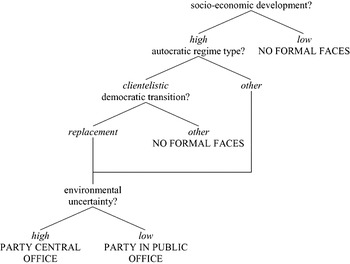
While programmatic strategies promising the distribution of club goods are thus likely to be unsuccessful in new democracies, we can still make certain predictions as to whether the context will favour clientelism or programmatic catch-all strategies. Contexts that are highly selective towards clientelism are those characterized by widespread poverty. Income inequality, it is argued, makes the poor an effective target for clientelistic practices, while economic modernization will reduce the utility of clientelism as an electoral strategy.Footnote 19 Once institutionalized and embedded within social structures, however, political patron–client relationships may take on a life of their own, independent of the socio-economic conditions that had given rise to them originally.Footnote 20 More specifically, in newer democracies, the environmental context will favour clientelism as a strategy of voter mobilization if the former autocratic regime used clientelistic networks to elicit support for its non-democratic rule – either from the general population or social elites.
The survival of clientelistic networks beyond the end of autocratic rule depends on the type of democratic transition. Survival is likely if elements of the regime are able to maintain their positions of power through the democratic transformation of the political system, but highly unlikely if the transition is triggered and controlled by the pro-democratic opposition from below, leading to a total replacement of the regime.
We can now make a connection between the particular context and the dominant type of party organization likely to emerge in a new democracy, using actors' electoral strategies as the explanatory link between the two (see Figure 1). It does need to be noted, though, that actors will not always be able to adopt the party organization that best suits their electoral strategy. Most important, actors following a catch-all electoral strategy might find it impossible to establish the party in public office as the dominant face. Instead, when facing a context of high uncertainty, they might have to strengthen the party central office as a way to increase party discipline. In new democracies, environmental uncertainty for political parties tends to be relatively high, given that voter loyalties are often only weakly developed.Footnote 21 Moreover, loyalties also tend to be underdeveloped within parties, frequently leading to interparty conflicts.Footnote 22
Party Organization: Strategically Selected Outcomes in New Democracies

In sum, the environmental context in new democracies will favour certain electoral strategies over others. The players that are in a position to follow the electoral strategy selected by the context – because they have access to the necessary resources and because their interpretation of the environment allows them to realize the opportunities provided by the context – will thus become the most powerful actors in the electoral arena. These actors will use their power to design political party organizations that best match their electoral strategies.
Moreover, if possible, they will also design other institutions that shape the electoral competition so as to increase further the context's selectivity towards their own electoral strategies. For example, clientelism will be facilitated by electoral systems that specify the allocation of seats to candidatesFootnote 23 and the absence of effective laws that could punish the illegal aspects of clientelism such as vote-buying or bribing election officials.
POLITICAL PARTIES AS POWER STRUGGLES
In line with one of the central assumptions of HI – that actors can develop alternative strategic responses to the same contextual opportunities – political parties should not be seen as unitary actors but rather as collections of individuals and sub-party factions with often diverging strategies. Within each party, some actors will be more powerful than others. Party organizations empower certain actors over others, because these powerful actors designed the organization in this way. The ongoing distributional effects of the organization then allow the powerful actors to uphold their dominant position. Like certain approaches to party organization, HI thus recognizes the constraining effect of internal dynamics on human behaviour; it perceives institutions as ‘filters’ that selectively favour some interests over others.Footnote 24
Unlike the life-cycle or the generation-effect approaches, however, HI does not think of political actors as trapped in a process of organizational maturation that will always unfold in the same way, or as unable to escape the party's historical past. Instead, HI would argue that actors can change political parties in their own interests. Reflecting the notion of ‘goal-motivated change’ proposed by actor-centred approaches to party organization,Footnote 25 HI would maintain that organizational change becomes possible when the power distribution between a party's internal actors is radically altered by external shocks. Such ‘critical junctures’Footnote 26 open up space for agency, giving disadvantaged groups in the party the opportunity to reform the organization. Moreover, in line with the idea of power-motivated change, HI claims that change can happen without an external impetus. HI is much more sophisticated in its argument here than actor-centred approaches to party organization: it argues that change is not just seen as a product of leadership change or a change of the dominant faction, but actors are themselves equipped with the strategic skills to deliver organizational change.
There are different strategies that agents of change can follow to work actively towards organizational reform.Footnote 27 First, they can openly mobilize collective opposition against the organizational patterns that disadvantage them, hoping that this will weaken powerful groups and allow for the replacement of existing regulations with new ones (‘displacement’). Secondly, change agents can work within the system, thus disguising their preferences for organizational change, and promote amendments or additions to existing organizational rules, thereby changing the ways in which the original rules structure behaviour (‘layering’). Thirdly, change agents can exploit the ambiguities inherent in organizational rules – the hope is that, although rules remain formally the same, they will be interpreted and enacted in new ways (‘conversion’).
Following the fundamental assumptions of HI, change agents do not make their strategic decisions in a vacuum, but they take into consideration the fact that the context favours certain strategies over others. Change agents need to ask themselves two questions: does the political context afford defenders of the status quo strong or weak veto possibilities? And does the enforcement apparatus for specific rules involve discretion? The most favourable context for a strategy of displacement is characterized by weak veto possibilities and low discretion; layering is most likely to be successful in a context of strong veto players and low discretion; and conversion is the strategy selected in contexts of weak veto players and high discretion.
In addition to these two broad modes of change that roughly correspond to the ideas of goal-motivated and power-motivated change, HI identifies two further ways in which organizational change can occur. First, critical junctures are not only triggered by external shocks but they can also be caused by internal dynamics, such as when the dominant faction weakens as a result of splits within its own ranks. Second, changes in the environment can still lead to organizational changes, even if the internal power distribution is not disrupted. HI calls this ‘drift’– the impact of organizational rules changes as actors defending the status quo fail to respond proactively to environmental changes.
THE DEVELOPMENT OF POLITICAL PARTIES IN SOUTH KOREAFootnote 28
Existing theories of party organization make contradictory predictions regarding political party development in new democracies. Whereas the life-cycle approach expects all parties to follow the same path of evolution, the period-effect approach anticipates that all parties will adapt to a changing environment. The generation-effect approach precludes organizational change, arguing that parties are unable to escape their past. Finally, actor-centred approaches claim that any predictions are futile, because parties are the product of actors' individual goals and abilities. Although offering contradicting views, the two previous sections showed that these theories are not mutually exclusive but can be combined into a single narrative based on HI. This section will use the two concepts of political parties just developed – as strategic responses to electoral markets and as ongoing power struggles – to study party organization in Korea. We will outline the context in which actors make their strategic decisions, identify actors and their electoral strategies, describe them as either status quo or change agents, and categorize the latter's strategies to bring about organizational change.
The military-bureaucratic regime that ruled Korea until 1987 operated within the legalistic framework of a pseudo-democracy that tolerated opposition parties but subtly curtailed competition for political offices so the elite's claim to power would not be threatened. The elite sought to gain legitimacy for their authoritarian rule by emphasizing the military threat posed by North Korea and – closely related – the need for economic development. In particular, the regime's high economic efficiency proved to be a powerful source of legitimacy. Not only did the economic strategy of export-oriented industrialization lead to a general improvement of living standards, but quasi-taxes that the regime received from business conglomerates (chaebol) in return for public resources were directly channelled to individual citizens through clientelistic networks connecting the regime with the electorate.Footnote 29 The opposition, too, employed clientelistic linkage mechanisms to gain votes. Because of their relative lack of resources, however, opposition candidates could not engage as actively in the distribution of clientelistic rewards as the regime party's legislators.Footnote 30
As the regime's programme of economic modernization was largely based on cheap labour and repressive employment laws – causing the income gap between the working class and the rest of the population to widen accordingly – the disillusioned working class became the driving force for democratic change. With the support of students and intellectuals, workers took their protest to the streets, forcing the regime to hold ‘nearly’ free and fair elections for a new National Assembly in 1985, in which the opposition won almost a third of votes. Eventually, increasing political pressure forced the regime to invite the opposition to mutual talks on constitutional reforms.
This negotiated transition meant that the immediate neo-democratic electoral market favoured political actors who had developed clientelistic linkages with the electorate under autocratic rule. These actors then implemented institutional rules to regulate electoral competition that would further facilitate the maintenance and expansion of patron–client networks. First, they refrained from passing strict political finance laws, so the ‘cosy relationship between top business and political leaders’Footnote 31 would not be disrupted. Second, single-member electoral districts were implemented, making it easier for politicians to develop strong clientelistic links with voters in their constituencies.Footnote 32
Political parties soon formed around politicians who were in control of extensive patron–client networks: the two leaders of the pro-democracy movement, Kim Dae-jung and Kim Young-sam, and Kim Jong-pil, who had served as prime minister under the autocratic regime.Footnote 33 When, in 1990, Kim Young-sam merged his party with the former regime party, this heralded the era of the ‘three Kims’. At the same time, the merger between the two parties meant the end of the democracy–authoritarianism cleavage. Instead, since the Kims' clientelistic networks at the elite level were held together by personal ties established during high school – an important concept of self-identity in Korean culture – the three political parties acquired a distinctive regional character based on the family roots of their respective leaders, thus turning regional identities into the most important factor explaining voting behaviour in post-autocratic Korea.Footnote 34
The three Kims held an uncontested monopoly of power in their respective parties. Most important, they each controlled party internal factions through the allocation of resources. Because the three Kims were perceived as having the best chances of winning the presidency, they became a top target for political donations from large businesses.Footnote 35 Factions were dependent on these financial resources provided by the party leader to nurture their clientelistic networks that connected them with the electorate.Footnote 36
Reflecting these clientelistic strategies of voter mobilization, the political parties of the three Kims were nothing but screens to hide the informal patron–client links between politicians and voters. The formal party organizations remained underdeveloped, with the three faces of party organization failing to emerge. Party members did not differ much from common citizens in terms of their rights within and their obligations towards the party. For example, party members were not required to attend regular party meetings or pay regular membership fees. Instead, the local branches of the major parties in Korea were usually just the personal political machine of the assemblyman or candidate in the respective constituency, ‘based…on personal and particularistic bonds between a political boss and followers’.Footnote 37 Thus, the only formal criterion for identifying party members was whether they had been nominated as candidates for public election by their respective parties. The selection of candidates, in turn, was a highly informal and centralized process, monopolized by the party leader.Footnote 38 Similarly, financial resources were not controlled by the party as an abstract institution but by the party leader as an individual. As a result of this – and because of the absence of a mass membership that would have required administrative structures – parties did not develop strong party bureaucracies.
As factions within the Kims' political parties followed clientelistic strategies of voter mobilization, there were no party internal agents interested in organizational reform – that is, formalizing internal decision-making. This changed in the late 1990s when programmatic forces started to emerge in Kim Dae-jung's party. The most significant figures were Chun Jung-bae, Shin Ki-nam – both human rights lawyers – and Chung Dong-young, a former television anchorman. All three politicians had been nominated by Kim Dae-jung as candidates for the 1996 parliamentary elections to give the party a younger image. Not integrated into existing patron–client networks, the Chun–Shin–Chung faction developed a programmatic catch-all strategy of voter mobilization, stressing issues such as good governance and environmental protection, while also advocating a softer approach towards the regime in North Korea and a more critical attitude towards the United States. To implement this catch-all strategy the Chun–Shin–Chung faction had to institute formal procedures for collective decision-making. Being outnumbered within the party and lacking the resources to overwhelm the dominant clientelistic factions, though, the Chun–Shin–Chung faction hid its preferences for organizational change and decided to wait for the right moment to move into open opposition.
This moment came in 2002 when Kim Dae-jung announced his retirement from politics, leaving a huge power vacuum in his party, the Millennium Democratic Party (MDP), that no actor was able to fill. Because the various clientelistic factions were unable to reach a consensus over which candidate to nominate for the upcoming presidential election, they decided to implement a candidate-selection system that combined a closed and an open primary.Footnote 39 In other words, the rival factions adopted a more inclusive procedure of candidate selection as a means of determining which faction would be able to ‘outbuy’ the other factions. In taking this decision, the clientelistic factions underestimated the strength of the Chun–Shin–Chung faction, which had rallied behind Roh Moo-hyun as its candidate. Because of his background – he was born to a poor farming family and had worked as a human rights lawyer under authoritarian rule – Roh appealed to young voters in their twenties and thirties who had become increasingly disillusioned with the old style of Korean politics, particularly the regionalization of the party system. Inspired by Roh's outsider image and the programmatic platform he embodied, supporters set up (literally, ‘people who love Roh’), an internet-based ‘fan club’. By using new technology, succeeded in generating backing for Roh from voters who otherwise had little interest in politics, providing Roh with the necessary votes and resources to win both the MDP primary and the 2002 presidential election.Footnote 40
Encouraged by their electoral success, Roh and the programmatic catch-all factions split away from the MDP to establish the Uri Party. They then set out to reform the political system, with the goal of making the institutional environment less favourable for clientelism. To do so they adopted a strategy of displacement, openly criticizing the democratic institutions in a coordinated alliance with civil society and labour organizations. Put in more general terms, the Uri Party mobilized collective action among actors that were similarly disadvantaged by the political system as a way of increasing its power. The climate at the time was favourable for a strategy of displacement, as civic organizations had publicly been blacklisting politicians ‘unfit’ for office since the 2000 election, creating an atmosphere in which every politician who opposed political reforms was stigmatized as corrupt.Footnote 41 This considerably reduced the veto opportunities of clientelistic actors in the MDP and other parties who were interested in preserving the institutional status quo.
The Uri Party first succeeded in crafting stricter political finance laws that set more rigorous limits to both spending and contributions. Secondly, backed by the constitutional court, the Uri Party implemented electoral reforms, introducing a second vote for the additional party list of proportional representation (whereas before voters only received one ballot for both the district and list seats).
This, in turn, enabled the entrance of further programmatic actors into the party system, most notably the KDLP.Footnote 42 The KDLP had emerged from the pro-democracy student movement of the 1980s and was founded in January 2000. The party's electoral breakthrough came in the 2002 local elections, in which it received 8.3 per cent of the vote. Then, in 2004, ten KDLP candidates were elected to the National Assembly, making the KDLP the country's third-largest party. While the KDLP defines its constituency as including farmers, small business entrepreneurs, the urban poor, women, disabled people, young people, students and concerned intellectuals, it is primarily a party that seeks to represent Korea's working class. The KDLP thus targets narrowly defined social groups through the programmatic distribution of club goods.
In line with this electoral strategy, the KDLP's organization is dominated by a power-sharing arrangement between the party on the ground and the party central office. Similar to the socialist mass parties in late nineteenth-century Europe, a powerful party central office is needed to discipline members of the party in public office. The power of the party central office stems, first of all, from the fact that the KDLP, unlike other Korean parties, maintains a party membership that can be clearly distinguished from the general electorate, the administration of which requires a sophisticated bureaucratic apparatus. Most important, the KDLP imposes regular membership fees, and prospective members need to go through a formal process of registration. The KDLP also distinguishes itself from its competitors in that its members are organized into 150 genuine party branches across the country, each with a local organization at the neighbourhood or workplace level. Membership activity is relatively high throughout the year, as local chapters usually hold two meetings per week: one political meeting and one social meeting. The KDLP therefore appears to value its members both as sources of funding as well as a pool of potential candidates for public elections. In return for their financial contribution, members in the KDLP enjoy wide-ranging voting rights, reflected in the party's procedures for candidate selection: for both presidential and parliamentary elections the KDLP holds closed primaries, giving each member one vote. Finally, the party's resources, unlike in other Korean parties, are not monopolized by single politicians, but are administered by the party as an abstract institution. The largest share of the KDLP's income (around 50 per cent) comes from membership payments. Moreover, not only are KDLP parliamentarians obliged to forward all the donations they collect to the party central office, but they must also hand over much of their assembly salary so that they earn no more than the average Korean worker. Reflecting the bureaucracy's control over party resources, the KDLP's constitution declares that leading party bureaucrats must be represented in all decision-making bodies.
Roh's victory in 2002 and the emergence of the KDLP broadened the political discourse – from one that was highly anti-leftist to one that accepted more progressive views.Footnote 43 This, in turn, also facilitated the rise of programmatic factions in the former regime party, the Grand National Party (GNP). Given its record of human rights violations, its close links with large businesses and its pro-American leaders, the GNP had become an easy target for criticism from other parties. Since Kim Young-sam relinquished the party's leadership in the late 1990s, the GNP had been characterized by intense conflict between clientelistic factions, without any faction being able to establish itself as the dominant actor. What is more, none of these factions was able to offer a solution for how to regain control of the political discourse, as they were widely perceived by the electorate as corrupt and self-serving.
This paved the way for Lee Myung-bak to increase his power in the GNP. Having only entered politics in 2002 – leaving his position as CEO of Hyundai to become the elected mayor of Seoul – Lee was not embedded into the traditional clientelistic networks that the GNP had spun in its electoral stronghold in the eastern parts of the Korean peninsula. He thus used his public image as an economic mastermind to formulate catch-all economic policies, promising a rising standard of living for all. These promises struck a deep chord with the electorate, as the Roh government's failure to deliver jobs and economic growth meant that ‘voters cared primarily about the economy and wanted a competent economic manager to shepherd it’.Footnote 44 In other words, Lee's ideas of how to manage the economy, much more than the material resources controlled by the dominant clientelistic factions, seemed to provide a very effective strategy of voter mobilization.
Being the most likely candidate in the GNP to take back the presidential office after ten years in opposition provided Lee with the resources to engineer political support in the party. In particular, Lee promised that, when elected, he would push for the construction of a canal that would cut diagonally across the country between Seoul and Pusan. The canal project, estimated to cost US$50 billion, allowed Lee to ‘buy’ the support of legislators representing the rural hinterland behind the GNP's traditional stronghold on Korea's east coast.Footnote 45
This newly formed power base, in turn, put Lee in a powerful position before the 2007 presidential elections to openly demand a formalization of the nomination process, which thus far had not been formally institutionalized. Because the old guard controlled most of the party members through their clientelistic networks, Lee had to shift decision-making to outside the party. Reflecting the power stalemate between the clientelistic factions as the defenders of the status quo and Lee as the principal change agent, the result of the negotiations was a patchwork of different methods to nominate the candidate, combining member votes with votes from the general electorate and public opinion polls. Confirming Lee's calculation, it was the opinion poll element that helped him secure the GNP's nomination.
Moving on to win the presidential election as well, Lee then used his consolidated power position in the party to apply the same logic – that of shifting decision-making to outside the party – to the nomination of candidates for the 2008 parliamentary election: candidates were selected by a semi-external screening committee composed of senior party politicians and respected figures in Korean society. The Uri Party, having re-merged with the MDP to form the United Democratic Party (UDP), adopted a similar system of candidate selection, as the dominant programmatic factions thought that an external committee was a good way of getting rid of clientelistic actors who had had rejoined the party through the MDP.Footnote 46
While these new methods of candidate selection – coupled with the more effective political finance laws passed in 2004 – have made the major parties' survival less dependent on individual politicians, the different elements of party organization in the leading Korean parties still remain indistinguishable. This is mainly because virtually all politicians, regardless of whether their primary electoral strategy is clientelistic or programmatic, maintain their own supporter organizations (so-called sajojik), which undermine the need for a formal party on the ground. Because there is no formal party membership that pays regular fees – and because there are hardly any public subsidies available for political parties – party bureaucracies have not generated any sources of income themselves. Consequently, the party central office has not developed beyond a passive administrative body.
CONCLUSION
None of the existing theories of party organization can adequately explain the development of political parties in Korea. We are not witnessing parties at certain stages along a universal path of maturation, as the life-cycle approach argues, nor have all parties adopted the same organizational type to remain competitive in the given environment, as advocates of the period-effect approach would expect. The generation-effect approach, on the other hand, seriously underestimates actors' ability to change the organization of a political party in their own interest, as is indicated by the fact that the major political parties in Korea have become much more institutionalized and less dependent on individual politicians. Finally, we are not observing an unstructured collection of political parties, as the actor-centred approaches to party organization would predict, but certain behavioural regularities have clearly led to the emergence of a dominant type of political party.
This does not mean, however, that we need to discard existing theories of party organization. Rather, if we use HI to conceptualize political parties as strategic responses to electoral markets and as ongoing power struggles, the three types of factors identified by these theories – internal, external and agency factors – can be combined into a single narrative. It then becomes clear that the dominant type of political party to emerge in post-autocratic Korea is characterized by a lack of formal organizational faces because the electoral market strongly favours clientelism over other strategies of voter mobilization. As actors can develop different strategies to deal with the challenges posed to them by the context, we have also witnessed the emergence of a party that features a strong party in central office – the KDLP. More recently, the two traditional parties have undergone some considerable changes, institutionalizing formal procedures of decision-making that have made the nomination of candidates much less dependent on material resources. In both parties these changes followed shifts in the inter-factional power relations, with programmatic factions increasing their power over the dominant clientelistic factions. These power shifts, in turn, were triggered by strategic miscalculations by the dominant faction (in the case of the MDP) or changes in the party's environment (in the case of the GNP). The analysis also showed that disadvantaged actors need not wait for such internal or external triggers to produce change: the 2004 reforms of the political finance and electoral system were achieved through a strategy of displacement, as disadvantaged actors organized collective action across institutional boundaries.
By providing a coherent narrative of political party development in Korea – a highly complex case of party development – this article has highlighted the usefulness of HI to transcend current debates in the area of party organization. Moreover, the analysis identified a number of factors to describe the context for politicians to choose their electoral strategies, which helps us make certain predictions about the dominant type of party organization to emerge in a new democracy. To begin with, the case of Korea confirms that democracies in the third wave of democratization militate against programmatic strategies promising the distribution of club goods and thus also against parties characterized by a power-sharing arrangement between the party on the ground and the party central office. Instead, neo-democratic electoral markets will favour either clientelistic or catch-all strategies of voter mobilization, depending on the level of socio-economic development and the process of democratic transition. We should therefore expect the formation of parties without formal organizational faces or parties dominated by the party in public office – the degree of environmental uncertainty permitting.
As this article shows, however, electoral markets can change, and with them the dominant type of party organization. Therefore, although party systems across Asia are swamped with parties of the type that first emerged in Korea, this should not be understood as a cultural phenomenon. With growing middle classes refusing to sell their votes for clientelistic benefits, new opportunities open up for programmatic strategies of voter mobilization, which, in turn, require more sophisticated party organizations. Whether these parties will ever develop three distinct faces of party organization, however, is doubtful. Rather, given that, in an electoral market highly selective towards clientelism, parties are not a source of politically relevant resources, emerging programmatic actors could be forced to establish their individual support organizations. This means they will, at a later stage, lack the incentives to pool their own resources under the central control of a party organization. Therefore, as in Korea, parties might just provide rules for conflict resolution, but nothing more.