Introduction
Nosocomial infections account for the most important cause of mortality and morbidity in the neonatal intensive care unit (NICU).Reference Chandonnet, Kahlon and Rachh1, Reference Zervou, Zacharioudakis, Ziakas and Mylonakis2 Ventilator-associated pneumonia (VAP) is the second-most frequent cause of nosocomial infection and usually occurs in neonates requiring a longer period of intubation and mechanical ventilation.Reference Hocevar, Edwards, Horan, Morrell, Iwamoto and Lessa3, Reference Cernada, Aquar and Brugada4 VAP is associated with a longer duration of ventilation, an increased length of hospital stay, and a tendency toward increased mortality in the NICU patients.Reference Srinivasan, Asselin, Gildengorin, Wiener-Kronish and Flori5–Reference Foglia, Meier and Elward7 Several factors have been proven to predispose neonates to higher risk of VAP, such as prolonged duration of invasive intubation, prematurity, preceding bloodstream infection (BSI), re-intubation, and endotracheal suctioning.Reference Cernada, Aquar and Brugada4, Reference Apisarnthanarak, Holzmann-Pazgal, Hamavas, Olsen and Fraser8, Reference Tuan, Chen and Yu9
In addition to endogenous sources of pathogens from colonization of the naso/oropharynx or tracheal secretions, microorganisms can reach the respiratory airways and infect the lung parenchyma through contamination of the ventilator circuit.Reference Garland10, Reference Cernada, Brugada, Golombek and Vento11 Several studies have been conducted to investigate the relationship between the interval at which ventilator circuits are changed and the occurrence of VAP.Reference Han and Liu12–Reference Stamm15 Current evidence in adult intensive care units shows that the ventilator circuit can be safely used for 1 week without increasing the occurrence of VAP.Reference Han, Liu and Ma16, Reference Stoller, Orens and Fatica17 In the NICU, extending the ventilator circuit change up to 72 hours has been proven safe and cost-effective,Reference Makhoul, Kassis, Berant, Hashman, Revach and Sujov13 but further decreasing the frequency of ventilator circuit change, especially in those who require a prolonged period of mechanical ventilation, has not been adequately studied. In this study, we aimed to investigate the safety and cost-effectiveness of a weekly change of ventilator circuit in the NICU.
Patients and Methods
Setting, Patients, and Study Design
This observational study was conducted from June 1, 2011, through December 31, 2013, in the NICU of Chang Gung Memorial Hospital (CGMH), a university-affiliated teaching hospital and referral center in Northern Taiwan. This NICU contains 3 units and has a total capacity of 47 beds with mechanical ventilators and 58 beds with special nurseries. During this study period, all infants admitted to the NICU of CGMH who received invasive intubation for more than 7 days were studied. The exclusion criteria included neonates with congenital pneumonia, pneumonia before intubation, multiple congenital malformation, or severe cardiac-pulmonary anomalies, and referral neonates who had been admitted in another NICU for more than 1 week. This study was approved by the institutional review board of CGMH with a waiver of informed consent because all patient records and information were anonymized and deidentified prior to analysis.
Before the end of November 2012, a 2-day change of ventilator circuit was the policy in the NICU of CGMH. However, the ventilator circuit change in all adult ICUs of CGMH was switched to every 7 days several years ago. After the joint meeting of all neonatologists, the patient safety committee, and the respiratory care committee, we started to change the ventilator circuit every 7 days in all NICU patients with a mechanical ventilator beginning December 1, 2012. All other neonatal care policies and therapeutic strategies, including Staphylococcus aureus screening, decolonization, and policies of antibiotic utilization, have remained unchanged from early 2011 until now. This observational study was then launched to investigate the impact of a 1-week ventilator circuit change on VAP and its cost-effectiveness compared with the previous 2-day change. We retrospectively reviewed all neonates admitted to our NICU from July 1, 2011, through November 30, 2012, for comparisons.
Definition
The diagnosis of VAP was based on modified criteria from published literature and from the Centers for Disease Control and Prevention.Reference Horan, Andrus and Dudeck18, Reference Zhou, Lee and Jiang19 The definition of VAP was used throughout the study period and its diagnosis was approved by the attending neonatologist. VAP was considered when patients met all of the following criteria: the occurrence of a new and persistent radiographic infiltrate at least 48 hours after infants received mechanical ventilation; at least 3 clinical signs and symptoms, including temperature instability, wheezing, tachypnea, cough, abnormal heart rate, change in secretions, or an abnormal leukocyte count; receipt of antibiotics for at least 7 days; and exclusion of other possible diagnosis, including respiratory distress syndrome, early development of bronchopulmonary dysplasia, atelectasis, and meconium aspiration. Positive bacterial culture of secretions drawn from the lower respiratory tract through the endotracheal tube similar to that of blood culture was helpful in confirming the diagnosis of VAP.
In our NICU, a chest radiograph was performed every 1 to 2 days after confirming the diagnosis of VAP. We excluded episodes of superimposed VAP, which was defined as requirement of more aggressive mechanical ventilation and/or new infiltrates in the chest radiograph during the treatment course of VAP. However, after a complete course of appropriate antibiotic therapy for an episode of VAP, a new episode was defined according to the same criteria as described above. For diagnosis of BSI, we applied criteria the same as that previously defined in our published studies.Reference Tsai, Hsu and Chu20, Reference Tsai, Chu and Hsu21 If the same organism was identified after 14 days of appropriate antibiotic therapy or after 1 or more negative blood culture results, or if a different organism was identified from a subsequent culture 7 days after the first one, it was considered a new episode of BSI.
Data Collection
Patients’ clinical characteristics were recorded and included demographic characteristics, perinatal history, respiratory diagnoses at admission or birth, underlying disease, duration of mechanical ventilation, VAP, mortality, and duration of hospital stay.
Change of Ventilator Circuit
All patients received ventilatory support by infant ventilator VIP Bird (Babylog-8000-plus, Dräger). Each ventilator circuit included a humidifier, a heated water chamber assembly, and 3 Tygon tubes: 1 serving as an inspiratory limb, the second serving for airway pressure monitoring, and the third serving as an expiratory limb for gas exhalation. There was no filter in these tubes. The tubing and humidifier were changed every 2 days before December 1, 2012, and every 1 week after December 1, 2012. Ventilator circuit changes were performed by the 2-member team of 4 well-trained respiratory therapists throughout the whole study period following the standard procedure: 1 member bagged the infant briefly with a resuscitation bag connected to the endotracheal tube and an oxygen source while the other member changed the tubing and humidifier. The 2 staff members used sterile gloves. It took 2 to 4 minutes for the whole procedure, with SaO2, heart rate, color, and proximal airway pressure continuously monitored.
Statistical Analysis
We compared the demographic data, incidence rate of VAP and BSI, and the mortality rate between the neonates with ventilator circuit change every 2 days and those changed every 1 week. Categorical variables were compared by the χ2 test or Fisher exact test. Continuous variables were compared by the Mann-Whitney test or the t test, depending on the distributions. Multivariate logistic regression analysis of factors potentially associated with occurrence of VAP included all statistically significant variables with P<.1 in univariate analysis, gestational age or birthweight, and all clinically important variables, whether or not they were statistically significant. Because of the strong correlation between birthweight and gestational age, the risk factor of birthweight was excluded from analysis. All P values were 2-tailed, with P<.05 considered statistically significant. All statistical analyses were performed using SPSS, version 15.0 (SPSS).
Results
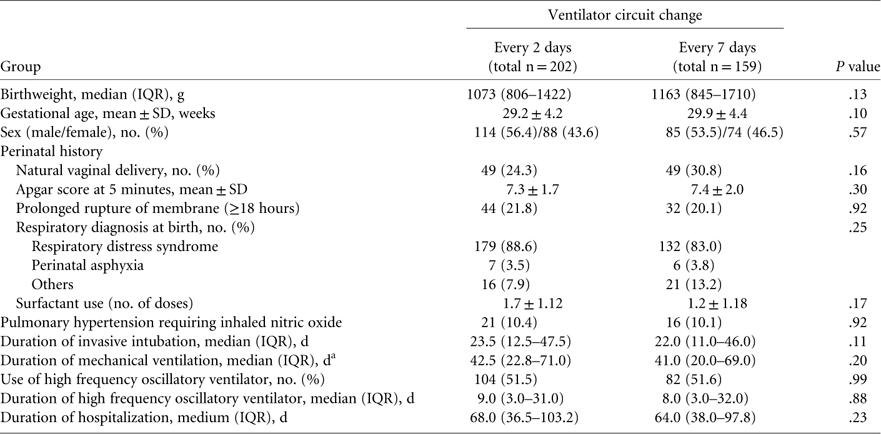
During the study period, a total of 2,226 neonates were admitted to the NICU of CGMH. Only 498 neonates received invasive intubation for more than 7 days. After excluding neonates with pneumonia before intubation, those with severe congenital anomalies or severe cardiopulmonary diseases, and those who had been admitted to another NICU for more than 7 days before being transferred to our NICU, a total of 361 neonates were included in the analysis (Fig. 1). Among our study cohort, there were 202 patients with ventilator circuit changes every 2 days and 159 patients with once-weekly ventilator circuit changes. The infants of the 2 study groups were not statistically different regarding demographic characteristics, duration of mechanical ventilation or invasive intubation, perinatal history, or surfactant replacement therapy (Table 1).
Diagram of patients admitted to the neonatal intensive care unit of Chang Gung Memorial Hospital (CGMH) between July 1, 2011, and December 31, 2013.

Demographic Data of the Study Population
NOTE. IQR, interquartile range.
a Including invasive intubation, nasal intermittent mandatory ventilator, and nasal continuous positive airway pressure.
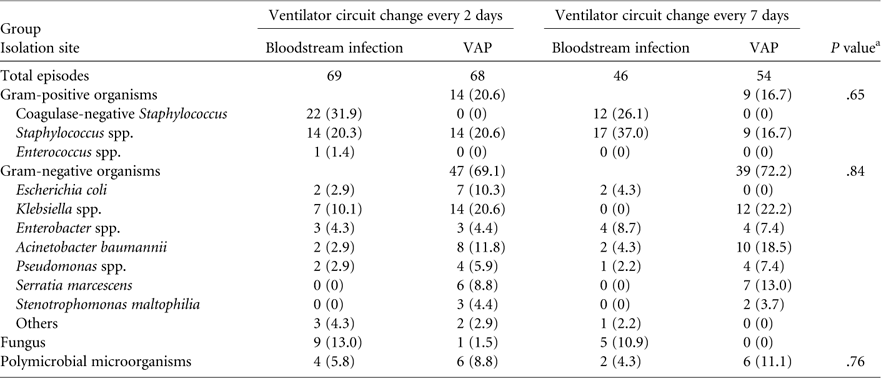
A total of 361 patients were maintained on mechanical ventilators for 13,981 days. One hundred seventeen neonates developed a total of 122 episodes of ventilator-associated pneumonia (32.4%; 8.73 per 1,000 ventilator-days). There was no significant difference in the rates of VAP between the 2 groups (8.2 vs 9.5 per 1,000 ventilator-days in the 2-day and 7-day groups, respectively, P=.439). Table 2 show the bacteria isolated from bloodstream and tracheal aspirate in the 2-day and 7-day groups, respectively, on the day of VAP diagnosis or within 3 days. The pathogen subtypes were not significantly different between these 2 groups (P=.405). Gram-negative pathogens were detected in 70.5% of cultures from tracheal aspirates, gram-positive pathogens were 18.8%, and polymicrobial pathogens were 9.8%. The median ages at diagnosis of VAP in the 2-day and 7-day groups were 24 (interquartile range, 15–34) and 24 (17–32) days, respectively. In this study cohort, a total of 115 episodes of BSI occurred in 101 patients (28.0%; 4.3 per 1,000 neonate-hospital days) were noted during their hospitalization. The coincidence of bacteria/fungi in the tracheal aspirate and bloodstream, which indicated cases of concomitant VAP and sepsis, was 8/67 and 4/55 in the 2-day and 7-day groups, respectively (P=.389).
Microorganisms Isolated in the Bloodstream Infections and Ventilator-Associated Pneumonia (VAP) of the Study Population
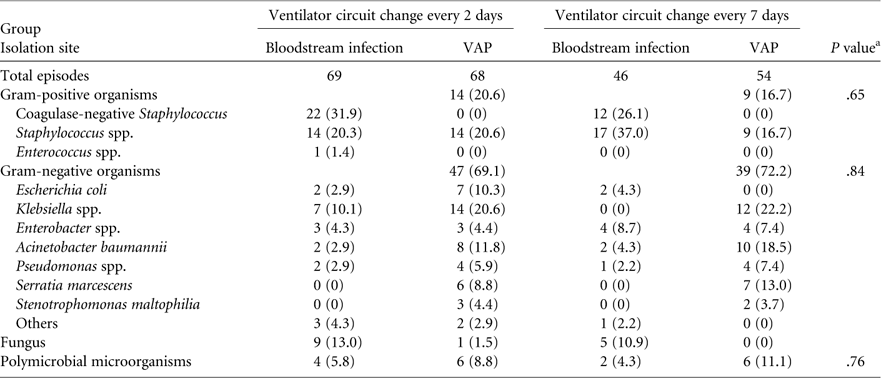
a P values are the comparisons of pathogens for VAP between these 2 groups.
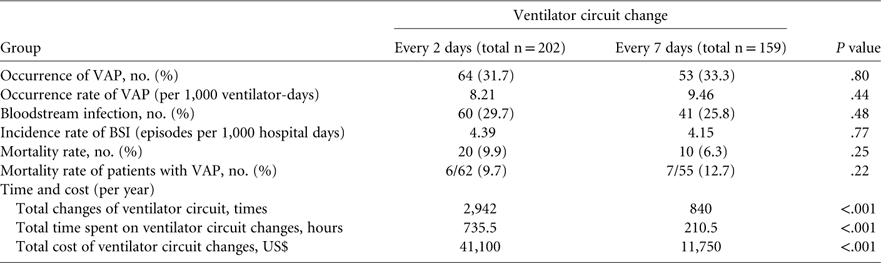
In addition to the comparable occurrence rate of VAP between the 2-day and 7-day groups, there was no significant difference in the rate and incidence rate of BSI, the mortality rate, and the mortality rate in patients with VAP between these 2 groups (Table 3). Only 3 patients died of VAP (2 in the 2-day and 1 in the 7-day group, respectively). However, the reduction in both material used and time spent after switching to a 7-day change policy would contribute to a great savings of money. The costs of 1 ventilator circuit change are approximately US $14 to $18. This includes the technician salary, sterilization of humidifiers and tubing, and the ventilator circuit itself. In the course of the study, the estimated yearly costs of replacement of the ventilator circuit every 2 days or 7 days would be US $41,100 and $11,750, respectively (Table 3). A total of approximately 2,102 times of ventilator circuit changes and 525 hours of time spent were saved annually. In summary, switching to a 7-day change policy would save our NICU a yearly sum of approximately US $29,350.
Outcomes and Cost-Effectiveness of Ventilator Circuit Changes Every 7 Days versus Every 2 Days
NOTE. BSI, bloodstream infection; VAP, ventilator-associated pneumonia.
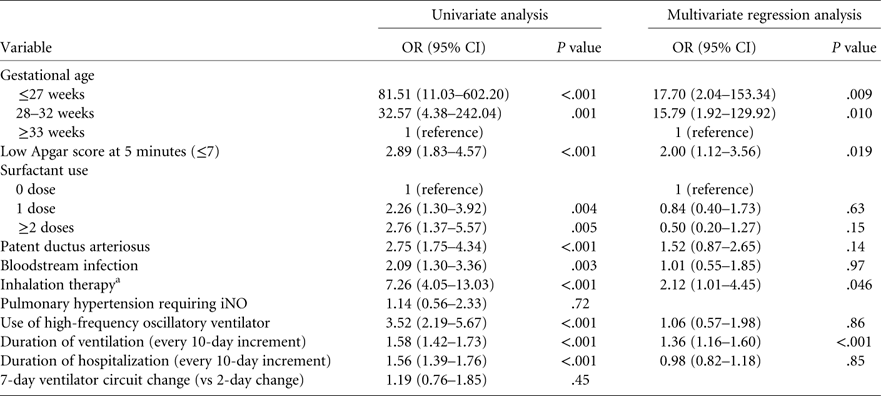
We investigated the independent risk factor for VAP in our cohort. By univariate logistic regression analysis, occurrence of VAP was associated with lower birthweight, lower gestational age, lower Apgar score at 5 minutes, longer duration of ventilator use and hospital stay, more severe respiratory distress syndrome (judged by more surfactant use) at birth, use of high-frequency oscillatory ventilator, inhalation therapy, and presence of patent ductus arteriosus and BSI, but not associated with the tubing change regimen (Table 4). Because birthweight and gestational age were highly correlated, only gestational age was enrolled into the final multivariate model. After multivariate logistic regression analysis, the duration of ventilator use (odds ratio, 1.36; 95% CI, 1.16–1.60; P<.001 for every 10-day increment of intubation), low Apgar score at 5 minutes (≤7) (odds ratio, 2.00; 95% CI, 1.12–3.56; P=.019), inhalation therapy (odds ratio, 2.12; 95% CI, 1.01–4.45; P=.046), and lower gestational age were identified as the independent risk factors for occurrence of VAP.
Risk Factors for Ventilator-Associated Pneumonia by Univariate and Multivariate Logistic Regression Analysis
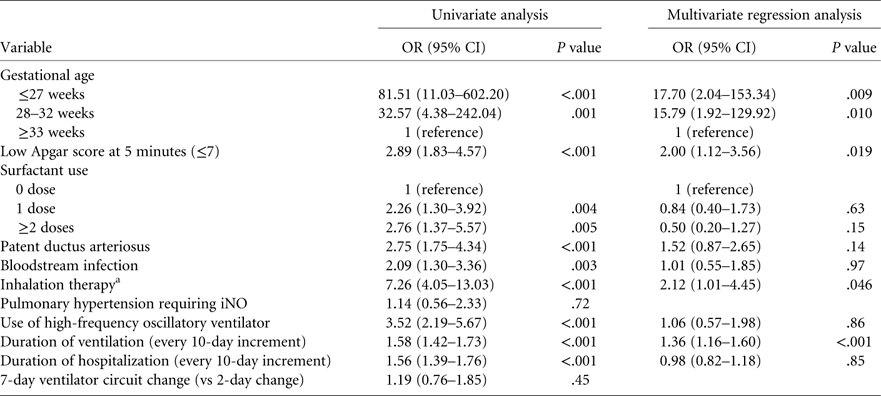
NOTE. iNO, inhalation of nitric oxide; OR, odds ratio.
a Including bronchodilator, corticosteroid, and all mucolytic agents.
Discussion
The results of this study provide evidence that extension of the ventilator circuit change interval from 2 days to 1 week is cost-effective and does not increase the occurrence rate of VAP. These findings were similar to those of previous studies that were conducted in adult intensive care units, neurosurgical units, or several settings.Reference Han and Liu12, Reference Samransamruajkit, Jirapaiboonsuk and Siritantiwat14, Reference Han, Liu and Ma16, Reference Stoller, Orens and Fatica17 In the neonatal period, the maximum duration of time that a ventilator circuit could be safely left unchanged was previously proven for only 3 days.Reference Makhoul, Kassis, Berant, Hashman, Revach and Sujov13 The strengths of this study included an adequate number of patients and ventilator-days and a follow-up period until extubation and death or discharge. Besides, we focused on neonates who required prolonged intubation, so the conclusion was practical and meaningful, since this subgroup was especially likely to have VAP and required many more ventilator circuits if changed very frequently.
This study was not randomized or a controlled trial. However, the different intervention of the 2 groups, the changing of ventilator circuits, was due to policy changes and performed by an independent team of respiratory therapists. As expected, we found there were no significant differences in the basic demographic characteristics between the 2 study groups, as well as the durations of ventilation and hospital stay, and the mortality rate. The neonatal care policies did not change over the short study period. We excluded patients with multiple congenital anomalies, severe congenital heart disease, congenital tracheal stenosis, and congenital neuromuscular disorders because these patients may require more intensive care and potentially confound this study. Therefore, we assumed there were fewer confounding factors in this study. Infection control physicians confirmed the diagnosis of VAP and supervised the whole work of respiratory care.
VAP constitutes approximately 20% of all nosocomial infections in the NICU. The reported rates of VAP in the NICU vary from 2.7 to 37.2 episodes per 1,000 ventilator-days.Reference Cernada, Aquar and Brugada4, Reference Cernada, Brugada, Golombek and Vento11, 22, Reference Morris, Kefala and Simpson23 The variability of the VAP rate could be explained by the use of different criteria to define VAP, methods to diagnose VAP, infection control policies, and regional economic development.Reference Cernada, Aquar and Brugada4, Reference Cernada, Brugada, Golombek and Vento11, Reference Baltimore24 The incidence rate of VAP in this study is lower than that in previous studies, although we enrolled patients with prolonged ventilation for analysis. The mortality rate of VAP in this study was also lower than other institutions.Reference Cernada, Brugada, Golombek and Vento11, Reference Tan, Xian-Yang and Zhang25 This may be due to the strict criteria of VAP we applied in this study, but some new VAP episode may have been missed and the real incidence rate is possibly underestimated. On the basis of our result, we found the incidence rate of VAP was higher than that of BSI in the subgroup of patients requiring prolonged ventilation, although BSI has been well-known as the most common nosocomial infection in the NICU.
In addition to longer duration of ventilatory support, which has been identified as the most significant risk factor for VAP acquisition,Reference Cernada, Brugada, Golombek and Vento11 we found lower gestational age, inhalation therapy, and lower Apgar score at 5 minutes were independently associated with higher rate of VAP. These results were based on neonates who required longer ventilatory support. Actually the earliest VAP diagnosed after intubation in our NICU was 8 days after intubation, so our inclusion criteria (enrollment of only neonates intubated for more than 7 days) avoided those who were mechanically ventilated for a short duration. By focusing on a subpopulation of prolonged ventilation, the most important variable—change of ventilator circuit weekly—did exist in every patient in our second study group and there were fewer confounding factors. There are several risk factors that have been found related to occurrence of VAP, including reintubation, enteral feeding, parenteral nutrition, transfusion, bronchopulmonary dysplasia, and length of stay in the NICU.Reference Apisarnthanarak, Holzmann-Pazgal, Hamavas, Olsen and Fraser8, Reference Cernada, Brugada, Golombek and Vento11, Reference Yuan, Chen and Yu26–Reference Shalini, Malik, Jain and Kohli29 However, these various results may be due to different study populations, study designs, inclusion or exclusion criteria of VAP, and analytic methods.
There were still some limitations in this study. Although we applied strict criteria for VAP diagnosis based on the US Centers for Disease Control and Prevention, we cannot exclude the possibility of misdiagnosis of VAP because of the retrospective study design in the 2-day group. The bacterial colonizations of ventilator circuit were not documented, and its association or cause-and-effect relationship with VAP was unknown. Because we excluded neonates with short ventilator use, the results may not be convincing in this group. Furthermore, this study is limited by its single-center experience and may be less generalizable to other facilities with different policies or patient populations.
We conclude that extending the ventilator circuit change frequency in NICU patients with prolonged ventilation from 2 days to 7 days is safe and cost-effective. Given the unavailability of a clear recommendation from the US Centers for Disease Control and Prevention for the maximum length of time that a ventilator circuit can be safely left unchanged during prolonged ventilation, our conclusion is useful and practical. However, our results are based on a single-center experience, and more studies are required in premature infants from other NICUs where the patient population or neonatal care are different from ours.
Acknowledgments
We thank Chiao-Ching Chiang for keeping the database of our NICU, and all nursing staff working in our NICUs for keeping extremely detailed patient records, which contributed greatly to the completion of this research. We thank Chun-Chun Cheng and Yu-Jr Lin for statistical consultation.
Financial support. None reported.
Potential conflicts of interest. All authors report no conflicts of interest relevant to this article.