Introduction
Soil respiration is an important aspect of soil-quality and an indicator of soil fertilityReference Staben, Bezdicek, Smith and Fauci1. As early as 1931, Smith and HumfeldReference Smith and Humfeld2 noted that during decomposition of green manures, the numbers of bacteria followed CO2 evolution, which rose rapidly during the first 4 days and then declined to a fairly constant level. Even earlier, GaineyReference Gainey3 noticed a parallel formation of CO2, NH4-N and NO3-N in soil. In 1924, LebedjantzevReference Lebedjantzev4 stated that drying soil at low temperature appeared to increase the fertility of the soil which, he noticed, also occurred in nature. For roughly 90 years, CO2 respiration from soil has been used as an indicator of the relative fertility of various soilsReference Gainey3–Reference Birch5. Soil CO2 respiration has been widely used for many years to quantify the impact on soil microbial activity of various treatment and management inputs. The purpose of many of these studies are mainly concerned with the rates of C, N or P mineralization in an effort to gain a clearer understanding of these natural processes. A clear understanding of nutrient cycling is essential to developing accurate computer models and could have a tremendous impact upon the soil testing industry.
Chemical titration for soil CO2 respiration is an effective means whereby different soils can be compared for microbial activity. Soils are incubated along with an aqueous solution of KOH or NaOH in a small vial. The alkali reacts chemically with CO2 and BaCl2 and can be back-titrated with HCl to a phenolphthalein endpoint which is relative to the amount of CO2 released by soil micro-organismsReference Anderson, Page, Miller and Keeney6. A control vial with no soil is included in the incubation to correct for the CO2 in the jar at the initiation of the incubation. An equation is then employed to arrive at mg CO2-C kg−1 soil. Soil CO2 respiration can also be measured with a gas chromatograph or an infrared gas analyzer (IRGA) for CO2 detector. Although chemical titration has avenues for error associated with the procedure, it is a fairly simple and straightforward method. However, the method requires mixing the alkali, assumption that the control is accurate, care in titration, and accurately hitting the endpoint, which can induce error.
More recently, soil laboratories have been reviewing early methods in view of environmental disposal concerns, such as in the use of dichromate for soil organic carbon digestion. The presence of BaCl2 in the CO2 titration procedure would qualify for such concern. To render unreacted BaCl2 harmless after titration requires the additional step of adding an equimolar or greater amount of a soluble source of sulfate ions, producing insoluble BaSO4. Such steps add to the complexity of the procedure.
The Solvita gel system was designed as a complete procedure to quantify the relative differences between varying types of compost in terms of the amount of CO2 evolved in a short time period. This is interpreted as an indication of the completeness of active degradation, also called a maturity indexReference Brinton7. In this research, a similar principle of CO2 respiration is being applied to soil respiration. Soils differ from compost in that the gross amount of respiration is likely to be less than soils, since soils typically have 1/10th–1/20th the amount of carbon. The Solvita gel system is a new tool to evaluate soil microbial respiration rate in an efficient and cost-effective manner, without the need for reagent handling and standardization. A pH-sensitive gel (paddle) is embedded in a one-piece plastic holder that narrows to a point so that it can be pushed into the soil. After a specified time-period, the paddle can be removed from the incubation jar and analyzed with a digital color reader (DCR) developed specifically for the test. This process takes a minimum of time and labor. The USDA Soil Quality Institute has listed the Solvita kit as an alternate soil respiration procedure in its national soil-quality test kit program which released a full soil quality test document. This application of the Solvita gel-system was found suitable since it was able to detect meaningful changes in surface gas chambers CO2 concentrations (John Doran, personal communication, October 2007). Solvita has been reported to have compared sensitivity to Dräger tubes when employed in compost chamber testsReference Brewer and Sullivan8. The Solvita chemistry gel technology is different from alkali traps in that it does not absorb all the CO2 but absorbs a relative concentration of CO2. Since its inception, the visual color strips used to interpret the reaction have been upgraded by the DCR in which the intensity of red, green and blue (RGB) emissions from the gel is read by a diode array detector (DAD) assembly within the DCR. Using this approach permits very rapid measurement of accumulated CO2 within the Solvita gel at any time during incubation, and improves reliability and significantly increases accuracy. The reactive gel with DAD appears to closely obey Beer–Lambert's optical law over a wide range of concentration of CO2 and suffers only small interference from volatile fatty acids which form a positive response with CO2 gels, consistent with an unstable compost condition.
The Solvita system is almost error free, since it involves placing the paddle in the soil and removing it after the allotted time-period, placing it in the reader and pressing a button. Soil CO2 respiration is a common and simple measure of biological activity in soil. Soil microbial activity as measured by CO2 respiration is a function of substrate availability, which is related to the amount or quality of organic C and N. The purpose of this research is twofold: first, to compare the soil CO2 release from the titration method, IRGA and the Solvita gel system, and secondly, to investigate the possibility that the release of CO2 can be adapted to soil testing labs to provide a biological method that could discern differences in soil microbial activity which might provide an additional insight to the relative activity of different soils.
Materials and Methods
Experiment 1
Thirty-six soil samples were collected from Texas, Oklahoma, Georgia, Mississippi, Idaho, Wyoming and Illinois. The range in soil pH was 5.0–8.3, soil organic C 0.65–4.52%, and clay content 10–55%. All soils were ground to pass a 5-mm sieve, dried at 40°C and weighed into 50 ml plastic beakers. All soils were wetted to approximately 50% water-filled pore space.
Titration
Forty grams of wetted soil was placed in a 1 pint mason jar along with a vial of 10 ml of 1 M KOH. The alkali traps were changed and titrated at days 1, 3, 7, 14, 21 and 28. Unreacted alkali in the KOH traps was back-titrated with 1 N HCl to determine CO2-CReference Anderson, Page, Miller and Keeney6. Basal soil respiration was calculated by subtracting the cumulative 7-day CO2-C from the cumulative 28-day CO2-C.
IRGA
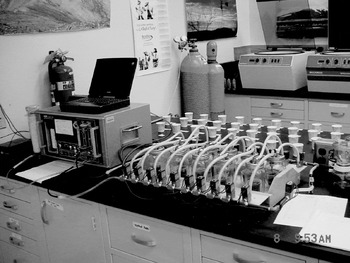
Forty grams of wetted soil samples were placed in 8 oz jars and capped. Each jar was connected to the IRGA via twin solenoids which open simultaneously to allow CO2-free air to purge the jar of CO2 and direct it to the analyzer (ADC model 225) at a rate of 400 ml min−1 for 3 min. Eight soil samples and two controls were used in the 10 sample system. Each glass jar was sampled for 3 min and then closed (Fig. 1). The samples were analyzed every hour for 24 h.
Closed system soil respirometer.

Solvita
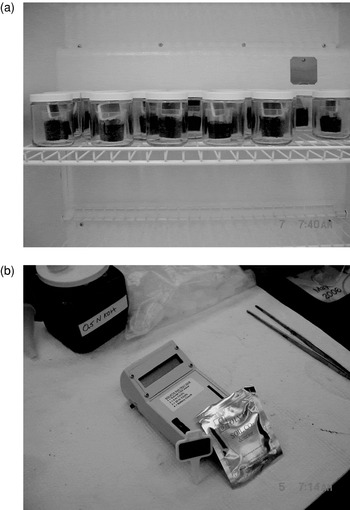
Forty grams of wetted soil samples were placed in 8 oz glass jars with a Solvita gel paddle. At the end of 24 h each paddle was placed in the DCR for analysis (Fig. 2). A simple regression analysis was used to assess the correlation between 24-h CO2 evolution from titration versus the Solvita gel and CO2-C from IRGA.
(a) Solvita gel paddles in soil and (b) Solvita digital reader.

Experiment 2
An additional 24 soil samples from Utah, Washington, California, Montana, New Mexico, North Carolina, Maine, Pennsylvania and Ohio were acquired and added to the original 36 in dry form. All 60 samples were wetted as described above and incubated for 24 h. The titration method and the Solvita gel system were used for 1-day CO2-C analysis to calibrate the DCR to the CO2-C from titration.
Experiment 3
Since the Solvita gel system does not absorb all the CO2 within the container but rather absorbs a relative amount, we chose 20 soil subsamples to study the influence of container volume on CO2 respiration by the Solvita gel system. Twenty grams of soil samples were weighed into 50 ml plastic beakers, rewetted as described above, and placed into 8, 16 and 32 oz glass jars with gel paddles in each jar. After 24 h of incubation the paddles were removed and analyzed with the DCR.
Results and Discussion
Experiment 1
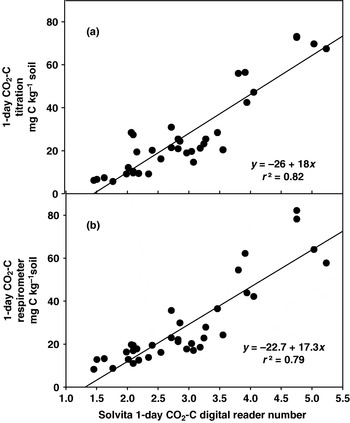
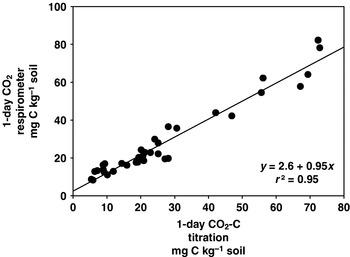
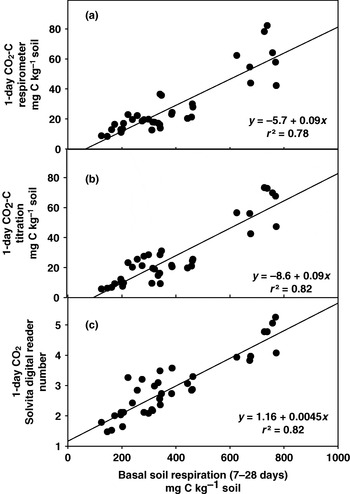
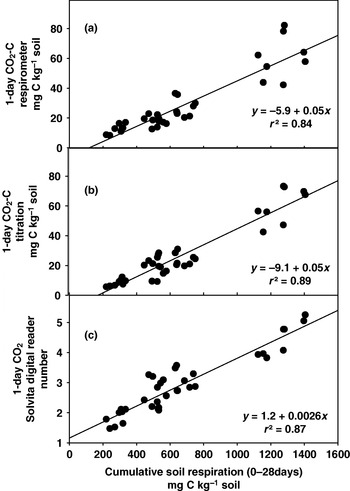
The Solvita number from the DCR was compared to the CO2-C from both the titration method and the CO2-C from the closed system respirometer (IRGA) glass after 24-h (1-day) incubation. Regression analysis established a highly significant relationship between CO2 evolution from the Solvita number and titration (r 2=0.82, Fig. 3a) and the Solvita number and the CO2-C from the respirometer (r 2=0.79, Fig. 3b). There was also a highly significant relationship between titration and the respirometer methods after a 24-h incubation (r 2=0.95, Fig. 4). The strong correlations between these methods suggest that any of the three methods could rapidly quantify soil microbial activity, although the Solvita method would be the simplest and least labor intensive. Since most of the 36 soils were in a dry state when they arrived at our lab, we chose to incubate the soils for 28 days after rewetting. We calculated basal soil respiration as the cumulative 28-day minus the initial 7-day period for CO2-C after rewetting. A paper by FranzluebbersReference Franzluebbers, Haney, Hons and Zuberer9 indicated that a 7-day incubation period was adequate to overcome the elevated release of CO2-C from the drying–rewetting effect. Therefore, we compared basal soil respiration (7–28 days) against the 1-day CO2 value from titration, respirometer, and Solvita to explore possible changes in microbial activity after removing the drying/rewetting flush of CO2. The relationships of each 1-day method to basal soil respiration are shown in Figure 5. The respirometer data for 1 day had an r 2=0.78 (Fig. 5a), titration exhibited an r 2=0.82 (Fig. 5b), and Solvita an r 2=0.82 (Fig. 5c) with basal soil respiration. Again, each method proved to be adequate at predicting basal soil respiration even though the 1-day CO2 release was taken during the greatest portion of the CO2 release from the drying/rewetting processReference Fierer and Schimel10, Reference Maysoon, Rice and Milliken11. We also compared the 1-day CO2 release after drying/rewetting with the cumulative 28-day CO2 evolved including the flush of CO2 from drying/rewetting. The relationships between 1-day CO2 and 28-day CO2 showed only slightly better correlations compared with 1-day CO2 and the basal rate. The respirometer data had an r 2=0.84 (Fig. 6a), titration an r 2=0.89 (Fig. 6b), and Solvita an r 2=0.87 (Fig. 6c) with cumulative 28-day CO2-C.
Solvita 24-h CO2 versus (a) 24-h CO2-C titration and (b) 24-h CO2-C closed system respirometer.

24-h CO2-C titration versus 24-h CO2-C respirometer.

Basal soil respiration (7–28 days cumulative) versus (a) 24-h CO2-C closed system respirometer, (b) 24-h CO2-C titration and (c) Solvita CO2 digital reader number.

Cumulative soil respiration (0–28 days) versus (a) 24-h CO2-C closed system respirometer, (b) 24-h CO2-C titration and (c) Solvita CO2 digital reader number.

Experiment 2
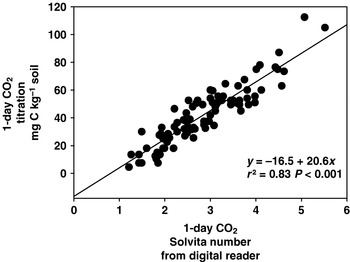
The soil CO2 released, after soil drying/rewetting and incubating for 24 h, from 60 soils was determined using the Solvita gel system with a DCR and was highly related to 24-h soil CO2 measured using the titration method (Fig. 7). Although drying soil is not a prerequisite to using the system; we used dried soil to start all the soils in the experiment from an equal state. We also wanted to accommodate soil testing protocols since most soil testing labs dry and grind their soil samples prior to analysis. The above-mentioned relationship suggests that the Solvita soil system can be equally as effective as the titration method as an index of microbial activity in order to quantify changes or differences in soil respiration from various soils. The equation y=20.6∗(Solvita number)−16.5 can be used to convert the DCR number to CO2-C, which is commonly reported with the titration method (Fig. 7).
1-day CO2 Solvita versus 1-day CO2 titration. Sixty soil samples from US, pH range 4.5–8.5, soil organic C range 0.8–4.6% clay content range 15–62%.

Experiment 3
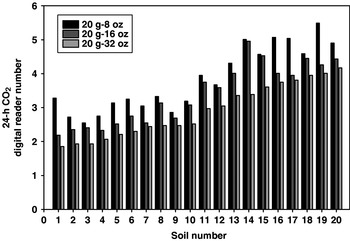
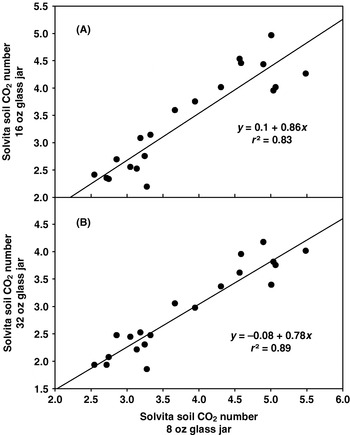
When high soil CO2 respiration is expected, it is possible to increase the container volume, which will dilute the relative amount of CO2 in equilibrium with the gel. This provides flexibility to measure soils with recent manure or compost additions without overwhelming the system with carbon dioxide. The analogous limit with standard CO2 titration methods is when the base (KOH or NaOH) becomes overwhelmed with excess carbonate, and the appropriate recourse is to increase the amount of alkali, or raise its concentration. When we compared various volumes, the mean Solvita number across all 20 soils for the 8 oz jar was 3.84 with a standard deviation of 0.22, mean for the 16 oz jar was 3.40 with a standard deviation of 0.20 and the mean for the 32 oz jar was 2.91 with a standard deviation of 0.18 (Fig. 8). The linear regression relationships between chamber volumes are illustrated in Figure 9. Twenty soils samples of 20 g were used for each chamber volume. The 20 g soil 8 oz glass jar volume is compared to both the 16 and 32 oz glass jar volumes. The data indicate that it is feasible to use greater volumes to dilute the CO2 when incubating soil samples that are expected to produce a high output of soil CO2. We chose to use the 8 oz glass jar since it had the strongest relationship with CO2 from both titration and IRGA compared to the 16 and 32 oz jars (data not shown).
Influence of chamber volume on digital reader number. Twenty grams of soil subsamples were used for each chamber. Chamber size was 8, 16 and 32 oz.

Chamber volume relationships on soil CO2.

Conclusion
The methods we compared were well correlated with each other and offer promise in utilizing soil CO2 data as an index of microbial activity. However, a concentrated effort would be needed to further this research and develop a standardized method for microbial activity which could be readily adapted by soil testing labs. The Solvita gel measurement of soil CO2 is a simple and rapid method which can quantify microbial activity from various soils. Since soil fertility is a relative estimate between soils, the introduction of a rapid and accurate method for soil testing labs, which could separate soils based on microbial activity, could find an application in tracking management changes for either conventional or organic farming systems. In addition, we recommend using the 8 oz glass jar unless soils contain recent addition of manure and/or compost and high CO2 is expected, in which case the use of 16 or 32 oz glass jars can then be substituted without loss of accuracy.
If soil fertility is reflected in the microbial community and one soil is more fertile than another, the more fertile soil should have higher yield potential than the other. Therefore, if we can make connections between soil fertility and soil microbial respiration, we can apply this information to our benefit as stewards of the land. This additional information may enable us to make better management decisions, give us direction in making more accurate fertilizer recommendations or give us a starting place with which to monitor our performance in our soil management strategies.