One of the fundamental debates among second language acquisition scholars revolves around possible explanations for non-convergence on the second language (L2) by (adult) learners. There is a body of evidence that shows that even at near-native levels a certain optionality remains, at least in the production of L2 speakers, and possibly in the grammars as well (Robertson and Sorace, Reference Robertson, Sorace, Klein and Martohardjono1999; Sorace, Reference Sorace2000, Reference Sorace, Cornips and Corrigan2005). The question is whether this is evidence for a deficit at the level of grammatical representation, for example because some categories or features are absent or somehow defective (Franceschina, Reference Franceschina2001; Hawkins and Franceschina, Reference Hawkins, Franceschina, Paradis and Prévost2004), or whether the problem lies in factors that may be considered external to the computational system in domains such as processing and/or pragmatics. Recently several researchers (Filiaci, Reference Filiaci2003; Serratrice, Sorace and Paoli, Reference Serratrice, Sorace and Paoli2004; Sorace and Keller, Reference Sorace and Keller2005; Tsimpli, Sorace, Heycock and Filiaci, Reference Tsimpli, Sorace, Heycock and Filiaci2005; Valenzuela, Reference Valenzuela2005; Sorace, to appear) have suggested that interfaces, that is, areas in which the modules of the grammar intersect with other modules, may be the locus of difficulty not only in second language acquisition but also in simultaneous bilingualism and attrition, leading to optionality and fossilization. In other words, it is not the syntax per se which is vulnerable, nor does the problem lie in the semantics/pragmatics. Rather it stems from the confluence of both domains.
A second area of debate centres on the role of transfer. On the one hand, it has been suggested that the initial stage of L2 acquisition is the first language (L1) (Schwartz and Sprouse, Reference Schwartz, Sprouse, Hoekstra and Schwartz1994, Reference Schwartz and Sprouse1996). On the other, scholars looking at early bilingualism and language attrition have suggested that transfer from one language to the other obeys certain restrictions, and in fact interface areas are particularly vulnerable (Hulk and Müller, Reference Hulk and Müller2000; Müller and Hulk, Reference Müller and Hulk2001).
The grammars of both English and Spanish include the distinction between adjectival and verbal passives, with adjectival passives denoting a state and verbal passives an event. In principle, then, transfer from English should facilitate acquisition. However, Spanish adds a small wrinkle to the mix: the two passives are explicitly distinguished by the choice of verb. As is well known, Spanish has two copulas, ser and estar, both of them equivalent to English be. Adjectival or stative passives are expressed with estar, verbal or eventive passives with ser. The learner has to acquire the correspondence between the interpretation, eventive or stative, and the choice of copula. In other words, simple transfer is not enough, because there is no guarantee that the input will provide enough evidence as to the nature of the two copulas. Several researchers have converged on the idea that the properties of ser and estar can be ascribed to the underlying aspectual difference between the two (Lema, Reference Lema, Amastae, Goodall, Montalbetti and Phinney1992; Schmitt, Reference Schmitt1992), and it is this basic difference that learners have to acquire in order to control the form-to-meaning mapping in the case of the passives. The semantics of aspect is known to cause problems not only for second language learners but also for heritage speakers and, thus, constitutes a prime example of the vulnerability associated with interface conditions (Montrul, Reference Montrul2002).
This paper will focus on knowledge of the properties related to the two passives by adult L1 English learners of L2 Spanish. It will compare choice of copulas in the passives with the choice of copulas when the predicate is an adjective. Dekydtspotter, Sprouse and Thyre (Reference Dekydtspotter, Sprouse and Thyre2000), Borgonovo and Prévost (Reference Borgonovo, Prévost, Beachley, Brown and Conlin2003), Borgonovo, Bruhn de Garavito and Prévost (Reference Borgonovo, Bruhn de Garavito, Prévost, Burgos, Clark-Cotton and Ha2005) and Borgonovo, Bruhn de Garavito, Guijarro-Fuentes, Prévost and Valenzuela (Reference Borgonovo, Bruhn de Garavito, Guijarro-Fuentes, Prévost, Valenzuela, Foster-Cohen, Medved Krajnovic and Djigunovic2006), among others, have shown that acquisition of the syntax/semantics interface is indeed possible. Following these results, we predicted that learners would be able to converge on the target grammar, that is, learners would be able to distinguish the contexts that are appropriate for each of the copulas. As we will see, our results show only partial convergence, in that learners made the appropriate distinctions consistently only when the predicate was an adjective.
Eventive and stative passives in English and Spanish
The properties of verbal and adjectival passives were first described in detail in Wasow (Reference Wasow, Culicover, Wasow and Akmajian1977). In this seminal paper, Wasow suggested that the different properties of these constructions could be explained if we assume that verbal passives are the result of transformations while adjectival passives are lexically derived. He provided several tests to determine the difference between a participle which has been adjectivized, as in (1), and a verbal participle, as in (2), and these tests have been frequently used in the literature (see Levin and Rappaport, Reference Levin and Rappaport1986, among others).
- (1)
a. The chicken was well cooked/was uncooked.
b. The cooked/uncooked chicken.
c. The chicken seemed well cooked.
- (2)
a. The chicken was cooked/*uncooked in a coal stove.
b. *The chicken seemed cooked in a coal stove.
The generally accepted analysis of verbal passives is that the agent theta role is not assigned (or is assigned to the participial ending, as suggested by Baker, Johnson and Roberts, Reference Baker, Johnson and Roberts1989) and accusative case is absorbed. The theme argument must move to the specifier of IP to receive case (Jaeggli, Reference Jaeggli1986). In regard to adjectival passives, following Levin and Rappaport (Reference Levin and Rappaport1986), we will assume that the change of category of the participle from verbal to adjectival accounts naturally for the properties we find, namely the suppression of the external role of the base verb, the externalization of the internal role, the absorption of case and the elimination of the [NP, VP] position.
Although most of Wasow's tests for the two types of passive do not generally apply in Spanish, it seems clear that adjectival passives are expressed by way of the copula estar, as in (3), while verbal passives are expressed with ser, as in (4), as the translation of the English examples shows.
(3)

the chicken was (estar.imperfect) well cooked
“The chicken was well cooked.”
(4)
“The chicken was cooked in a coal stove.”

Levin and Rappaport (Reference Levin and Rappaport1986, p. 625 footnote) state that adjectival and verbal passives differ in that adjectival passives represent states and verbal passives events. We will concentrate on this distinction given that it is closer to the interpretation suggested in the literature to account for the two copulas.
The two Spanish copulas have been the focus of many researchers in the linguistic literature (Falk, Reference Falk1979; Vañó-Cerdá, Reference Vañó-Cerdá1982; Clements, Reference Clements1988; Leonetti, Reference Leonetti1994; Fernández Leborans, Reference Fernández Leborans1995, Reference Fernández Leborans, Bosque and Demonte1999; Delbecque, Reference Delbecque, Verspoor, Lee and Sweetser1997, among others). Within the generative framework scholars have arrived at a consensus that the difference between predicates expressed by way of ser and those expressed with estar is somehow related to aspect. There is disagreement, however, on whether the aspectual features are encoded on the predicates (Luján, Reference Luján1981; Bosque, Reference Bosque and Bosque1990; Varela, Reference Varela, Laeufer and Morgan1992) or are at the heart of the difference between the copulas themselves (Lema, Reference Lema, Amastae, Goodall, Montalbetti and Phinney1992; Schmitt, Reference Schmitt1992). Luján (Reference Luján1981) argues that all adjectives and most participles are stative in nature, but that they differ in whether they are perfective or not. Predicates that are expressed by way of estar express a perfective state, that is, they refer to a delimited period of time, while those expressed with ser are imperfective. Varela (Reference Varela, Laeufer and Morgan1992) has argued that in Spanish there is no need for recategorization of verbal participles into adjectivals in order to explain the differences between them. Rather, the difference can be explained if we assume that there is a covert aspectual marker on the participle that is maintained in the course of the derivation from the verb. She considers, for example, that a sentence such as La casa es construida “The house is built” (with ser) expresses a progressive passive with agent control and undelimited aspect. In contrast, La casa está construida “The house is built” (with estar) expresses a stative passive, with no agent controller and delimited aspect. In contrast to these approaches, Lema (Reference Lema, Amastae, Goodall, Montalbetti and Phinney1992) argues that only ser is a copula, without any features, while estar is a copulative auxiliary, carrying aspectual features. Schmitt (Reference Schmitt1992) also suggests that ser is unmarked for aspect, while estar is perfective. Following Schmitt (Reference Schmitt1992) and Lema (Reference Lema, Amastae, Goodall, Montalbetti and Phinney1992), we will assume ser is unmarked for aspect and derives its aspectual interpretation from the type of predicate. Estar, in contrast, represents the result state of an accomplishment verb, that is, it is marked as perfective. At the same time, we would like to argue that, as Luján and Varela suggest, the participles are also marked as +/− perfective and must check their features with the copula. Given that ser is unmarked, both perfective and imperfective participles will be possible without resulting in a clash. On the other hand, only perfective participles will be possible when the copula is estar.
Several properties arise from this analysis. In the first place, only eventive passives carry an implicit agent that can be expressed by means of a “by”-phrase (Varela, Reference Varela, Laeufer and Morgan1992). The resultant state, expressed with estar, cannot, as shown by the contrast between (5a) and (5b).Footnote 1 Sentence (5a) expresses the ongoing event of building, while (5b) expresses the state that results from building.
- (5)
a.
(por obreros mexicanos).
(by Mexican workmen)
“The houses are built in the valley by Mexican workmen.”
b.
(*por obreros mexicanos).
(by Mexican workmen)
“The houses are built in the valley.”
Secondly, because the verbal passive expresses an event, the canonical tense in the past for this structure is the preterite (or the present perfect, preferred in some dialects), illustrated in (6a). The resultant state, in contrast, will generally appear in the imperfect, (6b). Unlike (6b), in which the dinner was already in a state of having been prepared when the speaker arrived, in (6a), the preparing of the supper is interpreted as an event taking place subsequent to the act of arrival. This does not mean that ser passives can never be imperfect or that estar passives can never be preterite; it simply means that, in the absence of a context, the tenses in (6) would be the natural past tenses to use in each case.
- (6)
a.
preparada por Carmen cuando llegué a casa.
b.
Finally, it is well known that the subject of perfective predicates cannot be interpreted as generic (see Slabakova and Montrul, Reference Slabakova and Montrul2003). Given that ser does not carry the feature [+perfective], only the subject of ser can be interpreted as a true generic, while the subject of estar can only be interpreted as particular or belonging to a closed set. This contrast is illustrated in (7).
- (7)
a.
“Firemen (in general)/the firemen (specific group) are hurt frequently.”
b.
“*Firemen (in general)/the firemen (specific group) are hurt frequently.”
One question that remains to be addressed is whether eventive and stative passives in Spanish correspond exactly to what are generally taken to be verbal and adjectival passives in English. We believe that in general there is overlap, but the match is not exact. In particular, a group of stative verbs that represent mental states or psych verbs behave in unexpected ways, as noted by Luján (Reference Luján1981) and Varela (Reference Varela, Lee, Geeslin and Clements2002). Sentences (8a, b) shows that a participle such as conocido “known” appears exclusively with the verb ser. However, it is also a member of the small group of participles that can be used as an adjective preceding a noun, as in (8c), which would make it adjectival. It is possible that this problem is due to the double nature of these verbs. A verb like conocer “to know” is interpreted as a state when it appears in the present or imperfect tense, and as an event in the preterite, illustrated in (9). In other words, its aspectual features are not lexically fixed in the same way as other verbs.
- (8)
a.
“That professor is known by a lot of people.”
b.
“That professor is known.”
c.
“that (well)-known professor”
- (9)
a.
“María knew (was acquainted with) that professor.”
b.
“María met that professor.”
Apart from examples like those in (9), eventive passives with ser can be considered verbal passives, while stative passives with estar are adjectival. Although most tests for verbal and adjectival passives do not work in Spanish, the prefix in- may frequently serve to show that a participle has been turned into an adjective. As (10) shows, in- participles can only appear with estar.
(10)
“The work is unfinished.”
To summarize, ser with a past participle is interpreted as an eventive (verbal) passive, while estar points to a stative (adjectival) passive. Unlike stative passives, the subject of eventive passives in Spanish can be interpreted as generic, eventive passives are canonically expressed in the preterite when referring to the past, and they can take an agent “by”-phrase.
Before moving on to the next section it is necessary to note that, although the expression of the eventive passive with the verb “to be” is grammatical in Spanish, there is another form of passive that is very much preferred by most speakers, the impersonal passive with the clitic se. It differs from the “be” passive, among other ways, in that in most dialects the agent cannot be overtly expressed (Otero, Reference Otero, Bordelois, Contreras and Zagona1986; Bruhn de Garavito, Reference Bruhn de Garavito2000). This lack of frequency of the “be” passive in the input has been suggested as the explanation for its late acquisition in Spanish as a first language (Pierce, Reference Pierce1992).
Learnability problem
There is no reason to believe that English and Spanish differ in any fundamental way in relation to the syntax of eventive passives. English and Spanish exhibit similar grammatical representations at an underlying level, but at the surface level Spanish forces a choice that is not available in English. The question that arises is whether L1 speakers of English, a language that does not explicitly encode the difference between the passives, can extract from the input the correlation between type of passive and copular use in Spanish. The problem is somewhat similar to Sorace's groundbreaking work on the acquisition of unaccusative verbs (Sorace, Reference Sorace1993a, Reference Soraceb; see also Montrul, Reference Montrul2005). The distinction between unaccusatives and unergatives, first proposed by Perlmutter (Reference Perlmutter1978) and Burzio (Reference Burzio1986) exists in most languages, but in English the distinction is quite subtle and difficult to notice, while in Italian it is clearly encoded in the past tenses by the choice of auxiliary. Sorace (Reference Sorace1993a, Reference Soraceb) proposes an unaccusativity hierarchy (see also Montrul, Reference Montrul2005 for a similar analysis of Spanish), that is, there is a core set of verbs that are universally treated as unaccusative, while others may show different degrees of variation. In French, the distinction regarding the choice of auxiliary surfaces only in core cases while in Italian it is also marked on verbs that belong in the periphery. Sorace found that French learners of Italian exhibited what she termed a divergent grammar, that is, they produced consistent judgments that were nevertheless different from Italian judgments. The English speakers made random judgments, which Sorace took to mean their grammars where incomplete, lacking some of the properties of the L2. In other words, the learners were incapable of transferring the underlying knowledge which we may assume their grammar has regarding the distinction between different types of intransitive verbs in order to apply it to the overt distinction found in Italian. The input was insufficient to allow them to make the connection.
In order to connect the choice of copula with the type of passive, L2 learners of Spanish have to notice the aspectual properties of the copula, that is, the fact that ser does not carry perfective features while estar does. If our analysis of feature checking between the participles and the copulas is correct, they also have to realize that Spanish participles differ from English participles in that they may be marked for perfectivity. In both cases, the learners must access semantic interpretation, relying heavily on context to access the relevant properties.
Most researchers agree that adult second language learners do not necessarily converge on the target language. However, there is also a great deal of evidence that syntactic properties, including highly subtle ones, are acquirable (see White, Reference White2003). If this is the case, what is the cause for the lack of convergence? Scholars have recently suggested that the difficulty lies at those points where the computational system must interface with other systems, both internal, such as the syntax/morphology or phonology/morphology interfaces, and external, in particular the interface between syntax and the conceptual–intentional system (White, to appear). This last interface is particularly problematic for second language learners because the relevant information is not supplied by universal linguistic principles that are accessible to all but rather by context, as is the case for copular choice in Spanish. Interfaces such as these exhibit a certain “vulnerability” which may be implicated in delay in acquisition, fossilization, attrition or incomplete learning (Filiaci, Reference Filiaci2003; Montrul, Reference Montrul2004; Sorace, Reference Sorace2004; Tsimpli et al., Reference Tsimpli, Sorace, Heycock and Filiaci2005). These problems arise in different types of acquisition, including second language acquisition (Montrul, Reference Montrul2002; Serratrice et al., Reference Serratrice, Sorace and Paoli2004; Valenzuela, Reference Valenzuela2005; Lozano, Reference Lozano2006), bilingual acquisition (Hulk and Müller, Reference Hulk and Müller2000; Müller and Hulk, Reference Müller and Hulk2001), heritage languages (Montrul, Reference Montrul2002, Reference Montrul2004) and indirectly they are also implicated in language change (Montrul, Reference Montrul, Lefebvre, White and Jourdan2006). According to Sorace (Reference Sorace2004) the difficulties posed by interfaces may lead to permanent indeterminacy.
The explanations for this vulnerability vary. It may be that interface areas are more complex and therefore inherently difficult (Sorace, Reference Sorace2004; Valenzuela, Reference Valenzuela2005), or that vulnerability is linked to transfer (Tsimpli et al., Reference Tsimpli, Sorace, Heycock and Filiaci2005). In recent work, Sorace (Reference Sorace2006), following Clahsen and Felser (Reference Clahsen and Felser2006), has suggested that the problem may lie not with grammatical representation, but rather with processing. According to Clahsen and Felser, when parsing sentences, second language speakers rely on semantic, pragmatic and lexical cues and not on the syntactic structure, in contrast to L1 speakers. This is referred to as shallow parsing. Sorace differs from Clahsen and Felser in that she assumes that shallow parsing is available to all speakers, but that bilingual speakers rely on it to a higher degree. Furthermore, for Sorace (Reference Sorace2006, p. 91), shallow parsing is only a “relief strategy”, that is, it is brought into play when the processing load is heavy. Full processing is available at least to very advanced speakers. In this way, the vulnerability caused by shallow processing is not deterministic; it does not predict that acquisition cannot take place. Nevertheless, it is difficult to separate processing and acquisition, or processing and grammatical representation, in this way (Duffield, Reference Duffield2006). Carroll (Reference Carroll1999, Reference Carroll2000) has shown how processing at all levels – phonetic, phonological and syntactic – relies on grammatical representation at those levels. In fact, it is possible that acquisition takes place when processing breaks down at a particular level, forcing the learner to change the representation (see White, Reference White1987, for a similar suggestion). Furthermore, research has shown that learners are able to overcome the problems posed by heavy reliance on context in many areas (Dekydtspotter et al., Reference Dekydtspotter, Sprouse and Thyre2000; Borgonovo and Prévost, Reference Borgonovo, Prévost, Beachley, Brown and Conlin2003; Borgonovo et al., Reference Borgonovo, Bruhn de Garavito, Prévost, Burgos, Clark-Cotton and Ha2005; Borgonovo et al., Reference Borgonovo, Bruhn de Garavito, Guijarro-Fuentes, Prévost, Valenzuela, Foster-Cohen, Medved Krajnovic and Djigunovic2006).
Acquisition of the passives has been extensively studied in L1 research, particularly in relation to the late acquisition of verbal passives as opposed to adjectival passives (Bever, Reference Bever and Hayes1970; De Villiers and De Villiers, Reference De Villiers and De Villiers1973; Maratsos, Reference Maratsos1974; Borer and Wexler, Reference Borer and Wexler1992, among others). Recent refinements in research methods and extension of the examination of the passives to other languages (see Allen, Reference Allen1996, for Inuktitut; Demuth, Reference Demuth1990, for Sesoto, among others) led many scholars to conclude that both passives are acquired relatively early, although there may be a series of confounding factors. Interest in the passives has not spread to second language acquisition, although interest in the two copular verbs has received a lot of attention. VanPatten (Reference VanPatten1985, Reference VanPatten, VanPatten, Dvorak and Lee1987) carried out a longitudinal study of the formal acquisition of the two copulas by a group of six learners. He proposed five stages: omission of the copula (stage 1); almost exclusive use of ser (stage 2); use of estar to form the present progressive (stage 3); estar used to express location (stage 4); and estar with some adjectives (stage 5). Similar, although not identical, stages have been found in other studies (Ryan and Lafford, Reference Ryan and Lafford1992; Briscoe, Reference Briscoe1995; Ramírez-Gelpi, Reference Ramírez-Gelpi1995).
Apart from the interest in the stages of acquisition, most of the work on the two copulas has been carried out by Geeslin and Guijarro-Fuentes (Geeslin, Reference Geeslin, Leow and Sanz2000, Reference Geeslin2001, Reference Geeslin2002a, Reference Geeslinb, Reference Geeslin2003; Geeslin and Guijarro-Fuentes, Reference Geeslin and Guijarro-Fuentes2004, Reference Geeslin and Guijarro-Fuentes2006) working within a variationist model. Following Silva-Corvalán's (Reference Silva-Corvalán1986) work on heritage speakers of Spanish in the United States, Geeslin and Guijarro-Fuentes argue that binary oppositions (such as the aspectual distinction defended here) fail to account for the use of the two copulas in second language acquisition. They propose a series of variables that may receive different weightings in the decision to choose a particular copula in monolingual or bilingual speech. These weightings vary from speaker to speaker and the variation may be used to pinpoint the differences that may exist between first language speakers and second language learners, language learners at different stages, bilinguals, etc. They may also allow a comparison of possible differences between languages such as Portuguese and Spanish (Geeslin and Guijarro-Fuentes, Reference Geeslin and Guijarro-Fuentes2006) both of which distinguish between the two copulas. Geeslin (Reference Geeslin2001) also argues that the variation in weighting of the different features by speakers is active in both second language acquisition and language change. Language change mirrors language acquisition in that language change is movement away from a target and language acquisition a movement towards it. The variables include some of Silva-Corvalán's (Reference Silva-Corvalán1986) original distinctions, such as Frame of Reference and Susceptibility to Change, with some recent additions such as Adjective Class, Semantic Transparency, Animacy, Experience with the Referent, and, in more recent work (Geeslin and Guijarro-Fuentes, Reference Geeslin and Guijarro-Fuentes2006), the variable referred to as “Copulas Allowed”, that is, cases in which standard Spanish allows only one copula with particular adjectives. As can be seen, these variables are quite eclectic, ranging from semantic and pragmatic to lexical and syntactic, and it is perhaps this eclecticism that reduces their explanatory power. There is no restriction to the number or type of variables that may be involved. Although we agree that the subject is complex and it is very possible that it will turn out to be the case that strict adherence to one binary difference may not be sufficient to understand the uses of ser and estar, it seems to us that a more principled approach may have an important contribution to make.
Our main question for this empirical study was whether the L2 learners would be able to differentiate between eventive and stative passives on the basis of the choice of copula. In order to do this the learners must have extracted from the input knowledge about the aspectual properties of the copulas and the participles involved. The L1 of the L2 speakers, English, distinguishes between the passives, although this distinction is not marked overtly. In spite of this, we hypothesize that transfer from English would contribute towards “noticing” the distinction in Spanish.
The study
Participants
Two groups of participants took part in this study, 21 English-speaking advanced level learners of Spanish and 21 native speakers of Spanish. The learners were between 22 and 50 years old and all of them reported having been exposed to Spanish for the first time at the age of 12 or above. All were students at a Canadian university at the time of testing except for four, who were living in Spain. All the Canadian students had travelled to a Spanish-speaking country for a period ranging from 2 months to 2 years. Their proficiency level was established by a placement test based in part on the Spanish DELE and in part on the MLA Cooperative Foreign Language tests (see Duffield and White, Reference Duffield and White1999, for a description).
The native speakers were between 22 and 46 years old and all living in Canada at the time of testing. Of these, 14 were Mexicans, 2 were from Peru and 5 were Colombian. Their length of stay in Canada ranged from a few months to 14 years. Three said they learned English at school, while the others had studied it as a subject but never used it to communicate until they arrived. Impressionistically, their English was at the intermediate level or below.
Tests
Besides the language profile and the placement test, the participants were asked to complete three tasks: a Grammaticality Judgment Task, a Sentence Selection Task and a Translation Task. We will not be reporting the results of the translation task. As one of our reviewers suggested, the validity of such a task is doubtful. Furthermore, many of the native speakers were not able to complete it because their English was not good enough. We will describe each of the other two tests, and immediately after, report the results of that particular test.
Grammaticality Judgment Task
The Grammaticality Judgment Task was made up of 70 sentences, 40 grammatical and 30 ungrammatical. Where possible the contrast between grammaticality and ungrammaticality was made with minimal pairs. Judgments were made on a scale from 1 to 5, where 1 was a judgment of “totally unacceptable” and 5 a judgment of “totally acceptable”.
The first contrast tested knowledge of the copulas with an adjective. The adjectives were chosen from among those that only allow either ser or estar. There were 10 sentences with ser, 5 grammatical and 5 ungrammatical, and 10 with estar, 5 grammatical and 5 ungrammatical. The objective of these sentences was to establish whether the speakers showed a basic understanding of the difference between the two copulas in the presence of adjectival predicates that, as suggested by Geeslin and Guijarro-Fuentes (Reference Geeslin and Guijarro-Fuentes2006), are the most difficult to acquire. Impressionistically, we considered the adjectives chosen less frequent, although they were by no means rare. Examples are given in (11) and (12).
- (11)
a. Ser + adjective, grammatical
“The dog is loyal.”
b. Ser + adjective, ungrammatical
“The policemen are available.”
- (12)
a. Estar + adjective, grammatical
“The policemen are available.”
b. Estar + adjective, ungrammatical
“Luisa's cat is loyal.“
The second group of sentences focused on the two passives with and without agents. In the first place, there were 10 sentences without an explicit agent, exemplified in (13), 5 with ser and 5 with estar. These were all grammatical and were included to ascertain that the learners did in fact accept participles with both copulas. They were contrasted with 10 sentences in which the agent was expressed with a “by”-phrase, as in (14). Recall that the 5 sentences with ser would be grammatical while the 5 with estar would be ungrammatical.
- (13)
a. Eventive passive (ser), no agent expressed, grammatical
“In the consulate documents are handed in during office hours.”
b. Stative passive (estar), no agent expressed, grammatical
“The dinner is already prepared for the party.”
- (14)
a. Eventive passive (ser), agent, grammatical
“In the consulate documents are handed in by the secretary.”
b. Stative passive (estar), agent, ungrammatical
“The dinner is already prepared by a professional cook.”
The third contrast we tested involved the canonical past tense used for each of the passives. Recall that in this case it is not a question of grammaticality – both the imperfect and the preterite are possible with both copulas – but the more natural option is for states in the past to be expressed with the imperfect and events with the preterite (indicated by # in the examples below). There were 10 eventive passives, exemplified in (15), 5 in the imperfect and 5 in the preterite, and 10 statives, as in (16), again with both aspects.
- (15)
a. Eventive passive, preterite, preferred
the book was.preterite written in England
“The book was written in England.”
b. Eventive passive, imperfect, dispreferred
the book was.imperfect written in English
“The book was written in English.”
- (16)
a. Stative passive, preterite, dispreferred
“Yesterday the dinner was served on the table.”
b. Stative passive, imperfect, preferred
“Yesterday the dinner was served on the table.”
The final contrast was between participles with the prefix in-, which commonly appear only in statives given that these participles behave like adjectives. There were 10 sentences in this type, 5 with ser and 5 with estar.
- (17)
a.
“The painting is unfinished.”
b.
“The painting is unfinished.”
Results of the Grammaticality Judgment Task
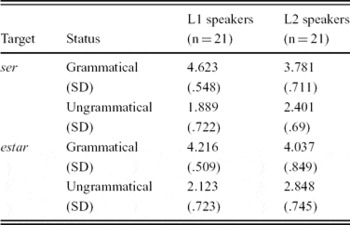
Overall, both groups clearly distinguish between the grammatical and ungrammatical sentences with both ser and estar. The scores were submitted to an ANOVA repeated measures with grammaticality and choice of copula as within-factors and group as between-factor. No significant difference was found between the groups (F(1,40) = .136, p = .7142), but there was a difference according to sentence type (F(3,40) = 141.114, p = 0001) and an interaction between group and sentence type (F(3,120) = 15.376, p = .0001). Table 1 shows the means and standard deviations for the results on grammaticality and choice of copula.
General mean responses on target ser and estar sentences (Grammaticality Judgment Task).

p < .01.
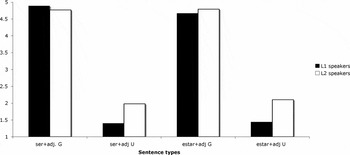
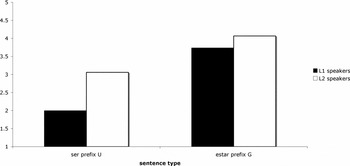
We will now turn to the different sentence types. Figure 1 summarizes the results for the use of the copulas with an adjective as predicate. As we see, both groups correctly accept the grammatical sentences and reject the ungrammatical ones. A Factorial ANOVA comparing the two groups on the different sentence types shows there is no significant difference between the groups for the grammatical sentences (F(1,40) = .282, p = .598 for ser grammatical; F(1,40) = .323, p = .572 for estar grammatical). There was a significant difference for the ungrammatical sentences (F(1,40) = .4.344, p = .043 for ser ungrammatical; F(1,40) = 6.876, p = .012 for estar ungrammatical). However, the L2 speakers clearly distinguish between the grammatical and ungrammatical sentences, and this is confirmed by planned comparisons which show a significant difference between the learners' acceptance rate for the grammatical and ungrammatical sentences (F(1,20) = 101.07, p = .0001 for ser; F(1,20) = 59.145, p = .0001 for estar).
Acceptance of two copulas with adjectives.

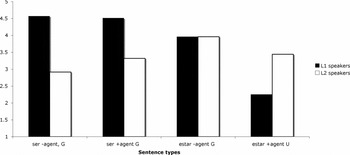
Figure 2 summarizes the results for the passive sentences that tested agentivity. It shows that the native speakers performed as expected. They accepted an eventive passive with and without an explicit agent to a similarly high degree. The responses were somewhat lower for the grammatical stative passives, but still above 4 out of 5. They also clearly distinguish between these statives without an explicit agent and the statives that were ungrammatical due to the presence of an agent.
Mean responses to the passives with and without agents.

It is a different story for the second language speakers. Their acceptance of the two types of eventive sentences is in general lukewarm in comparison to the native speakers, and in fact the two groups differ significantly in both cases (F(1,40) = 26.204, p = .0001 for eventive passives (ser) without an explicit agent; F(1,40) = 13.527, p = .0007 for eventive passives (ser) with an explicit agent). These results are easily explainable. Second language learners of Spanish are taught explicitly to use the impersonal passive instead of the passive with “be”, and are often corrected for overuse of this construction. They would therefore tend to reject these sentences. In fact, it is surprising that the L1 speakers accept them to such a high degree.
Regarding the statives, the mean responses are almost identical for the two groups in the grammatical sentences (F(1,40) = 4.40, p = .9834), which is unsurprising. However, they also accept the ungrammatical sentences to a higher degree than they accept the grammatical eventive passives, and in this respect they differ significantly from the native speakers (F(1,40) = 14.105, p = .0006).
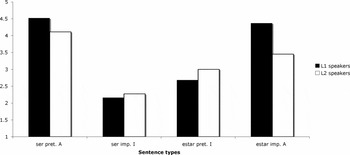
Figure 3 shows the responses to the sentences that tested canonical aspect. Recall that in Figure 3 we are not looking at grammaticality but rather at recognition that an event in the past is more commonly expressed by a perfect tense such as the preterite, while a state is expressed by way of an imperfect. The native speakers have responded appropriately, distinguishing the use of the two tenses. The second language learners do not differ from the native speakers in the eventive passives, clearly preferring the preterite, and in fact there is no significant difference between the groups (F(1,40) = 2.636, p = .1123 for the eventives in the preterite; F(1,40) = .106, p = .7461 for the eventives in the imperfect). They do not clearly distinguish between the two tenses in the case of the statives. We find no significant difference between the learners and the L1 speakers in their rejection of the preterite with statives (F(1,40) = .833, p = .3667), but they do differ significantly in their acceptance of the imperfect which is much lower than expected (F(1,40) = 7.39, p = .0097).
Canonical aspect in both types of passives.

The final contrast the Grammaticality Judgment Test looked at was the presence of the prefix in- on the participle, an indication that the participle is adjectival. Results are seen in Figure 4.
Copular choice in the presence of in-prefixes participles.

Both groups distinguish between the type of passives when the participle is prefixed. Although the second language learners do so to a lesser degree, there is in fact a significant difference between their responses to each type as a planned comparison shows (F(1,20) = 12.384, p = .0022). In the case of the eventive passives, there is a significant difference between the groups (F(1,40) = 12.504, p = .001), but not in the case of the statives (F(1,40) = 1.319, p = .2577).
To summarize, the L1 speakers make all the contrasts as expected. The L2 speakers make the relevant contrasts where the predicate is an adjective. In the case of the passives, however, they fail to clearly reject an agent in statives, they do not distinguish between the preferred and dispreferred past tense for statives, and they accept the choice of ser when the predicate participle has been turned into an adjective by prefixation.
Sentence Selection Task
The purpose of the Grammaticality Judgment Task was to see whether or not speakers distinguished between grammatical and ungrammatical sentences with the copulas. However, this task does not tell us anything about the interpretation of the subject by the two groups. As we pointed out, only the subject of ser can be interpreted as generic, and this applies both when the predicate is an adjective and in the passives. To elicit this information a Sentence Selection Task was included. As with the Grammaticality Judgment Task, a comparison was made between the passives and the two copulas with adjectival predicates. The task consisted of short scenarios followed by four options from which the participants had to choose: a sentence with the verb ser, a sentence with the verb estar, rejection of both, or acceptance of both. In total there were 40 scenarios, 22 of which tested the interpretation of the subject, with 18 distracters. Given that Slabakova and Montrul (Reference Slabakova and Montrul2003) showed that L2 learners are able to use perfectivity to conclude that the subject of a preterite cannot be interpreted as generic, all of the crucial sentences in this task used the present to insure that judgments were based on the type of copula and not on the tense of the verb. For 11 of the scenarios the only choice possible was the ser sentence because the scenario set up a situation in which the subject of the given sentence had to be interpreted as generic. In six of these the copula was followed by an adjective, as in (18), the other five were passives, as in (19). In the other 11 cases the scenario set up a situation in which the interpretation of the sentence was stative and the interpretation of the subject was specific, so the natural choice would be the verb estar. Of these sentences, 6 included an adjective, illustrated in (20), and 5 a participle, in (21).
(18) Copula + adjective, generic interpretation of the subject, ser
Enrique y Paquita est{a}n hablando de deportes. Enrique dice que le gustan todos los deportes menos el f{u}tbol. Paquita est{a} sorprendida y le pregunta por qu{e}. Enrique dice:
a. Los fan;ticos del fútbol son violentos.
b. Los fanáticos del fútbol están violentos.
c. Ni a ni b.
d. Ambas, a y b.
Enrique and Paquita are talking about sports. Enrique says he likes all sports except football (soccer). Paquita is surprised and asks why. Enrique says:
a. Football fans are (ser) violent.
b. Football fans are (estar) violent.
c. Neither a nor b.
d. Both a and b.
(19) Copula + participle, generic interpretation of the subject, ser
Patricia pidió una taza de té a la inglesa. No quiso tomárselo. Patricia dijo:
a. En Inglaterra el té es servido sin azúcar.
b. En Inglaterra el té está servido sin azúcar.
c. Ni a ni b.
d. Ambas, a y b.
Patricia asked for a cup of tea English style. She wouldn't drink it. Patricia said:
a. In England tea is (ser) served without sugar.
b. In England tea is (estar) served without sugar.
c. Neither a nor b
d. Both a and b
(20) Copula + adjective, non-generic interpretation of the subject, estar
Luisa y Guillermo están en el partido final del campeonato de fútbol en el que juega su equipo favorito. Suelen ir a todos los partidos pero hoy Luisa no lo está pasando bien porque . . .
a. Los fanáticos son violentos.
b. Los fanáticos están violentos.
c. Ni a ni b.
d. Ambas, a y b.
Luisa and Guillermo are in the final game of the football championship in which their favourite team is playing. They usually go to all the games but today Luisa is not having a good time because . . .
a. The fans are (ser) violent.
b. The fans are (estar) violent.
c. Neither a nor b
d. Both a and b
(21) copula + participle, non-generic interpretation of the subject, estar
Lucía está muy enojada. Esperaba una buena taza de café al llegar a casa. Lucía dijo:
a. ?‘Por qué no es servido el café?
b. ?‘Por qué no está servido el café?
c. Ni a ni b.
d. Ambas, a y b.
Lucía is very angry. She expected a good cup of coffee when she got home. Lucía said:
a. Why isn't (ser) the coffee served?
b. Why isn't (estar) the coffee served?
c. Neither a nor b
d. Both a and b
Results of the Sentence Selection Task
Before analysing the results of the Sentence Selection Task, we briefly address the problem of coding. Recall that the main objective of this task was to determine whether the generic interpretation of the subject was restricted to ser in the grammar of the participants. As mentioned above, it is well known that native speakers of Spanish do not generally like eventive passives with “be”, preferring either an impersonal passive or an active sentence. Because of this negative attitude towards eventive passives, there was the possibility that participants would answer “neither” when given a choice between a passive with ser or a sentence with estar when the subject was to be interpreted as generic. They would reject estar because the story forces a generic interpretation that is not available with this copula, and they might reject ser because they are not comfortable with passives. In a pilot study for this project this response was indeed quite frequent (Bruhn de Garavito and Valenzuela, Reference Bruhn de Garavito, Valenzuela, Dekydtspotter, Sprouse and Liljestrand2005). In the present study we decided to exclude the answer “neither”, counting only a clear choice of ser and a clear choice of estar. The native speakers rejected both options 16% of the time, the L2 speakers rejected it 8.57%. The answer “both” was included in the count as incorrect.
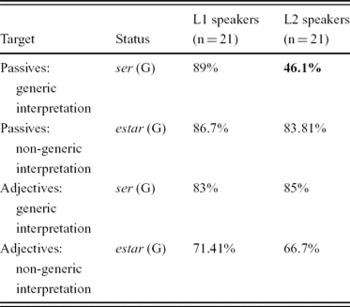
Table 2 shows the correct responses to the Sentence Selection Task. The native speakers responded as expected, choosing ser when the story forced a generic interpretation of the subject over 80% of the time, both in passives and when the predicate was an adjective. Interestingly, results of a Factorial ANOVA comparing the groups and the sentence types show the second language speakers’ responses were not significantly different from those of the native speakers when the predicate was an adjective (F(1,40) = .203, p = .6549 for the generic interpretation; F(1,40) = .679, p = .4149 for the non-generic interpretation), nor was there a significant difference in the case of the passives when the interpretation of the subject was not generic (F(1,40) = .269, p = .6071). However, when the genericity of the subject was found in a passive, they correctly chose ser only 46% of the time. This difference between the second language speakers and the native speakers is highly significant (F(1,40) = 24.26, p = .0001).
General mean responses on target ser and estar sentences (Sentence Selection Task).

Discussion and conclusions
In this research project we set out to discover whether English L1 learners of Spanish would be able to distinguish the two types of passive in relation to the choice of copula. We argued that in order to do this the learners had to extract from the input information about the aspectual features of the two copulas and of the participles in Spanish.
The first question we must address is, therefore, whether the learners’ performance provides evidence for knowledge of the distinction between the copulas. The results on those sections of the test that examine the copular distinction with adjectival predicates point to an affirmative answer. The learners correctly distinguished between the copulas with adjectives, not only in the Grammaticality Judgment Task but also in the Sentence Selection Task. This last finding is crucial, because it could be argued that the choice of copulas with adjectives is formally taught at all levels. However, as far as we know, students are never told that only the subject of ser can be interpreted as generic. If we assume, as most authors do (Montrul, Reference Montrul2002, among others), that aspectual distinctions are fundamentally tied to semantic interpretation (although these distinctions may be encoded in the syntax as well), it would seem that the semantics/lexicon interface represented in the choice of copula is controlled by these speakers. This is particularly clear in view of the fact that the aspectual distinction is tied in this case to the semantic interpretation of the subject as generic or non-generic.
The results for the choice of copula to distinguish between the two types of passive are not so clear. The learners’ performance on the Grammaticality Judgment Task differed significantly from the results for the native speakers. However, we must not forget that their responses distinguished between the grammatical and ungrammatical options, both overall and in the individual sections. The only exception was in the choice of morphological aspect for the stative passives but, as we have seen, this is not a matter of grammaticality, and in fact some of the native speakers failed to see the difference as well.
Again, the crucial results seem to be those of the Sentence Selection Task, and in this test the learners’ results for the passives are surprising. They clearly do not distinguish between the passives regarding the interpretation of the subject, although they do in the case of predicative adjectives. In fact the responses of the learners appear to be random, 46% appropriate choice of the ser passive, 54% inappropriate choice of the estar passive.
Can the problem seen here be due to the participle? As we have seen, Bosque (Reference Bosque and Bosque1990) and Varela (Reference Varela, Laeufer and Morgan1992) have suggested that the Spanish participle inherits the aspectual features of the base verb and these features are maintained when the participle is converted to an adjective. We assumed that this was the problem when we reported on a pilot study for this paper (Bruhn de Garavito and Valenzuela, Reference Bruhn de Garavito, Valenzuela, Dekydtspotter, Sprouse and Liljestrand2005). It is not clear, however, how the participle influences the interpretation of the subject. If, as we have suggested, estar is marked as perfective and the learners know this, the very presence of estar would make a generic interpretation of the subject impossible. Furthermore, recall that we used minimal pairs as much as possible, so the same participles were used in both stative and eventive contexts, in the same way as we used the same adjectives. Finally, the results of the Grammaticality Judgment Task show that the L2 speakers do make the appropriate distinctions regarding the passives. For these reasons we seriously doubt that the participle is the explanation, but there is not enough evidence here to rule out the possibility.
We should at this point ask how the distinction between generic and non-generic interpretation of the subject is made in English. As is well known, the presence or absence of the determiner is crucial, as illustrated in (22) and (23). As the Spanish translations show, the determiner is obligatory in subjects in Spanish. In principle, then, the determiner could be at the root of the problem. Nevertheless, because this was not the case in the choice of copulas with adjectives, we must rule out the determiners as a problem as well.
(22)
(23)
We would like to propose that the problem is related to processing at the interface between semantics and syntax, as proposed by Sorace (Reference Sorace2006). Given that eventive passives involve movement (Wasow, Reference Wasow, Culicover, Wasow and Akmajian1977; Baker et al., Reference Baker, Johnson and Roberts1989) while statives and adjectival predicates do not, we can assume that the processing load for the eventives is much higher. Matching the aspectual properties of the participle and the copula may also contribute to the problem. At the same time, learners are asked to make a semantic distinction, that between a generic and a non-generic subject. It is very possible that the resources, for example in short-term memory, needed for processing movement and feature checking in the syntax at the same time as the semantic interpretation of the subject leads to a breakdown in this particular area. This proposal is only tentative and calls for further research. In particular, it is necessary to look at near-native speakers to see if the problem disappears or is less severe at a higher level of proficiency. It is also necessary to try different methodology, one more appropriate to judging the effects of processing. In short, the value of this study lies perhaps in the questions it raises as much as in any firm results it may provide.