Introduction
In 1978, the Alma-Ata declaration defined Primary Health Care (PHC), particularly mother and child care, as the key tool for high-quality equity health care services and proposed standards.Reference Poropat, Heinz, Barbi and Ventura1–3 Under this scheme, pediatricians are an integral part of medical teams from the centers of PHC since 1984 in Spain, and their functions and activities were established as specialists in pediatrics that provide appropriate medical benefits in relation to health care to children up to 14 years old.4,5
These PHC pediatricians will likely be the first to provide health care at the scene of a life-threatening emergency (LTE) in children. Pediatric LTEs occur less frequently than LTEs among adults,Reference Shirm, Liggin, Dick and Graham6,Reference Adhikari, Mahathi and Ghosh7 and LTEs among children are more likely to commence outside the hospital. Pediatricians should be trained to initially intervene, safely and effectively the LTEs, including the activation of Emergency Medical Systems (EMS), an adequate stabilization of patients and transport to the hospital.8–Reference Ericsson10 This is achieved with adequate training in LTEs, as well as in theoretical knowledge and practical skills: pediatricians must be prepared to provide correct prehospital assistance and to know the activation of EMS.Reference Civantos Fuentes11
Studies have shown that emergencies are common in PHC practices that provide care to children.Reference Flores and Weinstock12 Pediatricians may be required to provide emergent care in their offices for children in their working hours, usually in the morning, at least until the arrival of EMS. The consequences of being unprepared, or thinking that they do not have the adequate theoretical knowledge and practical skills, are serious.
Also, prehospital care system personnel will likely be the first to provide health care at the scene of a mass-casualty event (MCE), in which children may be involved; pediatricians should prepare to intervene in these MCEs, if necessary.Reference Shirm, Liggin, Dick and Graham6 The training of pediatricians to solve LTEs not only includes the performance of techniques or procedures; also, one must considerer communication skills and the ability to work in coordinated teams.Reference Salas, Diaz-Granados, Weaver and King13,Reference Falcone, Daugherty, Schweer, Patterson, Brown and García14
The objectives of this study were to know the training received for out-of-hospital LTEs by PHC pediatricians of the Principality of Asturias (Spain) and the perception they have about their own theoretical knowledge and practical skills in a series of emergency procedures used in LTEs; also, to analyze the differences according to the geographical context of their work.
Methods
This was a cross-sectional survey of the training received and the theoretical knowledge and practical skills, as self-perceived, regarding 30 procedures or techniques that are employed in treatment of LTEs, in a simple random sample with replacement of 27 pediatricians (n) from PHC centers in the eight health care districts of Asturias, from among the total of 88 pediatricians (N) who make up the staff of pediatricians of the PHC Service of Asturias. The interview was conducted by mail from April through May 2019, and the sample was determined by a computer generating system. In the previous review of the bibliography, any validated survey to detect self-perception of the degree of theoretical knowledge and practical skills was found. For this reason, an ad hoc survey was drafted using the Curriculum in Primary Care Pediatrics (CPCP), developed by European Confederation of Primary Care Pediatricians (ECPCP; Europe), which indicates the procedures, theoretical and practical, that should be acquired by PHC pediatricians to solve LTEs.15 From among all the procedures included in the CPCP, 30 were selected because they are used systematically in LTEs using an 11-point Likert scale rating to detect self-perception of the degree of theoretical knowledge and practical skills from zero (“Minimum”) to 10 (“Maximum”). Firstly, a pilot test and cognitive pre-test of the 10 pediatricians from the Primary Health System was conducted in order to establish the most suitable type of question and response scale; the extent, comprehensibility, and logical order of the questions; and also, the duration and acceptance of the survey. The value of the Cronbach Alpha coefficient considered adequate in terms of internal consistency was an alpha value greater than 0.8. Finally, the definitive survey was drafted. The survey also included questions regarding the training received in procedures of Emergency Medicine and its features and time-frame.
In order to demarcate the geographical areas of work into rural, suburban, and urban, the classification used by the Spanish Institute of Statistics (INE; Madrid, Spain) was used. In this manner, the category “rural” corresponded to population centers with 2,000 or less inhabitants; the category “suburban” corresponded to population centers from 2,001 to 10,000 inhabitants; and the category “urban” included population centers with 10,001 inhabitants or more.16
The data processing made use of absolute and relative frequencies, central tendency parameters, and dispersion parameters. Correlation analysis had been used in the bivariate analysis. The estimates for the entire population have been made using confidence intervals for the mean of 95%. In comparisons of parameter difference, parameters with a probability of error less than five percent (P < .05) have been considered significant. In order to compare averages between the different techniques in the different working areas, Kruskal Wallis’ test was used. In comparisons of means between the degrees of theoretical and practical knowledge of the different procedures with the degree of theoretical and practical general knowledge, the Wilcoxon’s signed ranges test was used. These non-parametric tests were chosen to be used because the sub-samples of the work areas were less than 30 pediatricians each one. For the correlation between the means of theoretical knowledge and general practices, and between these and the number of courses taken about Basic Cardiopulmonary Resuscitation (CPR), Advanced CPR, and Advanced Trauma Life Support (ATLS), Pearson correlation coefficient (r) was used. The statistics software used was SPSS Statistics v20 (IBM; Armonk, New York USA).
This study has been examined by Ethics Committee of the Faculty of Medicine and Health Sciences of the University of Oviedo (Spain) and was determinate to be exempt for need of full committee review.
Results
Of the 27 pediatricians, nine (33.3%) were men and 18 (66.7%) were women. All of them had the pediatric medical specialty acquired in the Resident Medical Intern program. Of the 27 professionals, five (18.6%) worked in rural areas, nine (33.3%) worked in suburban areas, and 13 (48.1%) worked in urban areas.
Regarding the institution that provided them with their training in Urgent and Emergency Medicine (UEM) in Pediatrics, two (7.4%) indicated that this took place in courses held by the Healthcare Service of Asturias (SESPA; Asturias, Spain); 16 (25.9%) had acquired this training on their own; while 16 (59.3%) had been trained both by SESPA and on their own. A total of two professionals (7.4%) refused to answer this question. Of the 27 professionals, a total of 63% had studied an official post-graduate university degree in UEM in Pediatrics.
Regarding training in Basic CPR: in rural areas, 80.0% of the total had completed this course most recently less than five years ago; and 20.0% had completed this course most recently more than five years ago and less than 10 years ago. In suburban areas, 100.0% of pediatricians had completed this course most recently less than five years ago. And finally, in urban areas, 53.8% had completed this course most recently less than five years ago; 23.1% had completed this course most recently more than five years ago and less than 10 years ago; and another 23.1% had never taken a Basic CPR course in their entire professional career.
Regarding training in Advanced CPR: in rural areas, 100.0% of pediatricians had completed this course most recently less than five years ago. In suburban areas, 33.3% of pediatricians had completed this course most recently less than five years ago; and 66.7% had completed this course more than five years ago and less than 10 years ago. Finally, in urban areas, 53.8% of pediatricians had completed this course most recently less than five years ago; 15.4% had taken an Advanced CPR course more than five years ago and less than 10 years ago; and 30.8% had never taken an Advanced CPR course in their entire professional career.
In rural areas, 80.0% of pediatricians had completed their last ATLS course more than five years ago and less than 10 years ago, and 20.0% of pediatricians had completed this course most recently more than 10 years ago. In suburban areas, 77.8% of pediatricians had completed this course most recently less than five years ago; 11.1% had completed this course most recently more than five years ago and less than 10 years ago; and another 11.1% had never taken an ATLS course in their entire professional career. Finally, in urban areas, 46.1% of pediatricians had completed their last ATLS course less than five years ago; 15.4% had completed this course more than five years ago and less than 10 years ago; and 38.5% had never taken an Advanced TLS course in their entire professional career.
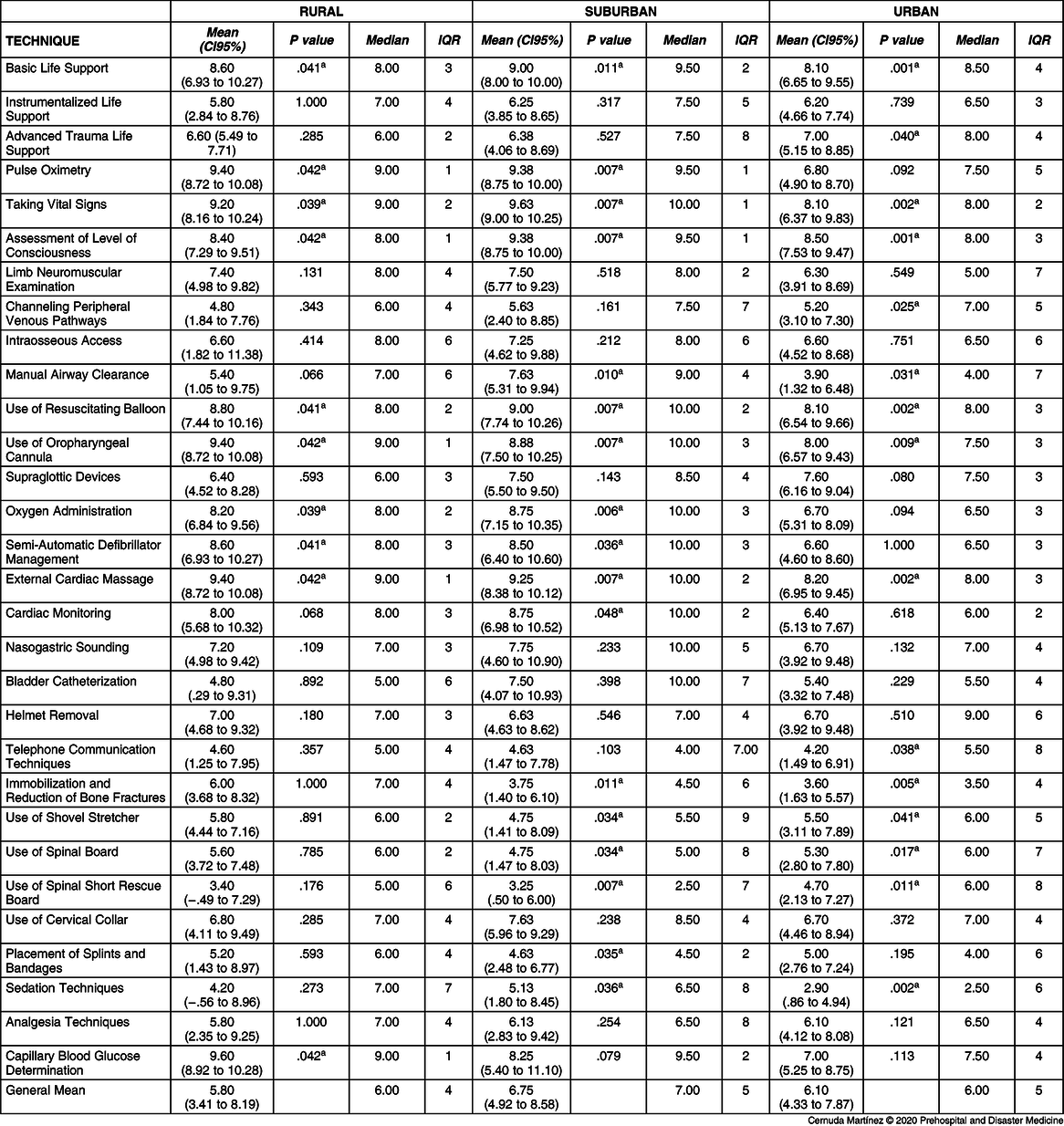
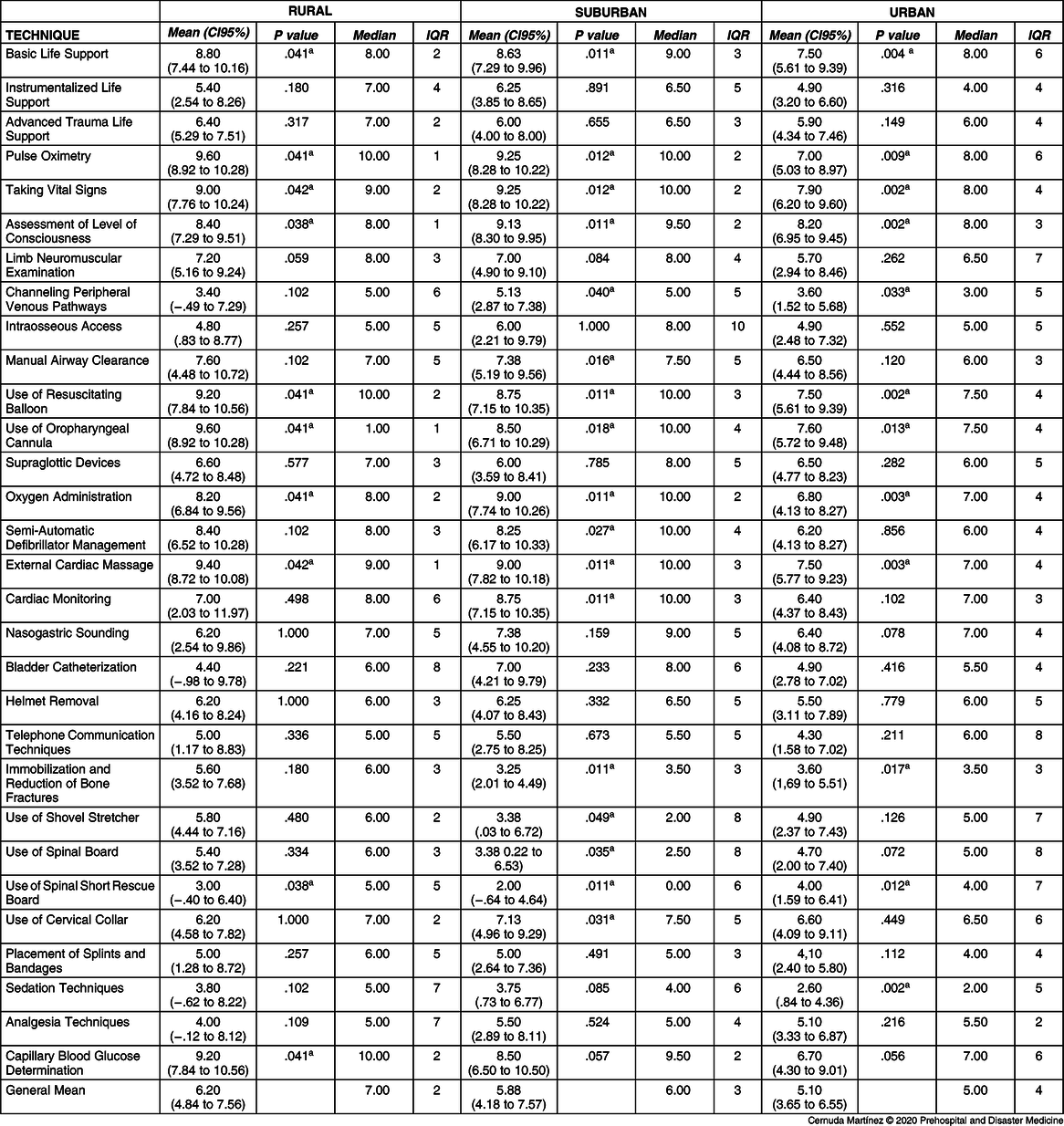
Table 1 and Table 2 display, respectively, the mean theoretical knowledge and practical skills in emergency procedures for all PHC pediatricians in Asturias, between each procedure or technique, and the general mean of theoretical knowledge and practical skill in LTEs, as well as medians and interquartile ranges (IQR). Table 3 shows the correlation between the general mean of theoretical knowledge and practical skill in LTEs and the correlation between both, and the number of courses completed about Basic CPR, Advanced CPR, and ATLS, as well as their P value of all PHC pediatricians of Asturias.
Mean Theoretical Knowledge in Emergency Procedures for All PHC Pediatricians in Asturias between Each Procedure or Technique and the General Mean of Theoretical Knowledge in LTE, as well as Medians and Interquartile Ranges (IQR)

Abbreviations: LTE, life-threatening emergency; PHC, Primary Health Care.
a Statically significative difference (P < .05).
Mean Practical Skill in Emergency Procedures for All PHC Pediatricians in Asturias between Each Procedure or Technique and the General Mean of Practical Skill in LTE, as well as Medians and Interquartile Ranges (IQR)

Abbreviations: LTE, life-threatening emergency; PHC, Primary Health Care.
a Statically significative difference (P < .05).
Correlation between the General Mean of Theoretical Knowledge and Practical Skill in LTEs and the Correlation between Both and the Number of Courses Completed about Basic CPR, Advanced CPR, and Advanced Trauma Life Support

Abbreviations: CPR, cardiopulmonary resuscitation; LTE, life-threatening emergency.
a Statically significative difference (P < .05).
As for the training of pediatricians, in general, for theoretical LTEs, regarding the areas of work, it was the suburban area that showed a greater average in general level of theoretical knowledge (6.75 of 10.0; CI 95%, 4.92 to 8.58), followed by the urban (6.10 of 10.0; CI 95%, 4.33 to 7.87), and the rural (5.80 of 10.0; CI 95%, 3.41 to 8.19). According to practical skills, it was the rural area that showed a greater average in general level of theoretical knowledge (6.20 of 10.0; CI 95%, 4.84 to 7.56), followed by the suburban (5.88 of 10.0; CI 95%, 4.18 to 7.57), and the urban (5.10 of 10.0; CI 95%, 3.65 to 6.55). These differences were not significant.
There were significant differences in the mean of theoretical knowledge and the mean of practical skills in the procedures studied, depending on the different areas of work. Regarding techniques with significant differences between rural, suburban, and urban areas in theoretical knowledge (P < .05), these techniques were: pulse oximetry (P = .021); taking vital signs (P = .045); oxygen administration (P = .039); semi-automatic defibrillator management (P = .041); external cardiac massage (P = .042); cardiac monitoring (P = .017); and capillary blood glucose determination (P = .022).
Regarding techniques with significant differences between rural, suburban, and urban areas in practical skills (P < .05), these techniques were: pulse oximetry (P = .01); semi-automatic defibrillator management (P = .030); external cardiac massage (P = .045); monitorization cardiac monitoring (P = .046); and immobilization and reduction of bone fractures (P = .041).
Discussion
The objective of this study was to compare the PHC pediatricians’ perception about their theoretical knowledge and practical skills in a series of emergency procedures used in LTEs according to the geographical context of their work. Pediatricians who work in suburban areas consider themselves having a higher average level of theoretical knowledge to solve LTEs, while it is those who work in rural areas who perceive themselves having a higher average level of practical skill to intervene satisfactorily in these situations. It could not be compared with previous studies conducted in pediatricians due to non-existence, but it has been compared with two similar studies in PHC doctors and nurses who worked in Asturias.Reference Cernuda Martínez, Castro Delgado, Ferrero Fernández and Arcos González17,Reference Cernuda Martínez, Castro Delgado, Cuartas Álvarez and Arcos González18 It was found that, regarding the doctors, both theoretical and practical self-perception was higher in rural and semi-urban areas, while in the case of nurses, it was both theoretical and practical in rural areas. These data are consistent with those obtained in the present study. This may be due to the fact that in both rural and semi-urban areas, health professionals in general, and pediatricians in particular, must solve LTEs themselves, without the possibility of having specialized sanitary equipment in Advanced CPR, due to dispersion of population and geographic existing in Asturias. In addition, it has been evidenced the existence of a positive, statistically significant correlation between the realization of a greater number of Basic CPR, Advanced CPR, and ATLS courses and a greater theoretical and practical self-perception (in this case, the positive correlation is only statistically significant with ATLS courses). These data suggest that a periodic reinforcement in pediatricians contributes to improve the self-perception of their LTEs training and, consequently, to increase their self-efficacy to positively solve these situations.
In this study, the existence of statistically significant differences stands out in some fundamental procedures, not only in LTEs, but in medicine in general, such as pulse oximetry, use of semi-automatic defibrillators, external cardiac massage, oxygen administration, or taking vital signs. This shows the heterogeneity of the training received by pediatricians, something that should be corrected so as not to bias urgent attention in children by geographical reason.
It has become clear that both at the level of procedures and global knowledge, self-perception is greater in theoretical knowledge than in practical skills to attend LTEs. Currently, although the theoretical part seems to be known, practical training seems more limited because, on the one hand, the probability that a pediatrician has to intervene in an LTE is low and, on the other hand, it is unethical nor professionally acceptable for a pediatrician to learn while putting the child at risk.Reference Civantos Fuentes, Rodríguez Núñez, Iglesisas Vázquez and Sánchez Santos19 An interesting alternative would be to provide advanced medical simulation for pediatricians to acquire the necessary skills without putting the patient at risk.Reference Civantos Fuentes, Rodríguez Núñez, Iglesisas Vázquez and Sánchez Santos19
In addition to formation, a new variable comes into play: anxiety about having to act before an LTE and not having an adequate level of self-efficacy to intervene in it due to a poor perception of theoretical/practical training.Reference Cottrell, O’Brien and Curry20 Some studiesReference Lammers, Byrwa, Fales and Hale21–Reference Lammers, Byrwa and Fales23 concluded that many mistakes made in these types of situations are attributable to the erroneous management of anxiety over insecurity to act. These PHC pediatricians, unlike those who work in hospitals, tend to find a variable environment, but in general, very limited in human and material resources, so that their ability to act can be very restricted. These out-of-hospital pediatricians must have the theoretical knowledge and practical skills necessary to begin the management of any LTE, following current recommendations.Reference Civantos Fuentes, Rodríguez Núñez, Iglesisas Vázquez and Sánchez Santos19
Limitations of the Study
The principal limitation of this study was the small number of study subjects, so the results should be interpreted with some caution. This study has been limited to the geographic area of the Principality of Asturias, and the results are not directly extrapolated to the rest of the Spanish regions. This article explores the pediatricians’ self-perception about their limitations and difficulties in providing a certain type of medical assistance to urgencies and emergencies, but it does not quantify (since it is not their explicit or implicit objective) the “real” capacity of professionals to act in emergencies through some type of examination or practical case.
Conclusions
Asturian pediatricians are generally well-prepared to solve LTEs with a few exceptions, such as telephone communication techniques, use of spinal short rescue board, sedation techniques, or analgesia techniques, in which pediatricians perceive limitations both in the theoretical knowledge and in the practical skills to execute them. The degree of self-perception and acquisition of general theoretical knowledge and general practical skills in LTEs is heterogeneous, with differences according to the scope of work: pediatricians who work in suburban and rural PHC centers have, respectively, a higher perception about their theoretical and practical capacity in LTEs, and urban pediatricians have a lower self-perception in both.
Rural and suburban pediatricians have completed more courses about Basic CPR, Advanced CPR, and ATLS in the last five years than urban pediatricians, so it is necessary to frequently reinforce these courses to increase their self-perception.
Conflicts of interest
none