This study was performed from November 1, 2010, through December 31, 2014, at Asan Medical Center, a 2,700-bed tertiary care teaching hospital in Seoul, Republic of Korea. All patients with CPE-positive clinical or surveillance cultures were prospectively identified. CPE control protocols included isolation in a single room, contact precautions, and weekly surveillance cultures. CPE clearance was defined as at least 3 consecutive CPE-negative follow-up cultures. All available patients who shared a room with CPE-positive patients underwent surveillance cultures for CPE. Production of carbapenemase was determined by phenotypic assays and specific polymerase chain reaction assays for KPC, NDM-1, VIM, IMP, and OXA.Reference Dortet, Brechard, Cuzon, Poirel and Nordmann 3 Only patients who had at least 1 follow-up culture were included in this study. This study was approved by the institutional review board of Asan Medical Center.
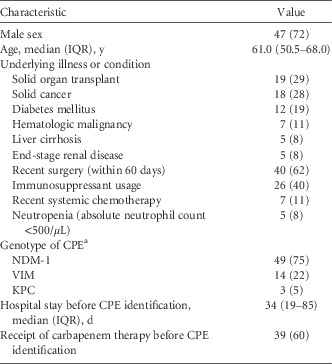
A total of 65 patients with CPE were included in this study (Table 1). Forty-seven patients (72%) were male, and the median age was 61 years. Solid organ transplantation (29%) was the most common underlying condition, followed by solid cancer (28%) and diabetes mellitus (19%). Forty patients (62%) underwent surgery, and 26 (40%) were receiving immunosuppressant therapy. NDM-1 was the most common carbapenemase (n=49), followed by VIM (n=14) and KPC (n=3). Klebsiella pneumoniae was the most common CPE organism (n=24), followed by Enterobacter species (n=20), K. oxytoca (n=8), Serratia marcescens (n=7), Citrobacter freundii (n=5), and Escherichia coli (n=1). The most common initially CPE-positive clinical specimens were urine (n=14), blood (n=12), and sputum (n=12). Surveillance stool cultures detected 9 cases, including 2 patients who had shared a room with CPE-positive patients. Patients were hospitalized for a median (interquartile range) of 34 (19–85) days, and 39 patients (60%) received carbapenem therapy before CPE identification.
Characteristics of the 65 Study Patients With Carbapenemase-Producing Enterobacteriaceae (CPE)

NOTE. Data are no. (%) of patients unless otherwise indicated. IQR, interquartile range.
a In one patient, NDM-1 and VIM were identified together from Klebsiella oxytoca.
A total of 266 follow-up cultures were collected, with a median (range) of 3 (1–19) cultures per patient. The first, second, and third follow-up cultures were negative in 46% (30/65), 57% (29/51), and 40% (14/35) of the cases, respectively. Patients with a single negative follow-up culture had a subsequent positive culture in 30% (15/50) of cases, while patients with 2 consecutive negative follow-up cultures had a subsequent positive culture in 33% (7/21) of cases. Twelve patients had 3 consecutive negative cultures. Three (25%) of these 12 patients relapsed. At hospital discharge, 9 patients (14%) met the definition of CPE clearance, with a CPE-carriage clearance rate of 3.03 episodes per 1,000 patient-days. The median (range) time to CPE clearance in those 9 patients was 27 (23–79) days. Stool that was initially CPE-positive tended to be negatively associated with CPE clearance (7.5% vs 24.0%, P=.08). The total amount of antibiotic use after CPE isolation was not significantly different between the CPE-nonclearance group and the CPE-clearance group (median, 82.9 vs 86.8 antibiotic-days per 100 patient-days; P=.89). Among 564 patients who shared a room with CPE-carrying patients, 263 patients underwent surveillance cultures, and 2 (0.8%) were CPE-positive.
We found that a single negative follow-up culture or 2 consecutive negative follow-up cultures were frequently accompanied by a subsequent positive CPE culture. Furthermore, 25% of our patients with 3 consecutive negative follow-up cultures had a relapse during the same hospitalization period. These findings are consistent with recent reports from the United States,Reference Lewis, Enfield, Mathers, Giannetta and Sifri 4 where KPC is the predominant CPE type. This suggests that 3 consecutive negative cultures may not be sufficient to safely remove CPE patients from isolation.
Notably, CPE clearance was not significantly associated with antibiotic use in our results. This finding should be interpreted with caution, however. The amount of antibiotic use in our patients was similarly high in both CPE-clearance and nonclearance groups. This might be responsible for the lower rate of CPE clearance (<20 %) in our patients.
Transmission of CPE among patients who shared a room was not frequently found in our surveillance cultures. Of the 9 CPE-positive patients identified by surveillance cultures, 7 were intensive care unit patients who never shared a room with CPE-carrying patients. These results highlight that timely, active surveillance of patients who did not have direct contact with CPE patients is also important.
Our study had several limitations of note. First, because clearance was defined as 3 consecutive negative cultures, cases with 1 or 2 consecutive negative cultures that were not re-cultured before discharge were classified as nonclearance cases. Second, CPE clearance outside of the hospital could not be evaluated. Finally, we grouped all CPE patients with different types of carbapenemase enzymes and species together. Different types of CPE might have different carriage and transmission characteristics.
In conclusion, CPE carriers have a low probability of CPE clearance during hospitalization. More than 3 consecutive negative follow-up cultures are needed to confirm the clearance of CPE carriage.
ACKNOWLEDGMENTS
Financial support. None reported.
Potential conflicts of interest. All authors report no conflicts of interest relevant to this article.