Introduction
The Caribbean Sea is a highly productive region, with considerable spatial heterogeneity, high biodiversity and complex biological interactions; it is considered one of the top five ‘marine biodiversity hotspots’ worldwide (Roberts et al., Reference Roberts, McClean, Veron, Hawkins, Allen, McAllister, Mittermeier, Schuelter, Spalding, Wells, Vynne and Werner2002; Dean, Reference Dean2012). Coral reefs are extensively distributed in this marine region, but there are also widespread seagrass meadows, algae and mangrove forests, which provide breeding habitats for many species (Bertness et al., Reference Bertness, Bruno, Silliman and Stachowicz2014; Ruiz-Abierno & Armenteros, Reference Ruiz-Abierno and Armenteros2017). More than 12,000 species have been recorded there, of which around 60% are fishes, crustaceans and molluscs (Miloslavich et al., Reference Miloslavich, Díaz, Klein, Alvarado, Díaz, Gobin, Escobar-Briones, Cruz-Motta, Weil, Cortés, Bastidas, Robertson, Zapata, Martín, Castillo, Kazandjian and Ortiz2010), and even sipunculans (Frontana et al., Reference Frontana-Uribe, Hermoso-Salazar and Solís-Weiss2018) but the other faunal groups, including the polychaetes, are poorly known.
Polychaetes are one of the most abundant and diverse macroinvertebrate groups in all marine environments and are an essential component in structuring benthic communities (Mackie & Oliver, Reference Mackie, Oliver and Hall1996), but in the recorded marine species of the Caribbean Sea, the annelids represent only about 5% (Costello et al., Reference Costello, Coll, Danovaro, Halpin, Ojaveer and Miloslavich2010; Dean, Reference Dean2012). In general, the most important invertebrate groups in dead coral environments are polychaetes, sipunculids, molluscs and crustaceans (Hutchings, Reference Hutchings and Barnes1983; Tribollet et al., Reference Tribollet, Decherf, Hutchings and Peyrot-Clausade2002; Fernández et al., Reference Fernández, Bone and Rodríguez2012). Sponges, molluscs and sipunculans are the major bioeroders of corals in mature boring communities (Hutchings, Reference Hutchings1986, Reference Hutchings, Wisshak and Tapanila2008), but the polychaetes are important in the early stages of bioerosion, facilitating subsequent colonization by other invertebrates (Hutchings, Reference Hutchings, Wisshak and Tapanila2008). Therefore, as Dean (Reference Dean2012) emphasized, it would be expected that the local polychaete fauna in the Caribbean Sea would be much richer in species than current records indicate.
The Mesoamerican Barrier Reef System is the second largest barrier reef in the world after the Great Barrier Reef in Australia, stretching over 1000 km from the northern tip of the Yucatan Peninsula, Mexico, down to Belize, Guatemala and Honduras. Unfortunately, economic development, increasing population and growing coastal tourism in the Caribbean represent a major threat to the region's coral reef ecosystems. Chinchorro Bank is part of this reef system and an important fishery zone as well as a tourist attraction. To limit coral reef degradation, the Mexican government has established several marine protected areas in the Caribbean region, and, in 1996, the Chinchorro Bank Biosphere Reserve was created as a priority conservation area (Castro-Pérez et al., Reference Castro-Pérez, Acosta-González and Arias-González2011). Although close to 800 species have been listed there, of which around 280 are invertebrates (INE, 2000), the polychaetes are virtually unknown in that region: there are almost no studies on these worms and records come only from occasional sampling in very restricted areas. So far, only about 35 species of polychaetes are known from Chinchorro Bank and they belong to the families Amphinomidae, Eunicidae, Euphrosinidae, Lumbrineridae, Maldanidae, Nereididae, Onuphidae, Sabellidae, Serpulidae and Terebellidae (Salazar-Vallejo, Reference Salazar-Vallejo1996; Carrera-Parra & Salazar-Vallejo, Reference Carrera-Parra and Salazar-Vallejo1998; Bastida-Zavala & Salazar-Vallejo, Reference Bastida-Zavala and Salazar-Vallejo2000; Carrera-Parra et al., Reference Carrera-Parra, Fauchald and Gambi2011, among others).
Few quantitative studies on the cryptic polychaetes have been conducted in the Caribbean Sea, but they have established that the eunicids are one of the most abundant and diverse families in dead coral habitats (Ochoa-Rivera et al., Reference Ochoa-Rivera, Granados-Barba and Solís-Weiss2000; Fernández et al., Reference Fernández, Bone and Rodríguez2012). Particularly, eunicids are also abundant and widely distributed in Chinchorro Bank, occurring at all stations sampled, and their bioeroder effects could contribute to important modifications and degradation of the coral rubble, defining the colonization process and the community structure in the dead coral environments. In contrast, 20 species of amphinomids have been recorded in the Caribbean Sea (Dean, Reference Dean2012); these are usually abundant in coral reefs, including Eurythoe complanata and Hermodice carunculata (Borda et al., Reference Borda, Yáñez-Rivera, Ochoa, Kudenov, Sanchez-Ortiz, Schukze and Rouse2015), the large, well-known coral reef dwelling worms. However, the amphinomids mainly feed on anemones and coral polyps, so that apparently their presence is limited in dead coral habitats and only four species were identified in Chinchorro Bank.
Thus, the aim of the present study was to examine the spatial changes of the Eunicida and Amphinomida polychaetes populating dead coral fragments in the Chinchorro Bank Biosphere Reserve. We analysed their composition, density and beta-diversity patterns along two transects based on depth and we partitioned the contribution of species turnover and nestedness to the variations in beta-diversity. The taxonomy of the Eunicida and Amhinomida, including remarks on their morphological variations, have already been described and the results are under revision to be published. Ecological studies, such as the one carried out here, are necessary to understand the role of these abundant and diverse groups of polychaetes in dead coral environments, to support future work on the marine biodiversity in the Caribbean Sea.
Different sites usually harbour characteristic biological assemblages and their community composition differences are important for the understanding of the biodiversity patterns prevalent in certain regions. Although the term beta-diversity was first introduced by Whittaker (Reference Whittaker1960) to evaluate the changes in community composition, or the degree of differentiation among biological communities along a complex environmental gradient, the use of dissimilarity measures to examine the changes of species diversity has a much longer history i.e. since the publications of Jaccard (Reference Jaccard1912) and Simpson (Reference Simpson1943) (Baselga, Reference Baselga2010, Reference Baselga2012). At present however, the concept of beta-diversity is generally applied in a broad sense to any measure of variation in species composition (Baselga, Reference Baselga2012).
Intuitively, the idea of changes in species composition is apparently clear; however, the differences in composition between two areas can be associated with two processes; the so-called spatial turnover, i.e. the replacement of some species by others from site to site, and the dissimilarity due to nestedness, which is associated with the fact that the poorest site can be a strict subset of the richest site (Baselga, Reference Baselga2010, Reference Baselga2012). Any biological assemblages that are not identical can be described with only these two components (turnover and nestedness) or the combination of both (Baselga, Reference Baselga2010).
Materials and methods
Study area
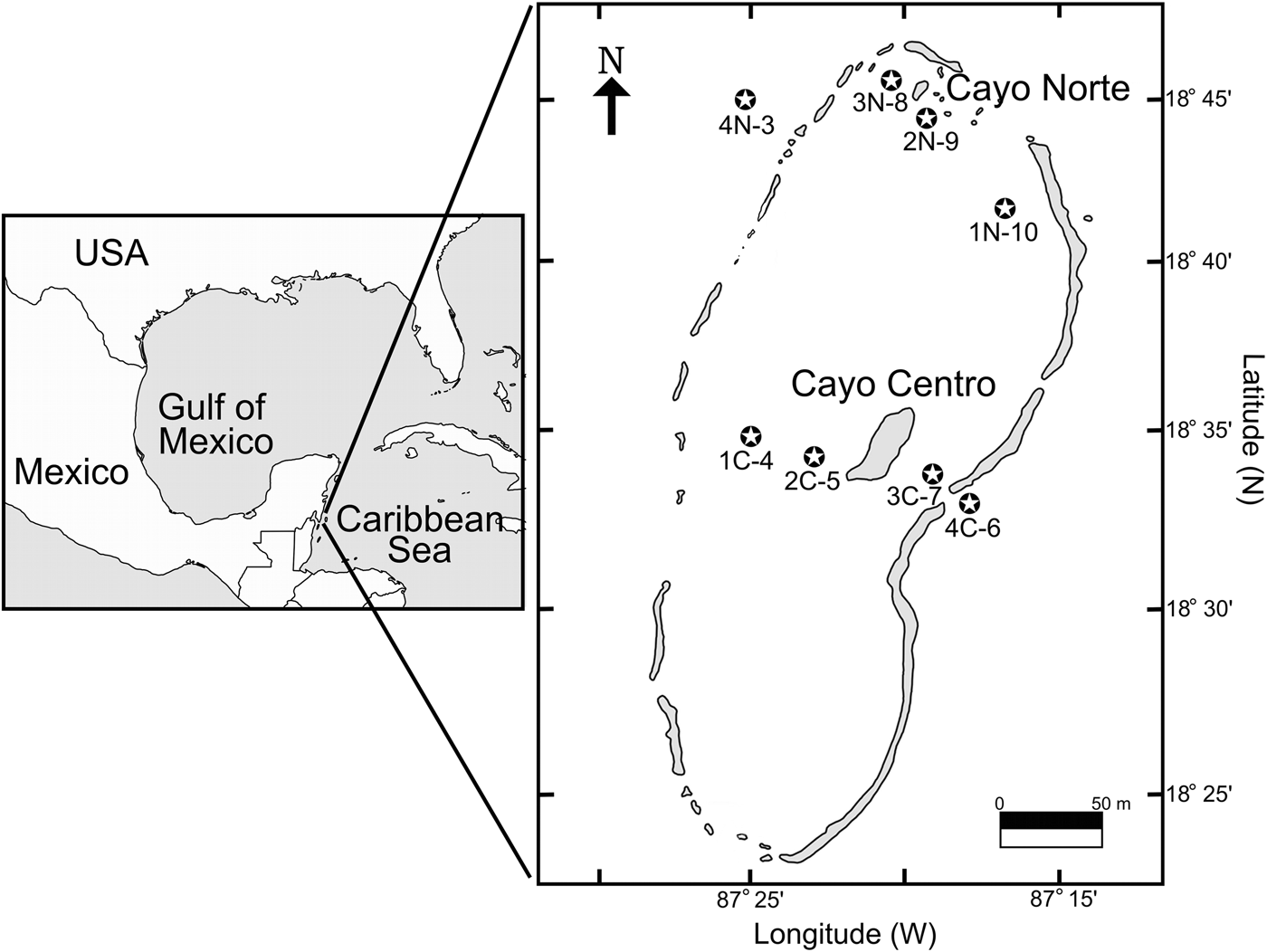
The Chinchorro Bank is found in the southern Mexican Caribbean (18° 47′–18°23′N 87°14′–87° 27′W), in the northern region of the Mesoamerican Barrier Reef System. It is located 30 km to the east of the coastal resort town of Mahahual (Quintana Roo state), separated by a large middle channel reaching 1000 m depth (Figure 1).
Location of the study area showing the sampling stations at Chinchorro Bank, Caribbean Sea.

The irregular elliptical shape that results from the emerged cays that delineate the Bank, and its large size (144,360 ha), lead it to resemble an atoll, and in fact it is sometimes called ‘the only atoll’ in Mexico (De Jesús-Navarrete, Reference De Jesús-Navarrete2003). It includes reef structures, a reef lagoon, three cays and oceanic waters. Its longitudinal axis is 43.26 km long and the largest transverse one is 18.03 km. It is totally encircled by a barrier reef of 115 km (Jordán & Martin, Reference Jordán and Martin1987). The barrier reef is large, well developed and well preserved, with sandy bottoms rich in seagrass meadows, Gorgonaceans and sponges. It is subject to an active process of sedimentary deposition coming from its eastern continental margin (INE, 2000). Also present are a set of emerged sandy beaches: Cayo Norte (0.9 km2), Cayo Centro (5.6 km2) and southern Cayo Lobos (0.2 km2) (UNEP/IUCN, 1988).
Sampling strategy
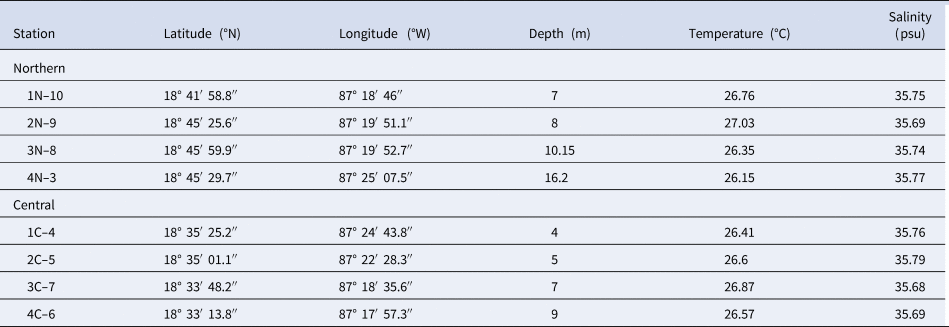
The sampling design was based on two transects located in the Northern and Central regions of the Bank. The biological material was collected in April 2008, and to ensure valid comparisons among sites while minimizing the influence of habitats, the sampling was only carried out in substrates of dead coral fragments. At each transect, four stations were aligned through the coral reef formations between 7 and 16.2 m depth in the Northern transect, and between 4 and 9 m depth in the Central transect. To associate the sampled stations' labelling with their position along the transects, we added a pair of characters before the original station number: the first code was a consecutive number from the shallowest (1) to deepest (4) station, and the second code indicated the position of the stations in the Northern (N) or Central (C) transect (Figure 1, Table 1). Stations were geo-referenced with a portable Global Positioning System (GPS), the salinity was measured with a refractometer (± 0.5 psu), using the Practical Salinity Scale, and the temperature was measured with a field mercury thermometer (± 0.1°C).
Location and environmental features of the sampling stations in Chinchorro Bank, by transect

The porosity of coral rubble varies widely following the intrinsic characterisitics of the species from which it originates. So, to ensure that comparisons among the polychaete fauna inhabiting these environments were valid, only fragments from the genus Porites were collected. These were selected because, among the stony corals, they show great overall porosity and thus can potentially contain a higher density of organisms inside them. About 5.6–12.4 kg of coral fragments were manually collected by scuba diving at each sampling site; back at the base of operations in the field, the volume of coral rubble was determined by water displacement for each station. Samples were then fixed with 10% formalin in seawater. In the laboratory, the rocks were washed with fresh water and carefully broken into small pieces to extract the specimens; later, the fragments were washed on a 0.5 mm mesh sieve to retain the macrofauna; all biological material was then preserved in 70% ethanol.
The polychaetes were separated, identified to families and quantified as density (individuals L−1) according to the procedure followed by Hutchings & Peyrot-Clausade (Reference Hutchings and Peyrot-Clausade1988) to enable comparisons between samples of different sizes. The Eunicida and Amphinomida polychaetes were identified to species following Uebelacker & Johnson (Reference Uebelacker and Johnson1984), Salazar-Vallejo (Reference Salazar-Vallejo1997), Carrera-Parra & Salazar-Vallejo (Reference Carrera-Parra and Salazar-Vallejo1997, Reference Carrera-Parra and Salazar-Vallejo1998), Carrera-Parra (Reference Carrera-Parra2006), Carrera-Parra et al. (Reference Carrera-Parra, Fauchald and Gambi2011), among others. The validity of names and synonymies of the species identified were verified with recent systematic reviews and with the World Polychaeta database (Read & Fauchald, Reference Read and Fauchald2018). The identified specimens were deposited in the Colección Nacional de Anélidos Poliquetos of the Instituto de Ciencias del Mar y Limnología (ICML), Universidad Nacional Autónoma de México (CNAP–ICML, UNAM: DFE.IN.061.0598).
Data analysis
The wide occurrence and high abundance of the Eunicida and Amphinomida polychaete groups in Chinchorro Bank, mainly those belonging to the family Eunicidae, provided an excellent opportunity for research into the spatial variations of the faunal assemblages and their beta-diversity changes associated with depth gradients. To begin with, variations of abiotic factors among stations were analysed with line plots and models of simple linear regressions, describing their changes along each transect and their relationships with depth.
To examine the spatial changes of the polychaete fauna across the sampling stations, a database with the species name and their density values (ind. L−1) was built. To test the null hypothesis that there are no differences in species composition between the examined transects, a one-way analysis of similarity (ANOSIM) was carried out. The faunal difference was estimated in a range of R = 0 (groups indistinguishable from one another) to R = 1 (no similarity between transects) (Clarke, Reference Clarke1993). A line plot was carried out to compare the spatial variation of density values of the 10 more abundant species along each transect. The changes in number of species among sampling sites was also analysed with bar graphs. Then, the beta-diversity was calculated using the Sørensen dissimilarity index (Sørensen, Reference Sørensen1948) to estimate the changes in species composition between regions and among stations along each transect. This index (βsor) (Sørensen, Reference Sørensen1948) provides a comprehensive visualization of the beta diversity, since it takes both species loss (or gain) and turnover into account (Baselga, Reference Baselga2010; Carr, Reference Carr2012). Thus, the Sørensen's dissimilarity index (total amount of beta-diversity) can be partitioned into its two additive components: the spatial species replacement, which was estimated with the Simpson's dissimilarity index (βsim) (Simpson, Reference Simpson1943), and the richness difference, which was calculated with the Baselga's nestedness index (βnes) (Baselga, Reference Baselga2010, Reference Baselga2012).
Results
Environmental characterization
A gradual increase of depth occurred along each transect, but the variation patterns were clearly different among them (Table 1). In the Northern transect, the stations were deeper (mean = 10.34 m) with a range from 7 m to 16.2 m, and their depth values along the transect (y = 2.975x + 2.9) increased more than in the other zone. The stations of the Central transect were shallower, on average 6.25 m deep, ranging from 4 to 9 m, so, the steepness of their regression coefficient was smaller (y = 1.7x + 2).
Along both transects few changes were observed in salinity and temperature values. Nevertheless, their variations with depth followed different patterns. In the Northern transect, temperatures ranged from 26.15°C to 27.03°C (SD = 0.40°C) and their variations were negatively correlated with the bathymetric changes (r 2 = −0.84), that is, the temperature slightly decreased with depth. However, in the Central transect, the temperature values fluctuated less, from 26.41 to 26.87°C (SD = 0.19°C), and their changes were not significantly correlated with depth (r 2 = 0.43). Salinity values were quite similar along the Northern transect (35.69 psu to 35.77 psu; SD = 0.03 psu). However, this factor showed a positive correlation with the bathymetric variations: r 2 = 0.62, basically because the highest salinity value (35.77 psu) was found in the deepest station (16.2 m). Low variations in salinity values, 35.68 psu to 35.79 psu (SD = 0.05 psu), were also observed in the Central transect, but in this case, the lowest salinities were found in the deepest stations (7–9 m) (35.68–35.69 psu), which determined its negative correlation with depth (r 2 = −0.81).
Faunal structure
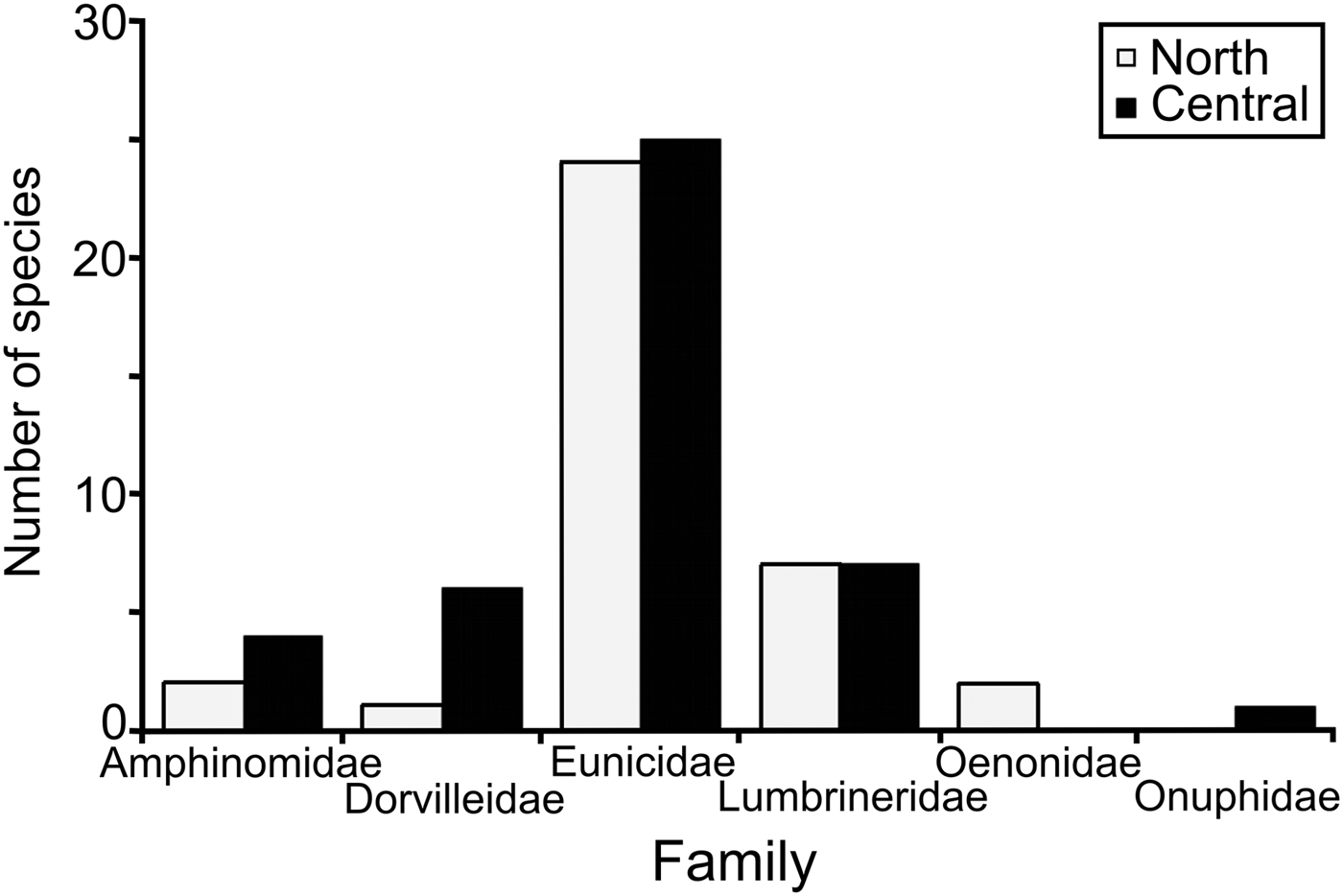
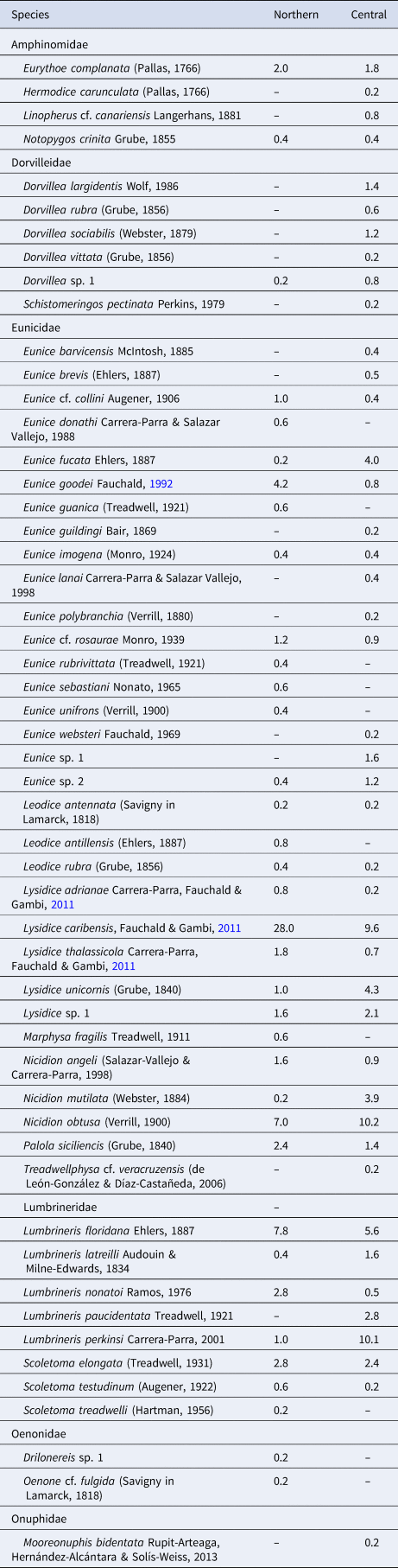
In all, 755 individuals belonging to 53 species from the families Amphinomidae, Dorvilleidae, Eunicidae, Lumbrineridae, Oenonidae and Onuphidae were identified (Table 2). The Eunicidae was clearly the most important family with the highest number of species (32) and individuals (514), followed by the Lumbrineridae (8 species, 187 individuals). In contrast, the families Oenonidae (2 species, 2 individuals) and Onuphidae (1 species, 1 individual) were very rare in these coralline environments (Figure 2).
Number of species per family at each examined transect.

Occurrence and density (ind. L−1) of polychaete species by transect

The families Amphinomidae, Dorvilleidae, Eunicidae and Lumbrineridae were reported for both Northern and Central transects. The most diverse families Eunicidae (25 and 26 species, respectively) and Lumbrineridae (7 species each) displayed a very similar number of species for each transect. In contrast, the Amphinomidae (Northern: 2 species; Central: 4 species) and Dorvilleidae (Northern: 1 species; Central 7 species) were best represented in the Central transect. The Oenonidae were only collected in the Northern zone, and the Onuphidae exclusively in the Central transect (Figure 2).
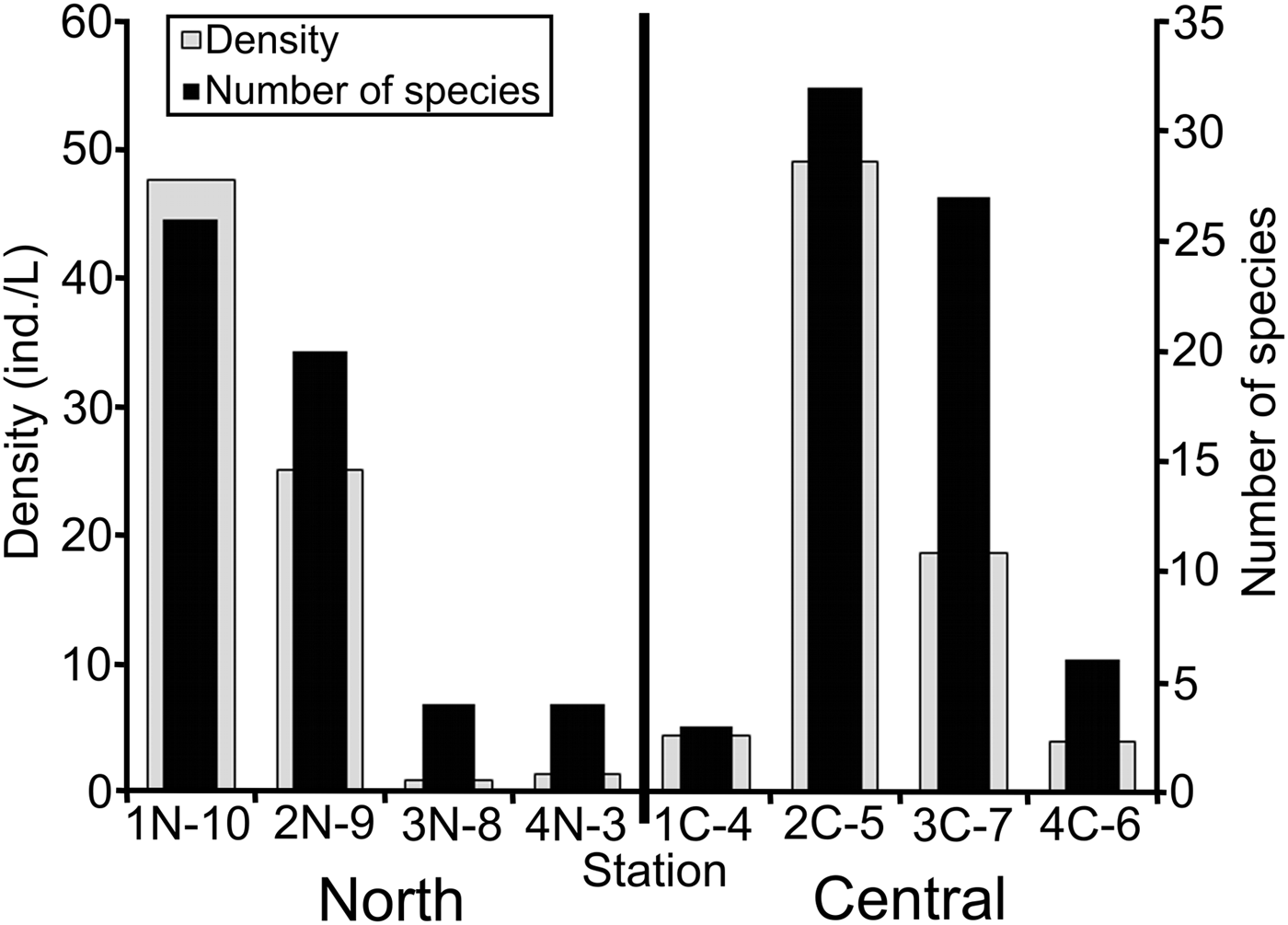
The spatial distribution of the density at each transect was similar: in the Northern transect a total of 75.2 ind. L−1 were collected, while in the Central transect 76.6 ind. L−1 were found. However, the density values along each transect displayed distinct patterns (Figure 3). Although in both transects the peak of density was associated with depths of around 5–7 m, in the Northern transect their values markedly decreased with depth, from 47.60 ind. L−1 at 7 m to 1 ind. L−1 at 10–16.2 m depth. In contrast, for the Central transect, the density noticeably increased in stations located at the midpoint of the transect: 49.01 and 18.55 ind. L−1 at 5 and 7 m, respectively.
Spatial distribution of number of species and density (ind. L−1) per sampling station.

The spatial changes of density were directly associated with the species richness patterns, since in the Northern transect the number of species also followed an inverse correlation with the bathymetric gradient: the number of species decreased with depth. The stations with more species in the Northern transect, 1N–10 (26 species) and 2N–9 (20 species), were located at 7 and 8 m respectively, while the deepest stations, 3N–8 (10.15 m) and 4N–3 (16.2 m) harboured only four species each (Figure 3). However, along the Central transect, the highest richness was found in the middle stations (2C–5 = 32 species; 3C–7 = 27 species), which in addition were the stations with the most species across the Chinchorro Bank; in contrast, the shallowest and deepest stations recorded the lowest number of species (1C–4: 3 species; 4C–6: 6 species).
The variations of the number of species along the Northern transect displayed a negative correlation with bathymetry (r 2 = −0.80), but positive interactions with temperature changed (r 2 = 0.86); that is, the highest species richness in the Northern transect, was found in shallow and warm environments. In contrast, on the Central transect, the highest number of species was found in stations located in the middle of the transect, and therefore, the species richness variations were not linearly correlated with depth (r 2 = −0.10). However, the number of species was significantly associated with the temperature variation (r 2 = 0.68), since the highest richness was exactly located in the middle stations where the temperature slightly increased. The salinity changes did not show any significant correlation with the faunal variations neither in the Northern (r 2 = −0.42) nor in the Central (r 2 = 0.18) transects.
Species composition and beta-diversity patterns
Although the ANOSIM test showed that the species composition between the examined transects was not significantly different (RANOSIM = 0.073, P = 0.331), the distinct bathymetric patterns showed by the density and number of species across each transect and the fact that the Central zone clearly harboured the more diverse fauna, suggested that the polychaete species perform differently along each transect.
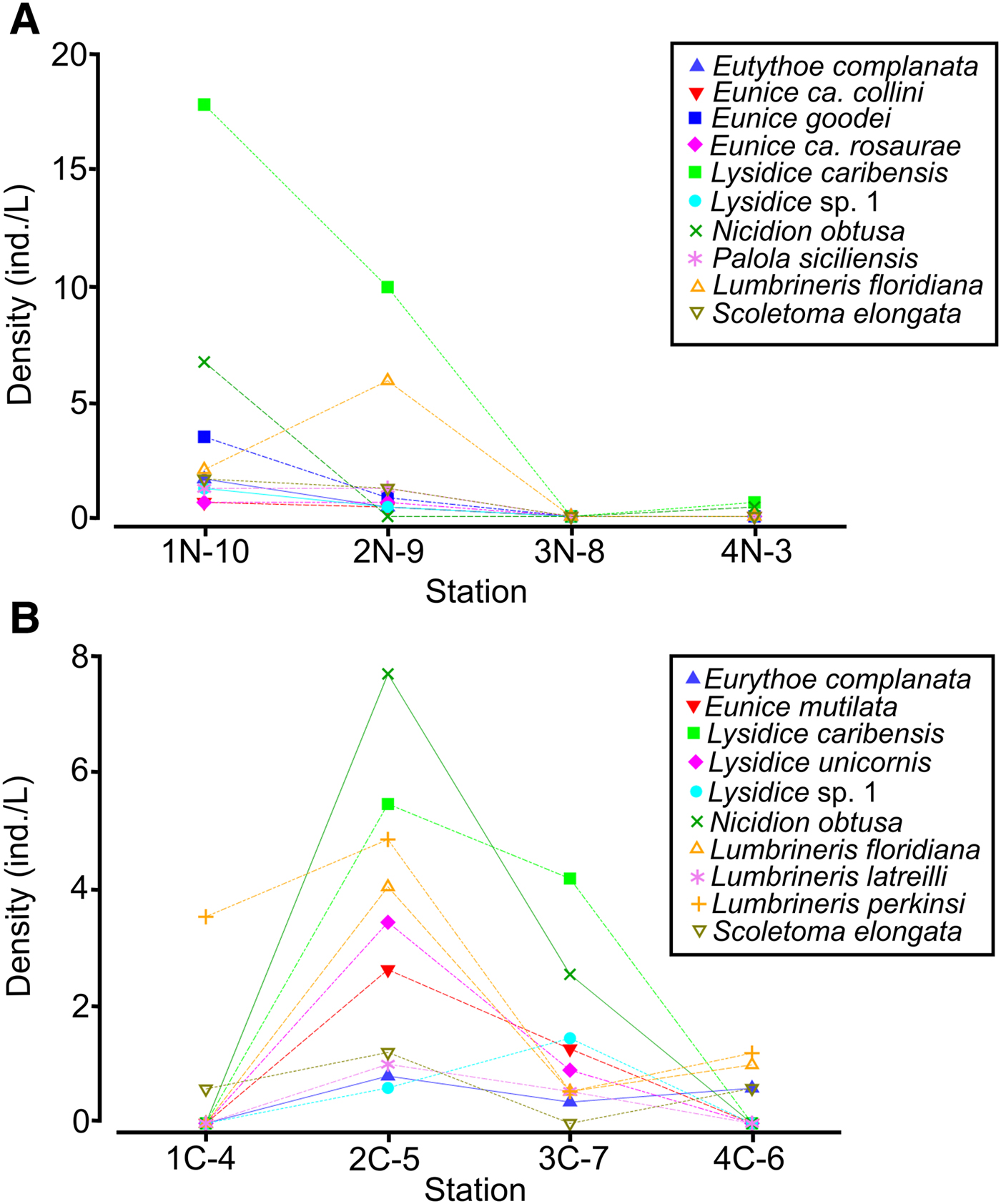
The comparison of the species composition between both studied regions showed that the polychaete fauna was, in fact, moderately different (βsor = 0.603), because around half of the polychaete species (26 species: 49.06%) occurred in both transects. The faunal differences were due to the fact that 10 species exclusively inhabited the Northern zone and 17 species were exclusively collected in the Central transect, but also that in the 26 shared species, notable differences in their abundance and distribution patterns along each transect were found. These faunal differences were mostly related with the higher abundance of Lysidice caribensis, Eunice goodei and Lumbrineris floridana in the Northern transect. The first two eunicids were more abundant at 7 m depth, while the lumbrinerid L. floridana increased its abundance at 8 m; however, they were all missing at depths above 10 m (Figure 4A). Other less abundant polychaetes, such as Nicidion obtusa also increased its importance at 7 m depth, disappearing at depths greater than 10 m; only eight species were found in deeper stations. In the Central zone, the most abundant polychaetes were Lumbrineris perkinsi, Nicidion obtusa, Lysidice caribensis, Lumbrineris floridana, Lysidice unicornis and Eunice mutilata, but in this case, they increased their abundances at the middle of transect, at 5 m depth, decreasing in number of individuals towards either shallower or deeper stations (Figure 4B).
Density (ind. L−1) line plots of the 10 more abundant species of polychaetes along each transect. (A) Northern transect; (B) Central transect.

To examine the different distributional patterns observed at each depth gradient and to evaluate the extent of change in its faunal composition, the beta-diversity between transects and between stations were analysed. As previously observed, the polychaete fauna was relatively similar between the examined regions (βsor = 0.603), but the separation of the β-diversity components (spatial species turnover and dissimilarity due to nestedness) showed that the faunal dissimilarity between the Northern and Central transects was mainly associated with species replacement (βsim = 0.581), rather than with species loss (or gain) (βnes = 0.022).
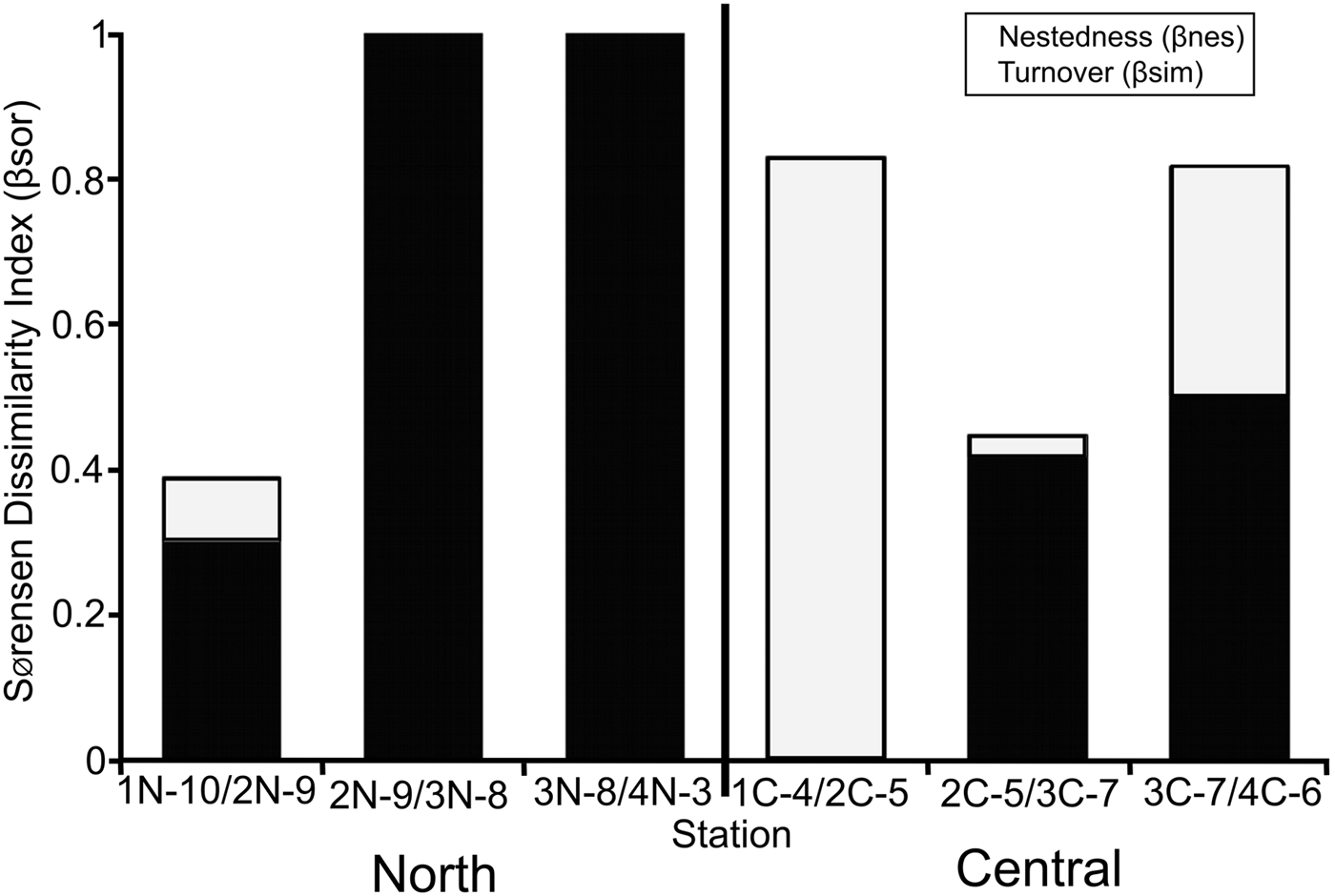
However, when the faunal comparison was carried out between pairs of stations along each transect, the spatial patterns of beta-diversity were clearly different, since the bathymetric distribution of species was substantially different along each transect (Figure 5). In the Northern zone, the changes in faunal composition among station pairs (βsor = 0.391 to 1) showed that species turnover was clearly the dominant component, which practically represented all faunal dissimilarity at each pair of comparisons. These beta diversity components ranged from βsim = 0.3 and βnes = 0.091 in shallow stations (1N–10/2N–9), to βsim = 1 and βnes = 0 among the deepest ones (2N–9/3N–8 and 3N–8/4N–3).
Species turnover (βsim) and richness difference (βnes) components of beta-diversity measured by Sørensen dissimilarity index (βsor) among stations from the Northern and Central transects.

In the Central zone, however, the dissimilarity due to nestedness clearly increased its importance, overall between shallow stations (1C–4/2C–5), where it practically explained all changes in the community composition (βsim = 0; βnes = 0.829) (Figure 5). However, the importance of species loss (or gain) to define the beta-diversity, decreased in stations located at the midpoint of the transect (2C–5/3C–7), since the faunal dissimilarity was mainly associated with the replacement of species rather than with richness differences (βsim = 0.414; βnes = 0.038). In the deepest stations (3C–7/4C–6) the replacement of some species by others was also the more important component (βsim = 0.5), because the dissimilarity due to nestedness (βnes) only contributed 0.318.
Discussion
In general, coral reefs are distributed in stable tropical environments, promoting the development of diverse and complex biological communities (Goreau et al., Reference Goreau, Goreau and Goreau1979; De Jesús-Navarrete, Reference De Jesús-Navarrete2003). In Chinchorro Bank, stable environmental conditions prevailed during the sampling season (spring), since temperature and salinity values showed few variations. These conditions were mainly associated with the shallowness of the reef, which together with the effect of the wind can cause surface to bottom mixing, and in fact, there is no persistent temperature stratification within the reef (De Jesús-Navarrete, Reference De Jesús-Navarrete2003). It is known that ‘extreme temperatures’ have deleterious effects on the settlement and development of coral reefs, since temperatures of 18 °C cause low coral diversity (Brigth et al., Reference Brigth, Kraemer, Minnery and Viada1984), while temperatures over 31 °C can cause coral bleaching (Brown & Ogden, Reference Brown and Odgen1993; De Jesús-Navarrete, Reference De Jesús-Navarrete2003). At Chinchorro Bank, the samples were taken during the dry season (April) and the observed temperatures (26.15–27.03 °C) were slightly lower than the ranges previously reported for this season (27.36–27.75 °C) (De Jesús-Navarrete, Reference De Jesús-Navarrete2003).
Coral reefs are characterized by their great spatial heterogeneity, associated with different habitats and the occurrence of complex biological interactions. However, the ecological mechanisms maintaining the high diversity of small invertebrates is poorly understood (Ruiz-Abierno & Armenteros, Reference Ruiz-Abierno and Armenteros2017). In dead-coral habitats, the destruction of coral colonies by abiotic (i.e. storms, wave action, sedimentation and bleaching, among others) and biotic factors (i.e. grazing and boring individuals, deleterious effects on the coral health) increase the amount of available material for colonization by cryptic organisms (Fernández et al., Reference Fernández, Bone and Rodríguez2012). Among the cryptic fauna found there, the polychaetes are usually the dominant group (Hutchings, Reference Hutchings and Barnes1983; Ibarzábal, Reference Ibarzabal1993; Tribollet et al., Reference Tribollet, Decherf, Hutchings and Peyrot-Clausade2002; Fernández et al., Reference Fernández, Bone and Rodríguez2012), which together with their bioeroder effect on the coralline skeletal structure, substantially damage and modify the substrate heterogeneity (Hutchings & Peyrot-Clausade, Reference Hutchings and Peyrot-Clausade1988; Chazottes et al., Reference Chazottes, Le Campion-Alsumard, Peyrot-Clausade and Cuet2002; Fernández et al., Reference Fernández, Bone and Rodríguez2012). The most abundant and diverse family of polychaetes in Chinchorro Bank, the Eunicidae, is a typical resident of rocks, coral crevices and dead coral fragments. Its dominance may be attributed to the morphological and physiological characteristics of its members, in particular: very muscular and long anterior body, and a strong jaw apparatus (Ochoa-Rivera et al., Reference Ochoa-Rivera, Granados-Barba and Solís-Weiss2000; Paxton, Reference Paxton, Beesley, Ross and Glasby2000). To erode the carbonate structure of the corals, the eunicids attack them with their well-developed maxillae (Fernandez et al., Reference Fernández, Bone and Rodríguez2012), whose abrasion processes are facilitated by mucus secretion on the cavity walls (Fauchald, Reference Fauchald1992).
Stations located in the Central zone of Chinchorro Bank had significantly more individuals and species than those located in the Northern transect. Polychaete abundance has been observed to increase in reef protected zones from the Caribbean Sea (Ochoa-Rivera et al., Reference Ochoa-Rivera, Granados-Barba and Solís-Weiss2000; Ramírez-Hernández, Reference Ramírez-Hernández2014). The phenomenon is probably related to a reduction in the effects of the swell force and tides. In the Chinchorro Bank, the Caribbean current is the main force moving water masses, which flow northward and regulate sediment transport, among other things. The Central and Northern regions (Cayo Norte and Cayo Centro) are located in lower wave energy zones, where fine sediments are dominant (De Jesús-Navarrete, Reference De Jesús-Navarrete2003). Mostly in Cayo Norte, the hydrological balance is determined by the rainfall pattern, which produces a freshwater lens on the surface, but in the dry season these effects are reduced. Therefore, the highest salinity values in Chinchorro Bank had been reported precisely in this dry period (35.56–36.09 psu at bottom) (De Jesús-Navarrete, Reference De Jesús-Navarrete2003) which, in fact, matched the low range of salinities found in the present study (35.68–35.79 psu).
In Chinchorro Bank, environmental factors, especially temperature and salinity, and their bathymetric variations, did not change significantly, remaining in a narrow range, so that depth was the most important parameter structuring the environmental gradient along transects. In general, coral reefs are stable ecosystems, which enable diverse and abundant communities to develop (Goreau et al., Reference Goreau, Goreau and Goreau1979), and the macro- and meiobenthos contribute significantly to the biodiversity in these marine habitats (Ruiz-Abierno & Armenteros, Reference Ruiz-Abierno and Armenteros2017). Although Chinchorro Bank is surrounded by an oligotrophic oceanic environment, it is richer than the adjacent oceanic waters (Emery, Reference Emery1968), which could contribute to the high diversity of polychaetes. In fact, although only the Eunicida and Amphinomida were examined in the present study, the 53 species of six families identified so far, represent almost 20% of the 268 polychaete species reported from the Mexican Caribbean. Thus, increasing the sampling effort and the number of families examined will probably yield records of many more species in this region.
The polychaete taxonomic composition found in Chinchorro Bank agreed well with previously reported species in the Western Caribbean, but no studies have been carried out there to analyse the distribution and diversity of these invertebrates. The faunal changes observed during this study along depth gradients demonstrated that, as has also been reported for other zones of the Caribbean Sea, the eunicids are one of the most abundant and diverse families in dead coral habitats (Ochoa-Rivera et al., Reference Ochoa-Rivera, Granados-Barba and Solís-Weiss2000; Fernández et al., Reference Fernández, Bone and Rodríguez2012). Also, although about 50% of the species were present on both transects, their occurrence and bathymetric distribution patterns were different in each region. The spatial variations in composition and structure of the fauna living in the coral reefs have been associated with changes in the geographic position of the chosen sites, but without any consistent spatial pattern (Hutchings & Peyrot-Clausade, Reference Hutchings and Peyrot-Clausade1988; Fernández et al., Reference Fernández, Bone and Rodríguez2012). Distinct localities are regularly inhabited by different assemblages and their changes in species composition, or beta-diversity, are usually associated with the replacement of some species by others (Baselga, Reference Baselga2010). However, the loss of species from the richest to the poorest localities could also cause alterations in their beta-diversity patterns (Wright & Reeves, Reference Wright and Reeves1992; Ulrich & Gotelli, Reference Ulrich and Gotelli2007; Baselga, Reference Baselga2010), as happened in the shallow station 1C–4 (4.5 m) of the Central transect, where its assemblage had the smallest number of species and was a subset of the assemblage from the richer station (2C–5).
The bathymetric patterns of beta-diversity in Chinchorro Bank showed that the components of species replacement and dissimilarity due to nestedness contributed in different ways to change the faunal composition across each transect. In general, but mainly in the Northern zone, the turnover was the most important component explaining the existence of depth patterns for beta-diversity. The replacement of some species by others can be a consequence of environmental sorting or spatial and historical constraints of the fauna (Qian et al., Reference Qian, Ricklefs and White2005), and in Chinchorro Bank the turnover could be associated with the restrictions linked to depth, since in the Northern region none of the species was able to inhabit along the whole transect. Similarly, in the Central transect, only Lumbrineris perkinsi was located at all depths, and Scoletoma elongata, Eurythoe complanata and Lumbrineris floridana were collected at 75% of the sampling stations. That is, in Chinchorro Bank, almost all the polychaete species settled in a narrow depth range. Although no formal studies examining this trend have been carried out in the Caribbean Sea, the occurrence of polychaete communities dominated by species with narrow depth ranges had already been reported in soft bottoms' environments (Moreno et al., Reference Moreno, Rivadeneira, Hernández, Sampértegui and Rozbaczylo2008; Hernández-Alcántara et al., Reference Hernández-Alcántara, Salas-de León, Solís-Weiss and Monreal-Gómez2014). These researchers showed that the depth gradient in the continental shelfs of Chile and the Gulf of California were also defined by a high presence of species with narrow ranges.
Disentangling the contributions of species turnover and nestedness to beta-diversity patterns can give good insights into the effect of environmental change on faunal assemblages and on the importance of species interactions (Legendre, Reference Legendre2014). In this study, it was evident that the polychaete assemblages inhabiting Chinchorro Bank showed a strong species turnover structure both between regions and along transects. Although polychaete endemism was absent, since all the species identified had already been previously recorded in the Caribbean Sea and around 50% of the studied fauna was common to both transects, the polychaete species had different distribution patterns across the bathymetric gradient. Benthic community changes with depth are well known, but many doubts about their bathymetric patterns and whether the biotic changes associated to depth are gradual or not, still prevail (Hernández-Alcántara et al., Reference Hernández-Alcántara, Salas-de León, Solís-Weiss and Monreal-Gómez2014). Mechanisms responsible for bathymetric changes in the number of species have been associated with a wide variety of environmental and biological factors (Gray et al., Reference Gray, Poore, Ugland, Wilson, Olsgard and Johannessen1997), but the presence of species can also vary with small depth changes. Here, the polychaete species with narrower distribution ranges were dominant and their bathymetric patterns could be affected by the changes in species composition at each depth level. The depth range size is related to the species' tolerance to local or regional environmental conditions, and in the study area it seems that few polychaete species are able to expand their distribution range across all stations, reflecting their tolerance limits to abiotic changes associated to depth.
The dissimilarity due to nestedness can be a consequence of any factor (abiotic or biotic) that encourages the orderly disaggregation of faunal groups (Gaston & Blackburn, Reference Gaston and Blackburn2000; Baselga, Reference Baselga2010), but in this study it was not an important component to explain the beta-diversity pattern. In particular, an increase in importance of the species loss (or gain) component at both extreme points of the Central transect cannot be directly associated with a particular mechanism, since that nestedness was the result of a drastic reduction in the number of species (3 and 6 species) at 4.5 and 9 m depth, respectively. As was pointed out by Baselga (Reference Baselga2010), in this study the notion of species loss was also used to indicate that species are absent from some localities, without relation to processes such as dispersal capacity, competition or extinction, among others, which are practically unknown for the polychaetes living in the Caribbean Sea.
Acknowledgements
We would like to thank Maria del Carmen García Rivas, then Director of the ‘Chinchorro Bank Biosphere Reserve, Quintana Roo’ who allowed us to use all the facilities of the Chinchorro Bank field station. Our deepest gratitude goes to Admiral Francisco M. Sáynez, at the time Navy Secretary of Mexico, who gave us all the required logistical support in the field for this project. Sarita Frontana, Efrain Chávez and Guy Doyhemboure are especially acknowledged for their sustained help in the field, together with all the other participants in that expedition.
Financial support
The Instituto de Ciencias del Mar y Limnología of the Universidad Nacional Autónoma de México provided the financial support to undertake this study.